다문화 가정 아동의 정서행동적 특성에 영향을 미치는 요인
Factors Influencing Emotional and Behavioral Characteristics of Children in Multicultural Families
전혜인*, 정평강**, 이혜경***
건양대학교 초등특수교육과*, 이화여자대학교 특수교육과**, 건양대학교 사회복지학과***
Hae-In Jeon([email protected])*, Pyung-Gang Jung([email protected])**, Hye-Kyung Lee([email protected])***
요약
본 연구의 목적은 다문화 가정 자녀들의 정서행동 특성에 영향을 미치는 요인들을 탐색하는 것이다. 이 를 위해 주요 요인으로 인구사회학적 특성과 심리적 특성을 포함하였다. 조사대상자는 결혼이민여성 200 명을 대상으로 하였으며 이중 148명을 분석하였다. 연구결과 이들 아동의 정서행동적 특성은 어머니의 연 령과 가구소득과 유의미한 관련을 나타냈다. 또한 결혼이주여성의 문화적응스트레스는 자녀들의 전반적 행동특성에 유의미한 관계를 나타냈다. 마지막으로 결혼이주여성이 높은 수준의 문화적 스트레스를 경험 하고, 자녀가 연령이 높을수록 내면화된 문제행동을 나타냈다. 또한 결혼이주여성의 한국어 능력과 결혼만 족도 역시 자녀의 내면화된 문제와 외현화된 문제영역에 유의미한 영향을 미치는 것으로 나타났다. 이상의 연구결과를 바탕으로 다문화 가정 아동의 정서행동 문제의 예방 프로그램을 개발하기 위한 실천적 제안을 논의하였다.
■ 중심어 :∣다문화 가정 아동∣문화적응스트레스∣결혼생활 만족도∣아동의 정서행동문제∣
Abstract
The purpose of this study was to examine factors influencing emotional and behavior characteristics among children in multicultural families. The factors include demographic and psychological characteristics of married immigrant women. Surveys were distributed to 200 married immigrant women and, 148 surveys were returned and analyzed. The findings are as follows: first, emotional and behavioral characteristics of children were significantly associated with the age of their mothers and household income. Second, acculturative stress in married immigrant women was significantly related to the overall behavior characteristics of their children. Third, children whose mothers experienced a higher level of acculturative stress and were of older age showed internalizing problems. The level of Korean language proficiency and marital satisfaction were also important factors influencing sub-categories of internalizing and externalizing problems aside from acculturative stress. Implications and suggestions to develop preventative programs for emotional and behavioral problems of children in multicultural families are discussed.
■ keyword :∣Children in Multicultural Families∣Acculturative Stress∣Marital Satisfaction∣Emotional and Behavioral Problems of Children∣
접수일자 : 2017년 07월 25일 수정일자 : 2017년 08월 21일
심사완료일 : 2017년 08월 21일
교신저자 : 이혜경, e-mail : [email protected]
I. INTRODUCTION
The number of multicultural families in Korea has been increasing since the 1990s. International marriages comprise 9 % of total marriages, indicating that one in 10 marriages is international. With increasing international marriages, the number of multicultural families has also grown rapidly.
Multicultural families in Korea reached about 700,000 in 2012 and it is estimated that by 2020, the number will be nearly one million. Corresponding to this increasing trend, the number of children in multicultural families is expected to reach approximately 300,000[1].
In general, Koreans are less sensitive to an awareness and acceptance of different cultures compared to people in other countries. According to a study on Public Receptiveness to Multiculturalism conducted by the Ministry of the Gender Equality and Family(MOGEF)[2], 36% of Koreans agreed with the concept of cultural coexistence(i.e., it is good to coexist with various races, religions, and cultures across countries); this percentage response is much less compared to the 73% agreement among Europeans. The respondents pointed out plausible problems that could occur due to cultural differences such as declining job market, increasing crime rates, and an increasing financial burden on the government [2]. Furthermore, Koreans appear to have different attitudes toward immigrants from economically developed countries versus under-developed countries[3]. MOGEF, Presidential Council on Nation Branding, and the Dong-A Ilbo newspaper conducted a national awareness survey with 1,500 adult males and females in 2011. The results of the survey showed that Korean society struggles to embrace multicultural families. Approximately 76% of the respondents agreed with the statement “The Korean
society discriminates against multicultural families”
and 78% agreed with the statement “The Korean society discriminates against different races or countries”[4].
Research has been conducted on stress in married immigrant women in the Korean society, which, as previously mentioned, is less sensitive to embrace other cultures. According to previous research, married immigrant women in Korea are experiencing difficulties with discrimination, language barriers, lack of social supports and financial resources, and isolation[5-7]. Parents in multicultural families are experiencing not only parenting stress but also acculturative stress in the process of adapting to new cultures. The acculturative stress leads to mental health problems such as anxiety and depression[8][9].
In particular, maternal depression directly influences the emotional and behavioral problems of women’s children, since women with depression are less responsive to their children than women without depression. The depressed mood distorts women’s abilities to perceive and recognize their children’s behavior and leads to negative parenting. The negative parenting results in negative effects on emotional and behavioral problems of children in multicultural families[10-12].
Although it is assumptive to say that children in multicultural families show more behavioral problems than those in general families, it is more likely that they face difficulty in their upbringing and experience cultural stress compared to those who are not from such environment. Research indicates that children from international marriage families showed low level of self-identity development than those from general families[13]. They also appeared to experience difficulty in academic performance and adjustment to school life due to bullying and discrimination[14].
Thus, a better understanding of psychological
characteristics and challenges that children from multicultural families is needed.
Recently, a few studies have been conducted on the characteristics of children in multicultural families.
The majority of studies, however, have focused on children’s language problems[15-17], academic performance[18][19], and adaptation to school life[20-23]. Research on the emotional and behavioral characteristics and maladjustment of children in multicultural families has been relatively scarce.
Research on some aspects of emotional and behavioral characteristics and maladjustment of children in multicultural families has been conducted by Yang and colleauges and Kim[24][25], although there still remains a room for more in-depth research on these topics. Reference[26] examined the effects of mothers’ parenting stress and acculturative stress on maladjustment behaviors of children in multicultural families in Korea. The author explored overall characteristics of maladjustment behaviors by two categories: internalizing and externalizing behaviors.
Specific and detailed characteristics of maladjustment behaviors by each category, however, were not examined. In addition, generalization of the study’s findings is limited to students in grades 3 to 6 in Seoul and Kyoungi-do areas.
The Korean government has planned and implemented various supports to help married immigrant women adapt to life Korea. At the national level, the Korean government has established an official policy for multicultural families and it includes support for the growth and development of children in multicultural families[3]. These plans and policies to support children in multicultural families, however, mainly focus on improving Korean language skills, basic academic performance, and life in school. Thus, psycho-emotional supports along with other academic supports are necessary to enhance the balanced
development of children of multicultural families.
More specifically, exploring factors that influence emotional and behavioral characteristics of children in multicultural families would provide foundational evidence for planning specific psycho-emotional supports.
The purpose of this study was to examine the factors influencing emotional and behavioral characteristics of children in multicultural families in terms of general characteristics and specific characteristics within two subcategories: internalizing and externalizing problems. Participants were married immigrant women in multicultural families who have 4 to 18-year-old children in Chungnam and Daejeon areas. Research questions include the following:
What are the relationships between socio-demographic characteristics of immigrant women in multicultural families and the emotional and behavioral problems of their children?
What are the relationships between acculturative stress and marital satisfaction of immigrant women in multicultural families and the emotional and behavioral problems of their children?
What are the effects of acculturative stress and marital satisfaction of immigrant women in multicultural families on the emotional and behavioral problems of their children?
Ⅱ. METHODS
1. Participants
Participants included married immigrant women with children between 4-18 years of age in Chungnam and Daejeon areas. Surveys were conducted through the Korean Multicultural Family Support Center and community social service center from October 1, 2011 to February 20, 2012. If
respondents were not able to complete the survey, assistants in the agencies helped them to respond to the surveys. Otherwise, respondents filled out surveys themselves. A total of 200 surveys were distributed and 170 were returned. All subjects participated voluntarily. Objectives and procedures of the study were explained prior to the study via a survey. All participants provided informed consent.
Due to incomplete responses or the incompatible ages of children in multicultural families, 22 surveys were excluded and 148 surveys were analyzed in total.
2. Measures
The survey consisted of a set of general questions to examine socio-demographic characteristics of the participants and specific questions to examine marital satisfaction, acculturative stress, and emotional and behavioral characteristics of their children.
2.1 Marital satisfaction
Marital satisfaction items used in Kim[27] and Chung[28] were applied to this study. Items to be rated were on a 1-to-5 scale. The respondents rated how strongly they agree or disagree on each item.
Scores for each item were reverse-coded and analyzed with higher scores indicating greater marital satisfaction. The Cronbach’s α reliability coefficient was .926.
2.2 Acculturative stress
Acculturative stress was measured by the Acculturative Stress Scale for International Student (ASSIS), which was translated into Korean by Lee[29]. Items were modified to consider the characteristics of study participants. The scale had 15 items and higher scores indicated higher acculturative stress. The Cronbach’s α reliability estimate was .932.
2.3 Emotional and behavioral characteristics of children in multicultural family
In order to examine clinical characteristics, the Korean Version of the Child Behavior Check List (K-CBCL)[30] was used. For this study, only the scale measuring emotional and behavioral problems was used. A total of 113 items were rated on 0-to-2 scale. Internalizing problems were measured in terms of withdrawn, somatic complaints, anxiety/depression, social problems, thought problems, and attention problems. Delinquent behavior and aggressive behavior were measured as externalizing problems.
The Cronbach’s α reliability estimate for each type of behavior ranged from .752 to .983.
3. Data Analysis
Survey data was analyzed using SPSS/PC WIN 18.0. Socio-demographic characteristics of participants in the study were examined using frequency analysis and descriptive statistics, and the reliability of all measures was examined through Cronbach’s α coefficients.
To examine significant differences on psychosocial characteristics of children in multicultural families depending on socio-demographic characteristics of married immigrant women, t-test and one-way analyses of variance (ANOVA) were used. The effects of psychosocial characteristics on emotional and behavioral characteristics of children in multicultural families were examined using a multiple regression analysis.
Ⅲ. RESULTS
1. Demographic characteristics
The socio-demographic characteristics of married
immigrant women are shown in [Table 1].
Table 1. Socio-demographic characteristics of participants (N=148)
Characteristics N (%) Characteristics N (%) Age of participants(years) Age of spouses(years)
20-29 87(58.8) 30-39 30(20.3)
30-39 52(35.1) 40-49 98(66.2)
40-49 9(6.1) 50-59 20(13.5)
Marriage duration(years) Korean language proficiency
1-3 8(5.4) Very Fluently 47(31.8)
3-5 51(34.5) Moderate 96(64.9)
5-10 45(30.4) Almost not 5(3.4)
>10 23(15.5)
Education level Household income(million won) Elementary school 21(14.2) <100 28(18.9) Middle school 25(16.9) 100-200 86(58.1)
High school 67(45.3) 200-400 31(20.9)
>College 35(23.6) >400 3(2.0)
Number of children Age of children
1 48(32.4) First child (5.86/2.75)
2 83(56.1) Second child (4.23/3.04)
2. Emotional and behavioral characteristics of children in multicultural families depending on socio-demographic characteristics of married immigrant women
A series of analysis variance(ANOVA) was conducted to examine significant differences on emotional and behavioral problems of children in multicultural families(for internalizing and externalizing problems), and the results of the analysis are shown in [Table 2]. Age of participants, education level, household income, and level of Korean language proficiency were used as independent variables. Statistically reliable differences were found for both internalizing and externalizing problems depending on their mothers’ age (F = 5.38, F = 4.82 respectively at p < .01), and household income(F=3.18, F=4.41 respectively at p < .01). As mothers were older and household income was lower, children showed more internalizing and externalizing
behavioral problems. There were no significant differences on children’s behavior, however, in terms of their mother’s marriage duration and level of Korean language proficiency.
Table 2. Emotional and behavioral characteristics of children depending on socio-demographic characteristics of married immigrant women
Factor
Internalizing Problems Externalizing Problems
M(SD) F
Sheffe M(SD) F
Sheffe Marriage duration(years)
1-3 2.62(3.42)
0.837
1.50(2.50)
1.874
3-5 8.09(9.94) 9.85(9.95)
5-10 7.56(8.19) 10.09(7.91)
>10 8.94(14.84) 9.66(14.78)
Age of Participants(years)
20-29 6.97(8.02)
5.38**
a,b<c
9.39(8.50) 4.82**
a,b<c
30-39 7.21(9.75) 7.98(9.11)
40-49 17.88(19.26) 18.77(19.39)
Korean language proficiency
almost not 10.20(13.34) 9.80(11.05)
moderate 7.96(10.93) 9.97(10.78)
very fluently 6.95(6.92) 8.38(7.72) Household income(million won)
< 100 11.51(14.20) 3.18*
a,b>c
13.93(13.83) 4.41*
a>b>c
100-200 7.29(9.20) 8.88(9.00)
200-400 5.32(5.41) 6.77(6.35)
M: mean, SD: standard deviation,
*P<.05, **P<.01
3. Relationship between psychosocial characteristics of married immigrant women and emotional and behavioral problems of their children
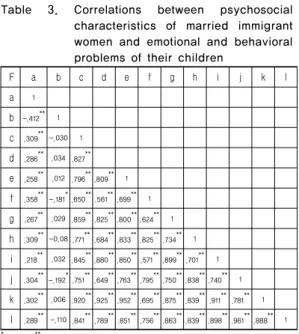
As shown in [Table 3], acculturative stress significantly influences internalizing problems(r=.302, p <.01) and externalizing problems(r=.289, p<.01). All specific types of behavior consisting of internalizing (i.e., withdrawn, somatic complaints, anxiety/depression, social problems, thought problems, and attention problems) and externalizing problems(i.e., delinquent behavior and aggressive behavior) were significantly correlated with the acculturative stress experienced by mothers.
Table 3. Correlations between psychosocial characteristics of married immigrant women and emotional and behavioral problems of their children
F a b c d e f g h i j k l
a
1b
-.412** 1c
.309** -.030 1d
.286** .034 .827**e
.258** .012 .796**.809** 1f
.358**-.181*.650**.561**.699** 1g
.267** .029 .859**.825**.800**.624** 1h
.309**-0.08 .771**.684**.833**.825**.734** 1i
.218** .032 .845**.880**.850**.571**.899**.701** 1j
.304**-.192*.751**.649**.763**.795**.750**.838**.740** 1k
.302** .006 .920**.925**.952**.695**.875**.839**.911**.781** 1l
.289** -.110 .841**.789**.851**.756**.863**.839**.898**.961**.888** 1*
P<.05,
**P<.01
참고: F=factor/ a=Acculturative Stress, b=Marital Satisfaction , c=Withdrawn , d=Somatic Complaints , e=Anxiety/ Depression , f=Social Problems, g=Thought Problems, h=Attention Problems, I=Delinquent behavior, j=Aggressive Behavior, k=Internalizing Problems, l=Externalizing Problems
4. Factors influencing emotional and behavioral problems of children in multicultural families
4.1 Factors influencing children’s internalizingproblems
Multiple regression was conducted to examine factors influencing the internalizing problems of children in multicultural families. Variance Inflation Factor(VIF) of each independent variable, ranged from 1.032 to 1.726, indicates that the data met the assumption of multicollinearity.
The results of multiple regression showed that 18.2
% of the variance related to internalizing problems was significantly accounted for by the socio-demographic and psychosocial characteristics of immigrant women(p < .001). Age of participants, number of children, and acculturative stress showed the important factors influencing the internalizing problems of children(see Table 4). Acculturative
stress was the greatest influential factor(β = .317, p
< .01), followed by number of children(β = .272, p <
.01) and age of participants(β = .258, p < .01).
Children showed more internalizing problems when they had mothers with higher acculturative stress, more children, and were older.
Table 4. Factors influencing emotional and behavioral characteristics: Internalizing problems
Factor
βSE
βt VIF
Socio-demographic characteristics
Marriage duration -0.924 1.246 -0.073 -0.742 1.726 Age of participants 0.458 0.168 0.258 2.730
**1.605 Age of spouses -0.137 0.118 -0.098 -1.163 1.265 Education level -0.147 1.094 -0.011 -0.134 1.203 Korean language proficiency -1.926 1.535 -0.102 -1.255 1.183 Household income 0.009 0.067 0.01 0.13 1.032 Number of children 4.253 1.358 0.272 3.133
**1.355 Psychosocial characteristics
Marital satisfaction 0.057 0.116 0.044 0.487 1.448 Acculturative stress 0.273 0.078 0.317 3.498
**1.472 R
2(Adjusted R
2) 0.232(0.182)
F 4.632
****
P<.05,
**P<.01,
***P<.001
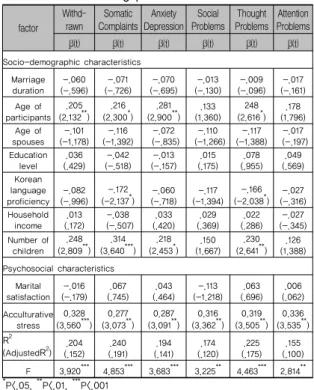
Correlations between socio-demographic and psychosocial characteristics of immigrant women and specific sub-categories of internalizing problems of children in multicultural families were reported in [Table 5]. The socio-demographic and psychosocial variables significantly explained 15.2% of the variance for withdrawn behaviors, 19.1% of the variance for somatic complaints, 14.1% of the variance for anxiety/depression, 12.0% of the variance for social problems, 17.5% of the variance for thought problems, and 10.0% of the variance for attention problems(p <
.01).
For withdrawn behaviors, acculturative stress demonstrated the highest impact(β = .328, p < .01), followed by number of children(β = .248, p < .01) and age of participants(β = .205, p < .05). For somatic complaints, the age of participants as well as level of
Korean language proficiency, number of children, and acculturative stress were significant factors. Among the four factors, number of children was the most influential factor(β = .314, p < .01), followed by acculturative stress(β = .277, p < .01), age of participants(β = .216, p < .05), and level of Korean language proficiency(β = -.172, p < .05). For anxiety/depression, acculturative stress(β = .287, p <
.01), age of participants(β = .281, p < .01), and number of children(β = .218, p < .05) were shown as important factors. For social problems, only acculturative stress was shown as an important factor with β = .316(p < .01). For thought problems, the influential factors were age of participants, level of Korean language proficiency, number of children, and acculturative stress. Among the four factors, acculturative stress was the greatest influential factor (β = .319, p < .01), followed by age of participants(β
= .248, p < .05), number of children(β = .230, p < .01), and level of Korean language proficiency(β = -.166, p
< .05). For attention problems, acculturative stress was the only significant factor(β = .336, p < .01).
Therefore, somatic complaints and thought problems were reliably associated with acculturative stress, number of children, age of participants and level of Korean language proficiency. Withdrawn behaviors and anxiety/depression were related to acculturative stress, number of children, and age of participants. Social problems and attention problems were statistically significantly related to acculturative stress only.
Table 5. Factors influencing sub-categories of internalizing problems
factor Withd-
rawn Somatic Complaints
Anxiety Depression
Social Problems
Thought Problems
Attention Problems
β(t) β(t) β(t) β(t) β(t) β(t)
Socio-demographic characteristics Marriage
duration -.060 (-.596)
-.071 (-.726)
-.070 (-.695)
-.013 (-.130)
-.009 (-.096)
-.017 (-.161) Age of
participants .205 (2.132**)
.216 (2.300*)
.281 (2.900**)
.133 (1.360)
248 (2.616*)
.178 (1.796) Age of
spouses -.101 (-1.178)
-.116 (-1.392)
-.072 (-.835)
-.110 (-1.266)
-.117 (-1.388)
-.017 (-.197) Education
level .036 (.429)
-.042 (-.518)
-.013 (-.157)
.015 (.175)
.078 (.955)
.049 (.569) Korean
language proficiency
-.082 (-.996)
-.172 (-2.137*)
-.060 (-.718)
-.117 (-1.394)
-.166 (-2.038*)
-.027 (-.316) Household
income .013 (.172)
-.038 (-.507)
.033 (.420)
.029 (.369)
.022 (.286)
-.027 (-.345) Number of
children
.248 (2.809**)
.314 (3.640***)
.218 (2.453*)
.150 (1.667)
.230 (2.641**)
.126 (1.388) Psychosocial characteristics
Marital satisfaction
-.016 (-.179)
.067 (.745)
.043 (.464)
-.113 (-1.218)
.063 (.696)
.006 (.062) Acculturative
stress
0.328 (3.560***)
0.277 (3.073**)
0.287 (3.091**)
0.316 (3.362**)
0.319 (3.505**)
0.336 (3.535**)
R
2(Adjusted
R
2) .204 (.152).240 (.191)
.194 (.141)
.174 (.120)
.225 (.175)
.155 (.100) F 3.920*** 4.853*** 3.683*** 3.225** 4.463*** 2.814**
*
P<.05,
**P<.01,
***P<.001
4.2 Factors influencing children’s externalizing problems
To examine factors influencing the externalizing problems of children in multicultural families, multiple regression was conducted. VIF of each independent variable, ranged from 1.032 to 1.726, indicates no violation of the multicollinearity assumption.
15.8 % of the variance of externalizing problems was explained by the socio-demographic and psychosocial characteristics of immigrant women and was statistically significant(p < .001). The significant factors influencing externalizing problems were the age of participants, number of children, and acculturative stress as shown in [Table 6]. The most influential factor was number of children(β = .255, p
< .01), followed by acculturative stress(β = .28, p <
.01) and age of participants(β = .234, p < .01). Thus, as the immigrant women had many children and were
older, children showed more externalizing problems.
Table 6. Factors influencing children’s externalizing problems
factor
βSE
βt VIF
Socio-demographic characteristics Marriage
duration -0.76 1.264 -0.06 -0.601 1.726
Age of
participants 0.415 0.17 0.234 2.442
**1.605 Age of
spouses -0.166 0.119 -0.119 -1.394 1.265 Education
level 0.572 1.111 0.043 0.515 1.203
Korean language
proficiency -2.288 1.558 -0.121 -1.469 1.183 Household
income 0.036 0.068 0.041 0.528 1.032
Number of
children 4.385 1.378 0.28 3.182
**1.355 Psychosocial characteristics
Marital
satisfaction -0.146 0.118 -0.113 -1.241 1.448 Acculturati
ve stress 0.22 0.079 0.255 2.772
**1.472 R
2(AdjustedR
2)0.210(0.158)
F 4.071
****
P<.05,
**P<.01,
***P<.001
Correlations of sub-categories of externalizing problems for children in multicultural families (i.e., delinquent behavior and aggressive behavior)with socio-demographic and psychosocial characteristics of their mothers are reported in [Table 7]. The socio-demographic and psychosocial variables significantly explained 15.2% of the variance for delinquent behavior and 14.4% of the variance for aggressive behavior.
For delinquent behavior, the important factors were the age of participants, number of children, level of Korean language proficiency and acculturative stress.
The most influential factor was number of children (β
= .297, p < .01), followed by age of participants (β = .244, p < .05), acculturative stress (β = .222, p < .05), and level of Korean language proficiency (β = -.178, p < .05). For aggressive behavior, the age of participants, number of children, acculturative stress,
and marital satisfaction were important factors. The most influential factor was acculturative stress(β = .249, p < .01), followed by number of children(β = .241, p < .01), age of participants(β = .204, p < .05), and marital satisfaction(β = -.185, p < .05).
The delinquent behavior, one of externalizing problems, was highly associated with number of children, age of participants, acculturative stress, and level of Korean language proficiency. The aggressive behavior appears to be significantly associated with number of children, acculturative stress, marital satisfaction, and age of participants.
Table 7. Factors influencing sub-categories of externalizing problems
factor
Delinquent behavior
Aggressive Behavior
β(t)
β(t) Socio-demographic characteristics
Marriage duration -.065(-.650) -.050(-.502) Age of participants .244(2.533
*) .204(2.107
*) Age of spouses -.137(-1.599) -.095(-1.107) Education level .024(.288) .050(.599) Korean language
proficiency -.178(-2.153
*) -.072(-.872) Household income .016(.208) .052(.669) Number of children .297(3.356
**) .241(2.710
**) Psychosocial characteristics
Marital satisfaction .020(.214) -.185(-2.014
*) Acculturative stress .222(2.406
*) .249(2.686
**) R
2(AdjustedR
2).204(.152) .196(.144)
F 3.928
***3.743
****
P<.05,
**P<.01,
***P<.001
Ⅳ. DISCUSSION
The purpose of this study was to examine important factors influencing the emotional and behavioral characteristics of students in multicultural families in the context of an increasing population of married immigrant women in Korea. Through collaborative work with the Korean Multicultural Family Support Center and community social service centers in Chungnam and Daejeon areas, 200 total surveys were distributed and 148 surveys were
analyzed. The findings and implications derived from this study are as follows.
First, significant differences in emotional and behavioral problems were found depending on the age of participants (women) and household income. No difference was found, however, in terms of marriage duration.
Second, children’s internalizing problems were significantly associated with the acculturative stress of their mothers.
Third, important factors affecting children’s internalizing problems in order of the magnitude of their effects included the acculturative stress, number of children, and age of participants.
Fourth, important factors affecting children’s externalizing problems in order of effect were number of children, acculturative stress, and age of participants.
Fifth, children showed more somatic complaints and thought problems (subcategories of internalizing problems) as their mothers had higher acculturative stress, more children, were older and had possessed lower levels of proficiency in Korean language. In the case of withdrawn behaviors and anxiety/depression, children appeared more emotional and had behavioral problems as their mothers experienced higher acculturative stress, had more children, and were older. For social problems and attention problems, acculturative stress was the only influential factor.
Sixth, children showed more delinquent behavior as their mothers had more children, were older, had higher acculturative stress, and had lower levels of Korean language skills. For aggressive behavior, the number of children, acculturative stress, marital stress, and the ages of participants were important factors.
The above findings suggest a benefit of planned support systems for married immigrant women and
children in multicultural families.
First, acculturative stress in married immigrant women highly influenced all emotional and behavioral problems (both internalizing and externalizing problems) and implies that support systems to alleviate acculturative stress are needed. The majority of children in multicultural families in Korea are currently preschool-aged children; however, the number of school-aged children is projected to increase until 2020. Issues regarding academic performance and school maladjustment will emerge and the number of occurrences will likely increase[3].
The acculturative stress in married immigrant women affects not only their own wellbeing but also the emotional and behavioral characteristics of their children. Thus, support programs to lessen the acculturative stress in immigrant women in multicultural families are needed.
Second, supports to prevent emotional and behavioral problems in children are needed. Recently, for emotional and behavioral treatment, preventative treatment approaches have emphasized care before children experience emotional and behavioral problems[31]. Given the number of challenges related to immigrant mothers’ abilities to adapt to new cultures, children in multicultural families are at greater risk of experiencing emotional and behavioral difficulties. Thus, specific preventative treatments for such children are necessary. Especially, multicultural education program should be provided to all children and teenagers to improve their understanding and respect of cultural diversity, leading to create a social atmosphere that supports the integration and sound development of children from multicultural families, free from prejudice or unnecessary frictions.
Third, Korean language programs to enhance communication skills for immigrant women are needed. These days, Korean language programs are
currently implemented. However, based on the results of this study that indicate the level of Korean language proficiency influences somatic complaints, thought problems, and delinquent behavior, immigrant women should receive more intensive language supports.
Finally, home support to enhance marital satisfaction is necessary for immigrant women in multicultural families. Approximately half of married immigrant women experience domestic violence resulting in a growing divorce rate; furthermore, significant correlations were found between the marital satisfaction of immigrant women and the aggressive behavior of their children. Thus, various home supports should be provided to improve marital satisfaction and build strong relationships between married couples.
The findings of this study should not be assumed to represent multicultural families across South Korea because participants were specifically recruited from Daejeon and Chungnam areas. Another limitation includes that neither school characteristics nor social contexts were analyzed for their impact on the emotional and behavioral characteristics of children in multicultural families. In addition, surveys for this study were distributed to the mothers of children from multicultural families. Thus, findings of this study may reflect experiences and feelings of those mothers in multicultural families, not the children’s.
Despite these limitations, this study contributes to the existing literature by examining factors influencing on behavioral and emotional characteristics of children in multicultural families, focusing internalizing and externalizing characteristics, and thus provides foundational information for future research.
참 고 문 헌
[1] Statistics Korea, Marriage and Divorce Statistics, 2011.
[2] Ministry of Gender Equality & Family Republic of Korea, Public Receptiveness to Multiculturalism, 2011.
[3] Ministry of Gender Equality & Family Republic of Korea,
The Second Basic Plan for Multicultural Family Support Policy, 2012.
[4] Dong-A Ilbo, [For coexistence beyond diversity]
Korea, beyond a mono-ethnic country, toward a multicultural society, 2010. 10. 16.
[5] S. G. Kim, “The Psycho-social Adaptation among Children of Multi-cultural Families,”
Korean Journal of Youth Studies, Vol.18, No.3, pp.247-272, Mar. 2011.
[6] H. M. Kim, S. J. Won, and S. H. Choi,
“Experiences of discrimination and psychological distress of children from multicultural families:
Examining the mediating effect of social support,” Korean Journal of Social Welfare studies, Vol.42, No.1, pp.117-149, 2011.
[7] J. H. Park and J. S. Nam, “The Language Development and Psychosocial Adjustment of Multicultural Children,” Korean Journal of Youth Studies, Vol.21, No.2, pp.129-152, May.
2010.
[8] I. S. Lee, The Influence of Acculturative Stress
on Migrant Workers' Mental Health: Focused on the Moderating Effects of Social Relationships, Yonsei University, 2004.
[9] I. Y. Han, “Depressive Traits of North Korea Defectors,” Mental Health & Social Work, Vol.18, No.2, pp.78-94, 2001.
[10] J. W. Baik, Parenting Behaviors and Child
Behavior Problems of Depressed and
Non-depressed Mothers : Comparisons
between Mother's Perception and Child's Perception, Ewha Womans University, 2009.
[11] M. Cummings, P. T. Davies, and S. B.
Campbell, “Understanding the impact of marital conflict on children,” Brown University Child &
Adolescent Behavior letter, Vol.17, No.5, pp.1-4, 2001.
[12] N. B. Miller, P. A. Cowan, C. P. Cowan, E. M.
Hetherington, and W. G. Clingempeel,
“Externalizing in preschoolers and early adolescents: A cross-study replication of a family model,” Developmental Psychology, Vol.29, No.1, pp.3-18, Jan. 1993.
[13] S. J. Song, The Effects of the Socialization of
a Child from an International Marriage on Ego-identity: Implications for Multi-cultural Education,
master thesis, Seoul National University, 2007.[14] K. Jun, “A Comparative Study on the Living Conditions of Teenagers from Multicultural Family and Normal Family in Gyeonggi Prefecture-Based on School Life and Family Life,” The Korea Journal of Youth Counseling, Vol.16, No.1, pp.167-185, 2008.
[15] M. J. Kwon, The comparison of metalinguistic
ability between children from multicultural families and non-multicultural families in terms of phonological processing,
doctoral dissertation, Deagu University, 2010.[16] Y. R. Kim and Y. T. Kim, “Linguistic Performance of Korean Children from Low SES Multicultural Families,” Journal of Speech-Language & Hearing Disorders, Vol.20, No.3, pp.73-88, Sep. 2011.
[17] S. Y. Bae and M. B. Kim, “Language Based Reading Abilities of Korean School-Aged Children with Multicultural Backgrounds,”
Korean Journal of Communication Disorders,
Vol.15, No.2, pp.146-156, May. 2010.
[18] H. Y. Jo, D. H. Seo, and S. H. Kwon, “An Ethnographic Study on the Academic Performance of Children Migrants,” Korea Journal of Sociology of Education, Vol.18, No.2, pp.105-134, Jun. 2008.
[19] H. R. Ahn and S. H. Yi, “Academic Achievement: Comparison of Children of Female Marriage Immigrant Families and General Families,” The Korean Journal of Child Studies, Vol.30, No.1, pp.1-10, Feb. 2009.
[20] S. G. Lee, S. G. Park, Y. H. Rho, and H. W.
Lee, “The Mediated Effects of Acculturative Stress and Cultural Capital on School Adaptation for Children in Multicultural Families; Focused on the Mediation Effects of Positive Self-concept,” Journal of Korean Society of Child Welfare, Vol.38, No.0, pp.235-264, Jun. 2012.
[21] S. M. Yang, “Variables Impacting the School Life Adjustment and Family Life Happiness of the Women Marriage Migrants Family`s Children in Rural,” The Korean Journal of Woman Psychology, Vol.12, No.4, pp.559-576, Dec. 2007.
[22] E. J. Bae, “A Study on the Ways to Solve the Problems in Elementary School of Foreign Workers-Children in South Korea,”
Anthropology of education, Vol.9, No.2, pp.25-55, Jul. 2006.
[23] S. K. Un, “A Study on the Factors Influencing School Adjustment of Bicultural Children:
Focused on Family Functioning,” Journal of Korean Society of Child Welfare, Vol.33, No.0, pp.37-68, Dec. 2010.
[24] S. Y. Yang, J. Y. Rhee, and J. Y. Lee, “Effects of Stress-coping Styles on Depression in Children from Multi-cultural Families: Focusing
on Mediating Effects of Social Support,” Journal of the Korea Contents Association, Vol.12, No.12, pp.810-822, 2012.
[25] J. C. Kim, “Instructional Strategy Developmental Marriage Home Chilren through the analysis of their Behavior Traits,” Journal of the Korea Contents Association, Vol.9, No.5, pp.277-283, 2009.
[26] J. Y. Rhee, “Research on the Influence of Mothers' Enculturation Stress and Parental Stress on Children's Maladjustment in Multicultural Families; Focusing on a Control Effect of Family Functions,” Korean Journal of Family Welfare, Vol.17, No.2, pp.105-125, May.
2012.
[27] D. S. Kim, “A Study on the Kansas Marital Satisfaction Scale,” Journal of Korean Home Management Association, Vol.7, No.2, pp.85-94, Dec. 1989.
[28] H. S. Chung, “Marital Relations: A Critical Review and Development of Measurement,”
Journal of the Korean Home Economics Association, Vol.35, No.1, pp.191-204, 1997.
[29] S. J. Lee, Relations between the acculturative
stress and belief system, social support of international students, Yonsei University, 1995.
[30] K. G. Oh and H. R. Lee, Development of Korean
version of Child Behavior Checklist(K-CBCL),
Korean Research Foundation Report, Seoul, 1990.[31] B. K. Scheuermann and J. A. Hall, Positive
Behavioral Supports for the Classroom (1st
Ed.), Pearson Education, 2008.저 자 소 개
전 혜 인(Hae-In Jeon) 정회원
▪2006년 2월 : 이화여자대학교 특 수교육과(교육학 박사)
▪2006년 9월 ~ 현재 : 건양대학 교 초등특수교육과 교수
<관심분야> : 정서행동장애 아동, 장애인 가족지원
정 평 강(Pyung-Gang Jung) 정회원
▪2015년 5월 : University of Minnesota(Ph. D.)
▪2016년 9월 ~ 현재 : 이화여자 대학교 특수교육연구소 박사후 연구원
<관심분야> : 학습장애아동, 읽기 및 쓰기 교수
이 혜 경(Hye-Kyung Lee) 정회원
▪2007년 8월 : 이화여자대학교 사 회복지학과(문학박사)
▪2008년 3월 ~ 현재 : 건양대학 교 사회복지학과 교수
<관심분야> : 가족복지실천, 정신보건사회복지