Vol. 19, No. 3, pp. 11-15, June 2015
Multi-point detection of hydrogen using the hetero-core structured optical fiber hydrogen tip sensors and Pseudorandom Noise code correlation reflectometry
Ai Hosoki*†, Michiko Nishiyama*, Hirotaka Igawa**, Atsushi Seki* and Kazuhiro Watanabe
(Received 7 January 2015, Revision received 7 April 2015, Accepted 10 April 2015)
Abstract: In this paper, the multi-point hydrogen detection system based on the combination of the hetero-core optical fiber SPR hydrogen tip sensor and interrogator by pseudorandom noise (PN) code correlation reflectometry has been developed. In a light intensity-based experiment with an LED operating at 850 nm, it has been presented that a transmitted loss change of 0.32dB was induced with a response time of 25 s for 4% H2 in N2 in the case of the 25-nm Au, 60-nm Ta2O5, and 5-nm Pd multi-layers film. The proposed sensor characteristic shows excellent reproducibility in terms of loss level and time response for the in- and out- H2 action. In addition, in the experiment for multi-point hydrogen detection, all sensors show the real-time response for 4% hydrogen adding with reproducible working.
As a result, the real-time multi-point hydrogen detection could be realized by means of the combination of interrogating system and hetero-core optical fiber SPR hydrogen tip sensors.
Key Words:Optical Fiber, Hetero-Core, Hydrogen, Palladium, Tip Structure, Multi-Point, Interrogator.
†Ai Hosoki (corresponding author), Michiko Nishiyam, Atsushi Seki and Kazuhiro Watanabe: Faculty of engineering, Soka University.
E-mail : [email protected], Tel : +81-42-691-9421
**Hirotaka Igawa : Aerospace research and development directorate, Japan Aerospace Exploration Agency
1. Introduction
Hydrogen is very clean, sustainable, and renewable, and its only by-product is water. In addition, the resources for making hydrogen are abundant. On the other hand, hydrogen is flammable and highly explosive properties when mixed with oxygen. A hydrogen concentration of more than 4%
in air (the lower explosive limit: LEL) generates an
explosive atmosphere of easy ignition. Therefore, cost-effective and reliable hydrogen sensors are needed in order to realize the accurate hydrogen leakages. In potentially explosive atmospheres, optical fiber sensors are preferable to be used because of no electrical contacts in the sensing point and transmission line for operating in explosive environments. Therefore, many fiber-based hydrogen sensors have been attractively developed [1-5]. In the most of optical hydrogen sensors a thin palladium layer is usually employed as the sensitive material because palladium allows the selective absorbability for hydrogen. At present, there are mainly several kinds of optical fiber hydrogen sensors, such as tapered fibers [1,2], unclad fibers [3], Fiber Bragg grating [4,5]. Most of them
attempted to enhance the sensor sensitivity and response time. For the practical hydrogen gas monitoring system, the wide sensing points and real-time measures are important issue. In generally, the location of the leakage point can be determined by optical time domain reflectometry (OTDR). This technique has been widely used for the detection of fault location in optical fiber sensors. When entire length of fiber cable is sensing region, the distribution of a sensing object along the fiber may be determined by OTDR. Sumida et al. [6] have demonstrated the hydrogen multi-point sensing using OTDR. However, OTDR needs the several minutes to improve the signal to noise ration because of a single pulse.
Comparing to the above techniques, our previous work [7] has reported a surface plasmon resonance (SPR) hydrogen sensor by means of hetero-core structured fiber optics with Au/Ta2O5/Pd multi-layers for the first time, which can detect Pd hydrogenation at the near infrared wavelength of 850 nm with high sensitivity. In addition, this sensor shows the excellent reproducibility with a response time of 15 s for 4% hydrogen in the case of 25-nm Au, 60-nm Ta2O5 and 3-nm Pd multi-layer films. In our previous work, it is obvious that when hetero-core optical fiber SPR sensors are connected with tandem, the sensitivity of the latter sensor becomes low. In the hetero-core structure, there would be a multi-mode distribution in the hetero-core region with many of incident angles corresponding to the multi-modes [8,9]. In addition, since the power distribution peak in the hetero-core region is shifted to the critical angle, the sensitivity of this SPR sensor is increased. Therefore, when the hetero-core SPR sensors are tandem-connected, the power distribution peak of latter SPR sensor change.
In this study, we adopted the hetero-core optical fiber hydrogen tip sensor and “bus” topology in order to avoid the change of the power distribution
in the hetero-core region. In this paper, we propose the multi-point detection system for hydrogen using the combination of the hetero-core optical fiber SPR hydrogen tip sensor and PNCR (Pseudorandom Noise code correlation reflectometry) method, which is proposed by Onoda et al [10]. This method makes use of the correlation between a launched pseudorandom noise code signal and its reflection, can obtain a high signal to noise ration.
2. Characteristics of the Hetero-core optical fiber SPR
hydrogen tip sensor
2.1 Sensor fabrication
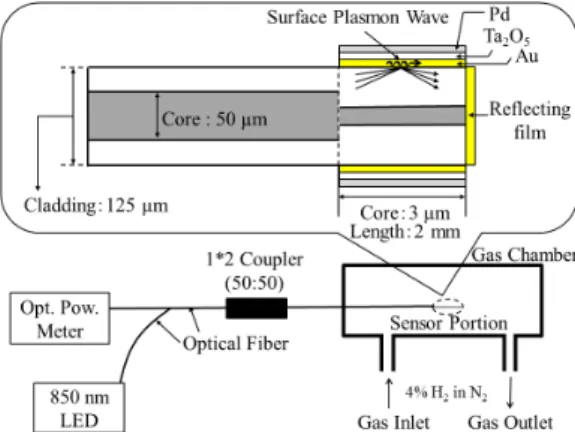
A schematic drawing of SPR hydrogen tip sensor based on a hetero-core fiber is shown in Fig. 1. The tip sensor consists of a transmission line multi-mode (GI) fiber and an inserted segment of single-mode (SI) fiber. Because of the difference in the core diameters, most of the light would leak into the cladding region of the SI sensor element. When the leaked light is reflected at the boundary of the cladding region and the surrounding under the condition of total internal reflection, an evanescent wave is induced at the surface of the cladding layer.
Therefore, SPR waves could be induced in a similar way of the Kretschmann configuration sensor if the surface is coated with a thin metal film. The proposed hetero-core fiber SPR hydrogen tip sensor consists of multi-layers made of thin Au, Ta2O5 and Pd films, in which Au plays the role of an SPR active metal, Ta2O5 shifts the SPR resonance wavelength to a longer range, such as 850 nm of wavelength, and Pd acts as a H2-sensing layer, whose dielectric functions changes by exposure to hydrogen gas. The reflected film is fabricated at the end of the fiber to reflect the light.
2.2 Experimental arrangement
Several samples of hetero-core sensors were fabricated with a 2-mm-long segment of a SI single-mode fiber connected with a GI multi-mode fiber. The SI and GI fibers had the same cladding diameter of 125 µm, but different core diameters of 3 and 50 µm, respectively. The fabricated hetero-core region was then cylindrically coated with a top layer of 5-nm Pd over a second layer of 60-nm Ta2O5 and an innermost layer of 25- nm Au by using an RF sputtering machine. In order to investigate the H2 response properties of the SPR hydrogen tip sensor, an experimental setup was used to measure the optical loss change of the sensor, as depicted in Fig. 1. The sensor was placed in the straight line in a 15-ml volume acrylic gas chamber with an inlet and an outlet to allow a continuous flow of gas. N2 or 4% H2 in N2 was alternatively introduced by controlling the two flow meters, with the maximum flow rates of 1000 ml/min. The fiber is illuminated by an LED light source whose wavelength is 850 nm and the reflected light at the end of the fiber is detected at an optical power meter through the coupler.
Fig. 1 A hetero-core optical fiber SPR hydrogen tip sensor and experimental set-up to measure the optical loss change of a hetero-core fiber SPR hydrogen tip sensor
Fig. 2 Real-time response in the optical loss changes of the hetero-core hydrogen SPR tip sensor with multi-layer films of 25 nm Au/60nm Ta2O5/5nm Pd for 0- and 4-% H2
contained N2
2.3 Experimental Result
Fig. 2 illustrates the optical loss changes of the SPR hydrogen tip sensor in real-time resulting from alternatively loading 0% and 4% H2. It is found from Fig. 2 that the tip sensor can absorb and desorb the H2 gas rapidly with a high sensitivity for 4% H2 in N2. The rise time and recovery time are defined as the period of the time for a loss change from 10% above ground to 90% of the maximum value and as the time required to fall from 90% to 10%, respectively. The rise time was 25 s at 4% H2
in N2 with a recovery time of 40 s. The optical loss change is indicated to be 0.32 dB for 4% hydrogen adding. As a result it is confirmed that the sensor characteristic shows excellent reproducibility in terms of loss level and time response for the in- and out- H2 action.
3. Multi-point hydrogen detection
3.1 Experimental set up
In order to realize the multi-point detection for hydrogen, we make use of the multi-point detection system for hydrogen using the combination of the SPR tip sensor and time domain interrogating
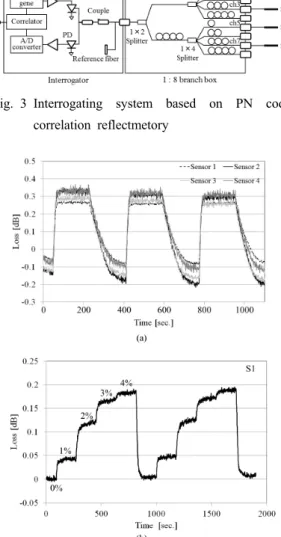
system, Ltd. Fig. 3 shows the system configuration of PNCR. The interrogator consists of SLD, PD, coupler, a reference fiber, and digital signal processing circuits, including PN code generator, A/D converter and correlator. An SLD, whose wavelength is 840 nm as a light source, is binary modulated by a PN code, whose output is launched into the fiber coil. Reflected light from these SPR
Fig. 3 Interrogating system based on PN code correlation reflectmetory
Fig. 4 Real-time response in the optical loss changes of the hetero-core hydrogen SPR tip sensor with multi-layer films of 25 nm Au/60nm Ta2O5/5nm Pd for 0- and 4-% H2
contained N2
sensors is brought to the PD. The PD output is converted to digital form at the A/D converter, of which cross correlation between the former modulating PN code is calculated at the correlator.
Therefore, it is possible to identify the 8 SPR tip sensors using this interrogating system. Nitrogen was used as carrier gas in the chamber. Each sensor element was set in a 15-ml volume acrylic gas chamber with an inlet and an outlet to allow a continuous flow of gas. Flow rates of N2 and 4%
H2 in N2 were individually controlled with mass flow controllers, with the maximum flow rates of 250 ml/min. Each sensor (S1-4) is connected to the channel (1, 3, 5, 7) of the interrogating system.
3.2 Results and discussions
Fig. 4(a) shows the optical loss changes in the real-time responses of the 4 SPR hydrogen tip sensors when the sensors were exposed to pure N2
and 4% H2 contained N2. As can been seen from Fig. 4(a), all sensors give rapid optical loss changes with and without hydrogen absorption, with showing the Pd hydrogenation process in real time with a high sensitivity. The rise time was 20 s at 4% H2
contained N2 with a recovery time of 80 s. In addition, all sensors induced the optical loss changes of about 0.3 dB for 4% hydrogen. Since the sensor characteristics show excellent reproducibility in terms of loss level and time response for the in- and out- H2 action, this interrogation system and SPR hydrogen tip sensor could be practical to realize the real-time multi-point hydrogen detection.
The real-time optical loss change due to varying hydrogen concentrations of a hetero-core optical fiber SPR tip sensor 1 is shown in Fig. 4(b). In this experiment, in order to enhance the signal to noise ration of the SPR hydrogen tip sensor, Au mirror is fabricated at the end of the SI fiber. The loss change is recorded when the concentration of hydrogen is stepwise increased from 0% up to 4%
with approximately 1% intervals, then reduced back to the ground level. From Fig. 4(b), the optical loss is gradually increased with hydrogen concentration, showing a non-linear response to increases in hydrogen concentration. This characteristics show the similar responses compared to previous reported our sensors [7]. Moreover, S2-S4 also detected the hydrogen concentration with a good sensitivity. As a result, it is confirmed that the real-time multi-point hydrogen detection could be realized by means of the combination of interrogating system based on PNCR method and hetero-core optical fiber SPR hydrogen tip sensors.
4. Conclusion
In this paper, the multi-point hydrogen detection system has been successfully developed using the PNCR method and the hetero-core optical fiber SPR hydrogen tip sensors. We have tested the 4 sensors characteristics to 4% hydrogen. It was observed from experimental results that all sensors induced the optical loss changes of 0.3dB with a response time of 20 s for 4% hydrogen for the 25-nm Au / 60-nm Ta2O5/5-nmPdmulti-layersfilm. In addition, it was shown that SPR hydrogen tip sensors can detect the hydrogen concentration with sufficient sensitivities.
References
1. J. Villatoro, D. Luna-Moreno, and D. Monzon- Hernandez, 2005, “Optical fiber hydrogen sensor for concentrations below the lower explosive limit,” Sens. Actuators B 110, 23-27.
2. J. Villatoro, and D. Monzon-Hernandez, 2005,
“Fast detection of hydrogen with nano fiber
tapers coated with ultra thin palladium layers,”
Opt. Express Vol. 13, No. 13, pp. 5087-5092.
3. M. Tabib-Azar, B. Sutapun, R. Petrick, and A.
Kazemi, 1999, “Highly sensitive hydrogen sensors using palladium coated fiber optics with exposed cores and evanescent field interactions,”
Sens. Actuators B 56, pp. 158-163.
4. C. L. Tien, H. W. Chen, W. F. Liu, S. S. Jyu, S. W. Lin, and Y. S. Lin, 2008, “Hydrogen sensor based on side-polished fiber Bragg gratings coated with thin palladium film,” Thin Solid Films 516, pp. 5360-5363.
5. A. Trouillet, E. Marin, and C. Veillas, 2006,
“Fibre gratings for hydrogen sensing,” Meas.
Sci. Technol. Vol. 17, No. 5, pp. 1124-1128.
6. S. Sumida, S. Okazaki, S. Asakura, H.
Nakagawa, H. Murayama, and T. Hasegawa, 2005, “Distributed hydrogen determination with fiber-optic sensor”, Sens. Actuators B 108, 508-514.
7. A. Hosoki, M. Nishiyama, H. Igawa, A. Seki, Y. Choi, and K. Watanabe, 2013, “A surface plasmon resonance hydrogen sensor using Au / Ta2O5/ Pd multi-layers on hetero-core optical fiber structures”, Sens. Actuators B 185, pp.
53-58.
8. M. Iga, A. Seki, and K. Watanabe, 2005, “Gold thickness dependence of SPR-based hetero-core structured optical fiber sensor,” Sens. Actuators B 106, pp. 363-368.
9. K. Takagi, and K. Watanabe, 2012, “Near Infrared Characterization of Hetero-Core Optical Fiber SPR Sensors Coated with Ta2O5 Film and Their Applications,” Sensors 12, pp. 2208-2218.
10. S. Onoda, K. Inoue, T. Nakata, O. Yumoto, and N. Tsukamoto, 2006, “Detection of Rayleigh Back Scattering by Pseudorandom Noise code Correlation Reflectometry,” IEICE general conference, C-5-12.