Introduction
The adzuki bean (Vigna angularis L.) is cultivated around the world, mainly in Asiatic countries, as a diverse food source (Gohara et al., 2016; Rho et al., 2003). In China and Korea, the bean has been used to treat diuretic dysfunction and other diseases such as dropsy and beriberi (Gohara et al., 2016; Kim and Chung, 2013; Luo et al., 2016). Adzuki beans leaves are also used as medicine and in side dishes in Korea (Moon et al., 2015). Sikryochanyo, the Korean traditional medical book, describes that adzuki bean leaves help treat and prevent diabetes (Kim and Chung, 2013). Although previous studies reported on characteristics of the adzuki bean such as antioxidant activity and phenolic and flavonoid content (Gohara et al., 2016; Han et al., 2015; Luo et al., 2016; Park et al., 2011; Woo et al., 2016), few study authors have analyzed the bean’s leaves.
Reactive oxygen species (ROS) are oxygen-derived molecules that include the superoxide anion, hydroxyl, peroxyl, alkoxyl,
nitric oxide, singlet oxygen, hydrogen peroxide, and hypochlorous acid (Fang et al., 2002). ROS damage cellular constituents such as DNA, proteins, amino acids, and lipids (Zou and ChangSam, 2014), and damage caused by ROS is an important risk factor in the pathogenesis of numerous chronic diseases such as asthma, inflammatory arthropathies, diabetes, Parkinson’s and Alzheimer’s diseases, cancers, and human aging (Chiavaroli et al., 2011). Many have reported the beneficial health effects of antioxidants contained in some food (Kim et al., 2012; Kim et al., 2017; Maynard et al., 2003; Sabe et al., 2012). Antioxidant uptake from food is recommended because the antioxidants in foods are considered to detoxify ROS in the human body (Terashima et al., 2013). Some researchers have reported that some antioxidant compounds are present in bound form in food matrices (Acar et al., 2009; Gökmen et al., 2009; Serpen et al., 2007; Serpen et al., 2008). Although these food-antioxidant complexes are not easily absorbed from the intestine, they are likely important for gastrointestinal tract health (Terashima et al., 2013).
Antioxidant and Biological Activity in the Leaves of Adzuki Bean (Vigna angularis L.)
Kyung Jun Lee 1 , Jung-Ro Lee 1 , Myoung-Jae Shin 1 , Gyu-Taek Cho 1 , Ho-Sun Lee 2 , Kyung-Ho Ma 1 , Gi-An Lee 1 and Jong-Wook Chung 3 *
1
National Agrobiodiversity Center, National Institute of Agricultural Sciences (NAS), RDA, Jeonju-Si 54874, Korea
2
International Technology Cooperation Center, RDA, Jeonju-Si 54875, Korea
3
Department of Industrial Plant Science & Technology, Chungbuk National University, Cheongju 28644, Korea
Abstract - The adzuki bean (Vigna angularis L.) is a red-grained legume that has a number of essential nutrients and is used in traditional dishes in Asia. Adzuki bean industrial by-products are also a potential low-cost source of some unique bioactive polyphenols. Hence, here, the authors aimed to perform a comparative study of the phytochemical profiles of the leaves and seeds of the adzuki bean and compare their antioxidant, α-glucosidase inhibition, and tyrosinase inhibition activity. The authors assessed antioxidant activity by DPPH, ABTS, FRAP, PR, TPC, and SOD assays, which showed wide variation, respectively. From the relative antioxidant capacity index results, 10 adzuki bean landraces were selected to compare for phytochemicals and bioactivity using leaf and seed extracts. Antioxidant, α-glucosidase inhibition, and tyrosinase inhibition activity in the leaf extracts were higher than in the seed extracts, and there were more flavonols and isoflavones in the leaf extracts than in the seed extracts. This study demonstrated that adzuki bean leaf extracts could be a new natural antioxidant or antidiabetic agent and a skin whitener and can also be used in industrial applications.
Key words – Adzuki bean leaves, Antioxidant, By-products, α-glucosidase inhibition activity, Tyrosinase inhibition activity
*Corresponding author. E-mail : [email protected] Tel. +82-43-261-2524
ⓒ 2018 by The Plant Resources Society of Korea
Original Research Article
Flavonoids are a general name for a group of chemicals that includes anthocyanins, pro-anthocyanins, flavonols, and isoflavones (Luo et al., 2016). Flavonoids provide color to plants and attract pollinators and seed dispersers. They include antioxidants to protect plants against UV radiation, attract insects, act as signaling molecules to facilitate nitrogen fixation, and defend against bacterial and fungal attack, and their bitter or astringent taste repels birds and other animals (Croteau et al., 2000; Kim and Cha, 2017; Wildmann, 2001; Winkel-Shirley, 2001; Winkel- Shirley, 2002). Several beneficial health properties of dietary flavonoids have been recognized in humans due to their anti- oxidant and antiproliferative effects, which protect the body from various pathologies such as cancers and cardiovascular and inflammatory diseases (Middleton et al., 2000; Nijveldt et al., 2001).
The aim of this study was to evaluate the potential of adzuki bean leaf extracts, by-products of adzuki bean production, as alternative sources of phytochemicals, antioxidants, antidiabetics, and skin whitening. For this purpose, we analyzed the antioxidant activity, flavonoid content, and α-glucosidase and tyrosinase inhibition activity and compared these with the same activity in adzuki bean seed extracts. This paper is the first attempt to assess the flavonoid content and bioactivity in adzuki bean leaf extracts.
Materials and Methods
Collection of plant material
We obtained 223 Korean adzuki bean landraces (KABLs) from the National Agro-biodiversity Center (http://genebank.rda.go.kr), NAS, Rural Development Administration, Republic of Korea.
The KABLs had been cultivated with conventional cultural practices in the NAS experimental field during 2015. Fully matured leaves and seeds of KABL from the plants were dried at room temperature and stored at 4℃.
Adzuki bean extraction for antioxidant activity
We added 100 milligrams of each ground sample to 1 ㎖ of 75% EtOH and sonicated the samples for 1 h. Then, we centri- fuged the mixtures at 13,000 rpm for 10 min. We collected the clear supernatants in new tubes and used them for antioxidant activity assays.
DPPH assay
We assessed the extracts’ DPPH radical-scavenging activity using a previously published method with slight modifications (Lee and Lee, 2004). Briefly, we added DPPH solution (150 μl;
150 μM in anhydrous EtOH) to 100 ㎕ of sample solution. The mixture was shaken vigorously and left to stand at 25℃ in the dark for 30 min. We measured absorbance at 517 ㎚ using a spectrophotometer (Epoch; Bio-Tek, Winooski, VT, USA), and the results are expressed as IC
50(㎕ sample volume) values.
ABTS assay
We estimated ABTS radical-scavenging activity using a previously described method with some modifications (Re et al., 1999). Briefly, we generated the ABTS radical cation by adding 7 mM ABTS to 2.45 mM potassium persulfate followed by overnight incubation in the dark at room temperature. We diluted the ABTS cation solution with methanol (MeOH) to obtain absorbance of 0.7 ± 0.02 at 735 ㎚, and we added the diluted radical cation solution (190 ㎕) to 10 ㎕ of sample solution.
After 6 min of incubation, we measured absorbance at 735 ㎚ with the spectrophotometer. The results are expressed as ascorbic acid equivalents (ASC) per gram of dry weight ( ㎎ ASC/g).
Ferric reducing antioxidant power assay
We determined ferric reducing antioxidant power (FRAP) using the method published by (Singh et al., 2012) with minor modifications. Briefly, we prepared the FRAP reagent by mixing 0.1 M acetate buffer at pH 3.6 (100 ㎖), 10 mM tripydyltriazine (TPTZ) solution in 40 mM HCl (10 ㎖), and 20 mM ferric chloride solution (10 ㎖). We prepared the FRAP reagent freshly and warmed it to 37 ℃ , and then we mixed 10 microliters 300 ㎕ reagent and recorded the absorbance at 593
㎚ after 30 min incubation at 37 ℃ . The results are expressed as ㎎ ASC/g.
Reducing power assay
We determined reducing power using a previously published
method with slight modifications (Yen and Duh, 1993). Briefly,
we mixed a 0.1 ㎖ aliquot of the extract with 0.5 ㎖ phosphate
buffer (0.2 M, pH 6.6) containing 1% K
3Fe(CN)
6and incubated
the mixture at 50℃ for 20 min. After centrifugation at 200 g
for 10 min, we mixed the upper layer (10 ㎕) with 390 ㎕ of
1% ferric chloride. We monitored absorbance at 700 ㎚ using a spectrophotometer, and the results are expressed as ㎎ ASC/g.
SOD assay
We measured the superoxide anion scavenging activity as described by (Robak and Gryglewski, 1988) with some modifi- cations. We generated the superoxide anion radicals in 100 ㎕ of Tris-HCl buffer (16 mM, pH 8.0) containing 0.3 mM nitroblue tetrazolium (NBT), 50 ㎕ NADH (0.936 mM) solution, and 100 ㎕ sample + 50 ㎕ Tris-HCl buffer (16 mM, pH 8.0). We initiated the reaction by adding 50 ㎕ phenazine methosulfate solution to the mixture and incubating at 25℃ for 5 min and then measured the absorbance at 560 ㎚. The results are expressed as IC
50( ㎕ sample volume).
Total polyphenol content assay
We measured total polyphenol content using a modified Folin–Ciocalteu method (Waterhouse, 2001). We added Folin –Ciocalteu reagent (100 ㎕) to 100 ㎕ of sample solution and allowed it to react at room temperature for 3 min. After we added 100 ㎕ of 2% sodium carbonate, we incubated the mixture at room temperature for 30 min. We measured absorbance at 750 ㎚ on a spectrophotometer using distilled water as the blank.
Total phenolic content was reported as milligrams of gallic acid equivalents (GAE) per gram of dry weight sample (㎎ GAE/g)
Analysis of flavonol content in KABL
We transferred 1 gram of each sample into 5 ㎖ polypropylene tubes and mixed this with 2.5 ㎖ of 80% methanol containing 1.2M hydrochloric acid for hydrolysis. We briefly vortexed the mixture and then incubated it at 80℃ for 2 h with tube inversion for mixing the samples with extract solution at 15- min intervals. After incubation, we centrifuged the samples at 14 000 rpm for 3 min and transferred the supernatant into 2 ㎖ Eppendorf tubes. We collected the supernatant and filtered it using a 0.45 ㎛ syringe filter prior to analysis with an Agilent 1260 Infinity HPLC system (Agilent Technologies, Santa Clara, CA, USA). HPLC conditions were as follows: solvent A, 0.1%
TFA/H2O; solvent B, CH3CN; gradient, 20% (B), 20-50% (B) in 5 min, 50-100% (B) in 6, hold at 100% (B) for 1 min, re- equilibrate at 20% (B) for 3 min; column temperature, 30 ℃; and flow rate, 0.40 ㎖/min. The filter detector was set at 370 ㎚.
Analysis of isoflavone content in KABLs
We added 1 gram of each sample to 2 ㎖ of 80% MeOH and sonicated this for 1 h. We hydrolyzed the sample in each tube using 150 ㎕ of 2N NaOH. After mixing for 10 min, we neutralized the solution with 50 ㎕ of glacial acetic acid and centrifuged the sample at 3,000 rpm for 5 min. We collected the supernatant and filtered it using a 0.45 ㎛ syringe filter prior to analysis with the Agilent 1260. We performed the analysis using a Cosmosil 2.5 Cholester (3.0 ㎜× 75 ㎜, 2.5 ㎛;
Nacalai Tesque, Inc., Kyoto, Japan). HPLC conditions were as follows: solvent A, 0.1% TFA/H2O; solvent B, 0.1%TFA/
CH3CN; gradient, 10% (B) for 0.35 min, 10-30% (B) in 3.96 min, hold at 30% (B) for 0.36 min, re-equilibrate at 10% (B) for 1.8 min; column temperature, 30 ℃ ; and flow rate, 0.58 ㎖ /min. The filter detector was set at 254 ㎚.
α-Glucosidase inhibition activity assay
We measured α-glucosidase inhibition activity as described by (Zhang et al., 2015). First we premixed each sample (10 ㎕) with 10 ㎕ α-glucosidase (1.1 U/㎖) for 10 min at 37℃; then we added pAPG/MPA/AuNPs (60 ㎕) into the mixed solution and continuously incubated it for 20 min at 37℃. After that, we added PDBA (30 ㎕) to the resulting mixture to obtain its final concentration of 3.00 mM. Lastly, we allowed the reaction solution to stand at room temperature for 15 min. We recorded the absorbance for each sample using UV-vis spectroscopy with the calculated IC
50. The inhibitory ratio (%) was expressed as follows:
Inhibitory ratio (%)
= (A650/A520-A’650/A’520)/(A’650/A’520)*100
where A650/A520 was the ratio of the absorbance at 650 ㎚ to that at 520 ㎚ in the presence of both the sample and the enzyme and A’650/A’520 was the ratio of the absorbance at 650 nm to that at 520 ㎚ in the presence of the enzyme. The results are expressed as IC
50( ㎕ sample volume).
Determination of Tyrosinase inhibition activity
We determined tyrosinase activity using L-tyrosine as a substrate. First, we mixed 70 ㎕ of L-tyrosine (0.03%) with 70
㎕ 0.05M PBS (pH 6.8). Then, we added 60 ㎕ of sample and
10 ㎕ of tyrosinase (125U/㎖) solution and incubated this at 37℃ for 10 min. After that, we immediately incubated the solution on ice for 5 min. We monitored absorbance at 475 ㎚ using a spectrophotometer. We calculated tyrosinase inhibition activity as follows:
Inhibition (%) = ((A-B)/A)*100
where A was without sample and B was with sample and substrate. The results are expressed as IC
50(㎕ sample volume).
Data analysis
We used least significant difference (LSD) and correlation analysis to determine differences among the 223 KABLs using SPSS Statistics 20 (SPSS Inc., Chicago, IL, USA). The integ- ration of antioxidant capacity results derived from different chemical methods (Sun and Tanumihardjo 2007) allowed us to calculate the relative antioxidant capacity index (RACI).
Results
The distribution of antioxidant activity in leaf extracts from the 223 KABLs
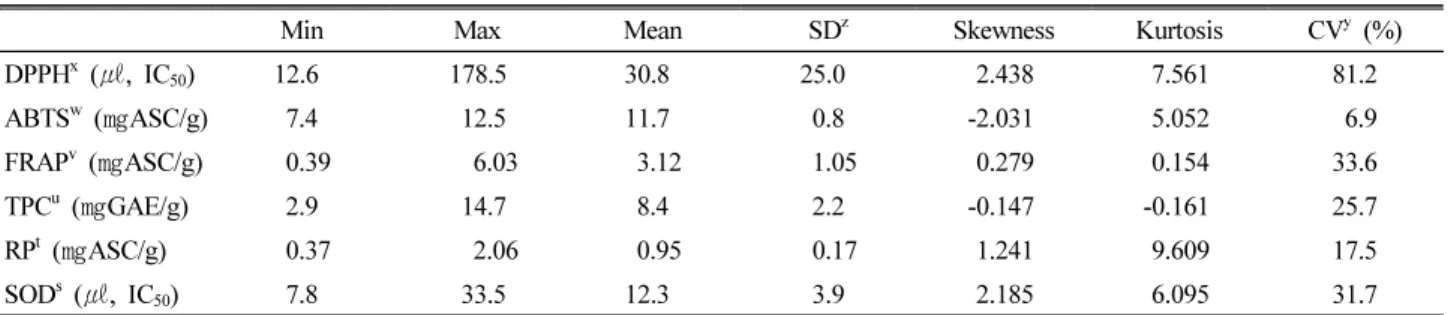
The distribution of antioxidant activity in the leaf extracts of the KABLs is presented in Table 1 and Appendix 1. Among five antioxidant activities, DPPH showed the highest variation (coefficient of variation [CV]: 81.2 %), and ABTS was the lowest (CV: 6.9 %). DPPH and SOD ranged 12.6 to 178.5 and 7.8 to 33.5 (㎕, IC
50), respectively. ABTS, FRAP, and RP ranged from 7.4 to 12.5, 0.39 to 6.03, and 0.37 to 2.06 ㎎ ASC/g, respectively, and TPC’s range was 2.9 to 14.7 ㎎ GAE/g.
Each antioxidant activity assay showed different ranges for the 223 KABLs (Appendix 1): the accessions with the most antioxidant activity were IT025842 in DPPH; IT142500 in ABTS; IT142625 in FRAP; IT142500 in TPC; IT142613 in RP; andIT120273 in SOD, and the accessions with the least activity were IT142514 in DPPH; IT142561 in ABTS; IT025789 in FRAP; IT120278 in TPC; IT025789 in RP; and IT025885 in SOD.
Fig. 1. Relative antioxidant capacity of leaf extracts of 223 Korean adzuki bean landraces.
Table 1. Descriptive statistics for antioxidant activity in the leaf extracts from 223 Korean adzuki bean landraces
Min Max Mean SD
zSkewness Kurtosis CV
y(%)
DPPH
x( ㎕, IC
50) 12.6 178.5 30.8 25.0 2.438 7.561 81.2
ABTS
w( ㎎ASC/g) 7.4 12.5 11.7 0.8 -2.031 5.052 6.9
FRAP
v( ㎎ASC/g) 0.39 6.03 3.12 1.05 0.279 0.154 33.6
TPC
u( ㎎GAE/g) 2.9 14.7 8.4 2.2 -0.147 -0.161 25.7
RP
t( ㎎ASC/g) 0.37 2.06 0.95 0.17 1.241 9.609 17.5
SOD
s( ㎕, IC
50) 7.8 33.5 12.3 3.9 2.185 6.095 31.7
z
SD: standard deviation,
yCV: coefficient of variation,
xDPPH: DPPH radical-scavenging activity,
wABTS: ABTS radical-scavenging
activity,
vFRAP: ferric reducing antioxidant power,
uTPC: total polyphenol content,
tRP: reducing power,
sSOD: superoxide anion
scavenging activity.
Integrating the antioxidant capacity results derived from different chemical methods allowed us to calculate RACIs, and the results are shown in Fig. 1. We found that IT142500 had the highest RACI, 1.42, followed by IT142476 (1.18), and IT142507 (1.03), with IT142561 having the lowest, -2.23.
Selecting adzuki bean landraces with high or low antioxidant activity using RACI
In order to confirm the relation among antioxidant activity, phytochemical contents, α-glucosidase inhibition activity, and tyrosinase inhibition activity, we selected 10 KABLs with high or low antioxidant activity based on the RACI results (Appendix 2), and we present the distribution of antioxidant activity in the leaf extracts from the 10 KABLs in Table 2. Among the five antioxidant activity assays, DPPH, FRAP, TPC, RP, and SOD were significantly higher in the high antioxidant group than in
the low group, whereas ABTS showed no significant difference between the two.
Comparison of flavonoid content between the high and low antioxidant groups
In order to compare the contents of phytochemicals between the high and low antioxidant groups, we measured six flavonoids (kaempferol, quercetin, myricetin, daidzein, glycitein, and genistein) related to antioxidant activity in 10 the selected landraces using HPLC. Among the six detected flavonoids, daidzein (36.1–67.3%, average of 51.9% in detected flavonoids) was the most abundant (Table 3). The daidzein, genistein, and glycitein content in the 10 selected KABLs ranged from 533.2 (IT142507, high group) to 3959 (IT142561, low group), 92.8 (IT120225, high) to 379.1 (IT142561, low), and 137.7 (IT025789, low) to 1068 (IT142500, high) ㎍/100g dried sample, respectively.
Table 2. Descriptive statistics for antioxidant activity in the leaf extracts from 10 selected Korean adzuki bean landraces according to RACI
DPPH
z( ㎕, IC
50)
ABTS
y( ㎎ASC/g)
FRAP
x( ㎎ASC/g)
TPC
w( ㎎GAE/g)
RP
v( ㎎ASC/g)
SOD
u( ㎕, IC
50)
HG
t14.5 ± 1.8 12.2 ± 0.5 4.8 ± 0.4 11.9 ± 2.1 1.1 ± 0.1 9.9 ± 1.7
LG 31.6 ± 15.0 10.1 ± 2.0 1.2 ± 0.8 6.2 ± 0.8 0.6 ± 0.2 19.2 ± 4.9
*
sns
r** ** ** **
z
DPPH: DPPH radical-scavenging activity,
yABTS: ABTS radical-scavenging activity,
xFRAP: ferric reducing antioxidant power,
wTPC:
total polyphenol content,
vRP: reducing power,
uSOD: superoxide anion scavenging activity,
tHG: high antioxidant group, IT142500.
IT142476, IT142507, IT120265, and IT120225, LG: low antioxidant group, IT142560, IT025789, IT025962, IT142561, and IT142559.
s*,**
: Significance at p ≤ 0.05 and 0.01, respectively,
rns: not significant.
Table 3. The flavonoid contents in the leaf extracts of 10 selected Korean adzuki bean landraces ( ㎍/100g)
IT Kaempferol Myricetin Quercetin Daidzein Genistein Glycitein
HG
zIT142500 235.8 ± 21.2 605.6 ± 2.0 473.3 ± 43.0 3450.6 ± 147.1 294.0 ± 68.4 1068.0 ± 60.8 IT142476 259.4 ± 21.3 333.7 ± 5.7 304.3 ± 16.2 2211.5 ± 116.4 270.5 ± 49.0 468.6 ± 39.2 IT142507 64.5 ± 2.7 200.5 ± 25.1 641.9 ± 29.5 533.2 ± 37.8 113.0 ± 5.7 407.3 ± 8.9 IT120265 237.2 ± 41.4 559.1 ± 9.7 371.6 ± 59.6 2576.5 ± 387.8 246.7 ± 6.0 1003.7 ± 190 IT120225 97.0 ± 4.6 247.2 ± 39.6 503.8 ± 15.4 981.0 ± 68.4 92.8 ± 19.6 379.6 ± 38.8
LG
IT142560 136.5 ± 24.4 55.0 ± 13.6 746.8 ± 53.8 1712.8 ± 326.6 143.6 ± 29.4 157.6 ± 51.9 IT025789 103.1 ± 3.4 61.4 ± 0.6 373.7 ± 25.7 1297.3 ± 102.5 104.6 ± 18.5 137.7 ± 47.8 IT025962 42.4 ± 1.7 227.1 ± 10.4 378.7 ± 27.2 640.2 ± 82.2 94.5 ± 2.8 391.8 ± 11.8 IT142561 90.3 ± 7.3 216.0 ± 17.1 793.1 ± 50.6 3959.7 ± 103.6 379.1 ± 68.7 446.4 ± 40.3 IT142559 106.3 ± 11.8 134.3 ± 18.2 691.0 ± 99.2 2172.7 ± 102.6 213.7 ± 29.0 278.0 ± 21.5
LSD
0.05y33.6 32.7 87.8 332.6 68.6 128.3
z
HG, high antioxidant group, IT142500. IT142476, IT142507, IT120265, and IT120225, LG: low antioxidant group, IT142560, IT025789, IT025962, IT142561, and IT142559.
y
LSD
0.05: least significant difference at p<0.05.
Among the flavonols, kaempferol, myricetin, and quercetin content ranged from 42.4 (IT025962, low) to 259.4 (IT142476, high), 55.0 (IT142560, low) to 605.6 (IT142500, high), and 304.3 (IT142476, high) to 793.1 (IT142561, low) ㎍/100g dried sample, respectively.
Comparison of α-glucosidase and tyrosinase inhibition activity between the high and low antioxidant groups
We tested the leaf extracts from the 10 KABLs we selected
for their α-glucosidase and tyrosinase inhibition activity (Table 4); among the 10, IT142507 showed the lowest inhibition activity for both enzymes. AGC and TIA were higher in the high antioxidant group than in the low group except for IT142507 and IT 120225. AGC in the high group ranged from 0.34 to 0.55 (IC
50, ㎍/㎖) and from 0.40 to 0.48 (IC
50, ㎍/㎖) in the low group. TIA in the high and low groups ranged from 0.53 to 0.83 and 0.58 to 0.69 (IC
50, ㎍/㎖), respectively.
Table 4. α-glucosidase inhibition and tyrosinase inhibition activity in the leaf extracts of 10 selected Korean adzuki bean landraces IT α-glucosidase inhibition activity (㎕, IC
50) Tyrosinase inhibition activity ( ㎕, IC
50)
HG
zIT142500 27.9 ± 1.2 45.6 ± 0.5
IT142476 28.5 ± 2.0 44.4 ± 0.6
IT142507 46.0 ± 4.6 68.5 ± 1.6
IT120265 29.8 ± 1.2 47.5 ± 0.2
IT120225 35.0 ± 1.6 53.2 ± 0.9
LG
IT142560 37.4 ± 2.2 52.5 ± 0.5
IT025789 39.0 ± 2.4 54.4 ± 0.9
IT025962 40.1 ± 2.4 57.5 ± 0.8
IT142561 32.9 ± 2.1 47.9 ± 1.0
IT142559 35.2 ± 1.9 51.5 ± 0.9
LSD
0.05y3.3 1.2
z
HG: high antioxidant group, IT142500. IT142476, IT142507, IT120265, and IT120225, LG: low antioxidant group, IT142560, IT025789, IT025962, IT142561, and IT142559.
y
LSD
0.05: least significant difference at p<0.05.
Table 5. Correlations among antioxidants, α-glucosidase inhibition activity, tyrosinase inhibition activity, and phytochemical contents
DPPH
zABTS
yFRAP
xTPC
wRP
vSOD
uAGC
tTI
sKaempferol Myricetin Quercetin Daidzein Genistein ABTS -0.112
FRAP -0.691*
r0.531
TPC -0.722* 0.530 0.953**
RP -0.725* 0.334 0.851** 0.745*
SOD 0.491 -0.520 -0.826** -0.694* -0.909**
AGC 0.234 -0.064 -0.355 -0.39 -0.445 0.382
TI 0.078 0.105 -0.105 -0.153 -0.215 0.133 0.960**
Kaempferol -0.317 0.340 0.516 0.634* 0.455 -0.361 -0.834** -0.739*
Myricetin -0.553 0.308 0.739* 0.797** 0.718* -0.741* -0.677* -0.474 0.710*
Quercetin 0.386 -0.500 -0.365 -0.435 -0.259 0.294 0.279 0.210 -0.433 -0.434
Daidzein -0.196 -0.309 0.114 0.186 0.225 -0.118 -0.765** -0.771** 0.531 0.475 0.238
Genestein -0.286 -0.266 0.246 0.278 0.344 -0.226 -0.728* -0.705* 0.534 0.488 0.202 0.955**
Glycitein -0.518 0.236 0.669* 0.747* 0.661* -0.688* -0.625 -0.426 0.656* 0.985** -0.324 0.520 0.514
z
DPPH: DPPH radical-scavenging activity,
yABTS: ABTS radical-scavenging activity,
xFRAP: ferric reducing antioxidant power,
wTPC:
total polyphenol content,
vRP: reducing power,
uSOD: superoxide anion scavenging activity,
tAGC: α-glucosidase inhibition activity,
s
TI: tyrosinase inhibition activity.
r*,**
Pearson’s correlation p-value of * < 0.05 and **< 0.01.
Correlations among antioxidant activity, phytochemicals, and α-glucosidase and tyrosinase inhibition activity in adzuki bean extracts
Table 5 shows the correlations among antioxidant activity, phytochemicals, α-glucosidase and tyrosinase inhibition activity;
among them, ABTS showed no correlations with other factors.
For five antioxidants, DPPH, FRAP, TPC, RP, and SOD, we detected positive or negative correlations among them, but there were no significant correlations for AGC or TIA activity.
AGC and TIA did show a high positive correlation between the two (r=0.960, p<0.01). Among six flavonoids, kaempferol, myricetin and glycitein showed correlations with antioxidant activity. We detected negative correlations for AGC and TIA with kaempferol, daidzein, and genistein, and myricetin showed a negative correlation with AGC only.
Comparison of antioxidant activity, phytochemicals, and α-glucosidase and tyrosinase inhibition activity between leaf and seed extracts
To confirm the potential uses for adzuki bean leaves, we compared leaf (LEs) and seed (SEs) extracts from the 10 selected KABLs based on phytochemical content and antioxidant and α-glucosidase and tyrosinase inhibition activity (Appendix 2 and 3). Among them, DPPH and FRAP showed no significant differences between the LEs and SEs (Table 6).
For antioxidant activity, there was only more RP in the SEs
(1.4 ± 0.3 ㎎ASC/g) than in the LEs (0.8 ± 0.3 ㎎ASC/g).
There were, respectively, 2.3 and 4.2 times more AGC and TIA in the LEs (35.2 ± 5.7 and 52.3 ± 7.0 ( ㎕, IC
50), respectively) than in the SEs (81.0 ± 32.0 and 221.1 ± 134.2 (㎕, IC
50), respectively). For the six detected flavonoids, there was 133 times more daidzein in the LEs than in the SEs.
Discussion
For centuries, farming communities have continuously contri- buted to the evolution, enrichment, and maintenance of landrace diversity on farms (Brush, 1995; Jarvis et al., 2008). However, little has been done to understand the landrace diversity or to improve these landraces (Sthapit and Rao, 2009). suggested that landraces can be effectively improved by simple trait selection if they offer sufficient natural variations in their populations. In this study, we evaluated the antioxidant activity, phytochemical content, and α-glucosidase and tyrosinase inhibition activity in the leaf extracts of Korean adzuki bean landraces to identify their potential as new industrial resources. Our results revealed that the leaf extracts of these KABLs had different physiological activities and phytochemical contents. The success of a breeding program depends on the existence of genetic variability available to breeders (Hoisington et al., 1999). Landraces contain important genetic variability, which determines their ability to adapt to changes in their environments (Frankel et al., 1995). In addition,
Table 6. Antioxidants, α-glucosidase inhibition activity, tyrosinase inhibition activity, and six phytochemical contents between leaf and seed extracts of adzuki bean landraces
DPPH
z( ㎕, IC50
50)
ABTS
y( ㎎ASC/g)
FRAP
x( ㎎ASC/g)
TPC
w( ㎎GAE/g)
RP
v( ㎎ASC/g)
SOD
u( ㎕, IC
50)
AGC
t( ㎕, IC
50) LE
r23.0 ± 13.5 11.1 ± 1.8 3.0 ± 2.0 9.0 ± 3.4 0.8 ± 0.3 14.5 ± 6.0 35.2 ± 5.7
SE 23.6 ± 12.4 2.6 ± 0.1 2.3 ± 0.7 3.6 ± 1.2 1.4 ± 0.3 70.6 ± 8.2 81.0 ± 32.0
ns
q** ns ** ** ** **
TI
s( ㎕, IC
50)
Kaempferol ( ㎍/100g)
Myricetin ( ㎍/100g)
Quercetin ( ㎍/100g)
Daidzein ( ㎍/100g)
Genistein ( ㎍/100g)
Glycitein ( ㎍/100g) LE 52.3 ± 7.0 137.3 ± 78.1 264 ± 188 527.8 ± 177 1953.6 ± 1152.1 195.2 ± 100.3 473.9 ± 317.3 SE 221.1 ± 134.2 2.7 ± 1.0 14.5 ± 15.5 12.2 ± 7.1 14.7 ± 3.6 7.2 ± 4.9 44.4 ± 24.2
** ** ** ** ** ** **
z
DPPH: DPPH radical-scavenging activity,
yABTS: ABTS radical-scavenging activity,
xFRAP: ferric reducing antioxidant power,
wTPC:
total polyphenol content,
vRP: reducing power,
uSOD: superoxide anion scavenging activity,
tAGC: α-glucosidase inhibition activity,
s
TI: tyrosinase inhibition activity,
rLE: leaf extracts, SE: seed extracts.
q**
: Significance at p ≤ 0.01, ns: not significant.
landraces provide useful variability for breeding provided that they are accompanied by characterization and agronomic evaluation (Allard, 1996; Frankel et al., 1995). This information is essential for the correct conservation of genetic variability and for the accessions to be of use in breeding programs (Vilaro et al., 2004). Our results could contribute to more efficient conservation and utilization of adzuki bean landraces.
In this study, the leaf extracts from the adzuki bean landraces had more efficient antioxidant activity than did the seed extract.
Other studies reported that flavonoids are present in leaf extracts but absent in seed extracts (Archana et al., 2012; Nanna et al., 2013) ; their authors’ suggested that antioxidant, antimicrobial, and anti-inflammatory plant activity may be due to the presence of flavonoids. Flavonoids and total polyphenols are important secondary plant metabolites present at high levels in plants under stress (Koh et al., 2009; Stanojevic et al., 2009) because they play roles in reducing the oxidative stress caused by ROS (Patil and Jadhav, 2013). Flavonoids are free radical scavengers that prevent oxidative cell damage (Salah et al., 1995). Although our result did not show significant correlations between anti- oxidant activity and flavonoid content, we suggest that the higher flavonoid content in the leaf than the seed extracts might be responsible for the leaf extracts’ high antioxidant activity.
Plant antioxidants have been purported to have anti-aging properties and may prevent numerous diseases such as cancer, diabetes, and neurodegenerative diseases (Bansal et al., 2013).
In our study, we measured the antioxidant activity of 223 Korean adzuki bean landraces using various methods. Additionally, based on the antioxidant activity findings, we evaluated the α -glucosidase and tyrosinase inhibitor activity in the leaf and seed extracts of the landraces. We found more α-glucosidase and tyrosinase inhibition activity in the leaf extracts, by 2.3 and 4.2 times, respectively, than in the seed extracts, although there were no significant correlations between antioxidant activity and α-glucosidase and tyrosinase inhibitor activity.
Shoots and leaves have been reported to have higher phenolic content than that in other plant parts (Bernardi et al., 2008), and (Shaik et al., 2011) reported that leaf extracts of Lessertia frulescens showed more phenolics, flavonoids, alkaloids, and saponins than did seed extracts. In particular, (Oleszek and Stochmal, 2002) reported that flavonoid content in the seeds was characteristically low. Our results agreed with the previous
studies: The phytochemical content in the leaf extracts was greater than in the seed extracts, resulting in more antioxidant and α-glucosidase and tyrosinase inhibitor activity.
α-Glucosidase inhibitors are potential agents for diabetes therapy given that glucosidases are involved in several important and relevant biological processes (Fontana Pereira et al., 2011).
Our results showed that the flavonoid content in the leaf extracts was higher than in the seed extracts. In addition, among six flavonoids, kaempferol, myricetin, daidzein, and genistein had negative correlations with α-glucosidase inhibition activity (IC
50). Flavonoids are naturally occurring phenolic compounds that are widely distributed in plants, and some of them have been described as glucosidase inhibitors (Cazarolli et al., 2009).
Tadera et al. (2006) reported that anthocyanidin and isoflavone and flavonol groups were potent α-glucosidase inhibitors and cyanidin, myricetin, quercetin, genistein, kaempferol, and daidzein especially showed higher α-glucosidase inhibition activity.
Other studies reported that some flavonoids such as quercetin, kaempferol, and daidzein are strong glucosidase inhibitors (Fontana Pereira et al., 2011; Kim et al., 2000). (Andrade- Cetto et al. (2008) reported that high flavonoid content in some plant extracts efficiently inhibits α-glucosidase activity.
In our study, we analyzed the tyrosinase inhibition activity of leaf and seed extracts from the adzuki bean, and we found higher tyrosinase inhibition, which could have been because of the higher flavonoid content in the leaf extracts than in those from the seeds (Matsuda et al., 1996). reported that several flavonoid derivatives including quercetin, myricetin, and myricetin- glucoside had varying degrees of inhibitory activity toward tyrosinase. Many flavonols and flavones such as quercetin, kaempferol, galangin, luteolin, chrysin, baicalein, and luteolin- 7-O-glucoside were reported to have weak tyrosinase inhibitory activity (Kubo et al., 2000). In addition, Chang et al. (2007) reported that five isolated isoflavones such as daidzein, glycitein, and genistein showed tyrosinase inhibitory activity.
In this study, we evaluated the phytochemical content and in vitro antioxidant, α-glucosidase inhibition, and tyrosinase inhibition activity in the leaf extracts of Korean adzuki bean landraces using various methods for the first time. KABLs contain high phytochemicals and exhibited strong bioactivity.
With the present study, we demonstrated that leaf extracts of
adzuki beans are a new source of natural antioxidants, cosmetics,
and medicines that could be used in industrial applications, which will strongly increase the utilization of adzuki bean by-products. This study laid a good foundation for developing and utilizing adzuki bean by-products as a new source.
Acknowledgments
This study was carried out with the support of the “Research Program for Agricultural Science & Technology Development (Project No. PJ010883)”. It was also supported by the 2017 Postdoctoral Fellowship Program of the National Institute of Agricultural Science funded by the Rural Development Admini- stration, Republic of Korea.
References
Acar, O.C., V. Gokmen, N. Pellegrini and V. Fogliano. 2009.
Direct evaluation of the total antioxidant capacity of raw and roasted pulses, Nuts and Seeds. Eur. Food Res. Technol.
229:961-969.
Allard, R.W. 1996. Genetic basis of the evolution of adaptedness in plants. Euphytica 92:1-11.
Andrade-Cetto, A., J. Becerra-Jiménez and R. Cárdenas- Vázquez. 2008. Alfa-glucosidase-inhibiting activity of some Mexican plants used in the treatment of type 2 diabetes. J.
Ethnopharmacol. 116:27-32.
Archana, P., T. TSamatha, B. Mahitha, Chamundeswari and N.
RamaSwamy. 2012. Preliminary phytochemical screening from leaf and seed extracts of Senna Alata L. roxb-an ethnomedicinalplant. Int. J. Pharm. Biol. Res. 3:82-88.
Bansal, S., S. Choudhary, M. Sharma, S.S. Kumar, S. Lohan, V.
Bhardwaj, N. Syan and S. Jyoti. 2013. Tea: A native source of antimicrobial agents. Food Res. Int. 53:568-584.
Bernardi, A.P.M., J.D. Nunes, M.K. Marchioro, L.M.G. Rosa, G.L. von Poser and S.B. Rech. 2008. Phenolic compounds profiles during ex vitro acclimatization of micropropagated Hypericum polyanthemum. Plant Physiol. Bioch. 46:694-700.
Brush, S.B. 1995. In-situ conservation of landraces in centers of crop diversity. Crop Sci. 35:346-354.
Cazarolli, L.H., P. Folador, M.G. Pizzolatti and F.R.M.B. Silva.
2009. Signaling pathways of kaempferol-3-neohesperidoside in glycogen synthesis in rat soleus muscle. Biochimie 91:
843-849.
Chang, T.S., H.Y. Ding, S.S.K. Tai and C.Y. Wu. 2007. Mushroom tyrosinase inhibitory effects of isoflavones isolated from soygerm koji fermented with Aspergillus Oryzae Bcrc 32288.
Food Chem. 105:1430-1438.
Chiavaroli, V., C. Giannini, S. De Marco, F. Chiarelli and A.
Mohn. 2011. Unbalanced oxidant-antioxidant status and its effects in pediatric diseases. Redox Rep. 16:101-107.
Croteau, R., T.M. Kutchan and N.G. Lewis. 2000. Natural products (secondary metabolites): In Buchanan, B., W.
Gruissem and R. Jones (eds.), Biochemistry and Molecular Biology of Plants, American Society of Plant Physiologists 24:1250-1319.
Fang, Y.Z., S. Yang and G.Y. Wu. 2002. Free radicals, antioxidants, and nutrition. Nutrition 18:872-879.
Fontana, Pereira D., L.H. Cazarolli, C. Lavado, V. Mengatto, M.S.R.B. Figueiredo, A. Guedes, M.G. Pizzolatti and F.R.M.B.
Silva. 2011. Effects of flavonoids on α-glucosidase activity:
Potential targets for glucose homeostasis. Nutrition 27:1161- 1167.
Frankel, O., A.D.H. Brown and J.J. Burdon. 1995. The con- servation of plant biodiversity. Cambridge University Press, Cambridge, UK.
Gökmen, V., A. Serpen and V. Fogliano. 2009. Direct measure- ment of the total antioxidant capacity of foods: The ‘Quencher’
approach. Trends Food Sci. Technol. 20:278-288.
Gohara, A.K., A.H.P. de Souza, S.T.M. Gomes, N.E. de Souza, J.V. Visentainer and M. Matsushita. 2016. Nutritional and bioactive compounds of adzuki bean cultivars using chemometric approach. Cienc. Agrotec. 40:104-113.
Han, K.H., T. Kitano-Okada, J.M. Seo, S.J. Kim, K. Sasaki, K.
Shimada and M. Fukushima. 2015. Characterisation of anthocyanins and proanthocyanidins of adzuki bean extracts and their antioxidant activity. J. Funct. Foods 14:692-701.
Hoisington, D., M. Khairallah, T. Reeves, J.-M. Ribaut, B.
Skovmand, S. Taba and M. Warburton. 1999. Plant genetic resources: What can they contribute toward increased crop productivity? Proc. Natl. Acad. Sci. 96:5937-5943.
Jarvis, D.I., A.H.D. Brown, P.H. Cuong, L. Collado-Panduro, L. Latournerie-Moreno, S. Gyawali, T. Tanto, M. Sawadogo, I. Mar, M. Sadiki, N.T.N. Hue, L. Arias-Reyes, D. Balma, J.
Bajracharya, F. Castillo, D. Rijal, L. Belqadi, R. Ranag, S.
Saidi, J. Ouedraogo, R. Zangre, K. Rhrib, J.L. Chavez, D.J.
Schoen, B. Sthapit, P. De Santis, C. Fadda and T. Hodgkin.
2008. A global perspective of the richness and evenness of
traditional crop-variety diversity maintained by farming
communities. Proc. Natl. Acad. Sci. USA 105:5326-5331.
Kim, J.-S., C.-S. Kwon and K.H. Son. 2000. Inhibition of alpha-glucosidase and amylase by luteolin, a flavonoid.
Biosci. Biotechnol. Biochem. 64:2458-2461.
Kim, J., J. Hong, H.K. Jung, Y.S. Jeong and K. Cho. 2012.
Grape skin and loquat leaf extracts and acai puree have potent anti-atherosclerotic and anti-diabetic activity in vitro and in vivo in hypercholesterolemic zebrafish. Int. J. Mol.
Med. 30:606-614.
Kim, M.-H. and H.-K. Chung. 2013. Review of food therapy and development of diet therapy program for diabetes mellitus in 「Sikryochanyo」. J. Kor. Soc. Diet. Cult. 28:
562-575.
Kim, S.M, J.H. Park, H.O. Boo, S.G. Song and H.Y. Park. 2017.
In vitro comparision of biological activities of solvent fraction extracts from Orostachys japonicus. Korean J. Plant Res.
30:133-143.
Kim, S. and H. Cha. 2017. Comparison of the total phenolic and flavonoid contents and antioxidant activities of four kinds of sand dune plants living in taean, Korea. Korean J. Plant Res.
30:8-16.
Koh, E., K.M.S. Wimalasiri, A.W. Chassy and A.E. Mitchell.
2009. Content of ascorbic acid, quercetin, kaempferol and total phenolics in commercial broccoli. J. Food Compos.
Anal. 22:637-643.
Kubo, I., I. Kinst-Hori, S.K. Chaudhuri, Y. Kubo, Y. Sánchez and T. Ogura. 2000. Flavonols from heterotheca inuloides:
Tyrosinase inhibitory activity and structural criteria. Bioorg.
Med. Chem. 8:1749-1755.
Lee, D.J. and J.Y. Lee. 2004. Antioxidant activity by DPPH assay. Korean J. Crop Sci. 49:187-194.
Luo, J.Q., W.X. Cai, T. Wu and B.J. Xu. 2016. Phytochemical distribution in hull and cotyledon of adzuki bean (Vigna Angularis L.) and mung bean (Vigna radiate L.), and their contribution to antioxidant, anti-inflammatory and anti-diabetic activities. Food Chem. 201:350-360.
Matsuda, H., M. Higashino, Y. Nakai, M. Iinuma, M. Kubo and F.A. Lang. 1996. Studies of cuticle drugs from natural sources.
IV. Inhibitory effects of some arctostaphylos plants on melanin biosynthesis. Biol. Pharm. Bull. 19:153-156.
Maynard, M., D. Gunnell, P. Emmett, S. Frankel and G.D.
Smith. 2003. Fruit, vegetables, and antioxidants in childhood and risk of adult cancer: The Boyd Orr cohort. J. Epidemiol.
Commun. H. 57:218-225.
Middleton, E., C. Kandaswami and T.C. Theoharides. 2000. The
effects of plant flavonoids on mammalian cells: Implications for inflammation, heart disease, and cancer. Pharmacol. Rev.
52:673-751.
Moon, H.-K., Y.-J. Lee, M.-R. Park and G.-Y. Kim. 2015.
Development of native local foods in Sangju by storytelling- combined - a Case of ‘General Jeong’s Table’. J. Kor. Soc.
Food Cult. 30:562-575.
Nanna, R.S., M. Banala, A. Pamulaparthi, A. Kurra and S.
Kagithoju. 2013. Evaluation of phytochemicals and fluorescent analysis of seed and leaf extracts of Cajanus Cajan L.. Int. J.
Pharm. Sci. Rev. Res. 22:11-18.
Nijveldt, R.J., E.L.S. Van Nood, D.E. Van Hoorn, P.G. Boelens, K. Van Norren and P.A.M. Van Leeuwen. 2001. Flavonoids:
A review of probable mechanisms of action and potential applications. Am. J. Clin. Nutr. 74:418-425.
Oleszek, W. and A. Stochmal. 2002. Triterpene saponins and flavonoids in the seeds of Trifolium species. Phytochemistry 61:165-170.
Park, Y.M., J.B. Jeong, J.H. Seo, J.H. Lim, H.J. Jeong and E.W.
Seo. 2011. Inhibitory effect of red bean (Phaseolus angularis) hot water extracts on qxidative DNA and cell damage. Korean J.
Plant Res. 24: 130-138.
Patil, A.B. and A.S. Jadhav. 2013. Flavonoids an antioxidants:
A review. Int. J. Pharm. Biol. Sci. Res. Develop. 2:7-20.
Re, R., N. Pellegrini, A. Proteggente, A. Pannala, M. Yang and C.
Rice-Evans. 1999. Antioxidant activity applying an improved ABTS radical cation decolorization assay. Free Radical Bio.
Med. 26:1231-1237.
Rho, C.W., S.Y. Son, S.T. Hong, K.H. Lee and I.M. Ryu. 2003.
Agronomic characters of Korean adzuki beans (Vigna angularis (Willd.) Ohwi & Ohashi). Korean J. Plant. Res. 16:147-154 Robak, J. and R.J. Gryglewski. 1988. Flavonoids are scavengers
of superoxide anions. Biochem. Pharmacol. 37:837-841.
Sabe, A.B., O.M. Onakoya and A.A. Oyagbemi. 2012. Hepato- protective and in vivo antioxidant activities of ethanolic extract of whole fruit of Lagenaria Breviflora. J. Basic Clin.
Physiol. Pharm. 23:27-32.
Salah, N., N.J. Miller, G. Paganga, L. Tijburg, G.P. Bolwell and C. Riceevans. 1995. Polyphenolic flavanols as scavengers of aqueous phase radicals and as chain-breaking antioxidants.
Arch. Biochem. Biophy. 322:339-346.
Serpen, A., E. Capuano, V. Fogliano and V. Gokmen. 2007. A new procedure to measure the antioxidant activity of insoluble food components. J. Agr. Food Chem. 55:7676-7681.
Serpen, A., V. Gokmen, N. Pellegrini and V. Fogliano. 2008.
Direct measurement of the total antioxidant capacity of cereal products. J. Cereal Sci. 48:816-820.
Shaik, S., N. Singh and A. Nicholas. 2011. Comparison of the selected secondary metabolite content present in the cancer- bush Lessertia (Sutherlandia) frutescens L. extracts. Afr. J.
Tradit. Complement.Altern. Med. 8:429-434.
Singh, V., N. Guizani, M.M. Essa, F.L. Hakkim and M.S.
Rahman. 2012. Comparative analysis of total phenolics, flavonoid content and antioxidant profile of different date varieties (Phoenix dactylifera L.) from Sultanate of Oman.
Int. Food Res. J. 19:1063-1070.
Stanojevic, L., M. Stankovic, V. Nikolic, L. Nikolic, D. Ristic, J. Canadanovic-Brunet and V. Tumbas. 2009. Antioxidant activity and total phenolic and flavonoid contents of Hieracium Pilosella L. extracts. Sensors-Basel 9:5702-5714.
Sthapit, B.R. and V.R. Rao. 2009. Consolidating Community's role in local crop development by promoting farmer innovation to maximise the use of local crop diversity for the well-being of people. Acta. Hortic. 806:669-676.
Sun, T. and S.A. Tanumihardjo. 2007. An integrated approach to evaluate food antioxidant capacity. J. Food Sci. 72:R159- R165.
Tadera, K., Y. Minami, K. Takamatsu and T. Matsuoka. 2006.
Inhibition of alpha;-glucosidase and alpha-amylase by flavonoids.
J. Nutr. Sci. Vitaminol. 52:149-153.
Terashima, M., A. Fukukita, R. Kodama, H. Miki, M. Suzuki, M. Ikegami, N. Tamura, A. Yasuda, M. Morikawa and S.
Matsumura. 2013. Evaluation of antioxidant activity of leafy vegetables and beans with myoglobin method. Plant Cell Rep. 32:349-357.
Vilaro, N., M. Rebuffo, C. Miranda, C. Pritse and T. Abadie 2004. Characterization and analysis of a collection of Avena Sativa L. from Uruguay. PGR Newsletters FAO-Bioversity 140:23-31.
Waterhouse, A.L. 2001. Determination of total phenolics. In:
Current protocols in food analytical chemistry. John Wiley
& Sons, Inc.
Wildmann, R. 2001. Nutraceuticals: A Brief review of historical and teleological aspects handbook of nutraceuticals and functional foods, CRC Press, Boca Raton:1-12.
Winkel-Shirley, B. 2001. Flavonoid biosynthesis. A colorful model for genetics, biochemistry, cell biology, and bio- technology. Plant Physiol. 126:485-493.
Winkel-Shirley, B. 2002. Biosynthesis of flavonoids and effects of stress. Curr. Opin. Plant Biol. 5:218-223.
Woo, K.S., S.B. Song, J.Y. Ko, Y.-B. Kim, W.H. Kim and H.-S.
Jeong. 2016. Antioxidant properties of adzuki beans, and quality characteristics of sediment according to cultivated methods. Kor. J. Food Nutr. 29:134-143.
Yen, G.C. and P.D. Duh. 1993. Antioxidative properties of methanolic extracts from peanut hulls. J. Am. Oil Chem.
Soc. 70:383-386.
Zhang, J., Y. Liu, J. Lv and G. Li. 2015. A colorimetric method for α-glucosidase activity assay and its inhibitor screening based on aggregation of gold nanoparticles induced by specific recognition between phenylenediboronic acid and 4-aminophenyl-Α-D-glucopyranoside. Nano Res. 8:920-930.
Zou, Y.P. and K.C. ChangSam. 2014. Antioxidant and anti- proliferative properties of extract and fractions from small red bean (Phaseolus Vulgaris L.). J. Food Nutr. 1:1-11.
(Received 12 January 2018; Revised 19 April 2018; Accepted 28 May 2018)
Appendix 1. Antioxidant activities of leaf extracts of 223 Korean adzuki bean landraces
# IT DPPH(ul, IC50) ABTS (mgASC/g) FRAP (mgASC/g) TPC (mgGAE/g) RP (mgASC/g) SOD (ul, IC50)
1 IT120213 18.6 ± 1.0 11.1 ± 0.5 4.3 ± 0.2 10.8 ± 0.4 1.0 ± 0.1 10.2 ± 0.4
2 IT120217 17.5 ± 0.8 9.4 ± 0.2 1.8 ± 0.1 7.1 ± 0.4 1.1 ± 0.0 8.8 ± 0.3
3 IT120225 17.5 ± 0.8 12.0 ± 0.2 4.1 ± 0.0 9.1 ± 1.7 1.2 ± 0.1 8.0 ± 0.2
4 IT120226 17.7 ± 0.9 12.0 ± 0.1 3.5 ± 0.2 12 ± 1.2 0.9 ± 0.1 10.1 ± 0.2
5 IT120233 15.5 ± 0.4 11.8 ± 0.2 2.5 ± 0.1 6.6 ± 1.2 0.8 ± 0.0 9.1 ± 0.3
6 IT120236 16.1 ± 0.5 10.4 ± 0.7 4.2 ± 0.1 10.5 ± 0.9 0.9 ± 0.1 9.6 ± 0.3
7 IT120237 16.9 ± 0.8 11.0 ± 0.0 3.2 ± 0.1 7.0 ± 0.1 0.9 ± 0.0 8.1 ± 0.1
8 IT120238 14.8 ± 0.8 10.5 ± 0.3 2.5 ± 0.1 9.6 ± 0.4 0.9 ± 0.0 8.3 ± 0.1
9 IT120242 28.7 ± 3.2 11.3 ± 0.1 1.6 ± 0.0 7.7 ± 0.5 0.9 ± 0.0 9.4 ± 0.2
10 IT120247 15.3 ± 0.6 12.2 ± 0.1 3.0 ± 0.2 8.6 ± 0.6 1.1 ± 0.1 8.1 ± 0.1
11 IT120248 15.6 ± 1.6 10.6 ± 0.2 2.9 ± 0.3 10.1 ± 0.9 1.0 ± 0.1 8.2 ± 0.4
12 IT120249 13.3 ± 0.5 11.6 ± 0.2 4.0 ± 0.0 9.9 ± 0.9 1.0 ± 0.1 9 ± 0.9
13 IT120251 34.9 ± 3.3 11.0 ± 0.6 4.0 ± 0.3 10.3 ± 0.7 1.0 ± 0.1 8.6 ± 0.2
14 IT120252 18.6 ± 1.7 10.9 ± 0.3 3.0 ± 0.2 9.5 ± 1.0 0.9 ± 0.0 9.2 ± 0.1
15 IT120253 15.7 ± 0.5 12.1 ± 0.3 3.1 ± 0.2 8.8 ± 0.4 1.1 ± 0.0 10 ± 0.2
16 IT120255 42.1 ± 1.9 11.9 ± 0.3 2.3 ± 0.2 9.1 ± 0.5 1.0 ± 0.1 9.2 ± 0.3
17 IT120257 62.3 ± 5.7 11.1 ± 0.4 4.4 ± 0.2 8.9 ± 0.1 1.1 ± 0.1 8.6 ± 0.2
18 IT120265 13.6 ± 0.6 11.3 ± 0.3 3.7 ± 0.2 11.0 ± 0.7 1.2 ± 0.0 8.6 ± 0.0
19 IT120273 13.3 ± 0.2 11.6 ± 0.2 3.8 ± 0.3 9.9 ± 0.6 0.9 ± 0.1 7.8 ± 0.2
20 IT120275 13.2 ± 0.5 10.1 ± 0.5 3.5 ± 0.1 6.4 ± 0.2 1.1 ± 0.0 8.1 ± 0.1
21 IT120277 65.3 ± 9.3 12.3 ± 0.1 3.6 ± 0.3 7.5 ± 0.4 1.2 ± 0.1 9.5 ± 0.4
22 IT120278 41.3 ± 6.0 12.4 ± 0.1 4.1 ± 0.1 2.9 ± 0.2 1.1 ± 0.1 8.9 ± 0.2
23 IT120281 42.4 ± 4.8 12.2 ± 0.1 2.4 ± 0.2 3.0 ± 0.1 0.9 ± 0.1 10.2 ± 0.2
24 IT120285 21.3 ± 1.1 12.1 ± 0.2 2.8 ± 0.0 3.4 ± 0.3 1.0 ± 0.1 8.8 ± 0.4
25 IT120286 17.0 ± 0.5 12.1 ± 0.1 3.9 ± 0.1 4.5 ± 0.2 1.2 ± 0.0 10.9 ± 0.3
26 IT120287 16.2 ± 0.1 12.3 ± 0.1 2.7 ± 0.1 5.3 ± 0.1 1.0 ± 0.0 11.7 ± 0.3
27 IT120289 37 ± 4.6 11.5 ± 0.3 2.7 ± 0.1 3.4 ± 0.1 1.1 ± 0.0 9.6 ± 0.3
28 IT120290 28.6 ± 3.1 10.9 ± 0.7 2.1 ± 0.0 7.6 ± 0.2 1.0 ± 0.0 9.3 ± 0.5
29 IT120292 20.9 ± 0.4 11.5 ± 0.3 2.7 ± 0.1 6.4 ± 0.4 0.9 ± 0.0 8.7 ± 0.3
30 IT120298 18.3 ± 0.6 12.2 ± 0.1 2.2 ± 0.1 4.3 ± 0.2 1.2 ± 0.1 8.8 ± 0.2
31 IT120302 22.2 ± 0.5 12.1 ± 0.1 2.1 ± 0.1 6.0 ± 0.1 0.8 ± 0.0 11.5 ± 0.4
32 IT120305 17.3 ± 0.4 12.1 ± 0.2 1.2 ± 0.1 5.2 ± 0.2 0.7 ± 0.0 11.1 ± 0.1
33 IT120320 19.0 ± 0.8 11.1 ± 0.7 1.9 ± 0.1 10.4 ± 0.6 0.8 ± 0.0 9.4 ± 0.4
34 IT120321 16.1 ± 0.6 10.9 ± 0.7 1.2 ± 0.1 7.1 ± 0.3 0.7 ± 0.1 9.6 ± 0.2
35 IT120334 15.6 ± 0.2 11.6 ± 0.8 1.5 ± 0.1 8.6 ± 0.6 0.8 ± 0.1 11.8 ± 0.9
36 IT120335 17.8 ± 0.6 11.2 ± 0.5 1.3 ± 0.1 7.9 ± 0.3 0.7 ± 0.0 10.4 ± 0.8
37 IT120338 16.3 ± 0.5 12.3 ± 0.1 2.1 ± 0.2 9.0 ± 0.2 0.8 ± 0.0 12.9 ± 1.1
38 IT120345 26.6 ± 0.8 9.5 ± 0.9 2.0 ± 0.1 8.7 ± 0.4 0.9 ± 0.1 11.9 ± 1.1
39 IT120353 35.8 ± 2.0 11.8 ± 0.2 3.0 ± 0.1 9.8 ± 0.5 1.2 ± 0.1 12.2 ± 0.9
40 IT120354 76.2 ± 10.6 11.8 ± 0.3 3.1 ± 0.2 8.1 ± 0.4 1.1 ± 0.1 12.5 ± 0.4
41 IT120369 17.8 ± 0.1 12.2 ± 0.1 4.0 ± 0.4 9.5 ± 0.3 1.0 ± 0.1 12.3 ± 1.1
42 IT120375 18.9 ± 0.3 11.4 ± 0.3 1.5 ± 0.1 9.7 ± 0.6 0.7 ± 0.0 13.0 ± 0.7
43 IT120376 22.7 ± 1.2 9.4 ± 0.4 2.8 ± 0.1 7.6 ± 0.3 0.9 ± 0.1 11.6 ± 0.8
44 IT120382 15.2 ± 1.2 10.8 ± 0.5 2.9 ± 0.2 7.8 ± 0.4 0.8 ± 0.1 13.3 ± 1.0
45 IT120383 14.7 ± 0.1 11.2 ± 0.2 2.4 ± 0.2 6.7 ± 0.5 0.9 ± 0.1 12.1 ± 0.8
46 IT120396 14.9 ± 0.2 11.7 ± 0.1 3.0 ± 0.2 8.0 ± 0.5 1.2 ± 0.1 10.8 ± 0.6
47 IT120398 14.3 ± 0.1 11.5 ± 0.4 4.5 ± 0.4 6.5 ± 0.1 1.0 ± 0.0 9.7 ± 0.5
48 IT120399 49.8 ± 5.0 9.1 ± 0.6 3.8 ± 0.0 6.9 ± 0.5 0.9 ± 0.0 8.8 ± 0.2
49 IT120401 94.7 ± 11.7 10.0 ± 0.7 2.8 ± 0.1 6.5 ± 0.3 1.0 ± 0.0 10.6 ± 0.6
50 IT120402 17.1 ± 0.9 12.2 ± 0.1 2.0 ± 0.1 8.4 ± 0.8 0.9 ± 0.0 11.4 ± 0.5
51 IT120405 15.4 ± 0.8 11.3 ± 0.4 2.7 ± 0.2 9.2 ± 0.3 0.9 ± 0.0 11.2 ± 0.5
52 IT120410 15.3 ± 0.3 10.6 ± 0.2 3.4 ± 0.0 10.3 ± 0.5 1.0 ± 0.1 10.8 ± 0.4
Appendix 1. Continued
# IT DPPH(ul, IC50) ABTS (mgASC/g) FRAP (mgASC/g) TPC (mgGAE/g) RP (mgASC/g) SOD (ul, IC50)
53 IT120411 30.2 ± 2.2 10.9 ± 0.4 2.3 ± 0.1 10.3 ± 0.1 1.0 ± 0.1 10.6 ± 0.4
54 IT120415 17.2 ± 0.3 12.0 ± 0.2 2.2 ± 0.1 8.6 ± 0.4 0.9 ± 0.1 10.4 ± 0.4
55 IT120422 17.4 ± 0.2 12.2 ± 0.2 2.6 ± 0.2 11.9 ± 0.2 0.9 ± 0.1 12.6 ± 0.6
56 IT120424 17.0 ± 0.2 12.2 ± 0.1 2.9 ± 0.2 10.5 ± 0.3 1.0 ± 0.1 9.4 ± 0.4
57 IT120425 16.5 ± 0.2 12.0 ± 0.1 1.4 ± 1.2 8.5 ± 0.6 0.7 ± 0.0 9.4 ± 0.4
58 IT120427 15.8 ± 0.0 12.1 ± 0.1 3.3 ± 0.1 10.5 ± 0.4 1.0 ± 0.1 10.2 ± 0.3
59 IT120431 19.9 ± 0.2 12.2 ± 0.0 3.0 ± 0.2 8.8 ± 0.3 1.0 ± 0.1 8.7 ± 0.4
60 IT120437 22.9 ± 0.8 12.2 ± 0.1 2.0 ± 0.1 10.3 ± 0.3 0.9 ± 0.1 11.5 ± 0.8
61 IT120459 24.2 ± 1.2 12.3 ± 0.1 1.6 ± 0.1 9.5 ± 0.4 0.8 ± 0.0 11.4 ± 0.6
62 IT120461 55.5 ± 4.6 12.2 ± 0.1 2.8 ± 0.2 10.0 ± 0.6 1.0 ± 0.1 11.1 ± 0.3
63 IT120464 76.3 ± 9.0 12.3 ± 0.1 2.3 ± 0.0 9.3 ± 0.4 0.9 ± 0.0 10.2 ± 0.3
64 IT120465 46.2 ± 1.8 12.3 ± 0.1 3.4 ± 0.2 10.5 ± 0.9 0.9 ± 0.1 8.2 ± 0.2
65 IT120468 28.8 ± 0.8 12.0 ± 0.1 1.5 ± 0.1 8.6 ± 0.8 0.8 ± 0.0 9.7 ± 0.3
66 IT120469 15.5 ± 0.1 12.1 ± 0.4 2.8 ± 0.2 9.6 ± 0.3 1.0 ± 0.1 11.3 ± 0.5
67 IT120470 56.4 ± 7.5 12.0 ± 0.3 3.4 ± 0.2 8.7 ± 0.6 0.9 ± 0.1 9.0 ± 0.3
68 IT120472 14.3 ± 0.2 12.2 ± 0.1 3.1 ± 0.3 6.2 ± 0.3 1.1 ± 0.1 13.6 ± 0.3
69 IT120478 13.8 ± 0.1 12.2 ± 0.1 2.9 ± 0.3 8.8 ± 1.5 1.0 ± 0.1 10.5 ± 0.7
70 IT120482 56.0 ± 7.8 12.3 ± 0.1 4.2 ± 0.3 11.2 ± 0.6 1.1 ± 0.1 11.9 ± 0.1
71 IT120483 88.6 ± 3.5 11.7 ± 0.4 2.5 ± 0.1 10.4 ± 0.4 0.9 ± 0.1 11.9 ± 0.2
72 IT120490 47.6 ± 6.7 12.1 ± 0.3 3.5 ± 0.2 7.1 ± 0.2 1.2 ± 0.1 9.7 ± 0.2
73 IT120491 30.2 ± 1.8 11.9 ± 0.2 2.8 ± 0.1 6.5 ± 0.5 1.1 ± 0.1 11.3 ± 0.2
74 IT120493 34.5 ± 0.7 10.1 ± 0.8 3.0 ± 0.0 8.7 ± 0.8 0.9 ± 0.0 9.5 ± 0.1
75 IT120502 45.1 ± 2.5 11.4 ± 0.5 3.4 ± 0.2 9.3 ± 0.1 1.1 ± 0.0 11.1 ± 0.2
76 IT120512 15.4 ± 0.7 12.0 ± 0.2 3.2 ± 0.1 6.8 ± 0.5 0.8 ± 0.1 10.0 ± 0.2
77 IT120522 17.7 ± 1.7 12.1 ± 0.2 3.3 ± 0.2 9.4 ± 0.5 1.2 ± 0.0 10.2 ± 0.1
78 IT120531 40.7 ± 3.1 10.8 ± 0.2 3.7 ± 0.2 8.5 ± 0.4 0.9 ± 0.1 9.0 ± 0.2
79 IT120532 15.8 ± 0.4 12.4 ± 0.1 3.2 ± 0.2 11.8 ± 0.1 1.1 ± 0.1 12.5 ± 0.5
80 IT120541 34.7 ± 1.7 12.2 ± 0.2 4.1 ± 0.1 10.0 ± 0.5 1.0 ± 0.0 10.0 ± 0.3
81 IT120548 14.9 ± 0.1 12.3 ± 0.1 3.8 ± 0.2 8.0 ± 0.3 1.0 ± 0.0 10.2 ± 0.2
82 IT120550 16.2 ± 0.1 12.2 ± 0.3 2.4 ± 0.1 7.1 ± 0.3 1.0 ± 0.0 11.7 ± 0.5
83 IT120551 14.3 ± 0.2 12.1 ± 0.1 2.0 ± 0.1 9.5 ± 0.5 0.9 ± 0.1 12.4 ± 0.1
84 IT120553 14.2 ± 0.6 12.3 ± 0.0 2.8 ± 0.1 7.3 ± 0.5 1.0 ± 0.0 11.6 ± 0.9
85 IT120554 79.4 ± 2.7 12.1 ± 0.0 1.4 ± 0.1 6.7 ± 0.4 0.9 ± 0.0 11.8 ± 0.8
86 IT120555 102.6 ± 8.2 12.2 ± 0.1 2.6 ± 0.2 5.2 ± 0.3 0.9 ± 0.1 11.2 ± 0.6
87 IT120559 41.3 ± 5.5 12.4 ± 0.1 2.6 ± 0.1 10.1 ± 0.2 1.0 ± 0.1 11.7 ± 0.2
88 IT120561 16.0 ± 0.3 12.3 ± 0.0 1.8 ± 0.2 9.5 ± 0.5 0.8 ± 0.1 9.9 ± 0.0
89 IT120563 32.4 ± 1.7 12.5 ± 0.1 5.3 ± 0.2 8.4 ± 0.2 1.0 ± 0.0 10.6 ± 0.3
90 IT120564 40.4 ± 3.8 12.2 ± 0.1 5.6 ± 0.2 9.0 ± 0.1 1.0 ± 0.0 9.5 ± 0.1
91 IT120566 28.0 ± 1.0 11.4 ± 0.1 3.0 ± 0.1 10.0 ± 0.4 1.0 ± 0.1 11.2 ± 0.2
92 IT120568 25.2 ± 1.6 10.4 ± 0.7 2.9 ± 0.0 7.3 ± 0.3 1.0 ± 0.0 8.3 ± 0.4
93 IT120570 123.8 ± 7 9.9 ± 0.4 3.1 ± 0.1 6.1 ± 0.4 1.0 ± 0.1 13.3 ± 1.3
94 IT120572 25.2 ± 0.6 11.4 ± 0.4 2.6 ± 0.1 8.2 ± 0.5 0.9 ± 0.1 14.9 ± 0.6
95 IT120574 20.3 ± 0.6 12.4 ± 0.2 3.0 ± 0.2 9.4 ± 0.9 1.0 ± 0.0 11.5 ± 0.5
96 IT120577 28.8 ± 1.8 12.3 ± 0.3 2.3 ± 0.1 5.9 ± 0.2 0.9 ± 0.0 8.5 ± 0.4
97 IT120578 87.6 ± 5.5 12.3 ± 0.1 4.0 ± 0.1 6.3 ± 0.5 0.7 ± 0.1 10.1 ± 0.4
98 IT120592 131.5 ± 3.6 12.3 ± 0.2 3.3 ± 0.2 6.0 ± 0.2 0.8 ± 0.1 10.0 ± 0.7
99 IT120593 17.7 ± 0.8 12.3 ± 0.1 2.9 ± 0.2 6.5 ± 1.2 1.0 ± 0.1 10.9 ± 1.1
100 IT120594 82.8 ± 6.0 12.3 ± 0.1 2.9 ± 0.3 7.5 ± 0.4 0.9 ± 0.1 13.2 ± 1.4
101 IT120595 15.3 ± 0.9 12.2 ± 0.1 2.2 ± 0.1 8.7 ± 1.0 0.9 ± 0.0 9.7 ± 0.2
102 IT120596 15.4 ± 0.7 12.5 ± 0.1 2.9 ± 0.1 9.8 ± 0.8 0.9 ± 0.1 9.4 ± 0.2
103 IT120597 80.4 ± 11.4 12.5 ± 0.1 4.3 ± 0.2 7.3 ± 1.0 0.9 ± 0.1 10.4 ± 0.5
104 IT120601 13.6 ± 0.1 12.5 ± 0.1 5.1 ± 0.3 8.9 ± 0.5 1.0 ± 0.1 15.8 ± 1.0
Appendix 1. Continued
# IT DPPH(ul, IC50) ABTS (mgASC/g) FRAP (mgASC/g) TPC (mgGAE/g) RP (mgASC/g) SOD (ul, IC50)
105 IT142476 13.4 ± 0.3 12.5 ± 0.1 5.4 ± 0.2 12.7 ± 0.5 1.1 ± 0.1 11.6 ± 0.5
106 IT142497 14.1 ± 0.0 12.3 ± 0.1 3.7 ± 0.1 10.5 ± 1.1 1.0 ± 0.1 10.1 ± 0.4
107 IT142499 16.7 ± 0.9 12.4 ± 0.1 3.8 ± 0.2 8.1 ± 0.1 0.9 ± 0.1 9.5 ± 0.5
108 IT142500 14.9 ± 0.4 12.5 ± 0.1 5.7 ± 0.4 14.7 ± 1.0 1.0 ± 0.1 9.7 ± 0.3
109 IT142503 21.1 ± 2.5 11.9 ± 0.4 2.3 ± 0.2 11.0 ± 0.8 0.9 ± 0.1 11.1 ± 0.3
110 IT142504 80.3 ± 6.8 12.1 ± 0.2 2.2 ± 0.2 11.0 ± 0.4 0.8 ± 0.0 11.1 ± 0.4
111 IT142505 43.4 ± 0.6 12.4 ± 0.1 3.5 ± 0.1 10.7 ± 0.7 0.9 ± 0.0 9.0 ± 0.2
112 IT142507 13.0 ± 0.2 12.5 ± 0.2 4.9 ± 0.2 12.0 ± 0.6 1.0 ± 0.0 11.6 ± 0.1
113 IT142508 80.0 ± 6.9 12.4 ± 0.1 4.4 ± 0.2 12.6 ± 0.3 1.2 ± 0.1 10.4 ± 0.5
114 IT142511 16.4 ± 1.1 11.3 ± 0.3 3.5 ± 0.2 11.3 ± 0.4 1.0 ± 0.1 11.3 ± 0.8
115 IT142513 37.3 ± 2.2 12.1 ± 0.1 2.4 ± 0.1 10.6 ± 0.1 0.9 ± 0.0 10.3 ± 0.5
116 IT142514 178.5 ± 6.3 12.4 ± 0.1 2.8 ± 0.3 12.5 ± 0.8 0.9 ± 0.0 10.6 ± 0.4
117 IT142515 16.7 ± 0.2 9.3 ± 0.4 1.9 ± 0.1 12.2 ± 0.5 0.8 ± 0.0 10.2 ± 0.1
118 IT142517 52.2 ± 0.0 12.2 ± 0.2 3.3 ± 0.1 11.4 ± 0.6 0.9 ± 0.0 10.2 ± 0.9
119 IT142519 25.7 ± 1.2 12.2 ± 0.1 4.3 ± 0.3 7.4 ± 0.1 0.9 ± 0.1 10.1 ± 0.4
120 IT142520 66.9 ± 3.8 12.0 ± 0.2 3.4 ± 0.3 10.5 ± 0.2 0.8 ± 0.1 11.2 ± 1.0
121 IT142523 27.5 ± 3.5 12.1 ± 0.3 2.5 ± 0.1 9.9 ± 0.1 0.8 ± 0.1 23.1 ± 1.7
122 IT142524 15.0 ± 0.2 11.8 ± 0.3 1.2 ± 0.1 9.5 ± 0.4 0.5 ± 0.1 10.3 ± 1.1
123 IT142525 12.8 ± 0.1 12.2 ± 0.2 4.2 ± 0.3 9.6 ± 0.4 1.1 ± 0.1 14.0 ± 0.9
124 IT142526 52.7 ± 7.5 11.8 ± 0.5 2.8 ± 0.3 8.9 ± 0.3 0.9 ± 0.1 10.7 ± 0.3
125 IT142537 36.0 ± 3.7 10.0 ± 0.9 3.0 ± 0.2 9.3 ± 0.6 0.9 ± 0.1 13.5 ± 0.9
126 IT142538 38.0 ± 5.4 10.8 ± 0.4 3.6 ± 0.3 9.0 ± 0.4 1.0 ± 0.1 12.3 ± 0.4
127 IT142545 45.9 ± 5.2 12.2 ± 0.4 2.2 ± 0.1 8.6 ± 0.6 0.8 ± 0.1 12.4 ± 0.2
128 IT142551 13.6 ± 0.3 11.9 ± 0.3 2.6 ± 0.2 8.4 ± 0.2 0.7 ± 0.0 15.0 ± 0.3
129 IT142553 14.1 ± 0.3 11.4 ± 0.7 3.2 ± 0.2 8.4 ± 0.1 0.7 ± 0.0 13.4 ± 0.6
130 IT142554 18.1 ± 1.7 9.4 ± 1.0 2.1 ± 0.1 7.9 ± 0.9 0.8 ± 0.0 12.5 ± 1.0
131 IT142557 99.8 ± 8.9 12.0 ± 0.3 3.6 ± 0.4 5.9 ± 0.5 0.9 ± 0.1 12.5 ± 0.4
132 IT142559 50.4 ± 11 12.4 ± 0.1 1.1 ± 0.1 5.0 ± 0.4 0.6 ± 0.0 14.2 ± 0.4
133 IT142560 42.3 ± 2.2 9.0 ± 1.0 0.6 ± 0.0 5.7 ± 0.2 0.4 ± 0.0 24.9 ± 1.1
134 IT142561 13.4 ± 0.1 7.4 ± 0.4 2.0 ± 0.1 6.9 ± 0.3 0.9 ± 0.1 16.8 ± 0.7
135 IT142562 18.6 ± 0.3 12.3 ± 0.1 3.1 ± 0.2 7.9 ± 0.3 0.8 ± 0.0 11.4 ± 0.1
136 IT142563 25.0 ± 1.1 12.2 ± 0.4 1.8 ± 0.1 9.4 ± 0.5 0.8 ± 0.0 19.7 ± 0.2
137 IT142565 50.5 ± 3.8 11.8 ± 0.3 2.9 ± 0.1 6.9 ± 0.4 0.7 ± 0.1 17.2 ± 0.6
138 IT142567 32.9 ± 1.0 11.2 ± 0.5 4.3 ± 0.4 9.9 ± 0.5 1.0 ± 0.1 19.3 ± 1.5
139 IT142568 31.6 ± 1.1 12.1 ± 0.1 3.0 ± 0.3 8.8 ± 0.6 1.0 ± 0.1 14.8 ± 0.7
140 IT142570 42.2 ± 3.0 12.1 ± 0.3 3.9 ± 0.1 9.9 ± 0.9 0.8 ± 0.0 19.6 ± 1.0
141 IT142573 71.0 ± 10.8 11.1 ± 0.5 5.9 ± 0.2 9.3 ± 0.5 0.9 ± 0.1 15.4 ± 1.5
142 IT142575 93.1 ± 8.7 10.2 ± 1.1 1.7 ± 0.1 11.1 ± 0.3 0.9 ± 0.0 15.9 ± 1.2
143 IT142577 23.6 ± 0.5 12.4 ± 0.1 2.5 ± 0.2 9.7 ± 0.7 0.9 ± 0.0 27.8 ± 3.5
144 IT142580 20.0 ± 1.2 11.6 ± 0.4 2.8 ± 0.2 8.8 ± 0.7 0.8 ± 0.1 10.8 ± 0.1
145 IT142584 15.7 ± 0.7 8.7 ± 0.9 4.3 ± 0.3 8.9 ± 0.4 1.0 ± 0.1 11.0 ± 0.4
146 IT142588 14.4 ± 0.2 11.5 ± 0.6 5.6 ± 0.1 9.1 ± 0.7 1.1 ± 0.0 15.0 ± 1.4
147 IT142590 13.9 ± 0.3 12.3 ± 0.2 3.5 ± 0.2 7.9 ± 0.4 1.1 ± 0.1 10.9 ± 0.1
148 IT142591 14.6 ± 0.2 12.5 ± 0.1 5.3 ± 0.1 14.0 ± 0.5 0.8 ± 0.0 16.5 ± 0.5
149 IT142592 15.6 ± 0.5 11.5 ± 0.2 3.0 ± 0.2 6.7 ± 0.3 1.0 ± 0.1 13.2 ± 0.5
150 IT142593 23.4 ± 1.0 11.5 ± 0.2 2.3 ± 0.1 5.5 ± 0.1 0.8 ± 0.0 16.7 ± 0.3
151 IT142594 16.7 ± 0.8 11.1 ± 0.6 3.5 ± 0.0 11.3 ± 0.6 1.0 ± 0.0 17.5 ± 1.1
152 IT142595 42.6 ± 2.7 11.8 ± 0.2 5.1 ± 0.2 7.3 ± 0.2 1.4 ± 0.0 14.2 ± 0.9
153 IT142598 16.0 ± 0.6 12.0 ± 0.2 2.9 ± 0.2 10.2 ± 0.4 1.1 ± 0.0 14.3 ± 0.5
154 IT142604 19.0 ± 1.5 11.9 ± 0.2 4.8 ± 0.3 6.6 ± 0.5 0.9 ± 0.0 8.3 ± 0.1
155 IT142609 18.4 ± 1.2 10.5 ± 0.6 2.8 ± 0.1 9.5 ± 0.2 0.8 ± 0.0 8.0 ± 0.3
156 IT142610 20.8 ± 0.9 10.4 ± 0.4 2.9 ± 0.2 4.0 ± 0.2 1.1 ± 0.0 14.0 ± 1.0
Appendix 1. Continued
# IT DPPH(ul, IC50) ABTS (mgASC/g) FRAP (mgASC/g) TPC (mgGAE/g) RP (mgASC/g) SOD (ul, IC50)
157 IT142612 123.3 ± 7.5 11.9 ± 0.3 4.9 ± 0.4 5.3 ± 0.1 1.1 ± 0.1 10.6 ± 0.3
158 IT142613 25.8 ± 2.4 12.0 ± 0.2 3.2 ± 0.1 5.2 ± 0.4 2.1 ± 0.1 10.7 ± 0.9
159 IT142615 14.9 ± 0.6 11.2 ± 0.6 4.4 ± 0.3 6.7 ± 0.1 1.0 ± 0.0 10.6 ± 0.5
160 IT142619 60.5 ± 6.9 12.0 ± 0.2 3.7 ± 0.1 5.7 ± 0.3 0.8 ± 0.1 10.5 ± 0.5
161 IT142625 16.4 ± 0.3 11.8 ± 0.3 6.0 ± 0.3 4.9 ± 0.2 0.8 ± 0.1 14.1 ± 1.0
162 IT142635 64.8 ± 2.7 12.0 ± 0.2 3.9 ± 0.1 5.9 ± 0.2 1.1 ± 0.1 12.8 ± 0.6
163 IT142640 17.9 ± 0.5 11.8 ± 0.2 3.8 ± 0.2 6.9 ± 0.1 0.9 ± 0.0 14.5 ± 1.1
164 IT142642 38.3 ± 3.8 11.8 ± 0.3 3.7 ± 0.2 10.0 ± 0.4 0.9 ± 0.0 11.8 ± 0.5
165 IT142646 19.5 ± 1.4 12.0 ± 0.2 3.9 ± 0.0 8.0 ± 0.2 1.0 ± 0.0 14.6 ± 1.3
166 IT142650 17.4 ± 0.5 12.1 ± 0.2 5.5 ± 0.3 6.5 ± 0.2 1.0 ± 0.1 12.0 ± 0.6
167 IT025806 14.5 ± 0.4 11.9 ± 0.1 4.2 ± 0.4 6.5 ± 0.3 0.9 ± 0.1 11.3 ± 0.6
168 IT025842 12.6 ± 0.0 12.0 ± 0.1 3.7 ± 0.1 9.7 ± 0.5 0.8 ± 0.0 16.3 ± 0.9
169 IT025785 36.4 ± 2.5 11.8 ± 0.2 2.3 ± 0.1 7.9 ± 0.2 0.8 ± 0.0 16.2 ± 1.6
170 IT025789 21.9 ± 1.0 11.6 ± 0.6 0.4 ± 0.0 6.3 ± 0.2 0.4 ± 0.0 24.0 ± 2.5
171 IT025790 73.6 ± 3.0 11.0 ± 0.3 1.5 ± 0.1 9.8 ± 0.3 0.7 ± 0.1 42.4 ± 3.2
172 IT025791 18.6 ± 0.3 11.2 ± 0.4 3.0 ± 0.2 11.7 ± 0.5 0.8 ± 0.1 11.9 ± 0.3
173 IT025805 17.0 ± 1.2 11.4 ± 0.3 2.8 ± 0.3 8.1 ± 0.5 0.8 ± 0.0 12.0 ± 0.4
174 IT025808 13.3 ± 0.2 11.9 ± 0.1 2.1 ± 0.1 10.0 ± 0.4 0.8 ± 0.1 12.1 ± 0.6
175 IT025875 22.1 ± 1.5 11.5 ± 0.5 3.1 ± 0.2 8.8 ± 0.2 0.8 ± 0.0 18.8 ± 2.1
176 IT025879 58.0 ± 5.5 12.0 ± 0.2 3.9 ± 0.2 10.3 ± 0.3 1.0 ± 0.1 12.8 ± 1.4
177 IT025885 15.6 ± 0.3 11.6 ± 0.4 2.0 ± 0.2 9.1 ± 0.4 1.2 ± 0.1 33.5 ± 1.6
178 IT025943 15.6 ± 0.8 12.1 ± 0.2 1.4 ± 0.1 8.6 ± 0.9 0.8 ± 0.0 13.4 ± 0.4
179 IT025945 15.5 ± 0.3 12.1 ± 0.2 1.2 ± 0.1 12.0 ± 1.0 0.7 ± 0.1 15.5 ± 1.0
180 IT025947 59.5 ± 5.7 10.9 ± 0.8 2.0 ± 0.2 9.7 ± 0.9 0.8 ± 0.0 10.7 ± 0.5
181 IT025948 15.5 ± 0.2 10.7 ± 0.5 1.5 ± 0.1 10.6 ± 1.0 0.7 ± 0.0 10.5 ± 0.3
182 IT025962 30.1 ± 2.5 9.9 ± 0.3 2.1 ± 0.1 7.0 ± 0.5 0.6 ± 0.0 16.0 ± 0.9
183 IT025970 18.7 ± 0.7 11.6 ± 0.3 1.4 ± 0.1 9.1 ± 0.3 0.8 ± 0.0 13.5 ± 0.9
184 IT100903 12.7 ± 0.1 11.9 ± 0.4 3.8 ± 0.1 10.1 ± 0.2 1.1 ± 0.0 10.6 ± 0.5
185 IT100916 17.0 ± 0.7 10.6 ± 0.7 2.6 ± 0.0 10.5 ± 0.4 1.1 ± 0.0 10.3 ± 0.4
186 IT100923 13.9 ± 0.4 11.5 ± 0.2 5.0 ± 0.2 5.0 ± 0.3 1.1 ± 0.0 8.9 ± 0.2
187 IT101078 13.6 ± 0.1 11.1 ± 0.3 3.0 ± 0.1 5.9 ± 0.1 1.0 ± 0.1 10.5 ± 0.2
188 IT105276 13.5 ± 0.1 11.6 ± 0.2 4.0 ± 0.2 4.5 ± 0.0 1.1 ± 0.0 13.2 ± 0.5
189 IT112745 28.2 ± 1.9 11.5 ± 0.1 4.3 ± 0.3 6.5 ± 0.1 1.2 ± 0.0 9.7 ± 0.2
190 IT115176 13.8 ± 0.5 11.7 ± 0.1 3.8 ± 0.2 7.3 ± 0.6 1.0 ± 0.1 8.8 ± 0.3
191 IT118986 13.5 ± 0.3 11.7 ± 0.2 5.0 ± 0.2 7.2 ± 1.0 1.2 ± 0.1 12.1 ± 0.5
192 IT138096 22.2 ± 0.9 11.9 ± 0.1 4.6 ± 0.4 5.5 ± 0.6 1.2 ± 0.1 14.1 ± 0.4
193 IT160598 13.7 ± 0.1 12.0 ± 0.1 2.7 ± 0.2 4.1 ± 0.3 0.7 ± 0.1 13.7 ± 0.5
194 IT160606 30.0 ± 2.3 12.1 ± 0.2 5.6 ± 0.4 8.8 ± 0.1 1.2 ± 0.1 25.3 ± 1.1
195 IT162895 14.3 ± 0.3 12.1 ± 0.2 3.3 ± 0.2 6.6 ± 0.2 0.9 ± 0.1 19.8 ± 1.0
196 IT167996 43.2 ± 4.0 11.9 ± 0.2 4.3 ± 0.2 4.5 ± 0.3 1.0 ± 0.1 9.5 ± 0.2
197 IT175828 14.1 ± 0.2 12.0 ± 0.1 2.9 ± 0.1 6.6 ± 0.2 1.0 ± 0.1 10.8 ± 0.4
198 IT175831 15.1 ± 0.8 12.0 ± 0.2 2.8 ± 0.2 8.7 ± 0.6 1.1 ± 0.1 10.7 ± 0.1
199 IT175879 32.3 ± 2.8 11.4 ± 0.5 1.6 ± 0.1 8.5 ± 0.4 0.7 ± 0.0 13.7 ± 1.1
200 IT175886 22.3 ± 0.6 11.6 ± 0.4 2.1 ± 0.1 8.8 ± 0.3 0.9 ± 0.1 23.7 ± 0.7
201 IT175981 43.6 ± 2.8 11.9 ± 0.3 3.2 ± 0.2 8.1 ± 0.3 1.2 ± 0.1 14.1 ± 0.3
202 IT178384 70.7 ± 7.0 11.8 ± 0.2 3.8 ± 0.2 8.9 ± 0.4 1.3 ± 0.1 9.8 ± 0.2
203 IT178390 56.5 ± 0.8 12.0 ± 0.1 2.3 ± 0.2 7.6 ± 0.4 0.9 ± 0.1 17.6 ± 1.2
204 IT180464 70.0 ± 7.9 11.6 ± 0.3 2.3 ± 0.2 7.2 ± 0.3 0.9 ± 0.0 14.2 ± 1.1
205 IT180478 18.3 ± 0.5 11.6 ± 0.3 1.9 ± 0.2 6.8 ± 0.1 0.7 ± 0.1 20.8 ± 0.6
206 IT180583 51.1 ± 2.1 11.8 ± 0.1 3.2 ± 0.2 4.8 ± 0.0 1.0 ± 0.1 13.2 ± 0.9
207 IT180585 14.8 ± 0.3 12.1 ± 0.1 3.3 ± 0.2 5.5 ± 0.2 1.0 ± 0.1 11.2 ± 0.6
208 IT180615 26.3 ± 2.3 12.2 ± 0.1 2.9 ± 0.1 8.9 ± 0.6 1.1 ± 0.1 10.1 ± 0.3
Appendix 1. Continued
# IT DPPH(ul, IC50) ABTS (mgASC/g) FRAP (mgASC/g) TPC (mgGAE/g) RP (mgASC/g) SOD (ul, IC50)
209 IT180655 15.3 ± 0.7 12.0 ± 0.2 3.5 ± 0.2 10.1 ± 0.4 0.9 ± 0.1 13.2 ± 0.8
210 IT180892 14.5 ± 0.3 12.0 ± 0.1 3.6 ± 0.2 11.9 ± 0.3 1.0 ± 0.1 9.7 ± 0.3
211 IT180894 16.2 ± 1.0 12.0 ± 0.2 3.8 ± 0.0 9.4 ± 0.3 1.1 ± 0.1 14.4 ± 0.3
212 IT181957 14.4 ± 0.5 11.7 ± 0.3 3.9 ± 0.2 4.5 ± 0.1 1.0 ± 0.0 10.9 ± 0.2
213 IT181958 16.6 ± 0.9 12.1 ± 0.1 3.5 ± 0.3 3.7 ± 0.1 0.8 ± 0.0 12.9 ± 0.3
214 IT186256 15.1 ± 0.6 12.1 ± 0.1 3.5 ± 0.1 6.8 ± 0.3 0.9 ± 0.0 13.1 ± 0.4
215 IT186259 18.2 ± 0.8 12.3 ± 0.1 3.3 ± 0.1 10.6 ± 0.3 1.0 ± 0.1 17.3 ± 1.3
216 IT186269 23.1 ± 1.4 12.1 ± 0.2 3.8 ± 0.3 10.1 ± 0.9 1.0 ± 0.0 24.0 ± 2.0
217 IT186276 17.6 ± 1.6 12.1 ± 0.1 3.1 ± 0.1 8.7 ± 0.4 1.5 ± 0.0 20.6 ± 1.0
218 IT186277 15.8 ± 0.5 12.1 ± 0.1 3.4 ± 0.2 6.2 ± 0.2 0.9 ± 0.1 24.3 ± 2.9
219 IT186288 17.2 ± 2.1 12.0 ± 0.1 2.8 ± 0.2 5.5 ± 0.1 0.8 ± 0.0 23.3 ± 2.2
220 IT186305 23.9 ± 6.6 11.4 ± 0.4 3.8 ± 0.2 9.2 ± 0.1 0.9 ± 0.1 11.7 ± 0.4
221 IT186308 15.0 ± 0.4 12.0 ± 0.2 4.0 ± 0.3 10.9 ± 0.6 1.0 ± 0.1 11.4 ± 0.3
222 IT189394 18.0 ± 1.2 12.2 ± 0.1 3.7 ± 0.3 10.7 ± 0.4 1.0 ± 0.0 11.5 ± 0.5
223 IT189406 34.2 ± 2.0 12.2 ± 0.1 3.0 ± 0.1 11.9 ± 0.2 1.1 ± 0.0 16.4 ± 0.4
LSD 4.2 0.5 0.3 0.7 0.1 1.0
Appendix 2. Antioxidant activity, a-glucosidase inhibition activity, tyrosinase inhibition activity, and phytochemical content of leaf extracts of ten selected Korean adzuki bean landraces
IT DPPH
(ul, IC50)
ABTS (mgASC/g)
FRAP (mgASC/g)
TPC (mgGAE/g)
RP (mgASC/g)
SOD (ul, IC50)
AGC
z(ul, IC50)
HG
IT142500 14.9 ± 0.4 12.5 ± 0.1 5.7 ± 0.4 14.7 ± 1.0 1.0 ± 0.1 9.7 ± 0.3 27.9 ± 1.2 IT142476 13.4 ± 0.3 12.5 ± 0.1 5.4 ± 0.2 12.7 ± 0.5 1.1 ± 0.1 11.6 ± 0.5 28.5 ± 2 IT142507 13.0 ± 0.2 12.5 ± 0.2 4.9 ± 0.2 12.0 ± 0.6 1.0 ± 0.0 11.6 ± 0.1 46 ± 4.6 IT120265 13.6 ± 0.6 11.3 ± 0.3 3.7 ± 0.2 11.0 ± 0.7 1.2 ± 0.0 8.6 ± 0 29.8 ± 1.2 IT120225 17.5 ± 0.8 12 ± 0.2 4.1 ± 0.0 9.1 ± 1.7 1.2 ± 0.1 8 ± 0.2 35 ± 1.6
LG
IT142560 42.3 ± 2.2 9.0 ± 1.0 0.6 ± 0.0 5.7 ± 0.2 0.4 ± 0.0 24.9 ± 1.1 37.4 ± 2.2 IT025789 21.9 ± 1.0 11.6 ± 0.6 0.4 ± 0.0 6.3 ± 0.2 0.4 ± 0.0 24 ± 2.5 39 ± 2.4 IT025962 30.1 ± 2.5 9.9 ± 0.3 2.1 ± 0.1 7.0 ± 0.5 0.6 ± 0.0 16 ± 0.9 40.1 ± 2.4 IT142561 13.4 ± 0.1 7.4 ± 0.4 2.0 ± 0.1 6.9 ± 0.3 0.9 ± 0.1 16.8 ± 0.7 32.9 ± 2.1 IT142559 50.4 ± 11.0 12.4 ± 0.1 1.1 ± 0.1 5.0 ± 0.4 0.6 ± 0.0 14.2 ± 0.4 35.2 ± 1.9
LSD 3.9 0.6 0.3 1.1 0.1 1.4 3.3
IT TIA
y(ul, IC50)
Kaempferol (ug/100g)
Myricetin (ug/100g)
Quercetin (ug/100g)
Daidzein (ug/100g)
Genesteiin (ug/100g)
Glycitein (ug/100g)
HG
IT142500 45.6 ± 0.5 235.8 ± 21.2 605.6 ± 2 473.3 ± 43 3450.6 ± 147.1 294 ± 68.4 1068 ± 60.8 IT142476 44.4 ± 0.6 259.4 ± 21.3 333.7 ± 5.7 304.3 ± 16.2 2211.5 ± 116.4 270.5 ± 49 468.6 ± 39.2 IT142507 68.5 ± 1.6 64.5 ± 2.7 200.5 ± 25.1 641.9 ± 29.5 533.2 ± 37.8 113 ± 5.7 407.3 ± 8.9 IT120265 47.5 ± 0.2 237.2 ± 41.4 559.1 ± 9.7 371.6 ± 59.6 2576.5 ± 387.8 246.7 ± 6 1003.7 ± 190 IT120225 53.2 ± 0.9 97 ± 4.6 247.2 ± 39.6 503.8 ± 15.4 981 ± 68.4 92.8 ± 19.6 379.6 ± 38.8
LG
IT142560 52.5 ± 0.5 136.5 ± 24.4 55 ± 13.6 746.8 ± 53.8 1712.8 ± 326.6 143.6 ± 29.4 157.6 ± 51.9 IT025789 54.4 ± 0.9 103.1 ± 3.4 61.4 ± 0.6 373.7 ± 25.7 1297.3 ± 102.5 104.6 ± 18.5 137.7 ± 47.8 IT025962 57.5 ± 0.8 42.4 ± 1.7 227.1 ± 10.4 378.7 ± 27.2 640.2 ± 82.2 94.5 ± 2.8 391.8 ± 11.8 IT142561 47.9 ± 1 90.3 ± 7.3 216 ± 17.1 793.1 ± 50.6 3959.7 ± 103.6 379.1 ± 68.7 446.4 ± 40.3 IT142559 51.5 ± 0.9 106.3 ± 11.8 134.3 ± 18.2 691 ± 99.2 2172.7 ± 102.6 213.7 ± 29 278 ± 21.5
LSD 1.2 33.6 32.7 87.8 332.6 68.6 128.3
z