• 검색 결과가 없습니다.

The Protective Role of TLR3 and TLR9 Ligands in Human Pharyngeal Epithelial Cells Infected with Influenza A Virus

N/A
N/A
Protected

Academic year: 2022

Share "The Protective Role of TLR3 and TLR9 Ligands in Human Pharyngeal Epithelial Cells Infected with Influenza A Virus"

Copied!
7
0
0

로드 중.... (전체 텍스트 보기)

전체 글

(1)

225 http://dx.doi.org/10.4196/kjpp.2014.18.3.225

ABBREVIATIONS: Hep-2, human pharyngeal epithelial cell line;

sH1N1, seasonal influenza A H1N1; TLR, Toll like receptor; IL-6, interleukin 6; TNF-α, tumour necrosis factor α; IFN-β, interferon β; Poly I:C, Polyinosinic-polycytidylic acid; CpG-ODN, Oligodeoxy- nucleotides with unmethylated deoxycytidyl-deoxyguanosine dinu- cleotides.

Received February 19, 2014, Revised March 31, 2014, Accepted April 12, 2014

Corresponding to: Yan Han, Dalian Center for Disease Control and Prevention, 78, Taiyuan street, Dalian 116021, China. (Tel) 86-189- 4095-6816, (Fax) 86-411-84335913, (E-mail) [email protected]

This is an Open Access article distributed under the terms of the Creative Commons Attribution Non-Commercial License (http://

creativecommons.org/licenses/by-nc/3.0) which permits unrestricted non-commercial use, distribution, and reproduction in any medium, provided the original work is properly cited.
The Protective Role of TLR3 and TLR9 Ligands in Human Pharyngeal Epithelial Cells Infected with Influenza A Virus

Yan Han, Zhi-jian Bo, Ming-yu Xu, Nan Sun, and Dan-hong Liu Dalian Center for Disease Control and Prevention, Dalian 116021, China

In this study we aim to extensively investigate the anti-influenza virus immune responses in human pharyngeal epithelial cell line (Hep-2) and evaluate the protective role of Toll-like receptor (TLR) ligands in seasonal influenza A H1N1 (sH1N1) infections in vitro. We first investigated the expression of the TLRs and cytokines genes in resting and sH1N1 infected Hep-2 cells. Clear expressions of TLR3, TLR9, interleukin (IL)-6, tumour necrosis factor (TNF)-α and interferon (IFN)-β were detected in resting Hep-2 cells. After sH1N1 infection, a ten-fold of TLR3 and TLR9 were elicited. Concomitant with the TLRs activation, transcriptional expression of IL-6, TNF-α and IFN-β were significantly induced in sH1N1-infected cells. Pre-treatment of cells with poly I:C (an analog of viral double-stranded RNA) and CpG-ODN (a CpG-motif containing oligodeoxydinucleotide) resulted in a strong reduction of viral and cytokines mRNA expression. The results presented indicated the innate immune response activation in Hep-2 cells and affirm the antiviral role of Poly I:C and CpG-ODN in the protection against seasonal influenza A viruses.

Key Words: Human pharyngeal epithelial cell, Influenza A virus, Innate immune response, TLR ligands

INTRODUCTION

Influenza causes worldwide outbreaks and occasional pandemics of acute respiratory disease every year [1].

Although usually self-limiting, influenza infection can pose a high morbidity and mortality to infants, the elderly, and individuals with underlying chronic diseases [2,3]. Influ- enza A viruses are enveloped negative-strand RNA viruses with eight single-stranded RNA segments encoding at least eleven viral proteins. The surface glyco-proteins hemag- glutinin (HA) and neuraminidase (NA) embedded in the lip- id bilayer of the viral envelope, are essential during viral replication and are the major antigenic determinants. The M1 protein is a matrix protein of the influenza virus. It forms a coat inside the viral envelope [4]. Although vaccines are available for influenza diseases, the compounding issue of antigen-dependent vaccination is antigenic shifts. To ad- dress this, influenza vaccines are reviewed annually to en- sure protection is maintained [5]. Moreover, control of influ- enza is particularly important at the beginning of pandemic events [6], while antibodies and specific T cells are first detected around four days after infection [7]. Exposure to

viral infections often occurs before antigen-dependent vac- cines can provide optimal protection. The innate immune system which is presently recognized as an essential re- sponse to viral infection has no time lag and antigen specif- ic recognition. It gives the host time to activate virus-specif- ic adaptive immune responses that are needed for the clear- ance of the virus [8].

Toll-like receptors (TLRs) which are evolutionarily con- served innate receptors expressed in various immune and non-immune cells of the mammalian host, play a crucial role in defending against pathogenic microbial infection. An alternative strategy to defense against the influenza vi- ruses may be to stimulate the innate immune response through the activation of TLRs signaling pathways [9,10].

Synthetic unmethylated CpG-containing oligodeoxynucleo-

tide motifs (CpG ODNs) have been identified as specific li-

gands for TLR9. Their ability to stimulate Th1-like re-

sponses makes them suitable adjuvants for vaccines

against viruses [11]. Pre-treatment of mice with CpG-ODN

(TLR-9 agonist) have been found to provide complete pro-

tection against lethal seasonal influenza A/PR/8/34 (H1N1)

[12]. The prior incorporation of CpG-ODN into the avian

influenza virus (AIV) H5N1 oil emulsion vaccine activates

both the humoral and Th1 type immune responses in chick-

ens [13]. TLR-3 is expressed on respiratory epithelium and

appears to play a central role in mediating both the anti-

viral and inflammatory responses of the innate immunity

(2)

in combating viral infections [14,15]. Poly I:C is TLR-3 ago- nist and is potent inducer of interferon. Intranasal pre- treatment of mice with Poly ICLC and LE Poly ICLC pro- vides high level of protection against lethal challenge with a highly lethal avian H5N1 influenza [12].

Viral infection rapidly induces a cascade of interferons (IFNs) and other pro-inflammatory cytokines in vertebrate cells [16]. Type I interferons (IFN α/β) are the key cyto- kines produced predominantly by innate immune cells to combat viral infections [17]. Experiments using IFN-β knock-out mice have demonstrated the susceptibility to in- fluenza virus [18]. Cytokines such as interleukin (IL)-6 and IL-12 play critical roles in amplifying airway inflammation caused by viral infection. Studies on influenza clinic volun- teer have shown a direct correlation between disease se- verity, viral replication in the upper respiratory tract, and the levels of cytokines in nasal wash fluids and plasma [19, 20].

Epithelial cells, the first defense barrier against virus in human tissues, potentially affect host defense against influ- enza viruses. Studies on the respiratory epithelial cells re- sponse to influenza virus have not been widely investigated and remain controversial. In this study, we investigated the innate immune response against influenza virus in an in vitro model of human pharyngeal epithelial cells (Hep-2).

We also analyzed for the antiviral potency of two TLR ago- nists in inducing protective antiviral immunity against in- fluenza viruses in Hep-2 cells. These findings will provide important information for new drug design and develop- ment for the treatment of influenza virus.

METHODS Cells and virus

Human pharyngeal epithelial cells (Hep-2) were cultured in Minimum Essential Medium with Earle’s Balanced Salts and L-glutamine (MEM-EBSS) supplemented with 5% fetal bovine serum (FBS), 100 U/mL penicillin, and 100 μg/ml streptomycin at 37

o

C in a humidified atmosphere of 5%

CO

2

. The culture medium was replaced every two days.

An influenza virus stock was used of a virus isolate which was obtained during the influenza epidemic 2008 in Liao- ning, A/Liaoning/1136/2009 (sH1N1). The preparation of this virus stock has been described previously [21]. Briefly, the virus was propagated in Madin-Darby canine kidney (MDCK) cells to make working stocks of the viruses in se- rum-free Dulbecco’s Modified Eagles Medium (DMEM) sup- plemented with tosylsulfonyl phenylalanyl chloromethyl ketone (TPCK)-treated trypsin (2 μg/ml) at 33.5

o

C under 5% CO

2

. When 100% cytopathogenic effect (CPE) was ach- ieved, cell debris was removed by centrifugation and the infected culture fluid was stored in aliquots at -80

o

C. Viral titers were expressed as multiplicity of infection (moi) based on MDCK plaque forming units. All cell culture re- agents were obtained from Gibco BRL.

Infection of Hep-2 cells with influenza virus Hep-2 cells were plated overnight in culture medium in 24-well plates at a density of 100,000 cells per well. Cells were washed twice with PBS, exposed to sH1N1 at a moi of 1.0 or 0.01. On each plate a control well (no virus) was included. Virus was allowed to be adsorbed by the cells for

1 hr with gentle rocking of the plates every 20 min. After 1 hr, virus was removed and 1 ml of serum-free MEM-EBSS medium with 100 U/ml penicillin, 100 μg/ml streptomycin and trypsin (1.5 μg/ml) (Gibco BRL) was added. Infected cells were incubated at 37

o

C under 5% CO

2

in humidified air. At t=1, 8, 24, 48, 72 and 96 hr post infection, culture supernatants were discarded and cells were collected for RNA isolation at each time point.

Stimulation and infection protocol

The sequences of unmethylated CpG-ODN used in the present study was: GTC GTT GTC GTT GTC GTT [22], syn- thesized by TaKaRa. The synthetic dsRNA analog, poly I:C, was obtained from InvivoGen (San Diego, CA, USA). Hep-2 cells were seeded over night into 24-well plates containing 100,000 cells per well in 1ml of complete MEM-EBSS me- dium at 37

o

C under 5% CO

2

. Prior to stimulation, cells were washed once more with PBS and then stimulated with CpG-ODN (5 μM), poly I:C (25 μg/mL), or a combination of the two at 37

o

C under 5% CO

2

. After 24 hr the con- ditioned medium was removed, cells were washed with PBS and infected with sH1N1 at a moi of 1.0 or 0.01 in MEM- EBSS medium without FBS for 1 hr with gentle rocking of the plates every 20 min at 37

o

C under 5% CO

2

. Next, the sH1N1 was removed and replaced by serum-free MEM- EBSS medium with 100 U/ml penicillin, 100 μg/mL strep- tomycin and trypsin (1.5 μg/ml). At t=48 (moi 1.0) or 72 hr (moi 0.01) post infection, culture supernatants were dis- carded and cells were collected for RNA isolation. Cells which were simultaneously stimulated with PBS and ex- posed to virus were used as a control.

RNA isolation, cDNA synthesis, and RT-PCR

Total RNA was isolated from frozen cell pellets using RNeasy Mini Kit (Qiagen) according to the manufacturer’s instructions. Isolated total RNA was eluted in RNase-free water and stored at -80

o

C until use. Reverse transcription (RT) was performed using the PrimeScript

TM

RT reagent Kit with gDNA Eraser (TaKaRa, Dalian, China), according to the manufacturer’s instructions. Briefly, the mixture of total RNA (2 μl), 5× gDNA Eraser Buffer (2 μl), gDNA Eraser (1 μl) and RNase-free dH2O (5 μl) was incubated at 42

o

C for 2 min to eliminate genomic DNA. After a brief centrifugation, the mixture was mixed with 5× PrimeScript Buffer 2 (4 μl), PrimeScript RT Enzyme Mix (1 μl), and Rnase-free dH

2

O to total volume of 20 μl. Single-strand cDNA was synthesized at 37

o

C for 15 min and 85

o

C for 5 s in an ABI Veriti thermal cycler (Applied Biosystems, USA) and stored at -80

o

C.

Polymerase chain reactions (PCR) were performed ac- cording to standard protocols with the primers indicated in Table 1. PCR conditions were as follows: 95

o

C for 30 s, followed by 40 cycles of 95

o

C for 5 s, 60

o

C for 34 s. PCR products were visualised on a QIAxcel instrument (Qiagen) using QIAxcel ScreenGel Software.

Quantitative real-time reverse transcription PCR (qRT- PCR)

Real-time quantitative PCR was performed as described in SYBR Premix Ex Taq

TM

II (TaKaRa, Dalian, China).

Briefly, 2 μl of cDNA was combined with SYBR Premix

Ex Taq

TM

II, 0.8 μl of primers (10 μM), 0.4 μl of ROX

(3)

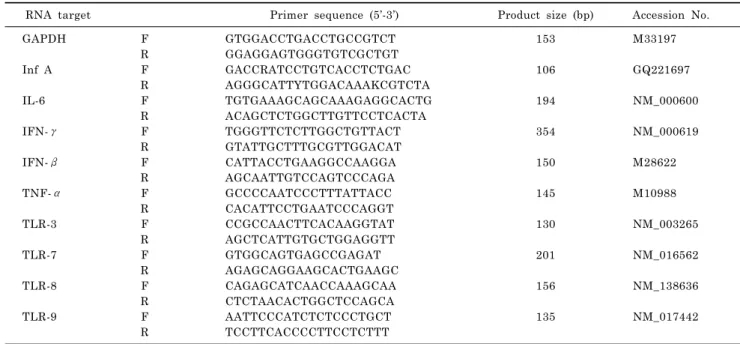
RNA target Primer sequence (5’-3’) Product size (bp) Accession No.

GAPDH F GTGGACCTGACCTGCCGTCT 153 M33197

R GGAGGAGTGGGTGTCGCTGT

Inf A F GACCRATCCTGTCACCTCTGAC 106 GQ221697

R AGGGCATTYTGGACAAAKCGTCTA

IL-6 F TGTGAAAGCAGCAAAGAGGCACTG 194 NM_000600

R ACAGCTCTGGCTTGTTCCTCACTA

IFN-γ F TGGGTTCTCTTGGCTGTTACT 354 NM_000619

R GTATTGCTTTGCGTTGGACAT

IFN-β F CATTACCTGAAGGCCAAGGA 150 M28622

R AGCAATTGTCCAGTCCCAGA

TNF-α F GCCCCAATCCCTTTATTACC 145 M10988

R CACATTCCTGAATCCCAGGT

TLR-3 F CCGCCAACTTCACAAGGTAT 130 NM_003265

R AGCTCATTGTGCTGGAGGTT

TLR-7 F GTGGCAGTGAGCCGAGAT 201 NM_016562

R AGAGCAGGAAGCACTGAAGC

TLR-8 F CAGAGCATCAACCAAAGCAA 156 NM_138636

R CTCTAACACTGGCTCCAGCA

TLR-9 F AATTCCCATCTCTCCCTGCT 135 NM_017442

R TCCTTCACCCCTTCCTCTTT

Table 1. Real-time RT-PCR primers

Fig. 1. Kinetics of influenza virus replication measured by qRT-PCR assay. Hep-2 cells were infected with sH1N1 at a moi of 1.0 or 0.01. At the indicated time points post infection the cells were tested for viral loads. Data are means and standard deviation from three independent experiments.

Reference Dye II (50×) and RNase-free water to total vol- ume of 20 μl. The cycling protocol was 95

o

C for 30 s, fol- lowed by 40 cycles of 95

o

C for 5 s, 60

o

C for 34 s, and a dissociation stage of 95

o

C for 15 s, 60

o

C for 1 min, 95

o

C for 15 s and 60

o

C for 15 s in an ABI 7500 Real-Time PCR System (Applied Biosystems, USA). The generation of a specific PCR product was tested using melting curve ana- lysis. Primer sequences used for qRT-PCR can be found in Table 1.

The amounts of TLRs and cytokines mRNA relative to unstimulated cells were calculated with 2

-△△Ct

method and the mRNA levels were normalized against GAPDH mRNA.

Gene slopes were determined with a series of 10-fold RNA dilutions (data not show).

To determine the actual number of sH1N1 copies, a refer- ence standard curve was used. Dilutions were made from a plasmid, which contains the sH1N1 PCR-target sequence.

Ten-fold dilutions equivalent to 1×10

1

to 1×10

6

copies per reaction were prepared.

Statistical analysis

Data are means and standard deviation from three in- dependent experiments. Data were analyzed using one-way analysis of variance or paired-sample t tests. p<0.05 was considered to be significant.

RESULTS

Influenza virus replication in Hep-2 cells

The most sensitive method for monitoring influenza virus replication in vitro is qRT-PCR assay. To determine virus dose effects, we infected Hep-2 cells with sH1N1 virus at a moi of 1.0 and 0.01. As shown in Fig. 1, at a moi of 1.0, a rise in viral load was observed at 8 hr post infection, reaching a maximum of 8.57×10

7

copies/mL 24 hr post

infection. Also at a moi of 0.01, viral replication was ob- served at 8 hr post infection, while the peak of 8.06×10

7

copies/ml was reached 48 hr post infection, 24 hr later than for a moi of 1.0. When Hep-2 cells were infected without addition of trypsin, viral replication could not be detected at any time point (Data not shown).

Human pharyngeal epithelial cells in culture consti- tutively expressed TLRs and proinflammatory cyto- kines

To determine TLRs and proinflammatory cytokines mRNA

distribution in Hep-2 cells, total RNA was isolated from ve-

hicle-only (without virus) treated Hep-2 cell at each time

points, and subjected to RT-PCR analysis. The results con-

(4)

Fig. 2. Expressions and distribution of TLRs and proinflammatory cytokines in Hep-2 cell lines. Total RNA was isolated from vehicle-only (without virus) treated Hep-2 cells and subjected to RT-PCR using primers as indicated in Table 1. The amplification products were estimated by capillary electrophoresis on a Qiaxcel apparatus (Qiagen).

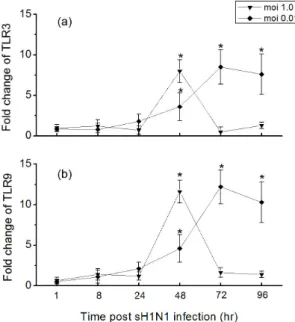
Fig. 3. Time course of TLRs expressions in Hep-2 cells in response to sH1N1 virus. Hep-2 cells were exposed to sH1N1 virus at a moi 1.0 or 0.01 for 1, 8, 24, 48, 72 or 96 hr and the expression of TLR3 (a) and TLR9 (b) mRNA were then determined by qRT-PCR.

Transcript levels normalized to GAPDH and expressed relative to unstimulated cells. Data are the averages±S.D. of triplicate deter- minations.

Fig. 4. Time course of cytokines expressions in Hep-2 cells in response to sH1N1 virus. Hep-2 cells were exposed to sH1N1 virus at a moi 1.0 or 0.01 for 1, 8, 24, 48, 72 or 96 hr and the expression of IL-6 (a), IFN-β (b) and TNF-α (c) mRNA were then determined by qRT-PCR. Transcript levels normalized to GAPDH and ex- pressed relative to unstimulated cells. Data are the averages±S.D.

of triplicate determinations.

formed well to our expectations that the level of TLRs and proinflammatory cytokines expression were not varied among the different time points (a representative data is shown as Fig. 2). For TLRs, TLR3 and TLR9 were detected at moderate levels, whereas TLR7 and TLR8 were not de- tected (Fig. 2). For proinflammatory cytokines, IL-6 tran- scripts were most abundant, followed by IFN-β, TNF-α was expressed at very low but detectable levels, IFN-γ was not detected.

Influenza virus upregulate the TLRs in Hep-2 cells To identify whether TLR3 and TLR9 expressed in these epithelial cells actually functional upon stimulation with the virus, we analyzed the time course of TLR3 and TLR9 expressions in Hep-2 cells in response to sH1N1 virus. As Fig. 3 shows, the influenza virus caused a significant in- duction of both TLR3 and TLR9 in Hep-2 cells. At a moi 1.0, the peak induction of TLR3 and TLR9 by sH1N1 virus occurred at 48 hr post-infection, 9 and 12-folds respectively

over the control. When Hep-2 cells were infected at a moi of 0.01, the peak induction of TLR3 and TLR9 were reached 72 hr post-infection, 24 hr later than for a moi of 1.0 (Fig.

3). These findings indicate that TLR3 and TLR9 in Hep-2 cells might be functional receptors in response to sH1N1 virus infection.

Secretion of inflammatory cytokines from influenza virus-infected Hep-2 cells

Since activation of TLRs may induce or amplify cytokines production, we sought to further examine the capacity of influenza virus to induce secretion of cytokines in Hep-2 cells. As Fig.4 shows, influenza virus elicited a rapid and significant increase of IL-6, IFN-β, and TNF-α mRNA ex- pression in Hep-2 cells. At a moi 1.0, the mRNA levels of these three cytokines reached the maxima at 48 hr post infection, while at a moi of 0.01, the peak induction of them were observed at later time points (t=72 hr). Depending on the moi, the level of IL-6 mRNA increased by 212-fold in Hep-2 cells at a moi of 1.0, markedly higher than for a moi of 0.01 (83-fold) (Fig. 4a). Not as IL-6, the levels of IFN-β and TNF-α mRNA induced from cells infected at a moi of 1.0 or 0.01 were similar (Fig. 4b and 4c).

Antiviral potency of TLRs ligands

To identify any inhibitory effect of TLRs agonists on influ-

(5)

Fig. 5. Differential reduction of viral loads by TLRs ligands. Hep-2 cells were pre-incubated with CpG-ODN (5 μM), poly I:C (25 μg/

ml) or in combinations of two for 24 hr and exposed to sH1N1 virus at a moi 1.0 or moi 0.01 for additional 48 hr. Cells which were simultaneously pre-incubated with PBS and exposed to sH1N1 virus at a moi 1.0 or moi 0.01 for additional 48 hr was used as a control. Viral loads were determined using qRT-PCR. Data are the averages±S.D. of triplicate determinations (*p<0.05 compared with control).

Fig. 6. Differential reduction of cytokines mRNA levels by TLRs ligands. Hep-2 cells were pre-incubated with CpG-ODN (5 μM), poly I:C (25 μg/ml) or in combinations of two for 24 hr and exposed to sH1N1 virus at a moi 1.0 or moi 0.01 for additional 48 hr or 72 hr, respectively. Cells which were simultaneously pre-incubated with PBS and exposed to sH1N1 virus at a moi 1.0 or moi 0.01 for additional 48 hr or 72 hr, respectively, was used as a control.

IL-6 (a), IFN-β (b) and TNF-α (c) mRNA expression levels were determined using qRT-PCR. Transcript levels normalized to GAPDH and expressed relative to unstimulated cells. Data are the averages±S.D. of triplicate determinations (*p<0.05 compared with control).

enza virus replication, the matrix protein 1 (M1) mRNA of influenza virus A was compared between TLRs agonist treated and untreated infected cells. Hep-2 cells were pre-incubated with CpG-ODN (5 μM), poly I:C (25 μg/mL) alone or in combinations of two for 24 hr and then exposed to sH1N1 virus. Total RNA extraction was performed at 48 hr after influenza virus infection, and the levels of intra- cellular influenza mRNA were measured. As illustrated in Fig. 5, at infection of moi 1.0, no reduction in viral mRNA expression was observed when cells were pre-treated with poly I:C, CpG-ODN alone or combination of the two. In con- trast, at moi 0.01, Hep-2 cells produced a significant reduc- tion in viral mRNA expression when stimulated with either CpG-ODN or poly I:C alone. The combination of the two TLR agonists did not demonstrate a synergistic or additive affect on viral mRNA reduction.

TLR ligands influence on cytokine production The virus-induced ‘cytokine storm’ appears to contribute to the influenza viruses pandemics [23,24]. In addition to investigating inhibitory effects against the virus, the influ- ence of TLRs ligands on the sH1N1-induced cytokines were further studied. Hep-2 cells were pre-incubated with CpG- ODN (5 μM), poly I:C (25 μg/ml) alone or in combinations of two for 24 hr prior to addition of sH1N1 virus at a moi 1.0 or moi 0.01 for additional 48 hr or 72 hr, respectively.

The levels of intracellular cytokines expression were com- pared to cells which were simultaneously stimulated with PBS plus sH1N1. At infection of moi 1.0, CpG-ODN and poly I:C induced a small, though significant decrease in cy- tokines mRNA expression. In contrast, at moi 0.01, pre- treatment of Hep-2 cells with CpG-ODN or poly I:C almost completely suppressed the cytokines elevation. Combina- tion of the two TLR ligands had no additive effect compared with the polyI:C or CpG-ODN alone (Fig. 6).

DISCUSSION

For sH1N1, Li et al. recently demonstrated that viral

load of ≥10

6

copies/ml was detected only in human cell

lines derived from tissues of lower respiratory tract, gastro-

intestinal tract, liver, kidney and muscle. CPE was present

only in 4 cell lines for sH1N1 (A549, Caco-2, HeLa, HEK)

[25]. In this study we have demonstrated that sH1N1 re-

plicated to 8×10

7

copies/ml in Hep-2 cells (Fig. 1), suggest-

ing its capability to replicate in upper respiratory tract cell

lines. Moreover, when Hep-2 cells were infected without ad-

dition of trypsin, viral replication could not be detected at

any time point (Data not shown). After the addition of exog-

enous trypsin to Hep-2 cell lines, the viral load of sH1N1

increased by at least 2 log

10

copies/ml. Presence of multiple

basic amino acids at the cleavage site of haemagglutinin

precursor molecule, which can be cleaved by ubiquitous pro-

teases, allows efficient replication in body sites with trypsin

and non-trypsin endogenous proteases [26]. In the present

study, Though, >2 μg/ml trypsin induced degeneration in

Hep-2 cell lines, 1.0∼1.5 μg/ml trypsin was required for

the cleavage of haemagglutinin precursor, and therefore in-

creased viral replication (Data not shown).

(6)

Toll-like receptors serve as pattern recognition receptors (PRRs) by initiating signals that elicit anti-viral immune responses. When activated, they trigger immune and in- flammatory responses to respond to the invading microor- ganism. There are four known toll-like receptors found in mammalians cells which recognize nucleic acids. They are TLR-3, TLR-7, TLR-8 and TLR-9 [27]. In this study, we found clear expressions of TLR3 and TLR9 in Hep-2 cells using RT-PCR (Fig. 2). After sH1N1 infection, expression of the TLR3 and TLR9 were significantly up-regulated (Fig.

3), which indicated that TLR3 and TLR9 in Hep-2 cells might be functional receptors in inducing anti-viral re- sponses in general.

It has been suggested that synthetic ligands, targeting TLR receptors, may have a therapeutic potential as anti- viral compounds [28]. Therefore, in this study the antiviral potency of Poly I:C and CpG-ODN, which were agonists spe- cific for TLR3 and TLR9 respectively, were examined in an in vitro model of sH1N1 infection. Our data showed, pre- treatment with CpG-ODN or poly(I:C) alone significantly reduced viral replication in Hep-2 cells at lower viral chal- lenge doses (moi=0.01). While, at higher viral challenge doses (moi=1.0), the agonists treatment did not work effectively. Not as expected, the synergy in limiting sH1N1 replication was not observed when the combinations of CpG-ODN (5 μM), poly I:C (25 μg/ml) were used (Fig. 5).

These results demonstrate that TLR3 and TLR9 pathways may contribute to the observed antiviral effects, while the effects of them were rather limited.

Type I IFNs are the most important antiviral cytokines produced by cells in response to viral infection [9]. TNF-α has also been shown to have anti-influenza virus effect in lung epithelial cells [29]. In this study, we observed a strong induction of IFN-β and TNF-α in influenza-infected Hep-2 cells (Fig. 4b and 4c), suggesting IFN-β and TNF-α have important functions at early times of virus infection. Influ- enza infection triggers a cascade of pro-inflammatory cyto- kines that is responsible for virus control and clearance, but also for many of the symptoms associated with the dis- ease [30]. Herein, we found that the production of IL-6, which is considered indicative of severe disease in humans [31,32], was delivered dependent on the infecting viral dose (Fig. 4a). We hypothesize that the elevated production of IL-6 may simply represent a response to increased patho- logy. Furthermore, cytokines expressed in Hep-2 cells is consistent with the previously published findings from hu- man volunteer studies and mouse experiments [33,34], demonstrating the value of the Hep-2 model for the study of the immune response to influenza.

Cytokine storms are associated with a wide variety of in- fectious and noninfectious diseases [35]. In the case of in- fections with H5N1, a highly pathogenic influenza strains, the cytokine response becomes dysregulated, resulting in a massive inflammatory response contributes to systemic tissue damage [23]. Therefore, the inhibition of virus-in- duced cytokine release is important for the treatment of influenza [36]. Although it is well recognized that certain TLR ligands are able to stimulate the release of cytokines, our results showed that TLR3 and TLR9 ligands (CpG-ODN and poly I:C) could significantly reduce sH1N1 virus-in- duced cytokine secretion. The reason for this discrepancy is not entirely clear, but could indicate that TLR ligands also possess an anti-sH1N1-induced-inflammation activity.

In summary, we have demonstrated that sH1N1 influen- za viruses marginally increased the expression of TLRs and

cytokines in Hep-2 cells. The ability of sH1N1 influenza vi- ruses to modulate immune responses in Hep-2 cells may be a feature shared by the other virulent influenza viruses.

Moreover, we demonstrated a strong antiviral effect of cer- tain TLR ligands, which may represent an affective anti- viral strategy to combat influenza viruses. The activity study of TLR ligands on influenza and underlying mecha- nisms will provide a theoretical and experimental basis to guide novel anti-influenza virus drug discovery.

ACKNOWLEDGEMENTS

Authors sincerely thank Mrs. Dan-hong Liu and Dr.

Ming-shan Niu for their valuable comments and discussions. This work was supported by National Natural Science Foundation of China (Grant No. 31201879) and the Foundation of Dalian Municipal Health Bureau.

REFERENCES

1. Miller M, Viboud C, Simonsen L, Olson DR, Russell C.

Mortality and morbidity burden associated with A/H1N1pdm influenza virus: Who is likely to be infected, experience clinical symptoms, or die from the H1N1pdm 2009 pandemic virus?

Version 2. PLoS Curr. 2009;1:RRN1013.

2. Treanor JD. Influenza--the goal of control. N Engl J Med. 2007 4;357:1439-1441.

3. Whitley RJ, Monto AS. Prevention and treatment of influenza in high-risk groups: children, pregnant women, immunocom- promised hosts, and nursing home residents. J Infect Dis.

2006;194 Suppl 2:S133-138.

4. Nayak DP, Hui EK, Barman S. Assembly and budding of influenza virus. Virus Res. 2004;106:147-165.

5. Centers for Disease Control and Prevention (CDC). Prevention and control of seasonal influenza with vaccines. Recom- mendations of the Advisory Committee on Immunization Prac- tices--United States, 2013-2014. MMWR Recomm Rep. 2013;

62:1-43.

6. Couch RB. Prevention and treatment of influenza. N Engl J Med. 2000;343:1778-1787.

7. Taubenberger JK, Kash JC. Influenza virus evolution, host adaptation, and pandemic formation. Cell Host Microbe. 2010;

7:440-451.

8. Julkunen I, Sareneva T, Pirhonen J, Ronni T, Melén K, Matikainen S. Molecular pathogenesis of influenza A virus infection and virus-induced regulation of cytokine gene ex- pression. Cytokine Growth Factor Rev. 2001;12:171-180.

9. Kawai T, Akira S. Innate immune recognition of viral infection.

Nat Immunol. 2006;7:131-137.

10. Kawai T, Akira S. The role of pattern-recognition receptors in innate immunity: update on Toll-like receptors. Nat Immunol.

2010;11:373-384.

11. Klinman DM. Immunotherapeutic uses of CpG oligode- oxynucleotides. Nat Rev Immunol. 2004;4:249-258.

12. Wong JP, Christopher ME, Viswanathan S, Karpoff N, Dai X, Das D, Sun LQ, Wang M, Salazar AM. Activation of toll-like receptor signaling pathway for protection against influenza virus infection. Vaccine. 2009;27:3481-3483.

13. Wang Y, Shan C, Ming S, Liu Y, Du Y, Jiang G. Immuno- adjuvant effects of bacterial genomic DNA and CpG oligo- deoxynucleotides on avian influenza virus subtype H5N1 inac- tivated oil emulsion vaccine in chicken. Res Vet Sci. 2009;

86:399-405.

14. Le Goffic R, Pothlichet J, Vitour D, Fujita T, Meurs E, Chignard

M, Si-Tahar M. Cutting Edge: Influenza A virus activates

TLR3-dependent inflammatory and RIG-I-dependent antiviral

responses in human lung epithelial cells. J Immunol. 2007;

(7)

178:3368-3372.

15. Li J, Jeong MY, Bae JH, Shin YH, Jin M, Hang SM, Lee JC, Lee SJ, Park K. Toll-like receptor3-mediated induction of chemokines in salivary epithelial cells. Korean J Physiol Pharmacol. 2010;14:235-240.

16. Li H, Zhang J, Kumar A, Zheng M, Atherton SS, Yu FS. Herpes simplex virus 1 infection induces the expression of proinflam- matory cytokines, interferons and TLR7 in human corneal epithelial cells. Immunology. 2006;117:167-176.

17. Samuel CE. Antiviral actions of interferons. Clin Microbiol Rev.

2001;14:778-809.

18. Koerner I, Kochs G, Kalinke U, Weiss S, Staeheli P. Protective role of beta interferon in host defense against influenza A virus.

J Virol. 2007;81:2025-2030.

19. Kaiser L, Fritz RS, Straus SE, Gubareva L, Hayden FG.

Symptom pathogenesis during acute influenza: interleukin-6 and other cytokine responses. J Med Virol. 2001;64:262-268.

20. Eccles R. Understanding the symptoms of the common cold and influenza. Lancet Infect Dis. 2005;5:718-725.

21. Rimmelzwaan GF, Baars M, van Beek R, van Amerongen G, Lövgren-Bengtsson K, Claas EC, Osterhaus AD. Induction of protective immunity against influenza virus in a macaque model: comparison of conventional and iscom vaccines. J Gen Virol. 1997;78:757-765.

22. Xie H, Raybourne RB, Babu US, Lillehoj HS, Heckert RA.

CpG-induced immunomodulation and intracellular bacterial killing in a chicken macrophage cell line. Dev Comp Immunol.

2003;27:823-834.

23. de Jong MD, Simmons CP, Thanh TT, Hien VM, Smith GJ, Chau TN, Hoang DM, Chau NV, Khanh TH, Dong VC, Qui PT, Cam BV, Ha do Q, Guan Y, Peiris JS, Chinh NT, Hien TT, Farrar J. Fatal outcome of human influenza A (H5N1) is associated with high viral load and hypercytokinemia. Nat Med. 2006;12:1203-1207.

24. Kash JC, Tumpey TM, Proll SC, Carter V, Perwitasari O, Thomas MJ, Basler CF, Palese P, Taubenberger JK, García-Sastre A, Swayne DE, Katze MG. Genomic analysis of increased host immune and cell death responses induced by 1918 influenza virus. Nature. 2006;443:578-581.

25. Li IW, Chan KH, To KW, Wong SS, Ho PL, Lau SK, Woo PC, Tsoi HW, Chan JF, Cheng VC, Zheng BJ, Chen H, Yuen KY.

Differential susceptibility of different cell lines to swine-origin influenza A H1N1, seasonal human influenza A H1N1, and avian influenza A H5N1 viruses. J Clin Virol. 2009;46:325-330.

26. Kido H, Okumura Y, Takahashi E, Pan HY, Wang S, Chida J, Le TQ, Yano M. Host envelope glycoprotein processing proteases are indispensable for entry into human cells by seasonal and highly pathogenic avian influenza viruses. J Mol Genet Med. 2008;3:167-175.

27. Sen GC, Sarkar SN. Transcriptional signaling by double stranded RNA: role of TLR3. Cytokine Growth Factor Rev.

2005;16:1-24.

28. Kanzler H, Barrat FJ, Hessel EM, Coffman RL. Therapeutic targeting of innate immunity with Toll-like receptor agonists and antagonists. Nat Med. 2007;13:552-559.

29. Seo SH, Webster RG. Tumor necrosis factor alpha exerts powerful anti-influenza virus effects in lung epithelial cells. J Virol. 2002;76:1071-1076.

30. Zu M, Yang F, Zhou W, Liu A, Du G, Zheng L. In vitro anti-influenza virus and anti-inflammatory activities of thea- flavin derivatives. Antiviral Res. 2012;94:217-224.

31. Kaiser L, Fritz RS, Straus SE, Gubareva L, Hayden FG.

Symptom pathogenesis during acute influenza: interleukin-6 and other cytokine responses. J Med Virol. 2001;64:262-268.

32. Svitek N, Rudd PA, Obojes K, Pillet S, von Messling V. Severe seasonal influenza in ferrets correlates with reduced interferon and increased IL-6 induction. Virology. 2008;376:53-59.

33. Brydon EW, Morris SJ, Sweet C. Role of apoptosis and cytokines in influenza virus morbidity. FEMS Microbiol Rev.

2005;29:837-850.

34. Bauer RN, Brighton LE, Mueller L, Xiang Z, Rager JE, Fry RC, Peden DB, Jaspers I. Influenza enhances caspase-1 in bronchial epithelial cells from asthmatic volunteers and is associated with pathogenesis. J Allergy Clin Immunol. 2012;

130:958-967.

35. Cheng XW, Lu J, Wu CL, Yi LN, Xie X, Shi XD, Fang SS, Zan H, Kung HF, He ML. Three fatal cases of pandemic 2009 influenza A virus infection in Shenzhen are associated with cytokine storm. Respir Physiol Neurobiol. 2011;175:185-187.

36. Tisoncik JR, Korth MJ, Simmons CP, Farrar J, Martin TR,

Katze MG. Into the eye of the cytokine storm. Microbiol Mol

Biol Rev. 2012;76:16-32.

수치

Table 1. Real-time RT-PCR primers
Fig. 4. Time course of cytokines expressions in Hep-2 cells in  response to sH1N1 virus
Fig. 5. Differential reduction of viral loads by TLRs ligands. Hep-2  cells were pre-incubated with CpG-ODN (5 μM), poly I:C (25 μg/

참조

관련 문서

Differential Expression of Desmoglein1, Desmoglein3, Epithelial Membrane Antigen, Ber-EP4 and CD10 in Basal Cell Carcinoma and Squamous Cell Carcinoma

Children's experience of life sdtress: The role of family social support and social problem-solving skills as protective factors.. “Social competence: An

In this study, we investigated the effects of low-power CO 2 laser on proliferation on human gingival fibroblast cells so that determine laser

Second, it was found that human rights education plays a controlling role in human rights sensitivity and human rights awareness (equal rights, right to

These results suggest that the bilobalide inhibits the cell proliferation and induces the apoptotic cell death in FaDu human pharyngeal squamous cell carcinoma via both

In the present study we investigated the proliferation effect of human oral cancer KB cell treated with pulsatilla koreana extract.. We analyzed the effects of this

The aim of this study was to examine the effects and mechanisms of the new metformin derivative HL156A in human multidrug-resistant cancer cell lines (FADU/PTX,

The PIG3 was interacted with the CTSB in human prostate cancer cell line PC3, which was verified by co-immunoprecipitation analysis using specific