Bo Seong Jang, Han Eum Choi, Jae Hyun Lee, Young Joo Sim, Ghi Chan Kim, Ho Joong Jeong Department of Physical Medicine and Rehabilitation, Kosin University College of Medicine, Busan, Korea
Objectives: To investigate the relationship between the psoas muscle cross-sectional area and physical performance in patients with liver cirrhosis.
Methods: This study analyzed ambulatory patients with liver cirrhosis aged < 65 years, who underwent abdominal com- puted tomography (CT) and Short Physical Performance Battery (SPPB) tests from December 2018 to December 2019.
A total of 46 patients (36 men, 10 women) were included. In abdominal CT scans, the psoas muscle cross-sectional area (mm2) was measured at the distal end-plate level of the L4 vertebral body and normalized by dividing by height (m).
Physical performance was evaluated using SPPB. A correlation analysis between the psoas muscle cross-sectional area and SPPB was performed. Kruskal-Wallis test was used to determine differences in the psoas muscle cross-sectional area and SPPB according to the Child-Pugh classification. Multiple regression analysis was performed to determine factors affecting SPPB.
Results: The correlation coefficient between the psoas muscle cross-sectional area and SPPB was 0.459 at the P < 0.01 level. No difference was observed in the psoas muscle cross-sectional area and SPPB according to the Child-Pugh clas- sification. The psoas muscle cross-sectional area was a factor affecting SPPB in multiple regression analysis.
Conclusions: Abdominal CT is an essential diagnostic tool in patients with liver cirrhosis. Ambulatory patients with liver cirrhosis aged < 65 years could have reduced physical performance. In this study, the psoas muscle cross-sectional area was correlated with physical performance and was a factor affecting physical performance. The psoas muscle cross-sec- tional area and physical performance should be evaluated in patients with liver cirrhosis.
Key Words: Liver cirrhosis, Physical performance, Psoas muscles
Liver cirrhosis is a representative disease caus- ing inadequate nutrition and protein depletion, with a chronic disease course.1In patients with liver cirrhosis, micronutrient deficiency and in- creased leptin and pro-inflammatory cytokines lead to a decrease in taste acuity and appetite.
Moreover, reduced intestinal absorption results
in hypermetabolic conditions, which are associ- ated with increased energy consumption and high protein catabolism. As a result, skeletal muscle loss and reduced physical performance occur.2 Therefore, it is important to evaluate skeletal muscle and physical performance in pa- tients with liver cirrhosis. Several studies have
Usefulness of Psoas Muscle Cross-Sectional Area in Evaluating Physical Performance in Patients with Liver Cirrhosis
Received: J u l . 02, 2020 Revised: Sep. 04, 2020 Accepted: Oct . 08, 2020 Corresponding Author: Ho Joong Jeong, Department of Physical Medicine and Rehabilitation, Kosin University
College of Medicine, 262, Gamcheon-ro, Seo-gu, Busan 49267, Korea
Tel: +82-51-990-6156 Fax: +82-51-990-3181 E-mail: [email protected]
evaluated skeletal muscle mass using computed tomography (CT). Kalafateli et al. and Kim and Jang evaluated skeletal muscle mass using cross- sectional muscle areas measured in CT scans.2,3
Among the various methods for evaluating skeletal muscle mass using CT scans, measure- ment of the psoas muscle has recently attracted attention. One previous study showed that the psoas muscle area significantly increased after the improvement of liver cirrhosis in patients who underwent a stent procedure.4Another study reported a negative correlation between the psoas muscle area and posttransplant mortality.5 The psoas muscle has also been reported to be useful in estimating skeletal muscle mass in patients with liver cirrhosis, as well as for nutritional and metabolic status assessment.6 In another study, the psoas muscle thickness of patients with liver cirrhosis was highly correlated with the skeletal muscle index (SMI) and was reported to predict mortality in this patient population.7 Similarly, various other studies have demonstrated the clin- ical importance of the psoas muscle in patients with liver cirrhosis.
Physical performance is one of the important factors predicting the prognosis of liver diseases.
In previous studies, higher physical performance was observed in nonhospitalized patients with liver cirrhosis than in hospitalized patients.8 Moreover, the Short Physical Performance Bat- tery (SPPB) was found to be useful for the de- velopment of a frailty index for predicting mortality in patients with end-stage liver disease.9
The cross-sectional area of the psoas muscle
can be easily obtained through abdominal CT, which is an essential imaging method in patients with liver cirrhosis. Assessing muscle mass using the psoas muscle cross-sectional area and analyzing its association with clinical parame- ters that can affect physical performance are use- ful. However, few studies have investigated the relationship between the psoas muscle cross- sectional area and physical performance in pa- tients with liver cirrhosis. Moreover, few studies have been published on the difference of the psoas muscle cross-sectional area and physical performance according to the severity of liver cirrhosis.
The purpose of this study was to investigate the relationship between the psoas muscle cross-sec- tional area, which is a quantitative parameter of muscle mass determined using abdominal CT scans, and physical performance. Moreover, we also investigated the relationship between phys- ical performance and other clinical parameters that can affect physical performance in liver cir- rhosis, including SMI, grip strength, and serum albumin level.
MATERIALS AND METHODS Patients
This study involved a retrospective review of medical charts of patients diagnosed with liver cirrhosis at OO university hospital between De- cember 2018 and December 2019. The inclusion criteria were as follows: (1) an initial diagnosis of liver cirrhosis based on abdominal CT and
liver biopsy results; (2) ability to ambulate; and (3) age < 65 years, to rule out low physical per- formance due to aging. The exclusion criteria were as follows: (1) advanced liver cancer at the time of liver cirrhosis diagnosis; (2) a history of neurologic disease that may affect physical per- formance; (3) active encephalopathy due to liver cirrhosis; and (4) inability to maintain a neutral anteroposterior position because of a spinal dis- ease, such as scoliosis. The severity of liver cir- rhosis was determined according to the Child-Pugh classification.10The sample size was obtained using the correlation coefficient be- tween the psoas muscle cross-sectional area and SPPB calculated with MedCalc (MedCalc Soft- ware, Ostend, Belgium), with a power of 0.80 and a significance of 0.01. This study was ap- proved by the Institutional Review Board of OO university hospital.
Psoas muscle cross-sectional area
In this study, the abdominal CT scans of all pa- tients, obtained using the same criteria and meth- ods, were used to measure the psoas muscle cross-sectional area. In a study on the psoas mus- cle cross-sectional area, the psoas muscle at the L4/5 level had the largest cross-sectional area and showed the highest symmetry.11In the cur- rent study, we measured the psoas muscle cross- sectional area at the distal end-plate level of the L4 vertebral body, which is close to the L4/5 in- tervertebral disc. The psoas muscle cross-sec- tional area on the right side was measured by two trained operators using FIJI/ImageJ software (Laboratory for Optical and Computational In- strumentation, University of Wisconsin-Madi- son, Madison, WI, USA) (Fig. 1). Finally, the average of the psoas muscle cross-sectional area measurements by the two operators was calcu-
Fig. 1. Measurement of the psoas muscle cross-sectional area (arrow) at the distal end-plate level of the L4 ver- tebral body.
lated and normalized by dividing by the patient’s height (m).
Skeletal muscle index
To obtain the SMI (kg/m2), the predicted skele- tal muscle mass (kg) was divided by height squared (m2). As this was a prospective study, bioimpedance analysis (BIA) was selected to measure the predicted skeletal muscle mass be- cause it is quick to perform, cost-effective, and safe compared with other evaluation methods.
BIA was performed using an Inbody S10 ma- chine (Inbody, Seoul, South Korea). When per- forming BIA, electrodes were attached to the first and third fingers, as well as to the ankles of the patient in the supine position. The SMI ob- tained using BIA is considered to indicate low muscle mass when the value is ≤ 8.87 kg/m2in men and ≤ 6.42 kg/m2in women, according to a representative study on SMI measurement using BIA.12
Muscle strength
Muscle strength (kg) was evaluated by measur- ing the isometric handgrip strength of the domi- nant hand using a Jamar hydraulic hand dynamometer (Jamar, Chicago, IL, USA). Tests were performed two times at 5-min intervals, and the higher value of the two tests was adopted for the analysis.
Physical performance
SPPB was used as a measure of physical per- formance. SPPB consists of balance, gait, strength, and endurance, assessed by examining
a patient’s ability to stand with the feet together in side-by-side, semi-tandem, and tandem posi- tions; the time to walk 4 m; and the time to rise from a chair and return to the seated position five times.12SPPB uses the total score of balance, gait speed, strength, and endurance with a minimum of 0 points and maximum of 4 points in each component.
Nutritional status assessment
The biochemical parameters used for nutri- tional status assessment in patients with liver diseases are albumin, pre-albumin, retinol-bind- ing protein, and serum total protein.13 In this study, we measured serum albumin, which is used as a criterion of liver cirrhosis severity and is commonly assessed in clinical practice. Serum albumin was considered abnormal when the level was < 3.5 g/dL, and the patients were di- vided into the normal and abnormal groups ac- cordingly.
Statistical analysis
Reliability analysis was performed to check the inter-rater reliability of the psoas muscle cross- sectional area. Bivariate correlation analysis was performed to investigate the correlation between SPPB and serum albumin, age, body mass index, and SMI. The Mann-Whitney U-test was per- formed to determine the effect of sex and serum albumin on the SPPB test results. A Kruskal-Wal- lis test was performed to determine differences in the psoas muscle cross-sectional area, SMI, serum albumin, and SPPB according to the sever- ity of liver cirrhosis. Univariate analysis was per-
formed to select independent variables in multiple regression analysis. Finally, multiple regression analysis was performed to determine the factors affecting SPPB.
RESULTS
A total of 46 patients (36 men, 10 women) were finally included in this study (the sample size calculated by MedCalc was 50 patients).
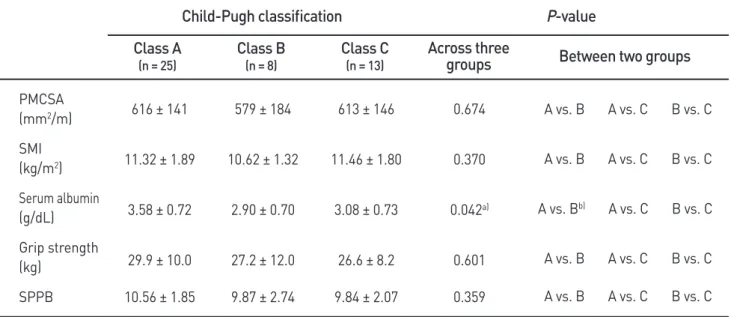
The number of patients with Child-Pugh class A, B, and C was 25, 8, and 13, respectively (Table 1). The inter-rater correlation coefficient was 0.959, with a P-value of 0.000. In bivariate correlation analysis, the psoas muscle cross- sectional area was significantly correlated with SPPB (r = 0.459, P < 0.01). SPPB had no sig- nificant correlation with SMI, age, or body
mass index (Table 2). In the Mann Whitney U- test, SPPB had a significant difference accord- ing to serum albumin (P = 0.003) but showed no significant difference according to sex (Table 2). The mean value of serum albumin was statistically significant according to the severity of liver cirrhosis; however, the differ- ences in the mean values of the psoas muscle cross-sectional area, SMI, and SPPB according to liver cirrhosis severity were not statistically significant in the Kruskal-Wallis test (Table 3).
The psoas muscle cross-sectional area, grip strength, and serum albumin showed signifi- cance in univariate analysis. In multiple regres- sion analysis, all independent variables were entered into the equation. The psoas muscle cross-sectional area, grip strength, and serum albumin were identified as factors affecting SPPB (Table 4).
Variable
Psoas muscle cross-sectional area (mm2/m) Skeletal muscle index (kg/m2)
Grip strength (kg)
Short Physical Performance Battery Serum albumin (g/dL)
Body mass index Age (years)
Child-Pugh classification Class A
Class B Class C
Men
(n = 36)
Value
652 ± 126 11.59 ± 1.78
31.5 ± 8.8 10.9 ± 1.9 3.38 ± 0.72 23.46 ± 3.67
56.2 ± 6.2 21 (58%) 5 (14%) 10 (28%)
Women
(n = 10)
456 ± 113 10.02 ± 1.08
17.8 ± 4.2 9.2 ± 2.6 3.11 ± 0.86 25.74 ± 6.0 55.8 ± 6.8
4 (40%) 3 (30%) 3 (30%) Table 1. Demographic and baseline clinical characteristics
Values are presented as mean ± standard deviation or number (%).
Bivariate correlation analysis Psoas muscle cross-sectional area Serum albumin
Grip strength Age
Body mass index Skeletal muscle index Mann-Whitney U-test
Sex
Serum albumin
SPPB
Correlation coefficient 0.459**
0.415**
0.672**
-0.710 -0.810 0.018 P-value
0.093 0.003**
Table 2. Comparison of factors with SPPB
SPPB, Short Physical Performance Battery.
** P < 0.01.
PMCSA (mm2/m) SMI (kg/m2) Serum albumin (g/dL) Grip strength (kg)
SPPB
616 ± 141
11.32 ± 1.89
3.58 ± 0.72
29.9 ± 10.0 10.56 ± 1.85
579 ± 184
10.62 ± 1.32
2.90 ± 0.70
27.2 ± 12.0 9.87 ± 2.74
613 ± 146
11.46 ± 1.80
3.08 ± 0.73
26.6 ± 8.2 9.84 ± 2.07
0.674
0.370
0.042a)
0.601 0.359
A vs. B A vs. C B vs. C
A vs. B A vs. C B vs. C
A vs. Bb) A vs. C B vs. C
A vs. B A vs. C B vs. C A vs. B A vs. C B vs. C
P-value Child-Pugh classification
Class A
(n = 25)
Class B
(n = 8)
Class C
(n = 13)
Across three
groups Between two groups
Table 3. Comparison of factors according to liver cirrhosis severity
Values are presented as mean ± standard deviation.
a)P < 0.05
b)P < 0.05 by Kruskal-Wallis test for continuous variables and Mann-Whitney U-test for post-hoc analysis.
PMCSA, psoas muscle cross-sectional area; SMI, skeletal muscle index; SPPB, Short Physical Performance Battery.
Standardized β
Psoas muscle cross-sectional area Grip strength
Serum albumin
0.269 0.335 0.300
P-value
0.035*
0.016*
0.021*
Adjusted R2
0.463 Table 4. Multiple regression analysis of factors correlated with SPPB
*P < 0.05 by multiple regression analysis.
DISCUSSION
In this study, the psoas muscle cross-sectional area showed a statistical correlation with SPPB, and was also identified as a factor affecting phys- ical performance in patients with liver cirrhosis in multiple regression analysis. In addition, the psoas muscle cross-sectional area was a statisti- cally more obvious factor than albumin. The SMI had no significant correlation with physical per- formance. Age, body mass index, and sex also had no significant correlation with physical per- formance. Therefore, the psoas muscle cross-sec- tional area is a useful parameter for evaluating physical performance in patients with liver cir- rhosis.
Gu et al. previously suggested the clinical use- fulness of the psoas muscle thickness for diag- nosing sarcopenia in patients with liver cirrhosis, and Kim et al. reported that the psoas muscle thickness divided by the patient’s height is a use- ful factor for predicting long-term mortality in patients with liver cirrhosis with ascites.5,14 Therefore, various evaluations and predictions using the psoas muscle have been attempted in patients with liver cirrhosis. In the current study, the psoas muscle cross-sectional area was iden- tified as a useful factor that was not associated with the severity of liver cirrhosis and was asso- ciated with physical performance. Previous stud- ies have demonstrated that the psoas muscle cross-sectional area differs according to age and sex; however, in this study, no differences in the psoas muscle cross-sectional area were found ac- cording to age and sex when the area was nor-
malized by the patient’s height.15 Few studies have considered the association between the psoas muscle cross-sectional area and physical performance in ambulatory patients with liver cirrhosis aged < 65 years. Therefore, this study is valuable as a basic preliminary study on this issue.
SPPB was used as a measure of physical per- formance. According to the Asian Working Group for Sarcopenia, the cutoff value of SPPB was 8 points, based on which nine patients in this study had low physical performance.16All pa- tients were aged < 65 years with no specific his- tory that could affect physical performance. Low physical performance may be considered a char- acteristic sign in patients with liver cirrhosis, raising the importance of physical performance assessment in patients with liver cirrhosis and suggesting that the psoas muscle cross-sectional area is a clinically useful factor for evaluating physical performance.
Further studies are needed in setting the cutoff value of the psoas muscle cross-sectional area normalized by the individual’s height depend- ing on age and sex, which can be a clinically useful indicator of physical performance in am- bulatory patients with liver cirrhosis aged < 65 years.
In this study, the SMI was obtained using BIA and had no significant correlation with physical performance. In addition, all patients showed a normal SMI, although some patients had low handgrip strength and low physical performance.
Prior studies have shown that muscle mass was not associated with physical performance in
weak older adults and that handgrip strength was clinically more important.17This study found that muscle mass was not associated with physical performance in patients with liver cirrhosis aged
< 65 years.
In this study, nutrition represented by serum al- bumin was found to affect physical performance.
Montano-Loza suggested using the psoas muscle cross-sectional image for nutritional and meta- bolic assessment in patients with liver cirrhosis and sarcopenia.6 In this study, the psoas muscle cross-sectional area had no significant associa- tion with serum albumin. Several possible rea- sons for this result can be suggested. First, all patients had no sarcopenia. Second, as the rate of muscle mass loss is estimated to be 1–2% per year and the metabolism cycle of serum albumin is 25 days, there was a difference in the rate of change for these parameters.18-20 Nevertheless, we suggest that there is a need to evaluate phys- ical performance in cirrhotic patients with low serum albumin because serum albumin was an important factor affecting physical performance in this study.
Whereas previous studies have focused on pre- dicting the SMI in patients with liver cirrhosis, the present study is a basic study on factors af- fecting physical performance and provides evi- dence on the clinical usefulness of the psoas muscle cross-sectional area.
This study had some limitations. First, the SMI is usually obtained using dual-energy x-ray ab- sorptiometry (DEXA) and BIA; however, we used only BIA in this study. Previous studies have questioned the accuracy of BIA and indi-
cated that DEXA has a higher accuracy than BIA.21-23 Further studies evaluating the SMI using DEXA may provide clearer results about the correlation between the SMI and physical performance. Second, the value of the psoas muscle cross-sectional area could have been be overstated in this study. In bivariate correlation analysis, grip strength had a higher correlation coefficient with SPPB than the psoas muscle cross sectional area. Therefore, besides the psoas muscle cross-sectional area, focus should also be directed to the clinical importance of grip strength in evaluating physical performance in patients with liver cirrhosis.
Abdominal CT is an essential diagnostic tool in patients with liver cirrhosis. Therefore, the psoas muscle cross-sectional area can be easily ob- tained in these patients without additional exam- ination and cost requirements. In this study, we found a correlation between the psoas muscle cross-sectional area and physical performance in ambulatory patients with liver cirrhosis aged <
65 years. Therefore, upon the first diagnosis of liver cirrhosis, evaluation of the psoas muscle cross-sectional area using abdominal CT is im- portant. Furthermore, it is also important to eval- uate physical performance in patients with liver cirrhosis with low psoas muscle cross-sectional area even if the SMI is normal. These evaluations may enable the early detection of deterioration of physical performance and allow planning im- mediate rehabilitation.
CONFLICT OF INTEREST
The authors report no potential conflicts of in- terest relevant to this article.
REFERENCES
1. Schuppand D, Afdhal NH. Liver cirrhosis.
Lancet 2008;371:838-51.
2. Kalafateli M, Konstantakis C, Thomopoulos K, Triantos C. Impact of muscle wasting on survival in patients with liver cirrhosis.
World J Gasteroenterol 2015;21:7357-61.
3. Kim HY, Jang JW. Sarcopenia in the prog- nosis of cirrhosis: Going beyond the MELD score. World J Gastroenterol 2015;21:7637- 47.
4. Tsien C, Shah SN, McMullough AJ, Dasarathy S. Reversal of sarcopenia predicts survival after a transjugular intrahepatic por- tosystemic stent. Eur J Gastroenterol Hepatol 2013;25:85-93.
5. Englesbe MJ, Patel SP, He K, Lynch Rj, Schaubel DE, Harbaugh C, et al. Sarcopenia and Mortality After Liver Transplantation. J Am Coll Surg 2010;211:271-8.
6. Montano-Loza AJ. Clinical relevance of sar- copenia in patients with cirrhosis. World J Gasteroenterol 2014;20:8061-71.
7. Gu DH, Kim MY, Seo YS, Kim SG, Lee HA, Kim TH, et al. Clinical usefulness of psoas muscle thickness for the diagnosis of sar- copenia in patients with liver cirrhosis.
Clinic Mol Hepatol 2018;24:319-30.
8. Marie S, Eduard P, Jennifer LD, Jennifer CL.
Frailty is independently associated with in-
creased hospitalisation days in patients on the liver transplant waitlist. World J Gas- troenterol 2017;23:899-905.
9. Jennifer CL, Kenneth EC, Jennifer LD, John B, Dorry LS, John PR, et al. Development of a novel frailty index to predict mortality in patiens with end-stage liver disease. Hepa- tology 2017;66:564-74.
10. Durand F, Valla D. Assessment of prognosis of cirrhosis : Child-Pugh versus MELD. J Hepatol 2005;42:S100-7.
11. Reid JG, Livingston LA, Pearsall DJ. The geometry of the psoas muscle as determined by magnetic resonance imaging. Arch Phys Med Rehabil 1994;75:703-8.
12. Cruz-jentoft AJ, Baeyens JP, Bauer JM, Boirie Y, Cederholm T, Landi F, et al. Sar- copenia: European consensus on definition and diagnosis. Age Ageing 2010;39:412-23.
13. Silva M, Gomes S, Peixoto A, Ramalho PT, Cardoso H, Azevedo R, et al. Nutrition in chronic liver disease. GE Port J Gastroen- terol 2015;22:268-76.
14. Kim TY, Kim MY, Sohn JH, Kim SM, Ryu JA, Lim SH, et al. Sarcopenia as a useful predictor for long term mortality in cirrhotic patients with ascites. J Korean Med Sci 2014;29:1253-9.
15. Imamura K, Ashida H, Ishikawa T, Fuiji M.
Human major psoas muscle and sacrospinalis muscle in relation to age: a study by computed tomography. J Gereontol 1983;38:678-81.
16. Chen LK, Liu LK, Woo J, Assantachai P, Auyeung TW, Bahyah KS, et al. Sarcopenia
in Asia: Consensus Report of the Asian Working Group for Sarcopenia. J Am Med Dir Assoc 2014;15:95-101.
17. Kim KE, Jang SN, Lim S, Park YJ, Paik NJ, Kim KW, et al. Relationship between muscle mass and physical performance: is it the same in older adults with weak muscle strength? Age Ageing 2012;41:799-803.
18. Haehling S, Morley JE, Anker SD. An overview of sarcopenia: facts and numbers on prevalence and clinical impact. J Cachexia Sarcopenia Muscle 2010;1:129-33.
19. Levitt DG, Levitt MD. Human serum albu- min homeostasis: a new look at the roles of synthesis, catabolism, renal and gastroin- testinal excretion, and the clinical value of serum albumin measurements. Int J Gen Med 2016:9;229-55.
20. Alber AB, Suter DM. Dynamics of protein synthesis and degradation through the cell
cycle. Cell cycle 2019;18:784-94.
21. Huang SW, Hsieh FC, Lin LF, Liao CD, Ku JW, Hsiao DJ, et al. Correlation between Body Composition and Physical Perform- ance in Aged People. Int J Gastroenterol 2018;12:186-90.
22. Mourtzakis M, Prado CMM, Lieffers JR, Reiman T, McCargar LJ, Baracos VE. A practical and precise approach to quantifica- tion of body composition in cancer patients using computed tomography images ac- quired during routine care. Appl Physiol Nutr Metab 2008;33:997-1006.
23. Antonio J, Kenyon M, Ellerbroek A, Carson C, Burgess V, Tyler-Palmer D, et al. Com- parison of dual energy x-ray absorptiometry versus a multi frequency bioelectrical im- pedance device for body composition assess- ment after a 4-week hypoenergetic diet.
Funct Morphol Kinesiol 2019;4:23.