일부지역 성인의 흡연자와 비흡연자의 주관적 구강건강 인식과 잇솔질 형태
이세나, 조민정, 최윤정, 김혜진, 이민경, 윤현서, 이정화*
동의대학교 치위생학과
Subjective Oral Health Awareness and Toothbrushing Pattern of the Smoker and Non-Smoker of Adults in Some Regions
Se-Na Lee, Min-Jeong Jo, Yun-Jeong Choi,
Hye-Jin Kim, Min-Kyung Lee, Hyun-Seo Yoon, Jung-Hwa Lee*
Department of Dental Hygiene, Dong Eui University
(Received May 26, 2013 : Revised June 3, 2013 : Accepted June 11, 2013)
Abstract1)
Purpose: The purpose of this study was to provide basic data of oral health policy and effective nonsmoking educational the basic data comparing the subjective oral health recognition and tooth brushing pattern by smoking whether or not, the subjects were adults to visit dental clinic.
Methods: The subjects were a total of about 245 adults visited dental clinics in Busan metropolitan city and Gyeongnam province some areas. The datas were collected from December 17, 2012 to February 17, 2013. Data analyses were done with SPSS program through frequency analysis and chi-square test.
Results: The tooth brushing pattern of non-smokers were more brushing after meals and snacks, and then brushing within three minutes before bedtime and brushing with more than 3 minutes, brushing with rotating method is pretty more, smokers were not brushing after the meal, a snack, and then within 3 minutes before going to bed without brushing, more than three minutes brushing with rotation method. Subjective oral health status of non-smokers, the more awareness is pretty healthy, but smokers were the more unhealthy side, the greater the smoking amount among smokers subjective oral health were recognized as a bad side.
Conclusion: It was necessary to recognize subjective oral health status and to provide a
* Corresponding Author : [email protected]
way to practice corrective brushing pattern according to smoking or not and smoking amount. Subjective oral health awareness and brushing pattern directly related to the smoking or not and smoking amounts of the subject, so when dental care, it should be followed to recognize exactly what to give oral health status of subjects and provide a way of effective oral health management in order to improve the oral health and quality of life.
Key words: Smoker, Subjective oral health awareness, Toothbrushing pattern
1. 서 론
흡연은 심혈관계질환이나 호흡기 질환의 원인요소이며, 장기적인 흡연으로 인하여 폐암, 후두암, 식도암, 신장암, 방광암, 췌장 암, 자궁경부암 및 심장질환, 페질환과 같은 합병증의 원인이 되는 것으로 알려져 있다.
또한 임산부의 흡연은 치주질환의 발생을 증가시킬 뿐만 아니라, 조산, 사산, 저체중 아 출산이 유발된다1,2).
또한, 흡연은 전신질환뿐만 아니라 구강건 강 영역에서도 구취, 치아우식증, 치주병, 급성괴사성궤양성치주염, 치아마모증과 치 아변색, 상처치유지연, 백반증, 구강암 등 각종 구강질환 발생과 연관된다3).
흡연시 구강점막은 구강과 비강을 통해 폐 로 들어가는 담배연기와 접촉하게 되어 기 능적, 유전자적 변화를 가져오게 되며 여러 가지 구강질환발생의 원인으로 작용한다4). 구강분야에서 흡연은 구강건강을 악화시켜 치아를 상실하게 하는 생활양식으로서 치주 조직병 발생과 진행 촉진에 직접적인 영향 을 주어 치조골의 소실로 인한 치아 상실을 초래하여 치주조직병 치료의 결과에도 불량 한 영향을 미치고 있다5-8).
또한, 흡연의 부산물인 타르는 치아에 부 착됨으로 흡연 띠를 형성하여 착색되며9), 구강위생지수를 높이는 원인이기도 하다10). 구강병 예방을 위해서는 치면세균막 관리 가 필수적인데 치면세균막을 관리하는 방법 은 전문가에 의해 관리를 하는 전문가관리 방법과 잇솔을 포함한 구강관리용품을 이용 하여 물리적으로 제거하는 자가관리방법이
있다. 치면세균막 관리 방법으로 가장 효과 적이면서 간편하고 기본적인 방법은 잇솔질
이다11,12). 그러나 상당수의 사람들이 매일
잇솔질을 하면서도 올바른 잇솔질을 인지하 지 못하고 있는 실정이다.
생활수준 향상과 건강에 대한 관심은 날로 증가하고 있으며, 삶의 질 향상과, 수명 연 장에 대한 요구도 또한 증가하고 있는 추세 이다. 그러나 흡연자에 있어서 니코틴은 혈 관을 수축시켜 혈액순환을 저해하기 때문에 구강내 치유능력을 저하시킨다.
흡연자에게서 발생되는 구강건조증, 치아변 색, 치조골파괴, 치아상실 등 흡연으로 인한 구강내 여러 가지 요인으로 인하여 비흡연 자에 비해 치주치료 및 임플란트 성공률이 낮은 편이다.
WHO는 “사람의 건강을 지키는 가장 효과 적인 방법은 흡연자가 금연을 하는 것이다”
라고 주장하면서 개인과 국민의 건강증진에 서 금연의 중요성을 강조하였으며, 보건인 들은 국민의 건강증진에 매우 중요한 책임 이 있으며 환자들의 금연동기를 이끌어내고 금연행동을 유발시킬 수 있는 위치에 있기 때문에 금연운동에 있어서 의료인들의 역할 은 아주 중요하다고 보고된 바 있다13,14). 따라서 본 연구는 30대, 40대, 50대 성인을 대상으로 흡연 여부에 따라 주관적 구강건 강인식 상태와 잇솔질 행태를 비교하여 구 강보건정책 수립을 위한 기초자료 및 흡연 자와 비흡연자의 치과 내원 시 대상자별 효 과적인 금연교육의 기초자료를 제공하고자 본 연구를 실시하였다.
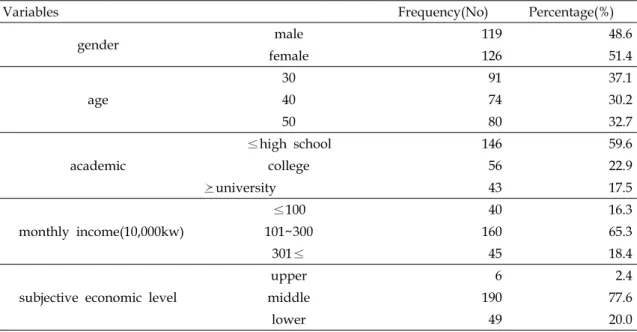
Table 1. The general variables of subjects (N=245)
Variables Frequency(No) Percentage(%)
gender male 119 48.6
female 126 51.4
age
30 91 37.1
40 74 30.2
50 80 32.7
academic
≤high school 146 59.6
college 56 22.9
뽧university 43 17.5
monthly income(10,000kw)
≤100 40 16.3
101~300 160 65.3
301≤ 45 18.4
subjective economic level
upper 6 2.4
middle 190 77.6
lower 49 20.0
2. 연구대상 및 방법
2.1 연구대상
2012년 12월 17일부터 2013년 2월 17일까 지 2개월 동안 편의추출에 의해 선정한 부 산, 경남 일부 지역에 거주하는 성인 300명 을 대상으로 조사하였고, 회수하지 못한 55 부의 설문지를 제외한 245명의 설문지를 최 종분석 하였다.
2.2 연구방법
PASW Statistics 18.0Ⓡ(SPSS Inc., Chicago IL, USA)을 이용하여 일반적 특성, 흡연량 은 빈도와 백분율로 산출하였다. 주관적 구 강건강 인식, 잇솔질 행태에 영향을 미치는 흡연 여부, 흡연량, 그리고 일반적 특성요인 을 파악하기 위해 빈도분석을 하였고, 흡연 여부에 따른 주관적 구강건강인식과 잇솔질 행태, 흡연 여부에 따른 시기별 잇솔질 유 무, 흡연 여부에 따른 잇솔질 행태, 흡연량 에 따른 주관적 구강건강인식을 파악하기 위하여 교차분석을 하였으며, 통계적 유의성
판정을 위한 유의수준은 0.05로 고려하였다.
3. 결과
3.1 연구 대상자의 일반적 특성
연구 대상자의 성별 분포는 여자 51.4%, 남자 48.6%로 나타났고 연령 분포는 30대 37.1%, 40대 30.2%, 50대 32.7%로 나타났다.
가구당 월평균 소득 분포는 100만원 이하 16.3%, 101~ 300만원 65.3%, 301만원 이상 18.4%로 나타났고, 주관적 경제 상태 분포 는 상 2.4%, 중 77.6%, 하 20%로 나타났다.
직업 분포는 전문직 15.1%, 사무/관리직 15.9%, 생산/판매직 28.6%, 자영업 17.6%, 기타 22.8%로 나타났고 최근 1년간 치과 방 문여부는 없다 68.6%, 있다 31.4%로 나타났 다. 음주는 전혀 안한다 18.8%, 1주일에 3회 미만 39.6%, 1주일에 3회 이상 39.2%, 거의 매일 2.4%로 나타났고 흡연은 전혀 안한다 61.2%, 하루에 반갑 이하 11.8%, 하루에 반 갑~한갑 16.7%, 하루에 한갑~두갑 9.4%로 나타났으며, 흡연 여부는 비흡연자 61.2%, 흡연자 38.8%로 나타났다(Table 1).
occupation
Professional 37 15.1
Secretary / manager 39 15.9
Manufacturing / sales 70 28.6
Business owners 43 17.6
etc 56 22.8
marrige no 65 26.5
yes 180 73.5
drinking
no 46 18.8
3times per 1week 97 39.6
more 3times per 1week 96 39.2
every day 6 2.4
smoking
no 150 61.2
less than a pack per 1 day 29 11.8
1/2-1 pack per 1 day 41 16.7
1-2 pack per 1 day 23 9.4
excise
no 75 30.6
1~2times per 1 month 101 41.2
1~3times per 1 week 47 19.2
every day 22 9.0
visiting dental clinic during 1yr
yes 77 31.4
no 168 68.6
Table 2. Subjective oral health awareness by smoking (N=245)
Variables No smoking
(n=150) smoking
(n=95) p
subjective oral health awareness
very bad 2.7 1.1
.000
little bad 22 20
usual 32 60
healthy 42 17.9
very healthy 1.3 1.1
* p<0.05 by chi-square test
3.2. 흡연여부에 따른 주관적 구강건강인식
흡연여부에 따른 주관적 구강건강인식에서 는 흡연자는 보통이다 60%, 조금 나쁜 편이
다 20%, 매우나쁜 편이다 1.1%, 비흡연자는 보통이다 32%, 대체로 건강한 편이다 42%, 매우 건강하다 1.3%로 나타나 통계적으로 유의하였다(p<0.001)(Table 2).
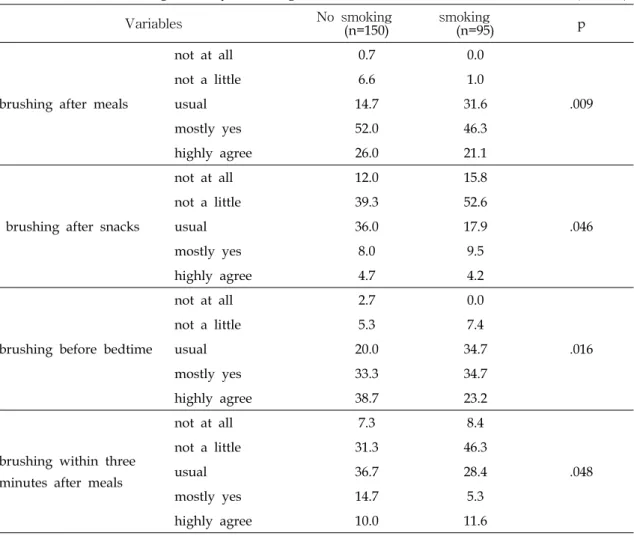
3.3. 흡연 여부에 따른 시기별 잇솔질 유무
흡연 여부에 따른 시기별 잇솔질 유무에서 는 식사 후 잇솔질은 그런 편이다가 흡연자 는 67.4%이고 비흡연자는 78%로 나타났고, 간식 후 잇솔질은 그렇지 않은 편이다가 흡
연자는 68.4%이고 비흡연자는 51.3%로 나타 났다. 취침 전 잇솔질은 그렇지 않은 편이다 가 비흡연자는 72%이고 흡연자는 57.9%로 나 타났고, 3분 내에 잇솔질은 그렇지 않은 편이 다가 흡연자는 54.7%이고 비흡연자는 38.6%
로 나타나 통계적으로 유의하였다(p<0.05)
Table 4. Tooth brushing pattern by smoking (N=245)
Variables p
brushing more than three minutes
not at all 2.0 1.1
.001
not a little 8.0 8.4
usual 25.3 51.6
mostly yes 42.7 26.3
highly agree 22.0 12.6
(Table 3).
Table 3. Tooth brushing time by Smoking (N=245)
Variables No smoking
(n=150) smoking
(n=95) p
brushing after meals
not at all 0.7 0.0
.009
not a little 6.6 1.0
usual 14.7 31.6
mostly yes 52.0 46.3
highly agree 26.0 21.1
brushing after snacks
not at all 12.0 15.8
.046
not a little 39.3 52.6
usual 36.0 17.9
mostly yes 8.0 9.5
highly agree 4.7 4.2
brushing before bedtime
not at all 2.7 0.0
.016
not a little 5.3 7.4
usual 20.0 34.7
mostly yes 33.3 34.7
highly agree 38.7 23.2
brushing within three minutes after meals
not at all 7.3 8.4
.048
not a little 31.3 46.3
usual 36.7 28.4
mostly yes 14.7 5.3
highly agree 10.0 11.6
* p<0.05 by chi-square test
3.4. 흡연 여부에 따른 잇솔질 행태
흡연 여부에 따른 잇솔질 행태에서는 3분 이 상 잇솔질은 그런 편이다가 흡연자는 38.9%이
고 비흡연자는 64.7%, 회전법으로 잇솔질은 그 런 편이다가 흡연자는 19%, 비흡연자는 41.3%
로 나타나 통계적으로 유의하였다(p<0.001) (Table 4).
wiping tongue when tooth brushing
not at all 1.3 2.1
.346
not a little 6.7 6.3
usual 16.0 18.9
mostly yes 39.3 48.4
highly agree 36.7 24.2
wiping gums when tooth brushing
not at all 4.0 4.2
.122
not a little 18.0 26.3
usual 38.0 43.2
mostly yes 22.0 18.9
highly agree 18.0 7.4
tooth brushing with rotation method
not at all 3.3 3.2
.000
not a little 14.0 42.1
usual 41.3 35.8
mostly yes 26.0 17.9
highly agree 15.3 1.1
* p<0.05 by chi-square test
Table 5. Subjective oral health awareness by smoking amount (N=245) Variables smoking amount per 1day(%)
no ≤1/2 pack 1/2~1 1~2 2≤ p
subjective oral health
awareness
very bad 2.7 .0 2.4 .0 .0
.012
little bad 22.0 17.2 22.0 17.4 50.0
usual 32.0 48.3 58.5 78.3 50.0
healthy 42.0 31.0 17.1 4.3 .0
very healthy 1.3 3.4 .0 .0 .0
* p<0.05 by chi-square test
3.5. 흡연량에 따른 주관적 구강건강인식
흡연량에 따른 주관적 구강건강 인식에서 는 흡연자중 주관적 구강건강인식이 보통이 다, 조금 나쁜 편이다, 매우 나쁘다가 흡연
량이 하루에 반갑 이하는 65.6% 반갑~한갑 은 82.9%, 한갑~두갑은 95.5%, 두갑 이상은 100%로 흡연량이 많을수록 주관적 구강건강 인식이 나쁜 편으로 나타나 통계적으로 유 의하게 나타났으며(p<0.05), 비흡연자는 보 통이다, 대체로 건강한 편이다, 매우 건강하 다가 75.3%로 높은 분포를 보였다(Table 5).
4. 고찰
흡연은 현대 사회에서 꾸준히 증가하고 있 는 하나의 질병으로 정부의 정책으로 담배 값 인상, 음식점 금연법 등의 노력에도 흡
연율은 감소되고 있지 않으며, 건강을 해치 는 위험도는 꾸준히 증가하고 있다.15)
구강건강은 전신건강의 일부로 구강내 문 제로 인하여 저작에 대한 문제가 생기게 되 면 소화기능에 문제를 야기시켜 영양에 불 균형을 초래하게 되며16), 구강 분비물인 타
액은 윤활 작용을 하여 음식물 소화에도 도 움을 주기 때문이다17).
이에 본 연구는 30대, 40대, 50대 성인을 대상으로 흡연 여부에 따라 주관적 구강건 강인식 상태와 잇솔질 행태를 비교하여 구 강보건정책 수립을 위한 기초자료 및 흡연 자와 비흡연자의 치과 내원 시 대상자별 효 과적인 금연교육의 기초자료를 제공하고자 본 연구를 실시하였다.
연구대상자의 흡연실태에서는 흡연자가 38.8%로 조사되어 Yoo등10)의 42.0%보다는 낮게 나타나 다소 차이를 보였고, 하루 흡 연량은 하루에 반갑~한갑 16.7%로 가장 높 게 나타났으며 Yoo등10)의 연구결과 44.9%
보다는 적게 나타나 선행연구와는 다소 차 이가 있는 것으로 나타나 이는 최근 금연에 대한 전국민 홍보가 반영된 결과라 여겨진 다.
흡연여부에 따른 주관적 구강건강인식에서 는 흡연자는 구강건강이 좋지 않다고 생각 하는 경향이 높아 Kim18)의 연구에서 일부 대학생을 대상으로 흡연과 주관적 구강건강 인지도와의 관련성을 분석한 결과 남녀 모 두 비흡연자보다 흡연자가 주관적 구강건강 인지도가 좋지 않다고 조사되어 본 연구와 비슷한 결과를 보였다.
흡연 여부에 따른 잇솔질 행태에서는 식사 후 잇솔질 유무에서는 비흡연자 78%, 흡연 자 67.4%로 흡연자에 비해 비흡연자가 잇솔 질을 더 잘 실천하고 있는 것으로 나타났 고, 취침 전 잇솔질에서는 비흡연자 72%, 흡연자 57.9%로 비흡연자가 취침전 잇솔질 을 잘 실천하고 있는 것으로 나타났으며, 3 분 내에 잇솔질은 그렇지 않은 편이다가 흡 연자는 54.7%이고 비흡연자는 38.6%로 흡 연자일수록 식사 후 3분 내 잇솔질을 하지 않는 편인 것으로 나타났다.
흡연자는 비흡연자에 비해 주관적 구강건 강 인식이 나쁜 편이고, 잇솔질 행태 또한 잘 지켜지지 않는 편이었다. 흡연자 중 흡 연량이 많을수록 주관적 구강건강 인식이
더욱 나쁜 편이고, 잇솔질 행태도 더욱 지 켜지지 않는 것으로 나타났다. 이는 흡연자 들을 대상으로 구강건강관리 능력을 위한 구강보건교육이 반복적으로 이루어져야 할 필요가 있는 것으로 사료된다.
흡연 여부에 따른 잇솔질 행태에서는 3분 이상 잇솔질에서 비흡연자가 흡연자에 비해 더 오래 잇솔질을 하고 있는 것으로 나타났 고, 올바른 잇솔질법인 회전법 잇솔질 실천 에서도 비흡연자가 흡연자보다 올바르게 잇 솔질을 하고 있는 것으로 나타나 3분이상 잇솔질과 회전법 잇솔질 실천에서는 유의성 을 나타냈다(p<0.001). Jang 등19)의 연구결 과에 따르면 흡연자가 비흡연자에 비해 구 강환경 청결을 위해 사용하는 구강보조용품 의 사용율과 잇솔질 시간이 낮다고 보고한 결과와 유사한 결과로 보여진다. 이는 흡연 자에 비해 비흡연자가 구강건강 지식정도와 관심도가 높아 구강건강관리 실천으로 이어 진 것으로 생각된다.
흡연량에 따른 주관적 구강건강인식여부에 서는 흡연량이 많을수록 주관적 구강건강인 식이 나쁜 편으로 나타났고 흡연량이 많을 수록 3분이상 잇솔질을 하지 않는 것으로 나타났으며, 회전법 잇솔질 여부에서도 흡 연량이 많을수록 회전법으로 잇솔질을 하지 않는 것으로 나타났다.
흡연여부와 흡연량에 따른 주관적 구강건 강 인식과 잇솔질 행태를 파악해 본 결과 자신의 주관적 구강건강을 인식하고 그에 따라 올바른 잇솔질 행태를 시행할 수 있 는 구강보건교육 프로그램의 개발이 필요 하며, 주관적 구강건강 인식과 잇솔질 행 태는 흡연여부와 흡연량과 관련성이 있으 므로 치과 진료 시 대상자에게 구강건강상 태를 정확히 인식시켜 대상자에 맞는 효과 적인 구강건강관리법을 마련하여 구강건강 과 삶의 질 향상에 도움을 줄 수 있도록 해야 할 것이다.
5. 결론
본 연구는 30, 40, 50대 성인을 대상으로 흡연 여부를 조사하고 흡연 여부에 따른 주 관적 구강건강 인식과 잇솔질 행태를 파악 하여 30, 40, 50대의 치과 방문 시 흡연 여 부에 따른 효율적인 구강건강관리 방법을 마련하여 구강건강 향상과 삶의 질 향상에 도움을 주고자 하는데 연구의 목적을 두었 다. 결론을 요약하면 다음과 같다.
1. 비흡연자는 61.2%, 흡연자는 38.8%이고 흡연량은 하루에 반갑~한갑이 가장 많 았다. 그리고 구강건강 상태 인식은 보 통이다, 대체로 건강한 편이다가 75.6%
로 나타났다.
2. 흡연여부에 따른 주관적 구강건강상태 인식과 잇솔질 행태를 살펴보면, 주관적 구강건강 인식은 비흡연자일수록 건강 한 편이었고, 흡연자일수록 건강하지 않 은 편으로 나타났고 통계적으로 유의하 였다(p<0.05).
3. 잇솔질 행태는 비흡연자일수록 식사 후, 간식 후, 취침 전 3분 이내에 잇솔질을 하고, 3분 이상 회전법으로 잇솔질을 하 는 편으로 나타났고, 흡연자일수록 식사 후, 간식 후, 취침 전 3분 이내에 잇솔 질을 하지 않고, 3분 이상 회전법으로 잇솔질을 하지 않는 편으로 유의한 차 이를 보였다(p<0.05).
4. 주요 관심 변수인 흡연량에 따른 주관 적 구강건강상태 인식과 잇솔질 행태를 살펴보면, 주관적 구강건강상태 인식은 비흡연자일수록 건강한 편이고, 흡연자 일수록 건강하지 않은 편인데, 흡연자 중 흡연량이 많을수록 주관적 구강건강 인식이 나쁜 편으로 유의한 차이를 보 였다(p<0.05).
References
1. Williams CE, Davenenport ES, Sterne
JA, et al. Mechanism of risk in preterm lowbirthweight infants. periodontol, 2000;
23:142-150.
2. Marwick C. Periodontal disease may pose one risk for premature birth.
JAMA, 2000; 283(22):2922.
3. Park JH, Kim YN, Yoo JH et al.
Relationship between smoking and periodontal pocket formation in Korean adults. J Korean Acad Dent Health, 2005;
29(3):293-301.
4. Yu MH. The effects of smoking on oral mucosa. The Journal of Namseoul Univ. 2004;10:449-468.
5. Linden GJ, Mullally BH. Cigarette Smoking And periodontal destruction in young adults. J periodontal, 1994;
65(7):718-723.
6. Tonetti MS, Pini-Prato G, Cortellini P.
Effect of cigarette smoking on periodontal healing following GTR in infrabony defects. J Clin Periodontol, 1995;22(3):
229-234.
7. Rosen PS, Marks MH, Reynolds Ma.
Influence of smoking on long-term clinical results of intrabony defects treated with regenerative therapy. J Periodontol, 1996;67(11):1159-1163.
8. Grossi SG, Zambon J, Machtei EE, et al. Effect of smoking and smoking cessation on healing after mechanical periodontal therapy. J Am Dent Assoc, 1997;128(5):599-607.
9. Hensrud DD, Sprafka JM. The smoking habit of minesota physicians. Am J Public Health, 1993;83(3):415-416.
10. Yoo JS, kim KE, Kim J. A study on actual smoking condition, knowledge, attitude and prctice related to dental health of Korean soldiers. J Korean Acad Dent Health, 2009;33(3):356-366.
11. Hong SJ, Lee SD, BAE JS. Reduction of plaque and gingival bleeding by toothbrushing education and scaling. J Korean Acad Dent Health, 1994; 18(20):
434-439.
12. Darby ML, Walsh MM. Application of the human needs conceptual model to dental hygiene practice. J Dent Hyg, 2000;74(3):230-237.
13. Fiore MC. US public health service clinical practice guideline: treating tobacco use and dependence. Respir care, 2000;45(10):1200-1262.
14. Vidrine Jl, Cofta-Woerpel L, Daza P et al. Smoking Cessation 2: behavioral treatments. Behav Med, 2006;32(2):99- 109.
15. Corelli RI, Kroon LA, Chung EP et al.
Statewide evaluation of a tabacco cessation curriculum for pharmacy students.
Prev Med, 2005;40(6):888-895.
16. Choi YH. A study on some high school boys practice of oral health control(around toothbrushing) and knowledge of decay and preferred taste. J Korean Soc Dent Hyg, 2010;10(2):
361-374.
17. Cho SH. Function of salival
composition and the diagnostic value of saliva. unpublished master’s thesis, Chonam National University, 2009.
18. Kim SH, Jang JH, Park YD. The Relationship of Smoking Behaviors to Perceived Oral Health Among University Students, J korean Dent Hyg Sci, 2005;
5(3):139-143.
19. Jang KA, Seong MK, Kang HK et al.
Availability of oral hygiene devices for the patients with smoking in some dental clinics. J Dent Hyg Sci, 2008;
8(1):7-12.