Received: 6 May, 2015 Revised: 27 May, 2015 Accepted: 28 May, 2015 Corresponding author: Changho Song
Department of Physical Therapy, College of Health and Welfare, Sahmyook University, 815 Hwarang-ro, Nowon-gu, Seoul 139-742, Republic of Korea Tel: 82-2-3399-1637 Fax: 82-2-3399-1639 E-mail: [email protected]
This is an Open-Access article distributed under the terms of the Creative Commons Attribution Non-Commercial License (http://creativecommons.org/licens es/by-nc/4.0) which permits unrestricted non-commercial use, distribution, and reproduction in any medium, provided the original work is properly cited.
Copyright © 2015 Korean Academy of Physical Therapy Rehabilitation Science
http://dx.doi.org/10.14474/ptrs.2015.4.1.32 Phys Ther Rehabil Sci
pISSN 2287-7576 2015, 4 (1), 32-37
eISSN 2287-7584 www.jptrs.org
Effects of mobile texting and gaming on gait with obstructions under different illumination levels
Jaeyun Cha
a, Hyunjin Kim
b, Jaemyoung Park
c, Changho Song
daDepartment of Rehabilitation Medicine, Sahmyook Seoul Medical Center, Seoul, Republic of Korea
bDepartment of Rehabilitation Medicine, Hanyang University Guri Hospital, Guri, Republic of Korea
cDepartment of Rehabilitation Medicine, Seoul Medical Center, Seoul, Republic of Korea
dDepartment of Physical Therapy, College of Health and Welfare, Sahmyook University, Seoul, Republic of Korea
Objective: This study was conducted to test the effects of mobile texting and gaming on gait with obstructions under different il- lumination levels.
Design: Cross-sectional study.
Methods: Twelve healthy adults aged 20 to 36 years (mean 23.5 years) were tested under six different conditions. All participants used touchscreen smartphones. Testing conditions included: 1) Walking with an obstruction under a bright illumination level; 2) walking with an obstruction with a low level of illumination; 3) walking with an obstruction while texting under a bright illumina- tion level; 4) walking with an obstruction while texting with a low level of illumination; 5) walking with an obstruction while gam- ing under a bright illumination level; and 6) walking with an obstruction while gaming with a low level of illumination. All partic- ipants were asked to text the Korean national anthem by their own phone and play Temple Run 2 using an iPhone 5. Gait variances were measured over a distance of 3 m, and the mean value after three trials was used. A gait analyzer was used to measure the data.
Results: Compared to normal gait with obstruction, gait speed, step length, stride length, step time, stride time, cadence while texting and gaming showed significant differences (p<0.05). Differences between the illumination levels included gait speed, step length, stride length, and step time (p<0.05) with no significant differences in stride time and cadence.
Conclusions: Dual-tasking using a smartphone under low levels of illumination lowers the quality of gait with obstructions.
Key Words: Cell phones, Gait, Task performance, Lighting
Introduction
Mobile phones are used for a significant portion of every- day life in all age groups. Seventy-seven percent of the world’s population have mobile phones, and they have been recognized as a cost-effective communication tool [1].
Although mobile phones provide great convenience, they cause risks in certain situations [2]. Pedestrian use of mobile phones increases cognitive distraction, decreases the ability to react to sudden changes, and increases disturbing actions causing injury or even death [3-6]. For example, in a virtual experiment, it was shown that texting while walking in-
creases the chance of being hit by a car or a motorcycle;
moreover, texting is a distraction from the surroundings [7].
Previous research on texting while walking has shown that pedestrians walk slower with less traffic awareness [3,5].
The act of texting while walking changes the consciousness of walking affected by the working memory and executive control [8].
In order to write a text, the attention must be focused on a
small screen. Because of gaze fixation on the mobile screen,
the visual information of the surrounding environment sig-
nificantly drops [9]. Also, a heightened attention level is
necessary while texting for agile hand movements. Atten-
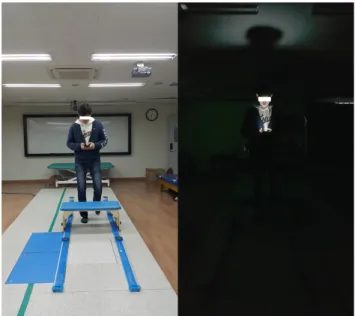
Figure 1. Texting and gaming on gait while walking with an ob- structions under different illumination levels.
tion is defined as personal processing ability [10], and mul- ti-tasking can be used as a tool to measure the attention level in processing data. Each individual has a limited central processing capacity, which is required in data processing. If multi-tasking exceeds the level of processing capacity, mul- ti-tasking will be affected [11]. As a result, multi-tasking cannot be used as a tool to measure the processing capacity level. Although safe walking requires both physical ability and sensory ability, multi-tasking (such as texting and gam- ing) disturbs the working memory and causes situational er- rors [12].
People multi-task most of the time in pedestrian activity.
However, even simple multi-tasking causes negative im- pacts on body balance and obstruction avoidance [13-15]. If one cannot locate a possible obstruction because of a lower awareness level, a trip or a fall will be expected [16].
Obstructions with different heights, widths, or depths re- quire locomotion patterns of jumping over, stepping down, and going around. These locomotion patterns are common when facing obstructions and are compulsory elements in successful locomotion. Locomotion patterns cause changes in gait patterns and demands for physical and conscious qualifications [17,18].
While walking, the visual system provides important in- formation on the surroundings and contributes to route plan- ning and maintaining body stability [19,20]. The availability of visual information on the location of an obstruction sig- nificantly affects how a pedestrian deals with the obstruc- tion. Loss of visual information while approaching an ob- struction increases the risk of incorrect foot placement by 50% [21].
Although research has been conducted on the risk of mo- bile phone use while walking, research on multi-tasking us- ing mobile phones is inadequate. Therefore, this study was conducted to test the influence of multi-tasking on gait in different illumination settings.
Methods Subjects
Twelve healthy adults from Sahmyook University in Seoul were included in the study. All participants were free of any medical conditions and used touchscreen smart- phones. The study excluded candidates with abnormal limbs, a history of nerve disease, inability to use a touch screen, and less than six months of smartphone experience.
The study was conducted after obtaining approval from the
ethics committee of Sahmyook University. Prior to partic- ipation, subjects received an explanation of the objective and methods of the study and completed a consent of agreement.
Procedures
The experiment was performed inside a flat lecture room
in Sahmyook University. Testing conditions included: 1)
Walking with an obstruction under a bright illumination lev-
el; 2) walking with an obstruction with a low level of illumi-
nation; 3) walking with an obstruction while texting under a
bright illumination level; 4) walking with an obstruction
while texting with a low level of illumination; 5) walking
with an obstruction while gaming under a bright illumina-
tion level; and 6) walking with an obstruction while gaming
with a low level of illumination. All participants were asked
to text the Korean national anthem by their own phone and
play Temple Run 2 (Imangi Studios, Raleigh, NC, USA) us-
ing an iPhone 5 (Apple Inc., Cupertino, CA, USA). Partici-
pants began texting and gaming just before they began
walking. To minimize light adaptation, dark and light shades
were applied correspondingly. Gait variance was measured
for a length of 3 m, excluding the 1 m walked before and af-
ter the tested area. The experiment value was the mean value
after three trials for each subject. To measure the data, a gait
analyzing tool (OptoGait, 2010; Microgate Srl, Bolzano,
Italy) was used. The analyzing tool contained two trans-
mitters, a 1 m receptor stick, and a webcam (Logitech
Figure 2. Differences of gait parameters in normal, texting, and gaming gait. *Significant differences between normal and texting, normal, and gaming (p<0.05).
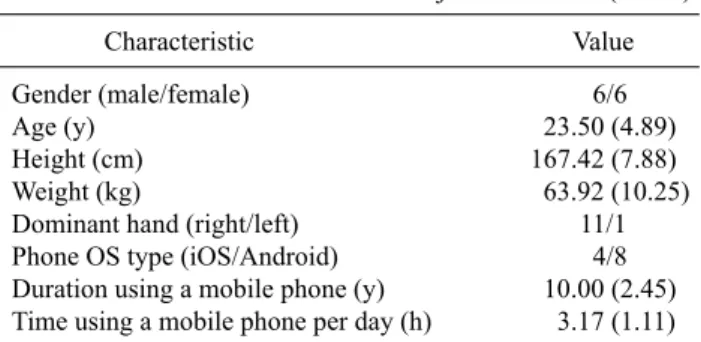
Table 1. General characteristics of subjects (N=12)
Characteristic Value
Gender (male/female) 6/6
Age (y) 23.50 (4.89)
Height (cm) 167.42 (7.88)
Weight (kg) 63.92 (10.25)
Dominant hand (right/left) 11/1
Phone OS type (iOS/Android) 4/8
Duration using a mobile phone (y) 10.00 (2.45) Time using a mobile phone per day (h) 3.17 (1.11) Values are presented as number only or mean (SD).
Webcam Pro 9000; Logitech International S.A., Lausanne, Switzerland). OptoGait software (version 1.5.0.0; Micro- gate Srl) was used to analyze the gait data. The intra-class correlation coefficients for test-retest reliability of OptoGait were between 0.785 and 0.982 [22]. A table 75 cm in length, 30 cm in width, and 30 cm in height was used to create an ob- struction (Figure 1).
Data analysis
Statistical software (IBM SPSS Statistics version 19.0;
IBM Co., Armonk, NY, USA) was used for data analysis.
The experiment used descriptive statistics for each partic- ipant’s general features. All variables were compared among the different conditions using repeated two-way analysis of variance. A significance level of p<0.05 was ap- plied to all analyses.
Results
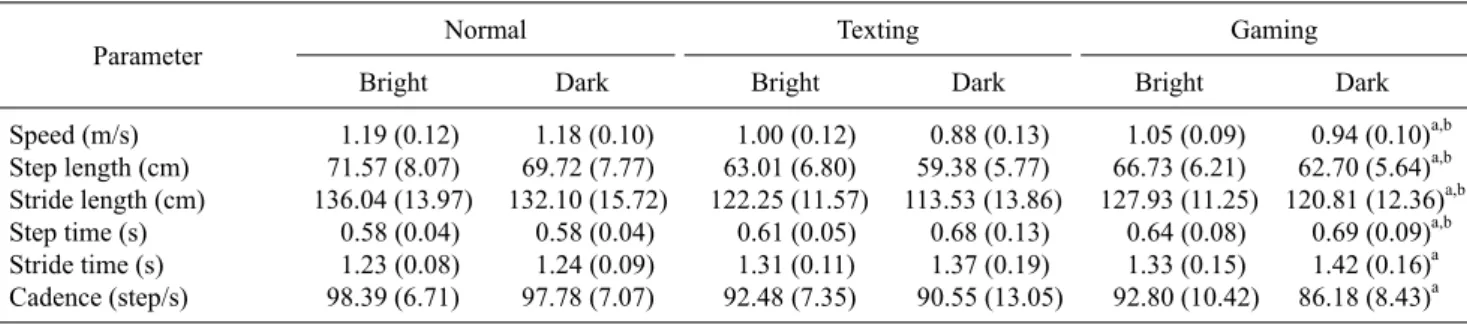
The general features of the 12 participants are shown in Table 1. The participants ranged in age from 20 to 36 years with a mean age of 23.5 years. They averaged 3.17 hours of smartphone use per day. Compared to the normal gait, gait speed, step length, stride length, step time, stride time, ca- dence while texting and gaming showed significant differ- ences (p<0.05) (Figure 2). Differences between contrasting illumination levels included gait speed, step length, stride length, and step time (p<0.05) with no significant differ- ences in stride time or cadence (Table 2).
Discussion
Multiple concurrent tasks often require attention during
daily activities [6]. To adapt to the external environment,
Table 2. Comparison of normal, texting, and gaming gait in different illumination levels (N=12)
Parameter Normal Texting Gaming
Bright Dark Bright Dark Bright Dark
Speed (m/s) 1.19 (0.12) 1.18 (0.10) 1.00 (0.12) 0.88 (0.13) 1.05 (0.09) 0.94 (0.10)a,b Step length (cm) 71.57 (8.07) 69.72 (7.77) 63.01 (6.80) 59.38 (5.77) 66.73 (6.21) 62.70 (5.64)a,b Stride length (cm) 136.04 (13.97) 132.10 (15.72) 122.25 (11.57) 113.53 (13.86) 127.93 (11.25) 120.81 (12.36)a,b Step time (s) 0.58 (0.04) 0.58 (0.04) 0.61 (0.05) 0.68 (0.13) 0.64 (0.08) 0.69 (0.09)a,b Stride time (s) 1.23 (0.08) 1.24 (0.09) 1.31 (0.11) 1.37 (0.19) 1.33 (0.15) 1.42 (0.16)a Cadence (step/s) 98.39 (6.71) 97.78 (7.07) 92.48 (7.35) 90.55 (13.05) 92.80 (10.42) 86.18 (8.43)a Values are presented as mean (SD).
aSignificant differences between normal and texting, normal, and gaming conditions (p<0.05). bSignificant differences between bright condi- tions and dark conditions (p<0.05).
proper posture with good body balance is necessary [23].
Multi-tasking can be defined as performing multiple tasks during the same period of time [24]. Previous multi-tasking research focused on hand motion while walking, verbal ac- tivity while walking [25], and simple reflection period time during the gait [26]. Multi-tasking causes a serious influence on gait in adults, slowing the locomotion and requiring a greater base of support [27,28]. This effect on gait occurs be- cause the balance system increases in stability when faced with a threat [29,30]. Disturbances to stability can occur in a chaotic environment; however, executive function and at- tention are needed to sustain body safety and locomotion pattern [31]. Texting while walking results in negative dy- namic stability because it combines a physical task and a cognitive action [31]. Obstructions and the visual system al- so have an impact on dynamic stability. People normally face obstructions and unorganized roads while walking.
Nevertheless, these types of obstructions alter the locomo- tion pattern. Jumping over an obstruction increases the de- mand on the locomotion pattern and increases the chance for a fall [32]. The visual system not only provides information on obstructions but also maintains balance [20] and change of route [33]. Multi-tasking is influenced by the fear of falling. Fear of a fall decreases gait speed and step width which may change the locomotion pattern [34].
In this experiment, we studied how smartphone mul- ti-tasking under different illumination levels influenced the gait with obstructions. Compared to gait under normal con- ditions, texting and gaming caused a significant decrease in gait speed, step length, stride length, and cadence (p<0.05) with an increase in step time and stride time (p<0.05).
However, no significant difference was shown between the texting and gaming gait pattern. Sending an email or texting while walking requires focused attention. Gaze transfers or
gaze fixations while texting or writing an email alter loco- motion patterns [34]. Demura and Uchiyama [35] supported our data by analyzing stride length and gait speed. Also, Lamberg and Muratori [12] reported in their recent experi- ment that multi-tasking results in cognitive distraction which slows gait speed and causes deviation from a straight path. Harbluk et al. [36] discuss how pedestrians have a slowed gait speed because of their fear of facing obstruc- tions and fear of a fall. Moreover, distractions from mul- ti-tasking exposes a person to more possible threats from the surroundings. Ebersbach et al. [37] reported that young adults from age 20 to 42 years have changed their locomo- tion pattern because of secondary tasks such as fine motor tasks and finger tapping. Our experiment also supported the idea that multi-tasking has a great impact on gait variables.
The experiment with different illumination levels shows that levels of illumination decreased gait speed, step length, and stride length (p<0.05) and increased step time (p<0.05).
Interestingly, stride time increased in both illumination lev- els while cadence decreased. In a normal gait, visual sight takes a dominant role in body balancing and target change [38]. Visual information also determines gait route, step time, cadence, stride length, and stance phase [19,39-41].
Blurring, disturbing, or occluding sight decreases step length, which can result in foot placement error [33,42,43]
and often changes the locomotion pattern and deviation
[40]. A mock test with restricted sight decreased the step
speed [44]. Previous studies reported that the reasons for de-
creased step speed are fear of a fall, fear of uncertainty, and
fear of exploration. Those reasons can be defined as a con-
servative strategy [20,45]. Choi et al. [46] reported that un-
der low light, gait speed and stance phase ratio of young
adults decreased. Studies of elderly participants reported
that gait speed and stride length decreased with obstructions.
Other studies report that they adopt the gait pattern as time increases [47,48]. Interestingly, when elderly people experi- ence a decrease in their visual ability, they have more gait stability by slowing their gait, decreasing step length, and using more double-limb support [26,49]. Studies on young adults show that changes in illumination levels have a great impact on gait speed, step length, stride length, and step time. Visual perceptions of the surroundings can prevent en- countering obstructions [20], but restricted visual percep- tions may increase the chance of a fall [50].
Our study had some limitations. First, the obstruction was not rearranged between trials. It is possible that candidates were fully aware of the obstruction in all six conditions.
Second, the experiment was carried out in a simple and quiet space. Third, we limited the participants to young adults. So there is a risk to generalization of all ages to use a smart- phone. Further studies are expected on gait pattern changes with auditory, visual, and other sensory systems.
Conflict of Interest
The authors declared no potential conflicts of interest with respect to the authorship and/or publication of this article.
References
1. Schabrun SM, van den Hoorn W, Moorcroft A, Greenland C, Hodges PW. Texting and walking: strategies for postural control and implications for safety. PLoS One 2014;9:e84312.
2. Stavrinos D, Byington KW, Schwebel DC. Distracted walking:
cell phones increase injury risk for college pedestrians. J Safety Res 2011;42:101-7.
3. Nasar J, Hecht P, Wener R. Mobile telephones, distracted atten- tion, and pedestrian safety. Accid Anal Prev 2008;40:69-75.
4. Bungum TJ, Day C, Henry LJ. The association of distraction and caution displayed by pedestrians at a lighted crosswalk. J Community Health 2005;30:269-79.
5. Hatfield J, Murphy S. The effects of mobile phone use on pedes- trian crossing behaviour at signalized and unsignalized inter- sections. Accid Anal Prev 2007;39:197-205.
6. Neider MB, McCarley JS, Crowell JA, Kaczmarski H, Kramer AF. Pedestrians, vehicles, and cell phones. Accid Anal Prev 2010;42:589-94.
7. Schwebel DC, Stavrinos D, Byington KW, Davis T, O'Neal EE, de Jong D. Distraction and pedestrian safety: how talking on the phone, texting, and listening to music impact crossing the street.
Accid Anal Prev 2012;45:266-71.
8. Rubinstein JS, Meyer DE, Evans JE. Executive control of cogni- tive processes in task switching. J Exp Psychol Hum Percept Perform 2001;27:763-97.
9. Langer P, Holzner B, Magnet W, Kopp M. Hands-free mobile
phone conversation impairs the peripheral visual system to an extent comparable to an alcohol level of 4-5 g 100 ml. Hum Psychopharmacol 2005;20:65-6.
10. Woollacott M, Shumway-Cook A. Attention and the control of posture and gait: a review of an emerging area of research. Gait Posture 2002;16:1-14.
11. Kahneman D. Attention and effort. Englewood Cliffs: Pren- tice-Hall; 1973. p. 246.
12. Lamberg EM, Muratori LM. Cell phones change the way we walk. Gait Posture 2012;35:688-90.
13. Boisgontier MP, Beets IA, Duysens J, Nieuwboer A, Krampe RT, Swinnen SP. Age-related differences in attentional cost asso- ciated with postural dual tasks: increased recruitment of generic cognitive resources in older adults. Neurosci Biobehav Rev 2013;37:1824-37.
14. Shumway-Cook A, Woollacott M, Kerns KA, Baldwin M. The effects of two types of cognitive tasks on postural stability in old- er adults with and without a history of falls. J Gerontol A Biol Sci Med Sci 1997;52:M232-40.
15. Weerdesteyn V, Schillings AM, van Galen GP, Duysens J.
Distraction affects the performance of obstacle avoidance during walking. J Mot Behav 2003;35:53-63.
16. Weerdesteyn V, Nienhuis B, Hampsink B, Duysens J. Gait ad- justments in response to an obstacle are faster than voluntary reactions. Hum Mov Sci 2004;23:351-63.
17. Byrne JM, Prentice SD. Swing phase kinetics and kinematics of knee replacement patients during obstacle avoidance. Gait Posture 2003;18:95-104.
18. Lamoureux E, Sparrow WA, Murphy A, Newton RU. The effects of improved strength on obstacle negotiation in community-liv- ing older adults. Gait Posture 2003;17:273-83.
19. Rietdyk S, Rhea CK. Control of adaptive locomotion: effect of visual obstruction and visual cues in the environment. Exp Brain Res 2006;169:272-8.
20. Hallemans A, Ortibus E, Meire F, Aerts P. Low vision affects dy- namic stability of gait. Gait Posture 2010;32:547-51.
21. Patla AE, Greig M. Any way you look at it, successful obstacle negotiation needs visually guided on-line foot placement regu- lation during the approach phase. Neurosci Lett 2006;397:110-4.
22. Lee MM, Song CH, Lee KJ, Jung SW, Shin DC, Shin SH.
Concurrent validity and test-retest reliability of the OPTOGait Photoelectric cell system for the assessment of spatio-temporal parameters of the gait of young adults. J Phys Ther Sci 2014;
26:81-5.
23. Morioka S, Hiyamizu M, Yagi F. The effects of an attentional de- mand tasks on standing posture control. J Physiol Anthropol Appl Human Sci 2005;24:215-9.
24. Pellecchia GL, Shockley K, Turvey MT. Concurrent cognitive task modulates coordination dynamics. Cogn Sci 2005;29:531- 57.
25. Lundin-Olsson L, Nyberg L, Gustafson Y. Attention, frailty, and falls: the effect of a manual task on basic mobility. J Am Geriatr Soc 1998;46:758-61.
26. Chen HC, Schultz AB, Ashton-Miller JA, Giordani B, Alexander NB, Guire KE. Stepping over obstacles: dividing attention im- pairs performance of old more than young adults. J Gerontol A Biol Sci Med Sci 1996;51:M116-22.
27. Catena RD, van Donkelaar P, Chou LS. Cognitive task effects on
gait stability following concussion. Exp Brain Res 2007;176:23- 31.
28. Siu KC, Lugade V, Chou LS, van Donkelaar P, Woollacott MH.
Dual-task interference during obstacle clearance in healthy and balance-impaired older adults. Aging Clin Exp Res 2008;20:
349-54.
29. MacLellan MJ, Patla AE. Adaptations of walking pattern on a compliant surface to regulate dynamic stability. Exp Brain Res 2006;173:521-30.
30. Marigold DS, Patla AE. Age-related changes in gait for mul- ti-surface terrain. Gait Posture 2008;27:689-96.
31. Helbostad JL, Vereijken B, Hesseberg K, Sletvold O. Altered vi- sion destabilizes gait in older persons. Gait Posture 2009;30:
233-8.
32. Austin GP, Garrett GE, Bohannon RW. Kinematic analysis of ob- stacle clearance during locomotion. Gait Posture 1999;10:109- 20.
33. Reynolds RF, Day BL. Visual guidance of the human foot during a step. J Physiol 2005;569:677-84.
34. Chamberlin ME, Fulwider BD, Sanders SL, Medeiros JM. Does fear of falling influence spatial and temporal gait parameters in elderly persons beyond changes associated with normal aging? J Gerontol A Biol Sci Med Sci 2005;60:1163-7.
35. Demura S, Uchiyama M. Influence of cell phone email use on characteristics of gait. Eur J Sport Sci 2009;9:303-9.
36. Harbluk JL, Noy YI, Trbovich PL, Eizenman M. An on-road as- sessment of cognitive distraction: impacts on drivers' visual be- havior and braking performance. Accid Anal Prev 2007;39:
372-9.
37. Ebersbach G, Dimitrijevic MR, Poewe W. Influence of con- current tasks on gait: a dual-task approach. Percept Mot Skills 1995;81:107-13.
38. Hallemans A, Beccu S, Van Loock K, Ortibus E, Truijen S, Aerts P. Visual deprivation leads to gait adaptations that are age- and context-specific: II. Kinematic parameters. Gait Posture 2009;
30:307-11.
39. Hollands MA, Marple-Horvat DE. Visually guided stepping un-
der conditions of step cycle-related denial of visual information.
Exp Brain Res 1996;109:343-56.
40. Jahn K, Strupp M, Schneider E, Dieterich M, Brandt T. Visually induced gait deviations during different locomotion speeds. Exp Brain Res 2001;141:370-4.
41. Rhea CK, Rietdyk S. Visual exteroceptive information provided during obstacle crossing did not modify the lower limb trajec- tory. Neurosci Lett 2007;418:60-5.
42. Patla AE, Davies TC, Niechwiej E. Obstacle avoidance during locomotion using haptic information in normally sighted humans. Exp Brain Res 2004;155:173-85.
43. Moe-Nilssen R, Helbostad JL, Akra T, Birdedal L, Nygaard HA.
Modulation of gait during visual adaptation to dark. J Mot Behav 2006;38:118-25.
44. Elliott DB, Bullimore MA, Patla AE, Whitaker D. Effect of a cat- aract simulation on clinical and real world vision. Br J Ophthal- mol 1996;80:799-804.
45. Iosa M, Fusco A, Morone G, Paolucci S. Walking there: environ- mental influence on walking-distance estimation. Behav Brain Res 2012;226:124-32.
46. Choi JS, Kang DW, Shin YH, Tack GR. Differences in gait pat- tern between the elderly and the young during level walking un- der low illumination. Acta Bioeng Biomech 2014;16:3-9.
47. Rosengren KS, McAuley E, Mihalko SL. Gait adjustments in older adults: activity and efficacy influences. Psychol Aging 1998;13:375-86.
48. Gill J, Allum JH, Carpenter MG, Held-Ziolkowska M, Adkin AL, Honegger F, et al. Trunk sway measures of postural stability during clinical balance tests: effects of age. J Gerontol A Biol Sci Med Sci 2001;56:M438-47.
49. Speers RA, Kuo AD, Horak FB. Contributions of altered sensa- tion and feedback responses to changes in coordination of postur- al control due to aging. Gait Posture 2002;16:20-30.
50. Paquet N, Lajoie Y, Rainville C, Sabagh-Yazdi F. Effect of navi- gation direction on the dual-task of counting backward during blind navigation. Neurosci Lett 2008;442:148-51.