약학회 지 제 48 권 제 1 호 88~92 (2004)
Yakhak Hoeji Vol. 48, No. 1 稱學合확
2’■ 메칠 및 41-페님 측쇄를 가진 새로운 카보사이클릭 뉴크레오사이드의 합성 및 항바이러스 약효검색
양선화•홍준희#
조선대학교 약학대학
(Received February 2, 2004; Revised February 19, 2004)
Synthesis and Antiviral Activity of Novel 2'-Methyl and 4'-Phenyl Branched Carbocyclic Nucleosides
Sun W ha Yang and Joon H ee H ong#
College of Pharmacy, Chosun University, Kwangju 501-759, Republic of Korea ,
Abstract ᅳ In this study, a series of 2',4-doubly branched carbocyclic nucleosides ( 8, 9,10) were synthesized from simple acyclic ketone derivative as starting material. The installation of the 4'-quaternary carbon needed was carried out using a [3,3]-sigmatropic rearrangement. In addition, the introduction of a methyl group in the 2'-position was accomplished by Grig
nard reaction. Bis-vinyl was successfully cyclized using a Grubbs' catalyst II. The natural bases (adenine, cytosine, uracil) were efficiently coupled with the use of a Pd(0) catalyst. Although all the synthesized compounds were assayed against sev
eral viruses, only cytosine analogue 9 showed weak antiviral viral activity (EC 50=45.4 |iM) against CoxB3 virus.
Keywords □ branched nucleoside, antiviral agents, grignard reaction, ring-closing metathesis (RCM)
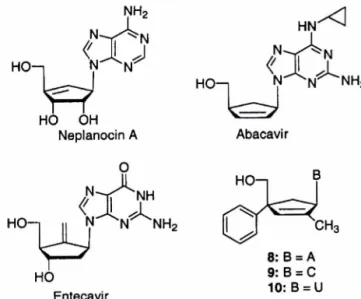
카보사이클릭 뉴크레오사이드1〉는 당부분의 산소가 탄소로 치 환된 분자구조를 가지며 흥미있는 항암효과와 항바이러스효과를 가진 매우 전망이 밝은 분자구조로 이루어 졌다. 특히, (-)- aristeromycin2)과 neplanocin A3)는 천연에서 얻을 수 있는 화합 물로서 카보사이클릭 뉴크레오사이드를 대표하는 화합물이다. 그 외에 abacavir4)와 entecavir5)(Fig. 1)와 같은 합성 카보사이클릭 뉴크레 오사이 드는 human cytomegalovirus(HCMV),6) herpes virus,^ hepatitis B virus(HBV),8) human immunodeficiency virus(HIV)9)와 같은 바이러스에 대하여 탁월한 항비이러스 효과 를 나타낸다.
이들 카보사이 클릭 뉴크레오사이드는 분자구조에 glycosidic bond를 가지고 있지 않아 뉴크레오사이드의 가수분해 효소인 phosphorylase10)에 대하여 화학적으로 안정한 분지구조이다. 또 한 카보사이클릭 뉴크레오사이드는 체세포 효소인 S-adenosyl- L-homocysteine(AdoHcy) hydrolase# 저해하여 여러 가지 약효 를 나타내는 것으로 알려지고 있다. 이 효소는 5-adenosyl-
#본 논문에 관한 문의는 저자께게로 (전화) 062-230-6378 (팩스) 062-222-5414 (E-mail) [email protected]
Neplanocin A
ᄋ
故
Entecavir
Fig. 1 - Structures of olefinic carbocyclic nucleosides and target nucleosides.
methionine(SAM) 의존성 methylatioir을: 조절하며 AdoHcy룰 가 역적으로 adenosine과 homocysteine으로 가수분해한다.11) S- adenosyl-L-homocysteine(AdoHcy) hydrolas을• 저해함으로서 결 과적으로 AdoHcy의 농도가 증가된; 그럼으로 AdoHcy가 효소의
88
2’• 메칠및 4’-페닐측쇄를가진새로운카보사기클릭뉴크레오사기드의힙성및함비이러스익효검색 89
작용을 저해하게 되며 AdoMet-dependent methylation reaction 이 차단된다.12) Methyltransferase는 mRNA를 성숙시키는데 반 드시 필요한 효소이다. 결과적으로 AdoHcy 대사를 차단함으로 서 methyltransferase가 저해되어 바이러스의 mRNA 생성이 중 단된다. AdoHcy는 대게 광범위 항바이러스 약효를 가진다. 특히 이와같은 작용기전과 다른 기전을 가진 뉴크레오사이드와 combination therapy을 통한 약물개발이 활발하게 진행되고 있 다. 카보사이클릭 뉴크레오사이드는 이와 같이 흥미있는 작용기 전과 다양한 항바이러스 약효를 가지고 있기 때문에 본 연구에 서는 2번 위치에 methyl기와 4번 위치에 phenyl기를 동시에 가 진 새로운 카보사이클릭 뉴크레오사이드를 합성하고 이들의 항 바이러스 약효를 검색하고자 일련의 반응을 수행하였다.
실 험 방 법
시약 및 기기
본 실험에 사용된 시약들은 Aldrich 社,Sigma 社, Tokyo Kasei 社, 및 Fluka A 에서 구입한 특급과 일급시약을 시용하였 으며 silica gel(230~400 mesh)은 Merck사 제품을 사용하였고, 용매는 필요에 따라 정제하여 사용하였다. Thin layer chromato- graphy(tlc)는 Kieselgel F254(0.25 mm>l- 비른 유리핀을 잘라 이 용하였으며 tic spot은 자외선램프 UVGL-58과 Anisaldehyde, KM n04 발색시약을 사 용 하였다. 융점 측정은 Gallen-Kamp m elting point apparatus를사용하였으며, 이에 대한보정은하 지 않았다. NMR spectra는 tetramethylsilane(TMS)를 내부 표 준물질로 하여 FT-300MHZ를 사용하였다.
(re/)-(3i? and 3S,5S)-5-(t-Butyldimethylsilyloxymethyl)- 2-methyl-6-phenyl-hepta-l,6-dien-3-ol(2) - 알데히드 1(5.0 g, 16.42 mmol)를 무수 THF(120m/)에 용해하였다. 여기에 isopro- penylmagnesium bromide(19.7 m l, 1.0 M in THF屠 -20oC에서 천천히 부가하였다. 2시간 후에 포화 NH4C1 용액을 부가하여 반 응을 종결하였다. 천천히 반응액을 상온까지 올리고 EtOAc와 물 로 추출하였다. 유기용매층을 brine으로 씻은 후, 무수 M g S O ^ 건조, 여과, 감압농축하여 그 잔사를 colum n chromatography (EtOAo/hexane=l:7)로 정제하여 오일상의 화합물 2(4.83g, 85%)를 얻었다. Diastereomeric mixture로서: ^ NM R (CDC13, 300 MHz) 5 7.48-7.32 (m, 5H), 6.09-6.03 (m, 1H), 5.44-4.23 (m, 4H), 4.25-3.53 (m, 3H), 2.13-2.19 (m, 2H), 1.86 (s, 3H), 0.96 (m, 9H), 0.10 (s, 3H), 0.05 (s, 3H); 13C N M R (CDC13, 75 MHz) 8 148.19, 144.65, 143.17, 142.42, 128.10, 127.59, 127.42, 126.48, 115.23, 114.07, 109.99, 72.18, 72.02, 69.03, 67.90, 49.39, 43.04, 42.25, 25.79, 18.19,17.83, -5.52, -5.78.
(reZ)-(lR,4S)-4-(t-Butyldim ethylsilyloxym ethyl)-2- methyl-4-phenyl-cyclopent-2-enol(3p); and (reZ)-(lS,4S)-
4-(t-Butyldimethylsilyloxymethyl)-2-methyl-4-phenyl- cyclopent-2-enol(3a) - 혼합물 2(4.0 11.54 m m ol)을 무수 CH2C12(20m/)에 용해하고 여기에 Grubbs' catalyst 11(195mg, 0.23 mmol)을 0oC에서 부가하였다. 반응액을 철야동안 환류교반 한 후 감압 농죽하였다. 그 잔사를 column chromatography (EtO A c/hexane=l: 5)로 정제하여 유상의 cyclopentenol 유도체 3p(1.7g, 46%)과 3a(1.7g, 46%>S 각각 얻었다. 화합물 3p: lH NM R (CDC13, 300 MHz) 8 7.26-7.11 (m, 5H), 5.55 (s, 1H), 4.26 (dd, /= 11 .4 Hz, 1H), 3.62 (d, /= 9 .3 Hz, 1H), 3.44 (d, /= 9 .3 Hz, 1H), 2.35 (dd, /= 13.8, 6.9 Hz, 1H), 2.10 ( d ,/ =
13.8 Hz, 1H), 1.81 (s, 3H), 0.81 (s, 9H), 0.05 (s, 6H); 13C NM R (CDCI3, 75 M Hz) 8 145.61, 144.98, 129.79, 128.38, 126.47, 78.24, 70.25, 58.05, 46.45, 25.97, 18.59, 14.07, -5.42;
화합물 3oc: lH NM R (CDCI3, 300 MHz) 5 7.36-7.23 (m, 5H), 5.83 (s, 1H), 4.75 (d, / = 6.6 Hz, 1H), 3.69 (d, /^=9.6H z, 1H), 3.62 (d, /= 9 .6 Hz, 1H), 2.86 (dd, 7=13.2, 7.5 Hz, 1H), 1.95 (dd, /=13.2, 5.7 Hz, 1H), 1.91 (s, 3H), 0.89 (s, 9H), 0.07 (s, 6H); 13C N M R (CDCI3, 75 M H z) 5 146.60, 143.49,131.13, 128.12, 126.55, 126.07, 79.38, 71.19,56.62, 46.12, 25.79, 18.16, 13.71, -5.62.
(rel)-( IR
,4S)-1 -Ethoxycarbonyloxy-4-(t-butyldimethyl- silyloxymethyl)-2-methyl-4-phenyl-cyclopent-2-ene(4) - 화 합! : 3p(2.0g, 6.27m m ol)을: 무수 pyridine(7 m /H 용해하고, 여 기에 0oC 에서 ethyl chloroformate(0.89 m/, 9.40 mmol) 과 dimethyl aminopyridine(85 mg, 0.7 mmol)을 부가하였다. 반응액 을 상온에서 철야동안 교반한 후 포화 NaHC03 용액 (2 rn im 부 가하여 반응을 종결하였다. 반응혼합액을 toluene과 혼합히여 감 압 농축한 후, EtOAc와 물로 추출하였다. 유기 용매층을 brine 으로 씻고, 무수 MgS04로 건조, 여과, 감압 농축하였다. 잔사를 column chromatography(EtOAc/hexane=l: 10)로 정 제하여 유 상의 화합물 4(2.20 g, 90%)를 얻었다. 1H NMR (CDC13, 300 MHz) d 7.37-7.25 (m, 5H), 6.09 (s, 1H), 5.57 (t, /= 3 .6 Hz, 1H), 4.32 (q, /= 6 .9 Hz, 2H), 3.80 (dd, /= 12 .9 , 9.3 Hz, 2H), 2.69 (dd, /= 14.4, 7.8 Hz, 1H), 2.37 (d d,/= 1 4.4, 3.6 Hz, 1H), 1.93 (s, 3H), 1.42 (t, /= 6 .9 Hz, 3H), 0.90 (s, 9H), 0.04 (s, 6H); 13C N M R (CDCI3, 75 M Hz) d 155.30, 145.79,138.61, 135.55, 127.93, 126.94, 126.05, 84.70, 71.39, 63.80,57.25, 41.82, 25.77, 18.19, 14.31, 13.98, -5.60.
(re/)-(l'iJ,4'S)-9-[4-(t-Butyldim ethylsilyloxym ethyl)- 2-methyl-4-phenyl-cyclopent-2-en-l-yl] adenine(5) - NaH (53.25 mg, 2.22 mmol)을: 무수 DMSC)(6.0m/)에 용해하고, 여기 에 adenine(300 mg, 2.22 mmol)을 가한 후 50~55oC에서 3Q&
동안 교반하고 상온으로 온도를 내렸다. 한편, 무수 THF(5 m/) 에 Pd2(dba)3 • CHCl3(28mg, 15 나mol)을 용해하고 P(CW-Pr)3
Vol. 48’ No, 1, 2004
90 양선화 . 홍준희
(0.56 m/, 1.4 mmol)을 가하고 30분 동안 상온에서 교반한 용액 을 위의 a denm fl 들어있는 반응액에 천천히 부가하였다. 이 반 응 혼합액에 무수 THF(5m/)에 용해된 출발물질 4(819 mg, 2.1 mmol)을 천천히 가한 후,반응액을 60oC에서 철야동안 교반하 였다. 반응액을 상온까지 냉각한 후에 물(4 m/)을 가하여 빈응을 종결하였다. 반응액을 methylene chloride와 물로 추출한 후에 유기용매 층을 무수 M gS04로 건조, 여과, 감압 증발하였다. 잔 사를 column chromatography(MeOH/CH2Cl2= 1 : 10)로 정제하 여 백색고체상의 화합물 6(320 mg, 35%)을 얻었다. mp 198〜
200°C; UV (MeOH) 261.5 nm; lH N M R (CDC13, 300 MHz) d 8.29 (s, 1H), 7.96 (s, 1H), 7.31-7.19 (m, 5H), 5.84 (s, 1H), 5.59 (dd, /= 8 .4 , 7.2 Hz, 1H), 3.75 (s, 2H), 2.85 (dd, 7=13.5,8.7 Hz, 1H), 2.50 (dd, /=13.5, 6.6 Hz, 1H), 1.59 (s, 3H), 0.84 (s, 9H), 0.02 (s, 6H); 13C N M R (CDC13, 75 MHz) 5 156.27, 153.33, 151.03,147.12,142.50, 140.12,131.77, 129.46, 126.47, 125.50, 119.05, 79.31,72.24,57.89, 46.47, 25.86, 18.24,13.32, -5.41.
(reZ)-(l'JR,4,S)-l-[4-(t-Butyldimethylsilyloxymethyl)-2- methyl-4-phenyl-cyclopent-2-en-l-yl] cytosine(6) - 화합물 5와 유사한 방법으로 6번 화합물을 합성 하였다. Yield 32%; mp 180〜 1820C; UV (MeOH) ^ 271.5 nm; !H N M R (CDC13, 300 MHz) d 7.50 (d, /= 6 .9 Hz, 1H), 7.30-7.22 (m, 5H), 5.94 (m, 2H), 5.57 (m, 1H), 3.79 (s, 2H), 2.91 (dd, /=14.0, 8.6 Hz, 1H), 2.55 (dd, /=14.0, 6.8 Hz, 1H), 1.62 (s, 3H), 0.86 (s, 9H), 0.05 (s, 6H); 13C NM R (CDC13, 75 MHz) 8 167.21, 157.45, 147.63, 143.01,142.82, 131.73, 127.71, 126.59, 126.12, 93.50, 78.62, 71.78, 57.12, 46.12, 25.52, 18.20, 13.89, -5.54.
(re/)-(l'/2,4,S)-l-[4-(t-Butyldimethylsilyloxymethyl)-2- methyl-4-phenyl-cyclopent-2-en-l-yl]uracil(7) - 화합물 5와 유사한 방법으로 7번 화합물을 합성 하였다. Yield 30%; mp 188〜 190oC; UV (MeOH) ^ 268.5 nm; lH NM R (CDC13, 300 MHz) d 7.78 (d ,/= 8 .0 H z , 1H), 7.31-7.19 (m, 5H), 5.81 (s, 1H), 5.62 (d, /= 8 .0 Hz, 1H), 5.62 (m, 1H), 3.78 (dd, / = 13.4, 4.5 Hz, 2H), 2.30 (dd, /= 13.6, 8.5 Hz, 1H), 2.05 (dd, /=13.6, 6.4 Hz, 1H), 1.61 (s, 3H), 0.86 (s, 9H), 0.06 (s, 6H);
13C NMR (CDC13, 75 MHz) 8 166.47, 151.92,145.12, 142.34, 130.32, 128.17, 126.45, 126.12, 102.67, 78.21, 69.67, 57.61, 46.01, 26.21, 18.34, 13.23, -5.47.
(re/)-(l'i2,4'S)-9-[4-(Hydroxymethyl)-2-methyl-4-phenyl- cyclopent-2-en-l-yl]adenine(8) - 화합물 5(100 mg, 0.23 mmol)을 무수 THF reagent(TBAF)(5 m/)에 용해하고 상온에서 씨 간 동안 교빈하였다. 빈응액을 김합 농축한 후에 잔사를 column chromatography(MeOH/CH2Cl尸 I : 5)로 정제히여 백색고체상의 화합물 8(63.5 mg, 86%)을 얻었다. mp 202〜 204oC; UV (H20)
261.0 nm; lH NM R (DMSO-i/6, 300 M H z) 5 8.16 (s, 1H), 8.10 (s, 1H), 7.35-7.22 (m, 5H), 7.20 (br s, D20 exchangeable, -NH2), 5.97 (s, 1H), 5.47 (br s, 1H), 4.69 (br s, D20 exchangeable, OH), 3.65 (d, /= 3 .9 , Hz, 2H), 2.49 (dd, /=14.0, 9.4 Hz, 1H), 2.01 (dd,/= 1 4.0, 6.0 Hz, 1H), 1.57 (s, 3H); 13C N M R (D M S 0 ^ 6, 75 M Hz) 8 156.90, 154.23, 151.92, 145.77, 142.63, 139.56, 132.51, 128.67, 126.61, 126.12, 118.71,78.63, 70.78, 57.21, 46.78, 14.02.
(rcZJ^l'iJ^'SJ-l-t^CHydroxymethyO^-methyl-^phenyl- cyclopent-2-en-l-yl]cytosine(9) - 화합물 8과 유사한 방법으로 9번 화합물을 합성 하였다. yield 78%: mp 179〜 181°C; UV (H20 ) 271.0 nm; N M R (D M S 0 ^ 6, 300 M Hz) d 7.48 (d, /= 7 .2 Hz, 1H), 7.32-7.18 (m, 5H), 7.02 (br d, D20 ex
changeable, -NH2), 5.94 (s, 1H), 5.76 (d, /= 7 .2 Hz, 1H), 5.46 (t,/= 7 .5 Hz, 1H), 4.72 (t, / = 6.6 Hz, TXzO exchangeable, OH), 3.54 (d, /= 9 .0 Hz, 2H), 3.15 (d, /= 9 .0 H z , 1H), 2.43 (dd, /=13.5, 9.3 H z’ 1H), 2.01 (dd,/= 1 3 .5 ,6.6 Hz, 1H), 1.55 (s, 3H) 13C NM R (DMSO-d6, 75 MHz) 8 166.87, 156.70, 145.81, 143.45, 142.45, 130.78, 128.21, 127.12, 126.45, 92.12, 80.82,71.48, 56.73, 47.54, 13.88.
(re/J-fl'/^^'SJ-l-t^CH ydroxym ethyO ^-m ethyW -phenyl- cyclopent-2-en-l-yl]uracil(10) - 화합물 8과 유사한 방법으로 10번 화합물을 합성 하였다. yield: 84%; mp 198~200°C; UV (H20 ) 267 nm; lH NM R (DMSO-rf6,300 M H z) 8 7.69 (d, /= 7 .8 Hz, 1H), 7.35-7.21 (m, 5H), 5.63 (s, 1H), 5.54 (d, /= 7 .8 Hz, 1H), 5.33 (d, /= 4 .3 Hz, 1H), 4.70 (t, /= 6 .7 Hz, D20 exchangeable, OH), 3.39 (dd, 7=12.5, 8.6 Hz, 2H), 2.23 (dd, /=13.0, 8.5 Hz, 1H), 2.00 (dd,/= 1 3.0, 6.8 Hz, 1H), 1.52 (s, 3H); 13C N M R (D M S 0 ^ 6, 75 M Hz) 5 165.76, 151.51, 145.81, 143.21, 142.78, 129.34, 128.46, 126.99, 126.12, 103.22, 78.24, 71.21, 57.21, 47.12, 13.56.
실험결과 및 고찰
Scheme 1 에 나타낸 바와 같이 목적하는 뉴크레오사이드를 합 성하기 위해서 합성방법이 알려진1 a,(3-unsaturated ester유도 체 1를 출발물질로 선택히였다. 1번 화합물에 CH2=C (C H 3)MgBr 를 이용한 Grignard 반응을 수행하여 부분입체이성질체로서 bis- olefin 유도체 2를 85%의 높은 수율로 합성할 수 있었다. 이성질 체를 분리하지 않고 Grubbs’ catalyst II14)를 처리하여 3 a 와 3P 를 1 :1 비율로 합성하였으며 이들은 silica gel column chro
matography^. 분리되었다. 각각의 입체구조는 NOE를 이용하여 쉽게 확정할 수 있었다. 3p와 달리 3 a 의 H-1 과 H-&게서는 NOE 가 관찰되었다. 이들 화합물중에서 3p만이 목적하는 뉴크레오사
]• Pharm. Soc. Korea
2’• 메칠 및 4•- 페닐 측쇄를 가진 새로운 카M시이클릭 뉴크레오시이드의 합성 및 함비이러스 약효검색 91
ref. 13
2-Hydroxy acetophenone
8: B = A (86%) 9: B = C (78%) 10: B = U 84%)
5: B = A (35%) 6: B = C (32%) 7 :B = U (30%)
3a: X = H, Y = OH (46%) 3P: X = OH, Y = H (46%) Hi
90%x 4:X = 0 C 0 2Et, Y = H
Reagents: i) CH2=C(CH3)MgBr, THF, -20 °C; ii) Grubbs' catalyst II, CH2CI2,reflux, overnight; iii) CICO2ᄐt, DMAP, pyridine, rt; iv) Bases (A = adenine, C = cytosine, U : uracil), Pd2(dba>3.CHCI3, P(ᄋ-/■Pr)3, NaH, THF/DMSO, reflux, overnight; v) TBAF, THF, rt.
Scheme 1 - Synthesis of 2 -methyl and 4,-phenyl branched carbocyclic nucleosides.
이드와 같은 입체구조를 가진 반응 중간체이기 때문에 3P에 ethyl chloroformate를 촉매량의 DM AP와 함께 처리하여 목적하는 ethoxycarbonyl 화합물 4을 90% 수율로 합성 할 수 있었다.
염기류(A=adenine, C=cytosine, U =uracil)를 금속촉매인 Pd2(pda)3 . CHC13을 이용하여15) 축합한 결과 원하는 입체구조 를 가진 뉴크레오사이드 유도체인 5~7을 30-35% 수율로 각각 합성할 수 있었다. 최종 뉴크레오사이드를 합성하기 위하여 각 각의 화합물에 tetrabutyl ammonium fluoride(TBAF)룰 처리하 여 목적하는 8~ 10을' 합성할 수 있었다.
본 연구에서 합성된 adenine, cytosine, uracil 유도체는 모두 신규 화합물임을 문헌조사에서 알 수 있었으며 합성된 화합물을 여러 가지 바이러스(HIV-1, HSV-1, HSV-2, CoxB3 virus)에 대 한 항바이러스 약효를 검색하였지만, 오직 cytosine 유도체 9가 CoxB3 virus에 대하여 약한 항바이러스 약효(EC50=45.4 나M )를 보여주었다.
감사의 말씀
이 논문은 2002년도 조선대학교 학술연구비 (연구조교D)의 지 원을 받아 연구되었음으로 이에 감사드립니다.
참고문헌
1) (a) Borthwick, A. D. and Biggadike, K. : Synthesis of chiral
carbocyclic nucleoside. Tetrahedron 48, 571 (1992); (b) Agrofoglio,L.,Suhas, E., Farese, A., Condom, R., Challand, S., Earl, R. A. and Guedj, R. : Synthesis of carbocyclic nucleosides. Tetrahedron 50,10611 (1994).
2) (a) Borchardt, R. T. and Wu, Y. S. : Potential inhibitors of S- adenosylmethionine-dependent methyl transferase. 1. Modifi - cation of the amino acid portion of 5-adenosylhomocysteine. /.
Med. Chem. 17, 862 (1974); (b) Borchardt, R. T., Huber, J. A.
and Wu, Y. S. : Potential inhibitors of S-adenosylmethionine- dependent methyltransferase. 2. Modification of the base portion of 5-adenosylhomocysteine. /• Med. Chem. 17, 868 (1974); (c) Borchardt, R. T. : Inhibition of indolethylamine- N- methyltransferase by analogs of 5-adenosylhomocysteine.
Biochem. Pharmacol. 24, 1542 (1975).
3) Marquez, V E. : In advances in antiviral drug design, JAI press, vol. 2, pp 89 (1996), and references therein.
4) Daluge, S. M., Good, S. S., Faletto, M. B., Miller, W H., StClair, M. H., Boone, L. R. Tisdale, M .,Parry, N. R.,Reardon, J. E., Domsife, R. E., Averett, D. R. and Krenitsky, T. A. : 1592U89, a novel carbocyclic nucleoside analog with potent, selective anti-human immunodeficiency virus activity. Antimicrob.
Agents Chemother. 41, 1082 (1997).
5) Levine, S., Hernandez, D., Yamanaka, G., Zhang, S., Rose, R., Weinheimer, S. and Colonno, R. J. : Efficacies of entecavir against lamivudine-resistance hepatitis B virus replication and recombinant polymerase in vitro. Antimicrob. Agents Chem
other. 46,2525 (2002).
VoL 48, No. 1, 2004
92 잉선화 . 흉준희
6) Slusarchyk, W A., Young, M. G., Bissacchi, G. S., Hockstein, D. R. and Zahler, R. : Synthesis of SQ-33,054, a novel cyclobutane nucleoside with potent antiviral activity.
Tetrahedron Lett. 30,6453 (1989).
7) Borthwick, A. D., Kirk, B., Biggadike, K., Exall, A., Butt, S., Roberts, S., Knight, D., Ryan, J. and Coates, D. : Fluorocarbocyclic nucleosides: synthesis and antiviral activity of 2'- and 6'-fluorocarbocyclic 2'-deoxy guanosine. /• Med Chem. 34,907 (1991).
8) Price, R M. Baneijee, R. and Acs, G. : Inhibition of the replication of hepatitis B virus by the carbocyclic analogues of 2'-deoxyguanosine. Proc. N atl Acad. Sci. USA 86, 8541 (1989).
9) Hayashi, S., Norbeck, D. W, Rosenbrook, W, Fine, R. L., Matsukura, M., Plattner, J. J., Broder, S. and Mitsuya, H. : Cyclobut-A and cyclobut-G, carbocyclic oxetanocin analogs that inhibit the replication of human immunodeficiency virus in T cells and monocytes and macrophases in vitro. Antimicrob.
Agents Chemother. 34,287 (1990); Vince, R. and Hua, M. : Synthesis and anti-HIV activity of carbocyclic 2',3'-didehydro- 2,,3'-dideoxy-2,6-disubstituted purine nucleosides. J. Med.
Chem. 33, 17 (1990).
10) Herdewijn, R, De Clercq, E., Balzarini, J. and Vanderhaeghe, H.
: Synthesis and antiviral activity of the carbocyclic analogues of
®-5-(2-halovinyl)-2'-deoxyuridines and (E)-5-(halovinyl)-2- deoxycytidines. J. Med. Chem. 28, 550 (1985).
11) (a) Palmer, J. L. and Abeles, R. H. : The mechanism of action
5-adenosyl homocysteinase. J. B iol Chem. 254, 1217 (1979);
(b) Ueland, R M .: Pharmacological and biochemical aspects of 5-adenosyl homocysteine and S-adenosylhomocysteine hydrolase. Pharmacol Rev. 34, 223 (1982).
12) (a) Hoffman, J. L .: The rate of transmethylation in mouse liver as measured by trapping S-adenosylhᄋmocysteine. Arch.
Biochem. Biophys. 205,132 (1980); (b) Helland, S. and Ueland, R M .: Inactivation of S-adenosylhomocysteine hydrolase by 9- P-D- arabinofuranosyladenine in intact cells. Can. Res. 42, 1130 (1982).
13) Hong, J. H. and Ko, O. H .: Synthesis of 4'a-C phenyl-branched carbocyclic nucleoside using ring-closing metathesis. Bull. Kor.
Chem. Soc. 24, 1289 (2003).
14) (a) Grubbs, R. H. and Chang, S. : Recent advances in olefin metathesis and its application in organic synthesis. Tetrahedron 54, 4413 (1998); (b) Gurjar, M, K. and Maheshwar, K. : Stereoselective synthesis of a novel carbocyclic nucleoside. J.
Org. Chem. 66,7552 (2001).
15) (a) Crimmins, M. T., King, B. W, Zuercher, W. J. and Choy, A.
L. : An efficient, general asymmetric synthesis of carbocyclic nucleosides: application of an asymmetric aldol/ring-closing metathesis strategy. J. Org. Chem. 65, 8499 (2000); (b) Hong, J. H., Shim, M. J., Ro, B. O. and Ko, O. H .: An efficet synthesis of novel carbocyclic nucleosides with use of ring-closing metathesis from D-lactose. J. Org. Chem. 67,6837 (2002).
J. Pharm. Soc. Korea