Demographic and Clinical Characteristics of Primary Frozen Shoulder in a Korean Population: A Retrospective Analysis of 1,373 Cases
Chul-Hyun Cho, Tae Won Koo, Nam-Su Cho1, Kyoung-Jin Park2, Bong Gun Lee3, Dongju Shin4, Sungwook Choi5, Seung-Hyun Cho6, Myung-Sun Kim7, Sang-Hun Ko8, Chul-Hong Kim9, Jin-Young Park10, Yon-Sik Yoo11
Department of Orthopedic Surgery, Dongsan Medical Center, Keimyung University School of Medicine, Daegu, 1Department of Orthopedic Surgery, Kyung Hee University Hospital at Gangdong, Seoul, 2Department of Orthopedic Surgery, Chungbuk National University College of Medicine, Cheongju, 3Department of Orthopedic Surgery, Hanyang University Seoul Hospital, Seoul, 4Department of Orthopedic Surgery, Daegu Fatima Hospital, Daegu, 5Department of Orthopedic Surgery, Jeju National University Hospital, Jeju, 6Department of Orthopedic Surgery, Gachon University Gil Medical Center, Incheon, 7Department of Orthopedic Surgery, Chonnam National University Medical School, Gwangju, 8Department of Orthopedic Surgery, Ulsan University Hospital, University of Ulsan College of Medicine, Ulsan, 9Department of Orthopedic Surgery, Dong-A University College of Medicine, Busan, 10Center for Shoulder, Elbow & Sports, Neon Orthopaedic Clinic, Seoul, 11Department of Orthopedic Surgery, Hallym University Dongtan Sacred Heart Hospital, Hwaseong, Korea
Background: The aim of this study was to investigate the demographic and clinical characteristics of patients with primary frozen shoul- der in a Korean population.
Methods: A total of 1,373 patients whose shoulders were diagnosed with primary frozen shoulder across 11 resident-training hospitals were reviewed retrospectively. Various demographic characteristics and clinical characteristics according to gender and presence of dia- betes were evaluated.
Results: The average age of patients was 55.4 years. Gender proportion was 58.3% females and 41.7% males. The frozen shoulder in- volved the non-dominant arm in 60.7% of patients and the bilateral arms in 17.6% of patients. The average duration of symptoms was 8.9 months, and 51.3% of patients had experienced nocturnal pain. Comorbidities associated with frozen shoulder in our sample of patients included diabetes (18.7%), cardiovascular diseases (17.7%), thyroid diseases (5.4%), and cerebrovascular diseases (3.6%). The diabetic group was correlated with the following demographic and clinical characteristics: old age, involvement of the dominant arm, nocturnal pain, long duration of symptoms, and no history of trauma. Further, we found that, in males, having a frozen shoulder was significantly correlated with a history of trauma; in females, having a frozen shoulder was significantly correlated with having thyroid diseases.
Conclusions: These demographic data of primary frozen shoulder in the Korean population were consistent with those of previously reported epidemiologic studies. Primary frozen shoulder with diabetes was correlated with old age, bilateral involvement, long duration of symptoms, and nocturnal pain.
(Clin Shoulder Elbow 2015;18(3):133-137)
Key Words: Frozen shoulder; Primary; Risk factors; Diabetes mellitus Clinics in Shoulder and Elbow Vol. 18, No. 3, September, 2015 http://dx.doi.org/10.5397/cise.2015.18.3.133
Received January 26, 2015. Revised April 26, 2015. Accepted April 28, 2015.
Correspondence to: Yon-Sik Yoo
Department of Orthopedic Surgery, Hallym University Dongtan Sacred Heart Hospital, 7 Keunjaebong-gil, Hwaseong 18450, Korea Tel: +82-31-8086-2413, Fax: +82-31-8036-2029, E-mail: yooo@hallym. ac.kr
Financial support: This work was supported by the National Research Foundation of Korea (NRF) Grant funded by the Korea Government in 2013 (NRF-2013R1A1A1076068). Conflict of interests: None.
Introduction
Frozen shoulder is often interchangeably referred to as an ad- hesive capsulitis or a peri-arthritis of the shoulder. It is one of the most common etiologies that can occur shoulder pain and dis- ability.1-3) Frozen shoulder can be broadly categorized into two
subgroups depending on the etiology; primary frozen shoulder is idiopathic in origin whereas secondary frozen shoulder can be explained, for example, by fractures, surgeries, cervical herni- ated discs, and other lesions of the shoulder.1,4,5)
Primary frozen shoulder is a disabling condition that restricts shoulder motion globally and causes pain without obvious in-
trinsic etiologies; after a long period of symptomatic status of around 1 to 2 years, it is known to spontaneously resolve.4,5) However, several studies reported that some patients may have permanent restriction of shoulder motion without spontaneous resolution.1,4-6)
Limited motions of the glenohumeral joint in a frozen shoul- der influences the normal function of the other joints that to- gether compose the shoulder anatomy: scapulothoracic joint, acromioclavicular joints, and sternoclavicular joints. Subsequent- ly, an abnormal dynamics of the shoulder leads to a decreased ability of the upper limb to function; the patients’ quality of life is severely compromised.1) As Cho et al.7) reported, that patients with frozen shoulder had noticeable pain and functional disabil- ity. Furthermore, they had significant incidence of sleep distur- bance by nocturnal pain and had a significantly lower quality of life.
Despite its clinical importance, a consensus has not been reached with regards to the terminology of the condition, etiol- ogy, incidence, classification, diagnosis criteria, and treatment of frozen shoulder.3) The incidence of frozen shoulder has been shown to be on the rise because of an aging population, changes in life habits, and increases in chronic diseases, yet the number of epidemiological studies relating to frozen shoulder that is published in the literature does not reflect this trend.8-12) A large- scale epidemiological study specifically on Asian populations is scarce. In this regard, accumulating epidemiological data on primary frozen shoulder in Koreans will prove to be immensely beneficial by facilitating the comparative analysis to equivalent western epidemiology data and by providing clinicians with a better knowledge of the clinical characteristics and prognosis of frozen shoulder. Thus, the aim of this study was to investigate the demographic and clinical characteristics of primary frozen shoulder in the Korean population through a multi-center epide- miological study.
Methods
Eleven resident-training hospitals contributed to this study.
We retrospectively analyzed the demographic and clinical characteristics of 1,373 patients who presented with a primary frozen shoulder between January 2013 and December 2013. A diagnosis of a primary frozen shoulder was made if the following criteria were fulfilled: restricted active and passive shoulder mo- tions of more than 50% of the total motion without no intrinsic or extrinsic etiologies. Even patients with comorbidities such as diabetes, thyroid diseases, cardiovascular diseases, and cerebro- vascular diseases were included in our study. Those diagnosed with a secondary frozen shoulder with any etiology (for example, fractures, surgery, cervical herniated discs, arthritis, infection, ro- tator cuff tear, or calcific tendinitis) were excluded.
We accumulated patient information regarding the follow-
ing demographic and clinical factors: age, gender, involved side, bilateral involvement, duration of symptoms, nocturnal pain, his- tory of trauma, occupational status, smoking, and menopause, for demographic variables, and the prevalence of comorbidities such as diabetes–a known risk factor for frozen shoulder, thyroid diseases, cardiovascular diseases, and cerebrovascular diseases, as clinical variables. We carried out a comparative analysis of these demographic and clinical characteristics between genders and between presence of diabetes by subgrouping the patients into either the diabetic group or the non-diabetic group.
All statistical analyses were performed using the SPSS statisti- cal package ver. 13.0 (SPSS Inc., Chicago, IL, USA). Comparative analyses of the demographic and clinical characteristics between groups stratified into either gender or presence of diabetes were made using an independent t-test and a chi-square test. Statisti- cal significance was set to a p-value<0.05.
Results
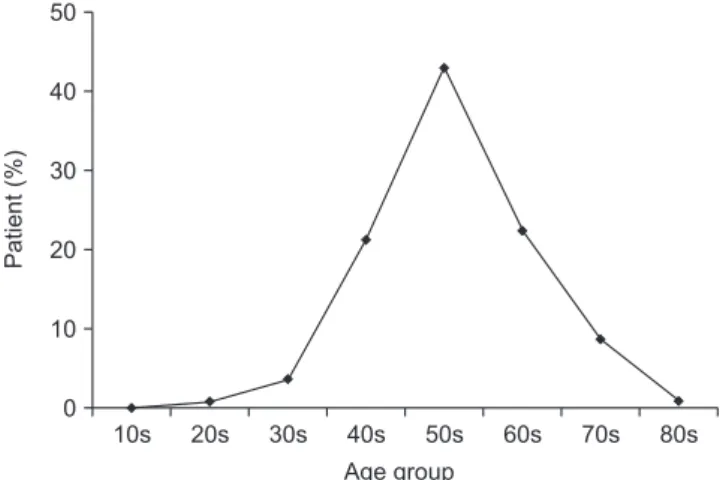
We found that the gender distribution of 800 females (58.3%) and 573 males (41.7%) in our sample of patients with frozen shoulder was tilted towards females. The average age of the pa- tients was 55.4 ± 9.9 years (range, 19–89 years), and the sex- specific average ages of the two genders were 55.5 ± 9.2 years for females and 55.3 ± 10.8 years for males (p>0.05). When the data were age-stratified, we found the following proportions of age-groups: in the order of decreasing proportion, 43.0% of patients were in their 50s; 22.4%, in their 60s; 21.2%, 40s; 8.7%, 70s; and 3.6%, 30s (Fig. 1). A total of 833 patients (60.7%) pre- sented with frozen shoulder on their non-dominant arm where- as 540 patients (39.3%) presented on their dominant arm. Of these, a total of 242 patients (17.6%) had bilateral involvement of the arms either at the time of diagnosis or had had a past his- tory of involvement of the contralateral arm.
The average duration of symptoms was 8.9 ± 17.3 months.
Fig. 1. The incidence of primary frozen shoulder according to age.
10s 50
40
30
20
10
0
20s 30s 40s 50s 60s 70s 80s
Patient(%)
Age group
Despite males having an average symptomatic period of 9.6 ± 18.4 months that is longer than that of the females, 8.4 ± 16.4 months, the difference was not statistically significant (p>0.05).
Of the total patients, 705 patients (51.3%) complained of sleep disturbance attributed to nocturnal pain, and 260 patients (18.9%) had a history of trauma–220 patients (16.0%) had minor trauma and 40 (2.9%) had major trauma–preceding the onset of symptoms.
In terms of the occupational status, 563 patients were un- employed (41.0%), 286 were laborers (20.8%), 276 were office workers (20.1%), and 248 were otherwise categorized (18.1%).
The number of patients who smoked was 258 patients (18.8%).
Of the 800 female patients, the number of patients who had ex- perienced menopause or acute changes in menstrual cycle was 560 (70.0%).
In terms of the medical comorbidities, a total of 257 patients (18.7%) had diabetes, a well-known risk factor for frozen shoul- der, 243 patients (17.7%) had cardiovascular diseases such as
hypertension, arrhythmia, and coronal artery diseases, 74 pa- tients (5.4%) had thyroid diseases, and lastly 50 patients (3.6%) had cerebrovascular diseases such as stroke, hemorrhage, and Parkinson’s disease.
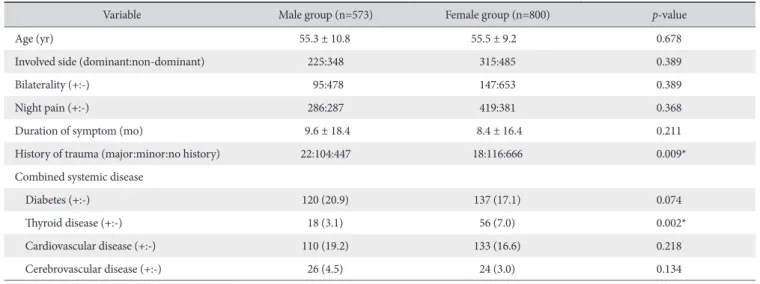
Gender-dependent correlation between frozen shoulder and clinical characteristics were as follows: in males, we found that frozen shoulder was significantly correlated with a history of trau- ma; and in females, frozen we found that frozen shoulder was significantly correlated with thyroid diseases (p=0.009, 0.002).
No statistically significant differences were found from gender- stratified groups for the following variables; arm dominance, bilateral involvement, nocturnal pain, duration of symptoms, presence of diabetes, cardiovascular diseases, and cerebrovascu- lar diseases (p>0.05) (Table 1).
Next, we sought to find a difference in the correlation be- tween frozen shoulder and the clinical characteristics in diabet- ics and in non-diabetics. We found that in the diabetic group was associated with old age, arm dominance, bilateral involve-
Table 1. Comparison of Demographic and Clinical Characteristics according to Gender
Variable Male group (n=573) Female group (n=800) p-value
Age (yr) 55.3 ± 10.8 55.5 ± 9.2 0.678
Involved side (dominant:non-dominant) 225:348 315:485 0.389
Bilaterality (+:-) 95:478 147:653 0.389
Night pain (+:-) 286:287 419:381 0.368
Duration of symptom (mo) 9.6 ± 18.4 8.4 ± 16.4 0.211
History of trauma (major:minor:no history) 22:104:447 18:116:666 0.009*
Combined systemic disease
Diabetes (+:-) 120 (20.9) 137 (17.1) 0.074
Thyroid disease (+:-) 18 (3.1) 56 (7.0) 0.002*
Cardiovascular disease (+:-) 110 (19.2) 133 (16.6) 0.218
Cerebrovascular disease (+:-) 26 (4.5) 24 (3.0) 0.134
Values are presented as mean ± standard deviation, number only, or nember (%).
*Statistically significant.
Table 2. Comparison of Demographic and Clinical Characteristics between Diabetic and Non-diabetic Groups
Variable Diabetic group (n=257) Non-diabetic group (n=1,116) p-value
Age (yr) 57.8 ± 10.4 54.8 ± 9.7 <0.001*
Gender (male:female) 120:137 453:663 0.074
Involved side (dominant:non-dominant) 118:139 422:694 0.017*
Bilaterality (+:-) 66:191 176:940 <0.001*
Night pain (+:-) 154:103 551:565 0.002*
Duration of symptom 11.1 ± 16.6 8.4 ± 17.4 0.026*
History of trauma (major:minor:no history) 3:36:218 37:184:895 0.041*
Values are presented as mean ± standard deviation or number only.
*Statistically significant.
ment, nocturnal pain, a long symptomatic period, no history of trauma with a statistical significance but not the non-diabetic group (p<0.001, p=0.017, p<0.001, p=0.002, p=0.026, and p=0.041). No statistically significant difference in gender was found in either group (p>0.05) (Table 2).
Discussion
The clinical significance of this study is that it was a multi-cen- ter epidemiological study on primary frozen shoulders character- ized using a definite diagnostic criteria of solely a Korean popu- lation; such a study is first of its kind to our knowledge. From our study, we found that most patients with primary frozen shoulder did not present with a comorbidity; when accompanied, the comorbidities that were found were as follows: in the order of decreasing proportion, diabetes, cardiovascular diseases, thyroid diseases, and cerebrovascular diseases. Even though the average age of the patients at the onset of symptoms was 55 years, the range of patients who presented with primary frozen shoulders was large between 19 and 83 years.
In recent years, the incidence of frozen shoulder has been on the rise–a phenomenon that is attributed to an aging population, changing life habits, increase in chronic diseases, and improved diagnostic tools. Even though numerous researches on frozen shoulder exist, they are focused on elucidating the molecular biological basis of etiology and on devising the best treatment methods. As such, epidemiology studies looking at the demo- graphics and incidence of frozen shoulder is sparse, and even those that have been carried out have been done so between the 60s and 90s.8,9,11,12) Therefore, clinicians may be ill-advised when extracting information from these outdated sources con- cerning the demographic and clinical characteristics of frozen shoulder, which by nature are heavily influenced by changing environmental and social factors. Moreover, most studies are on western subjects meaning that the data may not be applicable to Asian-background populations. Our study is clinically relevant in that it aims to improve on these limitations.
The incidence of frozen shoulder worldwide is 2% to 5%
showing an annual cumulative incidence of 2.4 cases in every 1,000 persons.1,4,5,12-16) Frozen shoulder is known to be a condi- tion to occur more in females, and usually the age of the patient at disease onset ranges from 40 to 60 years. Frozen shoulder oc- curs more on the non-dominant arm than on the dominant arm, and as for a bilateral involvement the percentage value of pa- tients with a bilateral involvement at the time of diagnosis or on a contralateral involvement in the past varies massively between reports from just 6% to 50%.1,4,5)
According to a study by Robinson et al.,15) primary frozen shoulder frequently occurs in individuals in their 40s to 60s, and the incidence outside this range is rare except for cases of sec- ondary frozen shoulders. In this study, however, although 86.5%
of patients with frozen shoulder were in their 40s to 60s, they were closely followed by those in their 70s, who took up 8.7%
of the proportion of patients with frozen shoulder. The higher prevalence of frozen shoulder in the elderly in our study than of that seen in other studies may be due to an aging population in Korea. An aging population with a greater life expectancy is expected also to show a higher prevalence of diseases, some of which may be risk factors for frozen shoulder. Lundberg11) found in 232 patients that the average age of patients with primary fro- zen shoulder was 52 years in females and 55 years in males at the time of symptom onset. In comparison to their study where the age at the onset of symptoms was higher in males than in females, in our study, we did not a significant difference in age between the genders.
Most studies report a stronger correlation between frozen shoulder and females than between frozen shoulder and males:
Shaffer et al.17) reported that of 62 patients with frozen shoulders 43 were women (69%) and 10% had a bilateral involvement;
Hand et al.10) reported that, of 223 patients, 61% were women and 20% had a bilateral involvement; and Lundberg11) reported that 58% were women and 17% had a bilateral involvement.
Similarly, in this study, the corresponding values were 58.3% and 17.8%; 60.7% showed an association with the non-dominant arm.
Known diseases associated with frozen shoulder are diabe- tes–which shows the strongest correlation, Dupuytren’s disease, thyroid diseases, cardiovascular diseases, Parkinson’s disease, stroke, adrenal insufficiency, autoimmune diseases, and oth- ers.4,5,10,11,13-16,18,19) As the patient group with one of the high- est risks for frozen shoulder, between 10% to 36% of diabetic patients develop frozen shoulders.13,18,19) Patients with insulin- dependent diabetes mellitus have been shown to have a bilater- ally involved frozen shoulder at a rate of 40% to 42%, which is 2 to 4 times as higher as the rate seen in healthy counterparts (10%
to 20%).9,11,13) Bridgman9) reported that 10.8% of 800 diabetic patients presented with frozen shoulder whereas only 2.3% of non-diabetic individuals showed to have this condition con- currently. Further, the proportion of individuals with a bilateral involvement of frozen shoulder was up to 41.7% in the diabetic pool, whereas this decreased to 21.4% in the non-diabetic pool.
In accordance with previous studies, we found that high per- centages of patients were found to have a comorbidity–the high- est being diabetes: 257 patients (18.7%) had diabetes; 243 pa- tients (17.7%) had cardiovascular diseases such as hypertension, arrhythmia, and coronal artery disease; 74 patients (5.4%) had thyroid diseases; and 50 patients (3.6%) had cerebrovascular dis- eases such as stroke, hemorrhage, and Parkinson’s disease. With this strong correlation of diabetes with frozen shoulder in mind, in this study, we compared the demographic and clinical charac- teristics of patients according to their diabetic status. Compared to the non-diabetic group, the diabetic group showed a higher
average age (57.8 years vs. 54.8 years) at the onset of symp- toms, a higher association with the dominant arm, and a more frequent bilateral involvement (25.7% vs. 15.8%). Further in our cohort, the diabetic group was more likely to have nocturnal pain (59.9% vs. 49.3%) and a longer duration of symptoms (11.1 months vs. 8.4 months) than the non-diabetic group.
There are a few limitations to this study: first, as a retrospec- tive study on patients with primary frozen shoulder, we could not incorporate into our study the many risk factors related to frozen shoulders; second, we could not calculate the inci- dence of frozen shoulder; and last, as our study did not include matched healthy controls against patients with frozen shoulder, we could not evaluate the risk factors specific for this condition.
To address these limitations, prevalence studies and large-scale multi-center prospective cohort studies are needed.
Conclusion
Our epidemiological study on primary frozen shoulders in Koreans showed similar findings to those of preexisting epide- miological studies. We found that primary frozen shoulder with diabetes was correlated with old age, bilateral involvement, long duration of symptoms, and nocturnal pain.
References
1. Korean Shoulder and Elbow Society. The shoulder and elbow.
1st ed. Seoul: Young Chang Medical Book; 2007. 289-98.
2. Neviaser JS. Adhesive capsulitis of the shoulder: a study of the pathological findings in periarthritis of the shoulder. J Bone Joint Surg Am. 1945;27(2):211-22.
3. Sheridan MA, Hannafin JA. Upper extremity: emphasis on fro- zen shoulder. Orthop Clin North Am. 2006;37(4):531-9.
4. Endres NK, ElHanssan B, Higgins LD, Warner JJ. The stiff shoul- der. In: Rockwood CA, Matsen FA, Wirth MA, Lippitt SB, Feh- ringer EV, Sperling JW, eds. The shoulder. 4th ed. Philadelphia:
Saunders; 2008. 1405-35.
5. Pillai G, Cuomo F. Classification, evaluation and nonoperative treatment of frozen shoulder. In: Zuckerman JD, Iannotti JP, Miniaci A, Williams GR, eds. Disorders of the shoulder: diag- nosis and management. 3rd ed. New York: Lippincott Williams
& Willkins; 2014. 203-10.
6. Nam KY, Moon YL, Kim DH. Bursoscopic finding in primary adhesive capsulitis of the shoulder. J Korean Shoulder Elbow Soc. 2008;11(1):19-23.
7. Cho CH, Jung SW, Son ES, Hwang IS. Sleep status and quality of life in patients with frozen shoulder. J Korean Orthop Assoc.
2012;47(3):205-10.
8. Binder AI, Bulgen DY, Hazleman BL, Roberts S. Frozen shoul- der: a long-term prospective study. Ann Rheum Dis. 1984;
43(3):361-4.
9. Bridgman JF. Periarthritis of the shoulder and diabetes mellitus.
Ann Rheum Dis. 1972;31(1):69-71.
10. Hand C, Clipsham K, Rees JL, Carr AJ. Long-term outcome of frozen shoulder. J Shoulder Elbow Surg. 2008;17(2):231-6.
11. Lundberg BJ. The frozen shoulder. Clinical and radiographical observations. The effect of manipulation under general anes- thesia. Structure and glycosaminoglycan content of the joint capsule. Local bone metabolism. Acta Orthop Scand Suppl.
1969;119:1-59.
12. van der Windt DA, Koes BW, de Jong BA, Bouter LM. Shoul- der disorders in general practice: incidence, patient character- istics, and management. Ann Rheum Dis. 1995;54(12):959- 64.
13. Guyver PM, Bruce DJ, Rees JL. Frozen shoulder: a stiff prob- lem that requires a flexible approach. Maturitas. 2014;78(1):
11-6.
14. Hsu JE, Anakwenze OA, Warrender WJ, Abboud JA. Current review of adhesive capsulitis. J Shoulder Elbow Surg. 2011;
20(3):502-14.
15. Robinson CM, Seah KT, Chee YH, Hindle P, Murray IR. Frozen shoulder. J Bone Joint Surg Br. 2012;94(1):1-9.
16. Shah N, Lewis M. Shoulder adhesive capsulitis: systematic review of randomised trials using multiple corticosteroid injec- tions. Br J Gen Pract. 2007;57(541):662-7.
17. Shaffer B, Tibone JE, Kerlan RK. Frozen shoulder. A long-term follow-up. J Bone Joint Surg Am. 1992;74(5):738-46.
18. Li W, Lu N, Xu H, Wang H, Huang J. Case control study of risk factors for frozen shoulder in China. Int J Rheum Dis. 2015;
18(5):508-13.
19. Wang K, Ho V, Hunter-Smith DJ, Beh PS, Smith KM, Weber AB. Risk factors in idiopathic adhesive capsulitis: a case control study. J Shoulder Elbow Surg. 2013;22(7):e24-9.