• 검색 결과가 없습니다.

Production of DNA polymerase from Thermus aquaticus in recombinant Escherichia coli

N/A
N/A
Protected

Academic year: 2021

Share "Production of DNA polymerase from Thermus aquaticus in recombinant Escherichia coli"

Copied!
5
0
0

로드 중.... (전체 텍스트 보기)

전체 글

(1)

Production of DNA polymerase from Thermus aquaticus in recombinant Escherichia coli

Sung-Gun Kim

1

, Jong-Tae Park

2

*

1

Department of Biomedical Science, Youngdong University, Chungbuk 370-701, Korea

2

Department of Food Science and Technology, Chungnam National University, Daejeon 305-764, Korea Received on 30 May 2014, revised on 8 August 2014, accepted on 14 August 2014

Abstract : Among dozens of DNA polymerases cloned from thermophilic bacteria, Taq DNA polymerase from Thermus aquaticus has been most frequently used in polymerase chain reaction (PCR) that is being applied to gene cloning, DNA sequencing, gene expression analysis, and detection of infectious and genetic diseases. Since native Taq DNA polymerase is expressed at low level in T. aquaticus, recombinant Escherichia coli system was used to produce Taq DNA polymerase in a large amount. Taq DNA polymerase was expressed as a soluble form under the control of tac promoter in E. coli, and purified by heat treatment and ion exchange chromatographies. The purified Taq DNA polymerase was nearly homogeneous and exhibited a similar DNA amplification activity with a commercial Taq DNA polymerase.

Key words : Taq DNA polymerase, polymerase chain reaction, recombinant protein, Escherichia coli

*Corresponding author: Tel: +82-42-821-6728 E-mail address: [email protected]

I. Introduction

Since polymerase chain reaction (PCR) is a useful method for the rapid amplification of target DNA sequences (Erlich, 1989), it has been extensively used in the biotechnology field including disease diagnosis, gene cloning and DNA sequencing (Bachmann et al., 1990; Hamilton et al., 2001; Louws et al., 1999;

Marchuk et al., 1991). The gene amplification process involves repeated cycles of heat denaturation of a DNA template, annealing of primers to the com- plementary DNA strands, and extension of the annealed primers with DNA polymerase and deoxynucleotides, which results in the exponential amplification of the DNA sequence between the flanking primers. Because of the heat denaturation step, a DNA polymerase that is stable during the repetitive thermal denaturation is required in PCR reactions.

More than 50 thermostable DNA polymerases have been isolated from various organisms including

thermophiles and archaea. The thermostable DNA polymerases elevated optimal temperature for poly- merization of 70 to 80 C and are single-subunit proteins of 80 to 115 kDa in solution, which are different to multi-subunit DNA polymerases from eubacteria (Klimczak et al., 1985; Kong et al., 1993;

Takagi et al., 1997). Due to their potential industrial

applications, various thermostable DNA polymerases

have been studied for the structure and thermostability

relationship and commercialized in many biotechnology

companies. Among them, Taq DNA polymerase has

been most commonly used in PCR. It was first purified

in 1976 from Thermus aquaticus that was isolated

from a hot spring in Yellowstone National Park (Chien

et al., 1976). The PCR technique using Taq DNA poly-

merase was patented by Cetus Corporation in 1989 and

currently the market for Taq DNA polymerase is in

the hundreds of millions of dollar per year. However,

since most thermostable enzymes are present at very

low level in the thermophilic bacteria which are

difficult to grow to obtain large quantity protein, the

purification of Taq DNA polymerase from T. aquaticus

(2)

results in low yields.

In this study, recombinant E. coli was exploited to produce Taq DNA polymerase in a large amount. Taq DNA polymerase was produced in recombinant E. coli where an expression plasmid cloned with polA coding sequence under the control of tac promoter was transformed. Taq DNA polymerase expressed as a soluble form in E. coli was purified via a heat treatment and a series of chromatography steps, and then applied to PCR reactions.

II. Materials and Methods

1. Bacterial strain and plasmid

A plasmid p33 was used for the expression of Taq DNA polymerase. The expression plasmid p33 was kindly provided by Dr. Masayori Inouye at University of Medicine and Dentistry of New Jersey. The expression of Taq DNA polymerase is under the control of the tac promoter, which can be induced by adding isopropyl- β-d-thiogalactopyranoside (IPTG). E. coli DH5α was used for the expression of Taq DNA polymerase.

2.Culture condition

Recombinant E. coli DH5a cells harboring plasmid p33 were cultured at 37°C in a 500-mL baffled flask containing Luria-Bertani medium (10 g/L tryptone, 5 g/L yeast extract, 10 g/L NaCl) supplemented with 50 mg/L ampicillin. Expression of Taq DNA polymerase was induced at the logarithmic growth phase (OD600

= 0.5 ~ 1.0) by adding 1 mM isopropyl-β-d-thiogalacto- pyranoside (IPTG), and allowed to grow for another 4 hr.

3. Purification of Taq DNA polymerase

The cells induced with IPTG for 4 hr were collected at 6,000 rpm for 10 min, and resuspended in 50 ml

of a resuspension buffer (50 mM Tris, pH 7.9, 50 mM glucose, 1 mM EDTA). The resuspended cells were disrupted by sonication, and the insoluble debris was removed by centrifugation at 12,000 rpm for 20 min at 4°C. The supernatant was incubated at 75°C for 1 hr to denature E. coli cellular proteins, which were removed by centrifugation at 12,000 rpm for 20 min at 4°C. The supernatant was applied to a DEAE column equilibrated with an anion binding buffer (10 mM Tris, pH 7.9, 1 mM EDTA, 0.5% Tween 20). After washing 5 column volumes, proteins bound to the anion exchanger were eluted by increasing KCl concentration up to 500 mM. The fractions containing Taq DNA polymerase was pooled and then desalted by dialysis against a cation binding buffer (20 mM HEPES, pH 6.9, 1 mM EDTA, 0.5% Tween 20) using a 10 kDa MWCO dialysis membrane for a subsequent purification step. The Taq DNA polymerase purified partially in the anion exchange chromatography was subjected to cation exchange chromatography on SP Sepharose Fast Flow using a 10 ml-Econo pack column (Bio-rad, Herculis, CA, USA). Taq DNA polymerase bound to the cation exchanger was eluted with KCl in a stepwise gradient of 0.0-500 mM over 10 column volumes. The purified Taq DNA polymerase was stored at -20°C in a Taq storage buffer (50 mM Tris, pH 8.0, 100 mM NaCl, 0.1 mM EDTA, 5.0 mM DTT, 1.0% Triton X-100, 50% glycerol).

4. Polymerase chain reaction

The relative Taq DNA polymerase activities were

determined by comparing band intensities of DNA

amplified by polymerase chain reaction (PCR) using

the purified and the commercial (Solgent Co., Daejeon,

Korea) Taq DNA polymerases. In this study, a 10 X

reaction buffer (100 mM Tris, pH 9.0, 500 mM KCl,

1.0% Triton X-100, 20 mM MgCl2, 10 mM b-mercap-

toethanol) was also prepared for PCR. E. coli BL21

(DE3) genomic DNA was used as the template DNA to

(3)

Table 1. Oligonucleotides used in this study.

Oligonucleotide Nucleotide sequence

ppiA-F ppiA-R

5´-GAATTCCTCGAGCATGTTCAAATCGACCCTGGCGGCGATG-3´

5´-AATCGCGAGCTCTTATTACGGCAGGACTTTAGCGGAAAGGAT-3´

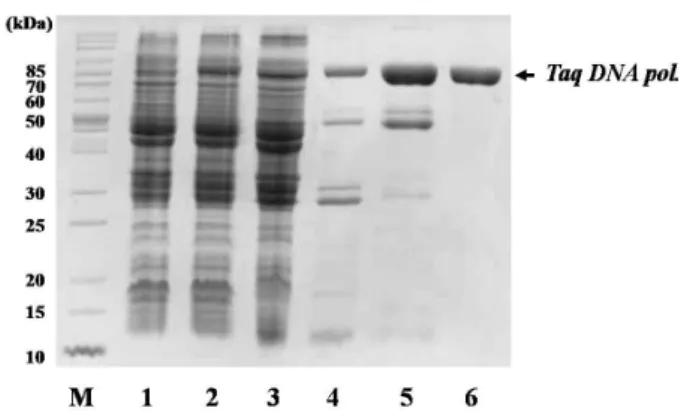
Fig. 1. SDS-PAGE analysis for expression and purification of Taq DNA polymerase from recombinant E. coli. Lane M, Marker proteins; Lane 1, E. coli cells before induction; Lane 2, E. coli cells after induction with IPTG; Lane 3, Soluble fraction after cell disruption; Lane 4, Soluble fraction after heat treatment at 75 C for 1 hr; Lane 5, Anion exchange chromatography; Lane 6, Cation exchange chromatography.

amplify the coding sequence of ppiA gene. The primers used to amplify ppiA gene in the PCR reaction are listed in Table 1. The PCR reaction was carried out in a 50 μl mixture containing 1 μl of plasmid DNA (20 ng), 5.0 μl of the 10X reaction buffer, 2.5 μl of a deoxynucleosides triphosphate (dNTP) mixture (2.5 mM of each dNTP), 2 μl of each primer (10 pM), 38 μl of DNase-free water and 1 μl of the purified or the commercial Taq DNA polymerase. After amplification with an automated thermocycler (GeneAmp PCR 2400, Perkin Elmer, Norwalk, CT, USA) for 30 cycles (30 sec at 94°C for denaturation, 30 sec at 55°C for annealing and 1 min at 72°C for extension), 10 μl of PCR mixture was analyzed by electrophoresis on a 1%

agarose gel in 0.5X TAE buffer.

5. Analytical methods

Optical density of the cells was measured at 600 nm of wavelength using a spectrophotometer (Optizen POP, Optizen, Daejeon, Korea). Dry cell weight was then obtained using a pre-determined correlation factor (0.367) between optical density and dry cell weight. Protein concentration was determined using the protein assay kit (Bio-rad) according to the manufacturer’s instruction. The protein samples were analyzed by SDS-PAGE using 14% gel with the Mini- PROTEIN® 3 Electrophoresis Cell (Bio-rad). Proteins on the gel were visualized by staining with Coomassie brilliant blue R-250 (Sigma, Saint Louis, MO, USA).

III. Results and Discussion

1. Expression of Taq DNA polymerase To assess the expression of Taq DNA polymerase in

recombinant E. coli, the plasmid p33 was transformed into E. coli DH5α. When the recombinant E. coli strain harboring p33 was induced with 1 mM IPTG in a batch culture containing LB medium, the expression of Taq DNA polymerase was analyzed with SDS-PAGE (Fig. 1).

In comparison with the cells before induction, a

distinct band of ca. 90 kDa was visualized in the cells

after IPTG induction. The apparent molecular weight

of Taq DNA polymerase is in accordance with its

theoretical molecular weight of 93.9 kDa, suggesting

that the full-length Taq DNA polymerase is able to

be produced in recombinant E. coli. Even though Taq

DNA polymerase was not overexpressed in E. coli, but

it was determined as a soluble form. The low expression

level of Taq DNA polymerase is likely attributed to

the high frequency of rare codons of E. coli in the

gene of Taq DNA polymerase. The rare codons in the

gene of Taq DNA polymerase was analyzed. These

amino acid residues include arginine, leucine, proline,

which are present in overall region of the gene (data

not shown).

(4)

Fig. 2. Analysis of apparent molecular weight for purified and commercial Taq DNA polymerases. The position of Taq DNA polymerase was indicated by the arrow. Lane M, Marker proteins; Lane C, commercial Taq DNA polymerase (Solgent Co.) (1X); Lane 1, purified Taq DNA polymerase (1X); Lane 2, purified Taq DNA polymerase (0.5X); Lane 3, purified Taq DNA polymerase (0.25X); Lane 4, purified Taq DNA polymerase (0.125X).

2. Purification of Taq DNA polymerase

Since the Taq DNA polymerase expressed in E. coli is a soluble form and has a thermostable nature, the cell lysate was incubated at 75 C for 1 hr prior to chromatographic purification steps. The Taq DNA polymerase was not observed in the insoluble fraction, indicating that it did not undergo the heat-denatured aggregation (data not shown). The vast majority of E. coli cellular proteins were denatured and thus eliminated by centrifugation following the heat treatment (Fig. 1, lane 4). There were still various contaminant proteins after the heat treatment even at 75 C for 1 hr, that are likely thermostable E. coli proteins. Fifteen cellular proteins of E. coli (DnaK, transcription pausing factor L (NusA), trigger factor (TF), maltose-binding proteins (MBP), galactose glucose- binding protein, FK-506-binding protein (FKBP), D-ribose binding protein (RbsB), adenylate kinase (AKN), outer membrane lipoprotein carrier protein, ribosomal protein S19 (RS19), putative EscN protein (EscN), and GroES) were identified to be thermostable (Thapa et al., 2008). For further purification, the soluble fraction of the heat-treated cell lysate was subjected to an anion exchange chromatography with Tris buffer at pH 7.9, since its theoretical isoelectric point (pI) is 6.03. The proteins electrostatically bound to a anion exchanger Q Sepharose fast flow resin was eluted by increasing KCl concentration in a stepwise manner. The SDS-PAGE analysis for the eluted fractions showed that major contaminant E. coli proteins were observed in the flow-through fractions but several contaminant proteins were co-purified with Taq DNA polymerase in the anion exchange chromatography.

Taq DNA polymerase was eluted at 0.1 M KCl. The fractions containing Taq DNA polymerase were pooled and desalted for a subsequent purification step. The desalted sample was loaded to a column packed with a cation exchanger (SP Sepharose fast flow). The column was washed with HEPES buffer (pH 6.9) and

then eluted with a stepwise gradient of KCl. The co-purified proteins in the anion exchange chro- matography did not bind to the cation exchanger.

However, most Taq DNA polymerase was eluted upon increasing KCl concentration, indicating an electrostatic binding of Taq DNA polymerase to the cation exchanger.

The purity of Taq DNA polymerase in the cation exchange chromatography was nearly homogenous based on SDS-PAGE and densitometric analyses. The purified Taq DNA polymerase in the cation exchange chromatography was stored at -20°C after a buffer- exchange to a storage buffer.

3. Activity of Taq DNA polymerase

The purified Taq DNA polymerase was compared

with a commercial Taq DNA polymerase in terms of

apparent molecular weight and purity. Figure 2 clearly

shows that the purified Taq DNA polymerase has the

same molecular weight as the commercial Taq DNA

polymerase. In addition, both the purified and the

commercial Taq DNA polymerase were shown as a

single band in the SDS-PAGE gel. The band intensity

(5)

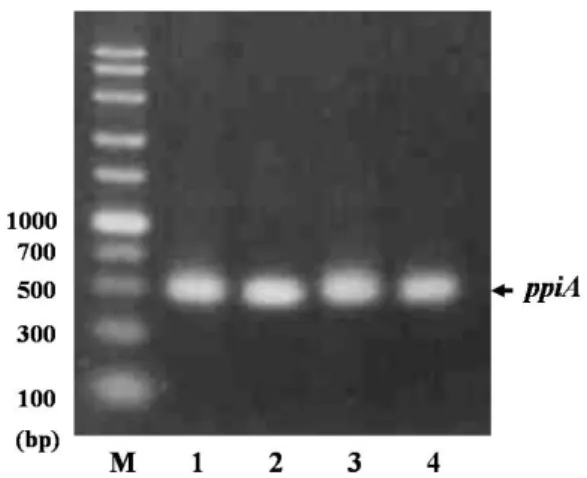
Fig. 3. Amplifications of ppiA gene of E. coli using the PCR kit produced in this study and a commercial kit. Lane M, DNA ladder; Lane 1, the purified Taq DNA polymerase and the reaction buffer prepared in this study; Lane 2, the commercial Taq DNA polymerase and the reaction buffer prepared in this study; Lane 3, the purified Taq DNA polymerase and the commercial reaction buffer ; Lane 4, the commercial Taq DNA polymerase and the commercial reaction buffer.

of the commercial Taq DNA polymerase was similar with that of the 4-fold diluted purified Taq DNA polymerase. Considering that the enzymatic activity of the commercial available Taq DNA polymerase is 5 U/μl, the activity of the purified Taq DNA polymerase could be estimated to be about 20 U/μl. The activity of the purified polymerase was also evaluated by PCR amplification and compared to the commercial Taq DNA polymerase. In the PCR reactions, both the Taq DNA polymerases effectively amplified ppiA gene of 573 bp from genomic DNA of E. coli BL21(DE3) showing the same band intensity (Fig. 3). When a PCR reaction buffer prepared in this study was replaced with the reaction buffer supplied with the commercial Taq DNA polymerase, the ppiA gene was amplified at the same levels as shown in Fig. 3. This result clearly demon- strates that the Taq DNA polymerase produced in this

study has a similar efficiency to the commercial Taq DNA polymerase.

References

Bachmann B, Lüke W, Hunsmann G. 1990. Improvement of PCR amplified DNA sequencing with the aid of detergents.

Nucleic Acids Research 18:1309.

Chien A, Edgar DB, Trela JM. 1976. Deoxyribonucleic acid polymerase from the extreme thermophile Thermus aquaticus.

Journal of Bacteriology 127:1550-1557.

Erlich HA. 1989. Polymerase chain reaction. Journal of Clinical Immunology 9:437-447.

Hamilton SC, Farchaus JW, Davis MC. 2001. DNA polymerases as engines for biotechnology. BioTechniques 31:370-383.

Klimczak L, Grummt F, Burger KJ. 1985. Purification and characterization of DNA polymerase from the archaebacterium Sulfolobus acidocaldarius. Nucleic Acids Research 13:5269- 5282.

Kong H, Kucera R, Jack W. 1993. Characterization of a DNA polymerase from the hyperthermophile archaea Thermococcus litoralis. Vent DNA polymerase, steady state kinetics, thermal stability, processivity, strand displacement, and exonuclease activities. Journal of Biological Chemistry 268:1965-1975.

Louws F, Rademaker J, De Bruijn F. 1999. The three Ds of PCR-based genomic analysis of phytobacteria: diversity, detection, and disease diagnosis. Annual Review of Phyto- pathology 37:81-125.

Marchuk D, Drumm M, Saulino A, Collins FS. 1991. Construction of T-vectors, a rapid and general system for direct cloning of unmodified PCR products. Nucleic Acids Research 19:

1154-1154.

Takagi M, Nishioka M, Kakihara H, Kitabayashi M, Inoue H, Kawakami B, Oka M, Imanaka T. 1997. Characterization of DNA polymerase from Pyrococcus sp. strain KOD1 and its application to PCR. Applied and Environmental Microbiology 63:4504-4510.

Thapa A, Shahnawaz M, Karki P, Dahal GR, Sharoar MG, Shin

SY, Lee JS, Cho B, Park I-S. 2008. Purification of inclusion

body-forming peptides and proteins in soluble form by fusion

to Escherichia coli thermostable proteins. BioTechniques

44:787-798.

수치

Fig. 1. SDS-PAGE analysis for expression and purification of  Taq DNA polymerase from recombinant E
Fig. 2. Analysis of apparent molecular weight for purified and  commercial  Taq DNA polymerases
Fig. 3. Amplifications of ppiA gene of E. coli using the PCR  kit produced in this study and a commercial kit

참조

관련 문서

Measurements items between the maxillary second premolar and the first molar: A, The occlusal plane and reference lines which were above 4, 6, 8 mm from cementoenamel junction

In addition, Wallace and Froum 20) reported that the bone formation rate was superior in the cases using a barrier membrane in comparison with the

We determined the nucleotide sequences of the mitochondrial DNA (mtDNA) control region using cloning and sequencing, and obtained the complete sequence from the cattle bones

The results show that the green seed extracts are only shown as antioxidants, but the others are shown as a prooxidants against DNA damage and Escherichia coli

 KAERI tested FSW between 10 mm thick CSC Cu coating and normal cu plate to get a sealing method of a disposal canister.  Before the FSW test, Bead-On test was done on the

The desalted crude is then sent to another series of heat exchangers (6 10) for heating to 427 o F then sent to exchangers (6-10) for heating to 427 o F, then, sent

tricuspidata on the production of proinflammatory cytokines in TNFα+IFNγ-stimulated HaCaT cells ...15 Fig.5: The cell viability of sub-fractions from 70% EtOH

 Blunt ends DNA containing restriction enzyme