• 검색 결과가 없습니다.

IEG 환경지질연구정보센터

N/A
N/A
Protected

Academic year: 2021

Share "IEG 환경지질연구정보센터"

Copied!
5
0
0

로드 중.... (전체 텍스트 보기)

전체 글

(1)

433

The Lateral Earth Pressure Distribution of the Earth Retaining Structure Installed in Colluvial Soil

Hong, Won-Pyo

1

and Yea, Geu-Guwen

2

*

1

Professor, Department of Civil and Environmental Engineering, Chung-Ang univ

2

Dept. of R&D, Sambu Construction Co., Ltd.

붕적토에 설치된 흙막이구조물의 측방토압분포

홍원표1·여규권2*

1

중앙대학교 공과대학 건설환경공학과,

2

삼부토건(주) 기술연구실

It's essential to build an earth retaining structure at the beginning and end point of a tunnel constructed in a col- luvium area. A large scale of colluvial soil may cause a problem to the stability of the excavation ground. An exca- vation in colluvium has different behavior characteristics from those in a sandy soil due to unstable elements and needs counter measures for it. There are few systematic research efforts on the behavior characteristics of an earth retaining structure installed in colluvial soil. Thus this study set out to collect measuring data from an excavation site at the tunnel pit mouth in colluvium and set quantitative criteria for the safety of an earth retaining structure.

After comparing and analyzing the theoretical and empirical earth pressure from the measuring data, the lateral earth pressure distribution acted on the earth retaining wall was suggested.

key words : colluvium, earth retaining structure, empirical earth pressure

붕적층에 시공되는 터널의 시 종점부 갱문은 흙막이가시설이 필요하다. 대규모의 붕적층은 굴착지반의 안정성에 문제 를 야기 시킬 수 있다. 붕적층에서 굴착은 사질토에서 굴착과는 다른 거동특성을 보이며, 사질토지반에 비해 불안정한 요소를 가지고 있어 이에 대한 대처방안이 필요하다. 그러나 붕적토에 시공되는 흙막이구조물의 거동특성에 대한 연구는 미진한 상태이다. 그러므로 본 연구에서는 붕적층에 터널갱구부가 위치한 굴착현장으로부터 계측자료를 수집하여 흙막이 구조물의 안정성을 판단할 수 있는 정량적인 기준을 마련하고자 한다. 그리고 계측자료를 활용하여 이론토압과 경험토압 을 비교 분석한 후 흙막이벽체에 작용하는 측방토압분포를 제한하였다.

주요어 : 붕적층, 흙막이구조물, 경험토압

Introduction

The recherches performed on earth retaining structure have mainly dealt with multi-layer ground and single layer ground of inland downtown area. Accordingly the calculation of lateral earth pressure at the colluvial soil in mountain topography with deep depth based on existing researches may generate unreasonable results.

Therefore the purposes of this research are to prepare

quantitative standard by compiling measurement data at the time of excavation works of colluvial soil at the tunnel pit mouth area with which the stability of earth retaining structures can be judged and also to suggest the lateral earth pressure given to the earth retaining wall through the comparison and analysis of theoretical earth pressure and empirical earth pressure based on earth pressure by utilizing measurement data at the time of installation of earth retaining structures.

*Corresponding author: [email protected]

(2)

Field condition

Site description

This research site is located from Sannai-myeon Milyang city to Sangbuk-myeon Ulsan Metropolitan City, and earth retaining structures were constructed at the beginning part of tunnel pit mouth among the tunnel work districts of total length of 4,580 m which pass through Sanoe-myeon and Sangbuk- myeon. The depth of colluvium layer of the object area for this research is 0.0 m~22.0 m and contains high level of rockmass while containing small quantity of residual soils, and therefore the result of water permeability test shows the water permeability coefficient of 1.56 × 10

−5

m/s on an average and underground water level was approximately G.L.( −) 15 m~16 m but it showed big fluctuation depending on the seasonal factor and precipitation.

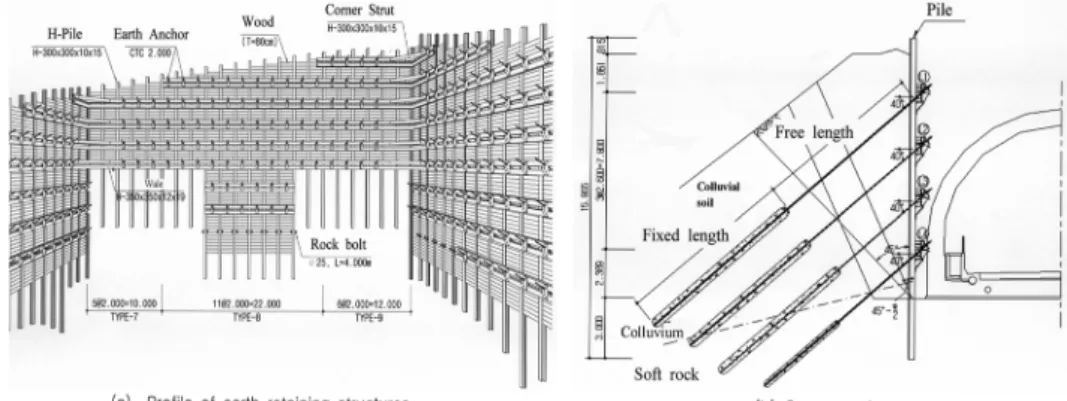
Anchored earth retaining structures status The type of earth retaining structure is adopted to the conventional method. Post piles(H-Pile, 300 × 300 × 10 × 15) were used for earth retaining structures while supporting method of earth retaining dry wall was on anchored support basis with anchor installation angle of 30

o

and the number of steel wire of 4-6 are installed. H-beam steel was used for earth retaining wall with the dimension of 350 × 350 × 12 × 9. The status of earth retaining structures and their cross section diagram is shown in the Fig. 1(a), (b).

Instrumentation system

In this research, the behaviors characteristics of earth retaining walls were investigated by load cell installing total 23 measuring instruments at the anchor. In order to measure the axial force of anchor as a major measurement item, while inclinometers were installed in order to investigate lateral displacement of earth retaining walls and the inverted ground during the construction.

And in order to survey the changes of underground water level during the excavation stage and ground water level gauge were installed near the inclinometer.

Result of measurement and analysis

Changes of underground water level

At the initial stage, the ground water level showed the distribution of G.L.( −)7.3 m~16.3 m while Fig. 2 Fig. 1. Earth retaining wall.

Fig. 2. Change of underground water-level.

(3)

show the gradual reduction of ground water level according to the increase in the number of days elapsed and the ground water level was converging toward the certain value which was almost similar to the height of excavated bottom.

Prediction of lateral earth pressure

Fig. 3 shows the prediction results of lateral earth pressure converted from measured anchor’s axial load.

Lateral earth pressures are calculated at each excavation stage using mid-point partition method. In order to illustrate the distribution of lateral earth pressure acted on the anchored earth retaining wall which was calculated as such, the elapsed days was plotted in the horizontal axis while lateral the earth pressure derived from anchor’s axial load are on the vertical axis.

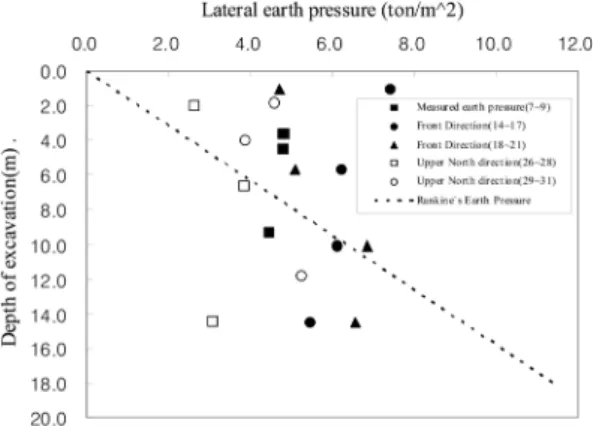
Comparison with theoretical earth pressure Fig. 4 is the comparison of the lateral earth

pressure predicted from the measured data and active earth pressure of Rankine(1857). As shown in the Fig. 4, there are big difference between actually measured earth pressure and Rankine’s active earth pressure because the earth pressures above 6 m with excavation depth of around 6 m showed bigger values than theoretical earth pressure but showed small values at the excavation depth of below.

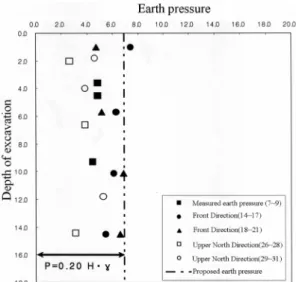
Comparison with empirical earth pressure The distribution of lateral earth pressure given to earth retaining wall of this sites and the distribution of empirical earth pressure by NAVFAC(1982), Hong and Yun(1995b) which were suggested for achored earth retaining wall were compared and reviewed.

Fig. 5(a) is a graph which illustrated the comparison of the suggested expression of NAVFAC, Hong and

Fig. 3. Lateral earth pressure given to anchored earth retaining wall.

Fig. 4. Comparison of measured earth pressure and Rankine`s earth pressure.

Fig. 5. Comparison with empirical earth pressure.

(4)

Yun(Pa = 0.65 Ka γH) and actually measured earth pressure. Maximum earth pressure of NAVFAC, Hong and Yun showed 7.6 ton/m

2

while showing actually measured earth pressure of 2.6~7.4 ton/m

2

with maximum 7.4 ton/m

2

. Fig. 5(b) shows the suggested expression of Hong and Yun(Pa = 0.2 γH) and actually measured earth pressure in graphic form and maximum earth pressure of Hong and Yun shows 7.0 ton/m

2

which represents smaller value by approximately 9% compared to the suggested expression of NAVFAC, Hong and Yun(Pa = 0.65 Ka γH). Fig. 5(c) shows the suggested expression of Hong and Yun(Pa = 0.4 Ko γH) and actually measured earth pressure in graphic form in which maximum earth pressure of Hong and Yun is 7.6 ton/m

2

, which shows the same value as the suggested expression of NAVFAC, Hong and Yun(P

a

= K

a

γH). Maximum actually measured earth pressure was 7.4 ton/m

2

and showed similar value to maximum value of empirical earth pressure of 7.0~7.6ton/m

2

and from this we can see that the distribution of earth pressure of anchored earth retaining dry wall in colluvial soil was similar to thesuggested expression of NAVFAC, Hong and Yun. However, actually measured earth pressure at the upper end of excavation showed a little bit bigger value than that of NAVFAC, Hong and Yun, it showed that predicted earth pressure was calculated to be a little bit bigger due to surcharge load at the back side of the excavation site.

Suggestion on lateral earth pressure distribution Fig. 6 shows maximum lateral earth pressure by respective cross section in graphic form in order to get the distribution of lateral earth pressure given to earth retaining wall and to calculate the form of maximum lateral earth pressure. As shown in the Fig. 6, the distribution of lateral earth pressure given to earth retaining dry wall showed rectangular form and the size of maximum lateral earth pressure of respective cross section was 0.12 γH ~0.21 γH.

Fig. 7(a) shows the distribution of earth pressure at Fig. 6. Maximum lateral earth pressure.

Fig. 7. Distribution of lateral earth pressure.

(5)

the flat ground behind the wall, and there maximum earth pressure is a little bit smaller but it shows the distribution of earth pressure in trapezoid form which is similar to the suggested earth pressure of Hong and Yun(Pa = 0.2 γH). And also the Fig. 7(b) show the earth pressure of slope ground behind the wall and we can see that the upper 0.3 H at the suggested earth pressure of Hong and Yun(Pa = 0.2 γH) shows the distribution in rectangular form.

Conclusions

Based on the measurement cases for the earth retaining structures installed at the colluvial soils at the beginning part of tunnel, we compared and analyzed the measurement cases against theoretical earth pressure and empirical earth pressure, and obtained the following conclusion:

1. The result of measuring at the site showed that changes of ground water level appeared to go down gradually with excavation depth and to converge at the same height as the final excavated bottom, which explicitly shows the characteristics of colluvial soil in which the water permeability coefficient is high.

2. The result of calculation of earth pressure through mean point partition method showed that the distribution of earth pressure depending on the depth showed approximately a trapezoid form.

3. The result of comparison of empirical earth pressure of NAVFAC, Hong and Yun (Pa=0.65Ka γ H) and actually measured earth pressure showed that maximum earth pressure of NAVFAC, Hong and Yun was 7.6 ton/m

2

. And also, maximum earth pressure of Hong and Yun(Pa = 0.2 γH) and Hong and Yun(Pa = 0.4 Ko γH) was 7.0~7.6 ton/m

2

respectively which showed similar value to the actually measured maximum earth pressure of 7.41ton/m

2

, and therefore it will be safe to use the suggested earth pressure of NAVFAC, Hong and Yun for anchored earth retaining dry wall in colluvial soil.

4. Based on this research, We would like to make a suggestion on the flat ground and slope

ground for earth pressure given to the anchored earth retaining wall in colluvial soil. that is to say, maximum earth pressure given to the anchored earth retaining wall in soils is Pa = 0.2 γH, and the distribution of earth pressure is the form of trapezoid, but slope ground behind the retaining wall has the rectangular form at the upper 0.3 H section.

References

Broms, B. B. and Stille, H. 1975, Failure of Anchored Sheet Pile Walls, Journal of Geotechnical Engineer- ing ASCE, 102(3), 235-251.

Caspe, M. S. 1966, Surface Settlement Adjacement to Braced Open Cut, Journal of Soil Mechanics and Foundation Engineering Div., ASCE, 92(SM4), 51-59.

Hong Won-Pyo and Yun Jung-Mann, 1995a, Lateral Earth Pressure given to anchored Earth Retaining Dry Wall at the time of underground excavation, Journal of Korean Geotechnical Society 11(1), 63-77.

Hong Won-Pyo and Yun Jung-Mann, 1995b, Research on the Stability of anchored Earth Retaining Dry Wall at the time of underground excavation, Korean Society of Civil Engineers, 15(4), 991-1002.

NAVFAC(1982) Design Manual for Soil Mechanics, Dept. of the Navy, Naval Facilities Engineering Com- mand, DM7.2-85-116.

Peck, R. B., 1969, Deep Excavation and Tunnelling in Soft Ground, Proc. 7

th

ICSMFE, State −οf −Art Vol- ume, 225-290.

Rackine, W. M. J., 1857, On Stability on Loose Earth, Philosophic Transactions of Royal Society, London, Part I, 9-27.

2008 년 10월 17일 원고접수, 2008년 12월 11일 게재승인 홍원표

중앙대학교 건설환경공학과

156-756, 서울시 동작구 흑석동 221번지 Tel: 02-820-5258

Fax: 02-824-0580 E-mail: [email protected]

여규권

삼부토건(주) 기술연구실

100-804, 서울시 중구 남창동 9-1번지 Tel: 02-3706-2537

Fax: 02-756-3905

E-mail: [email protected]

수치

Fig. 2. Change of underground water-level.
Fig. 3. Lateral earth pressure given to anchored earth retaining wall.
Fig. 7. Distribution of lateral earth pressure.

참조

관련 문서

Further, we define a firm’s maximum credit limit one (M CL 1 ) and maximum credit limit two (M CL 2 ) as the lower and upper bounds of asset value respectively, based on the

2 (Ministry of Food, Agriculture, Forestry and Fisheries and Korea Rural Commu- nity Corporation, 2015)... rpm and maximum injection pressure of 400 kgf/cm 2. 7) Using compressed

신뢰도 높은 분석을 위 하여 전 세계 수치표고모델과 유사시기에 촬영된 항공사 진의 영상정합으로 제작한 정밀 수치표고모델공간해상도 2 m 및 30 m과 국가기본도 표고점의

If CO 2 stored for geological sequestration escapes from deep formations and is introduced to shallow aquifers, it dissolves into groundwater, creates acidic environments, and

Ensemble probability distributions of 3 different subsurface media built from 100 single realizations conditioned on 2 borehole data at x = 100 and 400 m and 1st round history

현재 공룡발자국이 산출되는 배수로의 폭은 약 2 m 이나 발자국의 밀도가 비교적 높은 편으로 발자국이 산출 되는 지층면을 따라 발굴하면 많은 수의 다양한

현재 공룡발자국이 산출되는 배수로의 폭은 약 2 m 이나 발자국의 밀도가 비교적 높은 편으로 발자국이 산출 되는 지층면을 따라 발굴하면 많은 수의 다양한

High resolution chirp seismic profile and its interpretation showing two sedimentary units Unit 1 and 2, bounded by mid reflector-M, above the basal reflector-B.. SB: sequence