최광수·박재성
국립환경연구원 환경위해성연구부 환경역학조사과
Application of Probabilistic Health Risk Analysis in Life Cycle Assessment
Part I : A General Framework for Uncertainty and Variability Analysis of Health Risk in Life Cycle Assessment
Choi, Kwang-Soo·Park, Jae-Sung
Environmental Epidemiology Division, Department of Environmental Risk Research National Institute of Environmental Research, Seoul, Korea
Abstract
Uncertainty and variability in Life Cycle Assessment(LCA) have been significant key issues in LCA methodology with techniques in other research area such as social and political science.
Variability is understood as stemming from inherent variations in the real world, while uncertainty comes from inaccurate measurements, lack of data, model assumptions, etc.
Related articles in this issues were reviewed for classification, distinguish and elaboration of probabilistic/stochastic health risk analysis application in LCA.
Concept of focal zone, streamlining technique, scenario modelling and Monte Carlo/Latin Hypercube risk analysis were applied to the uncertainty/variability analysis of health risk in LCA. These results show that this general framework of multi-disciplinary methodology between probabilistic health risk assessment and LCA was of benefit to decision making process by suppling information about input/output data sensitivity, health effect priority and health risk distribution. There should be further research needs for case study using this methodology.
Keyword: Life Cycle Assessment, Health Risk Assessment/Management, Uncertainty/
Variability, Focal Zone, Streamlining Technique, Scenario Modelling, Probabilistic Health Risk Analysis
I. 서 론
환경적으로 건전하고 지속가능한 개발(Envi- ronmentally Sound and Sustainable Development;
ESSD)이라는 개념의 대두와 함께“환경보전과 개발의 조화”를 추구하기 위하여 다양한 연구기 법들이 적용·개발 되고있다. 1970년대초의 환경 영향평가(Environmental Impact Assessment), 1980 년대의 건강위해성평가(Health Risk Assessment), 그리고 비교적 최근인 1990년대에 급부상하여 주 목받고 있는 전과정평가(Life Cycle Assessment) 등의 방법론이 그것들이다.
이 기법들은 여러 기초 및 응용과학 학문분야 들이 학제적(Interdisciplinary)으로 결합하여 보다 다양하고 유용한 정보를 제공하는데 기여하고 있 으며 환경보전과 개발의 관점에 있어서 경제적, 생태적, 인간의 건강 측면 등에서 각 방법론의 특 성을 유지하며 발전하고 있다.
위 방법론 중 특히 전과정평가는 미국 코카콜 라사에서 1969년 여러가지 음료수병을 대상으로 Midwest Research Instutute에 의뢰하여 최초로 수 행된 이후 자원 및 환경 프로파일 분석(Resource and Environmental Profile Analysis; REPA)으로 알려졌고 1970년대에는 유사한 비교 전과정평가 연구를 미국뿐 아니라 유럽의 연구진들이 시작하 면서 Ecobalances로 알려져 많은 연구들이 진행되 었다. 1975년부터 1980년대 초의 에너지 위기로 자원절약에 대한 미국 정부의 관심이 고조되고 1980년대에서 1990년대 초까지 폐기물 급증에 대 한 대중들의 요구가 커지면서 전과정평가는 소비 되는 원재료와 에너지 소비, 배출되는 다량의 폐 기물 등으로 인한 환경부하에 초점을 두고 수행 되었다.8)
국내외에서 전과정평가가 본격적으로 관심을 받게된 계기는 국제무역기구(World Trade Organization; WTO)의 출범과 더불어 WTO에서 추진하고 있는 환경경영표준화(ISO 14000시리즈)
움직임 때문이다. 현재 환경경영시스템(Envi- ronmental Management System), 전과정평가(Life Cycle Assessment) 등을 포함한 총 7개 분야에 대해 표준화작업이 수행되고있다. 국내에서도 ISO 14000 시리즈가 국제 규격화된 하나의 무역 장벽으로 작용하여 경제에 심각한 영향을 미칠 수 있다는 우려 때문에 1994년부터 이에 대응하 고 있다(국제환경경영표준화대책반/제4작업반, 1994).1)
최근 전과정평가 연구에 자동차, 세제, 발전소, 건축물 등 적용되는 제품범위가 점차 커지고 적 용기법도 구조 경제학(Structural Economics), 독성 학(Toxicology), 확률분석(Probabilistic/Stochastic Analysis), 민감도분석(Sensitivity Analysis), 불확실 성분석(Uncertainty Analysis) 등 다양한 방법론이 적용되고 있고 평가지표로서 건강위해도(Risk)개 념 도입의 필요성이 제기되고 있다(Huijbregts, 1998).14)한편 건강위해성평가에서 위해도 예측시 존재하는 불확실성을 파악하기 위하여 몬테카를로 모의실험(Monte Carlo Simulation)이 적용되고 있는 데(Su et al., 1998)25) 전과정평가에서도 또한 이 기 법의 적용 필요성이 제기되고 있다(Huijbregts, 1998).14)
몬테카를로 모의실험은 가능한 상황을 확률분 포로 가정하여 이들 분포를 이루는 자료들이 예 측모델에서 계산되어 결과를 분포형태로 예측하 는 기법이다(Copeland et al., 1993; 박재성, 1997)9,2). VOCs, PAH 등의 대기오염으로 인한 위 해성평가 연구중 확률론적인 방법을 이용한 연구 사례들이 일부 보고되고 있으며(환경부, 1997)6) 화학제품의 생산 및 소비에 따른 위해 정도를 소 비형태에 따라 정량화한 연구도 일부 보고되고 있으나(Hertwich et al., 1999)12) 이를 전과정평가 에 적용한 사례는 국내에서 전무한 실정이다.
따라서 본 연구에서는 최근 전과정평가의 연구 를 문헌고찰하고 자료의 불확실성과 변이성에 대 한 확률론적 건강 위해도분석기법의 적용방안을
제시함으로써 전과정평가에 위해성평가기법 적용 가능성과 유용성 및 향후 본 기법의 개발방향을 제시하고자 한다.
II. 전과정평가 단계설정 1. 전과정평가 개요
전과정평가는 제품, 공정, 서비스를 포함한 활 동 등으로 인한 환경부하를 평가하는 기법이며 모든 제품에 대하여 생산단계부터 최종 폐기물이 되기까지의 전과정에 걸쳐 초래되는 환경부하를 가능한 정량적이고 종합적으로 평가하는 것이다 (山本良一, 1997).3)
국내외 문헌들에서 제시하고 있는 전과정평가 단계는 대부분 목적 및 범위설정(goal definition and scoping), 목록분석(Inventory analysis), 영향평 가(impact assessment), 개선평가(improvement assessment)의 4단계로 구분되고 있다. 그러나 최 근 ISO에서 제시하고 있는 전과정평가모형은 3단 계로 나누어져 영향평가에 개선평가를 포함하였 고 각 단계의 연구결과들을 상호 해석하도록 설 정되어 있다(Fig. 1).17)
가. 목적 및 범위설정(Goal and Scoping)
전과정평가에서 목적 및 범위설정은 가장 중요 한 단계이다. 전과정평가는 그 개념상 연구의 범 위가 매우 광범위하게 되므로 최근의 연구 경향 은 시스템의 범위를 국한하고 세부적인 항목을 모두 고려하기보다 간략하고 일반화된 거시적 관 점의 능률화 전과정평가(Streamlining LCA)가 논 의되고 있다.
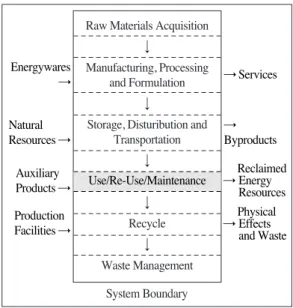
보다 구체적인 전과정평가의 시스템은 불완전 시스템과 완전시스템으로 나누어 접근할 수 있 다. ISO에서 제시하고 있는 불완전 시스템을 적 용한 전과정평가 개념도는 Fig. 2와 같다(ISO, 1993).16) 시스템의 경계에서 입력되는 원재료와 에너지, 출력되는 서비스와 부산물 및 폐기물은 고려대상에 따라 제외될 수 있다. 예를 들어 소비 단계에서 나타나는 환경부하에 초점을 두고 있다 면 Fig. 2에서 음영으로 표시된 소비, 재활용, 유 지단계를 관심범위로 할 수 있다.
나. 목록분석(Inventory analysis)
목적 및 범위설정이 끝나면 평가의 대상으로
Fig. 1. Life Cycle Assessment framework(ISO, 1997) Life cycle assessment framework
Goal and Scope Definition
Inventory Analysis
Impact Assessement
Interpretation
Fig. 2. The steps of a life-cycle and the relevant inputs and outputs of the incomplete system(ISO, 1993)
System Boundary Raw Materials Acquisition
↓
Manufacturing, Processing and Formulation
↓
Storage, Disturibution and Transportation
↓
Use/Re-Use/Maintenance
↓ Recycle
↓ Waste Management Use/Re-Use/Maintenance Energywares
→
Natural Resources →
Auxiliary Products → Production Facilities →
→ Services
→ Byproducts
Reclaimed
→ Energy Resources Physical
→ Effects
and Waste
사용될 항목을 결정하여 목록분석을 수행한다.
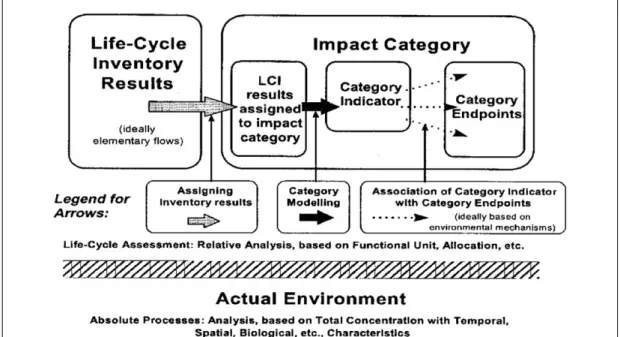
환경독성 및 화학회(Society of Environmental Toxicology and Chemistry: SETAC)에서 제시하 고 있는 전과정평가의 목록분석구조와 관계는 Fig. 3과 같다(SETAC, 1998).23)
목록에 포함되어야 할 정보의 양과 종류는 연 구에 따라 차이가 있을 수 있으나 대략적으로 대 기오염, 수질오염, 폐기물, 에너지 소비량, 원자재 소비량 등으로 나누어서 목록을 작성하며 이들에 의해 파생되는 환경부하에 대해서도 추가적으로 조사하여 평가하기도 한다.
다. 영향평가(Impact Assessment)
전과정평가 지침상에는 영향평가가 목록표 (Inventory Table)의 결과를 요약하고 환경 프로 파일(Environmental Profile)을 작성토록하고 있다.
즉 제품의 전과정에서 발생되는 CO2, NOx, SOx 등의 대기오염지표와 온실효과지표 등을 계산하 여 제시한다. 이 단계에서는 과학적으로 타당하
다고 생각되는 모델을 이용해 환경영향지표를 계 산하지만 인과관계나 정량적인 면에서 불확실성 (Uncertainty)이 문제가 되는 경우가 있다. 다차원 척도인 환경 프로파일은 건강 위해도와 같은 단 일 척도로 변환시킬 필요가 있다.
본래 영향평가의 개념에는 대안의 제시가 포함 되어있으므로 실제로는 개선평가도 같은 맥락에 서 포함된다. 영향평가에서 개선분석은 목적에 따라 목록표, 환경 프로파일등을 통해 서로 다른 제품 또는 공정에 대해 평가 결과를 비교하여 전 과정을 개선하는 것이 목적이다. 환경부하가 큰 공정을 이용하거나 각 공정의 단계별 인자들이 어느 정도 영향을 미칠 것인지를 여러 가지 환경 지표를 이용하여 정량적으로 분석 비교한다.
2. 시스템 경계 : 중점범주 개념과 적용
인적, 물적 자원의 제한점을 해결하기 위해서 는 평가대상의 모든 점을 고려하기 보다 관심범
Fig. 3. The structure and relationships of Life Cycle Inventory Assessment(SETAC, 1998)
위를 설정해서 전과정평가를 수행하는 것이 유리 하다. 전과정평가에서는 평가하고자 하는 시스템 을 구성할 때 모든 시스템을 고려대상으로 할 것 인지 아니면 최소한의 시스템으로 제한할 것인지 에 따라 전체시스템 모형과 최소시스템 모형으로 나뉜다(Trinius 등, 1999).27)
전체시스템모형(Whole System Model)은 전과 정평가 대상에 대해서 고려할 수 있는 모든 시스 템을 분석하는 것으로 매우 광범위한 데이터를 기반으로 하기 때문에 의사결정에 있어 제한요소 가 될 수 있으나 구체적인 모형(Physical Model)을 제시한다는데 의의가 있다. 반면 최소시스템모형 (Minimum System Model)은 부분적으로 가능한 범위만을 대상으로 하기 때문에 의사결정에 있어 서 다소 위험성을 안고 있으나 제한된 데이터와 자원 하에 전과정평가를 효과적인 의사결정 지원 수단으로 사용할 수 있게 한다는 장점이 있다.
최소시스템모형은 첫째, 정확한 목적을 명확하 게 유도해내고 문서화해야 하며(An explicit elicitation and documentation of those precise goals), 둘째, 평가자가 언급한 목적으로부터 평가범위를 결정하는데 명확한 기전을 제시해야한다(A clear mechanism for deriving scope from the goal(s) stated by the actor). 이러한 조건들을 만족시키기 위해서 제안된 것이 중점범주(Focal Zone)이다.
중점범주란 주어진 평가자의 의사결정 범위 내에 서 구체적으로 실존하는 부분의 시스템모형이라 고 정의된다(A system model of part of the physical reality based on part of a given actor’s decision scope). 이러한 평가자의 중점범주에 따라
필요한 자료의 질과 수준이 결정된다(Table 1).
평가자가 직접적인 관심을 가지는 부분은 일차 중점범주에 속하며 관련된 모든 단계를 평가 대 상으로 하고 데이터의 질과 상세도(Resolution)가 높아야 한다. 이차 중점범주는 데이터의 질은 중 간정도이며 상세도는 낮아도 되고 중점범주가 아 닌 단계(Non-focal)는 평가에서 제외한다.
의사결정범위(Decision Scope/Goal)를 정의하기 위해 우선순위(Priorities), 선호분야(Preferences), 정치·경제·기술·한시적으로 불가피한 사항 (Constraints)등을 결정해야 한다. 의사결정범위가 설정되면 이에 따라 중점범주가 결정되고 필요한 데이터의 질과 평가대상 단계를 한정지을 수 있 게된다. 따라서 제품이 소비자의 건강에 미치는 영향을 평가하는 것이라면 소비자와 접하게되는 장소, 기간, 형태 등이 관심범위가 되고 독성 (Toxicity) 및 역학(Epidemiologic)자료가 필요하게 되며 기타 자료와 단계는 생략할 수 있다.
3. 능률화 전과정평가 기법(Streamlining LCA)
중점범주와 관련해서 보다 효과적인 전과정평 가를 수행하는데 제안되고 있는 기법이 능률화 (Streamlining) 기법이다. 기존의 전체 전과정평가 (Full LCA)는 필요한 모든 정보를 줄 수 있는 반 면, 평가대상에 대한 자료가 제한되어 있고 평가 시 이용가능한 인적 물적 자원이 제한되어 있으 므로 이론상으로 가능할 뿐 실제로 적용하기는 힘든 방법이지만 능률화 전과정평가(Streamlining LCA)는 실제로 적용 가능한 방법으로 전체 전과
Table 1. Resolution and Data Quality in Relation to Focal Zones(Trinius et al., 1999)
Actor’s Context Focal Zone Scope Data Quality Resolution
Direct interest Primary Includes process High High
Indirect interest Secondary Includes Medium Low to zero process(aggregated
Processes plugged-in)
No interest Non-focal Excludes process Not relevant Not relevant
Actor’s Context Focal Zone Scope Data Quality Resolution
정평가를 위한 부분적인 단계로서 수행이 가능하 다. 이 방법은 전체를 조망할 수 없기 때문에 전 혀 다른 결과를 얻을 수 있는 위험성을 안고 있 으나 전과정평가를 수행할 때 본 기법의 한계를 분명히 함으로써 전체 전과정평가 결과와 차이가 나타나는 부분을 줄일 수 있다. 기존의 축약 전과 정평가(Abridged Life Cycle Assessment; Steele N.L.C. et al., 1998)24)도 개념상 능률화 전과정평가 의 하나라고 할 수 있다.
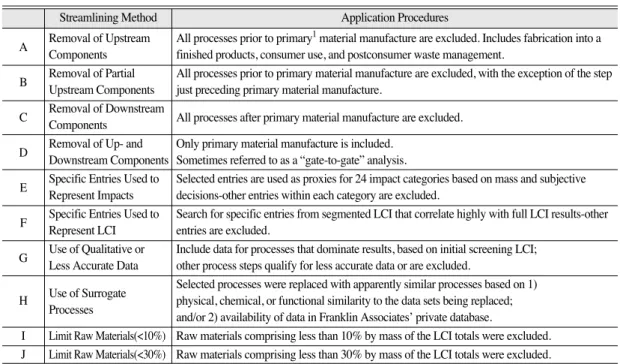
기존 연구에서는 능률화 전과정평가를 크게 10 가지로 분류하고 있다(Table 2; Hunt, R.G. et al., 1998).15) 능률화 전과정평가 방법은 생략하는 범 위에 따라 일차 재료의 제조 이전단계를 생략하 는 방법(Method A), 그 방법에서 바로 일차 재료 의 전 단계는 포함시키는 방법(Method B), 일차 재료제조 이후 단계를 모두 생략하는 방법 (Method C), A와 C방법의 병행(Method D), 영향 범주에서 가장 중요한 인자만으로 구성해서 평가
하는 방법(Method E), 전체 전과정평가에서 목록 분석의 각 범주에서 중요한 항목만을 선별해 평 가하는 방법(Method F), 다소 부정확하지만 결과 에 큰 영향을 미치는 자료를 이용하는 방법 (Method G), 현존하는 자료가 없을 때 유사한 다 른 평가자료로 대치하는 방법(Method H), 원재료 의 10%내외를 평가항목으로 하는 것(Method I), 원재료의 30%내외를 평가항목으로 하는 것 (Method J) 등이 있다.
전반적으로 유사한 특성끼리 묶어서 기술해 보 면 Method A-D, I, J 는 원자재와 관련된 부분을 평가에서 제외시켜 전과정평가 범위를 축소하는 방법이며, Method E, F, H 는 직접적인 관련자료 가 없을 때 유사한 형태의 다른 자료를 사용하여 필요한 자료의 양을 축소하는 방법이고 Method G는 관련자료를 얻는 것이 불가능하거나 정량적 으로 평가가 불가능한 경우 정성적(Qualitative)이 거나 다소 부정확한 자료로 대치하여 필요한 자
Table 2. Summary of procedures for applying streamling methods(Hunt et al., 1999) Streamlining Method Application Procedures
A Removal of Upstream All processes prior to primary
1material manufacture are excluded. Includes fabrication into a Components finished products, consumer use, and postconsumer waste management.
B Removal of Partial All processes prior to primary material manufacture are excluded, with the exception of the step Upstream Components just preceding primary material manufacture.
C Removal of Downstream
All processes after primary material manufacture are excluded.
Components
D Removal of Up- and Only primary material manufacture is included.
Downstream Components Sometimes referred to as a “gate-to-gate” analysis.
E Specific Entries Used to Selected entries are used as proxies for 24 impact categories based on mass and subjective Represent Impacts decisions-other entries within each category are excluded.
F Specific Entries Used to Search for specific entries from segmented LCI that correlate highly with full LCI results-other Represent LCI entries are excluded.
G Use of Qualitative or Include data for processes that dominate results, based on initial screening LCI;
Less Accurate Data other process steps qualify for less accurate data or are excluded.
Use of Surrogate Selected processes were replaced with apparently similar processes based on 1) H Processes physical, chemical, or functional similarity to the data sets being replaced;
and/or 2) availability of data in Franklin Associates’ private database.
I Limit Raw Materials(<10%) Raw materials comprising less than 10% by mass of the LCI totals were excluded.
J Limit Raw Materials(<30%) Raw materials comprising less than 30% by mass of the LCI totals were excluded.
*Examples of primary material manufacture are polymerization of a plastic, smelting of a metal, etc.
Streamlining Method Application Procedures
료의 양을 축소하는 방법이다. 상기에서 분류된 10가지 능률화 전과정평가는 전체 전과정평가와 최종결론이 상이할 수 있다. 따라서 연구자의 목 적과 제품의 특성에 맞게 선택하여 사용하여야 하며 의사결정자도 이런 점을 감안하여야 한다.
4. 시나리오 설정
전과정평가 대상제품의 환경성을 평가할 때 시 공간적인 변화나 사회, 경제상황에 따른 영향이 매우 중요한 변수로 작용한다. 이때 여러 가지 상 황을 고려하여 장단기적인 시나리오를 설정하여 의사결정에 이용한다. 지금까지 시나리오는 첫째, 특정한 어느 시점에서 중요한 변수의 상태에 따 른 단편(Snapshot)을 설명하는데 이용되었고, 둘 째, 몇가지 가능한 장래의 변화추이를 설명하는
두가지 관점에서 이용되었다. Pesonen, H.(2000)등 은 유럽 전과정평가의 표준제정을 위해 기존의 시나리오에 대한 정의(Table 3)를 종합하여“시 나리오란 전과정평가를 적용할 때 미래에 가능한 여러 가지 상황을 기술하는 것이며, 미래에 대해 서 특정한 가정을 기초로 하고, 현재에서부터 미 래에 이르기까지 발전되는 상황을 표현하는 것도 포함된다”라고 최종적으로 정의하였다(“A scenario in LCA studies is a description of a possible future situation relevant for specific LCA applications, based on specific assumptions about the future, and (when relevant) also including the presentation of the development from the present to the future”).22)
시나리오를 개발하기 위해서는 먼저 준비 (Preparation), 개발(Development), 보고 및 이용
Table 3. Definitions of scenarios(Pesonen et al., 2000)
Author Definition
Bartusik and Cabala(1997)
“One possible picture of future conditions of the object and its environment; above mentioned conditions are described by characteristics of the results of given sequences of events (situations) and factors which disturb the natural run (evolution) of these sequences.”
Gausemeier et al. (1995) “A description of a complex future situation that occurrence can not be predicted for sure as well as the presentation of the development that could lead from the present to the future.”
Hansmann (1983) “A description of the development of the object of the analysis in alternative framework conditions.”
Meristö (1991)
“A holistic script about the future, which defines the working environment of a company based on different assumptions and descibes the paths form present to the future.” and “Possible, but not necessarily ptobable views of the future.”
Mesarovic and Pestel (1974) “The consequences of possible decisions, measures and events are called a scenario.”(e.g.
population scenario)
von Reibnitz (1991) “Scenarios are descriptions of a future situation and the development respectively the description of the way which leads from the present into the future.”
Scholz (1996) “In contrary to prognoses, scenarios do not try to predict the future. scenarios do more try to
“throw light on thinkable future possibilities.”
Vartia (1994)
“Scenarios are used to describe that part of the organizations’ environment for which projections are difficult or even impossible. Scenarios give the possibility to prepare for alternative and uncertain future options without knowing anything about the probability of the possible outcomes. This makes the scenarios different from forecasts. Effective scenarios are distinct, logical and they are different enough form each other so that they are able to describe the central changing factors of the future and place questions on existing assumptions.”
Author Definition
(Reporting and Utilization)의 3단계를 거쳐야 한다.
준비단계에는 시나리오에서 다룰 범위를 정의하 고 장래에 중요하다고 생각되는 주요 요인을 열 거한다. 개발단계는 경제성장, 법이나 제도적 환 경, 기술의 변화 등의 주요 변화요인과 이러한 변 화요인들에 큰 영향을 미칠 수 있는 사건을 설정 하는 단계이다. 마지막으로 단순한 표와 개념도 로서 각 시나리오를 표현하는 단계가 보고 및 이 용단계이다.
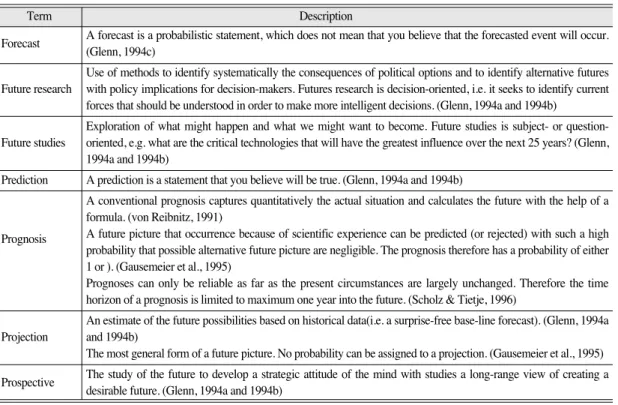
시나리오 이용은 미래연구(Future Research)중 의 한 방법으로 엄밀한 의미에서 미래연구자체는 학문(Science)으로 보기보다는 기존 학문적 결과 의 학제적인 운용이라고 할 수 있다. 미래연구방 법은 용어상 예측(Forecast), 미래연구(Future Research, Future Study), 예상(Prediction), 예후 (Prognosis), 투사(Projection), 전향적 연구 (Prospective Studies) 등 여러 가지 의미로 사용되
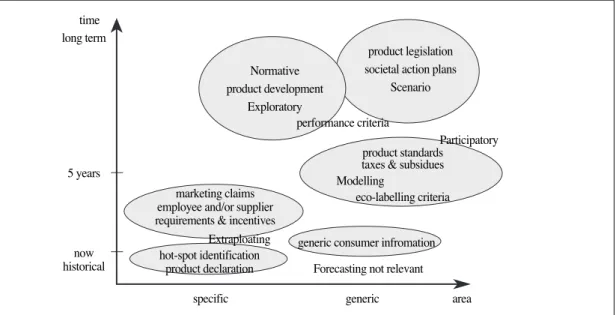
며 개념상 차이가 있기 때문에 구분되어 사용되 기도 한다(Table 4).
전과정평가에서 이용되는 미래연구방법은 외삽 법(Extrapolating Method), 탐색법(Exploratory Method), 모델링(Modelling), 시나리오법(Scenario Method), 참여법(Participatory Method), 표준법 (Normative Method) 등 6가지로 나뉜다. 외삽법은 과거의 사실들을 논리적으로 확장하여 장래를 예 측하는 방법이고, 탐색법은 정량적 기술, 형태분 석, 관련구조분석 등을 이용하여 가능한 미래의 구조적 예측법이다. 모델링은 미래의 여러 가지 요인들의 결정기전을 수식으로 표현하여 예측하 는 방법이다. 시나리오법은 미래는 예측이 불가 능하다는 전제 하에 가능한 여러 가지 상황을 불 확실성을 감안하여 예측하는 방법이며, 끝으로 표준화법은 원하는 미래상황을 얻기 위해서 목표 치에서부터 현재의 상황까지 역으로 추정하여 결
Table 4. Glossary(Pesonen et al., 2000)
Term Description
Forecast A forecast is a probabilistic statement, which does not mean that you believe that the forecasted event will occur.
(Glenn, 1994c)
Future research
Use of methods to identify systematically the consequences of political options and to identify alternative futures with policy implications for decision-makers. Futures research is decision-oriented, i.e. it seeks to identify current forces that should be understood in order to make more intelligent decisions. (Glenn, 1994a and 1994b)
Future studies
Exploration of what might happen and what we might want to become. Future studies is subject- or question- oriented, e.g. what are the critical technologies that will have the greatest influence over the next 25 years? (Glenn, 1994a and 1994b)
Prediction A prediction is a statement that you believe will be true. (Glenn, 1994a and 1994b)
Prognosis
A conventional prognosis captures quantitatively the actual situation and calculates the future with the help of a formula. (von Reibnitz, 1991)
A future picture that occurrence because of scientific experience can be predicted (or rejected) with such a high probability that possible alternative future picture are negligible. The prognosis therefore has a probability of either 1 or ). (Gausemeier et al., 1995)
Prognoses can only be reliable as far as the present circumstances are largely unchanged. Therefore the time horizon of a prognosis is limited to maximum one year into the future. (Scholz & Tietje, 1996)
Projection
An estimate of the future possibilities based on historical data(i.e. a surprise-free base-line forecast). (Glenn, 1994a and 1994b)
The most general form of a future picture. No probability can be assigned to a projection. (Gausemeier et al., 1995) Prospective The study of the future to develop a strategic attitude of the mind with studies a long-range view of creating a
desirable future. (Glenn, 1994a and 1994b)
Term Description
과를 얻는 방법이다. 시나리오는 이러한 방법들 에서 모두 사용되며 명확히 의미를 분리해서 사 용되기 보다 평가자의 의도에 따라 중복되어 사 용되는 것도 가능하다. 개념적인 미래연구방법의 차이는 연구분야와 기간에 따라 Fig. 4와 같이 표 현된다.
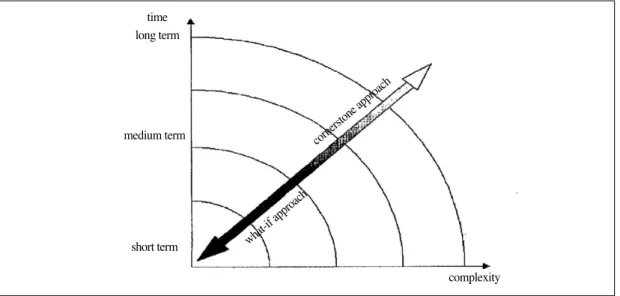
전과정평가에서 시나리오 개발시 기본적인 두 가지 접근방법은 상황설정 시나리오법(What-if-
Scenarios)와 초석 시나리오법(Cornerstone Scenario)이다. 상황설정 시나리오는 여러 가지 상 황을 고려해서 경우에 따라 예측하여 의사결정자 가 판단할 수 있도록 하는 시나리오이며 실제 데 이터를 기반으로 한다. 반면 초석 시나리오법은 현존하는 데이터가 없고 새로운 방법이거나 알려 진 방법이 없을 때 계속적으로 시나리오를 수정 해 가면서 제품이나 기술에 대한 지침을 개발하
Table 5. Features of the basic scenario approaches(Pesonen et al., 2000) What-if scenarios Cornerstone scenarios
• Field of research is well known; researcher is familiar with the object of research
• Research object is simple
• Well defined research plan, standardized research
• Purpose of the study is to investigate consequences of specific, discrete assumptions and uncertainties, which do not have any long-term implications
• Comparison of existing systems(process alternatives, product modifications, etc.)
• Operational or tactical information
What-if scenarios Cornerstone scenarios
Fig. 4. Relevance of dfferent future research methods in relation to applications of LCA(Weidema, 1998b, Recite from Pesonen et al., 2000)
time
Normative product development
Exploratory
product legislation societal action plans
Scenario
performance criteria
Extraploating
Forecasting not relevant
specific generic area
generic consumer infromation hot-spot identification
product declaration marketing claims employee and/or supplier requirements & incentives
product standards taxes & subsidues Modelling
eco-labelling criteria Participatory long term
5 years
now historical
• Field of research is new, unknown to the researcher
• Research object is complex
• Open research plan, scenarios are developed in the course of the study
• Purpose of the research is to increase understanding about the studied object
• Design and development (of new products, technologies, etc.)
• Strategic information
• Often serve as a base for future, more specific research with
What-if scenarios
는데 이용되고 정책적인 자료를 근거로 하며 상 황설정 시나리오를 이용해서 심화연구를 수행한 다(Table 5). 상황설정시나리오는 비교적 단순한 상황에 대해 단기간의 예측시 이용하고 초석 시 나리오법은 복잡하고 장기간을 필요로 하는 경우 에 사용된다(Fig. 5).
5. 자료의 불확실성과 변이성
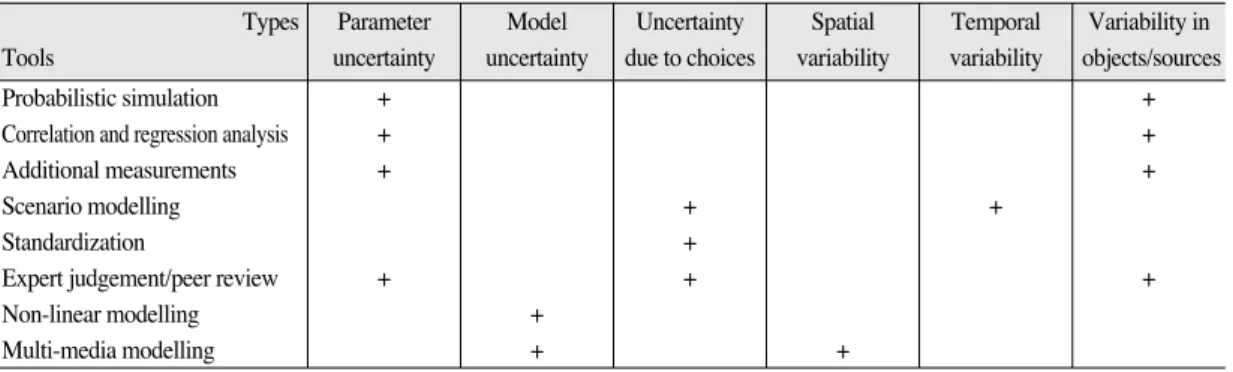
전과정평가 뿐만아니라 환경영향평가나 위해성 평가와 같은 장단기 예측에 있어서 불확실성 (Uncertainty)과 변이성(Variability)은 불가피한 요 인이다. 변이성은 이미 과거 연구를 통해서 자료 나 대상의 성질의 변화폭이 알려진 것을 말하는 반면 불확실성은 부정확한 측정(Inaccurate Measurement), 자료의 부족(Lack of Data), 모델 의 가정(Model Assumption) 등에서 나타나는 것 이다. 불확실성은 변수 불확실성(Parameter Uncertainty), 모델 불확실성(Model Uncertainty), 선택 불확실성(Uncertainty due to Choices)으로 나 뉘며 변이성은 공간적 변이성(Spatial Variability), 시간적 변이성(Temporal Variability), 원인과 대상
의 변이성(Variability between Sources and Objects)으로 대별된다. 목적과 범위(Goal and Scope), 목록분석(Inventory), 영향범주선택(Choice of Impact Category), 분류(Classification), 특성결정 (Characterization), 가중치 결정(Weighting)등의 전 과정평가 단계에서 나타나는 불확실성과 변이성 의 형태는 Table 6과 같다(Huijbregts 등, 1998).13)
전과정평가에서 자료의 불확실성과 변이원성을 설명하는데 이용되는 방법은 확률론적 모의실험 (Probabilistic Simulation), 상관 및 회귀분석 (Correlation and Regression Analysis), 부가측정 (Additional Measurement), 시나리오 모델링 (Scenario Modelling), 표준화(Standardization), 전문 가의 판단(Expert Judgement), 비선형 모델링 (Non-linear Modelling), 다중매체 모델링(Multi- media Modelling) 등이 있으며 상술한 6개 부분의 불확실성과 변이성중 해결이 가능한 부분이 개별 적으로 존재한다(Table 7). 따라서 언급된 각 방 법론 중 확률론적 모의실험기법과 시나리오 모델 링, 다중매체 모델링 세가지 방법을 결합하여 이 용하면 이들 불확실성과 변이원성을 모두 고려한 전과정평가가 가능하다.
Fig. 5. Two basic approaches to scenario development in LCA research(Pesonen et al., 2000)
what-if approachcornerstone approach
complexity time
long term
medium term
short term
6. 독성물질의 건강영향과 불확실성
제품은 소비자의 소비행태에 따라서 제품에 의 해 나타나는 부산물에 노출되는 경로와 기간이 다르게 나타난다. 따라서 기존의 연구와 같이 노 출용량만을 고려하여 전과정평가를 수행할 경우 에 실제 소비행태의 차이에 따라 나타나는 위해
성을 고려하지 못하는 결과가 초래된다.18) 특히 독성물질의 전과정평가에서 나타나는 불확실성의 형태는 불확실성 계수가 있는 경우도 있지만 없 는 경우는 추정해야 하며 기존의 안전상수를 쓰 기도 한다. 독성물질을 평가할 때 배출(Emission), 오염상태(Fate), 영향(Effect)단계에서 나타나는 불확실성의 형태는 Table 8과 같다.28)
Table 6. Examples of types of uncertainty and variability related to the phase of LCA(Huijbregts, 1998) Source Phase Goal and scope Inventory Choice of impact categories Classification Characterization Weighting
Phase
Goal and scope Inventory Choice of
Classification Characterization Weighting
Source impact categories
Parameter Uncertainty
Model Uncertainty
Uncertainty due to choices Temporal Variability Spatial Variability
Variability between object/
sources
Parameter Uncertainty Model Uncertainty
Functional unit
Inaccurate emission measurements Linear instead of non-linear modelling Use of several allocation methods
Differences in yearly emission inventories Regional differences in emission inventories Differences in emissions between factories which produce same product
Inaccurate emission measurements
Impact categories are not known Leaving out known impact categories
Inaccurate emission measurements
Contribution to impact category is not known
Uncertainty in life times of substances Characterization factors are not known Using several characterization methods within one category Change of temperature over time
Regional differences in environmental sensitivity Differences in human characteristics
Inaccurate normalization data Weighting criteria are not operational Using several weighting methods
Change of social preferences over time
Regional differences in distance to (political) targets Differences in individual preferences, when using panel method
Table 7. Overview of tools available to address types of uncertainty and variability in LCAs(Huijbregts, 1998)
Types Parameter Model Uncertainty Spatial Temporal Variability in
Tools uncertainty uncertainty due to choices variability variability objects/sources
Probabilistic simulation + +
Correlation and regression analysis + +
Additional measurements + +
Scenario modelling + +
Standardization +
Expert judgement/peer review + + +
Non-linear modelling +
Multi-media modelling + +
Types Parameter Model Uncertainty Spatial Temporal Variability in
Tools uncertainty uncertainty due to choices variability variability objects/sources
지금까지 전과정평가에서 평가항목으로 다루는 분야는 수질, 대기오염 지표뿐 만 아니라 에너지, 물, 전력, 목재 사용량 등 매우 광범위하다. 그러 나 인체 독성 또는 위해도와 같은 인간에 미치는 영향에 대해서는 상대적으로 평가항목이 부족하 고 우선 순위가 낮은 형편이며 독성자료에 대해 서 확률론적인 분석 방법으로 노출용량만을 고려 하여 평가한 사례만 있을 뿐이다(Hertwich, E.G.
et al., 1999).12)
III. 확률론적 위해도 분석 1. 건강 위해성 평가개요
가. 위해도의 정의
위해도(risk)란 유해물질의 특정농도나 용량에 노출된 개인이나 집단에 있어 유해한 결과가 발 생할 확률(probability)또는 가능성(likelihood)으로 정의되며 건강위해성평가란 어떤 독성 물질이나 위험상황에 노출되어 나타날 수 있는 개인 혹은 집단의 건강 피해 확률을 추정하는 과학적인 과 정이라고 정의될 수 있다(정용, 1997).5)
나. 위험성 확인(Hazard Identification)
위해성평가의 초기 정성 단계로써 대상 화학물 질이 인체에 유해한 영향을 유발시키는지를 결정
하기 위해 이용할 수 있는 모든 적절한 자료를 수집하는 것에서부터 시작하는 것이 위험성 확인 단계이다. 본 단계에서 수집한 자료는 과학적이 고 통계학적인 양질의 자료를 바탕으로 평가하며 이때 이용되는 자료는 역학자료(Epidemiological Study), 독성자료(Toxicological Study), 임상실험자 료(Controlled Human Experiments), in vivo, in vitro 실험자료, 물리화학적 성질관련 자료 등이 있다. 이들 자료는 발암, 비발암물질에 대한 위험 성 확인의 기본자료로 이용된다.
다. 용량반응평가(Dose-Response Assessment)
용량반응평가는 주입되거나 노출된 용량과 노 출된 인구집단에서의 인체영향 발생률 관계를 결 정짓는 과정으로 정의된다. 이것은 특정화학물질 에 대한 위험성이 확인되었을 때 대상물질의 위 해도를 수량적으로 표현하는 단계이며 발암물질 과 비발암물질로 접근법이 나누어진다. 이때 성, 생활습관등 개체의 반응에 영향을 주는 변수와 연령특성과 노출강도 등도 고려되어야 한다.
라. 노출평가(Exposure Assessment)
용량-반응 평가로부터 화학물질에 단위농도의 노출로 부과될 수 있는 위해도를 산출하였으나, 실제 노출환경으로부터 노출 가능한 인구집단이 처한 위해도를 정량화하기 위해서는 노출량을 평 가해야 한다. 노출평가에는 노출된 인구집단의
Table 8. Types of uncertainty with regard to emissions, fate and effects of toxic substances(Tukker, 1999)
Type of uncertainty Step
Emission Fate Effect
Data uncertainty Type and amounts of Substance properties(fate) Substance properties(toxicity) substances emitted Environmental information
Modelling uncertainty n.r Extent to which the model n.r
reflects the real world
Paradigmatic uncertainty Tacit biases and assumptions Tacit biases and assumptions Tacit biases and assumptions n.r: not relevant
grey: type of uncertainty illustrated in the case
Type of uncertainty Step
Emission Fate Effect
크기, 노출의 강도(Strength), 빈도(Frequency) 및 기간(Duration), 그리고 노출경로 등에 대한 요소 들이 반드시 고려되어야 하며, 환경오염도 측정 (현장 측정 또는 모델링)과 생체 감시(Biological Monitoring)를 통해 인체노출량을 추정할 수 있다.
만성 노출을 포함하는 대부분의 위해성평가에 있 어 노출(mg/kg/day)은 다음 식(1)과 같이 표현 될 수 있다.
Average daily lifetime exposure =
(1)
Total dose = Contaminant conc.×Contact rate×
Exposure duration×Absorption fraction
마. 위해도 결정(Risk Characterization)
위해도는 일반적으로 개인 위해도(Individual Risk)와 인구집단 위해도(Population Risk)로 표현 되며 주어진 인구집단내의 개인 위해도 분포로도 표현될 수 있다. 인구집단의 위해도는 집단위해 도(Aggregate Risk)로도 표현되는데 노출된 농도 에 추계된 단위위해도를 곱해서 얻는다. 단위 위 해도 추계치는 측정된 농도(1mg/L, 또는 1mg/
cm3)에 일생(70년)동안 연속적(호흡량 20m3/day) 으로 개인에게 노출되었을 때 야기되는 발암위해 도의 상한값으로서 저용량에서의 직선성을 가정 해서 얻어진 수치이다. 만약 저농도에서 비직선 성인 경우에는 단위위해도치가 상이한 결과를 나 타낸다. 단위위해도치와 발암 증거의 분류는 위 해도 결정과 위해도 의사전달에 영향을 준다.
특정 오염물질에 대해 용량-반응 평가를 통해 산출된 q1* 값과 노출 평가를 통해 얻어진 노출 량을 곱하거나 노출농도(Exposure Concentration) 에 단위위해도(Unit Risk)를 곱하면 개인위해도 (Individual Risk)를 얻을 수 있으며 인구집단 위해 도(Population Risk)는 개인 위해도에 노출 인구 집단의 인원수를 곱하여 산출된다(식 2).
Individual Risk
= Exposure Dose(mg/kg/day) x q
1*(mg/kg/day)
-1(2)
= Exposure Concentration(μg/m
3) x Unit Risk(μg/m
3)
-12. Monte Carlo 분석과 Latin Hypercube 방법
장기간의 대기오염과 노약자들의 천식, 병약자 들의 초과 사망에 대한 런던 smog의 조사연구이 후 전세계적으로 대기오염으로 인한 건강장해에 관한 논문들이 다루고 있는 내용으로는 호흡기질 환율, 사망율, 이환율 등의 증가에 관한 것이 주 류를 이루고 있다(Fairbairn et al., 1997; 이승준, 1996).10,4) 이 논문들은 환경오염도 수준에 따른 역학적 영향을 계량적으로 파악하여 장기적인 환 경관리에 이용하며 기준치설정에 필요한 기초자 료를 제공할 수 있다고 보고있다. 그러나 환경오 염물질의 노출수준을 결정하고 역학적 인체반응 을 측정하는 것은 이들 자료의 특성상 매우 어렵 고 산출된 자료가 불확실성을 내포하고 있기 때 문에(Brand et al., 1995)7) 통계학 및 확률론적인 방법을 이용한 추정을 통해 해결하려는 연구가 시도되고 있다(Lee et al., 1999; Gratt, 1996).20,11)
확률론적 위해도 분석은 건강위해성평가의 적 용기법중 하나로 위해성평가에서 존재하는 많은 불확실성(Uncertainty)의 해석에 있어 위해도 결 정단계에서 서술과 분석시 적용된다. 이들의 분 석을 위해서 일반적으로 Monte Carlo Simulation이 일부 학자들에 의해 이용되고 있다. 불확실성분 석(Uncertainty Analysis)이란 수학적 모델에 각 인자들의 변동에 따른 결과의 변화를 설명하기 위하여 사용되는 기법이며, 민감도분석(Sensitivity Analysis)이란 모델 각 인자들의 변이가 모델결과 변화에 미치는 영향을 파악하는데 적용되는 방법 이다. 불확실성과 민감도를 분석하기 위한 방법 으로는 Differential Analysis, Response-surface Replacement, Monte Carlo 또는 Modified-Monte
Total dose(mg)
Body weight(kg)×Life time(days)
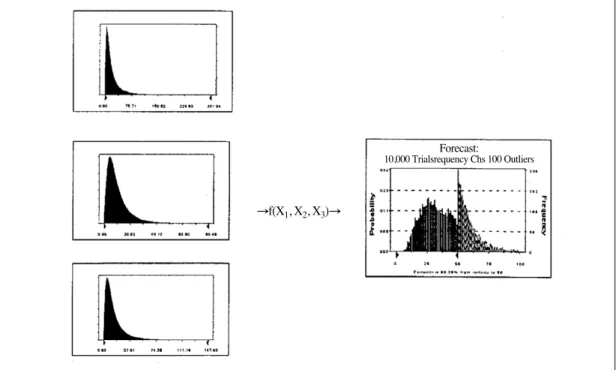
Carlo(Latin Hypercube Sampling) Method 등이 있 다. 특히 Monte Carlo Simulation은 본 연구에서와 같이 특정화학물질의 실내공기오염과 소비형태에 따른 노출모형을 설정하고 모형의 구성변수들이 일정한 분포를 한다고 알려져 있거나 가정할 수 있을 때 각 인자들의 분포를 확률적으로 입력하 고 그에 따른 결과를 확률적 분포로 도출하여 주 는 기법이다. 이때 위해도는 노출평가가 다양한 농도수준에 노출되는 인구수로 산출되며 단일 농 도 추정치만으로는 위해도 분포를 계산할 수 없 다. 3가지 입력변수로 구성된 모형 f(X1, X2, X3) 가 있을 때 각 변수의 분포를 가정하여 최종적으 로 조합된 모형의 결과를 Monte Carlo Simulation 하는 개념이다(Fig. 6).
특히 이러한 확률론적 모의실험기법으로 Monte Carlo방법과 Latin Hypercube방법이 이용되고 있는 데 Monte Carlo방법은 가정된 확률분포상에서 경 우의 수를 무작위 추출하지만 Latin Hypercube방 법은 가정된 확률분포상의 X축을 일정간격으로
동일하게 나누어 각 구간에서 선택되는 확률을 일정하게 유지하도록 해서 무작위 추출시 자료의 치우침을 막고 가정된 확률분포의 전체 형태가 변형되는 것을 막는 방법이다.
IV. 기법의 종합
지금까지 고찰한 내용들을 토대로 확률론적 건 강위해도 분석기법을 전과정평가에 적용하는 방 안을 제시하고자 한다. 전과정평가의 구성상 먼저 목적 및 범위설정(Goal and Scoping), 목록분석 (Inventory Analysis), 영향평가(Impact Assessment) 로 나누었을 때 첫 번째 및 두 번째 단계인 목적 및 범위설정/ 목록분석은 평가시스템의 중점범위 와 대상항목선정을 통해서 진행하고, 세 번째 단 계인 영향평가에서는 시나리오 구성과 불확실성/
변이원성을 기술한후 확률론적 모의실험을 통해 위해도를 분석한다. 지금까지 고찰된 전과정평가
Fig. 6. Structure and framework for Monte Carlo Simulation f(X
1, X
2, X
3)
Forecast:
10,000 Trialsrequency Chs 100 Outliers
및 위해성평가 기법을 토대로 종합된 단계별 개 념도는 Fig. 7과 같다.
1. 중점범위와 대상항목선정
특정 제품의 건강영향을 종합적으로 파악하기 위해서는 원재료, 부산물, 이용시 및 폐기처분시 제품 자체의 독성 등 포괄적인 건강영향을 파악 하여야 한다. 따라서 평가자는 중점범위(Focal zone)를 결정하여야 하므로 소비시의 건강영향에 중점을 둔다면 능률화 전과정평가(Streamlining
LCA)의 틀에 따라 원재료에 대한 시스템을 생략 하거나 제품의 독성자료가 부족하다면 비슷한 다 른 자료로 대치하는 등의 조치를 취할 수 있다.
자료의 수집과정에서는 독성자료나 건강 위해 도 자료에 대해 전문적인 데이터베이스를 이용하 여 검색하고 사용되는 원자재의 량이나 배출량과 배출농도는 제품의 생산자가 보유한 데이터를 이 용해야 한다. 목록분석시 전문가 참여방법을 이 용하게 되면 평가 시스템 모델의 불확실성을 검 증하기 위해 일치도 분석이나 반복 검증하는 것 이 필요하다.
Fig. 7. General framework for application of probabilistic risk assessment in LCA Goal & Scoping
Inventory analysis
Impact assessment
Life cycle assessment process Risk assessment process Hazard identification
Dose-response assessment
Exposure assessment
Risk characterization
• Focal zone
• Streamlining technique
• Products quantity & quality
• Resources Consumption
• Scenario setting - What-if - Cornerstone
• Scenario modelling
• Multimedia modelling
• Toxicological DB
• Human epidemiological DB
• Response curve
• Safety factor
• Concentration
• Time
• Distribution type
• Cancer risk
• Factor priority
• Probabilistic simulation - Latin Hypercube Method - Monte Carlo Method
• Sensitivity Analysis
2. 시나리오의 구성과 불확실성/변이원성 기술
제품에 대한 건강 위해성에 관심을 두고 모의 실험하고자 한다면, 먼저 제품 생산, 소비, 폐기 등에 대한 시나리오를 설정하여야 한다. 만일 제 품 생산시의 건강 위해도에 관심을 두고 있다면 제품 생산시 원재료에 노출되는 빈도(Frequency) 와 기간(Duration), 원재료의 독성(발암성, 만성 및 급성 등)의 경우에 따라 시나리오를 설정한다. 제 품의 단기적 단순 위해도분석을 위해서는‘노출 시간이 근무중 5시간일때’, 빈도는‘근무시간 모 두일때’와 같이 각각에 대한 상황설정 시나리오 법(What-if-scenario)을 이용하고 장기적이고 복잡 한 분석이 필요하면 초석 시나리오법(Cornerstone Scenario)을 적용하면 된다.
시나리오는 확률론적 모의실험(Probabilistic Simulation)을 이용하고, 생산시에 노출변수들을 모델의 입력변수로 모델링(Scenario Modelling)하 며, 한가지 물질이 아닌 여러 가지 물질의 다양한 노출경로를 고려하여 다중매체 모델링(Multi- media Modelling)을 하면 위에서 고찰한 바 있는 6가지 불확실성과 변이성을 모두 고려할 수 있다.
3. 확률론적 위해도와 민감도 분석
설정된 시나리오와 모델에 확률론적 모의실험 을 이용한 위해도 분석에는 Latin Hypercube법이 권장된다. Monte Carlo 방법을 적용할 때는 자료 의 치우침이 나타날 수 있기 때문이다. 그러나 자 료의 종류와 고려범주가 많고 입력자료의 양이 많을 때는 계산시간을 고려하여 Monte Carlo 방 법을 이용하는 것이 좋다. 모의실험이 끝나면 입 출력자료를 기반으로 민감도분석(Sensitivity Analysis)을 통해 입력변수에 대한 출력변수의 민 감도를 점검할 수 있다. 민감도 분석을 거치면 관 리 대상물질의 우선순위나 관리방안을 도출하는 데 많은 정보를 얻을 수 있다.
V. 고 찰
국내의 전과정평가연구는 1993년 경제정의 실 천연합 환경개발센터에서 한국 유리공업협동조합 의 의뢰로 수행한“유리병 재활용활성화 방안에 관한 연구”를 통해 미국, 네델란드, 스웨덴, 일본 의 포장용기에 대한 전과정평가연구결과를 최초 로 소개한 이래 공업진흥청(현 중소기업청)과 통 상산업부에서 발간한 국제환경경영표준화(ISO 14000) 관련자료집에 전과정평가 방법론에 대한 자료가 포함되어 학계와 산업계의 관심을 받게되 었다. 국외의 타 연구 수준과 비교해 볼 때 국내 의 관련 연구는 적용되는 대상이나 이용되는 평 가지수, 평가방법에 있어서는 큰 차이 없이 활발 하게 진행되고 있으나19,21) 연구 성과물의 양이나 재원에 있어 규모상의 차이가 있고 다양한 학제 적 방법론 적용 사례는 다소 부족하다.
국내외 전과정평가 연구는 전반적으로 환경오 염물질의 배출량 또는 소비되는 에너지와 원재료 의 량에 중점을 두고 있다. 이러한 자료를 기반으 로한 전과정평가는 개념상 여러 가지 비용 편익 분석의 적용이 가능하므로 의사결정자에게 양적 인 가치 판단의 근거자료를 제공한다. 그러나 인 간의 건강 영향과 같이 질적인 판단 자료를 주지 못하기 때문에 인간의 건강측면 즉 건강 위해도 (Health Risk)를 고려하는 평가항목이 부족하다는 점도 지적되고 있다. 따라서 독립적인 방법론으 로 존재하기 보다 위해성 평가, 지역 특성을 고려 한 환경평가(Site-specific Environmental Assess- ment), 기타 방법론을 보완하여 연구하는 것이 필요하다는 것이 전과정평가 분야 연구자들의 견 해이다.26)
본 고찰연구에서 살펴본 비교적 최근에 진행된 연구들은 다른 분야의 기존 연구성과를 적용하고 발전시켜 전과정평가가 보다 정확하고 설득력 있 는 방법론으로 개선하는데 중점을 두고 있다. 특 히 본 연구에서 제시된 바와 같이 건강영향에 대
한 고려를 위해도 개념을 도입해서 해결하고 자 료의 불확실성/변이원성을 시나리오와 모델링을 통한 확률론적 분석으로 설명하고자 하는 연구는 아직 발표된 바 없으나 이미 이런 방법론과 개념 들은 선행 연구자들이 확립해 놓은 상태이다. 본 연구는 전반적인 개념과 방법상의 틀을 제시하는 데 목적을 두고 있기 때문에 구체적인 사례연구 를 보여주지 못하고 있으나 차후 모의사례연구를 통해서 단순화시켜 설명하는 것이 가능할 것이 다. 제안된 본 기법이 여러 분야에서 적용되어 실 제 사례연구들이 진행되면 제품의 환경 및 건강 친화성을 높이는데 유용할 것으로 사료된다.
VI. 결 론
최근 전과정평가 방법론 연구에서 해결해야 할 가장 큰 문제로 부각되고 있는 불확실성과 변이 성을 사회과학적, 정책적 분야의 타 연구기법을 적용하여 해결하는 방안이 논의되고 있다. 전과 정평가단계에서 나타나는 불확실성/변이성은 그 특성상 실제 자료를 기반으로 추정할 수 있는 부 분과 가정을 통해서 예측해야 하는 부분으로 나 뉘며 추정과 예측의 과정에서 필요한 여러 가지 개념의 정립이 필요하다.
본 연구에서는 전과정평가에서 제품의 환경영 향을 고려하는 범주에서 차후 적용논의가 활발하 게 이루어지고 있는 건강영향을 건강 위해도 개 념을 도입하여 평가하고 이에 대한 불확실성과 변이원성을 해결하기 위해 확률론적 분석기법을 적용하는 방안을 도출하였다.
연구결과 기존의 연구결과에서 제시된 중점범 위, 능률화 전과정평가, 시나리오 선정, 불확실성/
변이성 분석, 확률론적 위해도 분석 등을 적용·
보완하여 건강 위해도의 개념을 도입한 전과정평 가의 개념적 틀을 얻을 수 있었으며 전과정평가 에 적용된 데이터의 불확실성과 변이성 분석시 필요한 기법을 종합하고 방법론을 예시할 수 있
었다. 본 연구에서 논의된 전과정평가의 확률론 적 위해도분석기법 적용의 틀을 기초로 향후 실 제 분석사례연구가 진행되어야 할 필요가 있다.
참고문헌
1. 국제환경경영표준화대책반/제4작업반, 1994, 국제환경경영표준화(ISO/TC207/SC5 관련문 서), 한국경영자총협회, 공업진흥청.
2. 박재성, 1997, 대기오염에 따른 건강영향지수 의 평가-대기오염모델의 몬테카를로 시뮬레 이션 적용, 연세대학교 보건대학원 석사학위 논문.
3. 山本良一, 1997, LCA(Life Cycle Assessment) 환경부하를 평가한다, 이동훈 편역, 서울시립 대학교 환경공학센터.
4. 이승준, 1996, 환경오염이 건강에 미치는 영향 에 관한 국내 연구의 고찰, 서울대학교 대학 원 석사학위논문.
5. 정용, 신동천, 최용욱 등, 1997, 여천공단지역 의 환경오염으로 인한 건강위해성평가, 연세 대학교 환경공해연구소.
6. 환경부, 1997, 대기오염물질의 위해성평가 및 관리기술, 환경위해성평가 및 관리기술 제2단 계 1차년도 보고서.
7. Brand, K.P., Small, M.J., 1995, Updating uncertainty in and integrated risk assessment:
conceptual framework and methods, Risk Analysis, 15(6), 719-731.
8. Breville, M., Gloria, T., O’Connell, M., Saad, T., Blake G , 1994, Life cycle assessment, trends, methodologies and current implementation, Department of civil and environmental engineering, Tufts University.
9. Copeland, T.L., Paustenbach, D.J., Harris, M.A., Otani, J., 1993, Comparing the results of a monte carlo analysis with EPA’s reasonable
maximum exposed individual(RMEI): A case study of a former wood treatment site, Regul.
Toxicol. Pharmacol., 18, 275-312.
10. Fairbairn, A.S., and Reid, D.D., 1997, Air pollution and other local factors in respiratory disease, J. Epidemiol. Communiy Health, 51, 216-222.
11. Gratt, L.B., 1996, Probablistic health risk assessment, Air toxic risk assessment and management, Van Nostrand Reinhold, 317-339.
12. Hertwich, E.G., McKone, T.E., Pease, W.S., 1999, Parameter uncertainty and variability in evaluative fate and exposure models, Risk Analysis, 19(6): 1193-1204.
13. Huijbregts, M.A.J., 1998, Application of uncertainty and variability in LCA- Part I: A general framework for the analysis of uncertainty and variability in life cycle assessment, Int. J. LCA, 3(5), 273-280.
14. Huijbregts, M.A.J., 1998, Application of uncertainty and variability in LCA- Part II:
Dealing with parameter uncertainty and uncertainty due to choices in life cycle assessment, Int. J. LCA, 3(6), 343-351.
15. Hunt, R.G., Boguski, T.K., Weitz, K. Sharma, A., 1998, Case studies examining LCA streamlining techniques, Int. J. LCA, 3(1): 36- 42.
16. International Standard Organization, 1993, Technical energy systems method for analysis:
Part I-Energyware and related systems in life- cycle assessment, ISO/TC 203, International Organization for Standardization.
17. International Standard Organization, 1997, Environmental management-Life cycle assessment-Principles and framework, Draft International Standard, ISO/DIS 14040,
International Organization for Standardization.
18. Keller, D., Wahnschaffe, U., Rosner, G., Mangelsdorf, I., 1999, Considering Human Toxicity as and Impact Category in Life Cycle Assessment, Int. J. LCA 3(2): 80-85.
19. Kim, S., Hwang, T. Lee, K.M., 1997, Allocation for cascade recycling system, Int. J. LCA, 2(4), 217-222.
20. Lee, J.T., Shin, D., and Chung, Y., 1999, Air pollution and daily mortality in Seoul and Ulsan Korea, Environ. Health Perspect., 107(2), 149- 154.
21. Lee, K.M., 1999, A weighting method for the Korean eco-indicator, Int. J. LCA, 4(3), 161-164.
22. Pesonen, H., Ekvall, T., Fleischer, G. et al., 2000, Framework for scenario development in LCA, Int. J. LCA 5(1): 21-30.
23. SETAC, 1998, Evolution and developmenmt of the conceptual framework and methodology of life-cycle impact assessment, SETAC Press.
24. Steele, N.L.C., Allen, D.T., 1998, An abridged life-cycle assessment of electric vehichl batteries, Environ. Sci. Technol./News , 40-46A.
25. Su, S.H., Little, R.M., and Gudka, N.J., 1998, Charaterization of Uncertainty, Risk assessment and indoor air quality, Lewis Publishers, 137-160.
26. Todd, J.A., Curran, M.A., Weitz, K. et al., 1999, Streamlined life-cycle assessment: A final report form the SETAC North America streamlined LCA workgroup, SETAC.
27. Trinius, W., T no, J.F.L, 1999, System boundaries according to decision scope: A concept of focal zones, Int. J. LCA 4(5): 253- 256.
28. Tukker, A., 1998, Uncertainty in life cycle impact assessment of toxic releases, Int. J. LCA 3(5): 246-258.