새로운 CMA 알고리듬
A New Constant Modulus Algorithm based on Minimum Euclidian Distance Criterion for Blind Channel Equalization
김 남 용* Namyong Kim
요 약
이 논문에서는 오차 확률 밀도와 델타 함수 사이의 유클리드 거리를 최소화하는 기준을 소개하고 이 기준에 근거한 새로운 CMA 형태의 블라인드 등화 알고리듬을 제안하고 있다. 제안한 기준에 나타나는 오차 항 대신에 constant modulus error를 대 치하여 블라인드 알고리듬을 완성하였고 이 알고리듬은 블라인드 등화 환경에서 탁월한 수렴성능과 정상상태의 자승평균오 차 성능 특성을 보였으며, 오차 신호 값이 0 값에 보다 집중된 밀도함수 형태를 나타냈다. 시뮬레이션 결과로부터, 이 제안된 방식은 멀티 포인트 통신에서 블라인드 등화를 위한 신뢰성 있는 알고리듬으로 사용될 수 있음을 보이고 있다.
ABSTRACT
In this paper, a minimum Euclidian distance criterion between error PDF and Dirac‐delta function is introduced and a constant modulus‐type blind equalizer algorithm based on the criterion is proposed. The proposed algorithm using constant modulus error in place of actual error term of the criterion has superior convergence and steady‐state MSE performance, and the error signal of the proposed algorithm exhibits more concentrated density function in blind equalization environments.
Simulation results indicate that the proposed method can be a reliable candidate for blind equalizer algorithms for multipoint communications.
☞ KeyWords : PDF; CMA; Euclidian distance; Blind equalization; ITL. 확률밀도함수, 상수 모듈러스 알고리듬, 유클리드 거리, 블라인드 등화, 정보이론적 학습
1. INTRODUCTION
Increasingly, multipoint communication has been a focused topic in computer communication networks including the Internet, the ATM, and the wireless/mobile networks [1]. In those applications, blind equalizers to counteract multipath effects are very useful since they do not require a training sequence to start up or to
* 정 회 원 : 강원대학교 공학대학 전자정보통신공학부 교수 [email protected]
[2009/02/25 투고 - 2009/03/16 심사 - 2009/05/28 심사완료]
restart after a communications breakdown [2][3].
One of the well known blind equalization algorithms is constant modulus algorithm (CMA) which utilizes output power and constant modulus of modulation schemes [4].
Problems involving the training of adaptive equalizers have been solved through the use of information theoretic optimization criteria. As a way for solving these problems, information-theoretic learning (ITL) has been introduced by Princepe [5]. Unlike the mean square error (MSE) criterion that utilizes error energy, ITL method is based on a combination of a nonparametric probability density function
(PDF) estimator and a procedure to compute entropy. As a robust ITL algorithm, minimization of error entropy (MEE) has been developed by Principe, Erdogmus and co-workers [6]. ITL-type methods have shown superior performance as an alternative to MSE in supervised channel equalization applications [7]. Recently, a new method of minimizing Euclidian Distance between two PDFs for adaptive blind equalizers has been introduced [8]. In order for Euclidian distance expressed with Parzen PDFs to be minimized, the authors proposed to use a set of randomly generated desired symbols at the receiver so that the PDF of the generated symbols matches that of the transmitted symbols. The performance, however, shows that the method leaves much room for improvement.
In this paper, instead of dealing with the Euclidian distance between desired PDF and output PDF, and based on the motive of concentrating error samples near zero, we propose to minimize the Euclidian distance between the error PDF and a Dirac-delta function and use constant modulus error in place of the error term of the proposed criterion for blind applications.
This paper is organized as follows. In Section II, we briefly describe the CMA which is based on MSE criterion. In Section III, the minimum ED algorithms using a set of randomly generated desired symbols for blind equalization are introduced. We describe the proposed algorithm in Section IV. Section V reports simulation results.
Finally, concluding remarks are presented in Section VI.
2. CMA BASED ON MSE CRITERION
In case of linear equalization, a tapped delay line (TDL) can be used for input
T M k k
k k
k x x x x
X =[ , −1, −2,..., − +1] and output
k T k
k W X
y = , where Wk is weight vector at time k. For training-aided equalization, error sample ek between the desired training symbol dkand outputyk are produced by
k T k k k k
k d y d W X
e = − = − . Channel
equalization without the aid of a training sequence dk is referred to as blind channel equalization. Using the power of outputyk and
constant modulus of the modulation scheme, CMA has been developed based on the following cost function based on mean squared error (MSE) criterion [4].
] ) [(y 2 R2 2 E
PCMA = k − , (1)
where R2 =E[dk 4]/E[dk 2].
The minimization of PCMA with respect to the equalizer coefficients can be performed recursively according to the steepest descent method,
W W P
Wnew old CMA CMA
∂
⋅∂
−
= µ
, (2) where µCMA is the step-size parameter. By differentiating PCMA and dropping the expectation operation we obtain the following LMS-type algorithm for adjusting the blind equalizer coefficients:
) (
2 2 2
1 W X y y R
Wk+ = k− µCMA⋅ k∗⋅ k⋅ k −
(3)
3. MINIMUM ED CRITERION AND RELATED ALGORITHMS FOR BLIND EQULIZATION
The Euclidian distance between the transmitted symbol PDFfdand the equalizer output PDF fycan be minimized with respect to weight W as
(ED f f )=Min(∫ f ξ dξ
Min d
y W
W [ d, ] 2( )
∫ − ∫ )
+ fy2(ξ)dξ 2 fd(ξ)fy(ξ)dξ . (4) If the two distributions are close to each other, the ED cost function (4) minimizes the divergence between the desired symbols and equalizer output samples. Our initial idea was to generate, at the receiver, random symbols that have the same PDF of the transmitted symbols [8], which is introduced as follows.
Given a set of randomly generated N symbolsDN ={d1,d2,...,dN}, the PDF based on Parzen window method can be approximated by
∑=
−
= N
i
i
d G d
f N
1
) 1 (
)
(ξ σ ξ
2 ] ) exp[ (
2 1 1
1 2
∑ 2
=
−
= N −
i
di
N σ
ξ π
σ . (5)
Where σ is the standard deviation of a zero-mean Guassian kernel. Under the assumption that all Llevels are equally likely, the number of random symbols corresponding to each level Al isN /L. Then the integrals of the multiplication of two PDFs in (4)
become
∫ ∑∑
= =
−
= N
i N j
i j
d G d d
d N f
1 1 2
2
2 1 ( )
)
(ξ ξ σ
, (6)
∫ = ∑∑N= = −
i N j
i j
y G y y
d N f
1 1 2
2
2 1 ( )
)
(ξ ξ σ
, (7)
∫ ∑∑
= =
−
= N
i N j
i j y
d G d y
d N f f
1 1 2
2 ( )
) 1 ( )
(ξ ξ ξ σ
(8) We note that (6) is not a function of weight.
By summing the interactions among pairs of output samples we can obtain the IP1(y,y) as in (7). Equation (8) defined asIP1(d,y) indicates the interactions between the two different variables dandy. So the cost function (4) can be reduced as P1 in (9).
) , ( 2 ) ,
( 1
1
1 IP y y IP d y
P = − ⋅ . (9)
Now a gradient descent method can be applied for (9) with respect to equalizer weight vector.
W W P
Wnew old
∂
− ∂
= µ1 1
, (10) The gradient is evaluated from
∑ ∑− +
= =− +
−
∂ =
∂ k
N k i
k N k j
i j k
y N y
W P
,
1 1
2 2
1 ( )
2 1
σ ) ( )
2(yj yi Xi Xj
G − ⋅ −
⋅ σ
∑ ∑− +
= =
⋅
−
⋅
−
− k
N k
i i
N
j dj yi G dj yi X
N21 2 1, 1( ) 2( )
σ σ .
(11)
For convenience sake, this method [8] shall be referred to here as minimum ED (MED) algorithm in this paper.
4. MINIMUM ED BETWEEN ERROR PDF AND
DIRAC-DELTA FUNCTION, AND THE PROPOSED CMA-TYPE ALGORITHM
In this section we develop an algorithm that tries to create a concentration of error samples near zero by matching the error PDF with the shape of Dirac-delta function located at zero.
Aiming at this goal, we first minimize the Euclidian distance D[fE(e),δ(e)]between the two PDFs, the error signal PDF fE(e) and Dirac-delta functionδ(e).
∫
∫ +
= ξ ξ δ ξ ξ
δ e f d d
e f
D[ E( ), ( )] E2( ) 2( )
∫
−2 fE(ξ)δ(ξ)dξ. (12)
Substituting Ve for ∫ fE2(ξ)dξ in (12), where Veis defined as information potential in [5], we obtain
) 0 ( 2 1 )]
( ), (
[fE e e Ve fE
D δ = + − . (13)
Since we can also remove the constant term from (13) for it is not controllable with equalizer weightW, minimizing D[fE(e),δ(e)] leads to the new criterion for errors.
)}
0 ( 2 {
min e E
W V − f
. (14)
For convenience sake, we refer to (14) as minimum ED for zero-error (MED-ZE) criterion.
Using the same approach as in (6) or (7), Ve
can be derived as follows:
∫
= f ξ dξ Ve E2( )
∑ ∑− +
= = − +
−
= k
N k i
k N k j
j
i e
e N12 1 G1 2( )
σ . (15)
The error PDF fE(e)using Gaussian kernel and a block of N error samples can be expressed as
∑− +
=
−
= k
N k
i i
E G e e
e N f
1
) 1 (
)
( σ
. (16) With e=0, the zero-error probability
) 0
E(
f reduces to
∑− +
=
−
= k
N k
i i
E G e
f N
1
) 1 (
) 0
( σ
. (17) Then the cost function P2of the proposed MED-ZE criterion becomes
∑ ∑− +
= = − +
−
= k
N k i
k N k
j G ei ej
P N
1 1 2
2 12 ( )
σ
∑− +
=
−
− k
N k i
ei
N1 G1 ( )
2 σ
. (18) This cost function can not be applicable to blind equalization because error signal requires desired signal or training symbols. Upon the fact that CMA uses constant modulus error instead of the exact error signal, now we develop a new blind equalization algorithm that tries to create a concentration of constant modulus error
2
2 R
y
eCMA = k − near zero by inserting
2
2 R
y
eCMA = k − into the proposed cost function P2 and using a block of past output samples Yk ={yk,yk−1,...,yk−N+1}.
∑ ∑− +
= = − +
−
= k
N k i
k N k
j G yi yj
P N
1 1
2 2 2 2
2 1 ( )
σ
∑− +
=
−
−
− k
N k i
i R
y
N G1 2
2 ])
[ 2 (
σ . (19) Now we derive a gradient descent method for minimization of the cost function (19).
W W P
Wnew old
∂
− ∂
= µ2 2
. (20) The gradient is evaluated from
∑ ∑− +
= = − +
−
∂ =
∂ k
N k i
k N k j
j i k
y N y
W P
1 1
2 2 2
2
2 1 ( )
σ
) )(
( 2 2
2
∗
∗−
−
⋅Gσ yi yj yjXj yiXi
∑− +
=
−
− k
N k i
i R
y
N G1 2
2
2 ( )
2 σ σ
2 *
2 )
(R − yi ⋅yi⋅Xi
⋅ , (21) where µ2is the step-size for convergence control of the proposed algorithm .
We assume that L-ary PAM signaling systems are employed and the all Llevels are equally likely to be transmitted a priori with a probability 1L
, and the transmitted levels Al
takes the following discrete values
L l
Al =2 −1− , l =1,2,...,L. (22) Then the constant modulus R2 becomes
] [ / ]
[ 4 2
2 E Al E Al
R = . (23)
5. SIMULATION RESULTS AND DISCUSSION
In this section the comparative performance of the proposed, MED, and CMA in blind equalization is presented for two linear channels and simulation results are discussed. The 4 level (L=4) random signal is transmitted to the channel and the impulse response, hiof the
channel model in [9] is ]}
/ ) 2 ( 2 cos[
1 2{
1 i BW
hi= + π −
, i=1,2,3. (24) The parameter BW determines the channel bandwidth and controls the eigenvalue spread ratio (ESR) of the correlation matrix of the inputs in the equalizer [9]. The channel models have typical multipath fading characteristics. The channel model 2 shows large attenuation of below -20 dB after a quarter of the sampling frequency.
Channel 1: BW=3.1, ESR=11.12, Channel 2: BW=3.3, ESR=21.71.
The number of weights in the linear TDL equalizer structure is set to M =11. The channel noise is zero mean white Gaussian for a SNR=30 dB. As a measure of equalizer performance, we use probability densities for errors (the difference between the actual transmitted symbol and the output) of CMA, MED and the proposed. The convergence parameters for CMA which have shown the lowest steady-state MSE are 0.00001 and 0.0000005 for CH1 and CH2, respectively. We
used a data-block size N =20 for ITL algorithms. For MED, the kernel size σ =0.5 in (6) and the convergence parameter
007 .
=0
µMED is used. For the proposed
algorithm, we use the kernel size σ =5in (20) and the convergence parameterµ=0.02. Clearly, small step-size makes the performance slow and large step-size induces fast learning speed but increased minimum MSE. In this simulation, 0.02 is chosen as the best step-size.
The kernel size of the proposed algorithm is also shown to have effect on MSE convergence speed and steady state MSE value. Large kernel size decreases the convergence speed and small kernel size of the proposed algorithm reveals to increase steady state MSE value. As the best kernel size, 5 is chosen from simulation, and it is noticeable that a more in-depth research on the effect of kernel size on the proposed algorithm is needed.
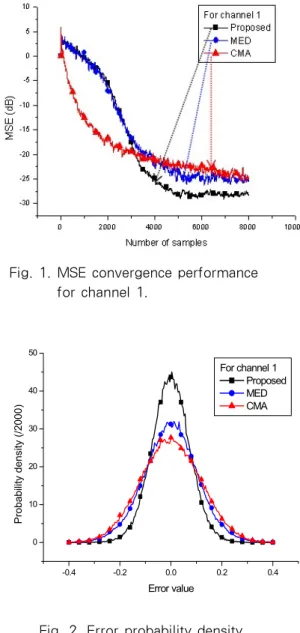
We have studied the PDF of steady-state errors and MSE learning curves of the proposed, MED and CMA as a figure of merit. We see in Figs. 1 and 3 for MSE performance that increasing the ESR has the effect of increasing the steady-state error of CMA.
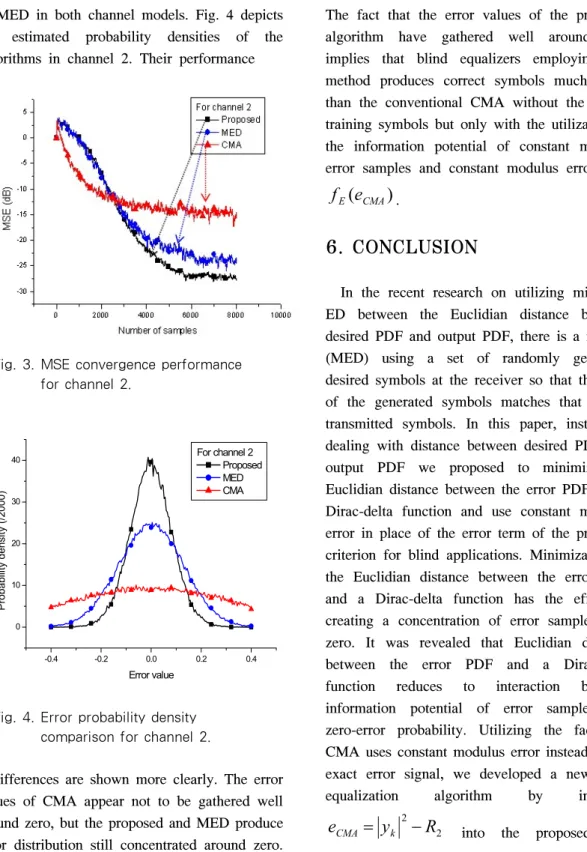
In case of channel 1 with ESR=11.12, the MSE performance in Fig. 1 shows that the proposed has a significantly enhanced performance in comparison with MED and CMA. In Fig. 2, the error PDF estimates are shown. Clearly, the error distribution of the proposed is more concentrated around zero. In the severer channel model, channel 2, whose ESR is 21.71, CMA shows severe performance degradation in Fig. 3. On the other hand, the steady-state error-performance of the proposed
and MED show similar performance to that in channel 1, so the ITL-type algorithms can be
Fig. 1. MSE convergence performance for channel 1.
-0.4 -0.2 0.0 0.2 0.4
0 10 20 30 40 50
Probability density (/2000)
Error value
For channel 1 Proposed MED CMA
Fig. 2. Error probability density comparison for channel 1.
considered relatively insensitive to ESR variations compared to CMA based on MSE criterion. Also the proposed algorithm yields about 3 dB performance enhancement compared
to MED in both channel models. Fig. 4 depicts the estimated probability densities of the algorithms in channel 2. Their performance
Fig. 3. MSE convergence performance for channel 2.
-0.4 -0.2 0.0 0.2 0.4
0 10 20 30 40
Probability density (/2000)
Error value
For channel 2 Proposed MED CMA
Fig. 4. Error probability density comparison for channel 2.
differences are shown more clearly. The error values of CMA appear not to be gathered well around zero, but the proposed and MED produce error distribution still concentrated around zero.
The fact that the error values of the proposed algorithm have gathered well around zero implies that blind equalizers employing this method produces correct symbols much better than the conventional CMA without the aid of training symbols but only with the utilization of the information potential of constant modulus error samples and constant modulus error PDF
) ( CMA
E e
f .
6. CONCLUSION
In the recent research on utilizing minimum ED between the Euclidian distance between desired PDF and output PDF, there is a method (MED) using a set of randomly generated desired symbols at the receiver so that the PDF of the generated symbols matches that of the transmitted symbols. In this paper, instead of dealing with distance between desired PDF and output PDF we proposed to minimize the Euclidian distance between the error PDF and a Dirac-delta function and use constant modulus error in place of the error term of the proposed criterion for blind applications. Minimization of the Euclidian distance between the error PDF and a Dirac-delta function has the effect of creating a concentration of error samples near zero. It was revealed that Euclidian distance between the error PDF and a Dirac-delta function reduces to interaction between information potential of error samples and zero-error probability. Utilizing the fact that CMA uses constant modulus error instead of the exact error signal, we developed a new blind equalization algorithm by inserting
2
2 R
y
eCMA = k − into the proposed cost
◐ 저 자 소 개 ◑
김 남 용(Namyong Kim)
1986년 연세대학교 전자공학과 졸업(학사) 1988년 연세대학교 대학원 전자공학과 졸업(석사) 1991년 연세대학교 대학원 전자공학과 졸업(박사) 1992-1998년 관동대학교 전자통신공학과 부교수
1998~현재 강원대학교 공학대학 전자정보통신공학부 교수 관심분야 : Adaptive Equalization, RBFN Odour Sensing Systems E-mail : [email protected]
function.
The performance of CMA based on MSE criterion and MED and the proposed one based on information theoretic learning have been compared in terms of MSE learning curves and the error distributions for two different multipath channels. These analyses demonstrated that the proposed algorithm has a faster speed of convergence, lower steady-state means squared error in comparison with CMA and MED.
The error samples of the proposed algorithm exhibited a more concentrated density function.
In more detail, the proposed algorithm yielded about 3 dB performance enhancement compared to MED in both channel models.
These results indicate that the proposed method can be an excellent candidate for blind equalizer algorithms for multipoint communications. In future work, it is needed a research for reduced computational complexity of the proposed method for efficient implementation of blind equalization applications.
REFERENCES
[1] W. M. Moh, Y. Chen, “Multicasting flow control for hybrid wired/wireless ATM networks,” Performance Evaluation, Vol. 40, Mar. 2000, pp. 161-194.
[2] L. M. Garth, “A dynamic convergence analysis of blind equalization algorithms,” IEEE Trans. on Comm., Vol. 49, April. 2001, pp. 624-634
[3] F. Mazzenga, “Channel estimation and equalization for M-QAM transmission with a hidden pilot sequence,” IEEE Trans. on Broadcasting, Vol. 46, June. 2000, pp. 170-176
[4] J. R. Treichler and B. Agee, “A new approach to multipath correction of constant modulus signals,”
IEEE Trans. Acoust., Speech, Signal Process. vol.
ASSP-31, Nov. 1983, pp. 349-372.
[5] J.C. Principe, D. Xu and J. Fisher, Information Theoretic Learning, in: S. Haykin, Unsupervised Adaptive Filtering, Wiley, New York, Vol. I, 2000, pp. 265-319.
[6] D. Erdogmus, and J.C. Principe, “An Entropy Minimization algorithm for Supervised Training of Nonlinear Systems,” IEEE trans. Signal Processing, vol. 50, July, 2002, pp. 1780-1786.
[7] D. Erdogmus, Y. Rao and J. C. Principe, “Supervised Training of Adaptive Systems with Partially Labeled Data,” Proceedings of the International Conference on ASSP, Apr. 2005. pp. v321-v324.
[8] N. Kim and L. Yang, “A New Criterion of Information Theoretic Optimization and Application to Blind Channel Equalization,”
Journal of Korean Society for Internet Information, Feb. 2009. pp. 11-17.
[9] S. Haykin, Adaptive Filter Theory, Prentice Hall, Upper Saddle River, 4th edition, 2001.