Received:February 21, 2020 Revised: June 3, 2020 Accepted: August 19, 2020
OPEN ACCESS
HORTICULTURAL SCIENCE and TECHNOLOGY 38(6):850-859, 2020
URL: http://www.hst-j.org pISSN : 1226-8763 eISSN : 2465-8588
This is an Open Access article distributed under the terms of the Creative Commons Attribution Non-Commercial License which permits unrestricted non-commercial use, distribution, and reproduction in any medium, provided the original work is properly cited.
Copyrightⓒ2020 Korean Society for Horticultural Science.
본 연구는 2019년도 농촌진흥청 연구개발사업(과 제번호: PJ01324101)에 의해 수행되었음.
코이어 배지 수경재배 시 재식밀도가 멜론(Cucumis melo L.) 3품종의 생육과 수량에 미치는 영향
임미영1 · 정호정1 · 최수현2* · 최경이1 · 김소희1
1국립원예특작과학원 시설원예연구소, 2국립원예특작과학원 채소과
Effect of Planting Density by Cultivars on the
Growth and Yield of Melons (Cucumis melo L.) in Hydroponics Using Coir Substrates
Mi Young Lim1, Ho Jeong Jeong1, Su Hyun Choi2*, Gyeong Lee Choi1, and So Hui Kim1
1Protected Horticulture Research Institute, National Institute of Horticultural and Herbal Science, RDA, Haman 52054, Korea
2Vegetable Research Division, National Institute of Horticultural and Herbal Science, RDA, Wanju 55365, Korea
*Corresponding author: [email protected]
Abstract
This study aimed to evaluate the effect of planting density by cultivar on the growth, quality, and yield of melon (Cucumis melo L.) in hydroponics using coir substrates. Experiments were conducted using three domestic netted melon cultivars, namely ‘Earl’s Kingstar’, ‘Hero’, and ‘PMR Dalgona’.
The plants were transplanted on March 19, 2019 to a venlo-type glass greenhouse. The spacing between the rows was 1.5 m and the planting density was 2.0, 2.7, and 3.3 plants/m2 (the within-row planting distance was 0.33, 0.25, and 0.20 m, respectively); the plants were grown using slabs of equal sizes (100 × 20 × 10 cm). The electrical conductivity (EC) levels in the supplied nutrient solution were 1.8 and 2.1 dS∙m-1 after transplanting and fruit setting, respectively. The EC level in the drained solution was less than 1.0 dS∙m-1 in the early stages of growth; it increased to 3.0 dS∙m-1 in the middle stages with the increase in irrigation, and in the late stages of growth, it was about 4.0 dS∙m-1 in all the treatments. The planting density did not have any significant effect on the EC level and pH of the drained solution. An evaluation of the growth of all the three cultivars showed that the lower the planting density, the larger the stem diameter, leaf length, leaf width, and leaf area of the plants. The lengths from 0 to 10th node tended to be small when the planting density was 2.0 plants/m2, and the node length from 10th to 20th node did not differ among different plant densities.
The lower the planting density, the heavier the fruit in all the three cultivars and the higher the soluble solids content. However, the yield increased by 20.8 to 32.6% as the planting density increased from 2.0 to 3.3 plants/m2. For ‘PMR Dalgona’, the rate of decline in average fruit weight was the lowest by 19.6% and the rate of yield increase was the highest by 32.6% when increasing the planting density from 2.0 to 3.3 plants/m2. For ‘Earl’s Kingstar', on the other hand, the rate of average fruit weight decreased the most by 26.8% and the rate of yield increased the least 20.8%.
The heavier fruit weight had a large decrease in the average fruit weight by planting density, which showed the sensitivity of planting density depending on cultivars. Therefore, this study suggests
that cultivars with a higher planting density with greater production per unit area have an advantage from an economic point of view, whereas the lower planting density is reasonable in terms of fruit quality.
Additional key words: fruit weight, leaf area, light interception, soluble solids content
서 론
멜론(Cucumis melo L.)은 박과에 속하는 1년생 식물로 단맛과 향이 좋고 수분을 제외한 대부분의 성분이 탄수화물이며 주 로 가용성 당 성분에 식이섬유도 소량 함유되어 있다(Lee et al., 2015). 우리나라의 멜론 재배면적은 2017년 1,456ha였다 (MAFRA, 2018). 그 중 수경재배 면적은 1.4%인 21ha에 불과하지만, 토양재배에서 발생되는 연작장해의 회피와 관수 및 재 배 작업의 생력화가 가능한 시스템으로써 수경재배의 경우 집약적인 관리와 재배 환경의 최적화를 통해 생산성과 품질 향상이 가능하다(Hwang et al., 1998; Dorais et al., 2001). 수경재배용 배지 종류는 암면, 펄라이트, 코이어, 피트모스, 혼합배지 등이 있는데, 최근 코이어 배지가 급증하여 전체 고형 배지 중 약 70%를 점유하고 있다(RDA, 2013; MAFRA, 2018; Choi et al., 2019). 코이어는 코코넛 열매의 껍질을 가공한 것이며 사용 후 폐기가 쉬운 친환경적 배지이다. 코이어 배지의 용적밀도는 0.06 ‑ 0.08g·m-3로 암면과 비슷하고, 펄라이트보다 가볍다(Choi et al., 2009; Kim et al., 2016). 최근에는 코이어 배지의 공극 률과 배수성의 확보를 위해 입자가 큰 칩을 첨가하여 근권의 함수율 조절이 용이하도록 하였다(An et al., 2009; Choi et al., 2017). 배지 종류마다 이화학성 차이로 인해 양액의 흡착과 배출이 달라지게 되며, 작물의 양수분 흡수에도 영향을 미칠 수 있 다(Handrek, 1993; Abad et al., 2002; Choi et al., 2012; Choi et al., 2019). 멜론 수경재배에서는 암면(Chang et al., 2012)이 나 펄라이트(Kim and Kim, 2003) 등 무기 배지를 이용한 연구가 선행되었으나, 코이어 배지에 대한 연구는 부족한 실정이다.
재식밀도는 엽수, 엽면적 및 초장 등 식물체의 형태 형성에 직접적인 영향을 미치며 적정한 재식거리의 확보가 수량 및 품질 을 결정한다(Okuda and Yukihiro, 2004; Seo et al., 2005; Lee et al., 2010; Wee et al., 2018). 또한, 일정한 범위의 재식밀도 증가는 작물의 광합성 지수 및 광 이용효율을 높일 수 있다고 하였으며(Diepenbrock, 2000), 생산량과 품질 측면에서 적정 재 식밀도가 각각 달라질 수 있다고 하였다(Uoon and Cho, 2019). 멜론 과실은 크기와 품질에 따른 가격 차이가 크다. 네트형 멜 론은 식물체 당 과실 1개를 착과 시키는 것이 보통이며, 재식밀도는 과실의 크기, 수량 및 품질에 많은 영향을 미친다 (Mendlinger, 1994; Hwang et al., 1998). 또한 재식밀도를 이용하여 식물체 집단 수를 증가시킴으로써 작물 총수량도 증가될 수 있다(Baron et al., 2006; Williams II, 2012; Wee et al., 2018). 재식밀도가 과실 수량에 미치는 영향의 수학적 모델링이 제 시되곤 하지만 품종마다 형태학적으로 차이가 있고 고수량 품종에 대한 예측에서 정확하게 이용될 수 없는 형편이다. 게다가 같은 품종이라도 포장 개체군 권장 수치도 지역에 따라 다르다(Maynard and Scott, 1998; Wee et al., 2018).
이와 같이 수경재배 시 배지 종류 또는 품종에 따라서 경제성을 고려할 때 생산성과 품질을 높일 수 있는 재식밀도 연구는 중 요하다. 따라서, 본 연구에서는 코이어 배지를 이용한 수경재배 시 네트형 멜론 3품종을 대상으로 각각의 재식밀도 처리가 생 육 및 수량에 미치는 영향을 알아보았다.
재료 및 방법
실험 장소 및 멜론 재배
이 연구는 국립원예특작과학원 시설원예연구소 벤로형 유리온실(672m2)에서 수행되었다. 시험 품종은 ‘얼스킹스 타’(Earl’s Kingstar, Nongwoobio Co., Ltd., Korea), ‘히어로’(Hero, Farm Hannong Co., Ltd., Korea), ‘피엠알달고 나’(PMR Dalgona, Lucky Seeds, Korea) 등 3가지가 사용되었다. 2019년 2월 18일에 육묘용 혼합 상토(토실, Shinan
Fig. 1. Daily temperature in the greenhouse during the growing period.
Growth Co., Ltd., Korea)를 충전한 50구 트레이에 파종하였으며, 그 후 29일간 육묘하였다. 3월 19일, 본엽이 2 ‑ 3매 정도 발 생하였을 때 온실에 정식하였다. 11 ‑ 13마디에 발생한 측지에 착과 시켰으며, 4월 22일에 23마디를 남기고 적심 하였고, 적심 후 식물체의 생육을 조사하였다. 6월 17일에 과실을 수확한 후 과실의 특성을 조사하였다.
재배기간 동안 온실 내부 온도는 최고/최저, 28 ‑ 30°C/15 ‑ 16°C로 설정하였다(Fig. 1). 온도 데이터 수집은 Cambell CR1000(Cambell Co., Ltd., USA)을 사용하였다. 양액은 멜론 전용 야마자키액(Yamazaki, 1982)을 사용하였다. 급액 EC는 정식 초기 및 착과 후 각각 1.8 ‑ 2.1dS·m-1 (pH 6.0)로 공급하였고, 각 생육 단계별로 배액의 비율을 20 ‑ 30 ‑ 10%가 되도록 급액량을 설정하였다. 이때 재식밀도 3처리에 대한 배액량을 지속적으로 모니터링하여 처리 별로 각각 단위면적당 비슷한 급 액량이 되도록 하였다.
실험 설계
재식밀도 처리를 위해 이랑 간격을 1.5m로 고정하고 식물체 포기 사이의 간격을 0.33, 0.25, 및 0.20m 즉, 각각 재식밀도 처 리가 2.0, 2.7, 및 3.3plants/m2 되도록 설정하여 3품종, 재식밀도 3처리를 4반복 난괴법으로 정식하였다. 배지 슬라브 규격은 100 × 20 × 10cm(20L), 칩과 더스트 비율이 5:5인 코이어 슬라브(Daeyoung GS, Daegu, Korea)를 사용하였다.
코이어 배지 배액의 화학성, 식물체 생육 및 수량 분석
배액의 화학성 변화를 관찰 하고자1일 총 8회 관수를 실시하고 마지막 관수가 끝난 시간 이후에 ‘히어로’ 품종을 정식한 코이 어 배지 슬라브로부터 하루 동안 배출된 총 배액을 집수하여 재식밀도 처리구 별로 수집한 후 총 배액량을 측정하였고, pH 미터 (Orion Star A211, Thermo Fisher Scientific, Massachusetts, USA)와 EC 미터(CT-54101B, DKK-TOA, Tokyo, Japan)를 사용하여 배액의 pH와 EC를 측정하였다.
식물체의 엽장, 엽폭, 엽병장, 과실의 과중, 과장, 과폭 등은 농촌진흥청 농업과학기술 연구조사분석기준에 따라 조사하였다 (RDA, 2012). 엽면적은 엽면적 추정식(Leaf area = 0.73 × leaf length × leaf width)을 이용하여 계산하였다(Wu et al., 2010).
식물체의 줄기 길이는 지제부를 기준으로 0 ‑ 10 마디까지 길이, 10 ‑ 20마디까지의 길이를 조사하고 식물체 총 길이를 계산 하 였다. 수확 후 평균 과중을 이용하여 10a당 과실 수량을 계산하였다.
과형지수는 과장/과폭의 비율로 계산하였다. 가용성 고형물 함량(Soluble solids content, °Brix)은 과실에서 표피와 종자 및 태좌부를 제거한 중간 과육을 믹서기로 갈아서 시료를 만든 다음 휴대용 당도계(PAL-1, ATAGO, Co., Ltd, Tokyo, Japan)를 이용하여 측정하였다.
Fig. 2. EC level changes of irrigation and drainage as affected by the planting density during growing period of musk melon ‘Hero’.
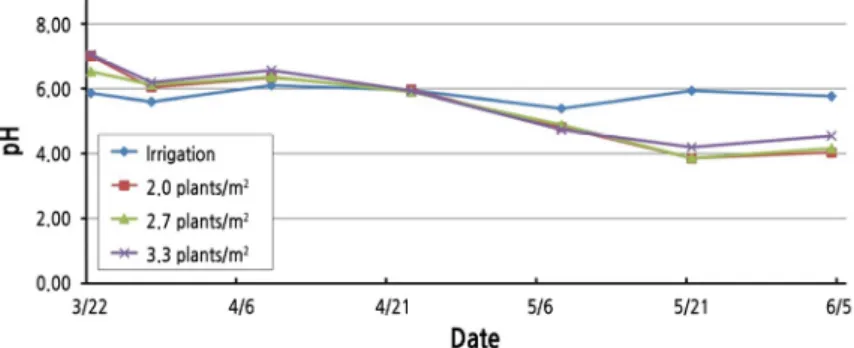
Fig. 3. pH changes of irrigation and drainage as affected by the planting density during the growing period of musk melon
‘Hero’.
통계 분석
멜론 3품종, 재식밀도 3처리를 난괴법 4반복으로 배치하였고, 품종과 재식밀도의 2요인 분산분석(ANOVA)을 하였다. 통 계 분석은 SAS 프로그램(Statistical Analysis System, V. 9.4, SAS Institute Inc., NC, USA)을 이용하였고, DMRT (Duncan’s multiple range test)로 처리 평균 간 유의성을 검정하였다(p ≤ 0.05).
결과 및 고찰
코이어 배지 배액의 화학성 변화
생육기간 동안 양액 EC는 정식 초기 및 착과 후기의 생육 단계별로 1.8 ‑ 2.1dS·m-1(pH 6.0)의 농도로 공급하였다. 생육 시기 에 따른 배액량 20 ‑ 30 ‑ 10% 수준이 되도록 단위면적당 동일한 급액량을 처리구마다 급액하였다.
‘히어로’ 품종의 재식밀도에 따른 급액과 배액의 EC 및 pH를 조사한 결과는 Fig. 2와 Fig. 3에 나타내었다. 배액의 EC는 생 육 초기에 1.0dS·m-1 이하였으나 관수량이 늘어나는 생육 중기에 3.0dS·m-1로 상승하였으며, 후기에는 약 4.0dS·m-1였다(Fig.
2). 배액의 pH는 생육 초기부터 중기까지 급액의 pH와 같은 경향을 보였으나 생육 후기 관수량이 줄어드는 시기에 재식밀도 각각 3처리구 모두 급액의 pH보다 더 낮아지는 변화를 보였다(Fig. 3).
Choi et al.(2019)의 선행 연구에서 ‘피엠알달고나’ 배액의 EC는 전 생육 기간 동안 1.0 ‑ 3.0dS·m-1 수준을 유지하였고, 더 스트의 비율이 높은 배지를 사용했을 때에는 착과 15일 이후 네트 형성기부터 배액 EC가 급격히 증가하여 3.0 ‑ 6.8dS·m-1로 높은 값을 나타내었는데, 이것은 더스트의 함수율이 높기 때문으로 판단하였다. 또한 코이어 배지 혼합 비율과 급액량 연구 결 과에서 코이어 배지의 물리성을 좌우하는 칩과 더스트 비율에 따라 멜론의 생육과 품질이 달라지고, 더스트 비율이 높은 경우
Table 1. Effects of planting density on the plant node characteristics of ‘Earl’s Kingstar’, ‘Hero’, and ‘PMR Dalgona’
muskmelons Cultivar (A)
Planting density (plants/m2) (B)
Node diameter (mm)
Internode length (cm)
0 ‑ 10 th 10 ‑ 20 th Total (0 ‑ 20 th)
Earl’s Kingstar
2.0 11.6 az 49.4 b 83.2 a 132.5 a
2.7 10.8 cde 52.8 a 80.0 b 132.8 a
3.3 10.2 f 53.6 a 79.8 b 133.4 a
Hero
2.0 11.5 ab 42.9 d 63.8 c 106.7 b
2.7 11.0 bcd 45.5 cd 62.6 c 108.1 b
3.3 10.6 def 44.7 cd 61.2 c 105.9 bc
PMR Dalgona
2.0 11.1 abc 44.8 cd 56.5 d 101.3 d
2.7 10.5 ef 46.3 c 54.4 d 100.7 d
3.3 9.7 g 46.6 c 55.9 d 102.5 cd
F-testy
A *** *** *** ***
B *** *** * NS
A × B NS NS NS NS
The values of growth characteristics are represented as averages of 20 samples (4 replications × 3 treatments).
zMean separation within columns by Duncan’s multiple range test at 5% level.
yNS, *, *** Nonsignificant or significant at p ≤ 0.05 or 0.001, respectively.
보수력이 증가하여 급액량이 높을수록 잎의 생장과 과실 비대에 긍정적인 영향을 주었지만 당도는 급액량이 낮을수록 높았고 품종 간 과실 품질 차이가 크다고 보고하였다(Choi et al., 2019). An et al.(2009)은 코이어 배지의 물리성은 적정 함수율 내 같 은 함수율에서 암면보다 근군의 변화가 적은 안정된 상황이므로 칩의 비율이 높은 배지를 사용할 경우 배수력이 높고 적정 함 수율을 유지하여 착과와 생육에 도움이 된다고 하였다. 본 연구에서는 배지의 칩 함유율이 50%로 동일한 코이어 배지를 이용 하였고, 단위면적당 동일한 관수량이 되도록 급액을 지속적으로 조절하여 재식밀도 이외의 근권부 수분환경의 영향을 최소화 하여 물리적 영향을 줄이고자 하였다.
결과적으로 재배기간 동안 코이어 배지 배액의 EC와 pH 모두 재식밀도 처리간의 차이는 나타나지 않았다. 착과 후 네트 형 성기부터 배액의 EC가 급격히 높아진다는 결과(Choi et al., 2019)와 같이 코이어 배지의 경우 재식밀도 처리와 상관없이 과실 비대기에 급액량을 많이 증가시켰다가 과실 성숙기 무렵 급액량을 급격히 줄였기 때문에 생육 후기의 EC가 상승한다는 것을 알 수 있었다.
재식밀도에 따른 식물체 생육
적심 후 11 ‑ 13 착과 마디의 평균 줄기 직경을 조사한 결과, ‘얼스킹스타’, ‘히어로’ 및 ‘피엠알달고나’ 3품종 모두 재식밀도 가 낮은 2.0plants/m2 처리구에서 유의성 있게 컸다(Table 1). 마디사이 길이(절간장)의 경우 0 ‑ 10 마디까지의 길이는 3품종 모두 재식밀도가 높을수록 길어지는 경향이었고, 10 ‑ 20 마디의 길이는 ‘얼스킹스타’ 품종은 재식거리가 가장 좁은 2.0plants/m2 처리구에서 83.2cm로 유의성 있게 가장 길었으나 ‘히어로’ 및 ‘피엠알달고나’ 품종은 처리 간에 차이가 없었다 (Table 1). 재식밀도에 따른 마디사이 길이의 변화는 생육 초기 0 ‑ 10 마디 사이가 생육 후기 10 ‑ 20 마디보다 영향을 더 많이 받는 것을 알 수 있었는데, 이는 Uoon and Cho(2019)의 연구 결과 콜라비 수경재배 시 재식밀도에 따른 초장은 정식 후 8일부 터 급격히 증가하기 시작하지만 정식 27일 후부터는 완만한 변화를 보이는 것과 같았다. 또한 멜론 ‘히트’ 품종 역시 재식밀도 가 높은 밀식 환경에서 초장이 유의성 있게 길었고(Hwang et al., 1998), 엽채류 수경재배에서도 밀식은 초장을 증가 시킨다는 보고와 같은 결과였다(Okuda and Yukihiro, 2004; Seo et al., 2005; Lee et al., 2010). 수경재배에서는 공간의 이용도를 높이
Table 2. Effects of planting density on the plant leaf characteristics of ‘Earl’s Kingstar’, ‘Hero’, and ‘PMR Dalgona’
muskmelons Cultivar (A)
Planting density (plants/m2) (B)
Leaf length (cm)
Leaf width (cm)
Petiole length (cm)
Leaf area (cm2)
Earl’s Kingstar
2.0 21.9 az 28.9 a 22.2 a 463.9 a
2.7 20.7 b 26.5 b 15.5 b 401.0 b
3.3 19.4 c 24.8 c 14.5 b 352.2 c
Hero
2.0 19.1 c 24.6 c 14.5 b 344.8 c
2.7 18.1 d 23.0 d 15.0 b 306.0 d
3.3 17.6 d 22.2 de 14.5 b 284.7 de
PMR Dalgona
2.0 19.7 c 24.7 c 14.0 b 355.5 c
2.7 18.3 d 22.7 d 12.8 b 303.7 de
3.3 17.8 d 21.6 e 12.4 b 282.2 e
F-testy
A *** *** *** ***
B *** *** * ***
A × B NS NS * *
The values of growth characteristics are represented as averages of 36 samples (4 replications × 3 treatments).
zMean separation within columns by Duncan’s multiple range test at 5% level.
yNS, *, *** Nonsignificant or significant at p ≤ 0.05 or 0.001, respectively.
기 위해 ‘세워 키우기’를 기본으로 실시하고 있으며, 줄기의 유인과 적심 등에 줄기의 길이가 매우 중요한 영향을 미칠 수 있다 (Lim et al., 2020). Ben-Oliel and Kafkafi(2002)는 멜론 육종 시 과실의 수확 기간을 최소화하고 시설 내에서 식물 상태를 우 수한 수준으로 유지하기 위해 마디가 짧은 형태의 품종을 개발하고자 노력하였다. 품종의 특성을 고려하면서, 재식밀도가 낮 도록 재식 거리를 넓게 설정하게 되면 초장을 낮게 관리하는데 유리할 것으로 보인다.
엽장, 엽폭 및 엽면적의 생육은 3품종 모두 재식밀도가 가장 낮은 2.0plants/m2 처리구에서 유의성 있게 가장 컸다. 엽면적의 경우 ‘얼스킹스타’ 463.9, ‘히어로’ 344.8 및 ‘피엠알달고나’ 355.5cm2 였으며 특히 ‘얼스킹스타’가 가장 컸다(Table 2). Choi et al.(2019)은 코이어 배지를 이용한 멜론 수경재배 시 급액량이 많을수록 엽장, 엽폭, 엽면적 등 모든 생육이 좋았다고 하였으 며, An et al.(2009)은 착과기의 급액량이 낮을수록 파프리카의 잎 크기가 감소한다고 하였다. 본 연구에서는 급액량이 제한조 건이 되지 않도록 배액율을 지속적으로 모니터링하여 단위면적당 거의 동일한 급액을 실시하였다. Gruda(2005)는 낮은 광도 에서 시설 엽채류 재배 시 엽면적 및 수량을 감소시킨다고 하였고, 시금치 수경재배 시 엽면적이 넓은 시금치는 밀식할수록 엽 장과 엽폭이 감소하기 때문에 적정 재식거리 확보가 수량과 품질에 미치는 영향이 크다고 하였다(Seo et al., 2005). 이처럼 결 과적으로 재식밀도에 따른 수광량이 잎의 생장에 큰 영향을 준 것으로 생각된다.
재식밀도 처리에 따른 품종별 과실 품질 및 수량
가용성 고형물 함량의 분석 결과, ‘얼스킹스타’ 10.3, ‘히어로’ 12.7, 및 ‘피엠알달고나’ 12.5°Brix로 재식밀도가 가장 낮은 2.0plants/m2 처리구에서 3품종 모두 가장 높았다(Table 3). Bhella(1985)의 연구에서도 재식거리를 1.0m(3,600plants/ha)에 서 0.25m(14,500plants/ha)로 줄여 재식밀도를 높였을 때 가용성 고형물 함량이 감소되었고, 재식밀도를 m2 당 2.0개체에서 8.0 개체로 높여 재배하였을 때에도 가용성 고형물 함량이 감소된 결과를 보였다(Mendlinger, 1994). 이처럼 가용성 고형물 함량과 재식밀도는 부의 상관관계가 있는 것으로 판단된다. 과실은 성숙하는 동안 잎에서의 광합성 작용을 통해 탄수화물을 축적하게 되는데, 재식밀도가 높으면 잎의 수광량이 줄어들게 되고, 재식밀도가 낮으면 광합성을 할 수 있는 수관이 넓어지게 된다(Wee et al., 2018; Kombo and Sari, 2019).
Table 3. Effects of planting density on the fruit characteristics of ‘Earl’s Kingstar’, ‘Hero’, and ‘PMR Dalgona’ muskmelons
Cultivar (A)
Planting density (plants/m2) (B)
Soluble solids content (°Brix)
Fruit length (cm)
Fruit diameter
(cm)
Fruit shape index
Flesh thickness
(mm)
Fruit cracking
(%)
Net indexz (1 ‑ 5)
Earl’s Kingstar
2.0 10.3 dy 165.1 ay 156.2 a 1.05 c 43.1 a 37.5 ab 1.3 ab
2.7 9.6 e 155.4 c 147.5 b 1.05 c 39.3 b 15.6 bc 1.4 a
3.3 10.0 d 143.7 de 141.0 cd 1.02 d 37.9 bcd 22.5 bc 1.4 a
Hero
2.0 12.7 a 159.1 b 142.8 c 1.11 a 38.9 b 48.6 a 1.2 b
2.7 12.1 bc 153.1 c 136.2 e 1.12 a 38.2 bc 51.0 a 1.1 b
3.3 12.5 ab 145.6 d 134.4 e 1.08 b 36.1 d 34.1 ab 1.4 a
PMR Dalgona
2.0 12.5 ab 141.1 e 139.2 d 1.01 de 37.4 bcd 2.7 c 1.1 b
2.7 11.8 c 134.3 f 133.8 e 1.00 de 36.7 cd 6.2 c 1.3 ab
3.3 11.8 c 130.2 g 130.8 f 0.99 e 33.8 e 4.1 d 1.2 ab
F-testx
A *** *** *** *** *** *** *
B *** *** *** *** *** NS *
A × B NS *** ** NS NS NS NS
The values of growth characteristics are represented as averages of 40 samples (4 replications × 3 treatments).
z1, excellent; 2, good; 3, average; 4, poor; 5, bad.
yMean separation within columns by Duncan’s multiple range test at 5% level.
xNS, *, **, *** Nonsignificant or significant at p ≤ 0.05 or 0.01 or 0.001, respectively.
A B C
Fig. 4. Photographs of muskmelons (A, ‘Earl’s Kingstar’ B, ‘Hero’ C, ‘PMR Dalgona’) by the planting density (plants/m2) on spring season culture.
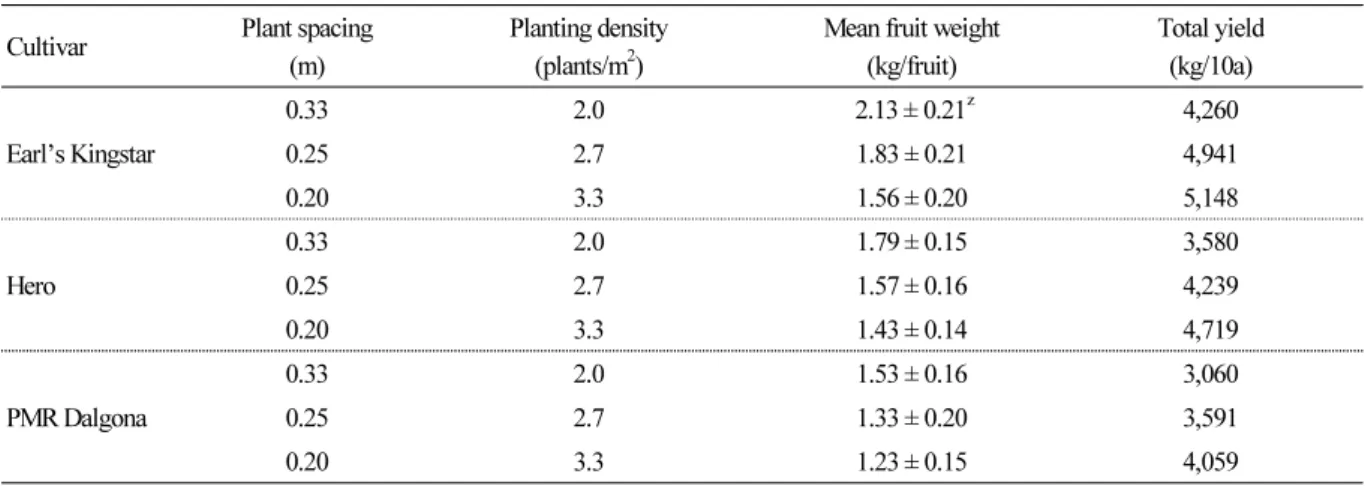
‘히어로’는 과형지수(과장/과폭)가 1.08 ‑ 1.12로써 과실 형태가 장형과에 속하였고, ‘얼스킹스타’와 ‘피엠알달고나’는 원형 과에 속하였다. 그리고 멜론 품질에서 중요한 네트 형성의 경우 3품종 모두 네트 발생이 우수하였다(Table 3, Fig. 4). 과실의 무게는 3품종 모두 재식밀도가 낮은 2.0plants/m2 처리구에서 가장 무거웠다(Fig. 5). 그러나 3품종 모두 재식밀도가 가장 높은 3.3plants/m2 처리구에서 10a 당 수량이 가장 높았다(Table 4). 결과적으로 3품종 모두 재식밀도가 감소하면 과실 개당 과중은 늘어나지만, 총 수량은 감소하였다(Table 4, Fig. 5).
‘피엠알달고나’의 경우 재식밀도가 2.0에서 3.3plants/m2로 증가할수록 평균 과중의 감소율이 19.6%로 가장 낮고, 수량의 증가율는 32.6%로 가장 높았다. ‘얼스킹스타’는 평균 과중의 감소율이 26.8%로 가장 컸고, 수량의 증가율은 20.8%로 가장 낮
았다(Table 4). 과실당 과중이 무거운 품종일수록 재식밀도에 따른 평균 과중의 변화폭이 더 큰 결과를 보였다. 이러한 결과를
Table 4. Effects of planting density on fruit total yield of ‘Earl’s Kingstar’, ‘Hero’, and ‘PMR Dalgona’ muskmelons
Cultivar Plant spacing
(m) Planting density
(plants/m2) Mean fruit weight
(kg/fruit) Total yield
(kg/10a)
Earl’s Kingstar
0.33 2.0 2.13 ± 0.21z 4,260
0.25 2.7 1.83 ± 0.21 4,941
0.20 3.3 1.56 ± 0.20 5,148
Hero
0.33 2.0 1.79 ± 0.15 3,580
0.25 2.7 1.57 ± 0.16 4,239
0.20 3.3 1.43 ± 0.14 4,719
PMR Dalgona
0.33 2.0 1.53 ± 0.16 3,060
0.25 2.7 1.33 ± 0.20 3,591
0.20 3.3 1.23 ± 0.15 4,059
zValues are mean ± SD, n=40.
Fig. 5. Fruit weights of three different musk melon cultivars as affected by the planting density (plants/m2) in the spring season.
토대로 품종에 따른 재식밀도의 민감성 여부를 알 수 있었다.
품종과 재식밀도 간의 2요인에 대한 분산분석을 실시한 결과, 엽면적, 가용성 고형물 함량, 과중 등이 각각 높은 유의성을 나 타내었다. 단위면적당 동일한 급액 조건에서 실시한 본 연구에서 재식밀도를 달리하였을 때 재식밀도가 낮은 처리구에서 ‘얼 스킹스타’, ‘히어로’, 및 ‘피엠알달고나’ 3품종 모두 과실 품질이 우수한 것으로 나타났다. 재식밀도가 낮을수록 수광률과 통기 성이 양호하기 때문에 엽면적이 확보되고 과실의 크기와 품질에 더 많은 영향을 미친다고 하였다(Lee et al., 2010). 또한 멜론 수경재배 시 과실 품질의 중요한 요소인 가용성 고형물 함량은 품종 간의 차이가 크다는 보고도 있다(Choi et al., 2019; Lim et al., 2020). 코이어배지를 이용한 멜론 ‘락’ 품종 수경재배 시 재식밀도가 증가함에 따라 ha 당 총 과실 수량이 선형으로 증가 하고, 재식거리와 총 수량에 유의적인 영향이 있다고 하였고, 그와 반대로 재식밀도가 감소하면 가용성 고형물, 아스코르브산 및 총 탄수화물 함량 등 과실 품질이 향상된다고 하였다(Wee et al., 2018).
경제성을 고려하면 단위면적당 생산량이 많은 재식밀도가 높은 쪽이 유리할 수도 있으나 과실 크기나 당도와 같은 품질 측면 에서 볼 때 재식밀도가 오히려 낮은 것이 적정하다고 할 수 있다(Hwang et al., 1998; Wee et al., 2018; Uoon and Cho, 2019).
본 연구 결과, 코이어 배지를 이용한 멜론 수경재배 시 경제적 수량성과 과실의 품질 두가지 측면을 고려한 적정 재식밀도의 선 택 시 과중이 작은 품종보다 과중이 큰 품종의 경우 특히 더 신중한 판단이 필요함을 알 수 있었다.
초 록
이 연구에서는 코이어 배지를 이용한 수경재배 시 멜론(Cucumis melo L.) 품종에 따른 재식밀도가 생육, 품질 및 수량에 미 치는 영향을 구명하였다. ‘얼스킹스타’, ‘히어로’ 및 ‘피엠알달고나’ 등 국내에서 육성한 네트형 멜론 3품종을 2019년 3월 19 일부터 6월 17일까지 재배하였다. 배지는 동일한 규격의 코이어 슬라브(100 × 20 × 10cm)를 사용하였고, 이랑 간격은 1.5m로 고정하였으며, 재식 밀도는 2.0, 2.7, 3.3plants/m2(식물체 간격 0.33, 0.25, 0.20m)로 설정하였다. 급액 농도는 정식 초기 및 착 과 후 각각 1.8 및 2.1dS·m-1로 공급하였다. 배액의 EC를 분석한 결과, 생육 초기에는 1.0dS·m-1이하, 관수량이 늘어나는 생육 중기에는 3.0dS·m-1, 생육 후기에는 모든 처리구에서 약 4.0dS·m-1으로 높아졌다. 배액의 EC와 pH는 재식밀도 처리에 따라 유의한 차이가 나타나지 않았다. 식물체의 생육을 조사한 결과, 줄기 직경, 엽장, 엽폭, 엽면적은 3품종 모두 재식밀도가 낮을수 록 컸다. 0 ‑ 10마디까지의 줄기 길이는 재식밀도가 낮은 2.0plants/m2에서 짧아지는 경향이었고, 10 ‑ 20마디의 길이는 처리 간 차이가 없었다. 3품종 모두 재식밀도가 낮을수록 과중은 무거웠으며, 가용성 고형물 함량은 높았다. 그러나, 재식밀도를 2.0 에서 3.3plants/m2으로 증가시켰을 때 수량이 20.8 ‑ 32.6% 증가하였다. ‘피엠알달고나’ 품종의 경우 재식밀도가 2.0에서 3.3plants/m2 증가할수록 평균 과중의 감소율이 19.6%로 가장 낮았고, 수량의 증가율는 32.6%로 가장 높았다. ‘얼스킹스타’
품종은 평균 과중의 감소율이 26.8%로 가장 컸고, 수량의 증가율은 20.8%로 가장 낮았다. 과실 개당 과중이 무거운 품종일수 록 재식밀도에 따른 평균 과중의 감소폭이 더 큰 결과를 보였다. 따라서 품종에 따른 재식밀도의 민감성 여부를 알 수 있었고, 경제성을 고려하면 단위면적당 생산량이 많은 재식밀도가 높은 쪽이 유리하고 과실 품질 측면에서 볼 때 재식밀도가 오히려 낮 은 것이 적정하다.
추가 주요어 : 과중, 엽면적, 수광량, 가용성 고형물 함량
Literature Cited
Abad M, Noguera P, Puchades R, Maquieira A, Noguera V (2002) Physico-chemical and chemical properties of some coconut coir dusts for use as a peat substitute for containerised ornamental plants. Bioresour Technol 82:241-245. doi:10.1016/S0960-8524(01)00189-4 An CG, Hwang YH, Shon GM, Lim CS, Cho JL, Jeong BR (2009) Effect of irrigation amount in rockwool and cocopeat substrates on
growth and fruiting of sweet pepper during fruiting period. Korean J Hortic Sci Technol 27:233-238
Baron VS, Najda HG, Stevenson FC (2006) Influence of population density, row spacing and hybrid on forage corn yield and nutritive value in a cool-season environment. Can J Plant Sci 8:1131-1138. doi:10.4141/P05-136
Ben-Oliel G, Kafkafi U (2002) Melon fruit quality as affected by timing, duration, and concentration of phosphate and nitrogen sources in recycled hydroponic system. J Plant Nutr 25:1563-1583. doi:10.1081/PLN-120005408
Bhella HS (1985) Response of muskmelon to within row plant spacing. Proc Indiana Acad Sci 94:99-100
Chang YH, Hwang YH, An CG, Yoon HS, An JU, Lim CS, Shon GM (2012) Effects of non-drainage hydroponic culture on growth, yield, quality and root environments of muskmelon (Cucumis melo L.). J Bio-Environ Control 21:348-353. doi:10.12791/KSBEC.2012.21.
4.348
Choi GL, Cho MW, Cheong JW, Rhee HC, Kim YC, Roh MY, Kang YI (2012) Effect of ec levels in nutrient solution on the growth of juvenile rose in hydroponics using coir substrate. J Bio-Environ Control 21:317-321. doi:10.12791/KSBEC.2012.21.4.317 Choi GL, Yeo KH, Choi SH, Jeong HJ, Kim SY, Kang NJ, Choi HG (2017) Moisture retention and diffusion characteristics of the coir
substrate according to the ratio of chip and dust. Korean J Hortic Sci Technol 35(Suppl II):92 Choi JM, Lim LY, Kim BG (2009) Soilless substrates. Hakyesa, Daejeon, Korea
Choi SH, Lim MY, Choi GL, Kim SH, Jeong HJ (2019) Growth and quality of two melon cultivars in hydroponics affected by mixing ratio of coir substrate and different irrigation amount on spring season. Prot Hortic Plant Fact 28:376-387. doi:10.12791/KSBEC.2019.28.
4.376
Diepenbrock W (2000) Yield analysis of winter oilseed rape(Brassica napus L.) a review. Field Crops Res 67:35-49. doi:10.1016/S0378-42 90(00)00082-4
Dorais M, Papadopoulos AP, Gosselin A (2001) Greenhouse tomato fruit quality. Hortic Rev 26:239-319. doi:10.1002/9780470650806.
ch5
Gruda N (2005) Impact of environmental factors on product quality of greenhouse vegetables for fresh consumption. Crit Rev Plant Sci 24:227-247. doi:10.1080/07352680591008628
Handrek KA (1993) Properties of coir dust, and its use in the formulation of soilless potting media. Comm Soil Sci Plant Anal 24:349-363.
doi:10.1080/00103629309368804
Hwang YH, Cho KH, Song GW, Shin WK, Jeong BR (1998) Effect of pinching and fruit setting, and planting density on fruit quality and yield of muskmelon cultured by deep flow technique. J Bio Fac Env 7:219-225
Kim HJ, Kim YS (2003) Effect of irrigation duration by integrated sol radiation on growth and water use efficiency of muskmelon grown in perlite culture. J Kor Soc Hortic Sci 44:146-151
Kim HM, No KO, Hwang SJ (2016) Use of pellet or cube-type phenolic foam as an artificial medium for production of tomato plug seedlings. Korean J Hortic Sci Technol 34:414-423. doi:10.12972/kjhst.20160042
Kombo MD, Sari N (2019) Rootstock effects on seed yield and quality in watermelon. Hortic Environ Biotechnol 60:303-312. doi:10.1007/
s13580-019-00131-x
Lee SY, Kim HJ, Bae JH (2010) Effect of planting density on growth and quality in Hydroponics of Sedum sarmentosum. Korean J Hortic Sci Technol 28:580-584
Lee WJ, Lee JH, Jang KS, Choi YH, Kim HT, Choi GJ (2015) Development of efficient screening methods for melon plants resistant to Fusarium oxysporum f. Sp. melonis. Korean J Hortic Sci Technol 33:70-82. doi:10.7235/hort.2015.14101
Lim MY, Choi SH, Jeong HJ, Choi GL (2020) Characteristics of domestic net type melon in hydroponic spring cultivars using coir substrates. Korean J Hortic Sci Technol 38:78-86
Maynard ET, Scott WD (1998) Plant spacing affects yield of “superstar” muskmelon. HortScience 33:52-54
Mendlinger S (1994) Effect of increasing plant density and salinity on yield and fruit quality in muskmelon. Sci Hortic 57:41-49.
doi:10.1016/0304-4238(94)90033-7
Ministry of Agriculture, Food and Rural Affairs (MAFRA) (2018) Present status of greenhouse and vegetable production in 2017. Sejong, Korea, pp 52-165
Okuda N, Yukihiro F (2004) Effects of planting density on the growth of welsh onion grown in NFT. Hortic Res (Japan) 3:205-208.
doi:10.2503/hrj.3.205
Rural Development Administration (RDA) (2012) Manual for agriculture investigation. Suwon, Korea, pp 590-593
Rural Development Administration (RDA) (2013) Nutrient solution management technology of strawberry in high bed hydroponic cultivation. Suwon, Korea, p 8
Seo JB, Choi KJ, Ahn PR, Lim HK, Hong SJ (2005) Effect of cultivars and planting distance on growth and yield of spinach for hydroponic cultivation in autumn season. J Bio-Environ Control 14:155-159
Uoon CI, Cho YY (2019) Optimal planting density on growth and quality characteristics of kohlrabi in a closed-type plant factory system.
Prot Hortic Plant Fact 28:104-109. doi:10.12791/KSBEC.2019.28.2.104
Wee WC, Lai KS, Kong CL, Yap WS (2018) Impact of within-row plant spacing and fixed fruit setting on yield and quality of rockmelon fruit cultivated by drip irrigation in a geenhouse. Korean J Hortic Sci Technol 36:172-182. doi:10.12972/kjhst.20180018
William II MM (2012) Agronomics and economics of plant population density on processing sweet corn. Field Crop Res 128:55-61.
doi:10.1016/j.fcr.2011.12.007
Wu HC, Chan LF, Wei ML, Lu HY (2010) A simple and inexpensive technique for estimating leaf surface area of muskmelon (Cucumis melo L.). J Taiwan Agric Res 59:71-77
Yamazaki K (1982) Soiless culture. Hakuyu Press, Tokyo, Japan, p 41