Article
Pseudomonas aeruginosa P-5 에 존재하는 polyhydroxyalkanoate synthase PhaC1 과 PhaC2의 기질특이성
우상희 ・ 이선희 ・ 이영하*
충남대학교 미생물 ․ 분자생명과학과
Substrate chain-length specificities of polyhydroxyalkanoate synthases PhaC1 and PhaC2 from Pseudomonas aeruginosa P-5
Sang Hee Woo, Sun Hee Lee, and Young Ha Rhee*
Department of Microbiology and Molecular Biology, Chungnam National University, Daejeon 34134, Republic of Korea
(Received September 13, 2016; Revised September 22, 2016; Accepted September 23, 2016)
ABSTRACT: Pseudomonas aeruginosa P-5 is an unusual organism capable of synthesizing polyhydroxyalkanoates (PHAs) consisting of 3-hydroxyvalerate (3HV) and medium-chain-length (MCL) 3-hydroxyalkanoate (3HA) monomer units when C-odd alkanoic acids are fed as the sole carbon source. Evaluation of the substrate chain-length specificity of two P. aeruginosa P-5 PHA synthases (PhaC1P-5 and PhaC2P-5) by heterologous expression of PhaC1P-5 and PhaC2P-5 genes in Pseudomonas putida GPp104 revealed that PhaC2P-5
incorporates both 3HV and MCL 3HAs into PHA, whereas PhaC1P-5 favors only MCL 3HAs for polymerization. In order to obtain PhaC2P-5
mutants with altered substrate specificity, site-specific mutagenesis for PhaC2P-5 was conducted. Amino acid substitutions of PhaC2P-5 at two positions (Ser326Thr and Gln482Lys) were very effective for synthesizing copolymers with a higher 3HV fraction. When recombinant P. putida GPp104 harboring double mutated phaC2P-5 gene (phaC2P-5QKST ) was grown on nonanoic acid, 2.5-fold increase of copolymer content with 3.8-fold increase of 3HV fraction was observed. The phaC2P-5QKST-containing Ralstonia eutropha PHB-4 supplemented with valeric acid also produced copolymers consisting of 3HV and 3-hydroxyheptanoate with a high 3HV fraction. These results suggest that recombinants containing phaC2P-5QKST could be useful for production of new PHA copolymers with improved material properties.
Key words: Pseudomonas aeruginosa P-5, polyhydroxyalkanoate synthases, site-directed mutagenesis, substrate specificity
*For correspondence.
E-mail: [email protected];
Tel.: +82-42-821-6413; Fax: +82-42-822-7367
Poly (3-hydroxyalkanoates) (PHAs) 는 과량의 탄소원이 존 재하지만 질소, 인, 황과 같은 영양분이 결핍되거나 용존산소 의 농도가 낮은 불균형 영양조건하에서, 탄소 및 에너지원으 로 사용하기 위하여 세균 세포 내에 축적되는 저장성 폴리에 스터 고분자이다(Steinbüchel and Lütke-Eversloh, 2003). PHAs 는 합성플라스틱과는 달리 재생자원을 발효기질로 사용하여 생산될 수 있고 생분해성 및 생체친화성이 우수하기 때문에 식품, 정밀화학, 의료용 소재 등의 다양한 분야에서 합성고분 자를 대체하여 사용될 수 있는 미생물고분자로 큰 관심을 모 으고 있다(Akaraonye et al., 2010; Keshavarz and Roy, 2010;
Chen, 2011).
3-Hydroxyalkanoates (3-HAs) 를 구성 단위체(monomer units)
로 하는 PHAs는 단위체의 탄소수를 기준으로 short-chain-length
(SCL)-PHAs (C3∼C5)와 medium-chain-length (MCL)-PHAs
(C6∼C14)로 구분된다. 지금까지 발견된 대부분의 PHA 생합
성 균주들의 경우 SCL-PHAs와 MCL-PHAs 중 한 가지만을
생합성할 수 있는데, 이러한 특징은 서로 다른 탄소사슬 길이
를 가지는 (R)-hydroxyalkanoyl-CoAs에 대한 PHA synthases
의 기질특이성(substrate specificity)에 기인한다. 즉, SCL-PHAs
생합성 미생물은 탄소수가 5 이하인 (R)-hydroxyalkanoyl-CoAs
에만 선택적 특이성을 보이는 SCL-PHA synthase를 보유하는
데 반하여, MCL-PHAs 생합성 미생물은 탄소수가 6 이상인
(R)-hydroxyalkanoyl-CoAs에 기질특이성을 나타내는 MCL-PHA
synthase를 갖고 있다(Kim et al., 2007). Polyhydroxybutyrate
(PHB) 로 대표되는 SCL-PHAs는 결정화도와 녹는 온도가 비 교적 높은 열가소성 고분자로서의 성질을 갖고 있다. 이에 반 하여 MCL-PHAs는 곁가지에 긴 탄소사슬을 가짐으로써 결정 화도와 녹는 온도가 비교적 낮은 고무탄성체 혹은 점착성 고 분자의 성질을 가진다. 이러한 물성의 차이에 의해 SCL-PHAs 와 MCL-PHAs는 각각 고유의 용도로 활용될 수 있지만, 특히 MCL-PHAs의 경우 사용되는 균주 및 탄소원에 따라 곁가지 의 중간이나 말단에 불포화기(C=C 결합 및 C≡C 결합) 등의 활성기(기능기)를 갖는 MCL-PHAs 생합성이 가능하므로 다 양한 물성의 기능성 고분자를 창출할 수 있다는 장점을 갖고 있다(Kim et al., 2000; Hazer and Steinbüchel, 2007; Kim et al., 2007).
최근 본 저자들의 연구실에서는 nonanoic acid, heptanoic acid 와 같이 홀수개의 탄소수를 갖는 alkanoic acids를 탄소원 으로 공급하였을 때, MCL 3HAs 이외에 3-hydroxyvalerate (3HV)를 단위체로 하는 공중합체를 생합성하는 Pseudomonas aeruginosa P-5 균주를 보고한 바 있다(Woo et al., 2012). 이 균 주로부터 생산되는 공중합체 내 3HV의 함량은 탄소원에 따라 5–10 mol% 수준이나, valeric acid를 보조기질로 첨가 시 26 mol%까지 크게 증진될 수 있었다. 이처럼 SCL 단위체와 MCL 단위체가 같이 존재하는 SCL-MCL-PHA 공중합체는 매우 특이한 고분자로서 기존의 SCL-PHAs 및 MCL-PHAs와는 확 연히 구분되는 물성을 가짐으로써 미생물고분자의 산업적 응 용 범위를 확장시키는데 유용할 것으로 기대된다. 또한 P.
aeruginosa P-5 균주로부터 PHA synthase 유전자를 분리하고 분석한 결과, 이 균주는 두 개의 MCL-PHA synthases (PhaC1 P-5
과 PhaC2 P-5 ) 유전자를 소유하지만 SCL-PHA synthase 유전자 는 결여되어 있는 것으로 나타났다(Woo et al., 2012). 이러한 결 과는 P-5 균주의 MCL-PHA synthases가 MCL (R)-hydroxyacyl- CoAs와 마찬가지로 (R)-3-hydroxyvaleryl-CoA를 합성반응의 기질로 인지하는 독특한 기질특이성의 효소임을 시사해 준다.
지금까지 MCL-PHA synthase가 SCL (R)-hydroxyacyl-CoA인 (R)-3-hydroxybutyryl-CoA를 기질로 인지하여 3-hydroxybutyrate (3HB)를 함유하는 SCL-MCL-PHA 공중합체를 생성할 수 있 음은 몇몇 Pseudomonas 속 균주들에서 발견된 바 있으나(Abe et al., 1994; Lee et al., 1995; Chen et al., 2001; Hein et al., 2002), 3HV를 함유하는 SCL-MCL-PHA 공중합체의 생합성 은 매우 드문 현상이다(Kang et al., 2001).
Pseudomonas aeruginosa P-5 균주의 PhaC1 P-5 과 PhaC2 P-5 는 다른 MCL-PHA 생산균주들의 PhaC1과 PhaC2와 마찬가지로 각각 559개의 아미노산과 560개의 아미노산으로 구성되어 있 으며, 두 효소간 아미노산 서열의 상동성은 58.1%에 불과하다
(Woo et al., 2012). 본 연구에서는 PhaC1 P-5 과 PhaC2 P-5 효소 중 SCL-MCL-PHA 공중합체 생합성이 어느 MCL-PHA synthase 에 기인하는지를 밝히기 위하여, PhaC1 P-5 과 PhaC2 P-5 유전자를 각각 PHA 생합성능이 결여된 돌연변이 균주(Pseudomonas putida GPp104 와 Ralstonia eutropha PHB-4)에서 발현시키 고 생성된 PHAs의 조성을 조사함으로써 각 효소의 기질특이 성을 비교하였다. 또한 MCL-PHA synthase의 특정 아미노산 치환에 의한 효소활성 및 기질특이성의 변화를 살펴보기 위하 여 위치지정 돌연변이생성(site-directed mutagenesis)을 수행 하였다.
재료 및 방법
균주, 플라스미드 및 올리고뉴크레오타이드
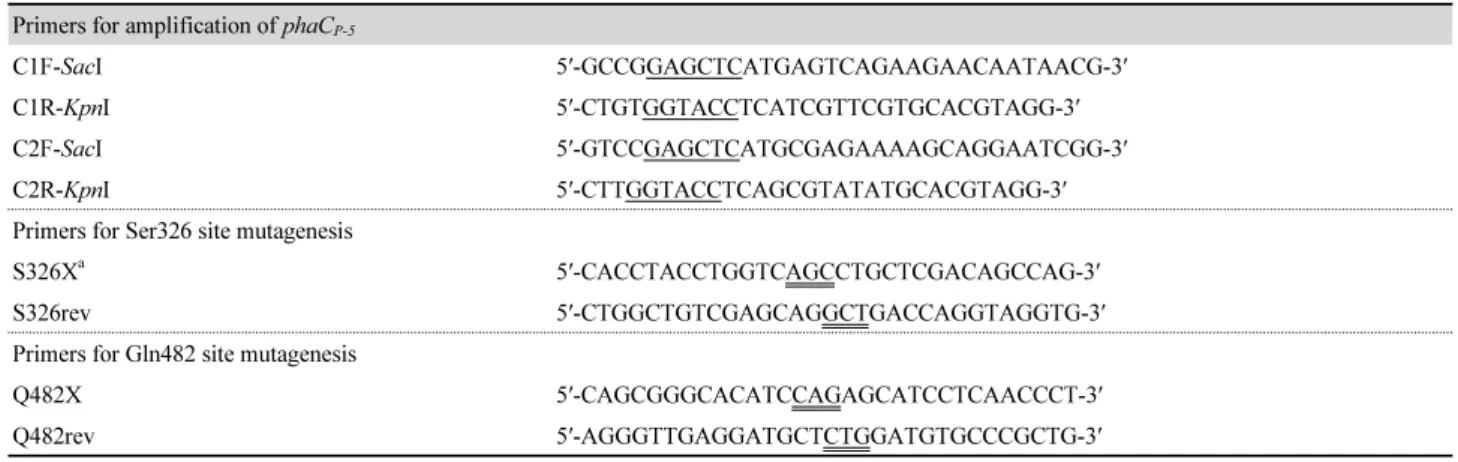
본 연구에서 사용된 균주 및 플라스미드는 Table 1에 정리 하였으며, 클로닝을 위하여 사용된 올리고뉴클레오타이드는 Table 2 에 정리하였다.
PHA synthase 유전자의 클로닝 및 위치지정 돌연변이생성
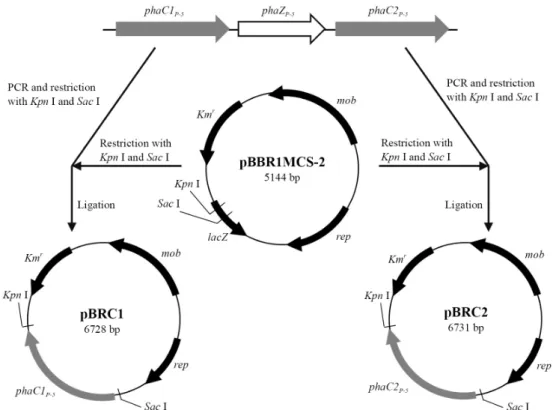
pGEM-T easy vector 에 P. aeruginosa P-5의 phaC1 P-5 와 phaC2 P-5 를 각각 클로닝 한 뒤, broad host vector로 알려진 pBBR1MCS-2 (Kovach et al., 1995)에 도입하기 위하여 제한 효소 SacI과 KpnI의 작용염기서열이 각각 전방향과 역방향 에 삽입된 프라이머를 제작하였으며 앞서 클로닝된 각각의 phaC1 P-5 와 phaC2 P-5 의 플라스미드를 주형으로 하여 PCR을 수행하였다. 이후 증폭된 산물과 pBBR1MCS-2에 SacI과 KpnI를 처리한 뒤 연결하였으며, phaC1 P-5 이 도입된 plasmid 를 pBRC1, phaC2 P-5 가 도입된 plasmid를 pBRC2로 명명하였 다(Fig. 1).
phaC2 P-5 의 아미노산 326번과 428번의 아미노산 치환을 위 한 위치지정 돌연변이생성을 수행하기 위해 염기서열을 바꾼 primers 인 S326X, S326rev 그리고 Q482X, Q482rev을 제작하 였다(Table 2). 각각의 pBRC1과 pBRC2를 주형으로 하여 위 에서 제작한 3세트의 primer를 넣고 PCR을 수행하여 아미노 산 326번과 482번의 염기서열이 변경된 PCR 산물을 얻었다.
PCR 조건은 95°C 5분 반응 후 95°C 1분, 55°C 1분, 72°C 7분 50 초 처리를 16회 반복하고 마지막 extension은 생략하였다.
위에서 얻어진 pBRC1와 pBRC2, 그리고 phaC2 P-5 의 아미노
산 326번과 428번이 mutation된 plasmids는 PHA 합성
negative 균주인 P. putida GPp104와 R. eutropha PHB-4에 전
기천공법(electroporation) 방법(Iwasaki et al., 1994)을 이용
Table 1. Bacterial strains and plasmids used in this study
Strains or plasmids Description Source or reference
Bacterial strains
Pseudomonas aeruginosa P-5 Lee et al. (2011)
Pseudomonas putida GPp104 PHA-synthase negative mutant of P. putida KT2440 Huisman et al. (1991) Ralstonia eutropha PHB-4 PHA-synthase negative mutant of R. eutropha H16 Schubert et al. (1988)
E. coli DH5α Standard cloning strain
Plasmids
pGEM-T easy vector Amp
r, pSKBluescript derivative, lacPOZ Promega Co.
pBBR1MCS-2 Km
r, broad host vector, lacPOZ Kovach et al. (1995)
pBRC1 pBBR1MCS-2 derivative, phaC1 of P. aeruginosa P-5 This study
pBRC2 pBBR1MCS-2 derivative, phaC2 of P. aeruginosa P-5 This study
pS326T pBRC2 derivative, mutant phaC2
P-5Ser326→Thr This study
pQ482K pBRC2 derivative, mutant phaC2
P-5Gln482→Lys This study
pQ482R pBRC2 derivative, mutant phaC2
P-5Gln482→Arg This study
pQKST pBRC2 derivative, double mutant phaC2
P-5Ser326→Thr, Gln482→Lys This study
Table 2. Oligonucleotide sequences used in this study to amplify phaC1
P-5and phaC2
P-5Primers for amplification of phaC
P-5C1F-SacI 5ʹ-GCCGGAGCTCATGAGTCAGAAGAACAATAACG-3ʹ
C1R-KpnI 5ʹ-CTGTGGTACCTCATCGTTCGTGCACGTAGG-3ʹ
C2F-SacI 5ʹ-GTCCGAGCTCATGCGAGAAAAGCAGGAATCGG-3ʹ
C2R-KpnI 5ʹ-CTTGGTACCTCAGCGTATATGCACGTAGG-3ʹ
Primers for Ser326 site mutagenesis
S326X
a5ʹ-CACCTACCTGGTCAGCCTGCTCGACAGCCAG-3ʹ
S326rev 5ʹ-CTGGCTGTCGAGCAGGCTGACCAGGTAGGTG-3ʹ
Primers for Gln482 site mutagenesis
Q482X 5ʹ-CAGCGGGCACATCCAGAGCATCCTCAACCCT-3ʹ
Q482rev 5ʹ-AGGGTTGAGGATGCTCTGGATGTGCCCGCTG-3ʹ
Bases underlined indicate SacI and KpnI restriction sites in F and R, respectively. Double underlines indicate the substitution codons for Ser326 (AGC) and Gln482 (CAG) in S326X and Q482X, respectively: Ser326 →Thr (AGC→ACC), Gln482→Lys (CAG→AAG), and Gln482→Arg (CAG→CGG).
a
X indicates the mutant amino acid residues.
하여 삽입하였다.
PHA 생합성 및 분석
Plasmid가 삽입된 재조합 균주들은 2단계 배양법을 이용하여 100 ml의 mineral medium이 들어있는 500 ml의 삼각플라스크 에서 200 rpm, 30°C의 조건으로 배양하였다. Mineral medium 은 리터당 0.2 g NH 4 NO 3 , 5.8 g K 2 HPO 4 , 3.7 g KH 2 PO 4 , 0.37 g MgSO 4 ・7H 2 O와 3 ml의 trace element stock solution이 포함된 배지이다. Trace element solution은 1 N HCl 용액에 0.29 g
ZnSO 4 ・7H 2 O, 1.98 g MnCl 2 ・4H 2 O, 1.67 g CaCl 2 ・2H 2 O, 2.78 g FeSO 4 ・7H 2 O, 2.81 g CoSO 4 ・7H 2 O, 0.17 g CuCl 2 ・2H 2 O 가 녹 아있는 용액이다. 먼저, 1단계로 PHAs 합성 없이 세포 생장만 이루기 위해 kanamycin (200 μg/ml)이 첨가된 nutrient broth에 서 재조합 균주를 20시간 배양하였다. 이후 원심분리를 통하 여 세포를 수득한 뒤, alkanoic acids가 2 g/L 포함된 mineral medium에 접종하여 48시간 동안 두 번째 단계의 배양을 수행 하여 PHA 합성을 유도하였다.
세포건조중량(dry cell weight)은 배양된 균체를 원심분리
Fig. 1. Construction and restriction maps of plasmids pBRC1 and pBRC2.
하여 수득하고, -20°C에서 얼린 뒤, 동결건조기로 하룻동안 건조시켜서 측정하였다. 생성된 PHAs의 회수 및 정제는 Lee 등(2011)의 방법으로 수행하였다. PHA의 정량 및 정성 분석 은 PHB와 polyhydroxyoctanoate를 표준시료로 하여 gas chromatography 방법을 이용하였다. GC 분석을 위한 초기 오 븐온도는 60°C로 4분 동안 유지한 뒤 분당 8°C씩 280°C까지 증가시켰다. PHA 단위체의 동정은 gas chromatography-mass spectroscopy (GC/MS) 분석에 의하였다.
결과 및 고찰
재조합 균주의 PHA 생합성
MCL-PHAs 를 생합성하는 것으로 알려진 rRNA homology group I 의 Pseudomonas 종들은 두 종류의 MCL-PHA synthases (PhaC1과 PhaC2)를 가지고 있다. 그 동안 이 두 가지 효소가 기 능적으로 어떠한 차이가 있는지 여부에 대하여 많은 연구자들 에 의한 연구가 이루어져 왔다. 각각 Pseudomonas chlororaphis HS21 와 Pseudomonas aeruginosa를 대상으로 PhaC1과 PhaC2 의 기질특이성에 관하여 조사한 Chung 등(2012)과 Qi 등(1997) 은 두 효소간 유의할만한 기질특이성의 차이가 없다고 보고한
반면에, Matsusaki 등(1998)은 Pseudomonas sp. 61-3 균주의 PhaC1과 PhaC2의 기질특이성이 상이하며, PhaC1이 PhaC2 에 비하여 기질특이성이 넓어서 MCL-3HAs 뿐만 아니라 SCL- 3HAs 인 3HB도 합성하는 효소라고 보고하였다. 한편, Chen 등(2004, 2006)은 P. stutzeri의 두 효소는 위와는 상반되게 PhaC2가 PhaC1에 비하여 기질특이성이 넓어서 MCL-3HAs 뿐만 아니라 SCL-3HAs인 3HB도 합성하는 효소임을 보고한 바 있다.
본 연구에서는 PhaC1 P-5 와 PhaC2 P-5 의 기능적 차이를 알아 보기 위하여 클로닝 된 phaC1 P-5 와 phaC2 P-5 을 pBBR1MCS-2 vector에 삽입하여 pBRC1와 pBRC2를 제조하였고, 이들을 각각 PHA 생합성능이 결여된 P. putida GPp104 균주와 R.
eutropha PHB-4 균주에 전기천공법을 이용하여 도입하였다.
pBRC1 또는 pBRC2가 삽입된 재조합 P. putida GPp104와 R.
eutropha PHB-4 균주는 각각 nonanoic acid와 valeric acid을
단일 탄소원으로 공급하여 배양하였다. pBRC2가 도입된 재
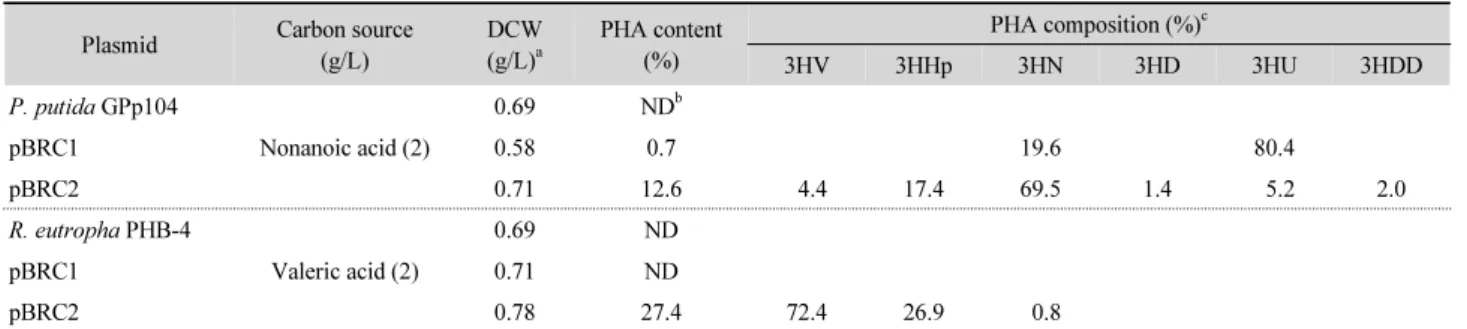
조합 P. putida GPp104 균주는 4.4% 3HV가 포함된 SCL-
MCL-PHAs을 건체량의 12.6% (w/w) 되게 합성하였다. 하지
만 pBRC1이 도입된 균주에서는 3-hydroxynonanoate (3HN)
와 3-hydroxyundecanoate (3HU)가 주를 이루는 MCL-PHAs
만 합성되었다(Table 3). 이 실험 결과를 통하여 PhaC1 P-5 는 긴
Table 3. PHA accumulation by recombinant strains harboring phaC1
P-5and phaC2
P-5Plasmid Carbon source (g/L)
DCW (g/L)
aPHA content (%)
PHA composition (%)
c3HV 3HHp 3HN 3HD 3HU 3HDD
P. putida GPp104
Nonanoic acid (2)
0.69 ND
bpBRC1 0.58 0.7 19.6 80.4
pBRC2 0.71 12.6 4.4 17.4 69.5 1.4 5.2 2.0
R. eutropha PHB-4
Valeric acid (2)
0.69 ND
pBRC1 0.71 ND
pBRC2 0.78 27.4 72.4 26.9 0.8
Cells were grown aerobically in 500-ml Erlenmeyer flasks containing 100 ml mineral medium at 30°C for 48 h with shaking at 200 rpm.
a
DCW, dry cell weight.
b
ND, not detected.
c
Calculated from GC area%. 3HV, 3-hydroxyvalerate; 3HHp, 3-hydroxyheptanoate; 3HN, 3-hydroxynonanoate; 3HD, 3-hydroxydecanoate; 3HU, 3-hydroxyundecanoate;
3HDD, 3-hydroxydodecanoate.
탄소수의 MCL-3HAs 만을 인식하여 합성하는 역할을 하고 PhaC2 P-5 는 SCL-3HAs인 3HV부터 MCL-3HAs까지 보다 광 범위한 기질특이성을 가지고 있는 것으로 판단되었다. 재조합 R. eutropha PHB-4 균주의 경우, pBRC1이 도입되었을 때 PHA 를 생성하지 못하였으나 pBRC2가 도입되었을 때 3HV 가 72.4l% 함유된 SCL-MCL-PHAs를 합성하였다(Table 3).
이러한 결과로 PhaC1 P-5 와 PhaC2 P-5 는 상이한 기질특이성을 가지고 있으며, 그 중 PhaC2 P-5 가 SCL-MCL-PHAs를 생합성 하는데 기여한다는 사실을 알 수 있었다. 또한 PhaC2 P-5 는 발 현되는 균주와 탄소원에 따라서 3HV 비율이 크게 다른 SCL- MCL-PHAs을 합성할 수 있는 것으로 나타났는데, 이는 PHA 단위체 조성의 조절을 통하여 서로 다른 물성의 바이오고분자 를 생산할 수 있다는 점에서 매우 유용한 특징이라 할 수 있다.
PHB 와 같은 SCL-PHAs는 딱딱하고 잘 부러지는 성질을 지 녀 산업적인 응용범위가 제한되고 있는 반면에, MSC-PHAs 는 고무탄성 혹은 점착성의 성질을 지닌다(Kim et al., 2007).
이에 반하여 SCL-MCL-PHAs는 일반적으로 SCL-PHAs와 MCL-PHAs 의 성질이 혼합된 물성을 갖고 있으며, 공중합체 내 각 단위체의 함량에 따라 매우 다양한 물성을 보임으로써 향후 PHAs의 실용화 범위를 크게 확장시킬 수 있을 것으로 기 대되고 있다(Abe and Doi, 2002; Nomura et al., 2004; Chen, 2011; Leong et al., 2014). 자연환경에서 분리되는 PHA 생합 성 미생물의 대부분이 SCL-PHAs 혹은 MCL-PHAs 중 한가지 고분자만을 생산할 수 있음을 고려할 때, SCL-MCL-PHAs를 합성하는 미생물은 희귀성이 인정된다. 특히, 지금까지 알려진 SCL-MCL-PHAs 생성 미생물들이 SCL 단위체로 3HB를 이용 하는데 반하여 P. aeruginosa P-5의 PhaC2 P-5 는 3HV를 단위체 로 이용한다는 점에서 매우 흥미로운 MCL-PHA synthase이다.
PhaC2
P-5
의 위치지정 돌연변이생성을 통한 효소개량SCL-MCL-PHAs 을 합성하는 미생물 중에서 Pseudomonas sp.
61-3의 PhaC1 Ps61-3 와 Pseudomonas stutzeri 1317의 PhaC2 Ps1317
이 3HB가 포함된 공중합체를 합성한다는 것이 알려져 있다 (Matsusaki et al., 1998; Chen et al., 2006). 이 중 Pseudomonas sp. 61-3 는 PhaC1 Ps61-3 을 무작위 돌연변이(random mutagenesis) 를 통하여 공중합체 내 3HB 함량이 크게 증가된 두 개의 돌연 변이주를 얻었다(Takase et al., 2003, 2004). 두 개 변이주의 돌 연변이 생성위치는 각각 Ser325와 Gln481로써 Ser325는 활성 중심(active center) 근처의 아미노산이며, Gln481은 잠정적 catalytic dyad 의 아미노산으로 이들의 돌연변이가 SCL-MCL- PHA 공중합체의 3HB의 함량의 증대에 관여했을 것이라고 추론하고 있다. 이에 Shen 등(2011)은 P. stutzeri 1317의 PhaC2 Ps1317 가 기능적으로 Pseudomonas sp. 61-3의 PhaC1 Ps61-3
와 유사하며, 아미노산 서열 비교상 유사하게 Ser325와 Gln481 부분이 Ser326와 Gln482로 일치하였기 때문에 이를 동일하게 돌연변이 시켰으며, Ser326 Gln482를 Thr326, Lys482로 돌연 변이 시켰을 경우 SCL-MCL-PHA 공중합체의 3HB의 함량이 증대되는 것을 보고하였다.
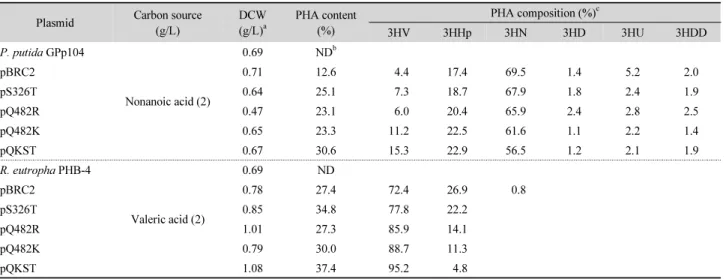
이러한 결과들을 바탕으로 P. aeruginosa P-5의 PhaC2 P-5 역 시 Ser326을 Thr326로, Gln482을 Lys482 또는 Arg482로 치 환한 돌연변이 플라스미드를 제작하였다. 아미노산이 치환된 pBRC2 는 PHAs 합성을 위해 P. putida GPp104와 R. eutropha PHB-4 에 전기천공법을 통해 삽입하였다. 야생형 PhaC2 P-5 와 비교해 보았을 때 단일 돌연변이(single mutation)된 PhaC2 P-5
모두 PHA 합성과 3HV 비율이 증가되는 것을 확인하였다
(Table 4). 하지만 Gln482Arg보다 Gln482Lys으로 치환한
PhaC2 P-5 가 PHAs 합성율과 3HV 함량이 더 높았다. Lys482가
짧은 탄소수의 단위체를 인식하여 합성하는데 더 적합하다 판
Table 4. Biosynthesis of PHA by recombinant P. putida GPp104 strains harboring mutated phaC2
P-5gene
Plasmid Carbon source (g/L)
DCW (g/L)
aPHA content (%)
PHA composition (%)
c3HV 3HHp 3HN 3HD 3HU 3HDD
P. putida GPp104
Nonanoic acid (2)
0.69 ND
bpBRC2 0.71 12.6 4.4 17.4 69.5 1.4 5.2 2.0
pS326T 0.64 25.1 7.3 18.7 67.9 1.8 2.4 1.9
pQ482R 0.47 23.1 6.0 20.4 65.9 2.4 2.8 2.5
pQ482K 0.65 23.3 11.2 22.5 61.6 1.1 2.2 1.4
pQKST 0.67 30.6 15.3 22.9 56.5 1.2 2.1 1.9
R. eutropha PHB-4
Valeric acid (2)
0.69 ND
pBRC2 0.78 27.4 72.4 26.9 0.8
pS326T 0.85 34.8 77.8 22.2
pQ482R 1.01 27.3 85.9 14.1
pQ482K 0.79 30.0 88.7 11.3
pQKST 1.08 37.4 95.2 4.8
Cells were grown aerobically in 500-ml Erlenmeyer flasks containing 100 ml mineral medium at 30°C for 48 h with shaking at 200 rpm.
a
DCW, dry cell weight.
b
ND, not detected.
c
Calculated from GC area%. 3HV, 3-hydroxyvalerate; 3HHp, 3-hydroxyheptanoate; 3HN, 3-hydroxynonanoate; 3HD, 3-hydroxydecanoate; 3HU, 3-hydroxyundecanoate;
3HDD, 3-hydroxydodecanoate.
단되어 3HV의 함량을 최대한 증가시키고자 Ser326Thr와 Gln482Lys의 이중 돌연변이(double mutation; pQKST)을 진 행하였다. pQKST가 삽입된 P. putida GPp104의 경우 PHAs 합성율은 2.5배, 3HV 함량은 3.5배 증가하였다(Table 4). 마찬 가지로 pQKST가 도입된 재조합 R. eutropha PHB-4에서도 PHAs 합성이 1.3배, 공중합체 내의 3HV 비율이 1.2배 증가하 였다(Table 4). 따라서 PhaC2 P-5 의 Ser326와 Gln482가 3HV를 인식하고 공중합체로 합성하는데 중요한 역할을 한다는 것을 알 수 있다. PhaC2 P-5 의 위치지정 돌연변이 생성을 통해 같은 배양조건에서 다양한 조성을 가지는 공중합체를 합성할 수 있 고 물성이 다른 PHAs를 생산함으로써 PHA의 응용범위를 넓 힐 수 있다는 점에서 phaC2 P-5 QKST 를 포함하는 재조합균주 는 산업적으로 유용할 것으로 기대된다.
적 요
Pseudomonas aeruginosa P-5 균주는 홀수개의 탄소수를 갖는 지방산으로부터 3-hydroxyvalerate (3HV)와 medium- chain-length (MCL) 3-hydroxyalkanoates (3HAs) 단위체로 구성된 popolyhydroxyalkanoate (PHA) 공중합체를 생산하는 특이한 성질을 갖고 있다. 이 균주가 갖고 있는 2개의 MCL- PHA synthases (PhaC1 P-5 와 PhaC2 P-5 ) 의 탄소길이에 따른 기 질특이성을 비교하기 위하여 각각의 유전자를 PHA 생합성능
이 결여된 돌연변이주 Pseudomonas putida GPp104에 도입하 고 발현시킨 결과, PhaC2 P-5 는 3HV와 MCL 3HAs로 이루어진 공중합체를 생산하지만 PhaC1 P-5 는 단지 MCL 3HAs로 구성된 공중합체를 생산하였다. 이는 PhaC2 P-5 가 PhaC1 P-5 과는 달리 보 다 짧은 탄소길이의 3-hydroxyvaleryl Co-A를 기질로 인지하여 합성반응에 이용할 수 있음을 보여주는 것이다. 또한 PhaC2 P-5
의 효소활성 및 기질특이성의 변화를 유도하기 위하여 위치지 정 돌연변이생성을 수행하고 P. putida GPp104과 다른 PHA 생합성능 결여 돌연변이주인 Ralstonia eutropha PHB - 4에서 발현시킨 결과, PhaC2 P-5 내 두 개 아미노산의 치환(Ser326Thr 과 Gln482Lys)이 공중합체의 3HV 함량을 크게 증진시키는 효과를 보였다. 두 개 아미노산이 모두 치환된 PhaC2 P-5 유전자 (phaC2 P-5 QKST)를 갖는 P. putida GPp104를 nonanoic acid가 탄소원으로 함유된 배지에서 배양하였을 때, 모균주에 비해 공중합체 함량과 공중합체 내 3HV 함량이 각각 2.5배 및 3.5배 증가하였다. 따라서 phaC2 P-5 QKST 를 포함하는 재조합 균주 는 개량된 물성의 신규 PHAs 생산에 유용할 것으로 기대된다.
감사의 말
본 논문은 2014년도 충남대학교 CNU 학술연구비의 지원
을 받아 수행되었습니다.
References