—61—
INTRODUCTION
The Korean endemic small cobitid fish, dwarf loach, Kichulchoia brevifasciata is restricted within Geogeum- Island, the extreme southwestern coast of Korea. It is actually considered to be an endangered species now.
This species was firstly described as Niwaella brevi- fasciata (Kim and Lee, 1995) on the basis of the absen- ce of a lamina circularis on the pectoral fin in males.
After that, it was redescribed as Choia by Kim et al.
(1997), because it has only 4 branched rays in the anal fin fewer than genus Niwaella. However, because Choia was a recognized homonym, it was transferred into the genus Kichulchoia (Kim et al., 1999).
This species lives in small streams with pebble bot- toms and low water currents 5~65 cm in depth. Major food items are aquatic insects and the spawning period was May to July (Kim and Kim, 2007). There were studies on the karyotype of some cobitid fishes in Korea and Japan, while karyotype of K. breivifasciata have not been investigated yet (Kimizuka and Mizuno, 1982;
Kim and Lee, 1986; Lee et al., 1986; Nam et al., 1991;
Kim et al., 1999, 2003). Therefore, this study examined the chromosome number, its composition and funda- mental number of this species to acquire basic data for phylogenetic information.
MATERIALS AND METHODS
Six specimens (five females and one male) of Kichul- choia brevifasciata were collected in Geumsan-myeon, Goheung-gun, Jeollanam-do, Korea from May to Novem- ber 2006, ranging 40.4 to 67.8 mm in the total length.
Using the flame-drying method, chromosome prepara- tions were taken from the gill, kidney and stomach tis- sues of the specimens (Ojima et al., 1972).
Colchicine was injected into the abdominal cavity of each live specimen. After 2~3 hours, the gill, kidney and digestive tissues were dissected and sheared in 0.075 M KCl. Minced cells were gathered by centrifu- gation (1,200 rpm, 10 min), and supernatants were re- moved to collect cell sediments fixed in a fresh metha- nol-acetic acid solution (Carnoy’s solution, 3 : 1). The supernatants were discarded and filled by fresh Car- noy’s solution three times. The cells were settled on the slide by pipetting using the flying dry method (Ojima et al., 1972) and dried at room temperature. The fixed cells on the slide were stained with 4% Giemsa solution for 40 minutes.
The treated slides were observed under a microscope and karyotypes examined to investigate chromosome numbers. The karyotypes were analyzed following Le- van et al. (1964). Classification for a fundamental num- ber of chromosomes was observed using the relative lengths of chromosomes on the metaphase, such as meta-submetacentric and subtelo-telocentric.
Karyotype of Dwarf Loach, Kichulchoia brevifasciata (Pisces: Cobitidae) from Korea
By Ik-Soo Kim* and Eun-Jin Kim
Faculty of Biological Sciences, College of Natural Sciences, Chonbuk National University, Jeonju 561-756, Korea
ABSTRACT The karyotype analysis of Kichulchoia brevifasciata was carried out, known as an end- angered small endemic cobitid fish of Korea. Five females and one male were collected from Geum- san-myeon, Goheung-gun, Jeollanam-do, Korea and its gill, kidney and digestive tract tissues were treated by flame-drying technique. The karyotype was found to be 2n==48 from 33 cells; 16 meta- submetacentric and 32 subtelo-telocentric chromosomes; 64 FN (fundamental number). This karyo- type showed a remarkably different karyotype formula from Niwaella multifasciata which is closely related to this species.
Key words : Chromosome, Kichulchoia brevifasciata, karyotype, fundamental number, Korea
*Corresponding author: Ik-Soo Kim Tel: 82-63-270-3354, Fax: 82-63-270-3362, E-mail: [email protected]
http://www.fishkorea.or.kr
Table 1. Chromosome number of Kichulchoia brevifasciata from Geumsan-myeon, Goheung-gun, Jeollanam-do, Korea Species No. of No. of cells No. of chromosomes
individuals investigated 40 41 42 43 44 45 46 47 48 49 50
Kichulchoia brevifasciata 5 98 3 2 4 1 2 8 12 12 33 13 8
Fig. 1. A figure of metaphase chro- mosome in the slide (A) and its kar- yotype (B) of Kichulchoia brevifa- sciata from Geumsan-myeon, Go- heung-gun, Jeollanam-do, Korea.
MSM: meta-submetacentric, STT:
subtelo-telocentric. Scale bar indi- cates 5µm.
MSM
STT
(A)
(B)
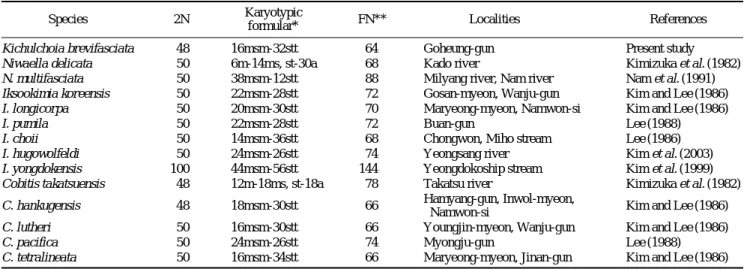
Table 2. A comparison in the chromosome constitution of cobitid fishes observed from Korea and Japan
Species 2N Karyotypic FN** Localities References formular*
Kichulchoia brevifasciata 48 16msm-32stt 64 Goheung-gun Present study
Niwaella delicata 50 6m-14ms, st-30a 68 Kado river Kimizuka et al. (1982)
N. multifasciata 50 38msm-12stt 88 Milyang river, Nam river Nam et al. (1991)
Iksookimia koreensis 50 22msm-28stt 72 Gosan-myeon, Wanju-gun Kim and Lee (1986)
I. longicorpa 50 20msm-30stt 70 Maryeong-myeon, Namwon-si Kim and Lee (1986)
I. pumila 50 22msm-28stt 72 Buan-gun Lee (1988)
I. choii 50 14msm-36stt 68 Chongwon, Miho stream Lee (1986)
I. hugowolfeldi 50 24msm-26stt 74 Yeongsang river Kim et al. (2003)
I. yongdokensis 100 44msm-56stt 144 Yeongdokoship stream Kim et al. (1999)
Cobitis takatsuensis 48 12m-18ms, st-18a 78 Takatsu river Kimizuka et al. (1982)
C. hankugensis 48 18msm-30stt 66 Hamyang-gun, Inwol-myeon,
Namwon-si Kim and Lee (1986)
C. lutheri 50 16msm-30stt 66 Youngjin-myeon, Wanju-gun Kim and Lee (1986)
C. pacifica 50 24msm-26stt 74 Myongju-gun Lee (1988)
C. tetralineata 50 16msm-34stt 66 Maryeong-myeon, Jinan-gun Kim and Lee (1986)
* msm: meta-submetacentric, stt: subtelo-telocentric, ac: acrocentric
** FN: fundamental number
RESULTS AND DISCUSSION
Chromosome analysis of Kichulchoia brevifasciata indicated 2n==48 in numbers from 33 cells (Table 1) dur- ing the metaphase (Fig. 1). Based on arm ratio analysis of the chromosomes, they consist of 16 meta-submeta- centric and 32 subtelo-telocentric chromosomes. The fundamental number of this species is 64. Polyploidy phenomenon or sex dimorphism between female and male chromosomes was not observed in the present study.
Karyotype serve as significant information for under- standing the phylogenic relationship and species classi- fication between similar groups (Miller and Walter, 1972). Even if the number of chromosomes in cobitid fishes is diverse, the diploid chromosome is 2n==50, and there are more monoarm chromosomes than biarm chro- mosomes (Ojima and Hitotsumach, 1969). Karyotypic studies on the cobitid fishes of Korea and Japan have been reported as follows: Iksookimia koreensis, I. long- icorpa (Kim and Lee, 1986), I. pumila (Lee, 1988), I.
choii (Lee et al., 1986), I. hugowolfeldi (Kim et al., 2003) with altogether 50 in 2n chromosome. Among them, closely related with genus Kichulchoia, Niwaella delicata was 2n==50 with FN==68 (Kimizuka et al., 1982) in Japan and N. multifasciata was 2n==50 with FN==88 (Nam et al., 1991) in Korea (Table 2).
In this study, Kichulchoia brevifasciata indicated 2n
==48, which is identical to Cobitis hankugensis (Lee et al., 1986) and C. takatsuensis in Japan (Kimizuka et al., 1982).
Although most cobitid fishes have 50 chromosomes, the karyotype formula and the fundamental number are different each other and are important for establishment of phylogeny position. Ohno (1974) reported that speci- es that have more acrocentric chromosomes are regard- ed as archetypes. Also the more recently specified spe- cies have many more arm numbers than the archetypes (Arai, 1983).
The genus Niwaella is closely related to the genus Ki- chulchoia on morphology characteristics (Kim, 1997) and molecular study (Kim et al., 2000) on cytochrome b sequence. However, Niwaella multifasciata shows a re- markably different karyotype formula in regarding to fewer acrocentric chromosomes and a more fundamen- tal number.
For getting of information regarding especially phy- logenic relationship and analysing of karyotype, various methods such as C-banding analyses, microsatellite multi -locus and DNA fingerprinting are required in the future.
REFERENCES
Arai, R. 1983. Karyological and osteological approach to
phylogenetics of fishes. Bull. Nat. Sci. Mus., Tokyo.
Ser. A., 9: 175-210.
Kim, E.J. and I.S. Kim. 2007. Population ecology of Kich- ulchoia brevifasciata (Cobitidae). In: XII European congress of Ichthyology, Cavat, Croatia, Sep. 9~13 2007, 122pp.
Kim, I.S. 1997. Illustrated encyclopedia of fauna & flora of Korea. Vol. 37. Freshwater Fishes. The Ministry of Education, Korea, 629pp., (in Korean).
Kim, I.S., E.K. Choi, H. Yang and M.H. Koh. 2003. Karyo- type analysis of southern spined loach, Iksookimia hugowolfeldi (Pisces, Cobitidae). Korean J. Ichthyol., 15: 127-129 (in Korean).
Kim, I.S. and J.H. Lee. 1986. A chromosomal study on the genus Cobitis (Pisces: Cobitidae) in the southern part of Korea. Bull. Korean Fish. Soc., 19: 257-264 (in Korean).
Kim, I.S. and W.O. Lee. 1995. Niwaella brevifasciata, a new cobitid fish (Cypriniformes: Cobitidae) with a revised key to the species of Niwaella. Japan. J.
Ichthyol., 42: 285-290.
Kim, I.S., J.Y. Park and T.T. Nalbant. 1997. Two new genera of loaches (Pisces: Cobitidae: Cobitinae) from Korea.
Trav. Mus. Nus. Natl. Hist. Nat (Grigore Antipa), 39:
191-195.
Kim, I.S., J.Y. Park and T.T. Nalbant. 1999. The far-east of the genus Cobitis with the description of three new taxa (Pisces: Ostariophysi: Cobitidae). Trav. Mus.
Nus. Natl. Hist. Nat. (Grigore Antipa), 41: 373-391.
Kim, S.Y., I.S. Kim, K.Y. Jahng and M.H. Chang. 2000.
Molecular phylogeny of Korean loaches inferred from mitochondrial DNA cytochrome b sequence. Korean J. Ichthyol., 12: 223-229.
Kim, S.Y., J.Y. Park and I.S. Kim. 1999. Chromosome of spined loach, Iksookimia yongdokensis (Pisces: Cobi- tidae) from Korea. Korean J. Ichthyol., 11: 172-176 (in Korean).
Kimizuka, Y., H. Kobayasi and N. Mizuno. 1982. Geogra- phic distributions and karyotypes of Cobitis takatsu- ensis and Niwaella delicata (Cobitididae). Japan. J.
Ichthyol., 29: 305-310.
Lee, H.S. 1988. Karyotype analysis of the genus Cobitis from Korea. Inha University, Ph. D. Thesis, 76pp., (in Korean).
Lee, H.Y., H.S. Lee and C.S. Park. 1986. Karyotype anal- ysis and geographical polymorphism in Korea Cobi- tis. Kor. J. Genet., 8: 65-74.
Levan, A., K. Fredga and A.A. Sandberg. 1964. Nomen- clature for centrometric position on chromosomes.
Hereditas, 52: 201-220.
Miller, P.R. and V. Walter. 1972. A new genus of cypri- nodontid fish from Nuevo Leon, Mexico. Contr. Sci.
Nat. Hist. Mus. Los Angeles County, 223: 1-13.
Nam, M.M., H.J. Yang and B.S. Chae. 1991. The karyo- typic analysis of Niwaella multifasciata Wakiya et Mori (Cobitidae), an endemic species in Korea.
Korean J. Icthyol., 3: 36-41 (in Korean).
Ohno, S. 1974. Protochordata, Cyclotomata and Pisces. In:
John, B.(ed.), Animal cytogenetics Chordata I. Gebru- der-Borntra-Ger, Berlin, pp. 1-92.
Ojima, Y. and S. Hitotsumachi. 1969. Cytogenetical studies in loaches (Pisces, Cobitidae). Zool. Mag., 78: 138- 141.
Ojima, Y., M. Hayashi and K. Ueno. 1972. Cytogenetics studies in low vetebrates. Karyotype and DNA studi- es in 15 species of Japanese Cyprinidae. Japan. J.
Genet., 47: 431-440.
미꾸리과 소형어류 좀수수치, Kichulchoia brevifasciata의 핵형
김익수ㆍ김은진
전북대학교 생물과학부
요 약 : 멸종위기에 처한 한국 고유종인 미꾸리과(Cobitidae) 소형어류 좀수수치, Kichulchoia brevifasciata의 핵형을 분석하였다. 전라남도 고흥군 금산면에서 6개체를 채집하여 핵형분석 결과 염색체 수는 2n==48으로서 16 meta-submetacentric, 32 subtelo-telocentric chromosomes로 구성되어 있었으며 FN==64이었고 유연관계에 있 는 수수미꾸리, Niwaella multifasciata와 핵형과 구성에 있어 큰 차이를 나타냈다.
찾아보기 낱말 :좀수수치, 한국고유종, 핵형