1. 서론
1.1 연구의 배경 및 목적
외모를 자신의 표현수단이자 경쟁력의 수단으로 인식
하고 있는 현대인들은 외모를 관리하기 위해 노력하고 있다. 첫인상을 결정짓는 여러 조건 중 70%이상의 효과 를 차지하는 헤어스타일은 패션, 메이크업, 피부 관리 등 여러 방법에 비해 효과적인 결과를 얻을 수 있기에 소비
20대 미용소비자의 DiSC행동유형에 따른 두피·모발관리 연구
조민혜1, 양은진2*
1서경대학교 대학원 미용예술학부 석사, 2서경대학교 미용예술학부 교수
A study on the scalp, hair care according to DiSC behaviors of cosmetic consumer in their 20s
Min-Hye Jo
1, Eun-Jin Yang
2*1
Student, Beauty Art, Graduate School of Seo Kyeong University
2
Professor, Beauty Art, Professor School of Seo Kyeong University
요 약 본 연구의 목적은 미용소비자의 DiSC행동유형에 따른 두피‧모발관리행동의 차이를 분석하는 것에 있다. 연구를 위해 20대 미용소비자를 대상으로 설문지 251부를 SPSS v.18.0 통계 패키지 프로그램을 활용하여 분석하였다. 분석 결과 첫째, DiSC행동유형에 따른 두피,모발관리 인식은 심리적 안정, 호감적 이미지, 건상상태유지에 대해 통계적으로 유의미한 차이가 나타났으며, 신중형(C)의 경우 다른 유형에 비해 심리적 안정, 호감적 이미지, 건상상태유지가 높은 것으로 나타났다.
둘째, DiSC행동유형에 따른 두피,모발관리 행동은상태인지관리, 제품사용관리에 대해 통계적으로 유의미한 차이가 나타났 으며, 신중형(C)이나 사교형(I)의 경우 상대적으로 상태인지관리, 제품사용관리가 높은 것으로 나타났다. 본 연구결과를 통 해 나타난 소비자의 DiSC행동유형에 따라 달라지는 모발관리인식 및 행동을 기업 마케팅전략의 기초자료로 제공하고자 한다.
주제어 : DiSC행동유형, 두피‧모발관리 인식, 두피‧모발관리행동
Abstract
The purpose of this study is to analyze the difference of scalp and hair care behaviors according to DiSC behaviors of beauty consumer. For the study, 251 questionnaires were analyzed using the SPSS v.18.0 statistical package program. First, there was statistically significant difference in psychological stability, favorable image, and maintaining state of scalp and hair management according to DiSC behavior type. In case of Shin Jung - hyung (C), psychological stability, Positive images, and maintaining good condition. Second, DiSC and hair management behaviors according to DiSC behaviors showed statistically significant difference in state cognition management and product use management. In the case of cognition type (C) and social type (I) Product use management. The results of this study suggest that hair management awareness and behavior, which is dependent on DiSC behaviors of consumers, are provided as basic data for corporate marketing strategy.Key Words :
DiSC behavior type, scalp‧hair care recognition, scalp‧hair care behavior*Corresponding Author : Eun-Jin Yang ([email protected]) Received August 21, 2018
Accepted October 20, 2018
Revised October 1, 2018 Published October 28, 2018
자들은 헤어스타일을 위해 많은 투자를 아끼지 않는다[1-3].
현대인의 다양한 화학적인 미용시술로 인해 이미 많은 손상을 입은 상태이며[4] 두피도 건강하지 못하다[5].
두피와 모발의 과도한 손상은 헤어스타일의 형태, 질 감, 색상을 다양하게 하는데 있어 제한을 가지게 되므로 두피, 모발에 대한 관리가 중요시되고 있다[6]. 20대 소비 자의 경우 외모관리에 관심이 가장 많은 시기이기에 모 발과 두피의 손상이 있더라도 다양한 헤어스타일을 경험 하려는 욕구가 강하다. 그러나 모발, 두피건강 유지를 위 해 꾸준히 관리를 받는 사람은 많지 않은 편이다[7]. 그러 나 최근 노푸 와 같은 자연친화적이며 손쉬운 방법으로 두피모발의 문제를 관리하려는 관심이 연령대를 구분하 지 않고 증가하고 있어 이러한 사회적인 분위기는 점차 확대될 것으로 보인다[8].
개인이 처한 환경에 따라 우호적으로 지각하는지와 그 환경에 비추어 자신의 개인적인 힘을 어떻게 인식하 느냐에 따라 인간의 행동유형이 달라지는데 William Mouston Marston은 이를 주도형(Dominance), 사교형 (inducement), 안정형(Submission), 신중형(Compliance) 의 네 가지로 구분하였다. DiSC 행동유형은 각 유형에 따라 다양한 성격 및 소비행동을 보이고 있다[9].
DiSC 행동유형에 관련된 연구로 미용분야에서는 ‘남 성고객의 DiSC 행동유형에 따른 헤어서비스 소비성향이 헤어태도에 미치는 영향’[10], ‘고객의 성격유형에 따른 미용서비스 만족도와 재방문 의도’[11], ‘행동유형이 직무 스트레스와 직무만족에 미치는 영향’[12] 등의 연구가 진 행되었다. 그러나 두피, 모발관리인식 및 행동을 소비자 의 DiSC 행동유형에 따라 진행한 연구는 미비한 형편이다.
본 연구는 20대 미용소비자를 대상으로 DiSC 행동유 형에 따른 모발관리 인식 및 행동의 상관관계를 알아보 고자한다. 본 연구의 결과는 미용기업이 각 유형별 특성 에 따른 두피와 모발을 위한 관리방안과 마케팅의 방향 을 정립하는데 도움을 주고자 하며, 미용시장에서 제품 적용 및 접근가능성을 찾는 고객 만족 및 기업 이윤창출 을 극대화 하는데 기초자료를 제공하고자 한다.
2. 이론적 배경
2.1 두피모발관리 인식
건강한 두피와 모발을 유지하기 위해선 샴푸의 종류
보다 올바른 샴푸 방법을 인식하는 것이 두피, 모발 관리 에 더욱 중요하다[13].
관리를 위해 중요하게 작용하는 두피‧모발관리 인식 은 두피‧모발 관리 태도로서 두피 및 모발관리에 대한 인 식, 관심 등의 총체적인 태도를 의미한다. 본인의 두피와 모발의 상태를 인식하는지, 문제점은 무엇인지, 어떠한 제품이 필요한 것인지, 올바른 관리 습관은 무엇인지에 대한 것들을 인지하고 있는 것과 연계하여 두피‧모발 관 리행동과 연계하였을 시 실천하기에 앞서 본인의 관리에 대한 명확한 인식과 판단이며, 관리행동에 적극적인 관 심을 가지게 되는 동기라고 할 수 있다[14].
2.2 두피‧모발관리행동
두피·모발관리행동이란 개인의 모발과 두피 질환을 최소화하고 모발이 상하거나 두피의 질환을 예방하려는 목적을 가지고 두피 및 모발건강을 유지, 증진하기 위해 실천하는 행위를 말한다[15].
두피관리는 현재의 두피상태를 제대로 파악하고, 두피 및 모발 건강에 저해요인으로 작용하는 문제점들이 발생 하기 전에 내적, 외적 요인을 통하여 예방과 개선을 하는 관리를 말한다[16].
모발 관리 시 샴푸는 피부의 pH농도와 유사한 pH5.5 정도의 약산성을 사용하는 것이 좋으며 미온수로 적당량 의 샴푸를 모발과 두피 사이에 바르고 두피를 꼼꼼히 샴 푸를 한 후 모발은 가볍게 쓸어내리고 비비지 않도록 한 다. 린스는 두피에 닿으면 모공을 막아 트러블을 일으킬 수 있으므로 두피에 닿지 않게 모발에 바른 다음 가볍게 헹구어 준다[17].
2.2 DiSC 행동유형에 관한 이론적 고찰
1928년 미국 콜롬비아 대학 심리학 교수인 William Mouston Marston의 『The Emotion of Normal People』저 서에는 인간의 행동이 개인이 처한 환경에 따라 우호적 으로 지각하는지와 그 환경에 비추어 자신의 개인적인 힘을 어떻게 인식하느냐에 따라 인간의 행동유형을 “주 도형(D: Dominance)’, 낙관적이고 긍정적이며 사람을 중 시하는 ‘사교형 (i : Influence)’, 팀워크과 조화를 중시하 고 변화를 두려워해 일관성에 동기부여 받는 ‘안정형(S : Steadiness)’, 분석적이고 논리적이며 항상 완벽함을 추구 하는 ‘신중형(C: Conscientiousness)’ 이 네 가지로 구분 하였다[18].
3. 연구방법
본 연구에서는 20대 미용 소비자를 대상으로 DiSC 행 동유형에 따른 두피‧모발관리행동을 조사하기 위하여 서 울, 경기 지역에서 2017년 8/1~8/14일까지 300부를 설문 배포하여 251부를 회수, 조사 자료로 사용하였다. 설문의 구성은 일반적 특성 6문항은 명목척도를 사용, 두피‧모 발관리 인식은 12문항으로 등간척도를 사용하였으며 두 피‧모발관리 행동속성은 10문항으로 등간척도를 사용하 였다.
수집된 자료의 통계처리는 데이터 코딩과 데이터 크 리닝 과정을 거쳐, SPSS v. 18.0 통계 패키지 프로그램을 활용하여 분석하였다. 첫째, 조사대상자의 일반적 특성을 알아보기 위하여 빈도분석을 실시하였다. 둘째, 측정도구 의 타당성 검증을 위해 탐색적 요인분석을 실시하였으며, 신뢰도 검증을 위해 Cronbach's α계수를 산출하였다. 셋 째, DiSC 행동유형에 따른 두피‧모발관리 인식 및 행동 을 알아보기 위하여 독립표본 t-test 및 일원변량분석 (One way ANOVA)을 실시하였으며, 사후검증 방법으 로는 Duncan test를 실시하였다.
4. 연구 결과 및 고찰
4.1 표본의 일반적 특성
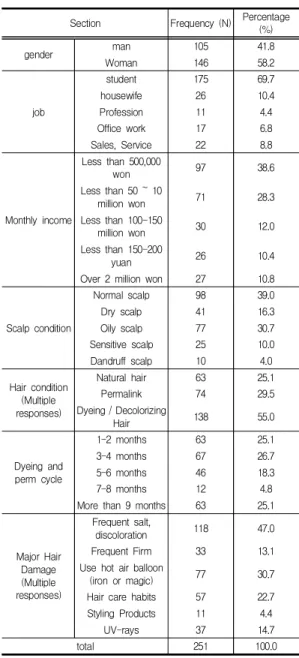
조사대상자의 일반적 특성을 알아보기 위하여 빈도분 석을 실시한 결과는 Table 1과 같다. 분석결과 성별은 남 자 105명(41.8%), 여자 146명(58.2%)으로 나타났고, 직업 은 학생 175명으로 가장 많았으며, 주부 26명, 판매·서비 스직 22명, 사무직 17명, 전문직 11명 순으로 나타났다.
월 소득은 500만원 미만 97명(38.6%), 50-100만원 미만 71명(28.3%)이 높게 나타났으며. 100-150만원 미만, 150-200만원 미만, 200만원 이상 순으로 높게 나타났고, 두피상태는 정상두피 98명(39.0%), 지성두피 77명 (30.7%)이 많았으며, 건성두피, 예민성두피, 비듬성두피 순으로 나타났다. 모발상태는 염색/탈색모발 138명 (55.0%), 퍼머모발 74명(29.5%), 자연모발 63명(25.1%)으 로 나타났고, 염색 및 펌 주기는3-4개월 67명, 1-2개월 63명, 9개월 이상 63명으로 높게 나타났으며, 5-6개월, 7-8개월 순으로 나타났다. 마지막으로 모발 손상 주요인 은 잦은 염, 탈색 118명으로 가장 높게 나타났으며, 열기 구 사용, 모발관리 습관, 자외선, 잦은 펌, 스타일링제품
순으로 나타났다.
Section Frequency (N) Percentage
(%)
gender man 105 41.8
Woman 146 58.2
job
student 175 69.7
housewife 26 10.4
Profession 11 4.4
Office work 17 6.8
Sales, Service 22 8.8
Monthly income
Less than 500,000
won 97 38.6
Less than 50 ~ 10
million won 71 28.3
Less than 100-150
million won 30 12.0
Less than 150-200
yuan 26 10.4
Over 2 million won 27 10.8
Scalp condition
Normal scalp 98 39.0
Dry scalp 41 16.3
Oily scalp 77 30.7
Sensitive scalp 25 10.0
Dandruff scalp 10 4.0
Hair condition (Multiple responses)
Natural hair 63 25.1
Permalink 74 29.5
Dyeing / Decolorizing
Hair 138 55.0
Dyeing and perm cycle
1-2 months 63 25.1
3-4 months 67 26.7
5-6 months 46 18.3
7-8 months 12 4.8
More than 9 months 63 25.1
Major Hair Damage (Multiple responses)
Frequent salt,
discoloration 118 47.0
Frequent Firm 33 13.1
Use hot air balloon
(iron or magic) 77 30.7
Hair care habits 57 22.7
Styling Products 11 4.4
UV-rays 37 14.7
total 251 100.0
Table 1. The General Characteristics of the Subjects
4.2 표본의 DISC 행동유형
20대 미용소비자의 행동유형을 분석한 결과는 Table 2와 같다. 분석결과 전체적으로 볼 때, ‘안정형(S)’이 97명 (38.6%)으로 가장 높게 나타났고, ‘사교형(I)’ 78명 (31.1%), ‘주도형(D)’ 43명(17.1%), ‘신중형(C)’ 33명 (13.1%) 순으로 나타나 대체적으로 안정형이 많은 것으 로 볼 수 있다.
division
DICS behavior type
χ²
(p)D
(Domina nce)
i (inducem
ent) S (Submiss
ion) C (Complia
nce)
gender
man 21
(20.0) 23 (21.9)
52 (49.5)
9
(8.6) 14.155
**(.003)
Woman 22
(15.1) 55 (37.7)
45 (30.8)
24 (16.4)
job
student 25
(14.3) 59 (33.7)
67 (38.3)
24 (13.7)
15.966 (.193) housewife 9(34.6) 6(23.1) 9(34.6) 2(7.7) Profession 1(9.1) 2(18.2) 5(45.5) 3(27.3) Office work 2(11.8) 6(35.3) 9(52.9) 0(.0)
Sales,
Service 6(27.3) 5(22.7) 7(31.8) 4(18.2)
Monthly income
Less than 500,000 won
12 (12.4)
28 (28.9)
49 (50.5)
8 (8.2)
22.076
*(.037) Less than 50
~ 10 million won
13 (18.3)
22 (31.0)
19 (26.8)
17 (23.9) Less than
100-150 million won
5 (16.7)
13 (43.3)
8 (26.7)
4 (13.3) Less than
150-200 million won
7 (26.9)
6 (23.1)
11 (42.3)
2 (7.7) Over 2
million won 6 (22.2)
9 (33.3)
10 (37.0)
2 (7.4)
Scalp condition
Normal scalp 14 (14.3)
33 (33.7)
38 (38.8)
13 (13.3)
13.020 (.368) Dry scalp 9
(22.0) 12 (29.3)
18 (43.9)
2 (4.9) Oily scalp 16
(20.8) 18 (23.4)
32 (41.6)
11 (14.3) Sensitive
scalp 2 (8.0)
10 (40.0)
7 (28.0)
6 (24.0) Dandruff
scalp 2(20.0) 5(50.0) 2(20.0) 1(10.0)
Dyeing and perm cycle
1-2 months 6 (9.5)
21 (33.3)
21 (33.3)
15 (23.8)
15.252 (.228) 3-4 months 13
(19.4) 22 (32.8)
27 (40.3)
5 (7.5) 5-6 months 10
(21.7) 12 (26.1)
16 (34.8)
8 (17.4) 7-8 months 2(16.7) 3(25.0) 6(50.0) 1(8.3) More than 9
months 12 (19.0)
20 (31.7)
27 (42.9)
4 (6.3)
total 43
(17.1) 78 (31.1)
97 (38.6)
33 (13.1)
*
p<.05,
**p<.01
Table 2. DiSC behavior type
4.3 타당성 및 신뢰성 검증
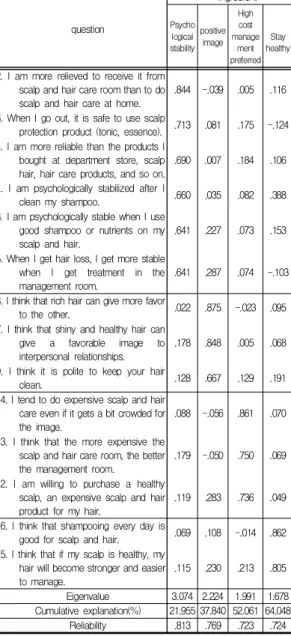
4.3.1 두피‧모발관리 인식에 대한 신뢰도 검증 두피․모발관리 인식에 대한 타당성 및 신뢰도 검증 결과는 Table 3과 같다. 두피․모발관리 인식에 대한 요
인분석 결과 2개의 문항이 제거, 총 4개의 요인으로 나타 났다. 각 하위요인별 분산설명력을 살펴보면 요인 1(21.955%)은 ‘심리적 안정’, 요인2(15.885%)는 ‘호감적 이미지’, 요인 3(14.221%)은 ‘고가관리 선호’, 요인 4(11.987%)는 ‘건강상태유지’로 나타났고, 모든 문항은 하나의 요인에 0.40 이상의 요인적재치를 보여 타당성이 확보되었고, 신뢰도 또한 0.7 이상으로 나타나 신뢰할 만 한 수준으로 나타났다.
question
ingredient
Psycho logical stability
positive image
High cost manage
ment preferred
Stay healthy
2. I am more relieved to receive it from
scalp and hair care room than to do scalp and hair care at home.
.844 -.039 .005 .116
6. When I go out, it is safe to use scalp
protection product (tonic, essence). .713 .081 .175 -.124 4. I am more reliable than the products I
bought at department store, scalp hair, hair care products, and so on.
.690 .007 .184 .106
1. I am psychologically stabilized after I
clean my shampoo. .660 .035 .082 .388
3. I am psychologically stable when I use good shampoo or nutrients on my scalp and hair.
.641 .227 .073 .153
5. When I get hair loss, I get more stable when I get treatment in the management room.
.641 .287 .074 -.103
8. I think that rich hair can give more favor
to the other. .022 .875 -.023 .095
7. I think that shiny and healthy hair can give a favorable image to interpersonal relationships.
.178 .848 .005 .068
9. I think it is polite to keep your hair
clean. .128 .667 .129 .191
14. I tend to do expensive scalp and hair care even if it gets a bit crowded for the image.
.088 -.056 .861 .070
13. I think that the more expensive the scalp and hair care room, the better the management room.
.179 -.050 .750 .069
12. I am willing to purchase a healthy scalp, an expensive scalp and hair product for my hair.
.119 .283 .736 .049
16. I think that shampooing every day is
good for scalp and hair. .069 .108 -.014 .862 15. I think that if my scalp is healthy, my
hair will become stronger and easier to manage.
.115 .230 .213 .805
Eigenvalue 3.074 2.224 1.991 1.678 Cumulative explanation(%) 21.955 37.840 52.061 64.048
Reliability .813 .769 .723 .724
Table 3. Verification of validity and reliability of hair management recognition behavior
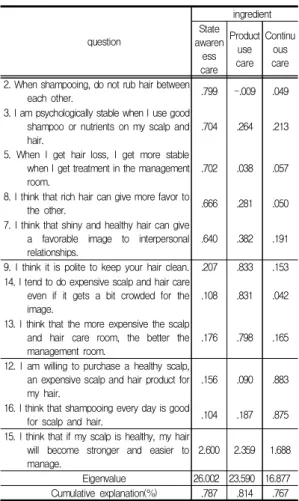
4.3.2 두피‧모발관리 행동에 대한 신뢰도 검증 두피․모발관리 실천행동에 대한 타당성 및 신뢰도 검증 결과는 Table 4와 같다. 두피․모발관리 실천행동 에 대한 요인분석 결과 총 3개의 요인으로 나타났다. 각 하위요인별 분산설명력은 요인1(26.002%) ‘상태인지 행 동’, 요인2(23.590%) ‘제품사용 관리’, 요인 3(16.877%) ‘지 속적 관리’로 나타났고, 모든 문항은 하나의 요인에 0.40 이상의 요인적재치를 보여 타당성이 확보되었고, 신뢰도 또한 0.7 이상으로 나타나 신뢰할 만한 수준으로 나타났다.
question
ingredient State
awaren ess care
Product use care
Continu ous care 2. When shampooing, do not rub hair between
each other. .799 -.009 .049
3. I am psychologically stable when I use good shampoo or nutrients on my scalp and hair.
.704 .264 .213
5. When I get hair loss, I get more stable when I get treatment in the management room.
.702 .038 .057
8. I think that rich hair can give more favor to
the other. .666 .281 .050
7. I think that shiny and healthy hair can give a favorable image to interpersonal relationships.
.640 .382 .191
9. I think it is polite to keep your hair clean. .207 .833 .153 14. I tend to do expensive scalp and hair care
even if it gets a bit crowded for the image.
.108 .831 .042
13. I think that the more expensive the scalp and hair care room, the better the management room.
.176 .798 .165
12. I am willing to purchase a healthy scalp, an expensive scalp and hair product for my hair.
.156 .090 .883
16. I think that shampooing every day is good
for scalp and hair. .104 .187 .875
15. I think that if my scalp is healthy, my hair will become stronger and easier to manage.
2.600 2.359 1.688
Eigenvalue 26.002 23.590 16.877
Cumulative explanation(%) .787 .814 .767
Table 4. Verification of validity and reliability ofhair management practice behavior
4.4 가설의 검증 4.4.1 가설 1 검증
DiSC 행동유형에 따라 두피․모발관리 인식에 차이 가 있는지를 분석한 결과는 Table 5와 같다. 분석결과 두 피․모발관리 인식의 하위요인별 심리적 안정, 호감적
이미지, 건상상태유지에 대해 통계적으로 유의미한 차이 가 나타났으며(p<.05), 신중형(C)의 경우 주도형(D), 사 교형(I), 안정형(S)에 비해 상대적으로 전반적인 두피․
모발관리 인식과 하위요인별 심리적 안정, 호감적 이미 지, 건상상태 유지가 높은 것으로 나타났다.
division
Behavioral awareness behaviors total Psychologi
cal stability positive
image Stay healthy
M SD M SD M SD M SD
DICS behavi or type
Dominance (D) 3.28
a.673 4.13
a.639 3.28
a.833 3.28
a.469 inducement(I) 3.33
a.779 4.26
ab.564 3.38
a.936 3.37
a.518 Submission(S) 3.46
a.675 4.11
a.740 3.44
a.838 3.40
a.517 Compliance(C) 3.76
b.721 4.45
b.606 3.89
b.882 3.66
b.450 F-value(p) 3.539
*(.015) 2.672
*(.048) 3.525
*(.016) 3.835
*(.010) total 3.42 .725 4.21 .662 3.46 .888 3.40 .510
*
p<.05
Table 5. DiSC Behavioral awareness behaviors according to behavior type
4.4.2 가설 2 검증
DiSC 행동유형에 따라 두피․모발관리 실천행동에 차이가 있는지를 분석한 결과는 Table 6과 같다. 분석결 과 두피․모발관리 실천행동 하위요인별 상태인지 관리, 제품사용 관리에 대해 통계적으로 유의미한 차이가 나타 났으며(p<.01), 신중형(C)이나 사교형(I)의 경우 다른 유 형에 비해 상대적으로 두피․모발관리 실천행동 하위요 인별 상태인지 관리, 제품사용 관리가 높은 것으로 나타 났다.
division
Hair Care Practice Behavior total State
awareness care
Product use care
M SD M SD M SD
Hair manage
ment awarene
ss behavior
Dominance (D) 2.94
a.706 2.70
a1.152 2.71
a.659 inducement(I) 3.38
b.792 3.40
bc1.317 3.15
b.740 Submission(S) 3.18
ab.767 3.12
ab1.203 2.95
ab.718 Compliance(C) 3.82
c.777 3.69
c1.222 3.48
c.737 F-value(p) 9.351
***(.000) 4.913
**(.002) 8.298
***(.000)
total 3.29 .804 3.21 1.263 3.04 .749
**
p<.01,
***p<.001
Table 6. DiSC Behavioral Differences in Behavioral Treatment Behavior
5. 결론
본 연구는 20대 미용소비자의 DiSC 행동유형에 따른 두피‧모발 관리 인식 및 행동에 대한 차이를 분석하였다.
본 연구의 실증분석 결과를 요약하면 다음과 같다.
첫째, DiSC 행동유형에 따라 두피․모발관리 인식에 서 심리적 안정, 호감적 이미지, 건상상태유지에 대해 통 계적으로 유의미한 차이가 나타났다. 신중형(C)의 경우 주도형(D), 사교형(I), 안정형(S)에 비해 심리적 안정, 호 감적 이미지, 건상상태유지를 위해 두피․모발관리를 하 는 것으로 나타났다. 이윤현(2012)의 연구에서 신중형(C) 의 경우 늘 깔끔하게 정돈되어 있으며, 비교분석하여 자 신에게 이익이 되는 것을 찾고 그것을 실천하는 유형이 라고 하였으며 이러한 행동유형으로 인해 본 연구 두피 와 모발관리 인식의 결과가 나타난 것으로 보인다. 또한 사교형(I)은 가격에 민감하게 반응하지 않고 사람들에게 자신이 어떻게 보이는지에 대한 관심이 많다고 하였다 [19]. 본 연구 결과 사교형(I)은 다른 사람들의 시선을 많 이 의식하고 호감적 이미지를 위해 두피․모발관리를 인 식하는 것으로 사료된다.
둘째, DiSC 행동유형에 따라 두피․모발관리 실천행 동 하위요인별 상태인지관리, 제품사용관리에 대해 통계 적으로 유의미한 차이가 나타났다. 김정임(2008)의 연구 에서는 머리 손질제품을 ‘사용하지 않는다‘가 가장 높게 나타났으며[20]. 진정애(2007)의 연구에서도 제품을 ‘가 끔 사용한다’가 가장 높게 나타났다[21]. 그러나 최근 주 민경(2018)의 연구에서는 두피 및 모발관리의 횟수가 ‘1 주 1회’가 가장 많은 것으로 나타나[22] 과거보다 소비자 의 두피, 모발관리에 대한 관심이 증대된 것을 볼 수 있 었다. 또한 관리 방법은 홈케어가 가장 많았다. 이는 홈쇼 핑 및 인터넷마켓을 통한 관리제품의 대중화로 인해 자 주 용이하게 관리할 수 있는 방법을 소비자가 알게 되었 으며 매스컴 등을 통해 관리의 필요성을 소비자들이 인 식하고 있는 것으로 사료되다. 신중형(C)이나 사교형(I) 의 경우 다른 유형에 비해 자신의 두피와 모발의 상태를 인지하고 좋은 상태를 위한 행동들을 신중하게 파악하여 그것들을 실천행동으로 옮기며, 홈 케어제품을 사용해 스스로 관리를 하는 것으로 나타났다.
본 연구의 결과 두피 및 모발 관리 인식 및 행동이 DiSC 행동유형에 따라 차이가 있었다. 이에 미용기업은 각 유형별 특성에 따른 두피와 모발을 위한 관리방안과
마케팅의 방향을 정립하고, 미용시장에서 제품적용 및 접근가능성을 찾는다면 고객 만족 및 기업 이윤창출을 극대화 할 수 있을 것이다.
본 연구의 한계점은 연구대상이 서울, 경기 지역으로 제한된 표본을 자료로 하였기에 20대 전체 소비자를 일 반화하기에는 한계가 있다. 향후 확장된 표본의 적용이 더욱 타당성을 가질 수 있을 것이다.
REFERENCES
[1] M. R. Song & J. H. Mo. (2010). The Effect of Environment and Genetic Elements on Women`s Alopecia. Journal of The Korean Society of Disign
Culture, 16(3), 255-261.
[2] S. H. Kim & S. S. Oh. (2010). The Actual Conditon and Recognition of Shampooing Habits and Scalp Management by Female University Students Majored or Non-majored in Beauty Treatment. Journal of Beauty
Art Management, 4(3), 23-34.
[3] G. R. Lee. (2008). A Study on Awareness and State of
Scalp & Hair Care : the case of Gangweon and north Chungcheong province. master’s thesis. Sookmyung
Women's University, Seoul.[4] H. J. Kim. (2012). A Study on the Cause of Hair Damage
and the State of Hair Care.
master’s thesis.SookmyungWomen's University, Seoul.
[5] H. J. JOO. (2015). Reality of Scalp and Hair care differed
by age. master’s thesis. sungkyul University, Gyeonggi.
[6] T. H. Kim. (2014). A Study of Consumer Behavior for
Nail Care by Appearance Interest. Doctoral dissertation.
Kyungsung University, Busan.
[7] R. Uchki. (2015). Amazing miracle only with water.
Seoul : Clema.
[8] Y. A. Lee. (2017). The effect of no-shampoo on the scalp.
master’s thesis. Konkuk University, Seoul.
[9] G. John. (1994). Personal Profile System. Seoul: KDiSC.
[10] S. Y. Yoon. (2017). An Effect of Consumption Trends in
Hair Services According to DiSC Behavior Patterns of Male Customers on Hair Attitudes. master’s thesis.
SeoKyeong University, Seoul.
[11] Y. H. Lee. (2012). Beauty Services Satisfaction and
Revisit Purpose following Customer's Personality Type.
master’s thesis. SeoKyeong University, Seoul.
[12] M. H. Son. (2013). A Study on the influence of Job stress
and job satisfaction depending on the DiSC behavior
type. master’s thesis. KyungHee University, Gyeonggi.
[13] S. Y. You. (2008). A Study on the Scalp Conditions
Dependent on the Perceptions and Habits to Shampoo.
master’s thesis. Konkuk University, Seoul.
[14] C. H. Kim. (2016). A Study on the The scalpㆍ hair
attitude to Management According to the Type of the Age of the women and Appearance Concern Degree and Management behavior. Doctoral dissertation. Kyungsung
University, Busan.[15] B. J. Ha. (1999). beauty biochemistry. Seoul : Hyungsul.
[16] H. J. KIM. (2005). A Study A Study on the Customer
Satisfaction Satisfaction of the Scalp & Hair Care Center.
master’s thesis. Sookmyung Women's University, Seoul.[17] S. H. Lee. (2004). Scalp and Hair care by using the Aromatherapy. Journal of The Korean Society Of
Trichology, 1(1), 5.
[18] W. M. Marston. (1979). Emotion of normal people. New York: Personal press. Inc.
[19] Y. H. Lee. (2012). Beauty Services Satisfaction and
Revisit Purpose following Customer's Personality Type.
master’s thesis. SeoKyeong University, Seoul.
[20] J. I. Kim. (2008). A Study on the State of Scalp & Hair
Care. master’s thesis. Sookmyung Women's University,
Seoul.[21] J. A. Jin. (2007). A Study on Perception and State of
Scalp & Hair Care among College Students in Beauty-Related Departments.
master’s thesis.Sookmyung Women's University, Seoul.
[22] M. K. Joo. (2018). A study on the behavior of selfscalp
management according to lifestyle of male college students. master’s thesis. dongduk Women's University,
Seoul.조 민 혜(Min-Hye, Jo) [학생회원]
․2013년 2월 : 서경대학교 미용예 술학과(미용예술학사)
․2017년 3월 ~ 현재 : 서경대학교 대학원(미용예술학석사)
․관심분야 : 뷰티, 마케팅
․E-Mail : [email protected]
양 은 진(Yang, Eun-Jin) [정회원]
․1989년 2월 : 이화여자대학교 가 정관리학과(가정학사)
․2007년 2월 : 서경대학교 대학원 (미용예술학석사)
․2011년 2월 : 서경대학교 대학원 (미용예술학박사)
․2008년 3월 ~ 현재 : 서경대학교(조교수)
․관심분야 : 뷰티, 마케팅
․E-Mail : [email protected]