Association between Smoking Cessation Attempts and Perceived Stress Level: the Korea National Health and Nutrition Examination
Survey 2015
Yejin Lee
1, Ji-yeon Kim
2, Ju Hyun Lee
3, Ki-Bong Yoo
4, Jin-Won Noh
5*1
the Master’s Course, Department of Healthcare Management, Eulji University
2
Undergraduate Course, Department of Healthcare Management, Eulji University
3
Researcher, National Institute of Dementia,
4
Assistant Professor, Department of Health Administration, Department of Information & Statistics, Yonsei University
5
Associate Professor, Department of Healthcare Management, Eulji University
금연 시도와 인지된 스트레스 정도와 연관성:
2015년 국민건강영양조사를 바탕으로
이예진1, 김지연2, 이주현3, 유기봉4, 노진원5*
1을지대학교 의료경영학과 석사과정, 2을지대학교 의료경영학과 학사과정, 3중앙치매센터 연구원,
4연세대학교 보건과학대학 보건행정학과 및 정보통계학과 조교수, 5을지대학교 의료경영학과 부교수
Abstract The purpose of this study is to analyze the association of smoking cessation attempts and the perceived stress level and to identify the factors affecting the perceived stress level of quit smoking. The study utilized the 2015 Korean National Health and Nutrition Examination Survey, and was applied an Ordinal Logistic Regression to examine the association of smoking cessation attempts and perceived stress level. The current smoker those who experience failure in smoking cessation, were more stressful than those who experience success in smoking cessation (OR=1.72, CI;1.41-2.08). This study identified smoking cessation failure as a major psychiatric factor associated with high perceived stress level, and suggests high stress after smoking cessation failure as one of the reasons why smokers do not reach complete smoking cessation. Also, in order to promote smoking cessation, it is needed to have political approach in reducing the psychiatric hurdle like high stress after smoking cessation failure.
Key Words : Perceived stress, Non-smoking policy, Smoking cessation attempts, Smoking cessation success, Smoking cessation failure, Psychiatric factors
요 약 본 연구는 금연 시도와 인지된 스트레스 정도와의 연관성을 규명하고 금연을 시도함에 있어 인지된 스트레스에 영향을 미치는 요인을 확인하고자 한다. 본 연구에서는 2015 국민건강영양조사 대상자 중 만 19세 이상인 참여자를 대상으 로 하였으며, 금연시도 및 성공 여부와 인지된 스트레스 정도의 연관성을 파악하기 위해 순서형 로지스틱 회귀분석을 수행 하였다. 금연 시도에 실패한 흡연자가 금연시도에 성공한 흡연자보다 더 높은 스트레스와 연관성이 있는 것으로 나타났으 며(OR=1.72, 95% CI: 1.41-2.08) 금연시도를 하지 않은 흡연자(OR=1.05, 95% CI: 0.71-1.55)에 대해서는 유의한 차이가 없었 다. 본 연구는 금연 실패와 흡연자들의 높은 스트레스 정도 간의 연관성을 확인하였으며, 흡연자가 완전한 금연 성공에 도달하지 못하는 원인 중 하나로 금연 실패 후 겪는 높은 스트레스를 제시한다. 또한 흡연자들의 금연 시도를 증진하기 위하여 금연 실패 후 겪는 스트레스와 같은 정신과학적 장벽을 낮추기 위한 정책적 접근이 요구된다.
주제어 : 인지된 스트레스, 금연 정책, 금연 시도, 금연 성공, 금연 실패, 정신과학적 요인
*This paper was supported by Eulji University in 2016 (EJBS-16-04).
*Corresponding Author : Jin-Won Noh ([email protected]) Received June 25, 2018
Accepted September 20, 2018
Revised September 4, 2018 Published September 28, 2018
1. Introduction
Smoking is not only the biggest harmful factor for personal health, but also a negative factor for public health and sanitation issues as well as indirect damage to non-smokers. Smoking continues to increase the relative and absolute risks of death from lung cancer, chronic obstructive pulmonary disease, ischemic heart disease, and any type of stroke [1]. It also has various other adverse health effects, such as causing inflammation and impairing immune function [2].
In addition to direct smoking, indirect smoking as exposure to secondhand smoke is causally linked to cancers, respiratory diseases, and cardiovascular diseases. Exposure to secondhand smoke have adverse health effects especially to infants and children [2].
Although the relative risk of indirect smoking is smaller than of the direct smoking, the absolute excess deaths caused by exposure to secondhand smoke is important because the exposed group is in large size [3].
In developed countries, strong anti-smoking policies are adopted by early recognizing malaise of smoking decades ago. Because of strict polices, smoking rates decreased around 20% and the death caused by smoking and lung cancer mortality is decreasing recently in U.K and U.S.A [4]. Therefore, national health care policy is the most important goal to decrease smoking rates and induce anti-smoking perception of smokers [5].
Smoking is country’s major leading cause of death, being responsible for 58,000 deaths each year [6]. It constitutes an enormous threat to the health and well-being of South Korea, accounting for 41% of all cancers for males and 5% of all cancers for females [7].
Both direct cost (medical expenses) and indirect cost (income and productivity) attributed to smoking was 7,126 billion Korean Won (KRW) in 2013, compared with 409 billion KRW in 2005 [7]. To improve the health problems caused by smoking, the Korean government has strengthened tobacco control
regulations and perused the National Health Plan 2020 (HP 2020). HP 2020 put forward an objective of reducing the smoking prevalence among adult males to 29% and among adult females to 6% by the year 2020 [8]. It established a path for significant advances in tobacco control.
Nevertheless the efforts, the smoking rates in South Korea are almost the highest level in the world, which are approximately 23% of all people aged 15 years and over, and over 30% among male adults [9]. Smoking rate of South Korea are decreasing lately, but the rates are still high, which is almost 2-3 times compared to developed countries’ rate. Instead, the total cigarette consumptions are increasing [4].
Smoking cessation attempts cause extreme stress to smokers and the stress level determines the success and failure of smoking cessation. Smokers accounted for the difficulties in smoking cessation and was counted their smoking as an addiction. For instance, smokers reported that smoking cessation is like attempting to quit heroin, because cigarette is such a strong drug in a way. By situating smoking within a wider drug discourse, the smokers can take up a position as an addict, and can account for smokers’
continuous smoking [10].
Numerous studies have addressed factors associated with making a smoking cessation attempt or success.
Previous studies have examined such associative
factors as age, gender, marital status, income level,
educational accomplishment, and smoking habit
differences among adults who attempted to quit
smoking [11]. Smoking cessation causes a series of
unpleasant physical symptoms such as sweating,
restlessness, chest tightness, and heart palpitations, as
well as mental and psychological symptoms such as
stress, difficulty concentrating, sadness, anxiety, anger,
aggression, irritability and insomnia [12]. Stress level is
inversely related to the duration of smoking cessation,
and continuous smoker reported higher stress level
[13]. Another study reported perceived stress level as
the only factor that prospectively predicted smoking
cessation success, with lower levels associated with higher quit rates [14].
Nevertheless, stress relief is commonly perceived as an advantage of smoking. In addition, smokers have prevalent belief about smoking as a stress reducing agent, even years after having quit [15]. The relieving nicotine withdrawal by smoking may be mistaken for general stress reduction, because the sensation of nicotine withdrawal is resemble with the experience of stress. [16]. Therefore, it is necessary to study the relationship between smoking attempts and stress level to improve awareness of smoking attempts.
The study aims to analyze the association between smoking cessation attempts and perceived stress level and identify the factors affecting the perceived stress level of quitting smoking. It aims to provide a comprehensive understanding of current smokers' smoking cessation attempts, and provide a scientific basis to support effective smoking cessation policies to promote current smokers' smoking cessation attempts.
2. Materials and Methods
2.1 Data and subjects
In this study, the Korea National Health and Nutrition Examination Surveys (KNHANES) data were used to identify the association between smoking cessation attempts and perceived stress level. The KNHANES data is a nationwide, cross-sectional survey of Korean population that assesses the health and nutritional status, monitors trends in health risk factors and the prevalence of major chronic diseases, and provides information for the development and evaluation of Korean health policies and programs [17].
There were 7,380 individuals included in the 2015 KNHANES data. We excluded 5,459 individuals who were younger than 19 years of age and had incomplete records. Finally, 1,921 individuals were included in the analysis.
2.2 Variables and measurements
In the independent variables, perceived stress level is divided with 4 categories such as ‘I feel very much’,
‘I feel much’, ‘I feel little’ and ‘I feel very little’, on a self-registration questionnaire ‘How much do you feel stress in daily life’[18].
In the dependent variables, smoking cessation attempts is grouped as that the non-smoker among those who have tried a cessation and succeeded in it, smoker among those who have tried a cessation and failed in it, smoker those who have not tried a cessation.
Demographic factors, socioeconomic status, and number of chronic diseases were included to identify the factors associated with percieved stress level.
Gender was classified into female. and male, and Age was classified into 19-39, 40-59, and over 60. Marital status was classified into married and unmarried (divorced, widowed, and separated). Education level was classified into elementary, middle school, high school, and over college. Household income was classified into low(under 761,200 KRW), average-low (1,575,900 – 761,200 KRW), average-high(1,575,900 – 2,687,700 KRW), and high(over 2,687,700 won).
Economic activity was classified into working, and not working. Number of chronic diseases was classified into none, 1, 2, and over 3, by adding all chronic diseases of patients. Chronic Diseases were including hypertension, dyslipidemia, cerebral stroke, myocardial infarction, angina, osteoarthritis, rheumatoid arthritis, tuberculosis, asthma, diabetes, thyroid disease, atopy dermatitis, allergic rhinitis, renal insufficiency, hepatitis B, hepatitis C, fatty cirrhosis, in case of cancer, and cancers diagnosed[5].
2.3 Statistical analysis
The descriptive statistics was conducted to identify
the general characteristics and distribution of the study
subjects. To investigate the gender differences in
smoking attempts, the general characteristics were
classified into male and female.
The chi-square test was conducted to identify the difference in the distribution characteristics of the normal perceived level per factor.
The ordinal logistic regression was performed to examine the association between smoking cessation attempts and perceived stress level. Odds ratios (ORs) and 95% confidence intervals (CIs) were calculated. All statistical analysis was conducted by SPSS software version 24.0[19].
3. Results and Discussion
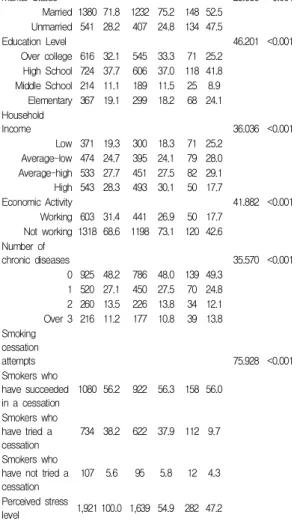
The general characteristics of the study subjects are presented in Table 1. In study subjects, men were 40.3
% in age group from 40 to 59 years old, and the women were 40.4% among 19 to 39 years old. Married was higher than unmarried in both male(75.2%) and female(52.5%). The education level was 37.0% for male and 41.8% for female with the highest for a high school graduate. The household income was 27.5% in males and 29.1% in females with the highest for the average-high level. In economic activity, males more participate in economical active as 73.1%, but females showed lower participate in economical active as 57.4%.
None chronic disease was the highest as 48.0% in males and 49.3% as females. In smoking cessation attempts, the rate of non-smoker was the highest who have tried a cessation and succeed in it with 56.3%, and among female, the rate of non-smoker was also was highest who have tried a cessation and succeeded in it with 56.0%. In perceived stress level, both male and women answered they felt a little stress with each 54.9% in male and the 47.2% in female. Table 1
Table 1. General characteristics of study subjects by sex
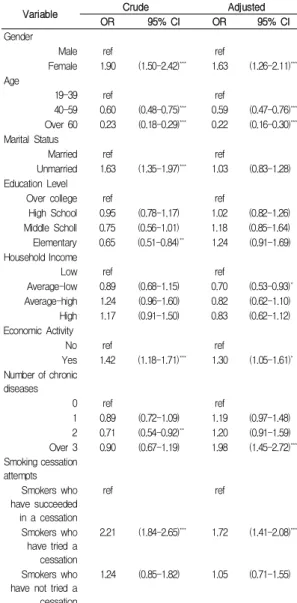
Table 2 summarizes the ordinal logistic regression analysis for perceived stress level after control the gender, age, marital status, education level, household income, economic activity, number of chronic disease, and smoking cessation attempt.
Woman over 19 years of age was under a lot of stress compared to the man (OR=1.63, CI;1.26-2.11). By age, in order the over 60 ages were less stressed (OR=0.22, CI;0.16-0.30), rather than younger groups including 40-59 ages (OR=0.59, CI;0.47-0.76) compared to 19-39 ages. The economically active population was more stressed compared to the non-economically active population (OR=1.30, CI;1.05-1.61). According to the number of chronic diseases, the 3 or more chronic diseases group were more stressful compared to those
Variable Total Male Female
x2 p
N % N % N %
Age 176.998 <0.001
19-39 480 25.0 366 22.3 114 40.4 40-59 765 39.8 660 403 105 37.2 Over 60 676 35.2 613 37.4 63 22.3
Marital Status 28.686 <0.001
Married 1380 71.8 1232 75.2 148 52.5 Unmarried 541 28.2 407 24.8 134 47.5
Education Level 46.201 <0.001
Over college 616 32.1 545 33.3 71 25.2 High School 724 37.7 606 37.0 118 41.8 Middle School 214 11.1 189 11.5 25 8.9 Elementary 367 19.1 299 18.2 68 24.1 Household
Income 36.036 <0.001
Low 371 19.3 300 18.3 71 25.2 Average-low 474 24.7 395 24.1 79 28.0 Average-high 533 27.7 451 27.5 82 29.1 High 543 28.3 493 30.1 50 17.7
Economic Activity 41.882 <0.001
Working 603 31.4 441 26.9 50 17.7 Not working 1318 68.6 1198 73.1 120 42.6 Number of
chronic diseases 35.570 <0.001
0 925 48.2 786 48.0 139 49.3 1 520 27.1 450 27.5 70 24.8 2 260 13.5 226 13.8 34 12.1 Over 3 216 11.2 177 10.8 39 13.8 Smoking
cessation
attempts 75.928 <0.001
Smokers who have succeeded in a cessation
1080 56.2 922 56.3 158 56.0
Smokers who have tried a cessation
734 38.2 622 37.9 112 9.7
Smokers who have not tried a cessation
107 5.6 95 5.8 12 4.3 Perceived stress
level 1,921 100.0 1,639 54.9 282 47.2
who without chronic diseases (OR = 1.98, CI: 1.45-2.72) and the smoker those who have tried a cessation and failed in it, were more stressful than those who have tried a cessation and succeeded in it (OR=1.72, CI;1.41-2.08). Table 2
Table 2. Factor associated with the perceived stress level
4. Conclusion
The purpose of this study is to analyze the
association between smoking cessation attempts and perceived stress level and identify the factors affecting the perceived stress level of quitting smoking. Based on the results, we aim to provide a comprehensive understanding of current smokers' smoking cessation attempts, and provide a scientific basis to support effective smoking cessation policies to promote current smokers' smoking cessation attempts.
Current smokers who have failed smoking cessation were significantly more likely to report greater level of perceived stress than smokers who have succeed smoking cessation. The overall negative symptoms such as depression, anxiety, and stress has been improved after succeeding in smoking cessation and showed the improvement of the perceived quality of life [20]. This result indicate that smoking cessation is associated with reducing stress and improving positive mood and quality of life compared with continuing to smoke. Another previous study reported that the smoker who tried to quit considered the negative result of the smoking act and the increasing stress caused by disappointment about self who failed in the smoking cessation [21]. This is because smoking is a useful and effective tool for relieving stress, and in fact there are many people smoke to decrease stress, whereas smoking cessation has a negative effect on stress.
The overall late of smoking cessation attempts in this population was 56.2%, in both male and female.
This smoking cessation rate is significantly lower than previous rates measured in the preceding studies, which reported 82.0% of smokers had made any quit attempts at recruitment [22]. To reduce the harms social public health and health hygiene, South Korea applied multiple smoking cessation programs, promoted smoking cessation campaigns, increased tobacco price, expanded smoking cessation area, warning picture legislation and so on [23]. Despite these efforts, the percentage of people who quit smoking after one year of smoking cessation was only about 20% [24]. This result shows that the reduction of smoking rate through policy support and efforts is bound to have
Variable Crude Adjusted
OR 95% CI OR 95% CI
Gender
Male ref ref
Female 1.90 (1.50-2.42)*** 1.63 (1.26-2.11)***
Age
19-39 ref ref
40-59 0.60 (0.48-0.75)*** 0.59 (0.47-0.76)***
Over 60 0.23 (0.18-0.29)*** 0.22 (0.16-0.30)***
Marital Status
Married ref ref
Unmarried 1.63 (1.35-1.97)*** 1.03 (0.83-1.28) Education Level
Over college ref ref
High School 0.95 (0.78-1.17) 1.02 (0.82-1.26) Middle Scholl 0.75 (0.56-1.01) 1.18 (0.85-1.64) Elementary 0.65 (0.51-0.84)** 1.24 (0.91-1.69) Household Income
Low ref ref
Average-low 0.89 (0.68-1.15) 0.70 (0.53-0.93)* Average-high 1.24 (0.96-1.60) 0.82 (0.62-1.10) High 1.17 (0.91-1.50) 0.83 (0.62-1.12) Economic Activity
No ref ref
Yes 1.42 (1.18-1.71)*** 1.30 (1.05-1.61)* Number of chronic
diseases
0 ref ref
1 0.89 (0.72-1.09) 1.19 (0.97-1.48) 2 0.71 (0.54-0.92)** 1.20 (0.91-1.59) Over 3 0.90 (0.67-1.19) 1.98 (1.45-2.72)***
Smoking cessation attempts
Smokers who have succeeded in a cessation
ref ref
Smokers who have tried a cessation
2.21 (1.84-2.65)*** 1.72 (1.41-2.08)***
Smokers who have not tried a cessation
1.24 (0.85-1.82) 1.05 (0.71-1.55)
*p<0.05,**p<0.01***p<0.001, ref(reference), OR(odds ratio), CI(confidence interval)