Project-based Learning and Learner Interaction by Web Convergency Communication Types
Myeong-Hee Shin, Do-Soon Choi
*Professor, Talmage Liberal Arts College, Hannam University
프로젝트기반 학습과 웹 융합 의사소통 유형별 학습자 상호작용
신명희, 최도순*
한남대학교 탈메이지 교양교육대학
Abstract The purpose of this study was to investigate the effects of learners' academic achievement and learner interaction through project - based learning. In the case of interaction, we focused on the field of learning, that is, the learner's communication style in various technical environments. The subjects of this study were 80 learners who took a 3-hour elective English language learning course at a university in Korea. This study is to investigate the effect of learner interaction through KakaoTalk and LMS (Learning Management System). As a result of the study, it was found that there was a significant difference between learner interaction by project - based learning and communication type and kakao talk utilization group and LMS (Learning Management System) group. 1) The results of the kakao talk utilization group were significant in both the learner interaction and the learner's academic achievement according to the project - based learning and communication type. For current digital native learners, Kakao Talk is the result of the fact that it is the optimal environment for problem solving, communication, and uploading and sharing of educational activities.
Key Words : Project-based learning, Learner's achievement, Learner's interaction, Technology environment, Communication types.
요 약 이 연구의 목적은 프로젝트 기반 학습을 통한 학습자의 학업 성취도와 학습자 상호 작용에 대한 효과를 알아보고 자했다. 학습자 상호 작용의 경우, 학습의 장(場), 즉 다양한 기술 환경 속에서의 학습자 의사소통 유형에 초점을 두었다.
본 연구는 2018년 3월부터 6월까지 주 3시간 교양영어 수강생 80명을 대상으로 카카오 톡과 LMS (학습 관리 시스템)을 통한 학습자 상호 작용의 효과에 관해 연구하였다. 연구 결과를 살펴보면, 프로젝트 기반 학습과 의사소통 유형에 따른 학습자 상호 작용은 카카오 톡 활용 그룹과 LMS (학습 관리 시스템) 그룹 간에는 유의 한 차이가 있는 것으로 나타났으며, 1)프로젝트 기반 학습과 의사소통 유형에 따른 학습자 상호 작용, 2) 프로젝트 기반 학습과 의사소통 유형에 따른 학습자 학업 성취도 모두 카카오 토크 활용 그룹의 결과가 유의미하게 나타났다. 디지털 네이티브인 요즘 학생들에게 Kakao talk 은 학습활동의 문제 해결 및 소통, 자료의 업로드 및 공유의 가장 좋은 환경이라는 것을 나타내 주는 결과이다.
주제어 : 프로젝트기반 학습, 학업성취도, 학습자 상호작용, 학습의 장, 의사소통 유형
*Corresponding Author : Do-Soon Cho ([email protected]) Received November 15, 2018
Accepted February 20, 2019
Revised February 1, 2019 Published February 28, 2019
1. Introduction
We are now living in the so-called knowledge-based society, experiencing a flood of information with the advent of the Fourth Revolution era. Therefore, educational strategies must also adapt. Furthermore, educational institutions should also provide a place for learning experiences which allow the learner to plan and implement methods for curriculum model in which learners themselves create questions and develop learning outcomes [1]. Project-based learning allows the learning to be actively involved in design, problem solving, decision making, and research activities in relation to teacher-assigned complex tasks, with the goal of autonomously producing and presenting actual results within a considerable period of time [2]. It has also been defined as a teaching-learning method involving practical learning content and evaluation, the role of the instructor as facilitator, and the clear goal of cooperative learning and reflection [3]. The characteristics of project learning in terms of Constructivism learning theory are that it fosters internal motivation, helps students take responsibility for their learning, and enhances the flexibility of thinking through interaction with peer learners and teachers [4].
Project-based learning can be a means or a way to engage in learning tasks. Also, respects the individual differences of learners and is effective in improving self - directed learning ability [5]. Projects should lead learners' attention, involve thinking, and encourage curiosity to lead them into a new realm, so a relatively long time must be spent on the implementation and the plan or goal Indicating that they should have potential value [6]. In the end, project-based learning can be accomplished through the process of planning, implementing, and solving the problems of learners themselves through practical problems, and it can instill a sense of accomplishment through the results.
The educational environment nowadays is spreading from e-learning to Web convergence education[3]. Web
convergence education enables learners to learn quickly and efficiently without restriction of time and space.
However, most of the existing researches are concerned with the design of educational contents. As in this study, there is little research on the interaction of learners in project-based learning activities through web convergence.
The process of project-based learning consists largely of three stages: start, development, and finalization [7]. In the first step, the start phase, teachers select a project and help learners to understand the relevant content, explore the resources needed to run the project, organize the project team, and set the objectives of the project team. In the second stage, the development phase, learners share ideas about the project through ongoing collaborative interaction and learning, find solutions to carry out the project, and produce deliverables. In the third stage, the finishing phase, the results of the project are summarized and the project results are shared, reflected, and evaluated within the team or the teams in the class.
As mentioned above, project-based learning produces results through interactive learning activities.
Interaction occurs when two-way communication between two or more people affects each other [8].
Interaction has a considerable influence on learners' learning outcomes, and the interactions that take place are social interactions based on the interaction between learners. The meaning of social interaction here refers to the communication between learners that is not directly related to the learning content [9].
The interaction between learners is divided into
learner-contents, teacher-learner, and learner-learner,
which is the most general classification of interaction
type classification [10]. The classification of interaction
types could comprehensively describe past learning
situations [11]. However, as the field of learning is
transferred to the various technology environments in
use today, learning participants’ interactions can be
presented in various ways such as Facebook, Kakao
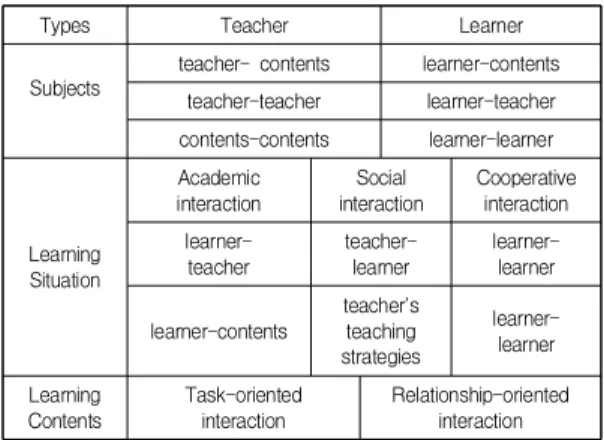
talk, and other various web bulletins. In the general classification shown in table 1, the interactions between teacher and learning contents, between teacher and teacher, and between learning contents and learning contents were added and divided into 6 types [12]. The most common ways to classify interactions by content are classified as task-oriented and relationship- oriented.[13].
Table 1. Interaction Types
Types Teacher Learner
Subjects
teacher- contents learner-contents teacher-teacher learner-teacher contents-contents learner-learner
Learning Situation
Academic interaction
Social interaction
Cooperative interaction learner-
teacher
teacher- learner
learner- learner
learner-contents
teacher's teaching strategies
learner- learner
Learning Contents
Task-oriented interaction
Relationship-oriented interaction
The purpose of this study was to investigate the effects of project-based learning based on learners' achievement and interaction. In the case of interaction, this study focused on the field of learning, that is to say, learners' communication types in various technology environments. The research problem of this paper is as follows:
1) Are there any differences in learner interaction according to the communication types on project-based learning?
2) Do activities done a through project-based learning model have a positive effect on learners' academic achievement?
2. Method
2.1 Subjects
The subjects of this study were 80 learners who
took a 3-hour elective English language learning course at a university in Korea. Data collection in this study was conducted for approximately four months, from March to June 2018.
Table 2. General characteristics of subjects
Variables N(80)
Gender Male 49
Female 31
Academic Achievement
Upper 16
Middle 44
Lower 20
2.2 Process
The purpose of this study was to investigate the effects of project-based learning on learner achievement and interaction. In order to find out learners' academic achievements, there were pre- and post- academic achievement tests.
In the same project learning topic, six teams of the total 12 teams in the class used the LMS (learning management system) bulletin board and the remaining six teams used Kakao talk during the same period to investigate the effect of interaction according to the different communication types. Participation and message analyses were conducted to investigate the difference between the academic achievement tests and the project interaction types.
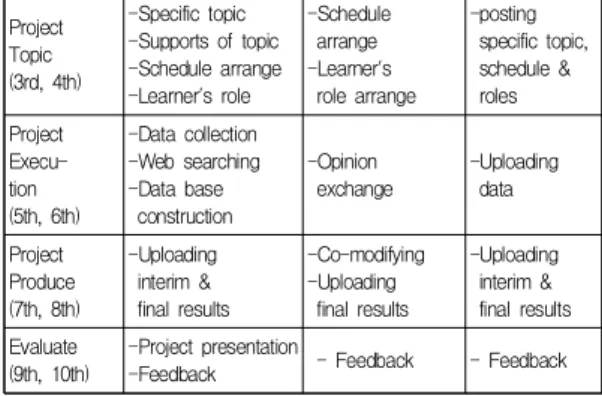
The project-based learning process consisted of a total of five steps during a total of 10 weeks. The first stage is project topic selection, the second stage is project plan, the third stage is project execution, the fourth is project production, and the final step is project evaluation.
Table 3. Process of Project-based learning
Step
(week) Process Kakao talk LMS
Project Topic (1st 2nd)
-general topic -brain storm -topic shaping
-definitizing topic -comparing
topics
-guiding study topic -guiding
schedule
2.3 Data Analysis
For the purpose of this study, all the data used in the analysis were SPSS win 21.0 and independent t test.
The analytic index model based on the research classified interactions into two groups:
relationship-oriented interaction and task-oriented interaction developed by Henry [15] and practiced by Cho [16] was used.
3. Results
3.1 Project-based Learning and Learners’
interaction
Does the learner's interaction differ according to the communication types between Kakao talk and LMS?
After dividing learners into two learning groups, each group was divided into 6 groups of 6. The number of posting for discussion messages in each group was quantified as semantic units and classified as task-oriented interaction and relationship-oriented interaction.
Table 4. Interaction by the communication types (N=80)
Group inter-
action Mean SD t st
Kakao task 13.24 9.20
2.550 .014*
relation 8.06 4.70
LMS task 8.09 4.00
-1.037 -309
relation 9.00 3.90
*p < .05
The results are shown in table 3 as follows. In the Kakao talk utilization group, the message frequency of task-oriented interaction was 13.24, which is higher than that of relationship- oriented interaction (8.06).
The t-test result is statistically significant as .014(*p<.05).
3.2 Project-based Learning and Academic Achievement
In the project learning, we examined whether there was a difference in learners' academic achievement according to the Kakao talk use group and the LMS (learning management system) bulletin use group.
Table 5. Academic Achievement by Interaction types (N=80)
Group Cases(N) Mean SD
Kakao 43 86.00 8.78
LMS 37 80.00 16.37
Total 80 83.00 13.05
The results showed that the average of the academic achievement of the group using Kakao talk was 86.00 and the average of the academic achievement of the group using the LMS bulletin board was 80.00. The academic achievement of the Kakao talk group was higher than that of the LMS group.
4. Conclusion and Discussion
In the case of project-based learning and learner's interaction, there was a significant difference between the Kakao talk utilization group and LMS (learning management system) group. In the Kakao talk utilization group, the message frequency of task-oriented interaction was 13.24 ( .014*)(*p<.05) compared to the group of LMS utilization as 8.06. For current digital native students, Kakao Talk is the result of the fact that it is the optimal environment for problem solving, communication, and uploading and
Project Topic (3rd, 4th)
-Specific topic -Supports of topic -Schedule arrange -Learner's role
-Schedule arrange -Learner's
role arrange
-posting specific topic, schedule &
roles Project
Execu- tion (5th, 6th)
-Data collection -Web searching -Data base
construction
-Opinion exchange
-Uploading data
Project Produce (7th, 8th)
-Uploading interim &
final results
-Co-modifying -Uploading
final results
-Uploading interim &
final results Evaluate
(9th, 10th)
-Project presentation
-Feedback - Feedback - Feedback