1. Introduction
The fourth industrial revolution is taking place due to the development of information technology and the development of artificial intelligence (AI). The World Economic Forum (WEF) presented its report on the Mastery of the Fourth Industrial Revolution at its 2016
annual meeting[1,2]. According to the report, 15 countries with 65% of global employment will create 2 million new jobs by 2020 and 71.1 million jobs will disappear. Chapter 2 introduces the 4th Industrial Revolution, Chapter 3 briefly introduces accountants and tax accountants, and explains the risks and countermeasures that will disappear. Finally,
Developing a Blockchain based Accounting and Tax Information in the 4th Industrial Revolution
Sunghyuck Hong, Cho-Rong Seo
*Division of Information Communication, Baekseok University
4차 산업혁명시대에 맞는 회계 및 세무 정보의 블록체인 구축 방안
홍성혁, 서초롱*
백석대학교 정보통신학부
Abstract According to the report, the World Economic Forum predicted that by 2020, more than 5.3 million jobs will be lost. Among them are accountants and tax accountants as well. Accountancy is a professional practice, accounting for management consulting, accounting audit, and management consultancy, and tax accountant duties are a professional profession that carries out duties such as tax returns and tax laws. Therefore, this study proposes a method to build transparent and safe tax and accounting information by increasing the efficiency of tax and accounting work by building a block chaining accounting and tax information suitable for the fourth industrial revolution era.
Key Words : fourth Industrial Revolution, Internet of Things(IoT), Artificial Intelligence, Accountants, Tax Accountants
요 약 이제는 1969년 컴퓨터 정보화 및 자동화 생산의 3차 산업혁명에 이어 인공지능(AI)을 통한 4차 산업혁명이 일어나 고 있다. 이로 인하여 세계 경제포럼의 발표에 따르면 2020년까지 510만개의 일자리가 사라질 것으로 전망하고 있다. 그 중에 회계사와 세무사 또한 포함되어 있다. 회계사는 경영컨설팅, 회계감사, IPO경영자문 등의 업무를 수행하며, 세무사는 세법신고, 세법자문 등의 업무를 수행하는 전문직업이다. 따라서 이 연구에서는 4차 산업혁명의 시대에 적합한 회계 및 세무 정보를 블록체인화하여 세무와 회계 업무의 효율성을 높여 투명하고 안전한 세무와 회계 정보 구축 방안을 제안한다.
주제어 : 4차 산업혁명, 인공지능, 사물인터넷, 회계사, 세무사
*This research is supported by 2018 Baekseok University Research Fund.
*Corresponding Author : Sunghyuck Hong ([email protected]) Received January 2, 2018
Accepted March 20, 2018
Revised February 26, 2018 Published March 28, 2018
conclusions are made in Chapter 4.
2. 4
thIndustrial Revolution
2.1 4
thIndustrial Revolution
The Fourth Industrial Revolution is an extension of the Third Industrial Revolution. The core of the Fourth Industrial Revolution is the convergence of various technologies. Information and communication technology has improved the information.
Another characteristic is 'network'. Through the artificial intelligence (AI) and the Internet (IoT), the boundaries between the physical space and the digital virtual space are broken down, establishing a mutual communication system, and the rate of diffusion of new technologies becomes difficult to predict.
In the 4th Industrial Revolution, Smart Platform with online technology applied to off-line industrial production facilities dramatically increases productivity and saves cost and time. This improves people's income and quality of life.
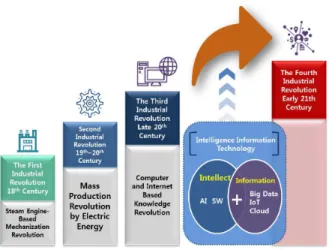
There will also be significant changes in labor and capital markets. Artificial intelligence (A.I) and large data will make talent and technology more representative than simple labor and capital, and there will be no money restrictions and a free network will solve them quickly. However, there is no good part due to the fourth industrial revolution. There is usually a polarization problem. People and businesses with talent and skills can grow fast, but those who do not and the business will quickly disappear. Also, due to future technological advances, machines can replace human work. In some, there is a prospect that robotic artificial intelligence will develop and surpass people. for example AlphaGo. In this regard, Schub, chairman of Davos's forum, stressed that "no matter how far future technology develops, it should not go beyond human control[3-5]." Fig. 1 shows the basic concept of industrial revolution.
Fig. 1. Industrial Revolution
in the first industrial revolution. As you can see, the Fourth Industrial Revolution can be seen as an extension of the tertiary industrial revolution combined with IoT and BigData [6,7].
2.2 Artificial Intelligence
Artificial intelligence is a technology that allows computers to follow, learn, think, and judge human intelligence. The term "AI" was first published in 1956 at the Dartmouth Conference in the name of "John McCarthy". In the 1990s, the birth of the Internet has greatly improved computer performance. This has enabled the accumulation and exchange of large amounts of data and 'machine learning' of computers.
Professor John Searle of the University of Berkeley used the concepts of 'weak artificial intelligence' and 'powerful artificial intelligence'. Weak AI refers to the level of imitating human intelligence only within defined rules or algorithms, It is a hypothesis that strong artificial intelligence can reach a level of performance similar to or higher than that of human intelligence. Figure 2 shows Honda motor, NeuV.
Artificial intelligence, as of 2017, is being introduced
into medicines as well as translations such as "Naver
Papago" and IBM's "Watson" artificial intelligence[8-10].
2.3 Examples of Artificial Intelligence
Fig. 2 is a NeuV self-propelled electric vehicle based on artificial intelligence technology announced at CES held in Las Vegas, USA from January 5 to 8. NeuV is a concept car with emotion engine. The emotional engine here means that AI has just entered the stage of expressing emotion beyond the machine itself[11].
Fig. 2. Honda Motor Co.. Ltd’s ‘NeuV’
2.4 Internet of Things
The Internet of things is an object-space network that forms intelligent relationships such as sensing, networking, and information processing in three co-ordinated, non-human interactions with three decentralized environmental factors: humans, objects and services.
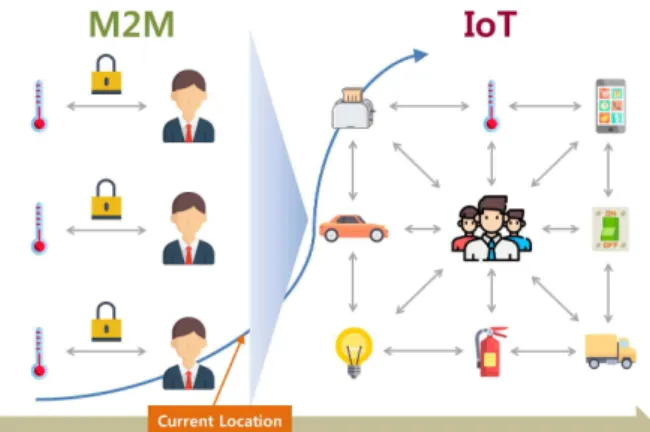
IoT is a key component of people, things and services. Objects include physical objects that comprise people, vehicles, various electronic equipment, cultural properties, and natural environments, as well as end devices of wired and wireless networks. The concept of M2M, which enables intelligent communication between people, objects, objects and objects using mobile communication network, has evolved into the concept of interacting with all information of reality and virtual world by expanding to internet. Fig. 3 shows the evolution of M2M and IoT concepts.
Fig. 3. The Evolution of M2M and IoT Concepts
Looking at the key technologies of IoT,
First, sensing technologies include physical sensors that can obtain information from existing sensors, such as temperature / humidity / heat / gas, in type objects such as remote sensing, radar, motion, image sensors and the environment. To improve application characteristics, physical sensors are developed as smart sensors with standardized interfaces and information processing capabilities, It also includes a virtual sensing feature that extracts specific information from already detected data, and the virtual sensing technology is implemented in the actual IoT service interface.
Second, wired / wireless communication and network infrastructure technology, which includes all wired and wireless networks capable of connecting people, things and services, such as existing WPAN, WiFi, 3G / 4G / LTE, Bluetooth, PLC.
Serial communication is a method of connecting computer devices, typically a communication method that reduces the number of connected lines and allows signals to be sent over long distances. Fig. 4 shows Rolls-Royce’s airplane motor engine.
Third, in the IoT service interface technology, the IoT service interface connects the three main components of IoT (person, object, and service) with the application service that performs a specific function.
The IoT service interface is an interface that can be
used to provide information such as detection,
processing / extraction / processing, storage, judgment, context awareness, recognition, security / privacy, authentication / (Storage, processing, transformation, etc.) for virtualization and service provisioning[12,13].
Fig. 4. Rolls-Royce’s Airplane Motor Engine
2.5 Examples of Internet of Things
Fig. 4 is a Rolls-Royce aircraft engine. Rolls-Royce is a heavy industry company familiar with automotive companies, but actually produces aircraft, marine engines and gas turbines.
Rolls-Royce introduced IoT technology to attach the sensor to the engine. This allows data to be received at about 40,000 feet above sea level and data from engines around the world converge on UK headquarters. This data is used to predict and diagnose engine failures through real-time monitoring of the engine through analysis. If the engine in flight is abnormal, it works remotely. If you can not control remotely, you can prepare a ground service team at the nearest airport and wait in advance.
Rolls-Royce plans to install CCTV at the core of the engine to withstand 2000 degrees Celsius, It is equipped with a snake robot that lives in the engine, checks the condition of the engine, and sends the problem to the image immediately after the engine is stopped[14].
3. Accountant and Tax Accountant
3.1 Issues Accountant and Tax Accountant
CPA, the corporate accounting officer, is responsible for sound management, stakeholder protection, As a tax attorney, he specializes in promoting sustainable development by cooperating with government tax policies, promoting taxpayer rights, promoting corporate value as a manager[8].
A tax accountant acts as an attorney to submit a tax return, submit a tax return, submit tax returns on behalf of the taxpayer, dispute the individual taxpayer property, and verify the tax return filing[15].
3.2 Main Tasks of Accountant and Tax Accountant
The main responsibilities of the auditor are: legal audits, voluntary audits, accounting consulting, IPO and capital market related services, computer audits, tax advisory and tax reporting, management strategy formulation, mergers and acquisitions. In addition to accounting-related business, we are currently carrying out IT-related tasks such as building an IT governance system for IT utilization, establishing an ERP (Enterprise Resource Planning) system, and suggesting alternatives for utilizing information technology in BPR (Business Process Reengineering).
The main tasks of a tax accountant are accounting books, consulting, various agencies and insurance affairs. With regard to tax reporting, we have been able to process tax reporting quickly and conveniently through computer development.
3.3 Accountants and Tax Accountants in the Fourth Industrial Revolution
Looking at the accounting work in the fourth industrial revolution that we are in progress,
First, the scope of financial information due to the Internet of things and the way of collecting audit evidence occurs.
Through the Internet, companies can collect all
information related to business planning and resource
allocation in real time, Process improvement, cost
savings and risk management. It can also be used in a
variety of areas such as corporate profits recognition, and the Internet impact of things will be particularly noticeable in the audit sector. The auditor automatically receives data from the digital system without having to visit the accounting department to collect customer information.
As the reliability of real-time data on inventory increases, the actual number of physical inventory counts will also decrease, As long as customers do not cheat, remote inventory based on RFID is more accurate than manual quantity calculation. As a result, the Internet of things will facilitate the introduction of regular audits.
Second, you can automate auditing tasks with artificial intelligence and cognitive technology.
The auditor should investigate every transaction record every year and identify the cause of the discrepancy, but it is often impossible to do so. But with artificial intelligence and cognitive technology, you can not only record who, where and when, but also analyze all the records recorded in your account books.
Third, you can overcome the limitations of traditional financial reporting systems through block chains.
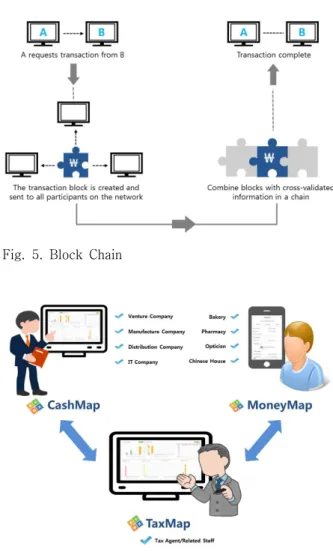
Block chaining is also known as open trading books, a technique that prevents hacking that can occur when dealing with virtual currency. Typically, transactions are kept on a centralized server, but the block chain uses a method of sending transactions to all users participating in the transaction and preventing data tampering for each transaction. By maintaining and managing financial transaction records through these block chains, auditors can audit banks' capital and risk levels in real time. In addition, books are chronologically recorded without changing them, which improves the accuracy of the internal control system and makes it impossible for anyone to tamper with the process[16]. Figure 5 shows the basic concept of blockchain. Figure 6 shows cash flow.
Fig. 5. Block Chain
Fig. 6. MoneyMap, CashMap, TaxMap
Next, in the 4th industry revolution, the tax accountant / tax accountant competition is getting tighter. Therefore, Cocoa Co. proposes that the tax accountant should expand the market on behalf of the taxpayer. Small business owners are relatively interested in accounting and books, but are more interested in tax reporting. This is because they are not accustomed to reporting taxes and can not be taken for granted because they are reporting it to the government.
CoCoa Co., Ltd. provides MoneyMap applications to
small business owners. With MoneyMap, you can view
and organize all bank account information, cash
receipts, and sales details. You can also calculate the
sales tax by retrieving the details of the purchased
electronic tax invoice. In this way, there is no need to
send data to a tax agent for tax and tax management purposes[10].
4. Conclusions
The needs of accountants, such as auditors, are increasing with changes in corporate and technology environments. Therefore, the Board of Auditors should focus on audit quality, reduce risk, promote audit innovation, and improve efficiency. Even as IT technology evolves, you can easily find information that you can consider and investigate more data than the basic tasks of each task, although it does not replace all the work of an accountant or tax accountant. As a result, accountants and tax accountants need to improve their understanding of IT skills, collaborate with IT professionals as well as basic expertise, and provide accurate and detailed data to customers who use accounting and tax services as well as various stakeholders. A block can improve data integrity and security, so it is necessary to clarify the meaning and purpose of the data according to various demands.
Future developments of this technology will increase the credibility of financial information and bring about practical effects such as cost reduction. Therefore, if the accountant and tax accountant do not maintain their current state through education and learning, but increase their understanding of the future society, they can move on to a new direction. If tax and accounting information is used by a blockchain model, the accounting and tax work will be efficient and secure.
Furthermore, financial expenses will be decreased and.
REFERENCES
[1] M. Skilton & F. Hovsepian. (2017). The Technology of the 4th Industrial Revolution.
The 4th Industrial Revolution,
29-68.DOI : 10.1007/978-3-319-62479-2_2
[2] E. A. Wrigley. (n.d.). The industrial revolution and
energy.
Energy and the English Industrial Revolution,
239-250. doi:10.1017/cbo9780511779619.010[3] O.
Heidrich. J. Harvey. & N. Tollin. (2009). Stakeholder analysis for industrial waste management systems. Waste Management,29 (2), 965-973.
doi:10.1016/j.wasman.2008.04.013
[4] A.
Toynbee. (n.d.). The Industrial Revolution I Introductory. Lectures on the Industrial Revolution in England, 27-152. doi:10.1017/cbo9781139094566.004
[5] S.Hong. (2017). Research on IoT International Strategic
Standard Model. Journal of the Korea Convergence Society,8 (2), 21-26. doi:10.15207/jkcs.2017.8.2.021
[6] P.Raj & A. C. Raman. (2017). The Internet of things:
enabling technologies, platforms, and use cases . Boca Raton: CRC Press/Taylor &Francis Group.
[7] A.
Likhovski (n.d.). The Rise of Tax Experts:
Accountants, Lawyers, and Economists. Tax Law and Social Norms in Mandatory Palestine and Israel, 203-246. doi:10.1017/9781316816851.006
[8] J. A.
Brierley. & D. R. Gwilliam. (2001). Accountants, or auditors, tax practitioners, management consultants etc.?
A research note. Managerial Auditing Journal, 16 (9), 514-518. doi:10.1108/eum0000000006083
[9] N.
Abuzainab. & W. Saad. (2018). Dynamic Connectivity Game for Adversarial Internet of Battlefield Things Systems. IEEE Internet of Things Journal,5 (1), 378-390. doi:10.1109/jiot.2017.2786546
[10] S.
Hong. (2017). Secure and light IoT protocol (SLIP) for anti-hacking. Journal of Computer Virology and Hacking Techniques, 13 (4), 241-247.
doi:10.1007/s11416-017-0295-5
[11] S.
Hong. (2017). Research on IoT International Strategic Standard Model. Journal of the Korea Convergence Society, 8 (2), 21-26. doi:10.15207/jkcs.2017.8.2.021
[12] L.Spector. (2006). Evolution of artificial intelligence.
Artificial Intelligence, 170 (18), 1251-1253.
doi:10.1016/j.artint.2006.10.009
[13] J.
Mccarthy. (1974). Artificial intelligence: a paper symposium. Artificial Intelligence, 5 (3), 317-322.
doi:10.1016/0004-3702(74)90016-2
[14] S.
Hong & K. Han. (2014). Cost-Efficient Routing Protocol (CERP) on Wireless Sensor Networks. Wireless Personal Communications, 79 (4), 2517-2530.
doi:10.1007/s11277-014-1883-z
[15] S.
Hong & Y. Seo. (2016). Countermeasure of Sniffing Attack : Survey. Convergence Society for SMB, 6 (2), 31-36. doi:10.22156/cs4smb.2016.6.2.031
[16] D. V.