한국컴퓨터정보학회 동계학술대회 논문집 제25권 제1호 (2017. 1)
79
Feature Modeling with Multi-Software Product Line of IoT Protocols
Asad AbbasO, Isma Fara Siddiqui, Scott Uk-Jin Lee
Dept. of Computer Science and Engineering, Hanyang University ERICA, South Korea e-mail:{asadabbasO, isma2012, scottlee}@hanyang.ac.kr
● 요 약 ●
IoT devices are interconnected in global network with different functionalities and manage the data transfer in cloud computing. IoT devices can be used anytime, anywhere with any device with different applications and protocols. Same devices but different applications according to end user requirements such as sensors and Wi-Fi devices, reusability of these applications can enhance the development process. However, large number of variations in cloud computing make it difficult the features selection in application because of compatibility issues of devices. In this paper we have proposed multi-Software Product Lines (multi-SPLs) approach to manage the variabilities and commonalities of IoT applications and protocols. Feature modeling is used to manage the commonalities and variabilities of SPL. We proposed that multi-SPLs feature model is more appropriate for modeling of IoT applications and protocols.
키워드:
IoT applications and Protocols, Software Product Line, Feature Model
I. Introduction
IoT devices are used everywhere to overcome daily challenges such as health, transportation, smart devices etc. IoT devices perform different functionalities according to environmental requirements. The aim of IoT is to connect the devices anywhere, anytime, with anything and using connectivity technology with anyone for specific purposes. Multiple IoT devices are connected with cloud internet to accomplish the tasks [1]. IoT applications enable the devices to perform functionality in different environments such as heat sensor functionality is different indoor and outdoor because of different requirements. Variation of environmental selection of IoT make complex and difficult task to differentiate the devices with applications. Reusability of IoT applications enhance the development and easier selection of applications according to end user requirements [2]. To increase
the reusability, Software Product Line (SPL) is extensively used for development of products with multiple variations and common features [3].
SPL approach is used to develop the family of software that share common resources and differentiate with variable features.
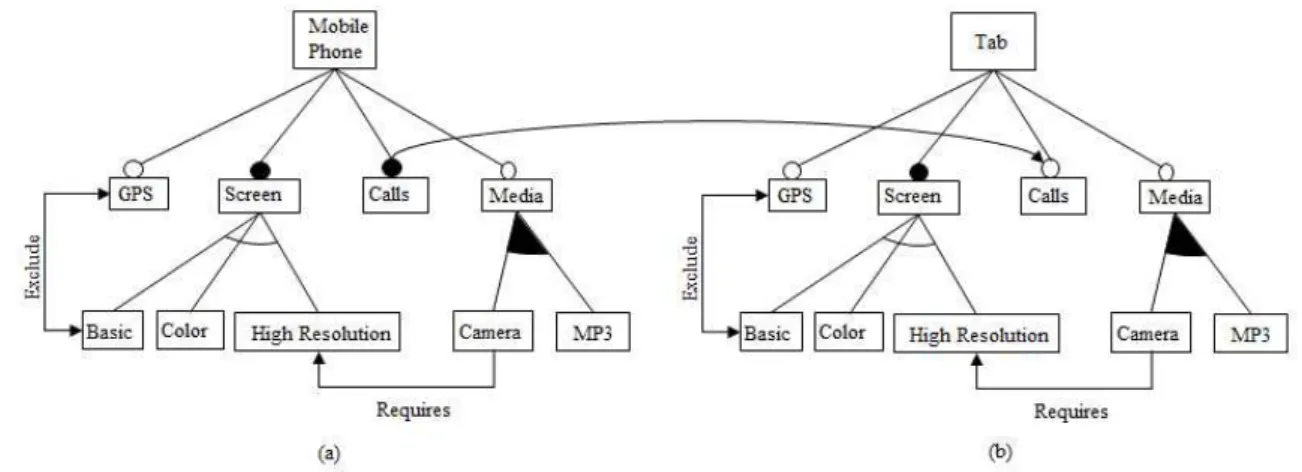
SPL approach consists on two development processes: 1) Domain Engineering (DE), is the complete scope of SPL i.e. contain all common and variable resources, 2) Application Engineering (AE), product derivation process according to end user requirements that use the existing common and variable resources from DE. Common features are necessary in every product of SPL however; the selection of variable features are based on stakeholder requirements [4]. Feature model is tree structure that mange the SPL common and variable features. Variable features can be alternative, optional and OR group. Fig. 1 shows
한국컴퓨터정보학회 동계학술대회 논문집 제25권 제1호 (2017. 1)
80
Fig. 1. Mobile Phone Feature Model
Fig. 2. Multi-SPL of Mobile Phones and Tabs the complete process of SPL.
II. RELATED WORK
Variability management of IoT agents in cloud computing is complex task because multiple devices are interconnected global network in different environments. Moreover, the compatibility of devices with different applications is hard to manage. Amor et. al. proposed the feature modeling of IoT applications with development of agents to overcome these challenges. Feature modeling of IoT agents make compatible the devices with other connected device in cloud network [6].
Chang-Su Kim et. al. proposed the XML based modeling of IoT devices protocols because of environmental requirements changes and become compatibility issues of IoT devices with each other. Author proposed XML-schema for modeling the variability management with constraints and relationships between devices. If requirements are changed by end user, XML-schema refine the relationships between IoT applications
[7].
Stuikys et. al. has proposed the Model-Driven approach for development of IoT applications. At DE level of IoT, feature model is used to get the functional and non-functional requirements of Body Area Network (BAN). Mata-model is created for all IoT applications according to the notations of feature model and develop the specific environmental IoT application of BAN [2].
Management of variable and common features in multi-SPL where more than two SPLs have some common goals however, also different features such as SensApp in cloud computing.
The behavior and output of heat sensor is different in indoor and outdoor environment but have some common goals such as temperature sensing and generate the output. Therefore, exploit the domain knowledge of multiple SPLs is important to manage the common and variable features to increase the reusability [8].
한국컴퓨터정보학회 동계학술대회 논문집 제25권 제1호 (2017. 1)
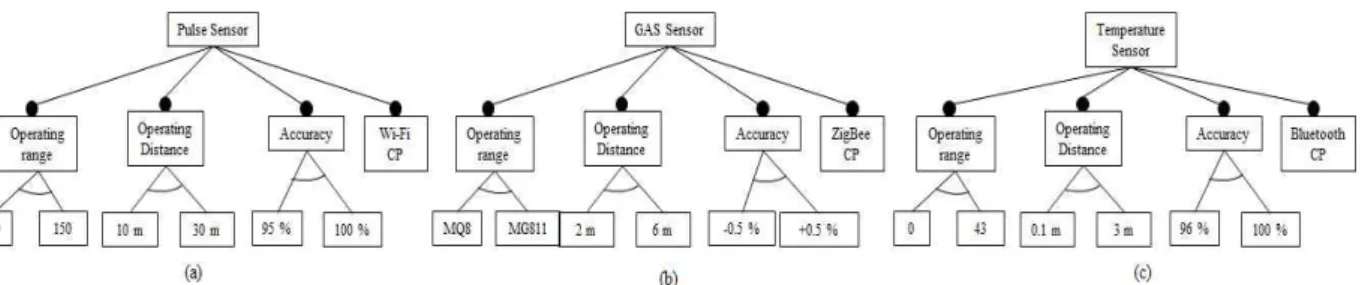
81 Fig. 3. Multi-SPL Feature Model of IoT Applications
III. MULTI-SPL BASED IoT PROTOCOLS MODELING
Multi-SPL that have common resources and some variation points as given in Fig. 2. Call is mandatory feature in cellular phone however; become optional feature in Tab. Fig. 2 (a) is the feature model with common and variable features but where each feature is variation point.
Fig. 3 shows the multiple IoT feature model with variability of operating range, operating distance, accuracy and Wi-Fi CP.
Each feature model has different operating applications that can be reuse according to end user requirements. Feature modeling of IoT differentiate the variation points of IoT protocols that can be implemented anywhere, anytime and with any other compatible device in cloud computing.
In above figure multiple variation points has given such as Wi-Fi, ZigBee and Bluetooth are the main variable features.
However, some features have different application functionality according to requirements of stakeholder. With multi-SPL feature model these variabilities can be managed in single feature model and reuse the resources wherever that are required.
IV. Conclusions
Same IoT devices are operate with different functionalities according to operating applications. Features of applications are selected with the need of end user. Selection of features is hard task because of complex relationships and constraints between features. The appropriate modeling of IoT applications and protocols features make easier selection that compatible with environment. In this paper we have proposed multi-SPLs based feature modeling of IoT protocols and applications that enables the feature selection easier without constraint violations and relationships. Predefined notations of feature model can be implemented on IoT applications to select or deselect the features. All resources in feature model reusable wherever that are required in multiple products of SPL.
Acknowledgment
This work was supported by the National Research Foundation of Korea(NRF) grant funded by the Korean government (MSIP) (No. NRF-2016R1C1B2008624).
References
[1] A. Abbas, Z. Wu, I. F. Siddiqui, and S. U.-J. Lee, "An Approach for Optimized Feature Selection in Software Product Lines using Union-Find and Genetic Algorithms,"
Indian Journal of Science and Technology, vol. 9, 2016.
[2] I. Ayala, M. Amor, L. Fuentes, and J. M. Troya, "A software product line process to develop agents for the iot," Sensors, vol. 15, pp. 15640-15660, 2015.
[3] C.-S. Kim, S.-K. Yoo, Y.-S. Jeong, Y.-W. Kim, and H.-K.
Jung, "A Study on Cooperative System between Devices to Construct Internet of Things," International Journal of u-and e-Service, Science and Technology, vol. 8, pp.
343-350, 2015.
[4] J. Lee and K. C. Kang, "Feature binding analysis for product line component development," in International Workshop on Software Product-Family Engineering, 2003, pp. 250-260.
[5] K. Lee, K. C. Kang, M. Kim, and S. Park, "Combining feature-oriented analysis and aspect-oriented programming for product line asset development," in 10th International Software Product Line Conference (SPLC'06), 2006, pp.
10 pp.-112.
[6] M. Tomlein and K. Grønbæk, "Semantic model of variability and capabilities of iot applications for embedded software ecosystems," in Software Architecture (WICSA), 2016 13th Working IEEE/IFIP Conference on, 2016, pp. 247-252.
[7] S. Urli, S. Mosser, M. Blay-Fornarino, and P. Collet,
"How to exploit domain knowledge in multiple software product lines?," in Product Line Approaches in Software
한국컴퓨터정보학회 동계학술대회 논문집 제25권 제1호 (2017. 1)
82
Engineering (PLEASE), 2013 4th International Workshop on, 2013, pp. 13-16.
[8] A. Venčkauskas, V. Štuikys, N. Jusas, and R. Burbaitė,
"Model-Driven Approach for Body Area Network Application Development," Sensors, vol. 16, p. 670, 2016.