1. Introduction
1.1. Background and Objectives of Research
According to a report on UNFCCC, the CO
2level in the atmosphere exceeds 400ppm (as of 2013) for the first time since the observation began. Also, the average global temperature has increased by 0.85, the sea level 19cm (as of 2010) for the past 1333 years. These are the warning signs that catastrophic results might be caused if there is no measure against global warming. In this context, Korea, the 9
thlargest carbon emitter in the world, is under pressure to take concrete measures to reduce carbon emissions.
Therefore, the Korean government has adopted low-carbon, green growth as a key policy direction, and pushed forward the development of renewable energy and a sustainable growth engine in cooperation with enterprises. Therefore, it is required for the building energy sector, which consumes about 1/3 of the total energy, to develop practical energy reduction measures.
In the past, school buildings were designed and constructed to provide relatively low-level indoor environment compared to other types of buildings. However, the number of school buildings with heating and cooling systems has rapidly increased in a bid to
pISSN 2288-968X, eISSN 2288-9698 http://dx.doi.org/10.12813/kieae.2014.14.4.047
improve the education environment, resulting in energy issues.
The problem of energy consumption is more serious in university buildings than primary, middle and high school buildings. Because university buildings have generally heating and cooling systems, and various incidental facilities.
1)In particular, university libraries spent more energy than any other university buildings, but there are only a few studies that identify whether energy is efficiently spent and suggest improvements, calling for more research on this area.
1.2. Methods and Scope of the Research
This research aims to assist an architect to make an optimal decision on designs in terms of energy saving when he/she tries to provide a guideline for a low-energy library design. Sejong city was chosen as a target location, and a fundamental case study was conducted in the previous research.
2)This time, space composition, use schedule, performance of the structure, etc. of the library in the same city were identified, and an energy simulation was performed by applying several measures that affect the improvement of energy performance. The results of the each case simulation on
1) Hong won hwa, Lee chun mi, Kim ju young, Cho soo, A study on the characteristics of the energy consumption unit of university, Journal of the architectural institute of korea planning and design, 2008.11
2) Roh, Ji Woong, A Basic Study on Energy Saving of University Library, Journal of the Institute of Ecological Architecture and Environment vol.13 n.4, 2013.8
KIEAE Journal
Korea Institute of Ecological Architecture and Environment
68
1)
Energy Performance and Improvement in University Library
- Concentrated on ‘K’University Library located in Seojong City - Roh, Ji Woong
** Corresponding author, Dept. of Architectural Engineering, Hongik University, South Korea([email protected])
A B S T R A C T K E Y W O R D
The problem of energy consumption is more serious in university buildings than primary, middle and high school buildings. Because university buildings have generally heating and cooling systems, and various incidental facilities.
In university, the library is one of the building that many people use and the most energy is spent. So, investigation on energy saving is very important and urgent.
This study aims finally to present the guideline for low-energy design of University library by aiding a designer to select best solution in the side of energy-saving. In this paper, composition of space, utilization schedule and performance of construction materials are grasped, some primary factors that effect to energy saving are analyzed by energy simulation.
The result of this study is as follows;
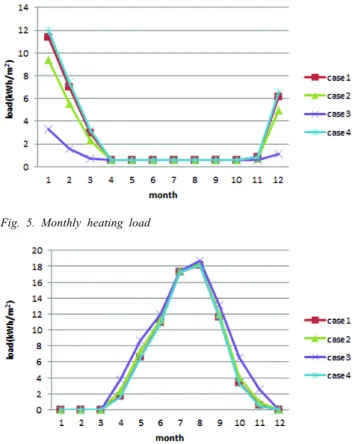
First, the subject library has more cooling load than heating load because of cooling load generated during middle season. Second, green roofs is the most effective to heating load saving, but not to cooling energy. Third, outdoor air cooling is the most effective to cooling energy saving among the investigated strategies included in this study.
ⓒ 2014 KIEAE Journal
University library, Energy saving, Utilization schedule, Energy simulation
A C C E P TA N C E IN F O Received July 14, 2014
Final revision received August 7, 2014 Accepted August 11, 2014
heating and cooling load and energy consumption were compared.
The K library uses EHP system for heating and cooling, but the energy analysis by the characteristics of the system was not included in this research. It will be covered in the next research after a careful inspection.
2. Simulation
This research used VE (Virtual Environment), an energy analysis program, to analyze improvements for energy saving.
Developed by the IES (Integrated Environmental Solutions), VE is an integrated simulation program which include the Apache-sim for a heat simulation, the Radiance for a light environment simulation, the Suncast for a solar radiation analysis, and the ModelIt, a 3D tool to describe a model.
2.1. Solar Radiation Analysis
This program calculates the solar radiation that reaches to the entire surface of a building at every step of every hour. The solar radiation is divided into two – direct solar radiation and diffuse solar radiation – and then calculated as shown below.
Direct solar radiation
Idir is calculated as follows:
cos (1)
represents the vertical incidence component, the incidence angle.
Diffuse solar radiation is divided into two – sky radiation (
) and terrestrial radiation (
) and then calculated as below.
cos (2)
sin (3)
Ihdiff represents diffuse sky radiation on the horizon, the surface tilt, and albedo. The total solar radiation on the horizon can be described as below.
sin (4)
But, here, is the solar altitude.
2.2. Analysis on Heating and Cooling Load
The indoor conduction, convection, radiation, and infiltration were calculated with the following formula.
The spatial temperature distribution of a solid without internal heat source (
Qcd)(W/m
2) is calculated as below.
∆ (5)
Here, represents thermal conductivity (W/m
2K), and T temperature (℃).
As for the convective heat transfer (
)(W/m
2),
(6)
Here, hc is the convective heat transfer rate, Ta the air temperature (℃), and Ts the average surface temperature (℃).
A radiant heat emitted from the surface (
) is
Qr = εAσΘ4 (7)
Here, represents surface heat dissipation, A the surface area,σ the Stefan–Boltzmann constant, and a surface absolute temperature (°K).
The heat transfer rate related to an air current that moving around spaces (
) is
(8)
Here, m is air volume (kg/s),
the specific heat under constant pressure of air (J/kg/K), and Ti the air temperature which is supplied (℃).
After consideration on physical figures, solar gain, internal heating value and others, the heating and cooling load is calculated.
2.3. Energy Consumption Calculation
After calculating the heating and cooling load, the heating and cooling systems are set. The efficiency of the systems, auxiliary power use, and power use of an outdoor unit and fan were considered in the calcaulation of the consumption of fuel and/or electricity.
3. Subject Building and Simulation Condition
3.1. Subject Building
The subject of the simulation is the 6-story (including a basement floor) library of K university in Sejong city. The basement floor consists of research rooms and seminar rooms.
Reading rooms, stack rooms, reference. etc. are located in ground floors. Fig. 1 shows the campus map and Fig. 2 the library’s 1
stfloor plan.
Excluding the basement floor, the simulation modeled the
ground floors from 1
stto 5
thfloors, and zoning by use was
conducted – the library and service zones. The library zone
consisted of the reading room, stack room, and office, reference,
etc. while the service zone includes the elevator core, warehouse,
corridors, stairs, etc. The building contents are shown in Table 1,
and the model zoning by each zone and their area is described in
Table 2.
The subject building changed its heating and cooling system to EHP in response to the government’s energy saving policies.
Before the change, the building used the central system installed in 1989 together with individual air conditioners that were added to the building when necessary. However, there have been no
architectural improvement for energy saving, and control measures such as outdoor air cooling have not been implemented.
The property of heating and cooling system is shown in Table 3.
By analyzing the floor plan and conducting an actual enumeration, the detailed information on the building was identified. Then, the building was modeled using the Model IT of the VE (Virtual Environment). The image is shown in Fig. 3.
3.2. Simulation Condition
The material property of the building is shown in Table 4, and windows used low-e glass with 24mm thick, as shown in Table 5.
During the simulation, the standard climate date provided by the Korean Solar Energy Society was used, and heating and cooling
zone contents area(m
2)
library reading room, stack room, office, reference etc. 5,369.7 service elevator core, warehouse, corridor, stairs etc. 3,653.1
total 9,022.8
Table 2. Model zonning
contents floor area(m
2)
library
reading room 1F, 3F 1,766.0
stack room 1F∼5F 2,856.8
office, reference etc. 1F∼3F 746.9
elevator core, warehouse, corridor,
stairs etc. 1F∼5F 3,653.1
non-library research room, seminar room, B1 2,888.4
total B1∼5F 11,911.2
Table 1. Building contents
before system change the present
boiler flue-smoke tube boiler 3.5 ton
EHP 680 HP + hot water boiler 1 ton
refrigerator turbo -
refrigerator 460 USRT + package air-conditioner 32 eta
Table 3. Property of heating and cooling system
material thickness
[mm] conductivity
[W/m·K] specific heat [J/kg·K]
wall ext.
mortar 25 0.5 1000
concrete 150 1.4 840
insulation 10 0.035 1000
plaster(dense) 9 0.5 1000
floor
cast concrete 100 1.13 1000
insulation 63 0.025 1400
chip board 25 0.15 2093
synthetic
carpet 10 0.06 2500
roof
mortar 24 0.5 1000
cast concrete 60 1.4 840
asphalt 5 0.5 1000
mortar 24 0.5 1000
concrete
lightweight 100 2.3 999.8
Table 4. Property of materials Fig. 1. K university campus
Fig. 2. library 1 floor plan
Fig. 3. Simulation model image
temperatures were set 18℃ and 26℃ respectively.
Related research
3)was used in identifying the amount of internal heat. Based on interviews, week day, weekend, and monthly schedules were surveyed to find out the overall operation schedule.
More specifically, the stack room controls temperature for 24 hours while the reading room has different schedules during week days and vacation. During week days, it provides air conditioning from 8:30 to 24:00 while during vacation, from 8:30 to 24:00 for only some reading rooms in 1
stand 2
ndfloors. (see Table 6)
4. Energy Simulation of Subject Building
4.1. Simulation Cases
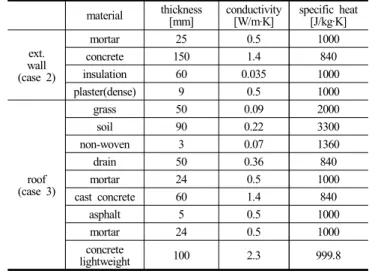
This research reviewed the standard Case (Case 1) by applying the operation result based on the result of the on-site inspection under the condition that the material properties of the existing walls and windows were applied when windows were closed. To check whether the energy performance of the building was improved,
3) Jung, Jae-woong, Kim, Dong-woo, Seok, Ho-tae, Yang, Jeong-hoon, A Study on the Improvement Plans of Energy Performance in University Building through the Analysis of Energy, Journal of the Korean Solar Energy Society, Vol. 30, No.1, 2010