711
FOREST SOCIETY
Physiological Responses and Phytoextraction Potential of
Pinus thunbergii on Cd-contaminated Soil
Sim-Hee Han
1*, Du-Hyun Kim
1, Venecio U. Ultra Jr
1,2and Jae-Cheon Lee
11Department of Forest Resources & Development, Korea Forest Research Institute, Suwon 441-350, Republic of Korea
2University of Eastern Philippines, Catarman, Northern Samar 6400, Philippines
Abstract :We investigated physiological responses and phytoextraction ability of Pinus thunbergii in cadmium contaminated soil as part of our efforts in identifying plant materials for the restoration and revegetation of forest soil contaminated by heavy metals. Thirty seedlings (ten per treatment) were assigned to three treatments (control, 0.3 and 0.6 mM CdSO4 solution) at first year experiment. At second year, ten seedlings per treatment treated with Cd during the first year experiment were divided by two groups (no Cd-treated and consecutive Cd-treated group). At first experiment, photosynthetic pigment content, and superoxide dismutase (SOD) and glutathione reductase (GR) activities have significantly reduced by Cd application, and the reduction rate was increased much higher as the rate of Cd application increased. On the other hand, thiol and malondialdehyde (MDA) content were significantly increased at the application of 0.6 mM of Cd. At the second year experiment, a general increase in chlorophyll and carotenoid content was observed with Cd treatment while SOD and GR activities showed a relative reduction compared to the control. Similar to the first year measurement, thiol and MDA contents also increased considerably due to Cd treatment. At harvest, dry matter was significantly reduced by Cd treatment especially at the rate of 0.6 mM Cd, but dry yield of P. thunbergii treated with 0.3 mM Cd was less affected and it was comparable with the control seedling. Cadmium concentration in seedling tissues increased with increasing Cd application rate while Cd uptake was higher in seedlings supplied with 0.3 mM Cd, which could be ascribed to their high dry matter. Overall, our study has demonstrated the unique physiological response of P. thunbergii to Cd-prolonged exposure by showing that the changes in photosynthetic pigment content and antioxidative enzyme activities were dependent on the concentration and duration of treatment. In addition, our results have demonstrated the potential of P. thunbergii to withstand up to 0.3 mM Cd (equivalent to cumulative Cd concentration of 134.4 to 268 mg kg−1) without showing growth reduction, hence it might be used for phytoremediation of Cd contaminated areas.
Key words :cadmium, photosynthetic pigments, physiological response, phytoextraction, Pinus thunbergii
Introduction
Alongside with industrial development, the associated drawbacks surfaced and threatened environmental sus- tainability. Example of which is the case of progressive mining activities that created serious problems threaten- ing sustainable development and safe environment. Many of the mining industries lead to environmental hazard espe- cially in abandoned and mined areas abound with mine waste contaminated with high levels of toxic metals.
Cadmium is considered as one of the most hazardous to
human and ecosystem health due to its high mobility in soils and potential toxicity to biota at low concentrations (Das et al., 1997). Although Cd is naturally present in soils at trace amounts, high levels of Cd have been reported in some soil environments. Cadmium is usually associated with several ores of precious mineral which could serves as point sources for Cd contamination in different ecosystems (Rodriguez et al., 2009). Widespread Cd contamination of land is also caused by the applica- tion of sludge or urban composts, pesticides, fertilizers, emissions from waste incinerators and irrigation with contaminated waste water (Yang et al., 2004). Because Cd is readily taken up by roots and translocated into leaves in many plant species, Cd is easily transferred
*Corresponding author E-mail: [email protected]
from the soil into the food chain, threatening human and animal health (Järup, 2003).
Current restoration strategies of containing Cd and other heavy metal contaminated mined areas include integrated approaches of landscape engineering and the application of appropriate technologies that would restore the eco- logical balance of the environment. In most cases, mined areas are devoid of sufficient vegetation that would sta- bilize the contaminated substrate and prevent these mate- rials from migrating into vulnerable environments, especially the arable agricultural lands devoted for crop production.
Consequently, phytoremediation is a potent strategy in restoring ecological health of mined areas because of its capability to stabilize the pollutants (phytostabilization), potentially decontaminate polluted environment and at the same time restore ecological balance by improving soil health and ecosystem.
The success of phytoremediation technology relies greatly on using plant species that are capable of surviving in polluted environment and at the same time accumulate heavy metals on the above ground parts. Several tree species have been identified as potent material for phy- toremediation ((Dickinson, 2000; Han et al., 2006a) but still there is a need to search for other candidates espe- cially among the indigenous plant resources in a partic- ular eco-climatic zone. Most of the abandoned mining areas are usually prone to erosion because of lack of sta- ble vegetation. In addition, heavy metal availability includ- ing Cd in forest ecosystems is also increasing due to deposition of heavy metal containing airborne particulate from air pollution in combination with acid rain occur- rence resulting to deterioration of forest trees and eco- system. Therefore, a thorough understanding of Cd uptake and its effect on growth and development in forest tree species is of major importance to avert heavy metal pol- lution and forest degradation.
In this study, we tried to assess the potential of Pinus
thunbergii as a candidate tree species for phytoremedia- tion application in Cd contaminated environment. This tree species is frequently found on the tailing of aban- doned mining area, and native to northeastern China, Korea and Japan and a popular landscape tree in Japan and in coastal gardens in northern Europe and the north- eastern U.S. It is very tolerant of high winds and salt spray, used to stabilize sand dunes (Tadaki, 1992), and reported to be tolerant of urban conditions which is asso- ciated with serious air pollution (Tsukahara et al., 1985).
To accomplish this goal, we have conducted experiments in order to determine the physiological responses of P.
thunbergii on elevated Cd concentrations supplied at dif- ferent rates and period of Cd treatment. Similarly, we also determined the Cd uptake potential of P. thunbergii at varying Cd concentration and frequency of application.
Materials and Methods 1. Plant material and treatment application
Pinus thunbergii seeds were collected from the closed zinc-minning area in Goseong, Gyeongnam Province and germinated in a greenhouse. One-year-old seedlings of P.
thunbergii were transplanted into plastic pots (2L volume) containing river sand. At first year, thirty seedlings (ten per treatment) with uniform standing (average height: 4.3 cm) were selected and subjected with Cd treatments. The first year experiment has three treatments including con- trol without Cd application, and it consisted of control, 0.3 mM Cd (T1), and 0.6 mM Cd application (T2). At second year, ten seedlings per treatment treated with Cd at first year were divided by two groups: non Cd-treated and con- secutive Cd-treated group. The second year experiment consisted of T1T0-supplied with 0.3 mM Cd during the first year and no Cd during the second year, T1T1-sup- plied with 0.3 mM Cd during the first and the second year, T2T0-supplied with 0.6 mM Cd during the first year and no Cd during the second year, and T2T2-supplied 0.6 mM Cd during the first and the second year. Thirty days after transplanting under screen house conditions, Cd was applied weekly over a five-month period from May to September. At each Cd application, approximately 200 mL of 0, 0.3 and 0.6 mM CdSO4 solutions were applied to the seedlings during the first year. On the second year, only seedlings belonging to T1T1 and T2T2 were supplied with 200 mL solution of 0.3 and 0.6 mM CdSO4 while other treatments (T1T0 and T2T0) were supplied with dis- tilled water. The pots were placed in plastic dishes to retain leached nutrients and CdSO4 solution. Pots were randomized in the greenhouse and moved about every two or three weeks throughout a five-month experimental period to minimize positional effects. During the experi- mental period, daily mean temperature and relative humidity were 23.1±2.1oC and 74.3 ±10.9%, respectively.
2. Pigment analysis
Photosynthetic pigments of P. thunbergii were ana- lyzed from 5-month-old (new) needles for the first and sec- ond measurement, respectively. Fresh needles (0.1 g) were excised and soaked in 10 mL DMSO (dimethyl sulfox- ide) in a glass vial after five months of Cd application (September 2005 and September 2006). The vial was tightly capped and incubated at 70°C for 2h in the dark.
The concentration of the extracted pigments (total chlo- rophyll, chlorophyll a, chlorophyll b, and carotenoid) was calculated based on their absorbance values at 664, 645, and 470 nm according to Lichtenthaler (1987).
3. Antioxidant enzyme activities
Fresh needles (0.1 g) collected on September 2005 and
September 2006 were homogenized under ice-cold con- dition with 5 mL of 50 mM phosphate buffer (pH 7.0), 10 mM ascorbic acid (AsA) and 1.0% (w/v) polyvinylpy- rolidone (Han et al., 2006b). The homogenate was cen- trifuged at 20,000 × g for 30 min, and the supernatant was collected for enzyme assays.
Superoxide dismutase (SOD) was assayed based on the inhibition of reduction of nitro-blue tetrazolium in the presence of xanthine at 530 nm according to the method of Beauchamp and Fridovich (1971). Activity of glu- tathione reductase (GR) was assayed as described in Carlberg and Mannervik (1985). The assay was carried out in a reaction mixture containing 50 mM phosphate buffer (pH 7.8), 0.1 mM NADPH, 0.5 mM GSSH and 0.1 mL enzyme extract. The change in A340 was recorded for 5 min after the addition of enzyme extract.
4. Thiol content
Freshly harvested needles (0.1 g) after the five month duration of Cd treatment were homogenized in 1.5 mL cold buffer containing 5% (w/v) 5-sulfosalicylic acid and 6.3 mM DTPA. The homogenized samples were centri- fuged (15,000×g, 10 min) and 250 µL of extract was mixed with 50 µL of Ellman's reagent (5,5'-dithiobis-2- nitrobenzoic acid) in 2.5 mL of 0.1 M sodium phosphate buffer (pH 8) containing 1 mM EDTA. Then, the mix- tures were incubated at room temperature for 15 min- utes. The absorption was recorded at 412 nm against a blank sample.
5. MDA content
Lipid peroxidation was determined by measuring the amount of malondialdehyde (MDA) produced by thiobarbi- turic acid reaction as described by Heath and Parker (1968). A crude extract was prepared using fresh needles (0.1 g) homogenized in 5 mL of 62.5 mM phosphate buffer (pH 7.8). The crude extract was mixed with the same volume of 0.5% (w/v) thiobarbituric acid solution con- taining 20% (w/v) trichloroacetic acid. The mixture was heated at 95oC for 30 min and then quickly cooled in an ice-bath. The mixture was centrifuged at 3000 × g for 10 min and the absorbance of the supernatant was monitored at 532 and 600 nm using UV-120 (SHIMADZU, Japan).
After subtracting the non-specific absorbance (600 nm), MDA concentration was determined by its molar extinc- tion coefficient (155 mM−1 cm−1) and the results expressed as mol MDA g−1 FW.
6. Biomass and cadmium determination
At harvest (September 2006), shoots and roots were carefully removed, and then thoroughly rinsed with dis- tilled water twice. The needle, stem and root were par- titioned and individually put in paper envelops. Oven dry
weights were obtained after oven drying the tissues at 70oC to constant weight.
Dried needle, stem and root (0.5 g each) were ground in a grinding mill (Retsch MM200, Germany). Nitric acid (70%, 15 mL) and hydrogen peroxide (30%, 5 mL) were added to 0.5 g of dried, ground seedling sample in a digestion vessel. Samples were digested using the micro- wave digestion system, cooled after addition of distilled water, and filtered prior to analysis. Cadmium concen- tration in the digested tissue was measured by atomic absorption spectrophotometer (AA-6701F, Shimadzu, Tokyo, Japan).
7. Data analysis
The data obtained during the first and the second year was independently subjected to analysis of variance based on complete randomized design at 5% level of signifi- cance. There were 3 treatments during the first year and 5 treatments on the second year. SAS System for Win- dows, Version 8.01 (SAS Institute Inc, 1996) was utilized for the analysis. When significant differences (P< 0.05) were indicated, Tukey’s Tests (HSD) were performed.
Results 1. Photosynthetic pigments
Photosynthetic pigment in the needles of P. thunbergii
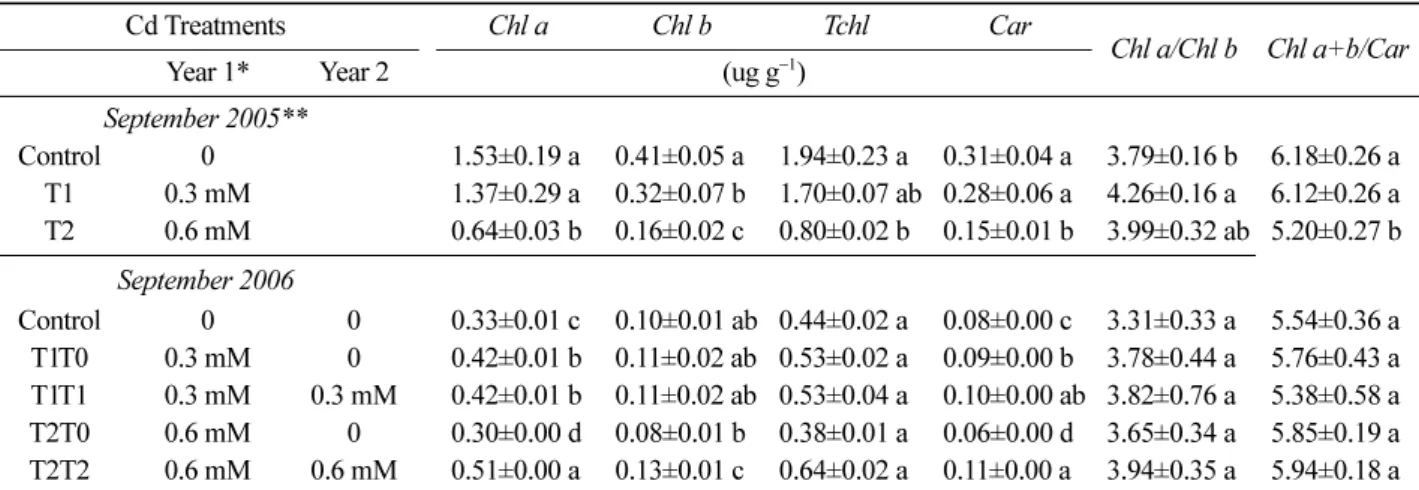
was affected by Cd treatment applied at different rates and frequency within the two-year period of experimen- tations (Table 1). During the first measurement on Sep- tember 2005, a significant reduction on chlorophyll a
(Chl a) was observed in seedlings supplied with 0.6 mM Cd by up to 58% based on the control. Similarly the
chlorophyll b (Chl b) and the total chlorophyll content were reduced significantly with Cd treatment and that higher reduction was observed with increasing Cd dos- age. The carotenoid (Car) content was also significantly reduced due to Cd application especially at 0.6 mM Cd.
The reduction due to 0.6 mM Cd application were up to 60%, 59% and 51% based on the control for Chl b, total Chl and Car, respectively. Cadmium application at 0.3 mM also resulted to lower photosynthetic pigment con- tent as compared with the control seedlings but such reduction was insignificant. The ratio of Chl a/Chl b in seedlings supplied with 0.3 mM Cd was significantly higher compared to the control but not with those seed- lings supplied with 0.6 mM Cd. On the other hand, the
Chl a+b/Car ratio were also reduced with the applica- tion of Cd at 0.6 mM.
During the second measurement (September 2006), the Chl a, Chl b, Car but not the total chlorophyll were significantly affected by different Cd treatments. Major- ity of the seedlings treated with Cd have Chl a, Chl b
and Car contents significantly higher than the control except for seedlings treated with 0.6 mM during the first year of treatment application (T2T0). The pigment con- tent in T1T0, T1T1 and T2T2 increased within the range of 24% to 51% for Chl a, 9% to 26% for Chl b and 16%
to 36% for Car over the control seedlings. On the other hand, the pigment content in T2T0 was reduced of up to 11%, 19% and 18% over the control for Chl a, Chl b and Car, respectively. There was no significant differ- ence on total chlorophyll (Tchl) content, the ratio of
Chla/Chlb and the ratio of Chla+b/Car among the dif- ferent treatments. Highest photosynthetic pigment con- tent was observed in seedlings supplied with 0.6 mM Cd for two consecutive years.
2. Antioxidative enzyme activity and thiol and MDA content
The superoxide dismutase (SOD) and glutathione reduc- tase (GR) activities, and the thiol and MDA contents of needles determined on September 2005 and at the end of experiment were presented in Table 2. During the first measurement, the SOD and the GR activities in the nee- dles of P. thunbergii exposed to Cd treatment did not gave significant differences with that of the control although Cd treatment reduced the SOD and GR activity of Cd treated seedlings. In contrast, the thiol and MDA content was significantly increased due to the application of 0.6 mM Cd on seedlings.
During the second measurement (September 2006), Table 1. Photosynthetic pigment content of Pinus thunbergii as affected by different dosage of Cd application1.
Cd Treatments Chl a Chl b Tchl Car Chl a/Chl b Chl a+b/Car
Year 1* Year 2 (ug g−1)
September 2005**
Control 0 1.53±0.19 a 0.41±0.05 a0 1.94±0.23 a0 0.31±0.04 a 3.79±0.16 b 6.18±0.26 a T1 0.3 mM 1.37±0.29 a 0.32±0.07 b0 1.70±0.07 ab 0.28±0.06 a 4.26±0.16 a 6.12±0.26 a T2 0.6 mM 0.64±0.03 b 0.16±0.02 c0 0.80±0.02 b0 0.15±0.01 b 3.99±0.32 ab 5.20±0.27 b
September 2006
Control 0 0 0.33±0.01 c 0.10±0.01 ab 0.44±0.02 a 0.08±0.00 c 3.31±0.33 a 5.54±0.36 a T1T0 0.3 mM 0 0.42±0.01 b 0.11±0.02 ab 0.53±0.02 a 0.09±0.00 b 3.78±0.44 a 5.76±0.43 a T1T1 0.3 mM 0.3 mM 0.42±0.01 b 0.11±0.02 ab 0.53±0.04 a 0.10±0.00 ab 3.82±0.76 a 5.38±0.58 a T2T0 0.6 mM 0 0.30±0.00 d 0.08±0.01 b0 0.38±0.01 a 0.06±0.00 d 3.65±0.34 a 5.85±0.19 a T2T2 0.6 mM 0.6 mM 0.51±0.00 a 0.13±0.01 c0 0.64±0.02 a 0.11±0.00 a 3.94±0.35 a 5.94±0.18 a
1Means within the same column and date of measurement followed by the same letter (s) are not significantly different from each other based on Tukey’s HSD test @ 5% level.
*Represent the year of Cd application.
**Date of measurement.
Table 2. Enzyme activities, thiol and MDA content of the needles of Pinus thunbergii as affected by different dosage of Cd application1.
Cd Treatments SOD GR Thiol MDA
Year 1* Year 2 unit g−1 nmol g−1 mmol g−1 µmol g−1
September 2005**
Control 0 123±6 a 326±212 a 0.64±0.00 b 07.52±0.11 b
T1 0.3 mM 087±47 a 161±43 a - -
T2 0.6 mM 104±89 a 144±57 a 00.7±0.04 a 11.74±0.06 a
September 2006
Control 0 0 279±47 a 179±30 a 0.66±0.01 c 08.64±0.05 d
T1T0 0.3 mM 0 207±50 b 232±62 a 0.89±0.08 a 11.65±0.05 a
T1T1 0.3 mM 0.3 mM 176±28 b 180±59 a 0.71±0.00 bc 10.02±0.04 b
T2T0 0.6 mM 0 319±36 a 163±18 a 0.73±0.01 b 09.29±0.06 c
T2T2 0.6 mM 0.6 mM 155±23 b 186±7 a 0.75±0.01 b 08.38±0.01 d
1Means within the same column and date of measurement followed by the same letter (s) are not significantly different from each other based on Tukey’s HSD test @ 5% level.
*Represent the year of Cd application.
**Date of measurement.
the SOD activity showed significant reduction due to Cd treatments as compared to the control except for those in T2T0. Based on the control, a reduction of up to 25%, 37% and 44% in SOD activity was observed in T1T0, T1T1 and T2T2, respectively, while a 14% increase in T2T0 was observed. Although non-significant, majority of the Cd treated seedlings showed a noticeably lower GR content than the control especially at higher Cd con- centration or at longer Cd exposure. Similarly, Thiol and the MDA content increased in seedlings treated with Cd solution during the second measurement. The increase of thiol content due to Cd treatment ranged from 7.5% to 36%. Highest increased was observed in seedlings sup- plied with 0.3 mM Cd during the first year of treatment application. Similarly, the MDA content was signifi- cantly affected by Cd treatment. All Cd treated seedlings have higher MDA content than the control except for those seedlings supplied with 0.6 mM Cd for two con- secutive years (T2T2). The increase in MDA was up to 35% observed in T1T0-seedlings based on the control.
3. Biomass
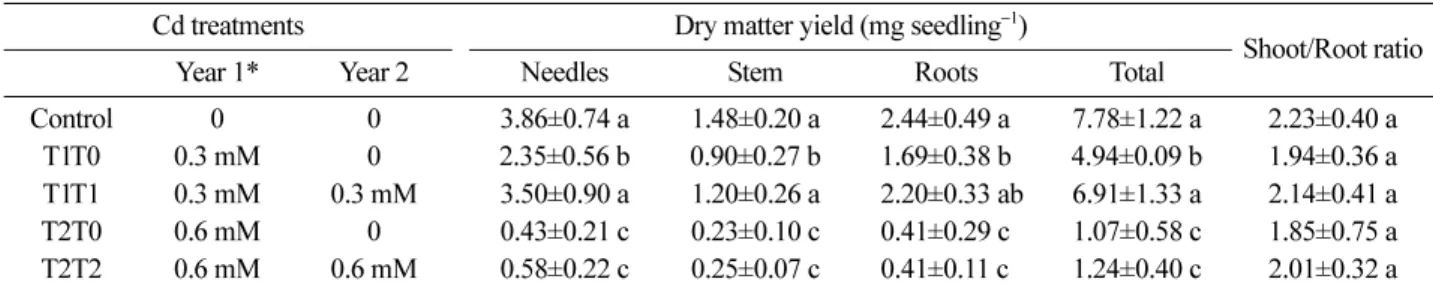
Cadmium treatment reduced needle, stem, root and total dry weight of seedlings (Table 2). The greatest sig- nificant reduction in dry matter yield was observed in seedlings exposed to high dose of Cd at 0.6 mM (T2T0 and T2T2) with more than 80% decreased based on the control. Seedling supplied with 0.3 mM during the first
year only (T1T0) have significantly lower needle, stem and total dry yield compared to those seedlings supplied with 0.3 mM Cd for the two consecutive years (T1T1).
Although there was a lower dry yield in T1T1 seedlings compared to the control, their difference was not found to be significant. There was no significant difference in terms of the dry yield shoot/root ratio among the Cd treatments and the control.
4. Cd concentration and uptake
Cadmium concentration in the needle, stem and root of P. thunbergii was significantly increased by Cd treat- ment (Table 3). The Cd concentration in the needles, stem and roots ranged from 45-275 mg kg−1, 70-380 mg kg−1, and 379-536 mg kg−1, respectively. Highest Cd concentration in the tissues were determined on seedlings supplied with 0.6 mM Cd for two consecutive years (T2T2), followed by those seedlings supplied with Cd at 0.6 mM during the first year (T2T0) and these seedlings have more than 4 times Cd concentration on needle and stem compared to those supplied with 0.3 mM Cd (T1T0 and T1T1).
Cadmium uptake in leaves, stem and roots as well as the total seedling uptake were significantly affected with different dosage and frequency of Cd treatment. Highest needle and stem uptake were observed in seedlings exposed to 0.6 mM Cd for two consecutive years while seedlings supplied with lower dose of Cd (T1T0 and T1T1) have sig- nificantly higher root Cd uptake compared to T2T0 and Table 3. Dry matter yield of Pinus thunbergii as affected by different dosage of Cd application1.
Cd treatmentsYear 1* Year 2 Needles Dry matter yield (mg seedlingStem Roots −1) Total Shoot/Root ratio
Control 0 0 3.86±0.74 a 1.48±0.20 a 2.44±0.49 a 7.78±1.22 a 2.23±0.40 a
T1T0 0.3 mM 0 2.35±0.56 b 0.90±0.27 b 1.69±0.38 b 4.94±0.09 b 1.94±0.36 a T1T1 0.3 mM 0.3 mM 3.50±0.90 a 1.20±0.26 a 2.20±0.33 ab 6.91±1.33 a 2.14±0.41 a T2T0 0.6 mM 0 0.43±0.21 c 0.23±0.10 c 0.41±0.29 c 1.07±0.58 c 1.85±0.75 a T2T2 0.6 mM 0.6 mM 0.58±0.22 c 0.25±0.07 c 0.41±0.11 c 1.24±0.40 c 2.01±0.32 a
1Means within the same column and date of measurement followed by the same letter (s) are not significantly different from each other based on Tukey’s HSD test @ 5% level.
*Represent the year of Cd application.
Table 4. Cadmium concentration and uptake of Pinus thunbergii as affected by different dosage of Cd application1. Cd treatments Cd concentration (mg kg-1) Cd uptake (mg seedling−1)
Year 1* Year 2 Needle Stem Roots Needle Stem Roots Total
Control 0 0 n.d. n.d. n.d. n.d. n.d. n.d. n.d.
T1T0 0.3 mM 0 53.9±0.5 c 70.3±0.9 d 447.2±2.6 c 135.9±24 b 66.1±21 b 784.2±18 a 986.3±21 a T1T1 0.3 mM 0.3 mM 45.0±5.6 c 92.2±0.8 c 379.3±3.3 d 154.2±61 b 104.5±22 a 834.7±15 a 1093.3±19 a T2T0 0.6 mM 0 228.3±1.8 b 311.3±3.4 b 547.8±2.0 a 89.2±52 c 71.5±37 b 224.8±18 b 385.5±27 b T2T2 0.6 mM 0.6 mM 275.5±10.2 a 379.9±1.4 a 536.4±3.1 b 183.1±43 a 106.3±19 a 236.3±48 b 525.7±10 b
1Means within the same column and date of measurement followed by the same letter (s) are not significantly different from each other based on Tukey’s HSD test @ 5% level.
*Represent the year of Cd application.
T2T2. On the other hand, total seedling uptake of Cd was higher in T1T0 and T1T1 than those in T2T0 and T2T2.
Discussion
Physiological responses such as photosynthetic pigments, enzyme activities and dry matter yield have been shown to be very sensitive to elevated cadmium in higher plants (Padmaja et al., 1990; Skórzyñska-Polit et al., 1995; Wu et al., 2003; Kim et al., 2004). Based on our results, there was a noticeable difference on the measured parameters between the first and the second year of mea- surement, varying with the degree at which the seedlings were exposed to Cd treatments. During the first year of Cd exposure, P. thunbergii responded similarly with other plants toward elevated Cd such as a reduction of photosynthetic pigments and increase in thiol and MDA contents of seedlings (Drazkiewicz, 1994; Abdel-Basset et al., 1995). The reduction of Chl b is more severe com- pared to Chl a as shown by higher Chla/b ratio indicat- ing that for P. thunbergii needles, Chl b was more sensitive to Cd treatment (Table 1). Conventionally, chl a hydrolysis more rapidly compared with chl b when seed- lings are under stress (Schoch and Brown, 1987; Drazk- iewicz, 1994; Abdel-Basset et al., 1995) but such phenomenon were not observed on P. thunbergii. Abdel- Basset et al. (1995) and Ewais (1997) pointed out that heavy metals accumulation would be responsible for the reduction of total chlorophyll. The decrease in chloro- phyll concentration may be due to the distortion of chlo- rophyll ultrastructure, inhibition of synthesis of photosynthetic pigments and enzymes of Calvin cycle (Baryla et al., 2001).
In contrast with the first year data, the pigments con- centrations in Cd treated seedlings were higher than the control except for T2T0 seedlings. This observation was similar to the response of Sedum alfredii subjected to Cd treatment where in the presence of Cd in the nutrient resulted to higher total chlorophyll, chlorophyll a and b content by as much as 32, 30 and 46% of controls, respectively when exposed to 1000 mM Cd. A decline was only found in the presence of 600 mM Cd, and the Cd content in S. alfredii leaves was the maximum at this Cd concentration (Zhou and Qui, 2005).
Carotenoids act as light-harvesting pigments and pro- tect chlorophyll and membrane destruction by quenching triplet chlorophyll and removing oxygen from the excited chlorophyll–oxygen complex (Young, 1991). In the case of P. thunbergii, the Car content in Cd treated seedlings were lower than control during the first year of mea- surement while prolonged exposure to Cd resulted to general increase especially at 0.3 mM Cd treatment. In
this study, carotenoids were less affected than chloro- phyll by Cd as shown in a lower Chla+b/Car ratio (Table 1). Carotenoids serve as lipid-soluble antioxidants against free radicals and photochemical damage because of conjugated double bonds (Rice-Evans et al., 1997).
Thus, less effect on carotenoids at lower concentration might represent their supportive role against oxidative stress (Seth et al., 2008). Concurrently, our result would imply that for prolonged exposure to Cd stress, the pho- tosynthetic pigments of young needles may not be a pre- pared parameter in assessing Cd responses of P. thunbergii. Alteration of the oxidant levels in plants is a conse- quence of the Cd toxicity effects (Foyer and Noctor, 2005) and accumulation of Cd was correlated with the generation of reactive oxygen species (ROS) in sensitive clones of Holcus lanatus (Hendry et al., 1992). In short term studies, Cd has been shown to elevate lipid perox- idation via ROS formation in plants (Halliwell and Gut- teridge, 1989). To scavenge ROS, plants possess a well- organized antioxidative defense system comprising enzy- matic and non-enzymatic antioxidants. The cooperative function of these antioxidants plays an important role in scavenging ROS and maintaining the physiological redox status of organisms (Cho and Seo, 2005). Apparently, the exposure of P. thunbergii to elevated Cd at long term did not result to increased SOD and GR activities in the needles rather a remarkable decrease was observed espe- cially during the secound year measurement (Table 2).
This would imply that in P. thunbergii, long term expo- sure to elevated Cd may not directly increased the pro- duction of superoxide such that no activation of the existing enzyme pools or increased expression of genes encoding antioxidative enzymes (Mishra et al., 2006).
Plants cope with cellular damage by sequestration of toxic metals away from the cytosol (Hall, 2002). This could be facilitated by complexation with metal-binding peptides, metallothioneins and phytochelatins and may serve to alleviate against Cd toxicity. Thus, the glu- tathione or phytochelatins might contribute to protect the photosynthesis against Cd toxicity in this plant. In this study, the thiol contents have increased significantly due to Cd treatment (Table 2). This would indicate that P.
thunbergii has the capacity to tolerate high and pro- longed exposure to Cd by synthesizing thiol compounds capable of binding with Cd. Similarly, some authors indicated a direct relationship of higher degrees of metal exposure to an increase in thiol productions and an accu- mulation of the longer chains (Tukendorf and Rauser, 1990, Lima et al. 2006).
The content of malondialdehyde (MDA) was generally increased in the presence of cadmium stress especially at 0.3 mM Cd treatments. However, continued Cd treat- ment resulted to significant reduction of MDA as com-
pared to those plants treated only for 1 year and that the MDA concentration was generally lower in plants sup- plied with 0.6 mM Cd than those supplied with 0.3 mM Cd. MDA is a product of lipid peroxidation and an indi- cator of free radical production and tissue damage. It seems that the tissue damage by free radicals is allevi- ated by some unknown direct and indirect enzymatic pathways and detoxifying action of carotenoids (Abad and Khara, 2007) during prolonged exposure to elevated Cd concentration.
The ultimate consequence of long term Cd stress in plants could be assessed on the dry matter yield of plants. Our results have shown that P. thunbergii could relatively tolerate Cd concentration up to 0.3 mM sup- plied for up to 2 consecutive years before showing sig- nificant reduction in dry matter yield. Increasing the Cd treatment to 0.6 mM Cd abruptly during the first year and continuously during the second year resulted to sig- nificant reduction in plant growth as evident in low dry yield. On the other hand, Cd accumulation on plant tis- sues have generally increased with increasing concentra- tion and that the concentration were in the order of root
> stem > needle. This concentration pattern were similar to other plants which is determined by several factors such as the binding of Cd to extracellular matrix (Horst, 1995), complexing inside the cell (Cobbett et al., 1998) and on the transport efficiency (Marchiol et al., 1996).
Additionally, the increased translocation of Cd to shoots with increasing Cd concentration on the growth media may result from the increased transpiration rate and thiol content in plants. Ding et al. (1994) reported that the Cd uptake was proportional to the increase of the thiol group content.
The needle Cd uptake by P. thunbergii was higher in 0.3 mM Cd than 0.6 mM treatments while higher stem Cd uptake resulted due to prolonged Cd treatments. In contrast, the root uptake and the total plant uptake were higher in seedling supplied with 0.3 mM than those with 0.6 mM Cd. These results imply that the Cd accumula- tion pattern of P. thunbergii is a function of doses, expo- sure time and the degree at which plants would be able to adapt to Cd stress at a particular growing condition. It appeared that lower Cd concentrations (T1T0 and T1T1) have not disrupted much of the physiological system and transpiration of P. thunbergii as compared to the much higher Cd application. It could also be noted that at lower Cd stress, plants could be able to counteract Cd stress by immobilizing them in the root system through cell wall and extracellular carbohydrates (Wagner, 1993).
In contrast, Cd concentration at 0.6 mM showed to be toxic to P. thunbergii which have resulted in disrupted physiological system, impaired photosynthetic functions and resulted to poor growth and total Cd uptake.
Overall, our study has demonstrated the unique phys- iologic response of P. thunbergii to prolonged exposure to Cd treatment by showing that the change in photo- synthetic pigment content and activity of antioxidant enzymes were dependent on the duration of treatment.
The results from this experiment suggest that the anti- oxidant system, besides its function in detoxification, can also be a sensitive target of Cd toxicity in plants.
Specifically, Cd-prolonged exposure of P. thunbergii
enhanced photosynthetic pigment and thiol content that could have been responsible for tolerance to moderate levels of Cd. In addition, our results have demonstrated the potential of P. thunbergii to withstand up to 0.3 mM Cd (equivalent to cumulative Cd concentration of 134.4 to 268 mg kg−1) without showing growth reduction, hence it might be used for phytoremediation of Cd con- taminated areas.
Literature Cited
1. Abad, A.K.J. and Khara, J. 2007. Effect of cadmium toxicity on the level of lipid peroxidation and antioxi- darive enzymes activities in wheat plants colonized by arbuscular mycorrhizal fungi. Pakistan Journal of Bio- logical Sciences10: 2413-2417.
2. Abdel-Basset, R., Issa, A.A. and Adam, M.S. 1995.
Chlorophyllase activity: effect of heavy metals and cal- cium. Photosynthetica 31: 421-425.
3. Baryla, A., Carrier, P., Franck, F., Coulomb, C., Sahut, C. and Havaux, M. 2001. Leaf chlorosis in oilseed rape plants (Brassica napus) grown on cadmium-polluted soil: causes and consequences for photosynthesis and growth. Planta 212: 696-709.
4. Beauchamp, C. and Fridovichi, I. 1971. Superoxide dis- mutase: Improved assays and an assay applicable to acrylamide gels. Analytical Biochemistry 44: 276-297.
5. Carlberg, I. and Mannervik, B. 1985. Glutathione reductase.
Methods in Enzymology 113: 485-490.
6. Cho, U.H. and Seo, N.H. 2005. Oxidative stress in Ara- bidopsis thaliana exposed to cadmium is due to hydro- gen peroxide accumulation. Plant Science 168: 113-120.
7. Cobbett, C.S., May, M.J., Howden, R. and Rolls, B. 1998.
The glutathione-deficient cadmium-sensitive mutant, cad 2- 1, of Arabidopsis thaliana is deficient in gamma- glutamylcysteine synthetase. The Plant Journal 16: 73- 8. Das, P., Samantaray, S. and Rout, G.R. 1997. Studies on78.
cadmium toxicity in plants: A review. Environmental Pollution 98: 29-36.
9. Dickinson N.M. 2000. Strategies for sustainable wood- land on contaminated soils. Chemosphere 41: 259-263.
10. Ding, X., Jiang, J., Wang, Y., Wang, W. and Ru, B. 1994.
Bioconcentration of cadmium in water hyacinth (Eich- hornia crassipes) in relation to thiol group content.
Environmental Pollution 84: 93-96.
11. Drazkiewicz, M. 1994. Chlorophyllase: occurrence, func- tions, mechanisms of action, effects of external and internal factors. Phytosynthetica 30: 321-331.
12. Ewais, E.A. 1997. Effects of cadmium, nickel and lead on growth, chlorophyll content and proteins of weeds.
Biologia Plantarum 39: 403-410.
13. Foyer, C.H. and Noctor, G. 2005. Oxidant and antiox- idant signaling in plants: a re-evaluation of the concept of oxidative stress in a physiological context. Plant Cell Environment 28: 1056-1071.
14. Hall, J.L. 2002. Cellular mechanism of heavy metal detoxification and tolerance. Journal of Experimental Botany 53: 1-11.
15. Halliwell, B. and Gutteridge, J.M.C. 1989. Free radi- cals in biology and medicine. Oxford: clarendon Press p. 188-206.
16. Han, S.H., Lee, J.C., Oh, C.Y. and Kim, P.G. 2006a. Alle- viation of Cd toxicity by composted sewage sludge in Cd-treated Schmidt birch (Betula schmidtii) seedlings.
Chemosphere 65: 5421-546.
17. Han, S.H., Lee, J.C., Oh, C.Y. and Kim, P.G. 2006b.
Antioxidant characteristics and phytoremediation potential of 27 taxa of roadside trees at industrial complex area.
Korean JournalofAgriculturaland ForestMeteorology 8: 159-168.
18. Heath, R.L. and Parker, L. 1968. Photoperoxidation in isolated chloroplasts. I. Kinetics and stoichiometry of fatty acid peroxidation. Archives of Biochemistry and Biophysics125: 189-198.
19. Hendry, G.A.F., Baker, A.J.M. and Ewart, C.F. 1992.
Cadmium tolerance and toxicity, oxygen radical pro- cesses and molecular damage in cadmium-tolerant and cadmium sensitive clones of Holcus lanatus L. Acta Botanica Neerlandica 41: 271-281.
20. Horst, W.J. 1995. The role of the apoplast in Al toxicity and resistance of higher plants: a review. Zeitschrift fur Pflanzenernabrung und Bodenkunde 158: 419-428.
21. Järup, L. 2003.Hazards of heavy metal contamination.
British Medical Bulletin 68:167-182.
22. Kim, C.G., Power, S.A. and Bell, J.N.B. 2004. Effects of host plant exposure to cadmium on mycorrhizal infection and soluble carbohydrate levels of Pinus sylvestris seedlings. Environment Pollution 131: 287- 23. Lichtenthaler HK. 1987. Chlorophylls and carotenoids:294.
pigments of photosynthetic biomembranes. Methods in Enzymology 148: 350-382.
24. Lima, A.I., Pereira, S.I., Figueira, A., Caldeira, G. and Caldeira, H. 2006. Cadmium detoxification in roots of Pisum sativum seedlings: relationship between toxicity levels, thiol pool alterations and growth. Environmental and Experimental Botany 55: 149-162.
25. Marchiol, L., Leita, L., Martin, M. and Peressotti, Z.G.
1996. Physiological responses of two soybean cultivars to cadmium. Journal of Environmental Quality 25: 562- 566.
26. Mishra, S., Srivastava, S., Tripathi, R.D., Govindarajan, R., Kuriakose, S.V. and Prasad, M.N.V. 2006. Phytoch- elatin synthesis and response of antioxidants during cadmium stress in Bacopa monnieri L. Plant Physiol- ogy and Biochemistry 44: 25-37.
27. Padmaja, K., Parsad, D.D.K. and Parsad, A.R.K. 1990.
Inhibiton of chlorophyll synthesis in Phaseolus vul- garis L. seedling by cadmium acetate. Photosynthetica 24: 399-404.
28. Rice-Evans, C., Sampson, J., Bramley, P.M. and Hol- loway, D.E. 1997. Why do we expect carotenoids to be antioxidants in vivo. Free Radical Research 26: 381- 398.
29. Rodrýguez, L., Ruiz, E., Alonso-Azcarate, J. and Rin- con, J. 2009. Heavy metal distribution and chemical speciation in tailings and soils around a Pb-Zn mine in Spain. Journal of Environmental Management 90: 1106- 1116.
30. SAS Institute Inc. 1996. SAS Software Proprietary Release 6.12. Cary (NC): SAS Institute Inc.
31. Schoch, S. and Brown, J. 1987. The action of chloro- phyllase on chlorophyll-protein complexs. Journal of Plant Physiology 129: 242-249.
32. Seth, C.S., Chaturvedi, P.K. and Misra, V. 2008. The role of phytochelatins and antioxidants in tolerance to Cd accumulation in Brassica juncea L. Eco-Environ- ment Safety 71: 76-85.
33. Skórzyñska-Polit, E., Bednara, J. and Baszyñski, T.
1995. Some aspects of runner bean plant response to cadmium at different stages of the primary leaf growth.
Acta Societatis Botanicorum Poloniae 64: 165-170.
34. Tadaki, Y. 1992. The ecological succession in coasts and coastal forests. pp. 52-57. In: Murai, H., Ishikawa, M., Endo, J.and Tadaki, Y. (Eds). Japanese coastal for- ests: the many sided environmental functions and the applications (in Japanese). Soft Science, Tokyo.
35. Tsukahara, H., Kozlowski, T.T. and Shanklin, J. 1985.
Tolerance of Pinus densiflora, Pinus thunbergii, and Larix leptolepis seedlings to SO2. Plant and Soil 88:
385-397.
36. Tukendorf, A. and Rauser, W.E. 1990. Changes in glu- tathione and phytochelatins in roots of maize seedlings exposed to cadmium. Plant Science 70: 155-166.
37. Wagner, G.J. 1993. Accumulation of cadmium in crop plants and its consequences to human health. Advances in Agronomy 52: 173-212.
38. Wu, F., Zhang, G. and Dominy, P. 2003. Four barley genotypes respond differently to cadmium: lipid perox- idation and activities of antioxidant capacity. Environ- mental and Experimental Botany 50: 67-78.
39. Yang, X.E., Long, X.X., Ye, H.B., He, Z.L., Calvert,
D.V. and Stoffella, P.J. 2004. Cadmium tolerance and hyperaccumulation in a new Zn-hyperaccumulating plant species (Sedum alfredii Hance). Plant and Soil 259:
181-189.
40. Young, A.J. 1991. The photoprotective role of caro- tenoids in higher plants. Physiologia Plantarum 83:
702-708.
41. Zhou, W. and Qiu, B. 2005. Effects of cadmium hyper- accumulation on physiological characteristics of Sedum alfredii Hance (Crassulaceae). Plant Science 169: 737- 745.
(Received July 14, 2010; Accepted September 29, 2010)