The Impact of the External Technology R&D Collaboration Network Heterogeneity on the Employment Increase of Small and Medium
Companies: The Mediating Effect of Export Growth
Yong Sauk Hau
School of Business, Yeungnam University
외부 기술 연구개발 협력 네트워크의 다양성이 중소기업의 고용 증대에 미치는 영향:
수출 증대의 매개 효과
허용석
영남대학교 경영대학
Abstract With a view to deepening the research stream on the factors positively influencing the export growth and the employment increase of South Korean small and medium companies, this research has developed the research model about the impact of small and medium companies’ external technology R&D collaboration network heterogeneity on their export growth and employment increase, and has empirically tested the research model with the 2,200 data collected from the small and medium companies in the South Korea. This study illuminates the two points from the empirical testing results. One point is that small and medium companies’ external technology R&D collaboration network heterogeneity significantly and positively influences their employment increase from technology development. The other point is that small and medium companies’ export growth from technology R&D partially mediates the impact of the external technology R&D collaboration network heterogeneity on their employment increase from technology R&D.
Key Words : External Technology R&D Collaboration Network, Small and Medium Companies, Export Growth, Employment Increase, Technology Convergence
요 약 본 연구는 한국 중소기업의 수출 증대와 고용 증대에 양(+)의 영향을 미치는 요인들에 대한 연구 흐름의 깊이를
심화시키기 위해 외부 기술 연구개발 협력 네트워크의 다양성이 중소기업의 수출 증대와 고용 증대에 미치는 영향을 연구 모형화 하였으며, 대한민국의 2,200개의 중소기업으로부터 수집된 데이터를 사용하여 연구 모형을 실증적으로 검증 하였다.
본 연구는 이러한 실증 검증 결과를 통해 다음과 같은 2개의 연구 결과를 조명한다. 첫째, 중소기업의 외부 기술 연구개발 협력 네트워크의 다양성은 기술 개발로 인한 고용 증대에 유의한 양(+)의 영향을 미친다. 둘째, 중소기업의 기술 개발로 인한 수출 증대는 기술 개발로 인한 고용 증대가 외부 기술 연구개발 협력 네트워크의 다양성에 의해 받는 양(+)의 영향을 부분 매개한다.
주제어 : 외부 기술 연구개발 협력 네트워크, 중소기업, 수출 증대, 고용 증대, 기술 융합
*Corresponding Author : Yong Sauk Hau([email protected]) Received October 10, 2017
Accepted March 20, 2018
Revised February 14, 2018 Published March 28, 2018
1. Introduction
Small and medium companies compose the most of the parts in the entire number of the enterprises in the Republic of Korea [1, 2], playing a very critical role in the South Korea’s economy [2]. The small and medium companies play a crucial role in not only the employment [3] but also the export of the South Korea [4]. However, the business environments are changing very quickly with the technology convergence among diverse domains [5, 6] and unlimited competitions facilitated by the free trade under the trading system of WTO [2]. Futhermore, a lot of small and medium companies in the South Korea are facing the big problem of the lack of their internal resources and capabilities necessary for successful technology R&D which can make them create and sustain competitive advantages [2, 7, 8]. Therefore, in order to provide meaningful implications about the influential factors positively influencing the export growth and the employment increase of South Korean small and medium companies, this study tries to build the research model about the effect of small and medium companies’ technology R&D collaboration network heterogeneity on their export growth and employment increase, and empirically test the research model with the 2,200 data collected from the small and medium companies in the South Korea. In line with this research purpose, this research addresses the following research questions;
(i) What impact does small and medium companies’
external technology R&D collaboration network heterogeneity have on their employment increase from technology R&D?
(ii) What is the role of small and medium companies’
export growth between their external technology R&D collaboration network heterogeneity and employment increase from technology R&D?
This research paper is composed of five sections including this section explaining the research purpose
and research motivation with the two research questions. In the second section, this research constructs the research model under the open innovation perspective suggested by Chesbrough (2003)[9] and Chesbrough (2006)[10]. In the third section, the research methodology for this study is explained. The research model testing results are reported in the fourth section. The implications from this study are presented in the last section for the conclusion from this study.
2. Theoretical Background and Research Model
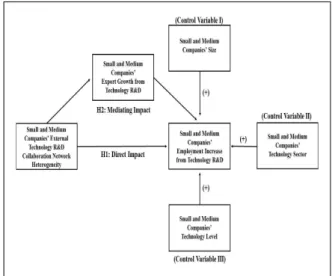
This study constructs the research model with two hypotheses under the open innovation perspective [9, 10]. The hypothesis 1 covers the direct impact of small and medium companies’ external technology R&D collaboration network heterogeneity on their employment increase from technology R&D. The hypothesis 2 covers the mediating role of small and medium companies’ export growth between their external technology R&D collaboration network heterogeneity and employment increase from technology R&D.
The open innovation perspective puts the accent on the point that it is fruitful for small and medium companies lack of internal resources and capabilities necessary for successful technology R&D to strategically get and digest the external knowledge from diverse external technology R&D collaborations in order to make their technology R&D more successful [7-11]. Small and medium companies’ new technology development capability is positively influenced by their external technology R&D collaboration network heterogeneity [7], which enables firms to make successful product innovation and make good differentiation [5, 6, 13]. Futhermore, Small and medium companies’ external technology R&D collaboration network heterogeneity has a positive effect on their production process improvement as well as cost
reduction [12], which enables firms to reduce their prices of products and create their cost leadership [13].
The differentiation and cost leadership are essential to making firms survive and grow in the heavy competition of their market [13] and the employment increase is a strong sign of firms’ growth [14].
Therefore, this study builds the hypothesis 1 about the positive impact of small and medium companies’
external technology R&D collaboration network heterogeneity on their employment increase as follows;
H1 : The external technology R&D collaboration network heterogeneity positively influences small and medium companies’ employment increase.
Product and price competitiveness are important factors to determining South Korean firms’ export performance [15, 16]. Technology R&D plays a critical role in creating product or process innovation which firms’ improved or new products or low costs result from [5, 6, 17]. Diverse external technology R&D collaborations can provide exterior knowledge which facilitates small and medium companies’ product or process innovation [5, 6, 8-11], and increases both the new technology development capability and the technology commercialization capability of South Korean small and medium companies [7], which can make small and medium companies’ external technology R&D collaboration network heterogeneity positively impact their export growth. Furthermore, the increase in the export demand promotes both domestic production and employment [18] and the export growth facilitates the employment of the South Korean firms in the manufacturing industry [19], which can make small and medium companies’ export growth positively influence their employment. Considering the positive effect of their external technology R&D collaboration network heterogeneity on the export growth which can positively influence the employment increase, this research makes the following hypothesis 2;
H2 : Small and medium companies’ export growth plays a mediating role between their external technology R&D collaboration network heterogeneity and employment increase.
In addition, small and medium companies’ size, technology sector, and technology level are used as the control variables in the research model as seen in the Fig. 1.
Fig. 1. Research model
3. Research Methodology
This study utilized the 2,200 data from the 2014 Small and Medium-Sized Enterprises’ Technology Statistics (2014 SMETS). The 2014 SMETS is a kind of survey about the management of technology R&D in South Korean small and medium companies as of 2013, conducted in 2014 by the Korea Federation of Small and Medium Business (KBIZ) and the Small & Medium Business Administration and authorized by the South Korea Government.
In measuring the independent variable, this research used the measurement of technology R&D collaboration network heterogeneity adapted from Tsai(2009) [20].
More specifically, this research measured the number of the different sorts of external technology R&D
collaboration partners utilized by each small and medium companies for their technology R&D in 2013.
The different types were assorted into six types such as (1) other small and medium companies (2) private research institutes (3) foreign organizations and companies, (4) conglomerates, (5) universities, and (6) national research institutes. In measuring the mediating variable and the dependent variable, which were the export growth and the employment increase from technology R&D respectively, the five point scale was utilized ranging from one with either no degree or very low degree to five with very high degree. For the measurement of the control variables, this study checked each small and medium company’s number of employees, whether each small and medium company belonged to the information technology sector or not by using a dummy variable, and whether it belonged to the group with the high level of technology or not by using a dummy variable. The Table 1 indicates the definitions of the variables in this study.
Variable Type Definition
ETRDCNH Independent
The number of the different sorts of the external technology R&D partners which a small and medium company cooperates with [7, 12]
EGTRD Mediating The degree of a small and medium company’s export growth from technology R&D [29]
EITRD Dependent The degree of a small and medium company’s employment increase from technology R&D [19]
CS Control The size of a small and medium company represented by its number of employees [31]
TS Control The technology sector which a small and medium company belongs to [30]
TL Control The technology level of a small and medium company [30]
Note: ETRDCNH stands for the External Technology R&D Collaboration Network Heterogeneity, EITRD for the Employment Increase from Technology R&D, EGTRD for the Export Growth from Technology R&D, CS for the Companies’ Size, TS for the Technology Sector, and TL for the Technology Level.
Table 1. The definitions of the variables
This research used the ordinary least squares(OLS) regression analysis with the Sobel test [21] and the Baron and Kenny test [22] to test the research model.
The Table 2 reports the profile of the 2,200 data used for the empirical analyses in this research.
Variable Max Min Average Standard
Deviation The Number of R&D
Workers 197 1 6.608 10.525
R&D Investment (South Korean Million
Won) 26,817 1 585.592 1,096.215
Total Sale
(South Korean Million
Won) 216,371 0 18,218.662 27,764.901
Total Export (South Korean Million
Won) 145,296 0 1,847.970 7,858.094
Table 2. The profile of the data
4. Research Model Testing Results
The research model testing results through the OLS regression indicate that the external technology R&D collaboration network heterogeneity positively influences small and medium companies’ employment increase (regression coefficient = 0.145, p-value = 0.000) in the significant level of 0.05, supporting the hypothesis 1.
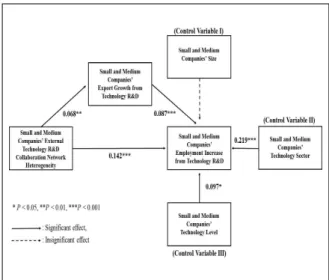
Fig. 2. The research model testing results
As seen in the Fig. 2, the results show that small and medium companies’ export growth partially mediates the impact of the external technology R&D collaboration network heterogeneity on the employment
increase, supporting the hypothesis 2. This study has performed the Sobel test [21] based on the following formula;
Z-value =
×
×
×
In the z-value formula, stands for the unstandardized regression coefficient of the external technology R&D collaboration network heterogeneity on the export growth, for the unstandardized regression coefficient of the export growth on the employment increase, and and for the standard error of the and , respectively. The Sobel test [21] has generated the z-value of 2.477, which proves the significant mediating effect of small and medium companies’ export growth between small and medium companies’ external technology R&D collaboration network heterogeneity and their employment increase.
The Baron and Kenny test [22] has confirmed that the mediating effect of the export growth is significant and partial. The regression coefficient of the external technology R&D collaboration network heterogeneity on the employment increase is 0.145 (p-value = 0.000) when the mediating effect of the export growth is not taken into consideration. But, It has been reduced to 0.142 (p-value = 0.000) when the mediating impact of the export growth has been considered, which is a significant sign of the point that small and medium companies’ export growth partially mediates the positive influence of their external technology R&D collaboration network heterogeneity on the employment increase based on the Baron and Kenny [22].
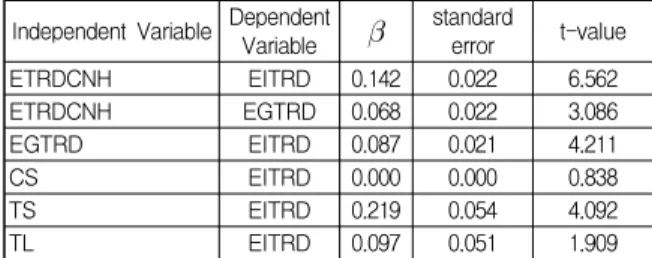
More specifically, as summarized in the Table 3, small and medium companies’ external technology R&D collaboration network heterogeneity significantly and positively impacts their export growth from technology R&D (regression coefficient = 0.068, p-value = 0.002). Small and medium companies’ export
growth from technology R&D positively influences their employment increase from technology R&D (regression coefficient = 0.087, p-value = 0.000).
Independent Variable DependentVariable standarderror t-value
ETRDCNH EITRD 0.142 0.022 6.562
ETRDCNH EGTRD 0.068 0.022 3.086
EGTRD EITRD 0.087 0.021 4.211
CS EITRD 0.000 0.000 0.838
TS EITRD 0.219 0.054 4.092
TL EITRD 0.097 0.051 1.909
Note: ETRDCNH stands for the External Technology R&D Collaboration Network Heterogeneity, EITRD for the Employment Increase from Technology R&D, EGTRD fro the Export Growth from Technology R&D, CS for the Companies’ Size, TS for the Technology Sector, TL for the Technology Level, and for the regression coefficient.
Table 3. The OLS regression analysis results
5. Conclusion
5.1 Implications from Findings
With a view to providing meaningful implications about the influential factors positively influencing the export growth and employment increase of South Korean small and medium companies, this research has attempted to develop the research model about the impact of small and medium companies’ external technology R&D collaboration network heterogeneity on their export growth and employment increase, and empirically test the research model with the 2,200 data from small and medium companies in the South Korea.
This study reveals the two points from the empirical testing results, providing the implications based on the points which has hardly been covered in the recent studies on small and medium companies including Hau (2016)[7], Kim and Hwang(2016)[23], Hau(2015)[24], Lee and Kim (2016)[25], Sohn, Lee, and Kim(2017)[26], Hau(2015)[27], and Hau(2017) [28]. One point from this study is that small and medium companies’ external technology R&D collaboration network heterogeneity significantly and positively influences their employment increase from technology R&D. This implies that the
external technology R&D collaboration with more diverse external partners contributes to making small and medium companies’ organization grow through employment increase. The other point from this research is that small and medium companies’ export growth from technology R&D partially mediates the impact of the external technology R&D collaboration network heterogeneity on their employment increase.
This indicates that small and medium companies’
external technology R&D collaboration network heterogeneity positively influences both the export growth and the employment increase from technology R&D, and the export growth also positively influences the employment increase from technology R&D, emphasizing the important role of the external technology R&D collaboration with diverse partners in making the export growth and the employment increase from technology R&D.
5.2 Suggestion for Better Future Studies This study controled the effects of such exogenous variables as the size, technology sector, and technology level of each small and medium company but considering and controling the effects of more various exogenous variables will be better for future studies.
Empirical analyses based on the data from foreign countries will be able to increase the external validity of the analysis results from future studies.
REFERENCES
[1] S. J. Yoo. (2010). A study on the measures for export promotion of small and medium enterprise in Korea.
International Commerce and Information Review, 12(4), 193-211.
[2] L. Manwoo & L. Sangwhan. (2002). Study on the effectiveness of tax support system on small and medium business. Asia Pacific Journal of Small Business, 24(3), 227-245.
[3] J. T. Kim. (2006). A study on the improvement of the tax support system for the small and medium enterprises. The Journal of Business Education, 13,
193-211.
[4] G. K. Kim. (2003). The structural relationship between export marketing strategy and performance of Korean small and medium firms.Journal of International Trade and Industry Studies, 8(2), 83-109.
[5] M. A. Schilling. (2013). Strategic Management of Technological Innovation. McGraw-Hill.
[6] P. Trott. (2012). Innovation Management and New Product Development.Prentice Hall.
[7] Y. S. Hau. (2016). An empirical analysis of the influence of external knowledge network on SMEs’ new technology development and technology commercialization capabilities in the perspective of open innovation.
Journal of Digital Convergence, 14(5), 149-156.
[8] H. Kim & Y. Park. (2010). The effects of open innovation activity on performance of SMEs: The case of Korea.International Journal of Technology Management, 52(3/4), 236-256.
[9] H. W. Chesbrough. (2003). The era of open innovation.
MIT Sloan Management Review, 44(3), 35-41.
[10] H. W. Chesbrough. (2006). Open Innovation : The New Imperative for Creating and Profiting from Technology.
Harvard Business School Press.
[11] V. van de Vrande, J. P. J. de Jong, and W.
Vanhaverbeke, & M. de Rochemont. (2009). Open innovation in SMEs: Trends, motives and management challenges.Technovation, 29(6-7), 423-437.
[12] Y. S. Hau. (2017). The effect of the external technology collaboration network diversity on SMEs’ production process improvement and cost Reduction: The moderating role of the use of the external information.
Journal of Product Research, 35(2), 7-12.
[13] M. E. Porter. (1980). Competitive Strategy: Techniques for Analyzing Industries and Competitors, Free Press.
[14] E. Stam & K. Wennberg. (2009). The roles of R&D in new firm growth.Small and Business Economics, 33(1), 77-89.
[15] C. G. Kim. (2001). An empirical study on the determinants of export performance by Korean small and medium firms. Korea Trade Review, 26(4), 323-351.
[16] Y. G. Kim. (2008). An empirical study on the determinants of export performance in Korean firms:
Focused on meta analysi., International Business Review, 12(2), 55-75.
[17] A. Afuah. (2003). Innovation Management, Oxford University Press.
[18] A. Y. Kim. (2007). Empirical investigation for export-led growth hypothesis in Korea. Journal of International
Trade and Industry Studies, 12(1), 81-100.
[19] B. C. Cin & E. Y. Lee. (2010). Effects of R&D and exports on technical efficiency using stochastic frontier approach.Korean Corporation Review, 17(1), 1-21.
[20] K. Tsai. (2009). Collaborative networks and product innovation performance : Toward a contingency perspective.Research Policy, 38(5), 765-778.
[21] M. E. Sobel. (1982). Asymptotic confidence intervals for indirect effects in structural equation models.
Sociological Methodology, 13, 290-312.
[22] R. M. Baron & D. A. Kenny. (1986). The moderator-mediator variable distinction in social psychological research : Conceptual, strategic, and statistical considerations.
Journal of Personality and Social Psychology, 51(6), 1173-1182.
[23] J. K. Kim & K. T. Hwang. (2016). A study on the factors affecting technological innovation of innovative IT SMEs. Journal of Digital Convergence, 14(11), 201-224.
[24] Y. S. Hau. (2015). External information network diversity and production management capability in IT SMEs in the age of digital convergence: the mediating effect of manufacturing capability. Journal of Digital Convergence, 13(9), 99-104.
[25] D. Y. Lee & S. G. Kim. (2016). Determinants of technology transfer for convergence management strategy of small and medium enterprises. Journal of Digital Convergence, 14(3), 83-94.
[26] D. Sohn, J. Lee, & Y. Kim. (2017). The effects of government support and regulation on SMEs technology innovation.Journal of Digital Convergence, 15(4), 117-125.
[27] Y. S. Hau. (2015). IT SMEs’ product planning capability and manufacturing capability in the context of digital convergence: The mediating impacts of the product exterior and interior design capabilities. Journal of Digital Convergence, 13(12), 55-62.
[28] Y. S. Hau. (2017). IT SMEs’ external information network diversity and product quality improvement in the era of technology convergence : The mediating role of the production process improvement. Journal of Digital Convergence, 15(4), 199-204.
[29] Y. S. Cho. (2016). The moderating effects of external turbulence toward the path between the open innovation and export performance of manufacturing SMEs.
Journal of Digital Convergence, 23(3), 77-97.
[30] Y. S. Hau. (2017). SMEs’ external technology collaboration network diversity and productivity improvement: The moderating effect of the chief
technology-officer driven technology development.
Journal of Society of Korea Industrial and Systems Engineering, 40(2), 99-103.
[31] G. O. Kim. (2012) An empirical study on the factors influencing the innovations of Korea’s exporting companies and export performance. International Commerce and Information Review, 14(2), 201-225.
허 용 석(Hau, Yong Sauk) [정회원]
▪1999년 2월 : 성균관대학교 경영학 과(경영학사)
▪2001년 8월 : 서울대학교 경영대학 (경영학석사)
▪2010년 8월 : KAIST 경영대학(경 영공학박사)
▪2013년 3월 ~ 현재 : 영남대학교 경영학과 조교수
▪관심분야 : 기술경영, 지식경영
▪E-Mail : [email protected]