Small and Medium Venture Companies’ Exterior Information Network Heterogeneity and New Technology Development Capability: The
Mediating Role of Product Planning Capability
Yong Sauk Hau
School of Business, Yeungnam University
중소 벤처기업의 외부 정보 네트워크의 다양성과 신기술 개발 역량: 제품 기획 역량의 매개적 역할
허용석
영남대학교 경영대학
Abstract Enterprises’ new technology development capability is essential for creating successful product innovation and process innovation in the heavy competition in the business context changing quickly with technology convergence and development. Based on the open innovation perspective, this research develops a research model about the direct effect of small and medium venture companies’ exterior information network heterogeneity on their new technology development capability and the mediating impact of their product planning capability on this direct effect. This study statistically tests the research model by using the ordinary least squares regression with the 683 small and medium venture companies, providing two major findings as follows. One finding is that small and medium venture companies’ exterior information network heterogeneity positively impacts their new technology development capability. The other finding is that small and medium venture companies’ product planning capability perfectly mediates the positive effect of their exterior information network heterogeneity on their new technology development capability.
Key Words : Exterior Information Network, Product Planning Capability, Small and Medium Venture Company, New Technology Development Capability, Open Innovation, Technology Convergence
요 약 기업의 신기술 개발 역량은 기술 융합 및 발전과 함께 빠르게 변화하고 있는 사업 환경의 치열한 경쟁 속에서
성공적인 제품혁신과 프로세스 혁신을 창출하는 데에 필수적이다. 본 연구는 개방형 혁신의 관점에서 외부 정보 네트워크 의 다양성이 중소 벤처기업의 신기술 개발 역량에 미치는 직접 효과와 이러한 직접 효과에 미치는 제품 기획 역량의 매개 효과에 대한 연구 모형을 개발한다. 683개의 중소 벤처기업 데이터를 사용하여 최소 자승 회귀 분석을 실시한 통계적 연구 모형 검증 결과를 통해, 본 연구는 다음과 같은 2가지의 주요 연구 결과를 제공 한다. 첫째, 중소 벤처기업의 외부 정보 네트워크의 다양성은 신기술 개발 역량에 정(+)의 영향을 미친다. 둘째, 중소 벤처기업의 제품 기획 역량은 외부 정보 네트 워크의 다양성이 신기술 개발 역량에 미치는 정(+)의 영향을 완전 매개한다.
주제어 : 외부 정보 네트워크, 제품 기획 역량, 중소 벤처기업, 신기술 개발 역량, 개방형 혁신, 기술 융합
*Corresponding Author : Yong Sauk Hau([email protected]) Received September 26, 2017
Accepted March 20, 2018
Revised February 14, 2018
Published March 28, 2018
1. Introduction
Enterprises’ new technology development capability is essential for creating successful product innovation and process innovation under the high pressure from the heavy competition in today’s business context changing quickly with technology development and convergence [1, 2, 4]. Product innovation enables enterprises to satisfy their customers’ needs with new qualities of products [3, 4]. Process innovation can make enterprises reduce the redundancy in the processes of their management system, and increase the efficiency of the processes [1, 4]. Therefore, product innovation and process innovation can bring about the sales growth and cost reduction [1, 2], which enterprises’ growth and survival in the competitions of the market depend on [1, 2, 4]. As a strategic effort to generate product or process innovation, substantial investments in new technology development have been made by enterprises but the success rate for their new technology development is very low in reality [2, 4].
Accordingly, there has been a growing demand for the research on the influential factors to enterprises’ new technology development capability.
A lot of small and medium companies have a tendency of facing a huge dilemma that they do not have enough their own resources and capabilities to successfully support their new technology development although they long for product or process innovation [5, 6]. Consequently, the studies based on the open innovation [5, 7-11] suggest that small and medium companies should use more diverse exterior information sources for successful new technology development. However, they do not seem to empirically provide sufficient answers about the following questions, which has motivated this study to focus on the following questions as the research questions;
(i) What effect does small and medium venture companies’ exterior information network heterogeneity have on their new technology development capability?
(ii) What impact does small and medium venture companies’ product planning capability have on this effect of the exterior information network heterogeneity on their new technology development capability?
2. Theory and Research Model
Enterprises’ information network for new technology development can be composed of the two types according to their organizational boundary: the exterior information network and the interior information network [7, 8]. An enterprise’s interior information network is within itself but their exterior information network is at the outside of itself [7, 8]. The enterprises based on the closed innovation use and apply the information only from their interior information network to their technology development, and the information base for their technology development is limited to the inside of themselves [7, 8]. But, the enterprises based on the open innovation use not only their interior information network but also exterior information network, and their information base for technology development is extended to the outside of themselves [7, 8]. The open innovation emphasizes the point that enterprises’ interior information network can not cover every information necessary for their successful new technology development, and should use their exterior information network [7, 8, 12]. In other words, the open innovation put the stress on that such enterprises as small and medium venture companies should absorb and use diverse information from heterogeneous exterior sources such as their customers, suppliers, universities, and so on to make their new technology development successful [7-9, 11].
In accordance with this logic of the open innovation,
Hau (2016)[5] has empirically shown that small and
medium companies’ external information network
heterogeneity positively impacts their new technology
development capability. Therefore, this study develops
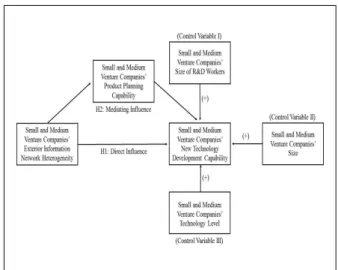
the hypothesis 1 about the positive impact of the exterior information network heterogeneity on small and medium venture companies’ new technology development capability as follows;
H1: Small and medium venture companies’ exterior information network heterogeneity positively impacts their new technology development capability.
The product planning capability is one of the important enterprises’ capabilities to their successful technology development [2, 4, 13]. Enterprises’ product planning is required to accurately identify their customers’ various needs, filter these needs out, and bring the filtered needs to their technology development [2. 13]. The heterogeneous exterior information network is very useful to providing various information from exterior information sources for successful technology development [2, 4, 7, 8], which can make small and medium venture companies’ exterior information network heterogeneity positively influence their product planning capability.
Enterprises’ products are the final outputs resulting from their new technology development [1, 2, 4]. The product planning guides the direction of product innovation which enterprises’ new technology development aims at [2, 13]. Therefore, enterprises’
excellent product planning helps their technology development to find the right direction to generate product innovations to effectively satisfy their customers [2, 4, 13, 14], which can make the product planning capability positively impact their new technology development capability.
Considering both the positive influence of the exterior information network heterogeneity on the product planning capability and the positive impact of the product planning capability on the new technology development, this study develops the hypothesis 2 for the mediating role of small and medium venture companies’ product planning capability between their exterior information network heterogeneity and new
technology development capability as follows;
H2: Small and medium venture companies’ product planning capability mediates the positive influence of the exterior information network heterogeneity on their new technology development capability.
The hypothesis 1 and 2 compose the research model for this study. In addition, in order to control the exogenous influences of small and medium venture companies’ size in terms of their sales, technology level, and number of R&D workers, this research uses the small and medium venture companies’ size of R&D workers, technology level and size in terms of sales as the control variables in the research model. The Fig. 1 provides the research model of this research.
Fig. 1. Research model
3. Research Methodology
3.1 Data and Measurement
The empirical analyses in this study were carried
out by using a sort of the South Korea
Government-authorized data, the 2014 Small and
Medium-Sized Enterprises’ Technology Statistics (2014
SMETS), collected in 2014 through the survey of small
and medium companies’ new technology R&D in the
South Korea in 2013 and run by the Korea Federation of Small and Medium Business (KBIZ) and the Small
& Medium Business Administration. The KBIZ allowed this study to use the 2014 SMETS for the academic research purpose of this study in the November in 2015.
This study used the 683 data of small and medium companies belonging to the venture enterprises in the 2014 SMETS.
Small and medium venture companies’ exterior information network heterogeneity indicates the different sorts of external information sources used by small and medium venture companies for their technology R&D [18]. By adapting Watson (2007) [15]’s measurement for the research context in this study, this research measured the degree of small and medium venture companies’ exterior information network heterogeneity. More specifically, this study measured how many heterogeneous exterior information sources were utilized by each small and medium venture company for its technology development in 2013. The types of exterior information sources were divided into eight categories such as (1) universities (2) domestic or international special books or journals (3) buyers (4) international or domestic expos, conferences, and seminars, (5) suppliers, (6) private or national research organizations, (7) competitors in the same business area, and (8) such private service organizations as consulting firms or private research institutes.
Option Max Min Average Standard
Deviation The number
of employees 299 5 40.260 50.015
The number
of R&D staffs 197 1 8.100 13.887
The technology R&D investment (South Korean
Million Won)
26,817 5 709.880 1,436.088
The total sales (South Korean
Million Won) 168,006 0 12,257.010 20,036.222
Table 1. The profile of dataTechnology indicates the knowledge used for not
only production processes but also products [2]. Small and medium venture companies’ new technology development capability indicates their ability to improve or innovate their technology [1, 2, 20]. Small and medium venture companies’ product planning capability is referred to as their ability to sense customers’ needs, analyze their requirements, and make schemes for improved or innovative products [1, 2, 13, 19]. The degrees of small and medium venture companies’ new technology development capability and product planning capability were evaluated by using the five point scale whose range was from the value of one to the value of five. The value of one in this scale indicated the very low degree including the no degree and the value of five in it stood for the high degree.
Each small and medium venture company’s size of R&D workers and sales were gauged and whether the technology level of each small and medium venture company belonged to the high technology level was checked for the control variables in the research model.
The Table 1 presents the profile of the 683 data in terms of the total sales, the number of R&D staffs and employees, and the technology R&D investment.
3.2 Analysis Method
This study used the IBM SPSS version 23 to statistically test the direct influence in the hypothesis 1 and the mediating influence in the hypothesis 2. The ordinary least squares (OLS) regression analysis was conducted to test both hypothesis 1 and 2. The Sobel test [16] was used to test the significance of the mediating influence in the hypothesis 2 and the Baron and Kenny test [17] was peformed to examine whether the mediating influence in the hypothesis 2 was partial or perfect.
4. Hypothesis Testing Results
The statistical analysis results from the OLS
regression analysis have revealed that the exterior
information network heterogeneity positively influences
small and medium venture companies’ new technology development capability (regression coefficient = 1.561, t-value = 2.807) at the significant of 0.05, supporting the hypothesis 1.
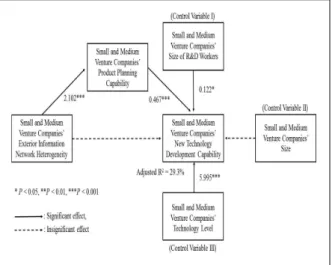
Fig. 2. The statistical analysis results
As illustrated in the Fig. 2, the statistical analysis results have confirmed the significant mediating role of the product planning capability between small and medium venture companies’ exterior information network heterogeneity and their new technology development capability, supporting the hypothesis 2.
The Sobel test [16] has generated the z-value of 3.412, confirming that the product planning capability is a significant mediator. The Baron and Kenny test [17]
has indicated that the product planning capability perfectly mediates the direct influence of the exterior information network heterogeneity on the new technology development capability. The significant influence of the exterior information network heterogeneity without considering the mediator (regression coefficient = 1.561, t-value = 2.807) has become insignificant after considering the mediator (regression coefficient = 0.591, t-value = 1.227), confirming that the product planning capability is a significant perfect mediator between small and medium venture companies’ exterior information network heterogeneity and their new technology development capability according to the Baron and Kenny [17].
Table 2. The OLS regression analysis results
Independent
Variable Dependent
Variable β Standard
Error t-value VIF
EINH NTDC 0.591 0.482 1.227 1.044
EINH PPC 2.102 0.601 3.497 1.000
PPC NTDC 0.467 0.030 15.537 1.020
SRDW NTDC 0.122 0.051 2.383 1.178
CS NTDC 0.000 0.000 -0.341 1.139
TL NTDC 5.995 1.581 3.792 1.051
Note: EINH stands for the Exterior Information Network Heterogeneity, NTDC for the New Technology Development Capability, PPC for the Product Planning Capability, SRDW for the Size of R&D Workers, CS for Companies’ Size, TL for Technology Level, β for the unstandardized regression coefficient, and VIF for Variance Inflation Factor.
The statistical analysis results have shown that the exterior information network heterogeneity positively influences the product planning capability (regression coefficient = 2.102, t-value = 3.497) and the new technology development capability is positively impacted by the product planning capability (regression coefficient = 0.467, t-value = 15.537). Moreover, The results have indicated that the 29.3% of the variance of the new technology development capability is explained by the research model developed by this study (adjusted R
2= 29.3%). The Table 2 summarizes the OLS regression results from this research.
5. Conclusion
5.1 Theoretical and Practical Implication The statistical findings from this study reveal two points and provide not only the practical but also theoretical implications based on them. One point is that small and medium venture companies’ exterior information network heterogeneity has a positive effect on their new technology development capability.
Theoretically, this point can deepen the research stream on the relation between small and medium companies’ external information network heterogeneity and their new technology development capability.
Hau(2016)[5] empirically showed that small and
medium companies’ external information network
heterogeneity positively impacted their new technology development capability. This study is expected to deepen this finding from Hau (2016)[5] by empirically confirming the significant effect of the exterior information network heterogeneity on the new technology development capability especially in the context of the small and medium venture companies.
This point practically suggests that small and medium venture companies should make their exterior information network more heterogeneous to increase their new technology development capability.
The other point is that small and medium venture companies’ product planning capability perfectly mediates the main effect of their exterior information network heterogeneity on their new technology development capability. Theoretically, this point is expected to illuminate the full mediating role of the product planning capability of small and medium companies. Hau (2015)[10] found out that small and medium companies’ product planning capability positively influenced their manufacturing capability and this influence was jointly and perfectly mediated by their product interior and exterior design capabilities.
But, this study has statistically revealed the significant and perfect mediating role of small and medium venture companies’ product planning capability between their exterior information network heterogeneity and new technology development capability. In the practical point of view, this point illuminates the important role of the product planning capability in small and medium venture companies’ management of technology development by empirically showing that the impact of their exterior information network heterogeneity is connected to their new technology development capability through their product planning capability.
5.2 Limitation
There exist several limitations in this research. First, the statistical findings in this study were based on small and medium ventures companies only in the South Korea. So, they can not be applied to the cases
of small and medium ventures companies in foreign countries. Second, reflecting moderators into the research model would be able to produce more meaningful findings. Third, using qualitative research methods with quantitative research methods would be more effective in generating more insightful implications from future research.
REFERENCES
[1] A. Afuah. (2003).
Innovation Management
Oxford University Press.[2] P. Trott. (2012).
Innovation Management and New Product Development
. Prentice Hall.[3] R. G. Cooper. (2017).
Winning at New Products:
Creating Value Through Innovation
. Basic Books.[4] M. A. Schilling. (2013).
Strategic Management of Technological Innovation
. McGraw-Hill.[5] Y. S. Hau. (2016). An Empirical Analysis of the Influence of External Knowledge Network on SMEs’
New Technology Development and Technology Commercialization Capabilities in the Perspective of Open Innovation.
Journal of Digital Convergence, 14(5),
149-156.[6] H. Kim & Y. Park. (2010). The Effects of Open Innovation Activity on Performance of SMEs: The Case of Korea.
International Journal of Technology Management, 52(3/4),
236-256.[7] H. W. Chesbrough. (2003). The Era of Open Innovation.
MIT Sloan Management Review, 44(3),
35-41.[8] H. W. Chesbrough. (2006).
Open Innovation-The New Imperative for Creating and Profiting from Technology
, Harvard Business School Press.[9] Y. S. Hau. (2015). External Information Network Diversity and Production Management Capability in IT SMEs in the Age of Digital Convergence: The Mediating Effect of Manufacturing Capability.
Journal of Digital Convergence, 13(9),
99-104.[10] Y. S. Hau. (2015). IT SMEs’ Product Planning Capability and Manufacturing Capability in the Context of Digital Convergence: The Mediating Impacts of the Product Exterior and Interior Design Capabilities.
Journal of Digital Convergence, 13(12),
55-62.[11] Y. S. Hau. (2016). The Impact of SMEs’ Strategic Use of the External Information Network for Technology
Development on Their Cost Reduction: The Moderating Effect of CEO-Driven Technology Development.
Journal of Product Research, 34(4),
55-60.[12] L. Huston & N. Sakkab. (2006). Connect and Develop : Inside Procter & Gambler’s New Model for Innovation.
Harvard Business Review, 84(3),
58-66.[13] F. Betz. (2011).
Managing Technological Innovation:
Competitive Advantage from Change
. Wiley.[14] W. J. Stevenson & S. C. Chuong. (2014).
Operations Management
. McGraw-Hill.[15] J. Watson. (2007). Modeling the Relationship between Networking and Firm Performance.
Journal of Business Venturing, 22(6),
852-874.[16] M. E. Sobel. (1982). Asymptotic Confidence Intervals for Indirect Effects in Structural Equation Models.
ociological Methodology, 13,
290-312.[17] R. M. Baron & D. A. Kenny. (1986). The Moderator-Mediator variable Distinction in Social Psychological Research : Conceptual, Strategic, and Statistical Consideration.
Journal of Personality and Social Psychology, 51(6),
1173-1182.[18] Y. S. Hau. (2017). The Mediating Effects of the Manufacturing Capability and the Testing and Inspection Capability on the Relation between Small and Medium Venture Firms’ External Information Network Heterogeneity and Technology Commercialization Capability.
Journal of Digital Convergence, 15(10),
233-241.[19] Y. S. Hau. (2015). IT SMEs’ Product Planning Capability and Manufacturing Capability in the Context of Digital Convergence: The Mediating Impacts of the Product Exterior and Interior Design Capabilities.
Journal of Digital Convergence, 13(12),
55-62.[20] Y. S. Hau. (2016). An Empirical Analysis of the Influence of External Knowledge Network on SMEs’
New Technology Development and Technology Commercialization Capabilities in the Perspective of Open innovation.