Gilsang Jeong, Hyejin Kang, Hansu Choi, Yonggu Lee and Seon Deok Jin 584
ISSN 1226-9999(print) ISSN 2287-7851(online) Korean J. Environ. Biol. 36(4) : 584~590(2018) https://doi.org/10.11626/KJEB.2018.36.4.584
아메리카동애등에(Hermetia illucens L.)는 파리목(Dip- tera) 동애등에과(Stratiomyidae)의 곤충으로 완전변태를 한 다(Fig. 1). 북아메리카가 원산지인 외래종으로, 1950년을 전 후해서 세계적으로 확산되어 세계적인 분포를 보이고 있다 (Sheppard et al. 2002). 우리나라에서는 아메리카동애등에가 1990년에 최초로 보고되었고, 현재 우리나라 전역에 걸쳐 분 포하는 곤충으로 알려져 있다(Kim 1997; Kim et al. 2008). 아 메리카동애등에는 축사, 퇴비사, 음식물쓰레기장 등에서 발 견되며, 유충은 수분함량이 60~90%에서 최적인 생활을 하 며, 음식물 쓰레기의 염분 농도인 3.45%에서 정상적인 생활
사를 이어간다(Kim et al. 2008; Myers et al. 2008; Alvarez 2012)(Fig. 1). 이러한 아메리카동애등에의 생활사 특성을 이 용한 음식물 쓰레기의 친환경적 처리에 관한 연구가 외국뿐 아니라 한국에서도 활발히 진행되고 있다(Tingle et al. 1975;
Sheppard et al. 1998; Sheppard et al. 2000; Choi et al. 2009;
Kim et al. 2011; Barragan-Fonseca et al. 2017). 그뿐만 아니 라 아메리카동애등에는 유충시기에만 먹이활동을 하며 집파 리 등 위생해충과 달리 병균을 매개하지 않고, 유해 박테리 아도 억제하는 것으로 알려져 있다(Sheppard et al. 2002;
Erickson et al. 2004; Liu et al. 2008; Hewitt 2011; Kim et al.
2014; Lalander et al. 2015). 이 곤충이 유기물쓰레기를 분해 하면서 생성되는 분변토도 퇴비로서의 가치를 평가하고 있 다(Choi et al. 2009; Lee et al. 2013; Lalander et al. 2015).
* Corresponding author: Seon deok Jin, Tel. 041-950-5988, Fax. 041-950-5953, E-mail. [email protected]
ⓒ2018. Korean Society of Environmental Biology.
아메리카동애등에 (Hermetia illucens L.) 의 외부형태 및 서식지에 관한 연구
정길상 · 강혜진 · 최한수1· 이용 구2· 진선덕*
국립생태원 생태기반연구실, 1(주)에코이엔지, 2잠실여자고등학교
External Morphology and Habitat of Black Soldier Fly (Hermetia illucens L.) in Korea
Gilsang Jeong, Hyejin Kang, Hansu Choi
1, Yonggu Lee
2and Seon Deok Jin*
Division of Basic Research, National Institute of Ecology, Seocheon 33657, Republic of Korea
1
Institute of Ecological Engineering, Seoul 01785, Republic of Korea
2
Jamsil Girl’s High School, Seoul 05676, Republic of Korea
Abstract - The adults of Hermetia illucens collected in Korea were about the same size as those from their origin. The body part with the largest size variation was the antenna 2 followed by the head width and the abdomen width. It can be the baseline of selection of superior individuals for organic waste decomposition and compost production. In regards to the habitat, the adult Hermetia illucens were collected from 22 of the 51 localities. Although geographical characteristics such as coordinates and altitude may not affect the insects, the presence of organic matters could affect them. The distribution pattern of the insects may act as an indicator of natural recycling of organic wastes.
Keywords : Hermetia illucens, morphology, habitat, organic waste decomposition, compost
<Note>
또한 최근에는 인분처리를 통한 위생환경 개선에 대한 가능 성도 탐색중이다(Banks et al. 2014).
현재 농촌진흥청의 주도하에 아메리카동애등에를 대량사 육하고 있음에도 불구하고, 생활사에 대한 연구는 있으나 (Myers et al. 2008; Kim et al. 2008; Tomberlin et al. 2009;
Holmes 2010), 국내외적으로 이 곤충의 외부형태에 대한 연 구는 매우 드물다(Kim et al. 2010; Oliveira et al. 2016). 특히 우리나라에서 서식하는 성충의 외부형태에 대한 조사는 전 무한 실정이다. 따라서 본 연구는 국내 여러 지역에 분포하 고 있는 아메리카동애등에의 외부형태 측정과 서식지 분포 에 대한 기초 분석을 수행하였다. 아메리카동애등에 성충의 채집은 2010년 5월 1일부터 동년 11월 3일까지 전국의 51개 지역에서 농경지 주변 또는 주거지역 주변의 유기물 쓰레기 주변을 주로 탐색하였다(Fig. 2). 발견한 경우 포충망을 이용 하여 각 지역당 10마리의 성체를 채집하였다. 포획된 아메리 카동애등에는 99.9% 순수 에탄올에 넣어 실험실로 이송 후 추가 분석시까지 -20°C 냉동고에 보관하였다.
채집된 아메리카동애등에 성충 146개체를 고정 후 등면에
서 머리길이(head length), 머리폭(head width), 가슴길이 (thorax length), 가슴폭(thorax width), 복부길이(abdomen length), 복부넓이(abdomen width), 더듬이 제1마디(antenna 1), 더듬이 제2마디(antenna 2), 날개길이(wing length), 날개 넓이(wing width), 넓적다리마디(femur)와 종아리마디(tibia) 의 길이를 버니어 캘리퍼스로 0.01mm 단위까지 측정하였다.
더듬이 제1마디의 경우 측정의 편의를 위해 기저부를 포함 하였다(Figs. 3, 4).
아메리카동애등에의 성충 몸 색깔은 전체적으로 검은색이 고, 성충은 크기가 13~20mm 정도이다. 성충의 제2복절에는 백색 또는 황갈색의 크고 반투명한 무늬가 관찰된다. 구기 (mouthparts)는 다른 파리목 곤충과 유사하게 흡취형(sponge type)으로 수분을 쉽게 섭취할 수 있는 구조이다. 성충의 촉 각(antenna)은 곤봉상 촉각으로 편절 끝에 하나의 커다란 곤 봉마디로 구성되어 있다. 겹눈은 구조색을 띠며 짙은 청색 또는 불그스레한 무늬의 줄모양이 나타나기도 한다(Figs. 3, 4). 아메리카동애등에 성충의 가슴등판에는 연한 황백색의 털다발이 세로띠를 형성하고 있으며, 평균곤(halter)의 색깔 Fig. 1. The life cycle of H. illucens(A: egg masses, B: larvae, C: pupae, D: adult).
Gilsang Jeong, Hyejin Kang, Hansu Choi, Yonggu Lee and Seon Deok Jin 586
은 백색이다. 성충의 날개는 투명하고 튼튼하며 색깔은 흑색 이다.
아메리카동애등에 성충의 외부형태 측정 결과 원산지인 미국과 유사하게 전체 몸길이는 약 15mm였다(https://exten-
sion.oregonstate.edu/news/big-maggots-your-compost-they- re-soldier-fly-larvae). 체형에서 각 개체의 외부형태 부분별 길이의 산포도가 가장 큰 부분은 더듬이 바깥쪽(antenna 2) 길이이며, 그 다음으로는 머리넓이(head width), 복부넓이(ab- Fig. 2. Typical habitats of H. illucens.
Yongin
Seongwhan
Jincheon
Pyeongtaek Icheon Gwangyang
Paju Seoul
Danyang Jinyoung
Jinju Dangjin
domen width) 순으로 나타났다(Table 1). 이러한 외부형태의 차이는 다른 대부분의 곤충과 마찬가지로 유충시기의 영양 상태에 의한 영향으로 추정된다(Mirth and Riddiford 2007).
현재 아메리카동애등에는 인공증식이 되고 있는데(Kim et al. 2010), 이와 같은 형태적 특성에 관한 정보는 인공적인 대량증식 기술 개발과 실용화에 개체 선발의 기준을 제시할 수 있을 것이다. 아메리카동애등에의 미토콘드리아 유전자 에 대한 연구결과 국내에는 10개의 모계 유전자형이 존재한
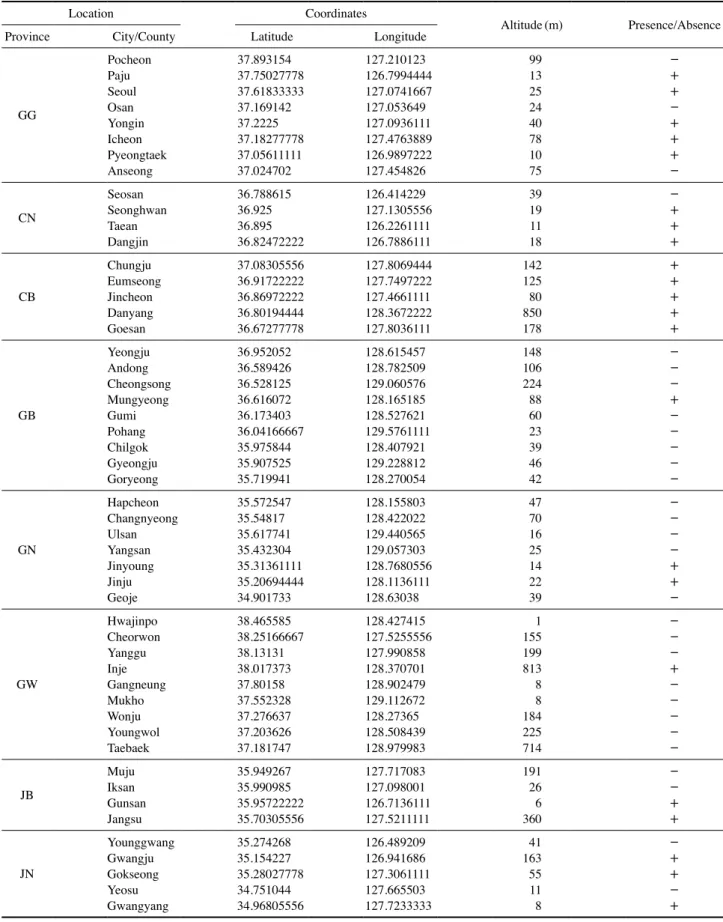
다(Park et al. 2017). 향후 유전자형과 연관하여 외부표현형 그리고 쓰레기분해능 및 분변토 변환율 등의 상관관계를 분 석함으로써 우수 유전자형의 발굴 등 효율화를 위한 노력이 필요할 것이다. 본 연구에서 조사한 51개 지역 중에서 22개 지 역에서 성충이 채집되었다. 그 채집지역이 위도 34.968055부 터 38.017373까지, 경도 126.226111부터 128.7680555까지이 Fig. 3. External features of the adult H. illucens(A: front of head, B: wing, C: terminalia-female, D: terminalia-male, E: halter, F: mouth-
parts).
Fig. 4. Measured external features of the adult H. illucens(A: front of head, B: wing, C: terminalia-female, D: terminalia-male, E: abdomen length, F: abdomen width, G: ante1, H: ante 2, J:
wing width, K: femur, L: tibia).
Table 1. Size of the body parts of H. illucens
Body part N Mean±S.D.(mm) S.D./Mean(%) Rank
A 146 2.09±0.37 17.70 2
B 146 4.04±0.37 9.16 10
C 146 5.18±0.67 12.93 4
D 146 4.11±0.49 11.92 5
E 146 7.97±0.75 9.41 9
F 146 3.25±0.51 15.69 3
G 146 2.13±0.25 11.74 7
H 146 1.65±0.3 18.18 1
I 146 11.82±0.87 6.77 12
J 146 4.66±0.41 8.80 11
K 146 3.29±0.36 10.94 8
L 146 2.87±0.34 11.85 6
A: head length, B: head width, C: thorax length, D: thorax width, E:
abdomen length, F: abdomen width, G: ante 1, H: ante 2, I: wing length, J:
wing width, K: femur, L: tibia.
Rank indicates the most variable part in the ascending order.
Gilsang Jeong, Hyejin Kang, Hansu Choi, Yonggu Lee and Seon Deok Jin 588
Table 2. Presence of H. illucens in the 51 localities in Korea
Location Coordinates
Altitude(m) Presence/Absence
Province City/County Latitude Longitude
GG
Pocheon 37.893154 127.210123 99 -
Paju 37.75027778 126.7994444 13 +
Seoul 37.61833333 127.0741667 25 +
Osan 37.169142 127.053649 24 -
Yongin 37.2225 127.0936111 40 +
Icheon 37.18277778 127.4763889 78 +
Pyeongtaek 37.05611111 126.9897222 10 +
Anseong 37.024702 127.454826 75 -
CN
Seosan 36.788615 126.414229 39 -
Seonghwan 36.925 127.1305556 19 +
Taean 36.895 126.2261111 11 +
Dangjin 36.82472222 126.7886111 18 +
CB
Chungju 37.08305556 127.8069444 142 +
Eumseong 36.91722222 127.7497222 125 +
Jincheon 36.86972222 127.4661111 80 +
Danyang 36.80194444 128.3672222 850 +
Goesan 36.67277778 127.8036111 178 +
GB
Yeongju 36.952052 128.615457 148 -
Andong 36.589426 128.782509 106 -
Cheongsong 36.528125 129.060576 224 -
Mungyeong 36.616072 128.165185 88 +
Gumi 36.173403 128.527621 60 -
Pohang 36.04166667 129.5761111 23 -
Chilgok 35.975844 128.407921 39 -
Gyeongju 35.907525 129.228812 46 -
Goryeong 35.719941 128.270054 42 -
GN
Hapcheon 35.572547 128.155803 47 -
Changnyeong 35.54817 128.422022 70 -
Ulsan 35.617741 129.440565 16 -
Yangsan 35.432304 129.057303 25 -
Jinyoung 35.31361111 128.7680556 14 +
Jinju 35.20694444 128.1136111 22 +
Geoje 34.901733 128.63038 39 -
GW
Hwajinpo 38.465585 128.427415 1 -
Cheorwon 38.25166667 127.5255556 155 -
Yanggu 38.13131 127.990858 199 -
Inje 38.017373 128.370701 813 +
Gangneung 37.80158 128.902479 8 -
Mukho 37.552328 129.112672 8 -
Wonju 37.276637 128.27365 184 -
Youngwol 37.203626 128.508439 225 -
Taebaek 37.181747 128.979983 714 -
JB
Muju 35.949267 127.717083 191 -
Iksan 35.990985 127.098001 26 -
Gunsan 35.95722222 126.7136111 6 +
Jangsu 35.70305556 127.5211111 360 +
JN
Younggwang 35.274268 126.489209 41 -
Gwangju 35.154227 126.941686 163 +
Gokseong 35.28027778 127.3061111 55 +
Yeosu 34.751044 127.665503 11 -
Gwangyang 34.96805556 127.7233333 8 +
GG: Gyounggi; CN: Chungnam; CB: Chungbuk; GB: Gyoungbuk; GN: Gyoungnam; GW: Gangwon; JB: Jeonbuk; JN: Jeonnam
고, 해발 6m에서 850m까지 고루 분포하는 것으로 볼 때 이 곤충은 위도와 경도 및 고도 등 지리적 특성의 영향을 적게 받는 것으로 확인되었다(Table 2, Fig. 5).
경상북도의 9개 조사 지역 중 문경을 제외한 지역에서 이 곤충을 발견하지 못했는데, 이 미발견 지역은 대개 공업지역 으로 다른 곤충을 대상으로 한 연구와 마찬가지로 그 분포가 제한되는 것 같다(Jana et al. 2006) (Table 2, Fig. 5). 강원도 에서도 인제를 제외한 지역에서 채집하지 못했는데 산악지 역으로서 유기물 또는 음식물 쓰레기가 다른 지역에 비해 산 재되어 있고 상대적으로 건조하기 때문으로 추정된다(Table 2, Fig. 5). 그러나 곤충은 날개를 이용해 분산능력이 매우 뛰 어난 생물군이므로, 이 곤충은 유기성 폐기물이 있는 여러 곳에서 발생할 가능성이 있다. 따라서 이 곤충의 발생현황은 유기성 폐자원의 선순환 구조를 파악할 수 있는 지표로 사용 될 수 있을 것으로 생각한다.
적 요
이 연구에서 채집된 아메리카동애등에의 성충은 원산지의 성충과 그 크기가 비슷했다. 체형에서 가장 큰 차이점을 보
의 우수개체를 선발하는데 기초자료가 될 것이다. 국내 51개 조사지역 중, 22개 지역에서 아메리카동애등에가 출현했으 며 위경도 및 고도 등 지리적 특성보다는 유기물의 존재에 더 영향을 받는 것으로 생각된다. 이 곤충의 발생현황은 유기 성 폐자원의 선순환 구조를 파악할 수 있는 지표로 사용될 수 있을 것이다.
사 사
본 연구는 농촌진흥청(PJ006893), 한국연구재단(NRF 2010-1523-1-3) 그리고 국립생태원 국가장기생태연구(NIE- 전략연구-2018-02)의 지원으로 이루어졌습니다. 채집지원을 해주신 (주)에코이엔지의 조광인 님에게 감사드립니다.
REFERENCES
Alvarez L. 2012. The role of black soldier fly, Hermetia illucens (L.)(Diptera: Stratiomyidae) in sustainable waste manage- ment in northern climates. PhD thesis. University of Wind- sor. Canada. p. 148.
Banks IJ, WT Gibson and MM Cameron. 2014. Growth rates of black soldier fly larvae fed on fresh human faeces and their implication for improving sanitation. Trop. Med. Int.
Health 19:14-22.
Barragan-Fonseca KB, M Dicke and JJ van Loon. 2017. Nutri- tional value of the black soldier fly(Hermetia illucens L.) and its suitability as animal feed-a review. J. Insects Food Feed 3:105-120.
Choi YC, JY Choi, JG Kim, MS Kim, WT Kim, KH Park, SW Bae and GS Jeong. 2009. Potential usage of food waste as a natural fertilizer after digestion by Hermetia illucens(Dip- tera: Stratiomyidae). Int. J. Ind. Entomol. 19:171-174.
Choi YC, KH Park, YG Lee, SK Moon and HS Choi. 2013.
Effect analysis of compost derived by black soldier fly (Hermetia illucens L.) using plant growth analysis method.
J. Seric. Entomol. Sci. 51:107-113.
Erickson MC, M Islam, C Sheppard, J Liao and MP Doyle.
2004. Reduction of Escherichia coli O157: H7 and Sal- monella enterica serovar Enteritidis in chicken manure by larvae of the black soldier fly. J. Food Protect. 67:685-690.
Hewitt CG. 1914. The house-fly: Musca domestica Linn: Its structure, habits, development, relation to disease and con- Fig. 5. Distribution of the adult H. illucens in Korea(Red dot:
Presence, Yellow dot: Absence).
Gilsang Jeong, Hyejin Kang, Hansu Choi, Yonggu Lee and Seon Deok Jin 590
trol. Cambridge University Press, Cambridge.
Holmes L. 2010. Role of abiotic factors on the development and life history of the black soldier fly, Hermetia illucens (L.)(Diptera: Stratiomyidae). Master thesis. University of Windsor. Canada. p. 168.
Jana G, KK Misra and T Bhattacharya. 2006. Diversity of some insect fauna in industrial and non-industrial areas of West Bengal, India. J. Insect Conserv. 10:249-260.
Kim ES, JY Park, SH Lee and YG Kim. 2014. Identification and physiological characters of intestinal bacteria of the black soldier fly, Hermetia illucens. Korean J. Appl. Ento- mol. 53:15-26.
Kim JI. 1997. Newly recording two exotic insects species from Korea. J. Kor. Biota. 2:223-225.
Kim JG, YC Choi, JY Choi, WT Kim, GS Jeong, KH Park and SJ Hwang. 2008. Ecology of the black soldier fly, Hermetia illucens(Diptera: Stratiomyidae) in Korea. Korean J. Appl.
Entomol. 47:337-343.
Kim WT, SW Bae, HC Park, KH Park, SB Lee, YC Choi, SM Han and YH Koh. 2010. The larval age and mouth mor- phology of the black soldier fly, Hermetia illucens(Diptera:
Stratiomyidae). Int. J. Indust. Entomol. 21:185-187.
Kim YS, SB Lee, SK Ham, HJ Lim and YC Choe. 2011. Soil physicochemical properties by applied with mixed ratio soldier fly(Hermetia illucens) casts. Asian J. Turfgrass Sci.
25:106-111.
Lalander CH, J Fidjeland, S Diener, S Eriksson and B Vin- nerås. 2015. High waste-to-biomass conversion and effi- cient Salmonella spp. reduction using black soldier fly for waste recycling. Agron. Sustain. Dev. 35:261-271.
Lee SB, YS Kim, SK Ham, HJ Lim, YC Choi and KH Park.
2013. Effect of soldier fly casts mixed soil on change of soil properties in root zone and growth of zoysiagrass. Weed Turf. Sci. 2:298-305.
Liu Q, JK Tomberlin, JA Brady, MR Sanford and Z Yu. 2008.
Black soldier fly(Diptera: Stratiomyidae) larvae reduce Escherichia coli in dairy manure. Environ. Entomol. 37:
1525-1530.
Mirth CK and LM Riddiford. 2007. Size assessment and growth control: how adult size is determined in insects. Bioessays
29:344-355.
Myers HM, JK Tomberlin, BD Lambert and D Kattes. 2008.
Development of black soldier fly(Diptera: Stratiomyidae) larvae fed dairy manure. Environ. Entomol. 37:11-15.
Oliveira FR, K Doelle and RP Smith. 2016. External morphol- ogy of Hermetia illucens Stratiomyidae: Diptera(L. 1758) based on electron microscopy. Annu. Res. Rev. Biol. 9:1- Park SY, HS Choi, JY Choi and G Jeong. 2017. Population struc-10.
ture of the exotic black soldier fly, Hermetia illucens(Dip- tera: Stratiomyidae) in Korea. Korean J. Environ. Ecol. 31:
521-528.
Sheppard DC and GL Newton. 2000. Valuable by products of a manure management system using the black soldier fly- a literature review with some current results. Proceedings, 8th International Symposium-Animal, Agricultural and Rood Processing Wastes, 9-11 October 2000. Des Monies, IA, American Society of Agricultural engineering, St. Jo- seph, MI.
Sheppard DC, GL Newton, S Thompson, J Davis, G Gascho and K Bramwell. 1998. Using soldier flies as a manure management tool for volume reduction, house fly control and reduction, house fly control and feedstuff production.
pp. 51-52. In Sustainable Agriculture Research and Educa- tion, Southern Region(Gwen Roland ed.). Annual Report.
Sustainable Agriculture Research and Education, Southern Region, Georgia Station, Griffin, Georgia, USA
Sheppard DC, JK Tomberlin, JA Joyce, BC Kiser and SM Sumner. 2002. Rearing methods for the black soldier fly (Diptera: Stratiomyidae). J. Med. Entomol. 39:695-698.
Tingle FC, ER Mitchell and WW Copeland. 1975. The soldier fly, Hermetia illucens in poultry houses in north central Florida. J. Ga. Entomol. Soc. 10:179-183.
Tomberlin JK, PH Adler and HM Myers. 2009. Development of the black soldier fly(Diptera: Stratiomyidae) in relation to temperature. Environ. Entomol. 38:930-934.
Received: 19 November 2018 Revised: 6 December 2018 Revision accepted: 7 December 2018