Print ISSN: 2288-4637 / Online ISSN 2288-4645 doi:10.13106/jafeb.2021.vol8.no9.0249
The Impact of Intellectual Capital on Knowledge Management Processes in Thailand
Ploychompoo KITTIKUNCHOTIWUT
1, Kumpanat SIRIYOTA
2Received: May 30, 2021 Revised: August 08, 2021 Accepted: August 15, 2021
Abstract
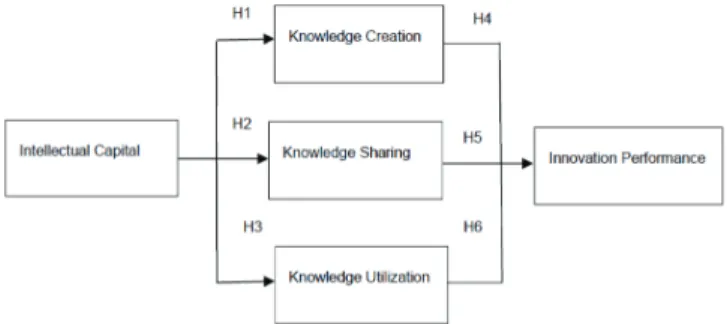
This research explores the effects of intellectual capital on knowledge management processes (creation of information, knowledge sharing, and use of knowledge) and innovation performance. The data was gathered from 224 fashion accessories in Thailand using a questionnaire. The population was collected on December 16, 2019 (https:/www.ditp.go.th) from a list database of the Department of International Trade Promotion, Ministry of Commerce of Thailand (2019). A questionnaire mail survey technique was used to collect data. Executives or managers were the key participants in this study. The statistical technique used to analyze is the ordinary least square regression. The findings show that intellectual capital has a significant positive effect on information management systems. Likewise, information management techniques have a significant positive effect on innovation performance. Moreover, increasing the use of information tends to make staff willing to use the knowledge to improve the quality and quantity of the service. This tendency contributes to productivity gain. Through the interaction of processes of information use, self-reflection, and input from customers, employees tend to increase the production of knowledge that eventually develops the results of the innovation. Hence, organizations should value knowledge management process elements to improve efficiency, and thus innovation.
Keywords: Intellectual Capital, Knowledge Creation, Knowledge Sharing, Knowledge Utilization, Innovation Performance JEL Classification Code: O31, O34, L11
radical changes in the political, social, and economic aspects affect international trade.
Nonetheless, 21st-century businesses are mostly motivated on fashion accessories and are driven by technology and the Internet economy. At the moment, they concentrate more on developing and executing concepts, and innovation will rely on successful intellectual capital (IC). It will also rely on the knowledge, as any invention involves the increase of new knowledge as both an input (e.g. new ideas, concepts, prototypes, etc.) and an outcome (e.g. generated novelty). Therefore, both intellectual capital (IC) and information are key innovation enablers in firms.
In this paper, we discuss innovation development from the intellectual capital (IC) perspective and the knowledge pools it creates for the business.
While authors in the past (Kang et al., 2012; Minbaeva, 2013; Minbaeva et al., 2009; Swart & Kinnie, 2013) described intellectual capital integration (IC) and knowledge perspective as a key issue with significant potential, it remains underdeveloped. There is, in particular, a lack of work covering both intellectual capital (IC) and expertise as a backdrop to corporate innovation.
1
First Author and Corresponding Author. Assistant Professor, Mahasarakham Business School, Mahasarakham University, Thailand [Postal Address: Kantarawichai District, Muang City, Maha Sarakham Province, 44150, Thailand]
Email: [email protected]
2
Instructor, Khonkaen Business School, Khon Kaen University, Thailand. Email: [email protected]
© Copyright: The Author(s)
This is an Open Access article distributed under the terms of the Creative Commons Attribution Non-Commercial License (https://creativecommons.org/licenses/by-nc/4.0/) which permits unrestricted non-commercial use, distribution, and reproduction in any medium, provided the original work is properly cited.