275
<원례보저>
Anti-oxidant activities of kiwi fruit extract on carbon tetrachloride-induced liver injury in mice
Wonyoung Kang, Heekyoung Yang, Hyun Ju Hong, Chang Hoon Han, Young Jae Lee*
College of Veterinary Medicine and Veterinary Medical Research Institute, Jeju National University, Jeju 690-756, Korea (Received: February 16, 2012; Revised: November 5, 2012; Accepted: November 27, 2012)
Abstract : The kiwi (Actinidia deliciosa) is well known to contain anti-oxidants. In this study, we investigated the anti-oxidant effects of kiwi extract on carbon tetrachloride (CCl4) induced liver injury in BALB/c mice. The radical scavenging effect of 80% methanol extract of Halla-Gold kiwi was observed. For the animal study, mice were randomly divided into four groups: normal group, CCl4-induced model group, kiwi extract administered group, and silymarin treated group. The kiwi extract was provided daily for 10 days. At the 24 h after last administration, CCl4 was injected.
The kiwi extract showed strong inhibitory effect of DPPH radicals and superoxide scavenging. In animal study, administration of CCl4 resulted in significantly elevated plasma levels of ALT and AST but they decreased in kiwi- extract pretreated group. Anti-oxidant enzymes such as GSH-px and GSH-rd were restored in the kiwi extract treatment group. Histopathological degeneration was also prevented in the kiwi extract treated group compared with of the control group, which exhibited CCl4-induced hepatotoxicity. On the basis of the obtained results, it can be concluded that kiwi extract showed protective effects, not only as anti-oxidant effects, but also in the protection of hepatotoxicity in CCl4-intoxicated mice.
Keywords : antioxidant, carbon tetrachloride, cytochrome P450 2E1, hepatotoxicity, kiwi fruit
Introduction
Liver injury has increased as a result of exposure to higher levels of environmental toxins, as the liver plays an impor- tant role in the detoxification of most environmental toxins entering the body [10]. It is well known that the hepatotoxic effect of carbon tetrachloride (CCl
4) is due to oxidative dam- age by free radical generation, and the antioxidant properties of hepato-protective drugs are their primary functionalities.
Because of the similarity of cirrhotic responses induced by CCl
4in animals, as compared to humans [16, 21, 23], CCl
4is commonly used as a hepatotoxin in experimental studies [13]. Kiwi fruits contain abundant vitamins, polyphenols, and lipophilic constituents, and are used for the treatment of many different types of cancers like stomach, lung and liver cancer [4, 17]. Several studies have shown that extracts of kiwi fruits inhibit cancer cell growth and exhibit cell protec- tion against oxidative DNA damage in vitro [17]. However, it is not known whether kiwi fruits can prevent or alleviate liver injury induced by CCl
4, and the mechanisms by which kiwi fruits may protect against CCl
4-induced hepatotoxicity are unclear. In this study, we aimed to investigate the effects of kiwi fruits, especially Halla-Gold kiwi fruit produced in Jeju island in South Korea, on CCl
4-induced oxidative stress.
Materials and Methods
Preparation of the kiwi extract
Korean kiwifruit (Actinidis chinensis var. "Halla Gold") a new kiwifruit cultivar bred by the Jeju Rural Development Administration. The pulp of the kiwi fruits were extracted in 80% MeOH after freeze-drying, and were thereafter referred to as kiwi extract. The kiwi extracts were freeze-dried and were used for in vitro experiments and for animal treatment studies.
In vitro assay of antioxidant activity
Diphenylpicrylhydrazyl (DPPH) radical scavenging assay:
The scavenging activity of kiwi extract was measured using the stable radical DPPH. Briefly, the kiwi extract was added to 0.2 mM DPPH solution (100 µL) at various concentra- tions (0~10 mg/mL) (100 µL), and was incubated at 37
oC for 30 min. The absorbance was measured at 490 nm and vita- min C and E were used as reference compounds. The inhibi- tion percentage (%) of radical scavenging activity was calculated as (1 − A
s/ A
0) × 100, where A
0and A
sare the absorbance of the control and sample, respectively.
O
2−scavenging assay: The O
2−scavenging activity was measured by monitoring the O
2−induced reduction of
*Corresponding author
Tel: +82-64-702-4217, Fax: +82-64-756-3354 E-mail: [email protected]
nitroblue tetrazolium chloride (NBT) to the blue chromogen diformazan [7]. O
2−was generated by the phenazine metho- sulphate (PMS)/nicotinamide adenine dinucleotide (NADH) system. The reaction mixtures in the sample wells contained the following reagents: 0.5 mM NBT (20 µL), 0.5 mM NADH (60 µL), 0.1mM PMS (20 µL) and kiwi extract at various concentrations (0~10 mg/mL) (20 µL). All reagents and kiwi extract were dissolved in 30 mM Tris-HCl, pH 8.0.
After the mixtures were incubated at 37
oC for 10 min, the absorbance was measured at 560 nm and was compared with the vitamin E content.
Animals and treatment
6-week-old, male BALB/c mice were purchased from Ori- ent (Korea). All mice were allowed free access to rodent chow (Charles River, USA) and tap water, maintained in a controlled environment at 22 ± 2
oC and 50 ± 5% relatively humidity with a 12 h dark/light cycle, and acclimated for at least 1 week before use. All animal experiments were car- ried out in accordance with the National Institute of Health’s Guide for the Care and Use of Laboratory Animals, and were approved by the Institutional Animal Care and Use Commit- tee of Jeju National University (approval No. 20080010).
Halla-Gold 80% MeOH extract were prepared in saline, and silymarin (Sigma, USA) was prepared by suspension in 5%
carboxyl methylcellulose as test compound. Mice were ran- domly divided four groups of 10. One group of mice was given saline (0.05 mL/10 g/day, p.o.) as a control and a sec- ond group of mice were given saline (0.05 mL/10 g/day, p.o.) as a CCl
4control. The third group of mice received Halla- gold 80% MeOH (100 mg/kg/day, p.o.) and the forth group of mice received silymarin (100 mg/kg/day, p.o.). All groups were treated once daily for 10 consecutive days. 24 h after the final treatment, the first group of the mice were treated with olive oil (Sigma) (0.1 mL/10g, i.p.) and the other groups of mice were treated with CCl
4(20 mg/kg, i.p., dissolved in olive oil). 24 h after administration of olive oil and CCl
4,the mice were sacrificed with 95% CO
2and 5% O
2gas, and blood was collected from the caudal vena cava. The cranial lobes of livers were separated and were fixed in 10% buffered form- aldehyde solution. The remainder of the livers were frozen quickly in dry ice and were stored at –80
°C for future study.
Measurement of plasma alanine aminotransferase and aspartate aminotransferase
Plasma alanine amino transferase and aspartate amino transferase were measured by automatic blood analyzer Pronto evolution (BPC, Italy) using commercial reagents (Asan pharm, Korea).
Measurement of NOx concentration and antioxidant activity
Analysis of NOx concentration in plasma: The plasma level of NO metabolites (NOx; nitrite and nitrate) was mea- sured with an automated NO analyzer (Eicom, Japan).
Briefly, nitrite and nitrate in plasma were separated by a reverse-phase separation column and the nitrate was reduced to nitrite in a reduction column. Nitrite was then mixed with Griess reagents (sulfanilamide and naphthalene-ethylene diamine dihydrochloride), and the absorbance at 540 nm was measured by a flow-through spectrophotometer.
Assay of glutathione peroxidase activity in RBC: Total glutathione peroxidase (GSH-Px) activity in RBC was assayed using a commercial kit (Cayman chemical, USA).
Briefly, assay buffer (50 mM Tris-HCl, pH 7.6, containing 5 mM EDTA) and a co-substrate mixture containing nicotina- mide adenine dinucleotide phosphate (NADPH) were mixed and were added to RBC lysates. The reaction was started by the addition cumene hydroperoxide as quickly as possible, and was monitored by continuous spectrophotometry at 340 nm and 25
oC.
Assay of glutathione reductase activity in liver: Total glutathione reductase (GSH-Rd) activity in liver was assayed using commercial kit (Cayman chemical, USA). Briefly, after assay buffer (50 mM potassium phosphate, pH 7.5, contain- ing 1 mM EDTA) and oxidized glutathione (GSSG) were mixed, added to liver homogenates. The reaction was started by the addition NADPH as quickly as possible, and moni- tored by a continuous spectrophotometry at 340 nm and 25
oC.
Western blot
For immunoblotting, liver tissues were homogenized in buffer containing 5 mM Tris-HCl pH 7.4, 320 mM sucrose, supplemented with fresh 1 mM phenylmethylsulfonyl fluo- ride (PMSF).
Liver homogenates were centrifuged at 10,000 × g for 20 min at 4
oC, and proteins in supernatants were estimated using the modified Bradford assay [1]. 40 µg proteins were resolved using 10% (v/v) SDS-PAGE and were transferred onto PVDF membrane (Millipore, USA) for 90 min at 110 V.
They were then incubated in blocking buffer TTBS (20 mM Tris-HCl pH 7.6, 137 mM NaCl, 0.1% Tween-20) supple- mented with 5% (w/v) skimmed milk for 90 min, washed in TTBS for 30 min and incubated with the following antibod- ies: cytochrome P4502E1 (1 : 5,000; Abcam, UK), anti-4- hydroxylnonenal (1 : 1,000; R&D systems, USA) and β-actin (1 : 2,500; Sigma) diluted in TTBS overnight at 4
oC. Follow- ing 50 min washes in TTBS the membranes were incubated with anti-rabbit IgG or anti-mouse IgG HRP-linked second- ary antibodies (Santa Cruz Bitotechnology, USA) at 1 : 10,000 or 1 : 5,000 in TTBS for 40 min. Reactive bands were revealed using enhanced chemiluminesence reagents (Intron Biotechnology, USA).
Histological examinations
Livers were isolated from mice and were fixed in 10%
formaldehyde. The fixed tissues were then embedded in par-
affin and were sectioned (4.0 µm). The sections were then
stained with hematoxylin and eosin and were examined under light microscope to determine histological changes.
Statistical analysis
All results are presented as the mean ± SEM. Compari- sons among the results were carried out using LSD tests and one way analysis of variance (ver. 12.0; SPSS, USA). P val- ues < 0.05 were considered significant.
Results
Anti-oxidative effects of Halla-Gold kiwi fruit extract An investigation of the anti-oxidant effects in vitro demon- strated that Halla-Gold kiwi fruit extract had stronger anti- oxidant effects compared with green kiwi extract (Table 1).
Effect of Hall-Gold kiwi fruit extract on CCl
4-induced hepatotoxicity
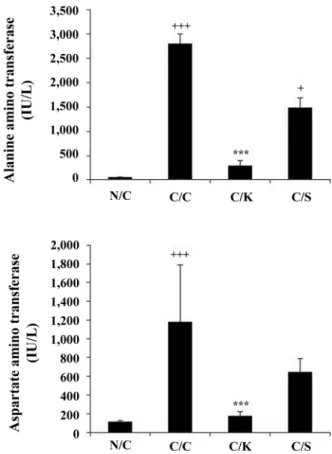
Serum hepatic and lipid biochemical data for the evalua- tion of CCl
4-induced hepatotoxicity are showed in Fig. 1, respectively. There was a significant increase of serum ala- nine aminotransferase (ALT) and aspartate aminotransferase (AST) activities in the CCl
4-treated group, as compared to the control, indicating CCl
4-induced damage to the hepatic cells (p < 0.001). However, treatment with kiwi extract prior to the CCl
4challenge was observed to reverse the CCl
4- induced alteration of ALT and AST (p < 0.001). These results suggest that kiwi extract provides protection against CCl
4- induced liver injury in mice.
Effect of Hall-Gold kiwi fruit extract on anti-oxidative enzymes and NO
Xlevels in CCl
4-induced hepatotoxicity GSH-px activity in RBC, and plasma NOx concentrations are shown in Figs. 2 and 3. GSH is a non-enzymatic antioxi- dant in the detoxification pathway, which reduces the toxic metabolites of CCl
4. GSH-px activity determined in the CCl
4group was significantly lower (p < 0.01) than that in the con- trol. Mice treated with kiwi extract showed significantly increased GSH-px activity (p < 0.05). In addition, a high pro- duction of NO has been suggested as a cause of tissue injury.
Mean NO
Xlevels among the groups were not found to differ in this study. The activity of GSH-rd in liver was showed in Fig. 4. GSH-rd activity in the CCl
4group was reduced, but
kiwi extract and syrimarin prevented inhibition of enzyme activity.
Table 1. Effects of kiwi 80% MeOH extract on radical scavenging DPPH radical IC50
(mg/mL)
Superoxideradical IC50 (mg/Ml)
Vit C 0.01± 0.001 –
Vit E 0.01± 0.001 0.24± 0.03
Halla-gold kiwi 1.91± 0.49*** 1.86± 0.04***
Zespri 2.37± 0.39*** 7.3± 0.8***###
Values are mean± SD. ***p < 0.001 vs. VitE, ###p < 0.001 vs. Halla- Gold kiwi.
Fig. 1. Plasma alanine aminotransferase (ALT) and aspartate aminotransferase (AST) levels. (A) ALT and (B) AST levels in serum decreased by treatment of kiwi extract. N/C: normal mice, C/C: CCl4 control, C/K: injected with CCl4 after treatment of Halla-Gold kiwi fruits, C/S: injected with CCl4 after treat- ment of silymarin. Values are mean
± SEM.
+p < 0.05, +++p <0.001 vs. N/C; ***p < 0.001 vs. C/C.
Fig. 2. Glutathione peroxidase activity in RBC. N/C: normal mice, C/C: CCl4 control, C/K: injected with CCl4 after treatment of Halla-Gold kiwi fruits, C/S: injected with CCl4 after treat- ment of silymarin. Values are mean± SEM. ++p < 0.01 vs. N/C;
*p < 0.05 vs. C/C; ## p < 0.01 vs. C/S.
Effect of Hall-Gold kiwi fruit extract on 4-HNE and CYP450 2E1 expressions
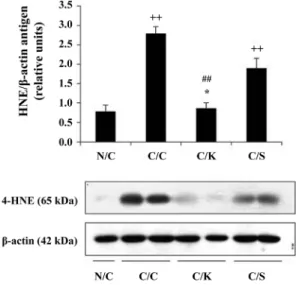
4-hydroxynonenal (4-HNE) and CYP450 2E1 expressions in mouse liver homogenates are shown in Figs. 5 and 6. 4- HNE, an aldehyde product of lipid peroxidation, is relatively stable and is able to diffuse into the cytosol from the site of production in the membrane [5, 6]. 4-HNE expression in the CCl
4group was significantly increased (p < 0.01) compared to that in the control. Pretreatment of kiwi extract signifi- cantly prevented up regulation of 4-HNE expression by CCl
4challenge. To investigate the possible mechanisms by which kiwi extract prevented the hepatic injuries induced by CCl
4, hepatic CYP2E1 expression was assessed. CCl
4treatment significantly suppressed hepatic CYP2E1 expression, as com- pared to the control (p < 0.01). In contrast, kiwi extract increased (p < 0.05) hepatic CYP2E1 expression significantly.
Histopathological examination
At the microscopic level, liver architecture and hepato- cytes of normal mice had no degenerative and lipomatous changes (Fig. 7). In the CCl
4-treated group, fatty degenera-
Fig. 3. Plasma nitrite and nitrate (NOx) concentration. N/C:normal mice, C/C: CCl4 control, C/K: injected with CCl4 after treatment of Halla-Gold kiwi fruits, C/S: injected with CCl4 after treatment of silymarin. Values are mean± SEM.
Fig. 4. Glutathione reductase activity in liver. N/C: normal mice, C/C: CCl4 control, C/K: injected with CCl4 after treatment of Halla-Gold kiwi fruits, C/S: injected with CCl4 after treat- ment of silymarin. Values are mean± SEM.
Fig. 5. 4-hydroxynonenal expression in liver. N/C: normal mice, C/C: CCl4 control, C/K: injected with CCl4 after treatment of Halla-Gold kiwi fruits, C/S: injected with CCl4 after treat- ment of silymarin. Values are mean± SEM. ++p < 0.01 vs. N/C;
**p < 0.01 vs. C/C; ##p < 0.01 vs. C/S.
Fig. 6. Cytochrome450 2E1 expression in liver. (A) Cytochrome450 2E1 expression reduced by CCl4 treatment. (B) Kiwi extract and syrimarin restored Cytochrome450 2E1 expression. N/C: nor- mal mice, C/C: CCl4 control, C/K: injected with CCl4 after treat- ment of Halla-Gold kiwi fruits, C/S: injected with CCl4 after treatment of silymarin. Values are mean± SEM. +p < 0.05, ++p <
0.01, +++p < 0.001 vs. N/C; ***p < 0.001 vs. C/C.
tion, especially that of hepatocytes, settled in the central zone was clearly identified. In the kiwi extract group, the liver and hepatocytes were in good condition, and were similar to those observed in control animals.
Discussion
Liver damage induced by CCl
4is a model commonly used to screen for the anti-hepatotoxic/hepatoprotective activity of drugs [2, 3]. The increased plasma levels of ALT and AST, which are released into the circulation after cellular damage, have been suggested to damage the structural integrity of the liver [19]. In the present study, pretreatment with kiwi extract effectively protected mice against CCl
4-induced hepatotoxic- ity, as evidenced by decreased plasma ALT and AST levels as compared to a positive control. Increased oxidative stress represents an imbalance between the intracellular production of free radicals and cellular defense mechanisms. Especially, lipid peroxidation is one of the most important markers of oxidative stress. Many studies have reported that CCl
4increases hepatic levels of MDA, depletes GSH, and decreases the activities of antioxidant enzymes [12, 18, 28].
The expression of 4-HNE induced by treatment of CCl
4in this study was as a result of the increase of lipid peroxida- tion. 4-HNE forms covalent cross-links with proteins via lysine, cysteine, and histidine residues [25, 26]. 4-HNE is normally detoxified by conjugation with GSH [11, 22, 27]. In this study, GSH levels were not measured, but the observed increase in the expression of 4-HNE could have been due to a depletion of GSH stores. The GSH system includes anti- oxidant enzymes such as GSH-px, GSH-rd and glutathione- S-transferase. The determination of these enzymes is appro- priate for an assessment of the oxidative stress status in cells, and in CCl
4treated rats, deletion of GSH-px, GSH-rd and GSH has been previously reported [15]. In this study, kiwi extract maintained the activity of GSH-rd and reduced 4- HNE expressions. Therefore, one of the protective mecha-
nisms of kiwi extract against acute hepatotoxicity could be the restoration of anti-oxidative enzyme activity and preven- tion of lipid peroxidation.
Biotransformed metabolites of CCl
4formed by cytochrome P450 (CYP) 2E1 include trichloromethyl radical (CCl
3) and trichloromethyl peroxyl radical (CCl
3O
2). The role of CYP2E1 in the initiation of CCl
4-induced hepatotoxicity has already been reported [29]. By using cyp2e1 −/− mice, no hepatotox- icity of CCl
4was observed in the absence of CYP2E1, unlike the significant liver damage observed in the wild type con- trol mice. However, in the present study, the expression of CYP2E1 was dramatically decreased by CCl
4treatment. This result was in agreement with the previous reports [24, 28], in which treatment of mice with CCl
4caused a reduction in lev- els of CYP2E1 protein and mRNA. After CCl
4is bioacti- vated, the resulting reactive radical binds covalently to CYP2E1, either at the heme group of CYP or at the active site of the enzyme, causing suicidal inactivation of the CYP pathway [8, 20]. It suggests that the other potential mechanism of the protective effect of kiwi extract may be mediated through a direct interaction with the reactive metabolite of CCl
4,since kiwi extract has novel radical scavenging activity.
Our study demonstrated the anti-oxidative activity of Halla-Gold kiwi extract. Kiwi fruit was previously reported to contain a number of anti-oxidant constituent, such as vita- min C and E, caffeic acid, naringenin, quercetin and epicath- echin [9]. Overall, gold kiwi was evaluated to have better anti-oxidative effects than green kiwi, both of which having stronger anti-oxidative effects than other fruits [14], and this was further confirmed in the present study.
Therefore, we proposed the novel role of Halla-Gold kiwi fruit of Jeju Island in South Korea for the effective prevention of hepatotoxicity and further disease caused by excessive oxidation.
Acknowledgments
This study was carried out with the support of "Coopera-
Fig. 7. Histopathology in liver. (A) normal mice, (B) CCl4 control, (C) injected with CCl4 after treatment of Halla-Gold kiwi fruits, (D) injected with CCl4 after treatment of silymarin. Scale bars = 50 µm.tive Research Program for Agricultural Science & Technol- ogy Development (Project No. PJ006686)", Rural Development Administration, Republic of Korea.
References
1. Bradford MM. A rapid and sensitive method for the quantitation of microgram quantities of protein utilizing the principle of protein-dye binding. Anal Biochem 1976, 72, 248-254.
2. Brattin WJ, Glende EA Jr, Recknagel RO. Pathological mechanisms in carbon tetrachloride hepatotoxicity. J Free Radic Biol Med 1985, 1, 27-38.
3. Brautbar N, Williams J 2nd. Industrial solvents and liver toxicity: risk assessment, risk factors and mechanisms. Int J Hyg Environ Health 2002, 205, 479-491.
4. Collins BH, Horská A, Hotten PM, Riddoch C, Collins AR. Kiwifruit protects against oxidative DNA damage in human cells and in vitro. Nutr Cancer 2001, 39, 148-153.
5. Esterbauer H, Cheeseman KH, Dianzani MU, Poli G, Slater TF. Separation and characterization of the aldehydic products of lipid peroxidation stimulated by ADP-Fe2+ in rat liver microsomes. Biochem J 1982, 208, 129-140.
6. Esterbauer H, Schaur RJ, Zollner H. Chemistry and biochemistry of 4-hydroxynonenal, malonaldehyde and related aldehydes. Free Radic Biol Med 1991, 11, 81-128.
7. Fernandes E, Toste SA, Lima JLFC, Reis S. The metabolism of sulindac enhances its scavenging activity against reactive oxygen and nitrogen species. Free Radic Biol Med 2003, 35, 1008-1017.
8. Fernández G, Villarruel MC, de Toranzo EG, Castro JA.
Covalent binding of carbon tetrachloride metabolites to the heme moiety of cytochrome P-450 and its degradation products. Res Commun Chem Pathol Pharmacol 1982, 35, 283-290.
9. Fiorentino A, D'Abrosca B, Pacifico S, Mastellone C, Scognamiglio M, Monaco P. Identification and assessment of antioxidant capacity of phytochemicals from kiwi fruits.
J Agric Food Chem 2009, 57, 4148-4155.
10. Gonzalez FJ. The molecular biology of cytochrome P450s.
Pharmacol Rev 1988, 40, 243-288.
11. Grune T, Siems WG, Zollner H, Esterbauer H. Metabolism of 4-hydroxynonenal, a cytotoxic lipid peroxidation product, in Ehrlich mouse ascites cells at different proliferation stages. Cancer Res 1994, 54, 5231-5235.
12. Hsiao G, Lin YH, Lin CH, Chou DS, Lin WC, Sheu JR. The protective effects of PMC against chronic carbon tetrachloride-induced hepatotoxicity in vivo. Biol Pharm Bull 2001, 24, 1271-1276.
13. Hsu YW, Tsai CF, Chang WH, Ho YC, Chen WK, Lu FJ. Protective effects of Dunaliella salina--a carotenoids- rich alga, against carbon tetrachloride-induced hepatotoxicity in mice. Food Chem Toxicol 2008, 46, 3311-3317.
14. Iwasawa H, Morita E, Yui S, Yamazaki M. Anti-oxidant effects of kiwi fruit in vitro and in vivo. Biol Pharm Bull 2011, 34, 128-134.
15. Khan MR, Siddique F. Antioxidant effects of Citharexylum spinosum in CCl4 induced nephrotoxicity in rat. Exp Toxicol Pathol 2012, 64, 349-355.
16. Lee KJ, Choi JH, Jeong HG. Hepatoprotective and
antioxidant effects of the coffee diterpenes kahweol and cafestol on carbon tetrachloride-induced liver damage in mice. Food Chem Toxicol 2007, 45, 2118-2125.
17. Motohashi N, Shirataki Y, Kawase M, Tani S, Sakagami H, Satoh K, Kurihara T, Nakashima H, Mucsi I, Varga A, Molnár J. Cancer prevention and therapy with kiwifruit in Chinese folklore medicine: a study of kiwifruit extracts.
J Ethnopharmacol 2002, 81, 357-364.
18. Quan J, Piao L, Xu H, Li T, Yin X. Protective effect of iridoid glucosides from Boschniakia rossica on acute liver injury induced by carbon tetrachloride in rats. Biosci Biotechnol Biochem 2009, 73, 849-854.
19. Recknagel RO, Glende EA Jr, Dolak JA, Waller RL.
Mechanisms of carbon tetrachloride toxicity. Pharmacol Ther 1989, 43, 139-154.
20. Roberts BJ, Song BJ, Soh Y, Park SS, Shoaf SE.
Ethanol induces CYP2E1 by protein stabilization. Role of ubiquitin conjugation in the rapid degradation of CYP2E1.
J Biol Chem 1995, 270, 29632-29635.
21. Rudnicki M, Silveira MM, Pereira TV, Oliveira MR, Reginatto FH, Dal-Pizzol F, Moreira JC. Protective effects of Passiflora alata extract pretreatment on carbon tetrachloride induced oxidative damage in rats. Food Chem Toxicol 2007, 45, 656-661.
22. Spitz DR, Malcolm RR, Roberts RJ. Cytotoxicity and metabolism of 4-hydroxy-2-nonenal and 2-nonenal in H2O2− resistant cell lines. Do aldehydic by-products of lipid peroxidation contribute to oxidative stress? Biochem J 1990, 267, 453-459.
23. Taira Z, Yabe K, Hamaguchi Y, Hirayama K, Kishimoto M, Ishida S, Ueda Y. Effects of Sho-saiko-to extract and its components, Baicalin, baicalein, glycyrrhizin and glycyrrhetic acid, on pharmacokinetic behavior of salicylamide in carbon tetrachloride intoxicated rats. Food Chem Toxicol 2004, 42, 803-807.
24. Tierney DJ, Haas AL, Koop DR. Degradation of cytochrome P450 2E1: selective loss after labilization of the enzyme. Arch Biochem Biophys 1992, 293, 9-16.
25. Uchida K, Stadtman ER. Covalent attachment of 4- hydroxynonenal to glyceraldehyde-3-phosphate dehydrogenase.
A possible involvement of intra- and intermolecular cross- linking reaction. J Biol Chem 1993, 268, 6388-6393.
26. Uchida K, Toyokuni S, Nishikawa K, Kawakishi S, Oda H, Hiai H, Stadtman ER. Michael addition-type 4- hydroxy-2-nonenal adducts in modified low-density lipoproteins:
markers for atherosclerosis. Biochemistry 1994, 33, 12487- 12494.
27. Ullrich O, Grune T, Henke W, Esterbauer H, Siems WG. Identification of metabolic pathways of the lipid peroxidation product 4-hydroxynonenal by mitochondria isolated from rat kidney cortex. FEBS Lett 1994, 352, 84-86.
28. Weerachayaphorn J, Chuncharunee A, Jariyawat S, Lewchalermwong B, Amonpatumrat S, Suksamrarn A, Piyachaturawat P. Protection of centrilobular necrosis by Curcuma comosa Roxb. in carbon tetrachloride-induced mice liver injury. J Ethnopharmacol 2010, 129, 254-260.
29. Wong FWY, Chan WY, Lee SST. Resistance to carbon tetrachloride-induced hepatotoxicity in mice which lack CYP2E1 expression. Toxicol Appl Pharmacol 1998, 153, 109-118.