• 검색 결과가 없습니다.

An Analysis of the Association Between Upper Extremity Function and the Wolf Motor Function Test in Chronic Hemiparetic Stroke

N/A
N/A
Protected

Academic year: 2021

Share "An Analysis of the Association Between Upper Extremity Function and the Wolf Motor Function Test in Chronic Hemiparetic Stroke"

Copied!
8
0
0

로드 중.... (전체 텍스트 보기)

전체 글

(1)

| Abstract |

Purpose: The purpose of this study was to evaluate the analysis of the association between upper extremity function and the Wolf Motor Function Test (WMFT) for chronic hemiparetic stroke patients and investigate the evidence of the WMFT as a clinical tool of upper extremity function in individuals with chronic hemiparetic stroke.

Methods: This study applied an observational, cross-sectional design in outpatients at three local rehabilitation units in Seoul.

Forty-nine individuals who had a diagnosis of first stroke participated in this study. All participants were analyzed for four clinical measures, including the Box and Block Test (BBT), the WMFT, grip strength, and the Canadian Occupational Performance Measure (COPM).

Results: Upon analysis, a significant relationship was found between the WMFT scores and BBT scores as well as the grip strength. The WMFT score was statistically and positively associated with the COPM satisfaction score; however, it was not related to the COPM performance score.

Conclusion: The results of this study suggest that the WMFT is positively related to simple tasks, such as hand muscle strength and manual dexterity. However, the WMFT does not have a relationship with complex tasks, which are measured by COPM performance abilities.

Key Words: Stroke, Upper extremity, Wolf motor function test

†Corresponding Author : Hye-Sun Lee ([email protected])

Original Article Open Access

뇌졸중 환자의 상지기능과 Wolf 운동기능검사의 관련성 분석
송창순⋅이혜선 1† ⋅염희영 2

1)

조선대학교 작업치료학과, 1 광주여자대학교 작업치료학과, 2 백석대학교 작업치료학과

An Analysis of the Association Between Upper Extremity Function and the Wolf Motor Function Test in Chronic Hemiparetic Stroke

Chang-Soon Song, O.T., Ph.D.⋅Hye-Sun Lee, O.T., M.S. 1† ⋅Hee-Young Yeom, P.T., Ph.D. 2 Department of Occupational Therapy, Chosun University

1 Department of Occupational Therapy, Gwangju Wonen’s University

2 Department of Occupational Therapy, Baeseok University Received: October 27, 2020 / Revised: November 24, 2020 / Accepted: November 30, 2020

ⓒ 2020 Journal of Korea Proprioceptive Neuromuscular Facilitation Association

This is an Open Access article distributed under the terms of the Creative Commons Attribution Non-Commercial License

(http://creativecommons.org/licenses/by-nc/3.0) which permits unrestricted non-commercial use, distribution, and reproduction

in any medium, provided the original work is properly cited.

(2)

Ⅰ. 서 론

뇌졸중(stroke)은 뇌혈관이 막히거나 터져서 발생하 는 뇌혈관사고로 인한 비정상적인 뇌 혈류 흐름으로 뇌세포가 사멸하는 의학적 상태를 말하며, 성인에서 후천적이고 영구적인 장애를 유발하는 가장 일반적인 원인 질환 중 하나이다(Coleman et al., 2017; Raffin

& Hummel, 2018). 뇌졸중 환자는 편마비, 언어장애, 삼킴장애, 동측성 반맹증, 인지손상 및 지각손상 등의 다양한 중추신경성 증상들이 출현한다(Heshmatollah et al., 2020; Sand et al., 2013). 다양한 증상은 뇌졸중 환자의 일상생활과 사회경제적인 측면에 영향을 미칠 뿐만 아니라, 궁극적으로 그들의 삶의 질을 감소시킨다.

뇌졸중 환자의 상지 손상은 일상생활에서 손상측 (more-affected side) 상지를 사용할 때 기능적 제한을 야기하는 원인 중 하나이다. 상지 손상은 뇌졸중 발병 초기에 적절히 치료되지 않으면, 손상측 상지에 학습 된 무용현상(learned non-use phenomenon)이 진행될 가 능성이 크다(Raghavan, 2015; Taub et al., 2006). 상지 기능에서 양손 과제(bimanual task)는 양손을 동시에 조작하거나, 한 손은 물체를 고정하고 다른 손으로 물체를 조작하지만, 한 손 과제(unimanual task)는 한 손으로 조작한다(Gosser & Rice, 2015). 일상생활에서 대부분의 동작이 양손 조작을 요구하지 않기때문에, 뇌졸중 환자들은 비 손상측(less-affected side) 상지를 집중적으로 사용하거나, 다른 신체 부위를 대용하는 등의 방법을 선택하여, 손상측 상지를 사용하지 않는 경향이 있다. 이러한 학습된 무용현상은 뇌졸중 발병 이후 상지기능재활에 장애 요인이 된다(Raffin &

Hummel, 2018). 따라서, 뇌졸중 발병 이후에 상지 기능 을 회복시키고 학습된 무용 현상을 배제하기 위하여, 상지 기능 재활은 우선되어야 하는 개선과제 중 하나 이다(Oujamaa et al., 2009).

선행 연구자들은 뇌졸중 환자의 운동 회복과정을 정확하게 평가하여, 효과적인 재활 프로그램을 제공 하고자, 다양한 임상평가도구를 개발하고 적용하고 있다. Wolf운동기능검사(Wolf motor function test,

WMFT)는 만성 뇌졸중과 외상성뇌손상(traumatic brain injury) 환자를 대상으로 상지운동결함(upper extremity motor deficit)을 평가하는 대표적인 임상평가 도구 중 하나이다. 이 평가도구는 Steven L. Wolf가 강제 유도운동치료(constraint-induced movement therapy)의 효과를 검증하기 위하여 2001년 개발한 것으로, 젭슨- 테일러 손기능검사(Jebsen-Taylor hand function test)를 수정보완하여, 대상자의 과제 수행 시간과 수행 수준 을 평가한다. 이 평가도구는 개발된 이후에 다양한 연구를 통하여 높은 신뢰도와 타당도가 입증된 도구 이다(Morris et al., 2001; Nijland et al., 2010; Whitall et al., 2006; Wolf et al., 2001).

Morris 등은 뇌졸중 환자를 대상으로 WMFT의 내적 일치도(internal consistency)를 α=0.92, 검사-재검사 신 뢰도를 r=0.95로 보고하였고, Nijland 등은 뇌졸중 환자 를 대상으로 α=0.98로 보고하였다(Morris et al., 2001;

Nijland et al., 2010). 또한 푸글-마이어평가척도-상지 (upper extremity Fugl-Meyer assessment scale)와 action research arm test와 동시타당도(concurrent validity)는 입증되었으나, 손의 민첩성이나 악력과 같은 상지기 능의 평가와의 타당도에 관한 연구는 미비하다 (Nijland et al., 2010; Whitall et al., 2006). 본 연구의 목적은 만성 편마비 뇌졸중 환자를 대상으로 WMFT 가 그들의 상지 기능 수준을 적절히 평가할 수 있는지 알아보기 위하여, WMFT과 상지 기능 임상평가를 비 교하여 그 상관성을 알아보고, 임상에서 적절히 사용 할 수 있는 임상평가도구 제언에 근거를 삼기 위함이 었다.

Ⅱ. 연구 방법 1. 연구대상자

본 연구참여자는 49명의 만성 편마비 뇌졸중 환자

로 연구 참여시 서울시 송파구 소재의 A 병원 등 3곳에

서 통원치료를 받고 있었다. 연구참여자의 선정기준

(3)

은 1) 경색 혹은 출혈로 인한 뇌혈관사고로 편마비 뇌졸중을 뇌영상 촬영을 기초로 전문의로부터 진단 받은 자, 2) 뇌졸중 발병 이후 6개월 이상인 자, 3) 평가자의 지시를 따르는데 충분한 인지기능을 가진 자(간이정신상태검사 점수 24점 이상인 자), 4) 도움없 이 적어도 10 m를 독립 보행 가능한 자, 5) 시지각 손상이 없는 자, 6) 연구결과에 영향을 미칠 수 있는 정형외과적 질환이 없는 자, 7) 뇌졸중 이외에 다른 신경학적 질환이 없는 자, 그리고 8) 연구 목적과 절차 를 이해하고 자발적으로 참여를 희망한 자 이었다.

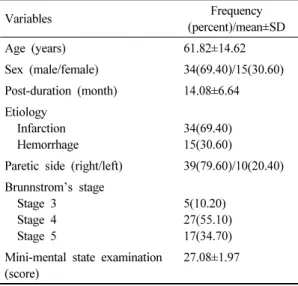
본 연구는 심각한 우울증, 항우울증치료제 복용자, 항- 간질약물 복용자는 연구에서 배제하였다. Table 1은 연구대상자의 일반적, 임상적 특징을 설명하고 있다.

2. 측정 도구

1) Wolf 운동기능검사

(Wolf motor function test, WMFT)

Wolf운동기능검사는 기능적 과제 수행을 통하여 상지 운동능력(upper extremity motor ability)을 정량화 하는 측정도구로서 Wolf, Lecraw, Barton 그리고 Jann 이 개발하였다(Wolf et al., 2001). Wolf운동기능검사는 21개 항목으로 구성되어 있는데, 광범위하게 사용되 는 버전은 17개 항목으로 구성된 것이다. 이 평가도구 는 시간(time), 기능적 능력(functional ability), 근력 (strength)로 구성된 복합적 평가도구이며, 0점(손상측 상지로 수행하지 못함)에서 5점(손상측 상지를 사용 하여 정상 움직임을 수행함)까지 6점 서열척도(ordinal scale)이다. 최고점은 75점으로, 점수가 높을수록 독립 적이고 정상적인 기능수행이 가능하다고 해석할 수 있다(Lang et al., 2008; Woodbury et al., 2010). WMFT는 만성 뇌졸중 환자를 대상으로 높은 측정자내신뢰도 (intrarater reliability)(r=0.95)와 측정자간신뢰도(interrater reliability)(ICC=0.93)가 보고되었다(Morris et al., 2001).

2) 악력(grip strength)

악력은 상지꿈치 근육에서 생성되는 최대 힘 혹은 장력을 측정하는 척도로, 상지 근력 및 전신 근력 측정 을 위한 선별 도구로 사용된다. 악력은 단순과제 (simple task) 측정으로, 치료효과를 추적하기 위하여 간단히 적용하는 평가방법으로 가장 유용하게 사용된 다(Stock et al., 2019). 본 연구에서는 악력을 측정하기 위한 손 악력계(Jamar hydraulic hand dynamometer, Jamar Technologies, INc., USA)를 사용하였다. 손 악력 계는 0-90 kg의 등척성 악력을 표시하는 이중 눈금 척도가 있는데, 외부 다이얼은 kg 단위이고, 내부 다이 얼은 lb 단위이다. 손잡이는 35 – 87 mm로 13 mm 단위 로 5개의 잡기 위치로 쉽게 조정할 수 있다.

3) 캐나다 작업수행측정(Canadian occupational performance measure, COPM)

COPM은 캐나다 보건복지부와 캐나다 작업치료사

협회가 10년 이상의 시간을 거쳐 개발한 반구조화된

(semi-structured) 면접 평가지 중 하나로, 1991년 초판

이후로 5판까지 출판되었으며, 24개국 언어로 번역되

어 전세계적으로 널리 사용되고 있는 도구이다

(McColl et al., 2000). COPM은 작업수행에 대한 대상자

의 자기-인식(self-perception) 정도에 대한 치료 전⋅후

변화를 평가하는 것으로, 대상자 중심 치료(client-

centered therapy)를 위하여 개발된 도구이며, 대상자가

자신의 문제에 중점을 두는 데 도움이 된다. 본 평가도

구는 대상자의 인식 변화를 기록하는 것으로, 평가 시

선택한 과제를 중심으로 수행도(Canadian occupational

performance measure-performance, COPM-P)와 만족도

(Canadian occupational performance measure-satisfaction,

COPM-S)를 측정한다. 본 평가도구는 높은 신뢰도

(r=0.87)가 보고되었다(Carpenter et al., 2001; Cup et

al., 2003).

(4)

4) 상자나무토막검사(box and block test, BBT)

BBT는 손의 도수민첩성(manual dexterity)을 측정하 는 도구로 간단하고 빠르게 손기능을 측정할 수 있어 서, 뇌졸중 환자 등을 포함한 광범위한 질환에 손기능 을 평가하기 위하여 사용한다. BBT는 가운데가 나누 어진 직사각형 모양의 나무상자(53.7cm x 25.4cm x 8.5cm)와 150개의 나무토막(2.5cm x 2.5cm x 2.5cm)으 로 구성되어 있으며, 우세손부터 시작하며 60초 동안 한쪽 상자에서 다른 쪽 상자로 하나씩 최대한 많이 나무토막을 옮기는 것이다. 본 평가도구는 만성 뇌졸 중 환자를 대상으로 검사-재검사신뢰도(r=0.98)가 높 게 보고되었다(Chen et al., 2009).

3. Study Procedures

본 연구는 단면, 관찰연구설계(cross-sectional, observational study design)로, 임상에서 널리 사용되고 있는 WMFT가 만성 편마비 뇌졸중 환자의 상지 기능 과 상관성을 알아보고, 만성 편마비 뇌졸중 환자의 상지 기능 평가를 위한 임상평가도구로 WMFT의 근 거를 제시하고자 하였다. 본 연구는 WMFT 이외에 대상자의 상지기능을 평가하기 위하여 악력, COPM 및 상자나무토막 검사를 실시하였다. 먼저 임상 평가 의 순서를 정하기 위하여 대상자는 제비 뽑기(1, WMFT → 악력 → COPM-P → COPM-S → BBT; 2, COPM-P → COPM-S → BBT → 악력 → WMFT; 3, BBT → 악력 → COPM-P → COPM-S → WMFT; 4, BBT → COPM-P → COPM-S → WMFT → 악력)를 실시하였다. 본 연구에서 사용한 평가도구는, 임상에 서 최소 5년 이상 뇌졸중 환자 평가에 적용한 경험이 있는 치료사 2명(S. H. & E. N)에 의해서 잘 정돈되고 조용한 평가실에서 시행되었다. WMFT와 COPM, BBT는 각 1회 평가를 진행하였고, 악력은 3회 측정하 여 평균값을 통계에 사용하였다.

4. Statistics analysis

본 연구의 측정 변수로는 WMFT, 악력, COPM 그리 고 BBT 이었다. 연구 대상자의 일반적 및 임상적 특성 을 알아보기 위하여 기술통계량(평균, 표준편차, 빈도, 백분율)을 사용하여 분석하였다. 또한, WMFT 및 상지 기능의 상관성을 알아보기 위하여 피어슨상관관계 (Pearson’s correlation coefficient)을 사용하여 분석하였 다. 수집한 자료는 윈도용 SPSS ver. 21.0(IBM, Co., USA)를 사용하여 분석하였다. 통계학적 유의수준 α

=0.05 이었다.

Ⅲ. 연구 결과

1. 연구참여자의 일반적 및 임상적 특성

Table 1는 연구참여자의 일반적 특성과 임상적 특성 을 설명하고 있다. 연구참여자의 평균연령은 61.82±14.62세 이었으며, 연구참여자의 성별은 남자가 34명, 여자가 15명 이었다. 그들의 발병 후 기간은 평균 14.08±6.64개월이었으며, 발병원인은 뇌경색이 34명, 뇌출혈이 15명 이었다. 연구참여자의 마비측은 오른

Variables Frequency

(percent)/mean±SD

Age (years) 61.82±14.62

Sex (male/female) 34(69.40)/15(30.60) Post-duration (month) 14.08±6.64 Etiology

Infarction

Hemorrhage 34(69.40)

15(30.60)

Paretic side (right/left) 39(79.60)/10(20.40) Brunnstrom’s stage

Stage 3 Stage 4 Stage 5

5(10.20) 27(55.10) 17(34.70) Mini-mental state examination

(score) 27.08±1.97

Table 1. Demographic of the participants (N=49)

(5)

마비가 39명, 왼 마비가 10명 이었다. 또한 그들의 운동 기능 회복 정도는 Brunnstrom 3단계 5명, 4단계 27명, 5단계 17명 이었다. 마지막으로 그들의 간이정신상태 검사 점수는 평균 27.08±1.97점 이었다.

2. Wolf운동기능검사 점수와 상지 기능 상관관계

Wolf운동기능검사 점수는 악력(r=0.47, p<0.01), COPM-S(r=0.34, p<0.05), 상자나무토막검사(r=0.39, p<0.01)와 양의 상관관계를 보였다. 악력은 Wolf운동 기능검사 점수 이외에 상지 기능 평가와는 유의한 상 관성을 보이지 않았다. COPM-S는 Wolf운동기능검사, 상자나무토막검사(r=0.35, p<0.05)와 통계학적으로 유 의한 상관성을 보였다. 상자나무토막검사 점수는 Wolf운동기능검사와 COPM-S와 통계학적으로 유의 한 양의 상관관계를 보였다.

Ⅳ. 고 찰

본 연구는 만성 편마비 뇌졸중 환자를 대상으로 상지 기능을 평가하는 WMFT와 상지기능 사이에 연 관성을 알아보고, 상지기능에 대한 임상평가도구로써 WMFT의 근거를 제시하기 위함이었다. 주요 연구결 과는 다음과 같았다. 첫째, WMFT 점수가 높을수록 악력이 컸고, 자신이 선택한 과제 수행에 대한 만족도 가 높았으며, 도수민첩성이 컸다. 둘째, WMFT는 환자 가 선택한 과제를 수행하는 수행력과 WMFT 점수는

서로 영향이 없었다.

뇌졸중 재활에서 표준화된 성과 평가는 근거-기반 중재(evidence-based intervention)를 실행하기 위해서 필수적이며, 재활과정 전반에서 권장되는 사항이다.

WMFT는 상대적으로 상지기능수준이 높은 뇌졸중 환 자의 운동결함을 평가하는데 유용하며, 손과 손가락 의 능동관절가동범위가 최소인 뇌졸중 환자나 발병 초기 환자에게는 바닥효과(floor effects)를 보인다 (Turtle et al., 2020). Nijland 등은 경증에서 중증 편부전 마비 환자를 대상으로 5%∼17%의 바닥효과와 천정 효과를 보고하였다(Nijland et al., 2010). 선행연구에서 는 WMFT의 이런 단점을 보완하고 평가 시 측정 오류 를 감소시키기 위하여, 대상자의 수행을 비디오로 촬 영하여 평가하는 방법으로 수정하기도 하였다(Turtle et al., 2020). 본 연구는 WMFT가 실제로 만성 편마비 뇌졸중 환자의 상지 기능 수준을 평가하는 표준화 도 구로서 적합한지 알아보기 위하여, 대표적인 상지기능 인 도수 민첩성, 악력 및 선택과제 수행력과 수행 만족 도를 평가하고 WMFT 점수와 연관성을 분석하였다.

근력강화(muscle strengthening)은 근골격계질환 (musculoskeletal disorders)에서 발생하는 장애와 통증 을 개선한다. Kim 등은 농촌에 거주하는 상지 근골격 계질환자를 대상으로 악력이 상지기능에 미치는 영향 을 연구한 결과, 악력이 증가하면, 상지의 기능적 활동 도 증가한다고 보고하였다. 본 연구결과도 WMFT 점 수가 높을수록 악력이 높은 것으로 조사되었다. 악력 은 손이 물체를 잡고 운반하고 조작하는 데 중요한 역량으로, 적절한 악력을 유지하지 못하면 물체를 잡

WMFT Grip Strength COPM-P COPM-S BBT

WMFT 0.47** 0.18 0.34* 0.39**

Grip Strength 0.47** 0.21 0.21 0.18

COPM-P 0.18 0.21 0.69** 0.16

COPM-S 0.34* 0.21 0.69** 0.35*

BBT 0.39** 0.18 0.16 0.35*

BBT: box-and-block test, COPM-P: Canadian occupational performance measure-performance, COPM-S: Canadian occupational performance measure –satisfaction, WMFT: Wolf motor function test

Table 2. Efficacy measures by clinical measurements for the participants (N=10)

(6)

지 못하거나, 운반하는 도중에 떨어트릴 수 있다. 따라 서 악력은 상지 기능을 유지하는데 중요하며, 연구결 과에서도 상지 운동기능평가 점수인 WMFT점수와 양 의 상관관계를 보여주었고, 도수 민첩성과 COPM-S점 수보다 높은 상관성을 보여주었다.

본 연구는 도수 민첩성을 뇌졸중 환자의 상지기능 회복에 중요한 척도로 보고하는 대부분의 선행연구에 기초하여 도수 민첩성과 WMFT 점수를 비교해 보았 다. 연구 결과 WMFT 점수가 높을수록 도수 민첩성도 높았다. 도수 민첩성은 뇌졸중 발병 이후에 손상되는 일반적인 상지기능으로 일상생활의 자율성에 중요한 문제 중 하나이다. 최근 연구에서는 뇌졸중 환자를 대상으로 손의 동작과 잡기능력이 개선되어도 손상된 도수 민첩성은 영구적으로 남아 있다고 보고하였다 (Birchemall et al., 2019). 반면에 대부분의 연구는 도수 민첩성이 작은 물체를 잡고 조작하는 등의 섬세한 조 절과 같은 손과 손가락의 협응력과 정확한 움직임을 수행하는 능력으로, 뇌졸중 환자의 상지기능 회복 정 도를 알아보는 중요한 방법 중 하나라고 보고하고 있 다(Teremetz et al., 2015).

본 연구에서는 COPM를 이용하여 대상자의 일상생 활활동의 수행력과 수행에 대한 만족도를 측정하였 다. 연구결과 WMFT 점수가 높을수록 COPM의 수행 만족도는 높게 조사되었으나, COPM의 수행력은 상관 성이 없는 것으로 조사되었다. Almhdawi 등은 뇌졸중 환자를 대상으로 과제-지향적 접근법이 상지기능에 미치는 영향을 알아보기 위하여 실시한 연구에서 COPM과 WMFT를 함께 측정도구로 사용하였다 (Khader et al., 2016). Roberts 등은 뇌졸중 환자를 대상 으로 강제유도운동치료의 효과를 알아보기 위한 연구 에서 두 평가도구를 적용하였다(Roberts et al., 2005).

COPM은 개별적이며, 클라이언트-중심적 성과측정도 구(client-centered outcome measure)로, 반구조화된 평 구도구인 반면, WMFT는 평가항목이 결정되어 있는 구조화된 평가도구이다. 본 연구결과를 살펴보면, COPM-P는 구조화된 측정도구인 악력, 도수민첩성, 그리고 WMFT의 점수와 모두 상관성이 없었고,

COPM-S는 도수 민첩성과 WMFT 점수와 상관성이 있는 것으로 조사되었다. 본 연구 결과를 바탕으로 뇌졸중 환자들이 선택한 상지기능 동작을 수행하는 능력과 WMFT와 같은 구조화된 평가항목을 수행하는 능력은 그 상관성에 관한 조사가 더 지속적으로 진행 되어야 할 것으로 사료된다.

본 연구는 WMFT와 손의 도수민첩성과 작업수행 능력의 상관성을 알아보고, 만성 편마비 뇌졸중 환자 의 상지 기능 임상평가도구로서 WMFT의 근거를 제 시하기 위함이었다. 연구결과, 만성 편마비 뇌졸중 환 자의 WMFT 점수는 악력과 가장 높은 양의 상관성을 보였으며, 도수 민첩성과 COPM-S 점수와도 양의 상 관관계를 보였다.

본 연구에서 적용한 악력 및 도수 민첩성을 평가한 방법은 단순과제평가(simple task assessment)로 악력 계를 이용한 손 근력 측정과 BBT를 이용한 도수 민첩 성 평가를 실시하였다. 본 연구에서는 상지 기능을 평가하기 위하여 COPM을 사용하여 일상생활활동들 중 복잡한 과제평가(complex task assessment)도 실시 하였다. 연구결과 WMFT는 복잡한 상지 기능을 평가 하는 도구의 수행력과 상관성을 보이지 않았다. 특히 본 연구에서 사용한 COPM 평가도구는 평가항목을 피검자가 선택하는 주관적이고 반구조화된 평가로 WMFT와 복잡한 상지 기능 평가의 상관성에 대한 연 구를 지속할 필요가 있다. 향후 연구에서는 WMFT와 일상생활동작, 기능적 활동의 상관성을 알아보고, 뇌 졸중 환자의 상지기능 회복을 평가하는데 보다 적절 한 평가방법을 제시할 필요가 있을 것이다.

Ⅴ. 결 론

본 연구는 WMFT와 손의 도수민첩성과 작업수행

능력의 상관성을 알아보고, 만성 편마비 뇌졸중 환자

의 상지 기능 임상평가도구로서 WMFT의 근거를 제

시하였다. 연구결과 WMFT 점수는 단순과제 평가를

하는 악력과 도수 민첩성과는 상관성이 있었으나, 복

(7)

잡한 과제평가를 하는 COPM의 수행력과는 상관성이 없었다. 향후 연구에서는 복잡한 과제평가와 상관성 및 내적일치도에 관한 연구를 지속해 볼 필요가 있다 고 사료된다.

References

Almhdawi KA, Mathiowetz VG, White M, et al. Efficacy of occupational therapy task-oriented approach in upper extremity post-stroke rehabilitation. Occupational Therapy International. 2016;23(4): 444-456.

Birchenall J, Teremetz M, Roca P, et al. Individual recovery profiles of manual dexterity, and relation to corticospinal lesion load and excitability after stroke – a longitudinal pilot study. Clinical Neurophysiology.

2019;49(2):149-164.

Carpenter L, Baker GA, Tyldesley B. The use of the Canadian occupational performance measure as an outcome of a pain management program. Canadian Journal of Occupational Therapy. 2001;68(1):16-22.

Chen HM, Chen CC, Hsueh I, et al. Test-retest reproducibility and smallest real difference of 5 hand function tests in patients with stroke. Neurorehabilitation and Neural Repair. 2009;23(5): 435-440.

Coleman ER, Moudgal R, Lang K, et al. Early rehabilitation after stroke: a narrative review. Current Atherosclerosis Reports. 2017;19(12):59.

Cup EHC, Scholte op Reimer WJM, Thijssen MCE, et al.

Reliability and validity of Canadian occupational performance measure in stroke patients. Clinical Rehabilitation. 2003;17(4):402-409.

Gladstone DJ, Danells CJ, Black SE. The Fugl-meyer assessment of motor recovery after stroke: a critical review of its measurement properties. Neurorehabilitation Neural Repairs. 2002;16(3):232-240.

Gosser SM, Rice MS. Efficiency of unimanual and bimanual

reach in persons with and without stroke. Topics in Stroke Rehabilitation. 2015;22(1):56-62.

Heshmatollah A, Mutlu U, Koudstaal PJ, et al. Cognitive and physical impairment and the risk of stroke – A prospective cohort study. Scientific Reports. 2020;

10(1):6274.

Huang CY, Lin GH, Huang YJ, et al. Improving the utility of the Brunnstrom recovery stages in patients with stroke: validation and quantification. Medicine.

2016;95(31):e4508.

Kim MJ, Park KS, Seo AR, et al. Determining functional activity profiles in patients with upper extremity disorders: is there effect modification by hand-grip strength? Clinical Interventions in Aging. 2018;

13:2351-2358.

Lang CE, Edwards DF, Birkenmeier RL, et al. Estimating minimal clinically important differences of upper-extremity measures early after stroke. Archives of Physical Medicine Rehabilitation. 2008;89(9):

1693-1700.

McColl MA, Paterson M, Davies D, et al. Validity and community utility of the Canadian occupational performance measure. Canadian Journal of Occupational Therapy. 2000;67(1):22-30.

Morris D, Uswatte G, Crago J, et al. The reliability of the Wolf motor function test for assessing upper extremity function after stroke. Archives of Physical Medicine Rehabilitation, 2001;82(6):750-755.

Nijland R, van Wegen E, Verbunt J, et al. A comparison of two validated tests for upper limb function after stroke: the Wolf motor function test and the action research arm test. Journal of Rehabilitation Medicine.

2010;42(7):694-696.

Oujamaa L, Relave I, Froger J, et al., Rehabilitation of arm

function after stroke - Literature review. Annals of

Physical Rehabilitation Medicine. 2009;52(3): 269-

293.

(8)

Raffin E, Hummel FC. Restoring motor functions after stroke:

multiple approaches and opportunities. The Neuroscientist. 2018;24(4):400-416.

Raghavan P. Upper limb motor impairment post stroke. Physical Medicine Rehabilitation Clinics of North America.

2015;26(4):599-610.

Sand KM, Midelfart A, THomassen L, et al. Visual impairment in stroke patients - A review. Acta of Neuroloqica Scandinavica Supplementum. 2013;(196):52-56.

Stock R, Thrane G, Askim T, et al. Development of grip strength during the first year after stroke. Journal of Rehabilitation Medicine. 2019;51(4):1650-1977.

Taub E, Uswatte G, Mark VW, et al. The learned nonuse phenomenon: implications for rehabilitation. Europa Medicophysica. 2006;42(3):241-256.

Teremetz M, Colle F, Hamdoun S, et al. A novel method for the quantification of key components of manual dexterity after stroke. Journal of NeuroEngineering

and Rehabilitation. 2015;12:64.

Turtle B, Porter-Armstrong A, Stinson M. The reliability of the graded Wolf motor function test for stroke. British Journal of Occupational Therapy. 2020;83(9):585- 594.

Whitall J, Savin D, Harris-Love M, et al. Psychometric properties of a modified wolf motor function test for people with mild and moderate upper extremity hemiparesis.

Archives of Physical Medicine Rehabilitation, 2006;87(5):656-660.

Wolf SL, Catlin PA, Ellis M, et al. Assessing Wolf motor function test as outcome measure for research in patients after stroke. Stroke. 2001;32(7):1635-1639.

Woodbury M, Velozo CA, Thompson PA, et al. Measurement

structure of the Wolf motor function test: implications

for motor control theory. Neurorehabilitation and

Neural Repair. 2010;24(9):791-801.

수치

Table  1.  Demographic  of  the  participants          (N=49)
Table  2.  Efficacy  measures  by  clinical  measurements  for  the  participants                                                            (N=10)

참조

관련 문서

XRD analysis, surface roughness test, FE-SEM imaging, and biaxial flexural strength test were performed... Results: In the result of XRD analysis, an phase change occurred

In the analysis of the dose constraint of nuclear medical radiation workers using chi-square test statistics, the dose constraint at (the time of) the highest

The Effects of Inhaling Rosa Rugosa Aroma Essential Oil on Brain Function Quotient by EEG Analysis

 A power series with a nonzero radius of convergence R represents an analytic function at every point interior to its circle of convergence..  The derivatives of this

: At a critical point an infinitesimal variation of the independent variable results in no change in the value of the function..

The result of this study on the intervention of function words in children with language development delay shows that intervention of function words by grammatically

At first, I arranged the current conditions and function of container terminal in the port of Busan through the existing literature study on the function

Finally the relationship of the weight rate in fiber content of the product and fiber orientation function J and that of the injection molding condition and fiber