637 https://doi.org/10.9713/kcer.2019.57.5.637
PISSN 0304-128X, EISSN 2233-9558
정유 및 석유화학플랜트 중대사고 전조신호 평가지표 개발에 관한 연구
윤용진* · 박달재**,†
*서울과학기술대학교 일반대학원 안전공학과 01811 서울시 노원구 공릉로 232
**서울과학기술대학교 공과대학 안전공학과 01811 서울시 노원구 공릉로 232
(2019년 5월 16일 접수, 2019년 7월 16일 수정본 접수, 2019년 8월 21일 채택)
A Study on the Development of Assessment Index for Catastrophic Incident Warning Sign at Refinery and Pertrochemical Plants
Yong Jin Yun* and Dal Jae Park**,†
*Department of Safety Engineering, Graduate School, Seoul National University of Science and Technology, 232, Gongneung-ro, Nowon-gu, Seoul 01811, Korea
**Department of Safety Engineering, Faculty of Engineering, Seoul National University of Science and Technology, 232, Gongneung-ro, Nowon-gu, Seoul 01811, Korea
(Received 16 May 2019; Received in revised form 16 July 2019; accepted 21 August 2019)
요 약
정유 또는 석유화학플랜트에서 폭발 등과 중대사고가 발생할 때 심각한 인명 및 재산피해를 야기시켜 보험시장에 큰 영향을 끼쳐왔다. 일반적으로 정유, 석유화학공장 등 장치산업에서 이러한 사고 발생시 국립과학수사연구원, 사고 원인 조사자, 손해보험사 손해사정사 등이 조사하여 손해 및 사고와 가장 인접한 근인 위주로 사고원인을 도출하고 있 다. 반면 실제 중대사고로 이어지기까지 문제 및 결함으로 작용한 여러 중대사고 전조신호에 대한 근본원인분석을 실 시하여 예방대책을 수립하는 것이 중요하나 그동안 이에 대한 것이 미흡하였다. 이에 본 연구에서는 전 세계에서 발생된 중 대사고 사례에 대하여 근본원인분석 방법과 스위스치즈모델 원리를 활용한 기여요소분석법 등을 통하여 도출하였던 미국 화학공정안전센터의 중대사고 전조신호 자체평가 도구의 전조신호 판단기준 항목을 우선적으로 고찰하였다. 여 기에 실제 정유 및 석유화학플랜트 내 중대사고 전조신호가 해외재보험사 Loss control engineer 등 Auditor 들에게 어 떠한 식으로 권고되어 왔는지 확인하고자 지난 17년간 Loss Control Engineer가 Risk Survey 이후 도출하였던 안전권 고사항 약 614개를 분석하였다. 최종적으로 이를 중대사고 전조신호 평가지표로 개발이 용이하도록 정유 및 석유화학 플랜트에서의 중대사고 전조신호 판단기준을 유형별로 그룹화한 후 상위 및 하위 항목으로 구분하였다. 또한, 정유 및 석유화학공장 관련 전문가(40명)에게 설문 실시 및 AHP기법을 적용하여 각 항목별 가중치(중요도)를 도출하여 최종 전조신호 판단기준과 항목별 가중치가 적용된 ‘정유 및 석유화학플랜트에서의 중대사고 전조신호 평가지표’를 개발하 였다. 그리고 개발한 지표를 8개의 정유 및 석유화학플랜트에 적용하여 분석하였다. 본 연구에서 개발된 평가지표는 정유 및 석유화학공장 등 장치산업에서의 중대사고 예방을 위하여 추적관리 되어야 할 전조신호 항목 및 요소가 무엇 인지 인식하고 취약수준을 평가하는데 도움이 될 수 있고, 관련 사업장 자체 관계자뿐만 아니라 외부 auditor들에게 유 용하게 활용되리라 판단된다.
Abstract − In the event of a major accident such as an explosion in a refinery or a petrochemical plant, it has caused a serious loss of life and property and has had a great impact on the insurance market. In the case of catastrophic incidents occurring in process industries such as refinery and petrochemical plants, only the proximate causes of loss have been drawn and studied from inspectors or claims adjustors responsible for claims of property insurers, incident cause investigators, and national forensic service workers. However, it has not been done well for conducting root cause analysis (RCA) and identifying the factors that contributed to the failure and establishing preventive measures before
†
To whom correspondence should be addressed.
E-mail: [email protected]
This is an Open-Access article distributed under the terms of the Creative Com-
mons Attribution Non-Commercial License (http://creativecommons.org/licenses/by-
nc/3.0) which permits unrestricted non-commercial use, distribution, and reproduc-
tion in any medium, provided the original work is properly cited.
Korean Chem. Eng. Res., Vol. 57, No. 5, October, 2019
leading to chemical plant’s catastrophic incidents. In this study, the criteria of warning signs on CCPS catastrophic incident waning sign self-assessment tool which was derived through the RCA method and the contribution factor analysis method using the swiss cheese model principle has been reviewed first. Secondly, in order to determine the major incident warning signs in an actual chemical plant, 614 recommendations which have been issued during last the 17 years by loss control engineers of global reinsurers were analyzed. Finally, in order to facilitate the assessment index for catastrophic incident warning signs, the criteria for the catastrophic incident warning sign index at chemical plants were grouped by type and classified into upper category and lower category. Then, a catastrophic incident warning sign index for a chemical plant was developed using the weighted values of each category derived by applying the analytic hierarchy process (pairwise comparison method) through a questionnaire answered by relevant experts of the chemical plant. It is expected that the final ‘assessment index for catastrophic incident warning signs’ can be utilized by the refinery and petrochemical plant’s internal as well as external auditors to assess vulnerability levels related to incident warning signs, and identify the elements of incident warning signs that need to be tracked and managed to prevent the occurrence of serious incidents in the future.
Key words: Catastrophic incident, Warning sign, Process safety performance indicator, Leading indicator, Analytic hier- archy process
1. 서 론
최근 10년간 재보험사의 사고분석 자료[1]를 살펴보면, 2007년 부터 2016년 기간 사이 전반 5년(평균 약 3,500억)에 비하여 후반 5년(평균 약 87,000억) 동안 대형재해로 인해 손해액이 크게 증가 한 것으로 나타났다. 또한, Marsh[2]에서 발표한 전 세계 100대 대 형 재물손실 사고를 검토한 결과, 화학플랜트에서의 폭발 등의 재 해로 인한 재산손실액이 전체 손실액의 약 66.7%를 차지하였다. 이 러한 심각한 물적손실의 발생은 정유 및 석유화학플랜트에서의 증 기운 폭발 등의 Catastrophic incident(본 연구에서는 중대사고로 명 명, 이하 중대사고)와 주로 관련된다.
정유 및 석유화학플랜트 등의 사업장에서 중대사고가 발생할 경우 근본원인분석(Root Cause Analysis, 이하 RCA) 기법 등을 통하여 사고로 이어지기까지 결함 등으로 작용한 전조신호 등을 파악하여 예방대책을 마련하는 것이 중요하다. 그러나 국내에서는 국립과학 수사연구원, 손해보험사 손해사정사, 사고원인 조사자 등이 조사하 여 손해와 가장 근접된 원인 위주로 도출하고 있는 실정이다. 미국 의 화학공정안전센터(Center for Chemical Process Safety, 이하 CCPS)[3]에서는 전 세계 정유 및 화학플랜트 등에서 발생한 중대 사고 사례분석과 기여요소분석 기법을 이용하여 중대사고의 전조 신호(Warning Sign) 항목들을 검토하여 정유 및 석유화학플랜트에 서 중대사고 전조신호를 자체적으로 평가할 수 있는 도구를 제시하 고 있다. 그러나 CCPS[3]의 중대사고 전조신호 항목은 단지 자체 평가 용도의 도구로 작성된 것으로 제3자 Auditor 등에게 있어 활 용도가 제한적이었고 개별적인 중대사고 전조신호들을 고려한 명 확한 판단기준 제안 및 각 카테고리별 가중치가 부여된 중대사고 전조신호 평가지표 개발 연구에까지는 이르지 못하였다. 또한, 고 병석[4]은 공정안전성과지표 운영에 필요한 구성요소 중 Indicator의 도출 절차 및 그 구성요소와 방법론을 제안, 백승현[5]은 CCPS[3]
에서 제시한 화학플랜트 중대사고 전조신호 자체평가 도구를 국내 정유 및 석유화학 플랜트에 적용하여 부서별 인식차이 및 공정안전 관리 수준평가와 개선방안을 제안한 바 있다. 그러나 이러한 중대 사고 전조신호 항목들이 그 동안 실제 정유 및 석유화학플랜트 사 업장에서 어떠한 형태로 존재하여 왔으며, 재보험 Loss control engineer들에게 어떠한 내용 및 빈도로 권장되었는지에 대한 파악 은 미흡하였다.
이에 본 연구에서는 CCPS[3]에서 제시된 평가 도구 분석, 보험
사 안전권고사항 검토, 관련 전문가 설문조사 등을 통하여 정유 및 석유화학플랜트 중대사고 전조신호 평가지표를 개발하여 관련 플 랜트 자체근무자 뿐 아니라 외부 Auditor들이 평가지표로 활용하는 데 도움을 주어 중대사고 예방에 기여하고자 하였다.
2. 정유·석유화학플랜트 중대사고 전조신호 중요성 및 평가지표 개발 방법
2-1. 중대사고 전조신호 개념 및 중요성
정유 또는 석유화학플랜트에서의 중대사고는 때로 관리시스템의 근본적인 결함으로 발생되며, 대다수의 경우 이러한 결함이 상당 기간에 걸쳐 내제되어 온 사례가 많다. Schiavo[6]는 ‘대부분의 사 고(Incident)는 예방이 가능하며, 어떠한 것에 결함이 있거나 문제 가 있지 않은 한 비행기가 하늘에서 추락하지 않는다’ 라고 언급하 였다. 즉, 중대사고 등을 피하고자 한다면, 사전 결함 및 문제를 해 결할 기회가 있을 때 근본원인을 정확히 찾아내어 조치를 해야 함을 의미하며 관련 중대사고 발생 메커니즘 및 전조신호 등에 대한 이 해가 요구된다.
CCPS[3]에서는 화학플랜트 등 장치산업에서 일련의 통제되지 않은 소규모 결함 및 사고들이 조합되어 화재, 폭발 등과 같은 중대 성이 심각한 중대사고가 발생할 수 있다고 보고하고 있다. 이러한 중대사고를 예방하는데 피해나 명확한 손실이 거의 없는 하부 단계 에서 부터의 전조신호의 관리가 더욱 중요하나 통상 최상단의 중대 사고 예방에만 주안점을 두는 경우가 많다고 지적하고 있다.
CCPS[7] 및 OECD[8]는 사망자 수 또는 사고율 등 안전사고와 관 련된 결과지표인 후행지표(Lagging Indicator)와 대비되는 사전 시 스템 및 예방활동 등을 포함한 전조지표 성격으로 선행지표 (Leading Indicator)를 정의한 바 있다. API RP 754[9]에서는 중대 사고가 단일 오류로 인해 일어나는 것이 아닌 다수의 실패 및 사건 (event) 등 안전피라미드 하단의 선행지표 들이 이어져 발생되는 것 으로 기술하고 있으며, Reason[10,11]은 다수의 시스템 및 결함(실 패)이 동시 또는 일련의 시간 경과를 가지고 이어져온 것에 대한 상 호 메커니즘을 ‘스위스치즈 모델’이라고 설명하고 사고를 방지하기 위한 방호계층(Protection Layer)의 중요성을 언급한 바 있다.
Hart[12]는 다양한 크기의 구멍을 가진 일련의 회전 디스크로서 Reason[10]의 모델을 설명하고, 방호계층은 관리·절차적이거나 설 비적인 것일 수 있으며 해당 구멍 및 결함이 대개 숨어 있거나, 잠
Korean Chem. Eng. Res., Vol. 57, No. 5, October, 2019
복되어 있어 초기단계에서 휴먼에러 등에 의해 언제든 개방될 수있음을 언급하였다.
CCPS[3]에서는 화학플랜트 등 장치산업에서의 여러 중대사고 사례연구를 실시하여 기존에 문제가 되었거나 향후 문제로 이어질 수 있는 지표들을 중대사고 전조신호(Warning Sign)로 언급하고 있으며, 사전에 중대사고 전조신호들을 인식하고 파악하여 대책을 세운다면 후행 사고들은 충분히 예방될 수 있다고 하였다. 실제 전 세계 정유 및 석유플랜트 등 장치산업에서의 심각한 심도 및 손해의 사고들을 검토하면, Piper Alpha 사고의 예와 같이 주요 전조신호 및 원인이 관점에 따라 다르게 분류되기도 하지만, 대다수의 경우 여러 차례 몇 가지 사전 전조신호가 중복되어 나타났던 것으로 보 고되고 있다[13]. 단, 초기 중대사고 전조신호들은 관련 위험성 인 식부족, 무시, 과소평가 등으로 조직 내에서 보고되지 않았을 가능 성이 크므로 사전에 이러한 결함 및 구멍 파악을 통한 보완의 중요 성이 크다고 할 수 있다[3]. Hopkins[14]는 중대사고 발생 전 반드 시 사고를 예방하기 위하여 대처했어야 할 전조신호가 반드시 있었 기 마련이나, 사업장내에서 이러한 것들이 간과되어 왔거나 억제 또는 부정하려는 전반적인 문화가 만연해 있어 왔던 것으로 중대사 고 전조신호 지표에 대해 사전에 알리는 것이 중요하다고 강조한 바 있다.
2-2. 중대사고 전조신호 평가지표 개발방법
본 연구에서는 정유 및 석유화학플랜트에서의 중대사고 전조신호 평가지표를 개발하고자 우선적으로 CCPS[3]에서 제시한 중대사고 전조신호 평가지표 항목(Table 1 참조)을 검토하여 수정 및 개량하 였으며, 전체적인 평가지표 개발 절차는 다음과 같다.
·첫째, CCPS[3]의 중대사고 전조신호 평가지표 항목 외에 추가 평가지표를 도출하고자 Global Loss Control Engineer가 지난 17년 간 정유 및 석유화학플랜트 Risk Survey 이후 도출하였던 안전권고 사항(Recommendation) 614개를 분석하였고, 공통권장사항 중 상
위빈도의 것은 중대사고 전조신호 추가판단기준 항목에 추가하여 제시하였다.
·둘째, CCPS 161개의 전조신호 추가판단기준에서 개량된 최종 174개 중대사고 전조신호 판단기준 항목의 가중치(중요도) 도출을 위하여 유형별 및 카테고리별로 그룹화 하였다.
·셋째, 중대사고 전조신호 평가지표 개발을 위하여 유사한 전조 신호를 상위 카테고리, 중위 카테고리 및 세부 카테고리(36개)로 나 누어 그룹화 하였으며, 중요도(가중치) 도출을 위하여 AHP기법을 사용하였다. AHP 기법 적용을 위해 계층도를 구성하여 쌍대비교 설문을 작성하였다. 설문점수는 9점 척도로 하였고, 설문조사는 정 유 및 석유화학 Risk Surveyor, 손해보험 손해사정사, 관련 기술사 등 해당 분야 전문가 50명을 대상으로 2017년 08월 03일 ~ 2017년 08월 20일(18일)간 이메일, 전화 등을 이용하여 실시하였다. 총 40 명의 응답을 받아 약 80%의 회수율을 보였다. 수집된 설문 결과를 통해 상대적 가중치를 분석하기 위해 Expert Choice 프로그램(버전 2000)을 사용하였다.
·마지막으로 최종 개발 완료된 중대사고 전조신호 평가지표를 국내 8개 정유 및 석유화학플랜트에 적용하였다.
3. 정유·석유화학플랜트 중대사고 전조신호 평가지표 개발 및 적용
3-1. 중대사고 전조신호 평가지표 개발
3-1-1. Global Loss Control Engineer 안전권고사항 분석에 의한 추가 평가지표 도출
CCPS[3]의 중대사고 전조신호 평가지표 항목 외에 추가평가지 표를 도출하고자 실제 지난 17년 간 해외재보험사 Loss Control Engineer가 10여개의 국내·외 정유 및 석유화학플랜트 Risk Survey 실시 후 도출하였던 안전권고사항을 수집하여 분석하였다.
평가지표 도출방법으로 우선 정유 및 석유화학플랜트 재보험사
Table 1. Example of catastrophic incident warning sign assessment index tool reported by CCPS[3]
Catastrophic incident warning sign assessment index development draft
Leadership and Culture
· Acceptable of the safe operating envelope outside
· Unclear, undefine, confusing for job roles & responsibilities
· Negative complaints from external party
· Worker’s fatigue sign
· Rampant confusion case between occupational safety &
process safety
Training and Competency
· No drill and training for potential catastrophic incident & events considering their characteristics
· No training on the process operation and the materials involved hazards
· No formal training program & ineffective training program
· No proper facility chemical processes’ training
· Inadequate formalized process safety system drill & training Continued below (on CCPS self assessment tool)
Table 2. The classification code for administrative warning sign
Administrative Warning Sign Category Division
Classification Code Reinsurer Recommendation Category Category on Existing CCPS
L Leadership & Culture Leadership & Culture
T Training & Competency Training & Competency
PSI Process Safety Information Process Safety Information
Pr Procedures
Procedures
PTW Permit To Work System
AI Asset Integrity Asset Integrity
RA Risk Analysis
Analyzing Risk and Managing Change
MOC Management of Change
A Audit Audit
E Learning from Experience Learning from Experience
Korean Chem. Eng. Res., Vol. 57, No. 5, October, 2019
안전권고사항(최근 17개년 614개 항목)의 유형별 분석을 실시하였 다. 안전권고사항은 ‘관리적 측면’의 전조신호와 ‘설비적 측면’의 전조신호로 구분하여 ‘관리적 측면’의 전조신호를 ‘S(Software)’로
‘설비적 측면’의 전조신호를 ‘H(Hardware)’로 각각 표기하였다.
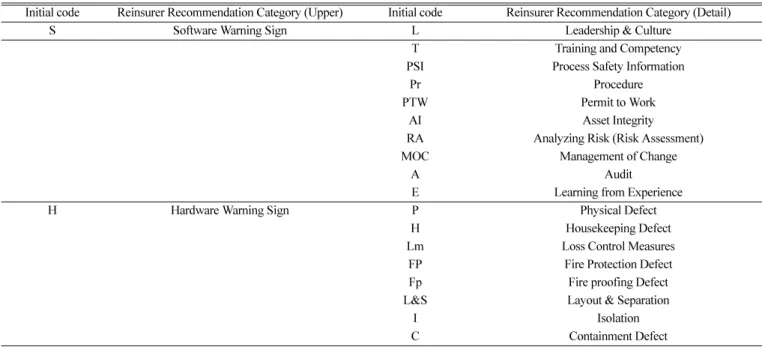
Table 2와 Table 3은 이의 세부 카테고리를 CCPS[3]의 Catastrophic Incident Warning Sign의 9개 카테고리에 대비하여 색인목록으로 작성한 것이다. 최종 안전권고사항의 관리적 전조신호 세부 카테고 리에는 기존 CCPS 카테고리 외에 Table 2와 같이 Permit to work system 색인이 추가되었으며, 설비적 전조신호에는 Table 3와 같이 기존 CCPS의 Physical warning sign을 Fire proofing defect 등 총 8개의 색인으로 분류하였다. Table 4는 추가 평가지표 도출을 위해 사용하였던 화학플랜트 재보험사 권고사항에 대한 이니셜 기호를 나타낸 최종 색인표이다.
Table 5는 지난 17년 간 해외재보험사 Loss Control Engineer의 안전권고사항에 상기 작업으로 부여된 1차적 분류(관리적 전조신 호(S)와 설비적 전조신호(H) 이니셜 기호)와 2차적 분류(Table 4의 세부 총 18개 이니셜 색인기호)를 부여한 작업 예시이다. 여기서 ‘×’
로 표기된 부분이 중대사고 전조신호에 해당되어 향후 사고와 연관 하여 방호계층 상 구멍 또는 공백이 될 수 있음을 의미한다.
안전권고사항 614개를 관리적 전조신호와 설비적 전조신호로 1차 분류한 결과, Fig. 1과 같이 관리적 전조신호(S)가 전체의 약 68%로,
설비적 전조신호(H) 약 32% 보다 높은 비율을 차지하였다(전체 614개 대상 중 S항목 418개 H항목 196개). 관리적 전조신호가 설 비적 전조신호보다 상대적으로 높은 권고 비율을 보였던 것은 세부 카테고리 18개 구분기호 항목 중 자산무결성(AI)(106개), 교육훈련 및 역량(T)(53개), 공정안전자료(PSI)(50개), 작업허가서(PTW)(37 개) 등이 높은 빈도로 권고되었기 때문이다. 반면 설비적 전조신호 에서 높은 권고 빈도를 보였던 것은 세부 카테고리 중 소방설비 결 함(FP)(58개), 물리적 경고신호(P)(43개), 내화처리 미흡(Fp)(39개) 등으로 나타났다.
이 중 빈도가 높았던 상위빈도의 공통 안전권고 사항 항목은 최종 개발된 화학플랜트에서의 중대사고 전조신호 평가지표의 최종 추 가판단기준에 포함하였다. Table 6은 세부 36개 카테고리 별로 상 위 빈도의 Loss control 안전 권고사항을 오른쪽 열에 추가하여 반 영한 예이다. 이를 통해 CCPS의 최초 161개의 중대사고 전조신호 평가지표에 Global loss control engineer의 공통권장사항 상위 빈 도 항목을 추가하여 총 174개의 중대사고 경고신호 전조평가지표로 개발하였다.
3-1-2. 중대사고 전조신호 평가지표 항목별 가중치 산정
Table 7은 기존 CCPS의 161개의 중대사고 평가지표에 Global loss control engineer의 공통권장사항 중 빈도가 높은 항목을 추가
Table 3. The classification code for hardware warning sign
Hardware Warning Sign Category Division
Classification Code Reinsurer Recommendation Category Category on existing CCPS
P Physical Warning Signs
Physical Warning Signs
H Housekeeping Defect
Lm Loss Control Measure
FP Fire Protection Defect
Fp Fire proofing Defect
L&S Layout & Separation
I Isolation
C Containment Defect
Table 4. Final code of the loss control recommendation by global reinsurer
Initial code Reinsurer Recommendation Category (Upper) Initial code Reinsurer Recommendation Category (Detail)
S Software Warning Sign L Leadership & Culture
T Training and Competency
PSI Process Safety Information
Pr Procedure
PTW Permit to Work
AI Asset Integrity
RA Analyzing Risk (Risk Assessment)
MOC Management of Change
A Audit
E Learning from Experience
H Hardware Warning Sign P Physical Defect
H Housekeeping Defect
Lm Loss Control Measures
FP Fire Protection Defect
Fp Fire proofing Defect
L&S Layout & Separation
I Isolation
C Containment Defect
Korean Chem. Eng. Res., Vol. 57, No. 5, October, 2019 T a ble 5 . The lo ss c o nt ro l r ec o mmen da ti o ns by g lo b a l r eins u re r g ro upe d b y 1 st & 2 nd cl a ssi fi ca ti o n s ( E xa mpl e) 1s t Cl assi fi cati o n
2nd Cl ass if icat i on A d m inist rat ive W arni ng S ign Har dwar e W arni ng S ign Recom m endat ion M ai n i ss u e
Adm in istrative/ Har dware Wa rn in g Si gn (1st )
Ni ne De ta il Cat egory (2nd)
L eader ship and Cu lt u re
T rai ni ng an d Com p et enc y
Pr o ce ss Sa fe ty Inf o rm at io n
Pr oce dur es
Pe rm it To Wo rk
Ass et Int egri ty
An aly zi ng Risk and
Ma na g i ng Change Audi t
Lea rni ng fr o m E xperie nce
P hys ic al W arning S igns L o ss Con tr ol M eas ure
H ousek eepi ng De fect i venes s
F ire P rotect ion Def ec ti veness
Fir e P roo fi ng De fe ct i venes s
L ayout & Se p er at io n
Iso lati on
Cont ai nm en t Def ec ti veness Fi re P roof ing f o r V ess el S addle
F ire proof ing f o r heat exchanger , condenser , drum , rece iver , accum u lat o r etc. lower S addl e par t by AP I 2218
S MOC X M odi fi cati on of Acces s to F ir e P u m p R em ove obst acles w h en acc essi ng f ire pum p HP X R evi ew F ire W ater V al v e Li m it Swi tc h in T ank F ar m
S et the l im it sw it ch to th e f u ll open posi ti o n HP X F ir e P u m p A nnual Pe rf or m ance T est F ir e per form ance t est s shoul d be conduct ed every 6 m onths accor d ing to NF PA standar d s (at l east once or tw ice a ye ar) (based on NF PA 25)
SA I X F lar e K onck O u t D rum P u m p w as on M anual M ode
T h e Knock- out drum pum p connected to t h e f lare shoul d be m anaged in Aut o m ode in st ead of m anual m ode
HP X Di ke f o r tr ansf orm er s near N C C # X CCR
Ins tal l a di ke to prepar e fo r fi re spr ead due t o l eakage of tr an sf o rm er o il HC X MOC s ta tis ti cs and R C A T h e com p let ion rat e of M O C im pl em ent ati on s hould be m onit o red, and if t h e M O C is delayed, T h e root caus e should be analyzed
S MOC X P lanni ng of Ba se li n e d ata m eas urem ent f o r new proje cts
P lan fo r the basel ine m eas urem en t program t o d ete rm in e th e c o rr o si o n r ate (det erm ine the dif ference betw een th e design basi s th icknes s and t h e act ual thi ckness )
SA I X F ire protec ti on fo r IT s erv er r o o m
Inst al l gas f ire ext inguishi ng sys tem s u ch as cl ean f ir e ext ingui shi ng agent i n IT se rver room
HF P X
Korean Chem. Eng. Res., Vol. 57, No. 5, October, 2019 T a b le 5. Con ti n u ed 1st C lass if icat ion
2nd C las si fi ca ti on Adm ini st rat ive W ar n ing S ign Hardw are W arning S ign R ecom m endati on M ain is sue
Ad m inistrati ve / H ardwa re Wa rn in g Si g n (1s t) Ni ne Det ail C ategor y (2nd)
L eader shi p and Cul tur e
T rai ni ng and Com p e te ncy
P roces s Sa fe ty In fo rm ati o n
Pr o ce dures
Pe rm it To Wo rk
Ass et In te g r it y
Ana ly zing Ri sk an d
Ma na g ing Change A udit
L ear nin g f ro m E xper ie n ce
P hys ical W arni ng S igns L o ss Con tr ol M eas ure
House ke epi ng Def ecti venes s
F ire P rotect ion De fe ct i veness
Fir e Proo fi ng De fect i venes s
L ayout & Se p er at ion
Iso latio n
C ontai n me n t Def ecti v eness P roc ess Isol ati on V alv e Lis t to b e se t up f o r Pr ocess Is olat ion
P roce ss shutof f val v e li st et c. S P S I X L ong T er m Int erl ock B ypass to be M anaged by M O C
M anage l ong te rm i n ter lock bypas s records by change m anagem ent (M O C ) SM O C X Fir e Pu m p D is ch ar g e V alve shoul d be L o cked Open In o rd er to e n su re th e re li ab il it y of t h e fi re pum p, t h e dis char g e pipe shoul d be kept in the open st at e and l o cked s tat e
SA I X In clude Doubl e C as in g Pu mp ( H P et hyl ene pum p) int o Inspect ion P rogr am .
Doubl e C asi ng P u m p t est in ter v al shoul d be short ened because i t is di ff icul t t o check unl ess it i s peri odic m ai n te nance ( accident cases caused boor m ai n tenance) SE X S eal t h e W indow s F acing Sphe res (2nd fl oor of S M CC R )
E n sur e se parat ion of contr o l room w indow s and proces s areas HL & S X Im proved F ire D etec ti on f o r S p ar e P art s W ar ehouse
Inst all f ir e al arm s y stem s u ch as f ire detec tors i n t h e spare wa rehouse HF P X Im proved Docum entat ion D o cum ent r evis ion and updat e S P S I X In cident Repor ti ng E nhance Inci dent R eport ing D ata col lect ion and securi ng st at is ti cs SA X In specti on P rogram m e Ins p ecti on pr ogram m anagem ent SA I X Im prove m anagem ent of Change (M O C ) procedure
M anagem ent of Change (M O C ) pr ocedure SM O C X
Korean Chem. Eng. Res., Vol. 57, No. 5, October, 2019 Fig. 1. Frequently recommended 18 categories by global loss control engineers for 17 years.
Table 6. Added catastrophic incident warning sign criteria through frequency analysis of loss control recommendations by global reinsurer for 17 years (Example)
Middle Class Detail Class
(36ea Category) CCPS Self Assessment Tool Criteria Modified (Added) Warning Sign Criteria
Leadership and Culture / Training
and Competency
Employee process safety awareness and
standards implementation
practices
· Allows operation outside safe operation range
· Lack of awareness and non-compliance with standards of workers
· There are a variety of driving practices and procedures for each shift
· It is rampant to confuse work industry safety with process safety
· Collision between production and safety goals
· Reduce process safety budget
· Delay in process safety practices
· Administrative response to process safety issues is slow
Organizational safety and specialization
· Job roles and responsibilities are not well defined, confused, and unclear
· Frequent change of job priority
· Frequent organizational changes
· Frequent changes in business owners
· High absenteeism and separation problems
(1) Inspection department is not independent, which
may conflict with production and maintenance schedule
Safety Communication
· Examples of negative complaints from outside (nearby companies and communities)
· Workers seem tired
· Most are too busy to work
· Show negative feedback when surveying workers' opinions
· Limited communication between managers and workers
· Workers recognize that the management organization is not listening
· Conflict between worker and manager on work conditions
· Indefinitely defined command system a bias in the organization (favoritism)
· Limited communication between managers and workers
· Workers recognize that the management organization is not listening
· Conflict between worker and manager on work conditions
· Indefinitely defined command system
· There is a bias in the organization (favoritism) Manager leadership
and behavioral characteristics
· Lack of qualifications of field supervisor and lack of credibility of responsible workers
· Lack of qualifications to serve as managers of supervisors and leaders
· Leadership behavior is more focused on public reputation than process safety
· Leaders clearly prioritize results-based behavior rather than action-oriented behavior
(rather than content)
Korean Chem. Eng. Res., Vol. 57, No. 5, October, 2019
하여 총 174개의 중대사고 경고신호 평가지표를 선정하고 이후 AHP기법을 통한 가중치 도출을 위하여 4개 상위 카테고리, 중위 9 개 카테고리 그리고 세부 36개 카테고리로 그룹화 작업을 한 것이 며, 이는 AHP 계층도 구성에도 동일하게 사용되었다.
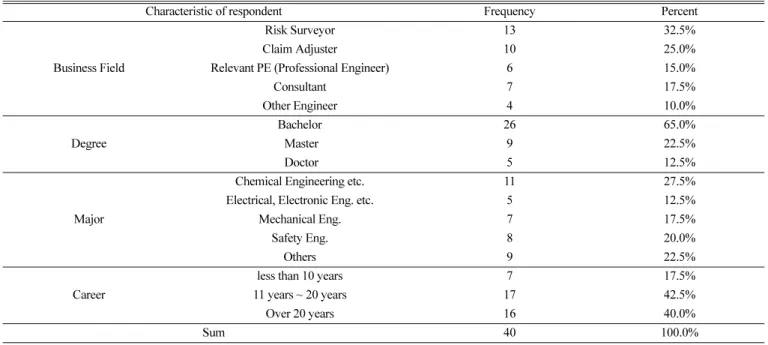
정유 및 석유화학플랜트에서의 중대사고 전조신호 평가지표의 카테고리별 가중치(중요도) 도출을 위한 AHP 기법 적용 대상 표본 에는 관련 분야 전문가집단 40명이 포함되었으며 이들 응답자 인구 통계 특성은 Table 8과 같다. 응답자의 전문 분야는 Risk Surveyor 13명(32.5%), 손해보험사 Claim 담당자 10명(25.0%), 관련 기술사 6명(15.0%), consultant 7명(17.5%), 기타 엔지니어 4명(10.0%)이 며, 응답자의 학위는 박사 5명(12.5%), 석사 9명(22.5%), 학사 26명 (65.0%)순으로 나타났다. 응답자 전공의 경우 화학공학 계열이 11 명(27.5%)으로 가장 많았으며 나머지는 전기공학 및 전자공학 계
열 5명(12.5%), 기계공학 계열 7명(17.5%), 안전공학 계열 8명 (20.0%), 기타 9명(22.5%) 순으로 나타났다. 또한 응답자의 해당분 야 평균경력은 20년 이상 16명(40.0%), 11년이상 20년 미만 17명 (42.5%), 10년 미만 7명(17.5%) 순이었다.
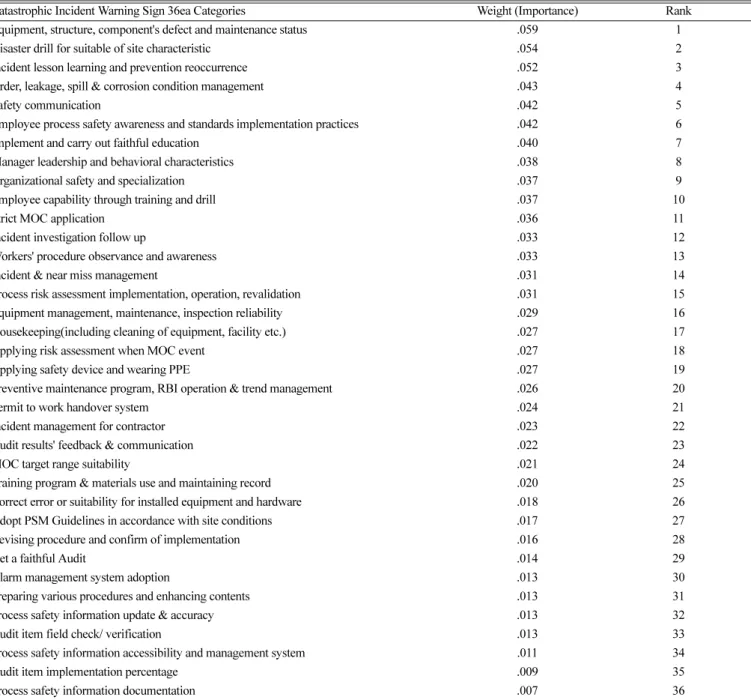
상위 카테고리 및 중위 카테고리의 전문가 집단별 가중치는 Table 9 및 Table 10과 같으며, 세부 카테고리에 대한 최종 가중치 (중요도) 및 우선순위는 Table 11과 같다. 각 단계 별 카테고리는 CR값이 0.1보다 낮게 나와 모두 일관성이 확보되었다. 상위 카테고 리에 대한 응답자의 상대적 중요도 및 우선순위 결과를 살펴보면
‘감사/경험으로부터의 학습’(.197), ‘자산무결성/물리적위험신호’
(.243), ‘공정안전자료/절차서/위험분석 및 변경관리’(.250), ‘리더쉽 과 문화/교육훈련 및 역량’(.310)의 순으로 나타났다. 중위 카테고 리에 대한 종합가중치는 ‘자산무결성’(.087), ‘위험분석(평가) 및 변
Table 7. AHP Hierarchy for developing the catastrophic incident warning sign assessment index
Upper Category Middle Category Subcategory
Leadership and Culture / Training and Competency
Leadership and Culture
Employee process safety awareness and standards implementation practices Organizational safety and specialization
Safety communication
Manager leadership and behavioral characteristics
Training and Competency
Disaster drill for suitable of site characteristic Employee capability through training and drill Implement and carry out faithful education
Training program & materials use and maintaining record
Process Safety Information / Procedures / Analyzing Risk
and Managing Change
Process Safety Information
Process Safety Information update & accuracy Process Safety Information documentation
Process Safety Information accessibility and management system Adopt PSM Guidelines in accordance with site conditions
Procedures
Preparing various procedures and enhancing contents Observation and awareness of workers
Revise and check procedure Permit to Work &r Handover system
Analyzing Risk and Managing Change
Analyzing Process risk implementation, operation, revalidation Analyzing Risk assessment when MOC event
MOC target range suitability Strict application of MOC
Audit / Learning from Experience
Audit
Audit item implementation percentage Audit item field check/ verification Get a faithful Audit
Audit result feedback & communication
Learning from Experience
Incident lesson learning and prevention reoccurrence Incident Investigation follow up
Incident management for contractor Incident & Near miss management
Asset Integrity / Physical Warning Signs
Asset Integrity
Equipment management, maintenance, inspection reliability Alarm management system adoption
Preventive maintenance program, RBI operation & trend management Correct the installed device, hardware suitability and error correction
Physical Warning Signs
Equipment, structure, component's defect and maintenance status
Oder, leakage, spill & corrosion condition management
Housekeeping (including cleaning of equipment, facility etc.)
Applying safety device and wearing PPE
Korean Chem. Eng. Res., Vol. 57, No. 5, October, 2019
경관리’(.115), ‘경험으로부터의 학습’(.140), ‘교육 훈련 및 역량’(.151), ‘물리적 위험신호’(.157), ‘리더십과 문화’(.159)의 순이다.
이러한 과정을 통하여 도출된 전문가집단별 36개 세부 카테고리에 대한 최종 종합가중치는 Table 12에 나타내었다.
3-1-3. 화학플랜트에서의 중대사고 전조신호 평가지표 Tool Table 13은 카테고리별 가중치 도출 후 최종 개발 완료된 중대사 고 전조신호 평가지표를 실제 사업장에 적용한 예시 결과이다. 최 종 화학플랜트에서의 중대사고 전조신호 평가지표 Tool에는 ‘판단 기준 예시(Criteria example)’와 ‘질문사항(Questionnaire)’을 기재
함으로써 각 화학플랜트의 자체평가자나 외부 Auditor들이 ‘질문사 항’을 이해하고 판정하는데 도움을 주도록 하였다. 최종 ‘획득점수 (Rating)’는 ‘가중치(Weight)’에 판정된 ‘배점(Point)’을 곱하여 얻 어지도록 하였다.
3-2. 중대사고 전조신호 평가지표 적용 결과
본 연구에서 개발된 중대사고 전조신호 평가지표를 국내 8개의 정유 및 석유화학플랜트에 적용하였다. 대상 화학플랜트 업종은 국 내 정유 4개 업체(50%), 석유화학 4개 업체(50%)이며, 대상 소속
Table 8. Respondent characteristics for deriving weight (importance) by category on index
Characteristic of respondent Frequency Percent
Business Field
Risk Surveyor 13 32.5%
Claim Adjuster 10 25.0%
Relevant PE (Professional Engineer) 6 15.0%
Consultant 7 17.5%
Other Engineer 4 10.0%
Degree
Bachelor 26 65.0%
Master 9 22.5%
Doctor 5 12.5%
Major
Chemical Engineering etc. 11 27.5%
Electrical, Electronic Eng. etc. 5 12.5%
Mechanical Eng. 7 17.5%
Safety Eng. 8 20.0%
Others 9 22.5%
Career
less than 10 years 7 17.5%
11 years ~ 20 years 17 42.5%
Over 20 years 16 40.0%
Sum 40 100.0%
Table 9. The relative importance of four upper categories and priority ranking by each respondent’s field
Upper Category (Major Category) Risk Surveyor Claim Adjuster PE Consultant Other Engineers
Weight Rank Weight Rank Weight Rank Weight Rank Weight Rank
Leadership and Culture / Training
and Competency .216 3 .365 1 .386 1 .463 1 .165 4
Process Safety Information / Procedures /
Analyzing Risk and Managing Change .252 2 .238 2 .253 2 .236 2 .204 3
Audit / Learning from Experience .199 4 .182 4 .178 4 .176 3 .230 2
Asset Integrity / Physical Warning Signs .334 1 .216 3 .184 3 .124 4 .401 1
CR .003 .004 .014 .004 .008
Table 10. The relative importance of nine middle categories and priority ranking by each respondent’s field
Middle Category Risk Surveyor Claim Adjuster PE Consultant Other Engineers
Weight Rank Weight Rank Weight Rank Weight Rank Weight Rank
Leadership and Culture .106 5 .171 2 .150 2 .316 1 .096 5
Training and Competency .110 4 .194 1 .236 1 .147 2 .069 6
Process Safety Information .041 9 .041 9 .054 9 .052 8 .053 7
Procedures .100 6 .103 5 .082 8 .067 5 .036 8
Analyzing Risk and Managing Change .111 3 .094 6 .117 3 .118 4 .115 4
Audit .066 8 .047 8 .095 5 .036 9 .031 9
Learning from Experience .133 2 .135 4 .083 7 .140 3 .199 2
Asset Integrity .072 7 .068 7 .101 4 .062 6 .187 3
Physical Warning Signs .261 1 .147 3 .083 6 .062 7 .214 1
Korean Chem. Eng. Res., Vol. 57, No. 5, October, 2019
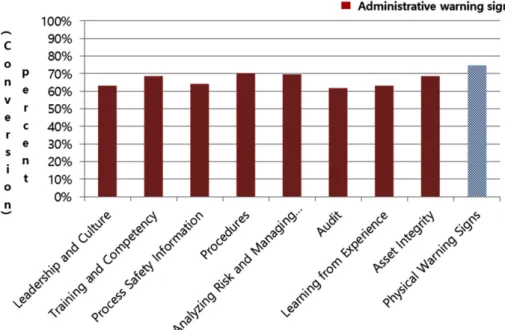
부서는 기술 및 공정팀 계열 50%, ESH(환경·안전) 계열이 50% 이 다. 평가지표 상 9개 중위 카테고리에서 평균치 이상을 나타낸 카 테고리는 Fig. 2와 같이 ‘교육훈련 및 역량(69%)’, ‘절차서(70%)’,
‘위험분석(평가) 및 변경관리(70%)’, ‘자산무결성(69%)’, ‘물리적 위험신호(75%)’ 등이며, 상대적으로 미흡하게 나타났던 카테고리는
‘리더쉽과 문화(63%)’, ‘공정안전자료(64%)’, ‘감사(62%)’, ‘경험으 로부터의 학습(63%)’ 등이다.
Fig. 3은 세부 카테고리 36개의 평가지표 점수를 관리적 전조 신호와 물리적 전조신호로 구분하여 백분위로 환산하여 나타낸 것이고, Fig. 4는 세부 카테고리 36개를 카테고리별 구분 없이 항 목별 내림차순으로 정리한 것이다. 상대적으로 양호하게 평가된
세부 카테고리는 Fig. 4와 같이 인수인계시스템 및 작업허가서, 예방정비 프로그램, RBI 운영 및 추세 관리, 장치·구조물·부품 결 함 등이며, 다소 미흡하게 평가된 세부 카테고리는 표준이행 관행 및 근로자 공정안전 인식, 앗차사고 및 사고관리, Audit 사항 현 장체크 및 검증 등이었다.
Fig. 5는 화학플랜트에서의 중대사고 전조신호 평가지표 결과 값을 정유공장 섹터와 석유화학 섹터로 구분하여 나타낸 것이다. 조직안 전성 및 전문화는 정유공장 섹터가 상대적으로 양호한 평가지표 결과 값을 나타내었고, 변경관리(MOC)시 위험성평가 병행, Audit 사항 이행(implementation) 비율 등은 석유화학공장 섹터가 다소 양호한 평가지표 결과 값을 보였다. 본 연구의 중대사고 전조신호
Table 11. The relative importance of 36 categories and priority ranking by each respondent’s field
Detail Category (36ea) Risk Surveyor Claim Adjuster PE Consultant Other Engineers
Weight Rank Weight Rank Weight Rank Weight Rank Weight Rank Employee process safety awareness and standards implementation
practices .032 9 .042 7 .038 7 .069 4 .023 20
Organizational safety and specialization .018 25 .057 3 .027 18 .072 3 .031 13
Safety Communication .027 14 .040 9 .041 6 .092 1 .027 18
Manager leadership and behavioral characteristics .028 12 .032 12 .045 4 .083 2 .015 25
Disaster drill for suitable of site characteristic .050 5 .054 5 .072 1 .042 7 .032 12
Employee Capability Through Training and Drill .022 22 .071 1 .056 3 .036 10 .010 27
Implement and carry out faithful education .027 13 .043 6 .064 2 .044 6 .020 21
Training program & materials use and maintaining record .011 33 .026 17 .043 5 .025 14 .007 30
Process Safety Information Update & Accuracy .012 32 .013 29 .010 34 .015 24 .010 28
Process Safety Information documentation .006 36 .006 36 .009 36 .009 32 .004 33
Process Safety Information accessibility and management system .010 34 .011 32 .012 31 .010 31 .009 29 Adopt PSM Guidelines in accordance with site conditions .013 28 .011 33 .023 22 .018 21 .031 14
Preparing various procedures and enhancing contents .013 31 .019 24 .013 28 .012 29 .004 35
Observation and awareness of workers .034 7 .042 8 .027 20 .025 15 .016 24
Revise and check procedure .023 20 .020 22 .013 29 .013 26 .004 34
Permit to Work & Handover system .030 11 .022 19 .029 16 .017 22 .012 26
Analyzing Process risk implementation, operation, revalidation .032 10 .029 14 .025 21 .030 11 .025 19
Analyzing Risk assessment when MOC event .024 18 .022 20 .035 9 .026 13 .029 16
MOC target range suitability .023 19 .016 25 .021 24 .023 18 .019 22
Strict application of MOC .033 8 .027 16 .036 8 .038 9 .043 8
Audit item implementation percentage .009 35 .007 35 .020 25 .005 36 .004 36
Audit item field check/verification .014 27 .013 30 .020 26 .007 35 .006 31
Get a faithful Audit .018 26 .012 31 .021 23 .008 34 .005 32
Audit result feedback & communication .025 16 .015 26 .034 10 .017 23 .016 23
Incident lesson learning and prevention reoccurrence .066 3 .054 4 .015 27 .048 5 .046 7
Incident Investigation follow up .024 17 .039 10 .011 33 .029 12 .096 1
Incident management for contractor .020 24 .014 28 .027 19 .024 16 .030 15
Incident & Near miss management .022 21 .027 15 .030 13 .039 8 .027 17
Equipment management, maintenance, inspection reliability .027 15 .025 18 .027 17 .022 19 .053 4
Alarm management system adoption .013 30 .010 34 .012 32 .009 33 .035 10
Preventive maintenance program, RBI operation & trend
management .020 23 .020 23 .032 11 .020 20 .047 6
Correct the installed device, hardware suitability and error correction .013 29 .014 27 .030 15 .012 28 .052 5 Equipment, structure, component’s defect and maintenance status .086 1 .061 2 .031 12 .024 17 .089 2 Oder, leakage, spill & corrosion condition management .078 2 .036 11 .030 14 .014 25 .055 3 Housekeeping(including cleaning of equipment, facility etc.) .050 4 .029 13 .009 35 .011 30 .035 11
Applying safety device and wearing PPE .047 6 .021 21 .013 30 .012 27 .035 9
Korean Chem. Eng. Res., Vol. 57, No. 5, October, 2019
평가지표를 국내 8개의 정유 및 석유화학플랜트에 적용한 것이기에 향후 대상 모집단이 확대될 시에는 섹터(부문)별 상대비교 결과 치가 다르게 나타날 수도 있다.
4. 결 론
본 연구에서는 정유 및 석유화학플랜트 중대사고 전조신호 평가 지표 개발을 통하여 관련 사업장 종사자 및 외부 Auditor에게 평가 지표 활용과 중대사고 예방에 도움을 주고자 하였다. 이를 위해 우 선 미국 CCPS[3]에서 제시한 중대사고 전조신호 판단기준 161개 항목을 관리적 전조신호 10개와 설비적 전조신호 8개, 총 18개의 카테고리로 분류하였다. 여기에 지난 17년 간 해외재보험사 Loss Control Engineer가 도출한 화학플랜트 중대사고 전조신호와 관련 된 안전권고사항 614개를 상기 카테고리로 분류하여 검토한 후 빈
도가 높은 항목을 추가 판단기준으로 선정하여 총 174개의 중대사 고 전조신호 평가기준 및 지표를 도출하였다. 최종적으로 정유 및 석유화학플랜트에서 중대사고 전조신호 평가지표 상 평가가 용이 하도록 중대사고 전조신호 판단기준을 유형별로 그룹화하여 상위 카테고리(대범주), 중위 카테고리(중범주), 하위 카테고리(소범주) 로 나누었다. 또한 정유 및 석유화학플랜트 관련 전문가(40명)로 부 터 얻은 설문결과를 AHP기법을 적용하여 각 카테고리 별 중요도 (가중치)를 부여하였다.
최종 개발된 중대사고 전조신호 평가지표를 8개의 정유 및 석유 화학플랜트에 적용한 결과, 물리적 전조신호 지표는 사업장 내 비 교적 잘 관리되고 있는 반면, 외부 Audit 사항 준수 및 검증 또는 Near miss & Incident 관리와 같은 관리적 전조신호 지표 값은 상 대적으로 미흡한 것으로 나타나고 있어 사업장에서 간과되고 있는 관리적 전조신호 인식개선이 필요하리라 판단된다.
Table 12. Final weight (importance) results and ranking for 36 categories
Catastrophic Incident Warning Sign 36ea Categories Weight (Importance) Rank
Equipment, structure, component's defect and maintenance status .059 1
Disaster drill for suitable of site characteristic .054 2
Incident lesson learning and prevention reoccurrence .052 3
Order, leakage, spill & corrosion condition management .043 4
Safety communication .042 5
Employee process safety awareness and standards implementation practices .042 6
Implement and carry out faithful education .040 7
Manager leadership and behavioral characteristics .038 8
Organizational safety and specialization .037 9
Employee capability through training and drill .037 10
Strict MOC application .036 11
Incident investigation follow up .033 12
Workers' procedure observance and awareness .033 13
Incident & near miss management .031 14
Process risk assessment implementation, operation, revalidation .031 15
Equipment management, maintenance, inspection reliability .029 16
Housekeeping(including cleaning of equipment, facility etc.) .027 17
Applying risk assessment when MOC event .027 18
Applying safety device and wearing PPE .027 19
Preventive maintenance program, RBI operation & trend management .026 20
Permit to work handover system .024 21
Incident management for contractor .023 22
Audit results' feedback & communication .022 23
MOC target range suitability .021 24
Training program & materials use and maintaining record .020 25
Correct error or suitability for installed equipment and hardware .018 26
Adopt PSM Guidelines in accordance with site conditions .017 27
Revising procedure and confirm of implementation .016 28
Get a faithful Audit .014 29
Alarm management system adoption .013 30
Preparing various procedures and enhancing contents .013 31
Process safety information update & accuracy .013 32
Audit item field check/ verification .013 33
Process safety information accessibility and management system .011 34
Audit item implementation percentage .009 35
Process safety information documentation .007 36
Korean Chem. Eng. Res., Vol. 57, No. 5, October, 2019
API RP 754 기준 상 언급된 공정안전성과지표 중 선행지표의 도 입을 통한 지속적 관리를 강조하고 있는 시점에 본 평가지표 항목
이 유용한 선행지표 자료로 활용될 것이라 기대된다. 본 연구를 통 해 개발된 평가지표를 바탕으로 향후 지속적인 동종 정유 및 석유
Table 13. Examples of the assessment index applied to the chemical plant selected in this study
Middle Category
Detail Category
(36ea) Questionnaire Point Criteria Example Weight Point Rating
Leadership and Culture
Employee process safety awareness and standards implementation
practices
There are cases where workers are not aware
of process safety and do not follow various
standards
0~10
· Allows operation outside safe driving range
· Lack of awareness and non-compliance of workers with various standards
· There are a variety of driving practices and practices for each shift
· It is common to confuse work (industry) safety and process safety without distinction.
· Conflicts between production targets and safety targets
· Reduced process safety budget
· Delays in process safety practices
· Administrative response to process safety issues is slow
4.2 2.5 1.1
Organizational safety and specialization
There is a lack of safety and specialization
within the organization
0~10
· Job roles and responsibilities are not well defined, confused and unclear
· Frequent change of job priority
· Inspection department independence
· Frequent organizational changes
· Changes in frequent business owners
· High absenteeism and turnvoer rate
3.7 7.5 2.8
Safety Communication
There is a lack of safety communication between managers and workers (or workers) and often
conflicts
0~10
· Negative complaints from outside (neighboring company and community)
· Workers seem tired
· Most are too busy to work
· Show negative feedback when surveying workers' opinions
· Limited communication between managers and workers
· Employees recognize that the management organization is not listening
· Conflict between worker and manager on work conditions
· The existence of an unambiguously defined command system within the organization (favoritism).
4.2 7.5 3.2
Manager leadership and
behavioral characteristics
There are cases where manager’s leadership is lacking and behavioral
characteristics are result-oriented
0~10
· Lack of qualifications of field supervisors and lack of credibility of responsible workers
· Lack of qualities that can serve as managers of supervisors and leaders
· Leadership behavior is more focused on public reputation than process safety
· Leaders clearly prioritize results-based behavior rather than action- oriented behavior (rather than content)
3.8 5 1.9
Process Safety Information
Process Safety Information
Update &
Accuracy
There are cases where documents such as process safety data are
not up-to-date and various drawings are inconsistent with site
conditions
0~10
· P&ID drawings is inconsistent with show the latest field situation
· Lack of precision and accuracy of process safety data documents other than P&ID
· MSDS and equipment datasheets are not current
· Incomplete electrical / hazardous (explosion proof) area classification drawing
· Poor equipment labeling and tagging
4.2 2.5 1.1
Process Safety Information documentation
There is a lack of documentation of process safety data
0~10
· Incomplete documentation of safety systems
· Inadequate documentation on chemical hazards
· Incomplete and inconsistent drawing forms and as-built
3.7 7.5 2.8
Process Safety Information accessibility and
management system
It is difficult to access the process safety data and it is difficult to identify the relevant management
personnel
0~10
· Problems with process safety data document management
· No person in charge of process safety information data
· Process safety information is not readily available
4.2 7.5 3.2
Adopt PSM Guidelines in accordance with
site conditions
Process safety guidelines do not meet the best practices and process safety performance indicators (PSPI) leading
indicators are not followed up
00~10
· No PSPI lagging & leading indicator
· Company process safety management (PSM) is inadequate compared to culture or resources (underdeveloped guidelines, etc.)
· No alarm management system
· PSPI lagging indicator & leading indicator are not on operation
3.8 5.0 1.9
Korean Chem. Eng. Res., Vol. 57, No. 5, October, 2019 Fig. 2. Percentage (%) of middle categories for two warning signs.
Fig. 3. Percentage (%) of detail categories for two warning sings.
화학플랜트 중대사고 사례분석 및 근본원인분석을 통하여 전조신 호 등 평가지표 항목을 추가하는 것이 필요하며, 선정된 평가지표 별 중요도(가중치)를 추가 연구함으로써 중대사고 예방을 위한 우
선순위 항목선정에 보다 신뢰성 있는 평가지표로의 개발이 요구 된다.
Korean Chem. Eng. Res., Vol. 57, No. 5, October, 2019 Fig. 4. Percentage (%) of detail categories by ranking order.
Fig. 5. Comparisons of 36 category indicators between domestic refinery and petrochemical sectors.
Korean Chem. Eng. Res., Vol. 57, No. 5, October, 2019
감 사
본 연구의 AHP 분석을 위해 설문에 참여한 전문가 집단에 감사 드립니다. 이 논문은 주저자의 석사학위논문인 “화학플랜트에서의 중대사고 경고신호 평가지표 개발에 관한 연구”(서울과학기술대학 교, 2018)의 일부내용을 수정·보완하여 작성한 것입니다.
References
1. Risk & Insurance Solutions of Korean Re, “The Risk,”2(2), 38 (2017).
2. Marsh & Mclennan Companies, The 100 Largest Losses, 1978- 2017, Large Property Damage Losses in the Hydrocarbon Indus- try, 24th edition, 7-29(2018).
3. CCPS, “Recognizing Catastrophic Incident Warning Signs in the Process Industries,” AICHE, Wiley, New York(2012).
4. Go, B. S., “A Study on Methodology for Process Safety Performance Indicators Development System in Plant Industries,” Kwang- woon University(2016).
5. Baek, S. H., “A Study on Evaluation & Improvement on Process
Safety Management in Refinery & Chemical Plant,” Chonnam National University(2017).
6. Mary Schiavo., “Flying Blind, Flying Safe,” Avon Books(1997).
7. CCPS, “Process Safety Leading and Lagging Metrics, You don’t Know What you Don’t Measure,” AICES, New York(2011).
8. OECD, “Guidance on Safety Performance Indicators”(2003).
9. American Petroleum Institute, “Process Safety Performance Indicators for the Refining and Petrochemical Industries,” Sec- ond Edition, ANSI/API Recommendation Practice 754(2017).
10. Reason, J., “The Contribution of Latent Human Failures to the Breakdown of Complex Systems,” Phil. Tran. Royal Soc. Lon- don. Series B. 327(124), 475-484(1990).
11. Reason, J., “Managing the Risks of Organizational Accidents,”
Ashgate Publishing Company, 1-13(1997).
12. Hart, C. A., “Stuck on a Plateau: A Common Problem of Work- shop Paper,” The National Academy of Engineering Program Office Accident Precursors Project, Washington, D.C(2003).
13. CCPS, “Incidents That Define Process Safety,” AICHE, Wiley, New York, 277-283(2008).
14. Hopkins, A., “Safety, Culture and Risk - The Organisational Causes of Disasters,” CCJ Australia(2005).
![Table 1. Example of catastrophic incident warning sign assessment index tool reported by CCPS[3]](https://thumb-ap.123doks.com/thumbv2/123dokinfo/5102853.327112/3.892.63.833.778.888/table-example-catastrophic-incident-warning-assessment-index-reported.webp)