R E S E A R C H Open Access
Influence of biodegradable polymer
membrane on new bone formation and biodegradation of biphasic bone
substitutes: an animal mandibular defect model study
Jeong-Kui Ku 1 , Young-Kyun Kim 2,3 and Pil-Young Yun 2*
Abstract
Purpose: The purpose of this study was to evaluate the influence of biodegradable polycaprolactone membrane on new bone formation and the biodegradation of biphasic alloplastic bone substitutes using animal models.
Materials and methods: In this study, bony defect was formed at the canine mandible of 8 mm in diameter, and the defects were filled with Osteon II. The experimental groups were covered with Osteoguide as barrier
membrane, and the control groups were closed without membrane coverage. The proportion of new bone and residual bone graft material was measured histologically and histomorphometrically at postoperative 4 and 8 weeks.
Results: At 4 weeks, the new bone proportion was similar between the groups. The proportion of remaining graft volume was 27.58 ± 6.26 and 20.01 ± 4.68% on control and experimental groups, respectively ( P < 0.05). There was no significant difference between the two groups in new bone formation and the amount of residual bone graft material at 8 weeks.
Conclusion: The biopolymer membrane contributes to early biodegradation of biphasic bone substitutes in the jaw defect but it does not affect the bone formation capacity of the bone graft.
Keywords: Beta-tricalcium phosphate, Biphasic calcium phosphate, Bone regeneration, Hydroxyapatite, Membrane, Polycaprolactone
Background
Cystic lesion is frequently developed in the jaw, which has higher risk of trauma and infection compared to other bones [1]. The surgical enucleation of cyst is the standard protocol unless an anatomical limitations [1, 2].
In general, the enucleation includes bony window forma- tion to access the cystic lesion, resulting a large postop- erative defect. Healing of the defect is affected by carious
conditions such as size of the defect, condition of perios- teum, soft tissue covering, and general conditions of pa- tient [3]. Without bone graft, however, the spontaneous bone regeneration was not completed within 6 months [4]. Many research reported that bone graft could reduce the bone-healing period and the risk of pathologic frac- ture after the enucleation [4 – 7]. In addition, Forssell et al. reported higher recurrence rate was in the larger size of cyst ( ≥ 4 cm) [ 8]. In order to detect the recur- rence, early increase in bone density is important to be continuously observed without change in volume and density after the enucleation [9, 10].
© The Author(s). 2020 Open Access This article is licensed under a Creative Commons Attribution 4.0 International License, which permits use, sharing, adaptation, distribution and reproduction in any medium or format, as long as you give appropriate credit to the original author(s) and the source, provide a link to the Creative Commons licence, and indicate if changes were made. The images or other third party material in this article are included in the article's Creative Commons licence, unless indicated otherwise in a credit line to the material. If material is not included in the article's Creative Commons licence and your intended use is not permitted by statutory regulation or exceeds the permitted use, you will need to obtain permission directly from the copyright holder. To view a copy of this licence, visit http://creativecommons.org/licenses/by/4.0/.
* Correspondence: [email protected]
2
Department of Oral and Maxillofacial Surgery, Section of Dentistry, Seoul National University Bundang Hospital, 300 Gumi-dong, Bundang-gu, Gyeonggi-do 463-707, Korea
Full list of author information is available at the end of the article
Although the gold standard for bone graft is still au- togenous bone, alloplastic bone has been developed in various ways for alternative option. Osteon II (Genoss Co., Suwon, Korea) altered to a reinforced microstruc- ture with small pore size of < 250 μm and inter- connective porosity from Osteon I (Genoss Co., Suwon, Korea), a hydroxyapatite (HA) scaffold with pore size of 300-500 μm [11]. The Osteon II is classified as a biphasic scaffold with combination of HA (30%) and resorbable ß-tricalcium phosphate (ß-TCP, 70%). Because of the composition of ß-TCP, this biphasic scaffold showed a degradable aspect and could be anticipated to new bone formation as much as the resorption [11]. The character- istic of micro- and macro-porosity structure is also advantageous for the attachment and proliferation of osteoblasts [12].
The effectiveness of using absorbable membrane has been controversial to enhance new bone formation in the cystic defect. Some studies suggested that the mem- brane could be necessary to additional stabilization process, especially, in a large cystic defect ≥ 3 cm and loss of periosteum or bone wall [13, 14]. On the other hand, Santamaria et al. showed that bone graft using membranes does not contribute to increase bone regen- eration [15]. Therefore, the efficacy of a membrane has still been controversial even in the large cystic defect [5–
7]. Osteoguide (Genoss Co., Suwon, Korea) is 5-50 μm microporous membrane with 0.13 mm in thickness, and it is manufactured by polycaprolactone (PCL), which is a biodegradable polymer with excellent mechanical prop- erties, and cell proliferation abilities [16, 17]. The pur- pose of this experiment was to evaluate the effectiveness of resorbable PCL membrane for new bone formation and biodegradation of the biphasic alloplastic bone sub- stitute in canine mandibular defect. We hypothesized that the membrane, covering the bone substitute, could contribute to enhance bone regeneration capacity and early bone formation.
Materials and methods
Guidelines regarding the care of animal research subjects were strictly followed the ARRIVE guidelines and ap- proved by the Institutional Animal Care and Use Com- mittee of Seoul National University Bundang Hospital, Korea (IACUC No. BA1205-104/034-01). Researches support that canines show more promise as animal models for the testing of bone implant materials because their bone structures had more similarities to the humans. Beagle was selected as animal models.
Animal preparation and surgical procedure
Four beagle dogs (5-6 months old, weighing 8-10 kg in good health) were used in the study. Beagles were fed with commercial diet (Dog Chow GoldPet, #35520,
Cargill Agri Purina, Inc., Pyungtaek, Korea) and housed in individual cages. The animals were prepared with a subcutaneous injection of atropine 0.005 mg/kg (Daihan Pharm. Co., Ansan, Korea) under supine position and anesthetized with an intramuscular injection of zoletil (Zoletil50, Virbac S.A., Carros, France) 5.0 mg/kg and xylazine (Rompun, Bayer Korea, Ansan, Korea) 0.2 mg/
kg after 15 min. After endotracheal intubation of a 6.5- sized tube, general anesthesia was maintained with en- flurane 2.2% (JW Pharmaceutical, Hwasung, Korea) and oxygen level at 3.0 l/min. Animals were injected intra- muscularly with cefazolin 30 mg/kg (Chongkundang Pharm, Cheonan, Korea) before surgical procedures.
The surgical field was scrubbed with povidone-iodine solution. Local anesthesia for hemostasis using 2% lido- caine with 1:100,000 epinephrine (Yuhan Co, Ltd., Seoul, Korea) was injected on both submandibular areas. Skin incisions were made on submandibular area, and subper- iosteal dissection was raised to expose lateral surface of mandibular body area. A standardized 4 round bone de- fects of 8.0 mm size simulating cystic lesion with bony window using large trephine bur on both mandible [18].
Each depth of defect was made until the lateral cortex was completely removed. Cold saline irrigation was per- formed to prevent heating by the burr (Fig. 1a)
Each bony defects was filled with OSTEON II (HA:β- TCP = 3:7, Genoss Co., Suwon, Korea) The experimental defects were covered Osteoguide membrane, and the others were closed without membrane coverage (Fig. 1b and c). All surgical sites underwent primary closure using polyglactin 4-0 (Vicryl, Ethicon, Menlo Park, CA).
Post-operatively, 1.0 ml of dexamethasone-21- isonicotinate (Voren, Boehringer Ingelheim Korea Ltd., Seoul, Korea) was injected for once, and clemizole peni- cillin G and sodium penicillin G (Antipen-SM, Woo- Gene B&G Ltd., Seoul, Korea) 1.0 ml/10.0 kg were injected for three times on every third day. Two beagles were sacrificed each time on 4 and 8 weeks later through formalin perfusion (Fig. 1d).
Histologic analysis
Block sections (8 × 8 × 5 mm) including grafted sites
were harvested. The sections were fixed with 10% buff-
ered neutral formalin (Sigma Aldrich Co. LLC., St. Louis,
USA) for 2 weeks and decalcified in formic acid (Shadon
TBD-1, Thermo Fisher Scientific Inc., Kalamazoo, USA)
following water rinse. The specimens were decalcified in
tissue processor (Shadon Citadel 2000, Thermo Fisher
Scientific Inc., Kalamazoo, USA) and embedded in paraf-
fin with embedding center (Shadon Histocentre 3,
Thermo Fisher Scientific Inc., Kalamazoo, USA). Serial
sections of 3.0 μm in thickness were cut using Micro-
tome (Shadon Finesse 325, Thermo Fisher Scientific
Inc., Kalamazoo, USA). And each specimen was stained with hematoxylin and eosin (H&E).
And dehydration of the specimens was done in etha- nol. Specimens were embedded with ethanol mixed resin solution (Technovit 7200 VLC, Heraeus Kulzer, Hanau, Germany). Blocks were fixed in light polymerization unit (EXAKT 520, EXAKT Technologies Inc., Oklahoma City, USA) and sections of 300 μm thickness were cut using EXAKT cutting system (EXAKT 300 CP, EXAKT Technologies Inc., Oklahoma City, USA) and grinded in 35 μm thickness. Each specimen was stained with H&E and Goldner-Trichrome stains.
To obtain histomorphometric measurements, image was acquired from a light microscope (BX51, Olympus Co., Tokyo, Japan) connected with computer, CCD camera (SPOT Insight 2Mp scientific CCD digital camera system, Diagnostic Instruments Inc., Sterling Heights, USA), and adaptor (U-CMA3, Olympus Co., Tokyo, Japan). SPOT Software V4.0 (Diagnostic Instruments Inc., USA) was used for the image analysis. Tissue sample images were taken at low magnifications for histologic examination (× 12.5) and histomorphometric measurement (× 40). New bone forma- tion was measured using Pro Plus® (Media Cybernetics Inc., Warrendale, USA) analysis software.
For histometric evaluation in this experiment, because OSTEON II was distributed irregularly in the entire treatment area, it is impossible to accurately evaluate the area of the treatment site, which is a conventional meas- urement method. Newly formed bony volume (BV) was evaluated within 12 mm
2. The boundary between the de- fect and the normal bone is first set, and the area of the newly formed bone is calculated as the percentage of the total area of the defect. Remaining grafting volume (RG) was evaluated as same as BV (Fig. 2).
In order to compare the differences in the degree of osteogenesis according to the presence or absence of membrane in the control and experimental groups, the Mann-Whitney test statistical analysis was performed at the significant probability of 95% using statistic program SPSS, version 25.0 (SPSS Inc., Chicago, IL, USA).
Results
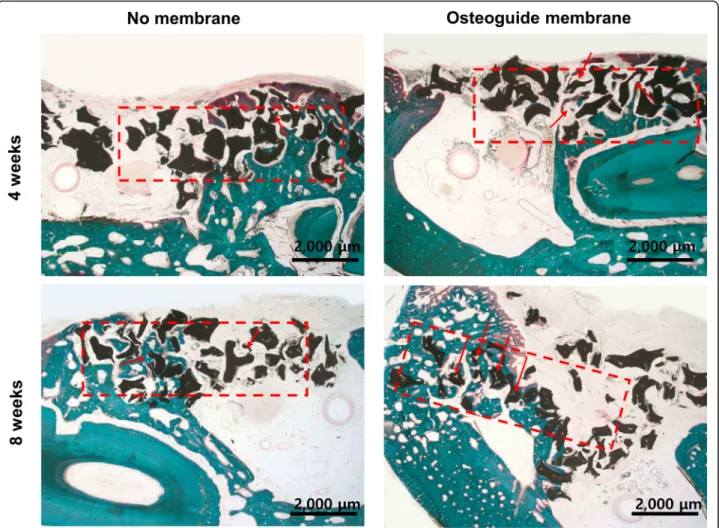
There were no any complications such as inflammatory reaction, wound dehiscence and infection. Histologic results were shown that the fibrous tissue was formed earlier than osteogenesis. Osteoguide was showed resorption progression, and calcium particles were observed on Osteoguide area without inflammation tis- sue. The covered shape of Osteoguide was irregular pat- tern. At 4 weeks, immature new bone was formed around the graft materials. The large amount woven bone was formed around the grafts with small portion of mature bone. At 8 weeks, a large amount of new bone was formed around graft material. There was shown a relatively large ratio of woven/lamellar bone, and tra- becular bone was detected around graft material with containing many osteoblasts (Fig. 2).
At 4 weeks, the newly formed bone volume was 15.84
± 3.43 and 15.93 ± 4.31% on the control and experimen- tal groups, respectively. The remaining graft volume was 27.58 ± 6.26 and 20.01 ± 4.68% on the control and experimental groups, respectively, with statistically difference (P < 0.05, Fig. 3a). At 8 weeks, the newly formed bone and the remaining graft volume were 19.88
± 3.43 and 18.36 ± 5.00% on the control group and 21.73 ± 5.01 and 20.70 ± 6.05% on experimental groups, respectively (Fig. 3b).
Fig. 1 Experimental photograph. a Drilling holes of 8.0 mm were made on mandible of dog. b The defects were filled with OSTEON II (Genoss
Co., Suwon, Korea). c Two of four holes were covered with Osteoguide membrane (Genoss Co., Suwon, Korea). d Sacrifice was performed at 4
and 8 weeks after surgery
Fig. 2 Histologic findings on the experimental and control groups at 4 and 8 weeks postoperatively. Newly formed bone (green) and remaining graft (black) volumes were calculated based on the total area (12 mm
2area, red square), respectively. The biodegradation in osteon was pointed as arrow. At 4 weeks, immature new bone was formed around graft material, large amount of woven bone with small portion of mature bone was formed around graft material. At 8 weeks, large amount of new bone was formed around graft material, and trabecular containing many osteoblasts were detected around graft material. The Osteoguide showed resorption progression and calcium particles are observed on the Osteoguide area without inflammation tissue. The covered shape of osteoguide was irregular pattern. There was shown to delayed new bone formation as fibrous tissue formed earlier than osteogenesis
Fig. 3 Histologic analysis on the experimental and control groups. a At 4 weeks, newly formed bone volume was similar between the groups,
but remaining graft volume was higher in no membrane group than osteoguide membrane group. b At 8 weeks, there was no significantly
difference of newly formed bone and remaining graft volumes between the groups. * Krustal-Wallis Test is significant at the 0.05 level (2-tailed)
Discussion
Although the proportion of new bone was not different, the proportion of remaining grafts was reduced with covering the absorbable membrane in early stage (at 4 weeks in canine). Considering that the 20% of the bone substitutes remained similarly even after 8 weeks, the membrane was seemed to have contribute to the rapid biodegradation of ß-TCP by stabilization of the graft, which could demonstrate both immobilization of osteons and early formed blood clots.
Several studies showed effectiveness of autogenous and alloplastic bone substitutes in the cystic defect [5–
7]. In general, alloplastic material has excellent mechan- ical properties including volume stability against com- pression of soft tissue [12, 19]. Osteon II, using in this study, has ratio of HA:β-TCP as 3:7, and similar com- position to human bones [20]. In particular, the pattern of bone regeneration with biodegradation of β-TCP was similar to intramembranous ossification, which is the way of jaw bone formation [21, 22]. In recent animal study, there reported a low rate of ossification regardless of β-TCP alone or when mixed with autogenous bone or HA, but similar healing patterns compared to autogen- ous bone graft [23–25]. Further, Horch et al. [26]
showed complete bone regeneration with β-TCP alone after cyst enucleation at postoperative 12 month. These studies collaborated with our study, which was observed stable new bone formation with maintained 20% of graft.
Therefore, the alloplastic bone substitutes including β- TCP could be effectively used in rapid bone healing after the cyst enucleation.
A randomized controlled trial reported that bone graft does not contribute to increased new bone volume and density between absorbable and non-absorbable mem- branes [15]. In addition, Dahlin et al. showed that bone density change was not different on the cystic defect be- tween the groups with and without membrane [14]. In this study, the proportion of new bone/remained bone substitutes was not different among the groups at 8 weeks after surgery. However, the experimental group was observed lower proportion of remained bone substi- tutes, and the proportion was maintained about 20%
during postoperative 8 weeks. A proper bone healing outcomes of jaw defect could be achieved if the perios- teum was repaired with the barrier membrane [27].
Therefore, the collagen membrane seems to have posi- tive effect of promoting early degradation of the biphasic scaffold by additional mechanical stability. In addition, Kitayama et al. reported that a biphasic scaffold (10%
HA and 90% TCP) with a hydroxyapatite-containing collagen membrane and a non-cross-linked collagen membrane was showed superior results, about 35% of new bone formation, compared with deproteinized bo- vine bone without a membrane [28]. Recently, another
biphasic scaffold (20% HA and 80% TCP) with ultravio- let cross-linked membrane was showed high biocompati- bility and 36% of new bone formation, comparable with chemically cross-linked collagen membrane [29]. Thus, further research should be conducted to decide an opti- mal proportion of HA and β-TCP in the biphasic scaf- fold and an effective type of membrane for enhance new bone formation.
A biomechanical role for the membrane has been pro- posed to stabilizing and protecting the nascent clot with appropriate mechanical properties necessary for osteo- genesis [30]. The bone regeneration is influenced by the micro-environment, and the initially formed blood clot may influence the migration of cells and vascularization [31]. However, few studies that demonstrated the processes with the membrane provided evidence that the membrane could act a biological role in bone regener- ation with the bone grafts [32]. With regard to our results with membrane, the stability of early formed blood clot could induce early biodegradation of the biphasic bone substitute and new bone formation [33].
After bone graft for the cystic defect, infection was re- ported 17.6% of thirty-four cases [1]. The infection lead to delay bone healing, and cause of the infection could be related with secondary inflammatory reaction mainly due to wound dehiscence [34]. With considering the membrane coverage, the grafts could endure the infec- tion even if the membrane was exposed after wound dehiscence [35]. In particular, rapidly resorbable mem- brane could even be effective as barrier layer [36], and the collapse of adjacent soft tissues could be prevented through the membrane [37, 38]. Although we could not reveal the infection-related aspect in this experiment, the biodegradable membrane could be suggested to use in the large defects, which has high risk of wound dehis- cence, infection, and recurrence for enhancing stability of grafted materials.
Conclusions
In canine mandibular defect, the biodegradable polymer membrane contributed to the early biodegradation of β- TCP in the biphasic alloplastic bone substitutes.
However, the membrane had not affected the bone regeneration capacity, including the proportion of new bone volume and remained bone substitutes.
Abbreviations
HA: Hydroxyapatite; TCP: Tricalcium phosphate; BV: Newly formed bony volume; RG: Remaining grafting volume
Acknowledgements Not applicable
Authors ’ contributions
Ku JK wrote the initial manuscript. Kim YK co-conceptualized the study. Yun
PY conceptualized the study and analyzed the data. All authors revised and
approved the final manuscript.
Funding Not applicable
Availability of data and materials
The datasets used during the current study are available from the corresponding author on reasonable request.
Ethics approval and consent to participate
The study was reviewed and approved by the Institutional Animal Care and Use Committee of Seoul National University Bundang Hospital, Korea (IACUC No. BA1205-104/034-01).
Consent for publication Not applicable
Competing interests Not applicable
Author details
1
Department of Oral and Maxillofacial Surgery, Section of Dentistry, Section of Dentistry, Armed Forces Capital Dental Hospital, Armed Forces Medical Command, 81, Saemaul-ro 117, Seongnam 13634, Bundang-gu, Korea.
2