ISSN: 1738-7167
DOI: http://dx.doi.org/10.7731/KIFSE.2014.28.5.089
사회복지시설의 유형에 따른 안전관리의 차이에 관한 연구
신효진 · 공하성*
†
경일대학교 사회복지학과, *경일대학교 소방방재학과
A Study on the Safety Management Differences According to Social Welfare Facility Type
Hyo-Jin Shin · Ha-Sung Kong*
†
Dept. of Social Welfare, Kyungil Univ.
*Dept. of Fire Safety, Kyungil Univ.
(Received August 7, 2014; Revised September 12, 2014; Accepted October 17, 2014)
요 약
이 연구는 사회복지시설의 증가로 인하여 사회복지시설의 안전관리의 중요성이 대두되고 있는 현시점에서 사회복지시 설의 안전관리인식, 안전관리실태, 시설구조 및 설비인식에 대한 분석을 하였다. 총 12개 사회복지시설에 소속된 204명 의 시설이용자와 시설관리운영자를 대상으로 설문조사를 실시하였으며, 사회복지시설의 유형에 따른 의미 있는 차이를 알아보기 위해 평균차이검증(t-test)과 일원분산분석(ANOVA)을 실시하였다. 분석결과는 다음과 같다. 첫째 안전관리인식, 안전관리실태, 그리고 시설구조 및 설비인식에 있어서 시설관리운영직원의 인식수준이 시설이용자보다 통계적으로 유의 하게 높은 것으로 나타났다. 둘째, 시설유형에 따른 안전관리분석 결과는 건강가정지원센터 관리자 및 사용자의 안전 인 식수준이 안전관리인식, 안전관리실태, 시설구조 및 설비인식의 모든 분야에 있어서 다른 사회복지시설의 응답자보다 유 의하게 낮게 나타났다. 셋째, 6~10년 미만 시설의 응답자 보다 10년 이상 된 시설 응답자의 안전관리인식과 시설구조 및 설비에 대한 인식이 높게 나타났다. 넷째, 건물높이에 따른 안전인식에 있어서는 3층과 4층이 1층보다 유의하게 높게 나타났다. 마지막으로 바닥면적과 안전인식과의 관계를 살펴보면, 400 m
2미만 또는 600 m
2이상의 바닥면적을 가진 응 답자들의 안전인식이 400 이상~600 m
2미만 응답자들보다 유의하게 높게 나타났다.
ABSTRACT
At a time of growing importance of safety management in the social welfare facility by the increase of social welfare facilities, this study analysed safety perceptions about facility management, facility conditions, and facility structure and arrangement. This study sample consisted of 204 service providers and service users in 12 social welfare facilities. T-test and ANOVA were used to find the group differences among facility types. The findings were as follows. Firstly, safety perceptions of the service providers were significantly higher than those of service users in terms of facility management, and facility structure and arrangement. Secondly, in terms of facility types, the respondents in the family service center had lower safety perceptions than the respondents in other service in all three areas. Thirdly, facilities that are of 10 years or older had higher safety perceptions than the respondents of facilities that are 6 to 10 years old in the area of facility management, and facility structure and arrangement. Fourthly, in regard to building heights, the respondents in 3 to 4 story facilities had statistically higher safety perceptions than respondents in 1 story facilities. Finally, looking at the rela- tionship between floor area and safety perceptions, safety perceptions of the respondents of less than 400 m
2facilities or 600 m
2and more facilities were significantly higher than those of 400 m
2~less than 600 m
2facilities.
Keywords : Social welfare facility, Safety perceptions, Facility management, Facility conditions, Facility structure and arrangement
1. 서 론
1.1 연구의 목적 및 필요성
최근 들어 한국사회의 고령화 속도가 점차 빨라짐에 따
라 노인층의 비중이 증가하고, 젊은 층의 비중이 감소하는 현상이 나타나고 있다(1). 또한 부부간의 성격차이, 경제적 인 문제, 배우자의 부정, 가족 간의 불화, 정신 · 육체적 학 대 등으로 이혼율이 점점 높아지고 있다. 이혼은 결손가정
†
Corresponding Author, E-Mail: [email protected]
†
TEL: +82-53-600-5402, FAX: +82-53-600-5419
을 야기하며 가정을 구조적으로 불안정한 상태로 만들어 간다. 이혼 등으로 가족이 해체되는 상황 속에서 아동양육 의 문제에 대한 책임과 역할은 모호하게 되며 건전하고 건 강한 아동의 육체적 정신적 발달은 어려워지게 된다. 가족 해체는 성장기 아동의 신체적 정신적 발달의 저해 요소로 작용할 가능성이 크다. 이와 같은 부모의 이혼으로 인해 아동들은 감정적, 정서적으로 타격을 받게 되고 이혼 가정 의 자녀들은 가정, 학교, 사회, 이성문제 등에 부적응 현상 을 초래할 경향이 높아지고 있다. 이러한 상황은 아동의 성격형성과 정서에 부정적 영향을 미치게 되어 가족으로 부터 벗어나 불량 동료 집단 속에서 삶의 도피처를 찾으려 고 한다. 한편 「2011년 장애인 실태조사」결과, 추정 장애 인구는 268만 3천명, 장애 출현율은 5.61%로 장애인구 및 출현율이 지속적으로 증가하고 있으며, 특히 인구고령화에 따른 장애노인이 크게 증가하고 있다(2). 이와 같은 사회적 현상으로 인해 노인복지시설, 아동복지시설, 장애인복지시 설, 건강가정지원센터 등의 중요성이 대두되고 있다.
이러한 복지시설의 증가와 중요성의 대두에도 불구하고 사회복지시설의 안전에 관한 실태조사나 문제제기는 거의 없는 실정이다. 예컨대 한국의 사회복지시설 규모가 대부 분 소규모로 소방관련법령을 적용받지 않아 안전 사각지 대에 놓여 있다. 또한 출입문을 폐쇄하거나 주요 피난로인 건물 계단 등에는 적치물을 쌓아 두고 있어서 비상 시 원 활한 대피마저 어려운 실정이다. 상황이 이런데도 관련 지 방자치단체는 소관 업무가 아니라는 이유로 마땅한 보완
책을 내놓지 않고 있다(3).
사회복지시설에 수용되어있는 시설이용자는 노인, 장애 인, 아동 및 다문화가정 등을 포함하고 있으며, 이들은 재난 이 발생하였을 때 초동대응, 대피 등에 있어서 일반인들에 비해 어려움을 갖는 경향이 높다. 따라서 이들이 이용하는 사회복지시설은 안전을 보장할 수 있는 시설구조가 갖추어 져 있어야하며, 각종 편의시설, 비상상황시설, 대피공간 등 이 마련되어 있어야한다. 따라서 이 논문은 사회복지시설의 시설운영관리직원과 이용자를 대상으로 시설의 안전관리에 대한 인식, 안전관리 실태, 그리고 시설구조 및 설비에 대한 인식에 관한 실태조사 및 시설특성에 따른 차이점을 분석하 고 연구의 함의 및 정책적 함의를 도출하고자 한다.
1.2 기존문헌검토
기존 사회복지시설의 안전관리에 관한 문헌을 검토하면 Table 1과 같다. 기존 논문을 분석해 보면 Cho (2008)(4)은 안전관리개선에 관한 연구로 노인복지시설 중 조사가능한 시설로 국한하여 전체를 일반화하는데 한계가 있고, Hwang (2008)(5) · Son etc (2011)(6) · Kim etc (2011)(7) · Hong etc (2011)(8)는 사회복지시설의 피난안전성 및 피난 용이성에 관한 연구를 진행하였고, Lee etc (2012)(9)는 사 회복지시설의 평가인증제에 관한 연구로 안전관리와는 무 관하다. Lee (2013)(10) · Choi (2013)(11)은 화재예방 및 화 재안전에만 한정하여 연구가 이루어졌다. 이 논문은 건축 물과 시설에 대한 안전관리에 관한 연구로써 기존의 연구 Table 1. Literature Review on the Safety of Social Welfare Facilities(4-11)
Researcher Study topic Study contents and limitations G. W. Cho
(2008)
A Study on the Security Management Improvement Plan for the Social Welfare Facilities: Focused on the Welfare Facilities for the Old People
Used convenient samples of elderly facilities in Seoul. Limitations with generalization of the findings.
E. K. Hwang (2008)
The Basic Study on the Improvement of the Evacuation Regulation Related with the Elderly Facilities
Limited samples on elderly facility service providers and studied evacuation safety.
I. T. Son etc (2011)
A Study on the Investigation and Combustibles Test of Combustion in Welfare Facilities of Handicapped
Studied combustibles tests on combustion in facilities with disabled people. Focused on evacuation safety.
E. S. Kim etc (2011)
A Study on Structure of Vertical Movement in Welfare Center for Disabled People
Studied evacuation readiness and solubility of vertical movement structure from the perspective of the disabled. Used case studies.
H. R. Hong etc (2011)
A Study on the Evaluation of Evacuation Safety in Welfare Facilities of Handicapped
Discussed problems concerning evacuation safety in terms of building safety planning.
J. S. Lee etc (2012)
A Comparative Study on Perceptions of Practitioners Regarding the Introduction of the Certification System in Social Welfare Facilities of Jeollabuk Province
Evaluated the certification system in welfare facilities, but the evaluation did not include safety management items in the certification system.
W. H. Lee (2013)
The Study Regarding Volunteer Action Program as to Fire Prevention of Social Welfare Facilities
The study samples limited on the service providers in welfare facilities.
K. C. Choi (2013)
A Study on Fire Safety Management of Social Welfare Facilities
The study samples included both service providers and service users, but the study only focused on fire safety.
에서 논의되지 않은 사회복지시설 집단 간의 차이점을 분 석하였다는 데 그 의의가 있다.
2. 이론적 고찰
2.1 사회복지시설의 개념
「사회복지사업법」제2조에서 “사회복지시설”이란 「아 동복지법」,「노인복지법」,「장애인복지법」등의 법률에 따른 보호 · 선도(善導) 또는 복지에 관한 사업과 사회복 지상담, 직업지원, 무료 숙박, 지역사회복지, 의료복지, 재 가복지(在家福祉), 사회복지관 운영, 정신질환자 및 한센병 력자의 사회복귀에 관한 사업 등 각종 복지사업과 이와 관 련된 자원봉사활동 및 복지시설의 운영 또는 지원을 목적 으로 설치된 시설을 말한다(12). 사회복지시설의 현황을 살 펴보면 Table 2와 같다.
2.2 사회복지시설의 안전 및 소방시설 설치기준 사회복지시설은 건축물의 안전 및 방화(防火) 등을 위하
Table 2. The Social Welfare Facilities Present State(13-16)
Category Total Elderly
facility
Child facility
The disabled facility
Family service center
Social service center The number of facilities
075,346 (75,288) 071,873 0,0281 02,600
151 441 (383) The number of service providers 138,310 108,86905,485
12,977 747 10,232 The number of residents 249,976 197,733 15,916 36,327 - - 주) 441 (Actual number of facilities), 383 (Nmber of facilities reported by the service provider).Table 3. Welfare Facility’s Safety and Fire Prevention Equipment requirements(17-19)
Equipments Installation Requirements
Handrail and floor
1) For buildings with a total floor area over 200 m2, handrails should be installed at both sides of the stairs and stair landings.
2) For buildings that have a total floor area over 200 m2, handrails should be installed for every 3 m or less of the stairs’ width.
3) Handrails and floors of enclosed stairways or smoke proof stairways should be convenient for elderly and disabled. Handholds should be installed if there are no handrails with both side walls.
Suppression system
Extinguishing mechanism
Over half of the number of extinguishing mechanisms and throwing extinguishing appliances required by the NFSC should be installed.
Fire hose station system
1) When the floor area is 1,500 m2 and over
2) When at least one floor area is 300 m2 and over in basements, stories without windows, or buildings with 4 or more stories.
Automatic sprinkler
system All facility stories with a total floor area 600 m2 and over.
Simple automatic sprinkler system
1) Total floor area 300 m2~600 m2
2) Total floor area 300 m2 and less with an installed muntin.
Fire alarm system
Automatic fire
detection system Total floor area 400 m2 and over.
Automatic notification
system Floor area 500 m2 and over.
여 필요한 난간 및 바닥 등의 시설을 규정하고, 관계인이 사회복지시설의 규모·용도 및 수용인원 등을 고려하여 갖 추어야 하는 주요 소방시설의 종류는 Table 3과 같다.
3. 조사 설계
3.1 조사수집방법
이 연구의 대상은 사회복지시설에 근무하는 시설관리운 영직원과 서비스를 제공받는 시설이용자들이다. 조사에 참 여한 시설은 서울, 경기, 대구, 경북 지역의 모두 12개 시 설로 노인복지시설 4개소, 아동복지시설 2개소, 장애인복 지시설 2개소, 건강가정지원센터 2개소, 그리고 종합사회 복지시설 2개소이며, 수집된 전체 표본 수는 204명이다.
조사기간은 2014년 4월~5월에 이루어졌다.
3.2 연구방법
3.2.1 사회복지시설의 안전관리분석
사회복지시설의 안전관리에 대한 분석은 안전관리에 대
한인식, 안전관리 실태, 시설구조 및 설비의 세 가지 요인 으로 분류하였다. 본 분석의 안전관리에 대한 인식은 Cho (2008)(20)에서 4문항, Lee (2013)(21)에서 6문항, 안전관리 실태는 Cho (2008)(20)에서 3문항, 시설구조 및 설비는 Cho (2008)(20)에서 5문항을 인용하였으며 이 연구의 사회복지시 설의 특성을 반영하여 수정 · 보완한 후 재구성하였다(20,21).
‘안전관리에 대한 인식’은 10문항으로 구성되어있으며, 해 당시설의 전반적인 안전상태 및 관리, 안전관리 교육훈련, 응급조치 운영, 비상모의훈련, 화재예방상식, 소화기/옥내 소화전 사용법, 휴대용 비상조명 사용방법, 전기콘센트 안 전사용방법 등을 포함한다. 안전관리 실태는 3문항으로 구 성되어있으며, 계단과 경사로 편의시설, 화장실 및 욕실 비상상황 시설, 긴급대피 장소에 관한 질문을 포함한다.
시설구조 및 설비에 대한 인식은 5문항으로 이루어져 있 으며, 떨어짐 방지 난간, 벽이나 천장 등 건물에 금이 간 곳, 바닥 미끄럼 방지, 전기콘센트 안전덮개, 스프링클러설 비 설치여부를 포함한다. 각각의 응답범주는 ‘전혀그렇지 않다(1)’에서 ‘매우그렇다(4)’로 4점 척도를 사용하였다.
3.2.2 자료분석 방법
이 연구의 분석을 위해 SPSS 17.0을 활용하여 각 변수 들의 기술통계값과 결측치 분석을 하였다. 또한 집단차이 분석을 위한 독립표본 T-test, 일원배치분석(ANOVA)을 실시하였다.
독립표본 T-test 분석 시 표본의 등분산성 가정을 조사하 기 위하여 Levene Test를 실시하였다. 또한 일원배치분석 (ANOVA)을 실시하기 위한 전제조건인 등분산성을 만족 시키기 위하여 Levene Test를 실시하였으며 등분산성을 만족시키지 않는 경우에는 Welche Test를 실시하여 가설 Table 4. Socio-demographic Characteristics of the Respon- dents (n = 204)
Variable Category Frequency (n) Percent (%)
Gender
Male
060 029.4
Female 142
069.6
Total 202
099.0
Age
19~30 years
042 020.6
31~60 years 135066.2
61 years and older027 013.2
Total 204 100.0
Disability
No disability 184
090.2
Physically disabled003 001.5
Mentally disabled017 008.3
Total 204 100.0
Status
Service provider 103
050.5
Service user 101049.5
Total 204 100.0
Table 5. Social Welfare Facility Characteristics of the Respondents (n = 204)
Variable Category Frequency (n)
Percent (%)
Facility type
Elderly facility
099 048.5
Child facility012 005.9
The disabled facility023 011.3
Family service center030 014.7
Social service center040 019.6
Total 204 100.0
Operating period
5 years and less
090 044.1
6~less than 10 years066 032.4
10 years and more048 023.5
Total 204 100.0
Floor area
Less than 400 m2
052 025.5
400 m2~less than 600 m2043 021.1
600 m2 and over 109053.4
Total 204 100.0
Building height
1-story-building
043 021.1
2-story-building022 010.8
3-stoy-building027 013.2
4-story-buiding 112054.9
Total 204 100.0
을 검증하였다. 또한 일원배치분석의 F 값이 유의미할 때, 다집단 분석(Scheffe Test)을 실시하여 집단 간 차이를 알 아보았다.
4. 연구결과
Table 4에서 전체 응답자의 성별을 살펴보면 남자가 60 명(29.4%)으로 여자 142명(69.6%)에 비하여 낮은 비율이 었다. 연령은 만31세~60세가 135명(66.2%)으로 가장 높 았으며, 만19세~30세가 42명(20.6%)으로 나타났다. 만61 세 이상이 27명(13.2%)으로 다른 연령대에 비하여 가장 낮은 비율이었다. 장애유무의 경우 장애 없음이 184명 (90.2%)으로 대부분을 차지하였으며, 정신적 장애가 17명 (8.3%), 신체적 장애가 3명(1.5%)으로 나타났다. 시설 내 지위를 살펴보면 시설관리운영직원이 103명(50.5%)이였 으며 시설이용자가 101명(49.5%)로 조사되었다.
Table 5에서 연구대상자가 참여하고 있는 사회복지시설 의 특성을 살펴보면 시설유형은 법인시설이 148명(72.5%) 으로 민간시설 56명(27.5%)보다 매우 많게 나타났다. 시 설종류는 노인복지시설이 99명(48.5%)로 거의 과반수에 가까왔으며, 종합사회복지관이 40명(19.6%), 건강가정지 원센터가 30명(14.7%), 장애인복지시설이 23명(11.3%), 아동복지시설이 12명(5.9%)의 순이다. 시설설립연수를 살
펴보면 5년 이하의 시설이 90개(44.1%)로 가장 많았으며, 6년 이상~10년 미만 시설도 66명(32.4%)이었다. 반면에 10년 이상 시설은 48명(23.5%)으로 가장 적게 나타났다.
바닥면적의 경우, 600 m2 이상 시설이 109명(53.4%)로 과 반수 이상을 차지하였다. 400 m2 미만 시설은 52명(25.5%) 으로 나타났고 400 m2 이상~600 m2 미만 시설은 43명 (21.1%)으로 나타났다. 마지막으로 시설층수는 4층 이상이 112명으로 54.9%를 차지하였고, 1층 43명(21.1%), 3층 27 명(13.2%), 그리고 2층 22명(10.8%)의 순으로 나타났다.
Table 6. The Comparison of Group Differences of Safety Management Perceptions (T-Test)
Variable Category N Mean SD df t value
Status Service provider 91 3.05 .52
175.119 −3.85***
Service user 92 2.78 .44
p* < .05, p** < .01, p*** < .001.
Table 7. The Comparison of Group Differences of Safety Condition Perceptions (T-Test)
Variable Category N Mean SD df t value
Status Service provider 97 2.76 .69
194 −.878
Service user 99 2.68 .68
p* < .05, p** < .01, p*** < .001.
Table 8. the Comparison of Group Differences of Safety Structure and Arrangement Perceptions (T-Test)
Variable Category N Mean SD df t value
Status Service provider 97 2.84 .62
194 −1.962
Service user 99 2.67 .58
p* < .05, p** < .01, p*** < .001.
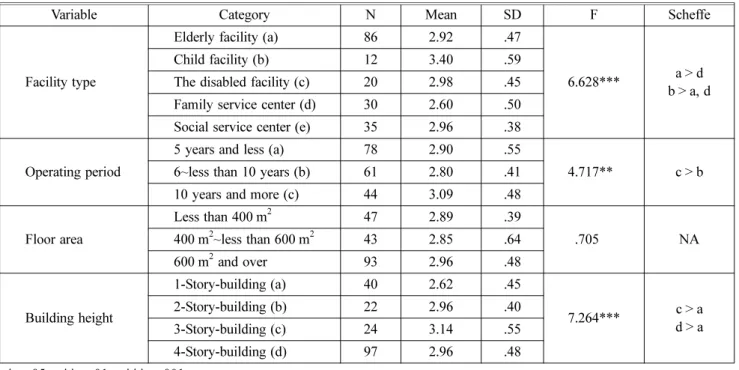
Table 9. The Comparison of Group Differences of Safety Management Perceptions (ANOVA and Scheffe test)
Variable Category N Mean SD F Scheffe
Facility type
Elderly facility (a) 86 2.92 .47
6.628*** a > d b > a, d Child facility (b) 12 3.40 .59
The disabled facility (c) 20 2.98 .45 Family service center (d) 30 2.60 .50 Social service center (e) 35 2.96 .38
Operating period
5 years and less (a) 78 2.90 .55
4.717*** c > b 6~less than 10 years (b) 61 2.80 .41
10 years and more (c) 44 3.09 .48
Floor area
Less than 400 m2 47 2.89 .39
0.705***
NA400 m2~less than 600 m2 43 2.85 .64 600 m2 and over 93 2.96 .48
Building height
1-Story-building (a) 40 2.62 .45
7.264*** c > a d > a 2-Story-building (b) 22 2.96 .40
3-Story-building (c) 24 3.14 .55 4-Story-building (d) 97 2.96 .48 p* < .05, p** < .01, p*** < .001.
Table 6에서 시설관리운영직원의 평균 안전관리인식은 3.05(표준편차 .52)로써 시설이용자의 평균 안전관리인식 2.78(표준편차 .44)보다 더 높다. 연구대상자에 따른 안전 관리인식의 차이는 아주 유의미한 차이(p < .001)가 있는 것으로 나타났다.
Table 7에서 시설관리운영직원의 안전관리실태 평균은 2.76(표준편차 .69)로 시설이용자의 안전관리실태 평균 2.68(표준편차 .68)보다 조금 높게 나타났으며, 분포에 있 어서도 큰 차이가 나타나지 않았다. 연구대상자에 따른 안
전관리실태의 차이는 유의미한 차이(p > .05)가 없는 것으 로 나타났다.
Table 8에서 시설관리운영직원의 시설구조 및 설비 인식 평균은 2.84(표준편차 .62)로 시설이용자의 평균 2.67(표 준편차 .58)보다 높게 나타났으나, 통계적으로 유의미한 차이(p < .05)는 나타나지 않았다.
Table 9에서 안전관리인식에 대한 차이를 분석한 결과 시설종류(F = 6.628, p < .001), 시설설립연수(F = 4.717, p <
.01), 건물층수(F = 8.323, p < .001)에 따라 유의한 차이가 있는 것으로 나타났으나, 연면적 및 바닥면적(F = 1.208, p > .05)은 유의한 차이가 나타나지 않았다. Scheffe 사후 분석 결과, 시설종류는 노인복지시설의 경우 안전관리인식 이 2.92로 건강가정지원센터의 2.60보다 유의하게 높게 나 타났다. 아동복지시설은 안전관리인식이 3.40으로 노인복 지시설(2.92), 건강가정지원센터(2.60)보다 유의하게 높게 나타났다. 시설연수의 Scheffe 사후분석 결과는 10년 이상 시설(3.09)이 6년 이상~10년 미만 시설(2.80)보다 유의하 게 높게 나타났으며, 10년 이상 시설(3.09)이 5년 이하 시 설(2.68)보다 유의하게 높게 나타났다. 건물층수의 Scheffe 사후분석 결과에 따르면, 3층의 안전관리인식(3.14)이 1층 (2.62) 보다 높게 나타났으며, 4층의 안전관리인식(2.96)이 1층(2.62)보다 유의하게 높게 나타났다.
Table 10에서 안전관리실태에 대한 차이를 분석한 결과 시설종류(F = 14.561, p < .000), 연면적 또는 바닥면적(F = 25.325, p < .000), 건물층수(F = 15.154, p < .000)에 따라 유의한 차이가 있는 것으로 나타났으나, 시설설립연수(F = 1.056, p > .05)는 유의한 차이가 나타나지 않았다. 시설종 류는 Scheffe의 사후분석 결과, 노인복지시설(2.90)의 안전
관리실태가 아동복지시설(2.28)과 건강가정지원센터(2.02) 보다 높게 나타났다. 장애인복지시설(2.84)이 건강가정지 원센터(2.02)보다 높게 나타났으며, 종합사회복지관(2.89) 의 안전관리 실태가 건강가정지원센터(2.02)보다 유의하게 높게 나타났다. 바닥면적의 경우 Scheffe의 사후분석결과는 400 m2 미만의 안전관리실태(2.86)가 400 m2 이상~600 m2 미만(2.13)보다 유의하게 높게 나타났으며, 600 m2 이상 (2.90)의 안전관리실태가 400 m2 이상~600 m2 미만(2.13) 보다 유의하게 높게 나타났다. 건물층수의 안전관리실태는 2층(3.00)이 가장 높게 나타났으며, Scheffe의 안전관리실 태에 대한 사후분석 결과, 2층(3.00)이 1층(2.20)보다 유의 미하게 높게 나타났고, 4층(2.92)이 1층(2.20)보다 유의미 하게 높게 나타났다.
Table 11에서 시설구조 및 설비 인식에 대한 차이를 분 석한 결과 시설종류(F = 20.639, p < .001), 시설설립연수 (F = 6.541, p < .01), 바닥면적(F = 7.442, p < .01), 건물층 수(F = 19.067, p < .001)에 따라 유의한 차이가 있는 것으 로 나타났다. 시설종류의 경우 Scheffe의 사후분석 결과는 건강가정지원센터의 시설구조 및 설비에 대한 인식이 1.99로 아동복지시설의 3.33, 장애인복지시설의 2.90, 종합 사회복지관의 2.87, 노인복지시설의 2.84 보다 유의하게 낮게 나타났다. 아동복지시설(3.33)은 노인복지시설(2.84) 보다 유의하게 높게 나타났다. 시설설립연수는 10년 이상 시설의 경우 시설구조 및 설비에 대한 인식이 2.98로 가장 높게 나타났으며 Scheffe의 사후분석 결과, 10년 이상 시설 (2.98)이 5년 이하 시설(2.68)보다, 6~10년 미만 시설(2.67) 보다 유의하게 높게 나타났다. 바닥면적에 대한 Scheffe의 사후분석 결과는 400 m2 미만의 시설구조 및 설비에 대한 Table 10. The Comparison of Group Differences of Safety Condition Perceptions (ANOVA and Scheffe Test)
Variable Category N Mean SD F Scheffe
Facility type
Elderly facility (a)
093
2.90 .6114.561***
a > b, c c > d e > d Child facility (b)
012
2.28 .68The disabled facility (c)
023
2.84 .65 Family service center (d)030
2.02 .71 Social service center (e)038
2.89 .44Operating period
5 years and less (a)
085
2.64 .8001.056***
NA6~less than 10 years (b)
065
2.80 .60 10 years and more (c)046
2.75 .56Floor area
Less than 400 m2 (a)
051
2.86 .6025.325*** a > b c > b 400 m2~less than 600 m2
043
2.13 .73600 m2 and over (c) 102 2.72 .56
Building height
1-Story building (a)
042
2.20 .6915.154*** b > a d > a 2-Story-building (b)
022
3.00 .603-Story-building (c)
026
2.60 .60 4-Story-building (d) 106 2.92 .60 p* < .05, p** < .01, p*** < .001.인식(2.91)이 400 m2 이상~600 m2 미만(2.38)보다 유의하 게 높았으며, 600 m2 이상의 시설구조 및 설비에 대한 인 식(2.83)이 400 m2 이상~600 m2 미만(2.38)보다 유의하게 높았다. 건물층수의 경우 Scheffe의 사후분석 결과는 1층 시설의 시설구조 및 설비에 대한 인식(2.22)이 2층(2.98), 3층(2.97), 4층(2.86)보다 유의하게 낮게 나타났다.
5. 결 론
이 연구의 분석결과를 요약하면 다음과 같다. 첫째, 시 설관리운영직원과 시설이용자간의 사회복지시설 안전관리 는 시설관리운영직원이 안전관리인식과 시설구조 및 설비 인식에 있어서 통계적으로 유의하게 높게 나타났으며, 안 전관리실태인식에 관해서도 유의하지는 않으나 평균적으 로 높게 나타났다. 시설관리운영직원은 소방관련법령에 의 해 2년에 1회 이상 안전관리교육을 이수하여야 하는 등의 의무사항을 준수한 결과로 보여진다(22).
둘째, 안전관리인식에 있어서 아동복지시설이 노인복지 시설과 건강가정지원센터보다 유의하게 높았으며, 노인복 지시설이 건강가정지원센터보다 유의하게 높게 나타났다.
안전관리실태인식은 노인복지시설이 아동복지시설과 건강 가정지원센터 보다 유의하게 높게 나타났으며, 장애인복지 시설이 건강가정지원센터 보다 높게 나타났다. 마지막으로 종합사회복지관의 안전관리 실태가 건강가정지원센터 보 다 유의하게 높게 나타났다. 시설구조 및 설비에 대한 인 식의 결과는 건강가정지원센터가 아동복지시설, 장애인복 지시설, 노인복지시설, 종합사회복지관 보다 유의하게 낮 게 나타났다. 반면 아동복지시설은 노인복지시설 보다 유
의하게 높게 나타났다. 이를 종합하면, 시설종류에 따른 안전관리분석결과는 건강가정지원센터가 다른 사회복지시 설과 비교할 때 유의하게 낮게 나타나는 특징을 보였다.
반면 아동복지시설, 노인복지시설, 종합사회복지관은 대체 로 높게 나타나고 있다. 그 이유는 건강가정지원센터는 다 른 종류의 사회복지시설에 비해 최근 설립되어진 것으로 보인다.* 따라서 안전관리 체계가 아직 안정되어지지 않았 을 것으로 추측해 볼 수 있다. 이것은 이 연구의 시설연수 안전관리 실태 결과와도 일치한다.
셋째, 시설연수의 경우 안전관리인식과 시설구조 및 설 비에 대한 인식은 집단 간 유의한 차이가 나타났으나 안전 관리실태에 대해서는 유의한 차이가 나타나지 않았다. 구 체적으로는 10년 이상 시설이 6~10년 미만 시설 보다 안 전관리인식과 시설구조 및 설비에 대한 인식이 높게 나타 났다. 이는 원칙적으로 시설연수가 적을수록 안전관리가 잘 되어 있을 것이라 생각되나, 많은 경우 10년 이상의 시 설일 경우 유지 · 보수가 이루어졌을 가능성을 배제할 수 없으며, 또한 시설연수에 비례하여 안전관리 체계가 보다 정교하게 구축되었을 것으로 판단된다.
넷째, 건물층수의 안전관리 차이는 안전관리인식에 있어 서 1층 보다 3층과 4층이 유의하게 높게 나타났다. 안전관 리실태는 2층이 가장 높게 나타났으며, 2층과 4층이 1층 보다 유의하게 높게 나타났고, 시설의 시설구조 및 설비에 대한 인식은 2층, 3층, 4층이 1층 보다 유의하게 높게 나 Table 11. The Comparison of Group Differences of Safety Structure and Arrangement Perceptions (ANOVA and Scheffe Test)
Variable Category N Mean SD F Scheffe
Facility type
Eldery facility (a)
093
2.84 .5420.639***
a > d b > a, d c > d, e > d Child facility (b)
012
3.33 .60The disabled facility (c)
022
2.90 .54 Family service center (d)030
1.99 .50 Social service center (e)039
2.87 .51Operating period
5 years and less (a)
085
2.68 .7006.541***
c > a, b 6~less than 10 years (b)064
2.67 .5110 years and more (c)
047
2.98 .47Floor area
Less than 400 m2
051
2.91 .3907.442***
a > b, c > b 400 m2~less than 600 m2043
2.38 .83600 m2 and over 102 2.83 .52
Building height
1-Story-building (a)
043
2.22 .5619.067*** a < b, a < c, a<d 2-Story-building (b)
022
2.98 .303-Story-building (c)
026
2.97 .55 4-Story-building (d) 105 2.86 .55 p* < .05, p** < .01, p*** < .001.* 2004 년 3개소의 센터가 설립되기 시작하여 2006년부터 본격적
으로 확대되어 2013년도에 151개가 전국적으로 설립, 운영되고
있다(www.familynet.or.kr).
타났다. Joo (2010)(23)과 Lee (2013)(24)에 의하면 3층 이상 고층 건물의 사회복지시설의 화재발생시 신체결함과 노령 으로인해 긴급 대피가 늦어짐으로 3층 이하 건물에서 생 활하는 것이 안전하다고 주장하고 있다(23,24). 그러나 이 논 문의 연구결과는 1층 보다 2~4층 시설이용자들의 안전실 태 인식도가 높음을 보여준다. 1층의 경우 방범 목적으로 인한 창살 등의 설치로 인하여 이용자들의 편의도가 떨어 짐으로 나타내는 결과라 추측된다.
마지막으로, 바닥면적의 경우, 600 m2 이상과 400 m2 미 만의 안전관리실태와 시설구조 및 설비 인식이 400 m2 이 상~600 m2 미만보다 유의하게 높게 나타났다. 600 m2 이 상의 인식이 높은 이유는 사회복지시설은 600 m2 이상인 경우에 소화설비 중 가장 유용성이 있다고 인식하는 스프 링클러설비가 의무적으로 설치되기 때문인 것으로 보여진 다. 400 m2 미만 시설의 인식이 높은 것은 400 m2 이상
~600 m2 미만 보다 피난 경로 및 피난 시간이 단축되어 상 대적으로 대피가 용이하다고 인식하기 때문인 것으로 판 단할 수 있다.
이 연구는 사회복지시설의 안전관리 실태를 조사하고 시설의 유형에 따른 집단 간의 차이점을 분석하였다는 데 의의가 있으나 편의수집방법(convenient sampling)의 사용 으로 연구결과를 일반화시키는데 제한점을 가지고 있다.
또한 설문지를 이용한 연구로서 조사대상자들의 주관적 인식을 반영하여 이에 대한 한계를 가진다. 이 연구결과에 따르면 사회복지시설의 전반적 안전관리 인식, 안전관리 실태, 시설구조 및 설비에 대한 인식은 높은 것으로 나타 났으며, 시설유형 · 시설종류 그리고 시설연수 · 시설층수 · 시설면적에 따른 차이가 있음을 보여준다. 정책적 함의로 첫째, 이 연구를 통해 사회복지시설의 안전관리에 대한 관 심을 제고 할 수 있다는 점이다. 기존의 사회복지정책이 고 령화에 따른 연금 등의 공적지원에서 한층 더 나아가 안전 관리에 대한 지속적인 관심과 투자로 이어져야 할 것이다.
둘째, 사회복지시설의 유형에 따른 안전관리실태에 대한 이해를 바탕으로 그에 적합한 안전관리를 할 수 있도록 시 설관리자에 대한 법제도적인 보완이 필요하다.
셋째, 사회복지시설 이용자들의 신체적 결함과 노령 등 의 개인적 특성을 고려할 때 일반시설보다 사회복지시설 이용자에 대한 안전교육의 중요성이 더욱더 강조된다.
References
1. Statistics Korea, http://hikostat.kr/1642 (2014).
2. S. H. Kim, “The Realities and Interpretations of the Dis- abled”, The Korea Institute for Health and Social Affairs, pp. 1-8 (2012).
3. News 1 (http://news1.kr) date: 2014.5.28.
4. G. W. Cho, “A Study on the Security Management Improvement Plan for the Social Welfare Facilities:
Focused on the Welfare Facilities for the Old People”,
Graduate School of Yonsei Univ, Master’s Thesis, pp.
96-101 (2008).
5. W. H. Lee, “The Study Regarding Volunteer Action Pro- gram as to Fire Prevention of Social Welfare Facilities”, Graduate School of Komoh National Univ. of Technol- ogy, Master’s Thesis, p. 2 (2013).
6. I. T. Son, D. G. Seo, H. R. Hong and Y. J. Kwon, “A Study on the Investigation and Combustibles Test of Combustion in Welfare Facilities of Handicapped”, Pro- ceedings of 2011 Fall Annual Conference, Korean Insti- tute of Fire Science & Engineering, p. 314 (2011).
7. E. S. Kim, J. H. Park, Y. S. Kwon, Su, L. Jeong and M. H. Kim, “A Study on Structure of Vertical Move- ment in Welfare Center for Disabled People”, Proceed- ings of 2011 Fall Annual Conference, Korean Institute of Fire Science & Engineering, p. 334 (2011).
8. H. R. Hong, D. G. Seo, Y. S. Kwon and Y. J. Kwon, “A Study on the Evaluation of Evacuation Safety in Welfare Facilities of Handicapped”, Proceedings of 2011 Fall Annual Conference, Korean Institute of Fire Science &
Engineering, p. 344 (2011).
9. J. S. Lee, J. H. Mo and Y. M. Kim, “A Comparative Study on Perceptions of Practitioners Regarding the Introduction of the Certification System in Social Wel- fare Facilities of Jeollabuk Province”, Korean Journal of Social Issues, Vol. 13, pp. 71-78 (2012).
10. W. H. Lee, “The Study Regarding Volunteer Action Pro- gram as to Fire Prevention of Social Welfare Facilities”, Graduate School of Komoh National Univ. of Technol- ogy, pp. 49-50 (2013).
11. K. C. Choi, “A Study on Fire Safety Management of Social Welfare Facilities”, Journal of Korean Institute of Fire Science & Engineering, Vol. 27, No. 1, p. 1 (2013).
12. Social welfare facilities are defined as institutions for old and child by laws related to fire-protection, “The enforce- ment regulation for fire-fighting equipment installation, maintenance and safety management Act” [appendix 2]
(2014).
13. The Ministry of Health and Welfare Statistical, (stat.mw.go.kr) (2013).
14. The Ministry of Health and Welfare, internal source (2014).
15. Family Service Center (www.familynet.or.kr) (2014).
16. Korean Institute for Healthy Family, internal source (2014).
17. Enforcement regulation section 48 of “The Building Law” (2014).
18. Regulations for building shelter·fire-protection structure, section 15, subsection 1&3 (2014).
19. The enforcement regulation for “Fire-prevention equip- ment installation, maintenance and safety management Act” [appendix 5] (2014).
20. G. W. Cho, “A Study on the Security Management Improvement Plan for the Social Welfare Facilities:
Focused on the Welfare Facilities for the Old People”, Graduate School of Yonsei Univ. a Master’s Thesis, pp.
88-93 (2008).
21. E. K. Hwang, “The Basic Study on the Improvement of the Evacuation Regulation Related with the Elderly Facilities”, Proceedings of 2008 Spring Annual Confer- ence, Korean Institute of Fire Science & Engineering, p.
329 (2008).
22. Section 36 of “The Enforcement Regulation for Fire- Fighting Equipment Installation, Maintenance and Safety Management Actt” (2014).
23. W. J. Joo, “A Study on Fire Extinguishment and Evacua- tion of High-Rise Buildings”, Kyung-Ki Univ., a Mas- ter’s Thesis, pp. 53-61 (2010).
24. W. H. Lee, “The Study Regarding Volunteer Action Pro- gram as to Fire Prevention of Social Welfare Facilities”, Kum-Oh College of Technology, a Master’s Thesis, p. 49 (2013).