DOI:https://doi.org/10.21218/CPR.2021.9.2.051 eISSN 2508-125X
Performance Analysis of Cost Effective Portable Solar Photovoltaic Water Pumping System
Richa Parmar* ․ Dr. Chandan Banerjee ․ Dr. Arun K. Tripathi
Department of Solar Photovoltaics, National Institute of Solar Energy, Gurugram, Haryana, India Received February 21, 2021; Revised March 25, 2021; Accepted April 6, 2021
ABSTRACT: Solar water pumping system (SWPS) is reliable and beneficial for Indian farmers in irrigation and crop production without accessing utility. The capability of easy installation and deployment, makes it an attractive option in remote areas without grid access.
The selection of portable solar based pumps is pertaining to its longer life and economic viability due to lower running cost. The work presented in this manuscript intends to demonstrate performance analysis of portable systems. Consequent investigation reveals PSWS as the emerging option for rural household and marginal farmers. This can be attributed to the fact that, a considerable portion (around 45.7%) of the country’s land is farmland and irrigation options are yet to reach farmers who entirely rely on rain water at present for harvesting of the crops. According to census 2010-2011 tube wells are the main source for irrigation amongst all other sources followed by canals. Out of the total 64.57-million-hectare net irrigation area, 48.16% is accounted by small and marginal holdings, 43.77% by semi-medium and medium holdings, and 8.07% by large holdings. As per 2015-16 census data, nearly 100 million farming households would struggle to make ends meet. The work included in this manuscript, presents the performance of different commercial brands and different technologies of DC surface solar water micro pumping systems have been studied (specifically, the centrifugal and reciprocating type pumps have been considered for analysis). The performance of the pumping systems has been analyzed and data is evaluated in terms of quantity of water impelled for specific head. The reciprocating pump has been observed to deliver the best system efficiency.
Key words: Solar Photovoltaic, Centrifugal motors, Reciprocating pumps, Wire to water efficiency, Hydraulic output
*Corresponding author: [email protected]
ⓒ2021 by Korea Photovoltaic Society
This is an Open Access article distributed under the terms of the Creative Commons Attribution Non-Commercial License (http://creativecommons.org/licenses/by-nc/3.0)
which permits unrestricted non-commercial use, distribution, and reproduction in any medium, provided the original work is properly cited.
Nomenclature
AC : alternate current DC : direct current E
sub: subsystem efficiency
G : acceleration due to gravity (9.81 m/s
2) H : Height (meter)
I : Current M : Friction Loss
MPPT : Maximum Power Point Tracking η : Efficiency
PSWS : Portable Solar Water Pumping System PV : Photovoltaic
Q : Flow rate ρ : Water Density SPV : Solar Photovoltaic
SWPS : Solar Water Pumping System V : Voltage
WTWE : Wire to Water Efficiency
1. Introduction
Portable Solar Water Pumping System are basically designed for fulfilling the requirements of small land holders as, com- pactness is an important requirement of such target beneficiaries.
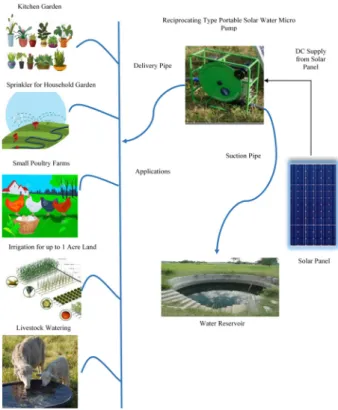
Impelled water can be used for various practices like livestock requirements for far-flung locations, irrigation of small fields, kitchen gardens and small farmhouses, etc. The impelled water can also be used to cater sanitation requirements in lavatories for convenient and effective utilization of solar energy and prevent water wastage. In this paper, characteristics, operating principle and practices of portable solar water micro pumping system (SWMPS) are described according to Indian requirements.
The development of micro pumps started with piston type or reciprocating pumps
1). Developing countries e.g. India, Sub Saharan Africa etc. have identified solar pumps as a climate smart technology to meet the growing irrigation demand
2). Experimental Analysis and simulation study of solar powered water pumping system
3)by optimizing the power conversion reveal the fact that, the performance of the SWPS is maximum at midday. The work presented in
4), categorize the renewable
51
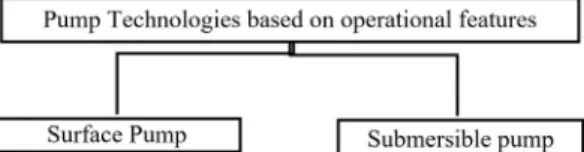
Fig. 1. Pump classification (operational features)
Fig. 2. Pump classification (constructional features)
energy source water pumping systems (RESWPs) into five
different groups. The performance of each category i.e., biomass water pumping systems (BWPSs), solar photovoltaic water pumping systems (SPWPSs), solar thermal water pumping systems (STWPSs), wind energy water pumping systems (WEWPSs) and hybrid renewable energy water pumping systems (HREWPSs) highlight the vital role played by renewable energy source in water pumping applications and its environmental impacts.
Energy consumption, water flow rate and crop water requirement are some of the significant aspects which are observed as per present technology and applications of solar water pumping systems
5-8). Solar water pumping technologies have aided in mitigating reliance on the existing diesel or grid-based systems
9). Optimization of multiple micro pumps to maximize the flow rate and minimize the flow pulsation has been discussed in
10). Further, performance analysis of the pumps at different locations, for surface and ground water has been presented in
11). The performance assessment and optimal sizing of the various commercially available pumping systems in Indian market based on has been included in
12-13). The work in
14)investigates the possibility of solar water pumping system for cassava irrigation in China and examines suitable area for solar water irrigation. A systematic approach for optimal sizing of photovoltaic irrigation systems has been discussed in
15-16). The fact that, operating temperature plays a key role in photovoltaic systems and exhibits linear variations with respect to the output power of a PV module has been presented in
17). The work in
19), investigates the socio-economic changes and their impact on water management pertaining to the wavering energy and water demands. In Sub- Saharan Africa a new solar powered methodology is proposed for irrigation that can be utilized for the small-scale lands in remote rural areas
19). Standalone solar powered water pumping systems are efficient and reliable approach to certain applications
20). Motivated by such observations, governments have incorporated certain initiatives to achieve the electrification target for effective utilization of green energy sources
21). Importance of SWPS for small land holders, pertaining to associated economic barriers restricting their ability to utilize such systems has been elaborated in
22). The measures undertaken by Government of India by means of policies and schemes, particularly for women and underprivileged groups, in order to address these restrictions have been discussed in
23). All these factors contribute in making SPV system, an economically attractive renewable technology
25). The significance of operating heads on various SPV water pumping systems using optimum PV array configuration has been
discussed in
26). The effects of variation in irradiation, on the performance of SPVWPS has also been premeditated
27). A cost sensitive analysis towards climatic conditions and geographical parameters is proposed smartly for system sizing and optimi- zation
28-29). The concept of centralized SPVWPS for domestic usage with emphasis on average water requirement has been investigated in
30). Optimal photovoltaic arrangement to cater requirements of agriculturists has been included in
31).
The work included in this paper introduces the concept of portable solar water pumps. The system employs an irrigation pump designed to meet requirements of the target beneficiary.
For small land farmers in remote areas, portability is still an important requirement to address the threat of expensive equip- ment being stolen. Portable solar water micro pump systems intend to develop a plug and play compatible SPVWPS that can be carried by a person in hand/on a bicycle. The portability enables using the system at different locations/sites without much effort. The work provides analysis of systems employing centrifugal / reciprocating technology-based surface Pumps.
Comparative study concluding DC Pumps to be more efficient than their AC counterparts has also been included.
2. Portable Solar Water Micro Pumps
Pumps can be broadly classified into Surface and Submersible
type based on their constructional features. However, portable
solar powered micro pumps readily integrate surface type pumps,
as these pumps can be operated by placing near the source of
water (like river, lake or storage tank) to the field. Surface
pumps are low-cost, high-efficiency pumps that require less
maintenance and are easy to install.
Fig. 3. DC surface solar water pumping system
Fig. 4. Centrifugal type portable solar water pumping system
Fig. 5. Reciprocating type portable solar water micro pumping system
Surface pumps can lift water up to 8-meter maximum height for instance, surface type water pumping systems are adapted where water is required to drive from a dam or cistern to a storage tank on the field. There are three main technologies of solar water pump system given below in Fig. 2.
2.1 Centrifugal pump
This type of pump utilizes rotational kinetic energy to pull water. The pumps employ rotating impellers to impel water. The capacity of the pump is determined by the number of impellers employed. Multistage pumps are capable of achieving high output pressure and high rate of water flow. Water enters the impeller core axially and accelerated outwards by radial push of the impellers. Centrifugal pumps are most conventional AC pumps. However, the pumps required relatively high operating voltage to perform steadily. Therefore, performance is poor in cloudy weather, early morning and late evening when irradiation is relatively lower.
2.2 Positive displacement pump
This type of pump uses a piston to pump water, the displace- ment of water in positive cycle which brings water into a chamber and then forces it out using a piston. Piston-type pumps achieve high lifts and are capable of drawing water from relatively deeper ground levels. These pumps are relatively slower than other technologies but perform better, even in low power operating conditions. The major difference in operational principle between the two technologies is that, while the centrifugal pump utilizes rotational kinetic energy of impeller to pump fluid, the recipro-
cating pump is a positive displacement type pump. This enables
the reciprocating pumps to handle even viscous fluids making them
less sensitive to debris and other solid particles. Reciprocating
pumps are generally ‘Farmer-Repairable’ (excepting DC Motor
and Solar PV Panels). With a proper Remote Monitoring being
installed, the System can provide advance intimation of pump-
health to the Technical Support team. Having a practical suction
capability of 8 meter with a total lift of 15 meter. It can be used
to pump water from wide range of water sources - open-wells,
lakes, ponds, canals, tanks, etc.
3. Experimental Setup & Methodology
The Solar Water Pump test facility established at National Institute of Solar Energy mainly consists of a sump well (10 m deep), Total head up-to 100 m and shut off dynamic head up-to 150 m. Which can create suction head from 0 to 7 meters for surface pumps. PV arrays of different capacities, mounted on suitable metallic structures conforming to the Standards specified by MNRE are installed for powering the pumps; the modules are configured in series and parallel to attain the required power output. Modules installed with SPV water pumping system are IEC 61215 and IEC 61730 Part I and II certified. Flow meters and pressure gauges are installed in the facility for a continuous monitoring of the flow and delivery pressure. The electrical output of these meters is automatically logged by the SCADA system which records all the parameters including the array- voltage/current, motor/pump voltage/current, radiation level both horizontal and tilted, module surface temperature, etc. on continuous basis, with periodicity of 10 seconds. The parameters are averaged over a period of 10 minutes and a data is stored in a memory as programmed. Two solar array simulators (Make:
CHROMA) are deployed for simulating the array output power.
The performance of the system can be determined by evaluating the data acquired under varying conditions. The performance evaluation can be performed either under laboratory (replicable and reproducible) conditions through simulators, or under field conditions for acceptance test through outdoor PV arrangements.
The programmable PV simulators are capable of simulating the necessary configuration (i.e., number of modules, type and required series/parallel combination) for laboratory test. The general layout of the system pipe work has been designed to avoid airlocks. For instantaneous performance testing, pressure can be sustained by means of a simple gate valve in which, a backpressure is sustained by restricting the flow. Separate valves were also deployed to sustain a constant upstream pressure (pressure sustaining valves). Necessary measures were practiced to counter the unpredictable performance of such valves. If possible, test laboratories may also sustain pressure by means of a pre-pressurized air chamber operating with a pressure maintaining valve at the outlet or a real water column. Water output is calculated in terms of liters per watt-peak against total irradiance and liters per day against total irradiance. Parameters like solar insolation, V
in, V
out, I
out, P
in, P
out, temperature of water, are measured to study the performance and feasibility.
3.1 Performance evaluation of pumps
Based on the capacity, size and head of operation four pumps were selected out of available solar water pumps in Indian Market (both indigenous and Foreign Manufacturers). The performance characterization was done on the basis of System Efficiency, Subsystem Efficiency, and Flow rate. Of these, the available DC systems are either directly connected, or are connected through an electronic controller for impedance matching. The controller can be either integrated with motor-pump or included separately connected to either brushes or electronically commutated motor-pump unit where the corresponding controls are integral with motor-pump. In case of systems employing AC motor-pump arrangement, a DC/AC inverter is integrated into the arrangement. For instantaneous performance testing, pressure can be sustained by means of a simple gate valve in which a backpressure is sustained by restricting the flow (IEC 62253).
3.1.1 Performance measurement
The following guidelines were practiced to ensure accuracy in results:
The pipeline set-up between the pump outlet and the pressure sensor should be of the same inner diameter as the manufacturer’s outlet fitting. It is assumed that, over the normal operating range of the pump, the pressure drop due to frictional losses between the pump outlet and the pressure sensor will be negligible. The kinetic energy component of the water at the pump outlet will be small compared to the increase in potential energy due to the increased pressure across the pump.
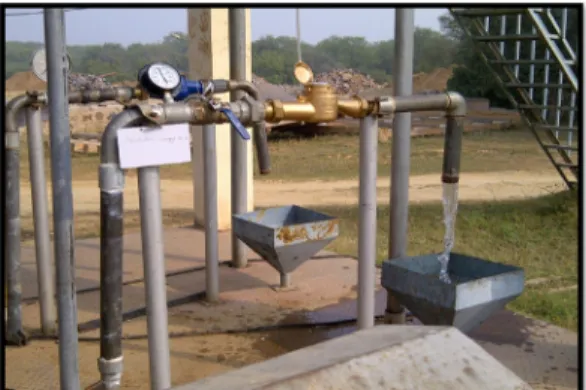
A flow meter is used to measure flow of water as shown in Fig. 6 (a), then the end of the discharge pipe should be beneath the water surface to prevent splashing. If the bucket and stopwatch method (field method) is used, it is not possible to discharge the water beneath the surface. Under such circumstances, a vertical baffle shall be inserted in the tank between the pump intake and the return pipe such that water has to pass under the baffle near the bottom of the tank to reach the pump. Alternatively, a large pipe can be placed around the pump with its top breaking the surface and an arch cut in its base to allow water entry and step by step test procedure is shown in Fig. 6 (b).
Subsystem efficiency is defined as the total hydraulic energy output divided by total PV power input.
Fig. 6. (a) Experimental test setup for performance analysis of water pumping system
Fig. 6. (b) Flowchart of the performance evaluation process of the solar water pumping system
Table 1. Standards for PV Array
Standards For PV Array
Sr. no. Standard Name Description
1. IEC 62124 PV Standalone system design verification
2. IEC 61725 Analytic Expression for daily solar profile
3. IEC 62548 Design requirements for
photovoltaic (PV) arrays
Table 2. Standards for pumps no.Sr. Standard
Name Description
1. IEC 62253 Design Qualification & Performance Measure 2. IS 14582 Single Phase Small A.C. Electric Motors for Centrifugal Pumps for Agricultural Applications
— Specification
3. IS 11346 Tests for Agricultural And Water Supply Pumps
— Code Of Acceptance 4. IS 14536 Selection, Installation, Operation and
Maintenance of Submersible Pump set -Code of Practice
5. IS 5120 Technical Requirements for Roto-dynamic Special Purpose Pumps 6. IS 14220 Open-well Submersible Pump sets
—Specification
Table 3. PV array capacity and micro pump configuration
N. NameS.
PV Array capacity and
Pump Configuration
Uses Type Total
Head
1. A 80 Watt Peak and 12 volts
open wells / rivers / farm ponds / tanks / streams
etc
HP DC Surface
(Type: pump Centrifugal)
5 to 40 m
2. B 80 Watt Peak and 24 volts
bore wells as well as open wells/rivers/farm
ponds/tanks etc
0.1 HP DC Surface
(Type: pump Centrifugal)
5 to 70 m
3. C 120 Watt Peak and 36 volts
Small-holder/
Marginal farmer, having small scattered holding,
Having shallow sub-terrane water or access to river/
lake/pond/canal system. Having little or no access
to grid-electricity
0.1 HP DC Surface
(Type : pump Piston)
10 m
4. D 300 Watt Peak and 36 volts
Small-holder/
Marginal farmer, having small/
scattered holding, Having shallow sub-terrane water or access to river/
lake/pond/canal system. Having little or no access
to grid-electricity
0.25 HP DC Surface
Pump (Type:
Piston) 10 m
Table 4. Comparative analysis between centrifugal pump and reciprocating pump
S.N. Performance
Parameters Centrifugal
Pump Reciprocating
Pump
1. Efficiency Low High
2. Reliability High High
3. Total Head Suction Head is low but Delivery Head is
high
Suction Head is high but Delivery Head is
low 4. Applications
Kitchen Garden, Toilet Sanitation, Sprinkler but not suitable for irrigation
Kitchen Garden, Toilet Sanitation, Sprinkler and also suitable for irrigation upto 1 Acre
area land
5. Cost Low High
6. Remote
Monitoring Unit Not provided Provided
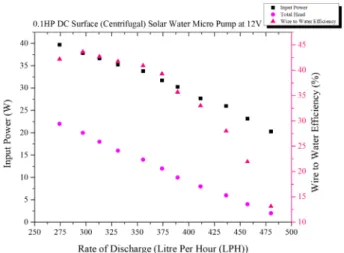
Fig. 7. 0.1HP DC surface (centrifugal) solar water micro pump at 12V
Fig. 8. 0.1HP DC surface (centrifugal) solar water micro pump at 24V
Wire to Water Efficiency is defined as total hydraulic energy divided by total power
Flow rate is defined as the water output of the Pump & Motor per unit time
3.2 Selection of the solar water pumping system Based on study of the pump performance at laboratory, the following parameters were identified as key parameters in context of Indian market: the operating head, total water output required per watt per day, wire to water efficiency and utilization factor.
The performance of Surface Pumps was observed to be good for lower head operation whereas, Submersible pumps were observed to perform better for higher head operation. Outcomes of the comparative analysis have been summarized in Table 4.
4. Discussion
A 0.1HP, 80Watt, DC surface pump was analyzed for operating voltage of 12V, 24V and 36V. Figure 7 depicts the estimation of wire to water efficiency with respect to rate of discharge of water and input dc power for a DC centrifugal surface pump at 12V. It has been observed that, at maximum head (22 m), the wire to water (WTWE) efficiency is 42.21% and input power is
39.72W. The maximum WTWE efficiency is observed to be 43.64% @ input power of 37.8W and operational head 20 m.
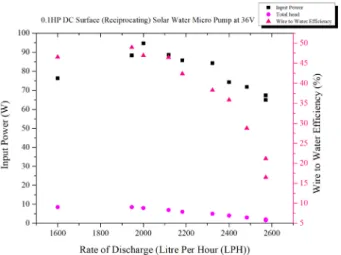
Estimation of wire to water efficiency with respect to rate of discharge of water and input dc power for a DC centrifugal surface pump at 24V is shown in Figure 8. At the maximum head (22 m). the WTWE efficiency is observed to be 46.47% and input power drawn is 44.56W which corresponds to its maximum WTWE efficiency. Fig. 9 records the estimation of wire to water efficiency with respect to rate of discharge of water and input dc power supply for the system at 36V. It is found that at maximum head of 8.5 m, the WTWE efficiency is 46.57% and input power is 76.35W. The maximum WTWE efficiency of 48.97% is also recorded for operational head of 8.5 m with input power of 88.31W due to increased irradiance.
Fig. 10: shows the estimation of wire to water efficiency with
respect to rate of discharge of water and input dc power supply
for a 0.25HP, DC surface pump. It is found that at maximum
Fig. 9. 0.1HP DC surface (reciprocating) solar water micro pump at 36V
Fig. 10. 0.25HP DC surface (reciprocating) solar water micro pump
head of 61 m, the WTWE efficiency is 62.69% with input power is 143.10W. The maximum WTWE efficiency of 67.86% was recorded with input power of 112W for operational head of 31 m.
5. Conclusion
The work presented in this paper establishes that Solar Water Micro Pumping Systems are portable, easy to use and require less maintenance. The analytical results of different technologies of solar water micro pumps demonstrates performance analysis between centrifugal and reciprocating technologies. Comparative analysis elaborate that reciprocating pumps are more efficient.
Although solar water micro pumps are suitable for only limited practices, the observations reveal this configuration being, sustainable and cost-effective method for marginal farmers along with applications like kitchen gardens, farm houses, etc.
without the consumption of electricity and conventional fuel, thereby providing a cost-effective alternative.
Acknowledgement
The authors gratefully acknowledge the support of Mr. Jitendra Lakhani, Future Pumps Ltd.(India) and Mr. Anupam Baral, Geetanjali Pumps Ltd. (India), for their valuable guidance.
References
1. Peter Woias, Micropumps—past, progress and future prospects Albert-Ludwigs-University Freiburg, Institute for Microsystem Technology (IMTEK), Design of Microsystems, Georges- Köhler-Allee 102, D-79110 Freiburg, Germany Available online 6 May 2004.
2. Petra Schmittera et al., Suitability mapping framework for solar photovoltaic pumps for smallholder farmers in sub-Saharan Africa, https://doi.org/10.1016/j.apgeog.2018.02.008.
3. NejibHamrouni et al., Theoretical and experimental analysis of the behavior of a photovoltaic pumping system, doi: 10.1016/
j.solener.2009.03.006.
4. C. Gopal et al., Renewable energy source water pumping systems - A literature review, doi.org/10.1016/j.rser.2013.04.012.
5. A.K. Plappally et al., Energy requirements for water production, treatment, end use, reclamation, and disposal, Cambridge, MA 02139-4307, USA, doi.org/10.1016/j.rser.2012.05.022.
6. M. Benghanem et al., Estimation of daily flow rate of photovoltaic water pumping systems using solar radiation data, doi.org/
10.1016/j.rinp.2018.01.022.
7. Maina Kumari et al., Crop Water Requirement, Water Pro- ductivity and Comparative Advantage of Crop Production in Different Regions of Uttar Pradesh, India.
8. S.S. Chandel et al., Review of solar photovoltaic water pumping system technology for irrigation and community drinking water supplies, doi.org/10.1016/j.rser.2015.04.0831364-0321/& 2015 Elsevier.
9. Saeed Mohammed Wazed et al., Solar Driven Irrigation Systems for Remote Rural Farms, 9th International Conference on Applied Energy, 10.1016/j.egypro.2017.12.030.
10. P. Dhananchezhiyana et al., Optimization of Multiple Micro Pumps to Maximize the Flow Rateand Minimize the Flow Pulsation, doi: 10.1016/j.protcy.2016.08.212.
11. M. AyubHossaina et al.,Technical and economic feasibility of solar pump irrigations for eco-friendly environment, doi:
10.1016/j.proeng.2015.05.047.
12. Renu et al., Optimum sizing and performance modeling of Solar Photovoltaic (SPV) water pumps for different climatic conditions, doi.org/10.1016/j.solener.2017.07.058 0038-092X/c 2017 Elsevier.
13. V.S. Korpale et al., Performance Assessment of Solar Agricultural
Water Pumping System, doi: 10.1016/j.egypro.2016.11.219.
14. Yingdong Yu et al., The feasibility of solar water pumping system for Cassava irrigation in Guangxi Autonomous Region, China, 10.1016/j.egypro.2017.12.070.
15. Zvonimir Glasnovic et al., A model for optimal sizing of photo- voltaic irrigation water pumping systems, doi: 10.1016/j.solener.
2006.11.003.
16. Chergui M.I et al., Optimization of the photo pumping system control, doi: 10.1016/j.egypro.2011.05.020.
17. Swapnil Dubey et al., Temperature Dependent Photovoltaic (PV) Efficiency and Its Effect on PV Production in the World A Review, doi: 10.1016/j.egypro.2013.05.072.
18. Andrea Momblanch et al., Untangling the water-food-energy- environment nexus for global change adaptation in a complex Himalayan water resource system, doi.org/10.1016/j.scitotenv.
2018.11.045.
19. Saeed Mohammed Wazed et al., Solar Driven Irrigation Systems for Remote Rural Farms, 10.1016/j.egypro.2017.12.030.
20. Chuanlin Jin et al., Energy Conversion Stage Design of Solar Water Pump in a Nanofiltration System, doi: 10.1016/
j.egypro.2011.10.137.
21. Rajib Baran, Roy Design and Performance Analysis of the Solar PV DC Water Pumping System, Canadian Journal on Electrical and Electronics Engineering Vol. 3, No. 7, September 2012.
22. Karen G. Villholth, Groundwater irrigation for smallholders in Sub-Saharan Africa - a synthesis of current knowledge to guide sustainable outcomes, Water International, 2013, Vol. 38, No. 4, 369-391, http://dx.doi.org/10.1080/02508060.2013.821644.
23. Saad Asghar Moeeni et al., Solar Photovoltaic Water Pumping
System for Pressurized Irrigation, Environmental and Earth Sciences Research Journal, ISSN: 2369-5668, Vol. 3, No. 3, September 2016, pp. 41-43 DOI: 10.18280/eesrj.030302.
24. K. Padmavathi, S. Arul Daniel, Studies on installing solar water pumps in domestic urban sector, Department of Electrical and Electronics Engineering, National Institute of Technology, Tiruchirappalli 620015, T.N., India.
25. Robert Fostera Solar water pumping advances and comparative economics, Energy Procedia 57 (2014) 1431-1436, doi: 10.1016/
j.egypro.2014.10.134.
26. M. Benghanem Effect of pumping head on solar water pumping system, Energy Conversion and Management 77 (2014) 334- 339, http://dx.doi.org/10.1016/j.enconman.2013.09.043.
27. Arunendra K. Tiwari Effects of total head and solar radiation on the performance of solar water pumping system, Renewable Energy (2017), doi: 10.1016/j.renene.2017.11.004.
28. Imene Yahyaoui Energetic and economic sensitivity analysis for photovoltaic water pumping systems, http://dx.doi.org/
10.1016/j.solener.2017.01.0400038-092X/c 2017 Elsevier.
29. P.E. Campana Economic optimization of photovoltaic water pumping systems for irrigation, Energy Conversion and Management 95 (2015) 32-41, http://dx.doi.org/10.1016/
j.enconman.2015.01.0660196-8904/c 2015 Elsevier.
30. A. Allouhi et.al. PV water pumping systems for domestic uses in remote areas: Sizing process, simulation and economic evaluation, Renewable Energy (2018), doi: 10.1016/j.renene.
2018.08.019.
31. V.S. Korpale Performance Assessment of Solar Agricultural Water Pumping System, Energy Procedia 90 (2016) 518-524, ICAER 2015, doi: 10.1016/j.egypro.2016.11.219.