pISSN 1229-3008 eISSN 2287-6251
Progress in Superconductivity and Cryogenics
Vol.16, No.2, (2014), pp.20~23 http://dx.doi.org/10.9714/psac.2014.16.2.020
```
1. INTRODUCTION
More than a decade ago, a simple binary boride, MgB2, had been discovered to be a superconducting compound with a Tc ≈ 39 K [1], one of the highest transition temperatures observed for any non-cuprate material. A great number of experimental and theoretical investigations have been subjected to MgB2 [2-5], not only to understand its superconducting mechanism, but also to explore its future prospect, especially in the power cable industry.
It has been widely known that SiC doping is one of the effective methods to improve the superconducting properties of MgB2 [6-8]. In our current work, we are applying SiC in a slightly different form; a form of buffer layer. The usage of amorphous SiC impurity layers had also proven to improve the critical current density (Jc) values of MgB2 films [9]. Furthermore, based on our previous works [10-11], MgB2 films with crystalline SiC buffer layers deposited on Al2O3 substrates have been confirmed to enhance Jc values.
In order to be able to be manufactured in a larger scale, more applicable metallic substrates are required to produce high-quality MgB2 superconductors. Wide variety of metallic substrates has been applied in the making of MgB2 superconducting tapes throughout the years [12-14]. All of which were made without inserting any buffer layer.
However, the Jc values of these different substrates-MgB2 films are not fairly high. For this reason, we have been investigating the usage of SiC buffer layer deposited on metal Hastelloy tape as the substrate in MgB2 film.
Hastelloy itself has been noted to have several advantages,
such as highly flexible, low corrosive and low AC loss-material [15]. And as for SiC buffer layer, its presence is highly anticipated to overcome several potential issues that might occur if we use Hastelloy tape as the substrate.
Preventing metal diffusion that could penetrate the MgB2 films, supplying the carbon which may be needed to enhance Jc; are some of the SiC buffer layers expected roles in fabricating MgB2 tapes.
Principally, this preliminary work was conducted based on our belief that SiC buffer layer plays a significant part in improving MgB2 superconducting properties when SiC buffer layers placed on the Al2O3 substrate. And since the effect of SiC/Hastelloy on MgB2 tapes has not extensively exposed, there are possibilities of getting interesting results on the superconducting properties of MgB2 films when SiC is applied on the metal Hastelloy.
This study on SiC buffer layers is essential to accommodate basic knowledge on the feasibility of SiC/Hastelloy structure to improve the Jc values of MgB2 tapes. Hopefully, by introducing metallic Hastelloy tape as the substrate for SiC buffer layer, there are much room for improvement for the production of better-quality of MgB2 tapes in the near future.
2. EXPERIMENTS
The substrate used for SiC buffer layer fabrication in this work was metallic Hastelloy tape. A typical pulsed laser deposition process involved heating the substrate to 400, 500, and 600 oC, and keeping it at these temperatures for 10 min by means of pulsed laser deposition (PLD) which then
A possibility of enhancing Jc in MgB2 film grown on metallic hastelloy tape with the use of SiC buffer layer
W. B. K. Putria, B. Kang*, a, M. Ranotb, J. H. Leeb, and W. N. Kangb
a Department of Physics, Chungbuk National University, Cheongju, Korea
b Department of Physics, Sungkyunkwan University, Suwon, Korea
(Received 9 June 2014; revised or reviewed 19 June 2014; accepted 20 June 2014)
Abstract
We have grown MgB2 on SiC buffer layer by using metallic Hastelloy tape as the substrate. Hastelloy tape was chosen for its potential practical applications, mainly in the power cable industry. SiC buffer layers were deposited on Hastelloy tapes at 400, 500, and 600 oC by using a pulsed laser deposition method, and then by using a hybrid physical-chemical vapor deposition technique, MgB2 films were grown on the three different SiC buffer layers. An enhancement of critical current density values were noticed in the MgB2 films on SiC/Hastelloy deposited at 500 and 600 oC. From the surface analysis, smaller and denser grains of MgB2 tapes are likely to cause this enhancement. This result infers that the addition of SiC buffer layers may contribute to the improvement of superconducting properties of MgB2 tapes.
Keywords: MgB2 films, critical current density, SiC buffer layers, Hastelloy
* Corresponding author: [email protected]
W. B. K. Putri, B. Kang, M. Ranot, J. H. Lee, and W. N. Kang
created a thickness of less than 200 nm. The deposition was conducted inside the vacuum chamber of ~10-6 Torr. Laser beams were generated from a KrF excimer laser (λ = 248 nm) and the laser energy was set at 230 mJ with a repetition rate of 8 Hz.
MgB2 thin films were fabricated inside a hybrid physical-chemical vapor deposition (HPCVD) system. The SiC/Hastelloy tapes were then heated up to 550 oC in 100 Torr of H2 gas flow for 15 minutes. As for the pure MgB2, bare Hastelloy tape was used as the substrate. B2H6 : H2 gas flow at 10 : 90 sccm was introduced into the quartz reactor to start the growth of MgB2 films. At last, the fabricated films were cooled down to room temperature in a flowing H2 carrier gas. As a result, the thickness of MgB2 films is less than 1 μm in average.
The surface morphology and the structure of the MgB2 films were investigated using scanning electron microscopy (SEM) and X-ray diffraction (XRD). The values of critical current density Jc were carried out from the magnetization measurements obtained by using a magnetic property measurement system (MPMS).
3. RESULTS AND DISCUSSIONS
In Fig. 1, the XRD patterns (θ-2θ scans) for both pure MgB2 films grown on bare Hastelloy tape and MgB2 films deposited on SiC/Hastelloy buffer layers with three SiC deposition temperatures of 400, 500, and 600 oC are shown.
The different temperatures are essential for crystalline SiC buffer layers to be properly grown on the Hastelloy substrates. This was also done in our previous works on MgB2/SiC/Al2O3 [10-11]. The crystalline SiC was formed as the temperature increased. However, SiC peaks are hard to detect by XRD alone; they inconsistently appear as
Fig. 1. X-ray diffraction patterns of the MgB2 films with SiC buffer layers deposited on Hastelloy tape at temperatures of: (a) 400, (b) 500, (c) 600 oC, and (d) Pure MgB2, respectively. The peaks labeled with an asterisk arise from the Hastelloy tape substrate.
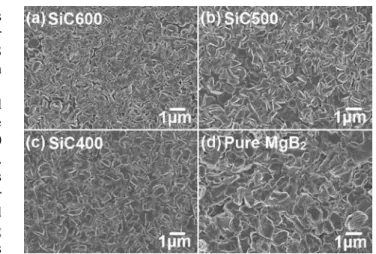
Fig. 2. Plane SEM images for MgB2 films on Hastelloy tape with SiC buffer layers deposited at different temperatures of: (a) 400, (b) 500, (c) 600 oC, and (d) Pure MgB2 grown on bare Hastelloy tape.
minor peaks in some of SiC/Hastelloy samples of our other works. This may due to the reaction between SiC and Hastelloy which affected the structure of SiC buffer layers.
As can be seen in the figure, the MgB2 (101) peaks of MgB2/SiC/Hastelloy films are becoming less intense, while pure MgB2 shows a slightly higher intensity of the peak.
Other peaks appeared on the patterns are combination between MgB4 and Boron peaks with various axis orientations. This result is comparable with others’ reports on MgB2/Hastelloy tapes which showed relatively small MgB2 (101), MgB4 and Boron peaks [16-18].
In Fig. 2. SEM images of pure MgB2 film and MgB2 films deposited at different temperatures on SiC/Hastelloy are presented. The grains of pure MgB2 in Fig. 2(d) seems to be bulkier than the other MgB2 films on SiC/Hastelloy.
Whereas MgB2 films deposited on SiC/Hastelloy are showing smaller-leaner grains along with various orientations of the grains which are in conformity with the XRD results that showed all MgB2 samples have randomly oriented grains. These random-oriented grains are also found in our related works on MgB2/SiC/Al2O3 films [11].
At cross section area (not shown here), all MgB2 samples have approximately less than 1 μm thickness.
In addition, pure MgB2 film displayed a delaminating problem in which the quality of the film surface deteriorated to a point where the film had become relatively fragile to handle. However, that was not the case with MgB2/SiC/Hastelloy films where all the samples are firmly attached at the surface. This implies that SiC somehow improve the quality of the surface and prevent the delaminating issue. It also gives us a hint that thicker MgB2 of more than 1 μm would solve the delaminating issue, and hence significantly upgrade the surface condition. In another on-going work, we have deposited a thicker MgB2 film on Hastelloy tape and the thicker MgB2 has been proven to stop the surface to be delaminated.
21
A possibility of enhancing Jc in MgB2 film grown on metallic hastelloy tape with the use of SiC buffer layer
103 104 105 106 107
0 1 2 3 4 5
103 104 105 106 107
5 K
(a)
SiC600 SiC500 SiC400 Pure MgB2
20 K
(b) Jc(A/cm
2 )
H(T)
SiC600 SiC500 SiC400 Pure MgB2
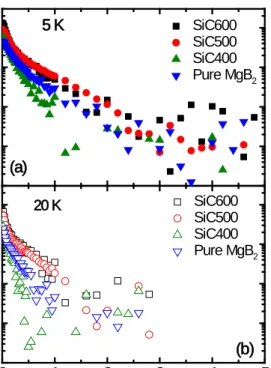
Fig. 3. Effect of SiC buffer layers on the field dependence of critical current density (Jc) curves measured at (a) 5 and (b) 20 K for pure and SiC-buffered-MgB2 films. MgB2 samples with SiC buffer layers grown on Hastelloy tape at 500 and 600 oC show larger Jc values than those of pure MgB2 at whole field region.
Another important parameter for practical applications of MgB2 is the critical current density (Jc). The values of Jc for pure MgB2 and MgB2/SiC/Hastelloy films when subjected to an applied magnetic field are showed in Fig. 3.
Jc values were obtained from the magnetization hysteresis loops (MHLs) using the Bean critical model [19].
The Jc-H behavior at both temperatures of 5 and 20 K has been improvedwith the addition of SiC buffer layers deposited at 500 and 600 oC, while pure MgB2 films show relatively lower Jc at the whole magnetic field region.
MgB2 films on the SiC buffer layer deposited at 500 and 600 oC showed enhanced Jc values over the whole magnetic field region, despite the fluctuations of the Jc values which are mainly shown in the higher field region. This may be resulted from the slightly smaller grains size of MgB2 films on the SiC buffer layers when compared with the pure MgB2 film, as depicted in Fig. 2, which then created a stronger pinning source and hence the enhanced Jc values.
On the other hand, the MgB2 film on SiC buffer layer deposited at 400 oC is not showing any enhancement most probably due to the low deposition temperature. This implies that the temperature above 400oC is most likely providing an optimum condition for SiC to be grown completely on the Hastelloy substrate.Additionally, bigger size of the grains of the pure MgB2 film might have generated less strong pinning sources which then contributed to the decreased Jc values.
When compared with the Jc values from other MgB2/Hastelloy tapes [16,18], it is apparent that our Jc has slightly lower values over the whole region. MgB2 thickness of less than 1 μm may be the cause of this low values. In the M-H curves (not shown here), MgB2/SiC/Hastelloy films showed weak superconducting signals, thus at high field region, fluctuation increased. In our on-going work on MgB2/SiC/Hastelloy, thick MgB2 films of more than 2 μm are proven to produce clear and stronger superconducting signals. Nevertheless, our MgB2 films have higher Jc values at zero fields than the ones of another report [17].
Even though the enhancement of Jc values of MgB2/SiC/Hastelloy films are still lower than those of the MgB2 films grown on SiC/Al2O3, as reported in our other related works [10,11]; still, this result indicates a positive signal of the possibility of enhancing Jc values of MgB2 films by using a SiC/Hastelloy structure.
4. CONCLUSION
SiC buffer layers on metallic Hastelloy tapes are likely to enhance the Jc values of MgB2 films. Enhancement of Jc is may resulted from the alteration in microstructure, grain sizes, and grain orientations of MgB2/SiC/Hastelloy films.
However, more detailed analysis on the pinning source may provide better understanding on the cause of these Jc
enhancements.
Our work emphasizes the importance of fabricating MgB2 films on SiC buffer layers with potential substrates, such as Hastelloy tape. This preliminary study, practically, provides a good start for more possibilities in fabricating better and more advanced MgB2/SiC/Hastelloy films. It is our hope that this result would be an auspicious beginning for improving the superconducting properties of MgB2 tapes which would be a substantial breakthrough in the power cable applications.
ACKNOWLEDGMENT
This work was supported by the Basic Science Research Program through the National Research Foundation of Korea (NRF) funded by the Ministry of Education, Science and Technology (2012R1A1A2008429).
REFERENCES
[1] J. Nagamatsu, N. Nakagawa, T. Muranaka, Y. Zenitani, and J.
Akimitsu, “Superconductivity at 39 K in magnesium diboride,”
Nature, vol. 410, pp. 63–64, Mar. 2001.
[2] S. X. Dou, S. Soltanian, J. Horvat, X. L. Wang, P. Munroe, S. H.
Zhou, M. Ionescu, H. K. Liu, and M. Tomsic, “Enhancement of the critical current density and flux pinning of MgB2 superconductor by nanoparticle SiC doping,” Appl. Phys. Lett., vol. 81, pp. 3419–3421, Oct. 2002.
[3] M. D. Sumption, M. Bhatia, M. Rindfleisch, M. Tomsic, S.
Soltanian, S. X. Dou, and E. W. Collings, “Large upper critical field
22
W. B. K. Putri, B. Kang, M. Ranot, J. H. Lee, and W. N. Kang
and irreversibility field in MgB2 wires with SiC additions,”Appl.
Phys. Lett., vol. 86, pp. 92507, Feb. 2005.
[4] A. Matsumoto, H. Kumakura, H. Kitaguchi, B. J. Senkowicz, M. C.
Jewell, E. E. Hellstrom, Y. Zhu, P. M. Voyles, and D. C.
Larbalestier, ”Evaluation of connectivity, flux pinning, and upper critical field contributions to the critical current density of bulk pure and SiC-alloyed MgB2,” Appl. Phys. Lett., vol. 89, pp. 132508, Sep.
2006.
[5] Y. Feng, Y. Zhao, A. K. Pradhan, L. Zhou, P. X. Zhang, X. H.Liu, P.
Ji, S. J. Du, C. F. Liu, Y. Wu and N. Koshizuka,”Fabrication and superconducting properties of MgB2 composite wiresby the PIT method,” Supercond. Sci. Technol., vol. 15, pp. 12, Jan. 2002.
[6] S. X. Dou, V. Braccini, S. Soltanian, R. Klie, Y. Zhu, S. Li, X. L.
Wang, and D. Larbalestier,”Nanoscale-SiC doping for enhancing Jc
and Hc2 in superconducting MgB2,” J. Appl. Phys., vol. 96, pp. 12, Dec. 2004.
[7] G. Serrano, A. Serquis, S. X. Dou, S. Soltanian, L. Civale, B.
Maiorov, T. G. Holesinger, F. Balakirev, and M. Jaime,”SiC and carbon nanotube distinctive effects on the superconducting properties of bulk MgB2,” J. Appl. Phys., vol. 103, pp. 023907, Jan.
2008.
[8] R. Zeng, S. X. Dou, L. Lu, W. X. Li, J. H. Kim, P. Munroe, R. K.
Zheng, and S. P. Ringer, ”Thermal-strain-induced enhancement of electromagnetic properties of SiC-MgB2 composites,” Appl. Phys.
Lett., vol. 94, pp. 042510, Jan. 2009.
[9] S-G. Jung, S. W. Park, W. K. Seong, M. Ranot, W. N. Kang, Y.
Zhao, S. X. Dou,”A simple method for the enhancement of Jc in MgB2 thick films with an amorphous SiC impurity layer,”
Supercond. Sci. Technol., vol. 22, pp. 075010, June 2009.
[10] W. B. K. Putri, D. H. Tran, B. Kang, N. H. Lee, W. N. Kang, and S.
J. Oh,”Enhancement in high-field Jc properties and the flux pinning mechanism of MgB2 thin films on crystalline SiC buffer layers,”
Supercond. Nov. Magn., vol. 27, pp. 401, Feb. 2014.
[11] W. B. K. Putri, D. H. Tran, B. Kang, M. Ranot, J. H. Lee, N. H. Lee, and W. N. Kang, “Effect of different thickness crystalline SiC buffer layers on superconducting properties and flux pinning mechanism of MgB2 films,” IEEE Trans. Magn., vol. 50, pp. 6, June 2014.
[12] L.-P. Chen, F. Li, T. Guo, C.-G. Zhuang, D. Yao, L.-L. Ding, K.-C.
Zhang, Z.-Z. Gan, G.-C. Xiong, and Q.-R. Feng, “Deposition of MgB2 superconducting films on different metal substrates,” Chin.
Phys. Lett., vol. 24, pp. 2074, July 2007.
[13] C. Zhuang, D. Yao, F. Li, K. Zhang, Q. Feng, and Z. Gan, “Study of micron-thick MgB2 films on niobium substrates,” Supercond. Sci.
Technol., vol. 20, pp. 287, Feb. 2007.
[14] F. He, D. Xie, Q. Feng, and K. Liu, “MgB2 films fabricated on molybdenum substrate by hybrid physical-chemical vapor deposition for superconducting RF cavity applications,” Supercond.
Sci. Technol., vol. 25, pp. 065003, March 2012.
[15] M. Sugano, K. Osamura, W. Prusseit, H. Adachi, and F. Kametani,
“Improvement of strain tolerance in RE-123 coated conductors by controlling the yielding behavior of Hastelloy c-276 substrates,”
IEEE Trans. Appl. Supercond., vol. 17, No. 2, June 2007.
[16] M. Ranot, K. Cho, W. K. Seong, S. Oh, K. C. Chung, and W. N.
Kang, “Effects of B2H6 flow rate and deposition time on superconducting properties of MgB2/Hastelloy tapes,” Physica C, vol. 471, pp. 582-585, July 2011.
[17] D. H. Kim, Y. S. Park, T. J. Hwang, M. Ranot, W. N. Kang, and K.
C. Chung, “Transport properties of MgB2 films grown on Hastelloy tape: substrate temperature effect,” J. Kor. Phys. Soc., vol. 62, No. 2, pp. 284-287, Jan. 2013.
[18] M. Ranot, S. Oh, K. C. Chung, and W. N. Kang, MgB2 coated conductors directly grown on flexible metallic Hastelloy tapes by hybrid physical-chemical vapor deposition,” Curr. Appl. Phys., vol.
13, pp. 1808-1812, July 2013.
[19] H. J. Kim, W. N. Kang, E. M. Choi, M. S. Kim, K. H. P. Kim, and S.
I. Lee,”High current-carrying capability in c-axis-oriented superconducting MgB2 thin films,” Phys. Rev. Lett., vol. 87, pp.
0870021, Aug. 2001.
23