* Corresponding author : Tae-Hwan Kim, Department of Animal Science, Institute of Agriculture Science and Technology, College of Agriculture & Life Science, Chonnam National University, Gwangju 500-757, Korea. Tel: +82-62-530-2126, Fax: +82-62-530-2129, E-mail: [email protected]
Research Article
Effects of Cattle Manure and Swine Slurry Acidification on Ammonia Emission as Estimated by an Acid Trap System
Sang-Hyun Park
1, Bok-Rye Lee
1,2and Tae-Hwan Kim
1*
1
Department of Animal Science, Institute of Agriculture Science and Technology, College of Agriculture & Life Science, Chonnam National University, Gwangju 500-757, Republic of Korea,
2Biotechnology Research Institute, Chonnam National
University, Gwangju 500-757, Republic of Korea
ABSTRACT
This study was conducted to assess the efficacy of slurry acidification in reducing ammonia emission from manure storage and application. The non-fermented cattle manure (NFC) and swine slurry (SS) were acidified by sulfuric acid and stored in an acryl chamber for 168 and 96 hours, respectively. Ammonia emitted from the chamber was collected using an acid trap system. The amount of ammonia emission was significantly reduced when the livestock manures were treated with sulfuric acid. The absolute amount of ammonia in NFC increased rapidly starting from 48 h and 72 h in the control (pH 8.6) and acidified NFC (pH 6.5), respectively. The absolute amount of ammonia was the highest at 96 h (3.65 g kg 1 h 1) in the control and at 144 h (2.34 g kg 1 h 1) in pH 6.5 NFC. The cumulative ammonia content in the control continuously increased until 96 h and was maintained until 168 h, whereas the increase rate of emission gas accumulation in acidified NFC was much less throughout the experimental period. Acidification of SS mitigated ammonia emission as proven in NFC. The cumulative amount of ammonia emission was decreased by 49.4% and 92.3% in the acidified SS at pH 6.5 and pH 5.5, respectively, compared to the control at 96 h after treatment. These results indicate that ammonia emission can be significantly reduced by sulfuric acid treatment of livestock manure during processing and the subsequent land application.
(Key words : Ammonia emission, Cattle manure, Swine slurry, Acidification)
. INTRODUCTION
In global agro-ecosystem, the biggest source of ammonia emissions is livestock, estimated to account for 50~85% of total emissions (USEPA, 2004). These emissions occur mostly from livestock housing, manure storage and application of manure onto fields (Sommer and Hutchings, 1995; 2001).
Ammonia volatilization altered the environmental quality (Sommer and Hutchigs, 2001) and may also be a health hazard (Erisman and Schaap, 2004). It also results in fertilizer-N loss when applied onto fields. Moreover, emissions of ammonia have been implicated as indirect greenhouse gas because ammonia deposition could induce the formation of nitrous oxide in the atmosphere (Moiser, 2001; Sanderson et al., 2006). With increasing concerns about climate change and the environmental issues above mentioned, many European countries already have regulations
limiting critical trace-gas emissions such as NH
3(NEC directive; directive 2001/81/EC of the European Parliament and of the Council).
Some techniques have been suggested and evaluated for
decreasing ammonia emissions. For example, urease inhibitors
can be used to reduce the hydrolysis of urea into ammonia
(Parker et al., 2005). The urease inhibitors addition in cattle
and pig slurries prevented the conversion of ammonia from
urea over 70% (Varel, 1997). The use of biological
nitrification-denitrification also converts ammonium into
non-volatile N-species such as nitrite, nitrate, or gaseous
nitrogen (Pan and Drapcho, 2001). The substances are having
a high affinity for NH
4+ions such as zeolite also reduce
ammonia volatilization through decreased concentration of
free NH
4+ions (Kithome et al., 1999). Besides, direct
manure injection or incorporation into the soil reduces
ammonia losses. Direct injections to within 30~300 mm
Table 1. Nitrogen compounds of non-fermented cattle manure (NFC) and swine slurry (SS)
Sample Total N
(g N kg
-1)
NH
4+(mg N kg
-1)
NO
3-(mg N kg
-1)
Organic N (g N kg
-1) NFC
SS
18.6 ± 0.4 1.4 ± 0.2
382.7 ± 14.2 1352.4 ± 13.5
115.5 ± 2.0 18.7 ± 2.0
18.09 ± 0.4 0.01 ± 0.0
Values are mean ± SE of three replicates.Fig. 1. Schematic diagram of the ammonia acid trap system.
depths reduced ammonia volatilization by 47~98% compared to surface application (Smith et al., 2000; Sommer and Hutchings, 2001).
To our knowledge, the strategies in reducing ammonia emission from livestock production have not yet been fully assessed in Korean agricultural environment, although extensive researches are attempting to elucidate the reduction of ammonia volatilization in the world. In addition, it is well documented that nitrogen in manure is converted to either ammonium (NH
4+) under acidic or neutral pH conditions or ammonia (NH
3) at higher pH levels. This indicated that manure pH is an important factors influencing ammonia emission (Bussink et al., 1994). Therefore, this study was conducted to evaluate the effect of sulfuric acid treatment on ammonia emission from two types of livestock manures.
. MATERIALS AND METHODS 1. Experimental design
Non-fermented cattle manure (NFC) and swine slurry (SS)
used in this study were acquired from the local livestock farm and Resourcified Center of Crop-Animal Farming (12, Gigok-ri, Bongsan-myeon, Damyang-gun, Korea). The nitrogen compounds in NFC and SS were shown in Table 1. In order to acidify non-fermented cattle manure (NFC) and swine slurry (SS), the pH of NFC and SS were controlled by sulfuric acid. NFC was divided into 2 groups were designated as control (pH 8.6) and acidified NFC (pH 6.5).
SS was separated into 3 groups were designated as control (pH 7.2), acidified SS (pH 6.5) and acidified SS (pH 5.5).
To collect ammonia emission, we used ammonia trap system which was modified Dräger Tube method described by Ndegwa et al. (2009) (Fig. 1). Five hundred gram of each acidified NFC and SS placed on chamber (20 cm diameter × 30 deep). The chamber attached to NH
3-N trapping bottles containing 20 mL of 50 mM sulfuric acid and a vacuum system to pull air through the chambers. The NH
3-N traps flew a rate of approximately 3 L per minute.
Ammonia emissions were determined for a period of 168
hours from NFC and 96 hours from SS. Ammonia was
collected at the first 12 h and then every 24 h after
acidification treatment.
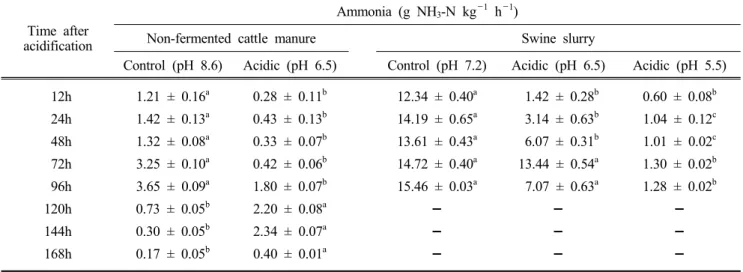
Table 2. Changes in absolute amount of ammonia emitted from non-fermented cattle manure (NFC) and swine slurry (SS) after acidification or under control condition
Time after acidification
Ammonia (g NH
3-N kg
-1h
-1)
Non-fermented cattle manure Swine slurry
Control (pH 8.6) Acidic (pH 6.5) Control (pH 7.2) Acidic (pH 6.5) Acidic (pH 5.5) 12h
24h 48h 72h 96h 120h 144h 168h
1.21 ± 0.16
a1.42 ± 0.13
a1.32 ± 0.08
a3.25 ± 0.10
a3.65 ± 0.09
a0.73 ± 0.05
b0.30 ± 0.05
b0.17 ± 0.05
b0.28 ± 0.11
b0.43 ± 0.13
b0.33 ± 0.07
b0.42 ± 0.06
b1.80 ± 0.07
b2.20 ± 0.08
a2.34 ± 0.07
a0.40 ± 0.01
a12.34 ± 0.40
a14.19 ± 0.65
a13.61 ± 0.43
a14.72 ± 0.40
a15.46 ± 0.03
a1.42 ± 0.28
b3.14 ± 0.63
b6.07 ± 0.31
b13.44 ± 0.54
a7.07 ± 0.63
a0.60 ± 0.08
b1.04 ± 0.12
c1.01 ± 0.02
c1.30 ± 0.02
b1.28 ± 0.02
bValues are mean ± SE of three replicates. Different letters in horizontal row indicate significantly different at p < 0.05 according to the Duncan’s multiple range test.
2. Chemical analysis
The pH was measured after mixing manure sample with water a 1 to 5 ratio (sample: water, w/v) and shaking for 1 h using a rotary shaker. Total nitrogen was determined using Kjeldahl procedure. Inorganic nitrogen was extracted by 2 M KCl solution and the NH
4+-N was determined by distillation in an alkaline medium (MgO). The same procedure was used for NO
3-N after reduction with Devarda’s alloy (Lu, 2000). Ammonia was analyzed by colorimetric method with Nessler’s reagent (Kim and Kim, 1996).
3. Statistical analysis
Duncan’s multiple range tests were used to compare the means of three replications between treatments. Unless otherwise stated, conclusions are based on differences between the means, with the significant level at p 0.05 by using SAS 9.1.3 software.
. RESULTS AND DISCUSSION
The absolute amount of ammonia was calculated by the amount of ammonia emitted from the chamber per hour. In non-fermented cattle manure (NFC), absolute amount of
ammonia was rapidly started to increase at 48 h and 72 h in control and sulfuric acid treated manure, respectively (Table 2). The absolute amount of ammonia was the highest at 96 h (3.65 g NH
3-N kg
1h
1) in control and at 144 h (2.34g kg
1h
1) in acidified NFC (pH 6.5), respectively, and then it was rapidly decreased in both treatments. In swine slurry (SS), absolute amount of ammonia was significantly higher in control (pH 7.2) than in acidified SS (pH 6.5 and pH 5.5). It was noteworthy that ammonia emission under strong acidic condition (pH 5.5) was below 1.3 g NH
3-N kg
1h
1(Table 2). Our results concurrent with Molloy and Tunney (1983) reported that ammonia emissions were completely stopped at pH 5 in swine slurries and at pH 4 in cattle slurries. Therefore, addition of acid to the slurry or compost manure leads to a decrease pH of manure, whereby more of the ammonia nitrogen transformed into ammonium (NH
4+) which is not an emission form. Similar results were reported by Le et al.
(2005) who suggested that ammonia is almost exclusively present as NH
4+at below a pH 7, thereby reducing volatilization as ammonia gas.
The cumulative amount of ammonia emitted from NFC is
shown Fig. 2. The cumulative ammonia emission continuously
increased until 96 h and then it maintained stable until 168
h in control NFC (Fig. 2). A similar tendency was observed
in acidified NFC (pH 6.5), but the emission rate was much
Fig. 2. Cumulative ammonia emission in non-fermented cattle manure (NFC) acidified to pH 6.5 ( ) and control (pH 8.6;
◌). Data are mean ± SE (n=3). Different letters indicate significantly different at p < 0.05 according to the Duncan’s multiple range test.
Fig. 3. Cumulative ammonia emission in the pig slurry (PS) acidified to pH 6.5 ( ), pH 5.5 ( ) or untreated control (pH 7.2;
◌). Data are mean ± SE (n=3). Different letters indicate significantly different at p < 0.05 according to the Duncan’s multiple range test.
lower in acidified NFC (pH 6.5) throughout the experimental period as compare to control. The cumulative ammonia emission from the swine slurry (SS) was shown Fig. 3.
Cumulate ammonia was much less by 49.4% in acidified SS (pH 6.5) and 92.3% in acidified SS (pH 5.5) at 96 h compared to control (pH 7.2). These results observed in present study are agreed with the findings of Stevens et al.
(1992a), who reported that ammonia volatilization could be decreased with 30 to 98% by lowering the pH of the manure from 7.0 to 6.5 using sulfuric acid in cow and swine slurries. Similarly, Al-Kanani et al. (1992) in laboratory experiments reported that 75% ammonia loss was observed when sulfuric acid is used for reducing the pH. In addition, in Northern Ireland, a slurry pH of 5.5, 6.0 and 6.5 resulted in a decrease of ammonia emission of more than 85% (Frost et al., 1990) and 90% (Stevens et al., 1992b), respectively.
These results clearly indicate that acidification of cattle manure and pig slurry results in a noticeable delay and reduction of ammonia emission during storage or composting process. It suggests that the acidification may influence the turnover of manure organic nitrogen during composting process and thereby also the N availability for plant growth. Therefore, future work with manure labelled stable isotope such as
15N would be certainly required to determine the effects of manure acidification on the turnover and plant availability of nitrogen.
. ACKNOWLEDGEMENT
This study was financially supported by the Rural Development Administration Grant (RDA-PJ010099), Republic of Korea.
. REFERENCES
Al-Kanani, T., Akochi, E., Mackenzie, A.F., Alli, I. and Barrington, S. 1992. Organic and inorganic amendments to reduce ammonia losses from liquid hog manure. Journal of Environmental Quality.
21:709-715.
Bussink, D.W., Huijsmans, J.F.M. and Ketelaars, J.J.M.H. 1994.
Ammonia volatilization from nitric-acid-treated cattle slurry surface-applied to grassland. Netherlands Journal of Agricultural Science. 42:293-309.
Erisman, J.W. and Schaap, M. 2004. The need for ammonia abatement with respect to secondary PM reductions in Europe.
Environment Pollution. 129:159-163.
Frost, J.P., Stevens, R.J. and Laughlin, R.J. 1990. Effect of separation and acidification of cattle slurry on ammonia volatilization and on the efficiency of slurry nitrogen for herbage production. Journal of Agriculture Science. 115:49-56.
Kim, T.H. and Kim, B.H. 1996. Ammonia microdiffusion and colorimetric method for determining nitrogen in plant tissues.
Journal of the Korean Society of Grassland Science. 16:253-259.
Kithome, M., Paul, J.W. and Bomke, A.A. 1999. Reducing nitrogen losses during simulated composting of poultry manure using
adsorbents or chemical amendments. Journal of Environmental Quality. 28:194-201.
Le, P.D., Aarnink, A.J.A., Ogink, N.W.M., Becker, P.M. and Verstegen, M.W.A. 2005. Odour from animal production facilities: its relationship to diet. Nutrition Research Reviews. 18:
3-30.
Lu, R. 2000. Soil Agricultural Chemical Analysis Methods. China Agricultural Science and Technology Press, Beijing.
Moiser, A.R. 2001. Exchange of gaseous nitrogen compounds between agricultural system and the atmosphere. Plant and Soil.
228:14-27.
Molloy, S.P. and Tunney, H. 1983. A laboratory study of ammonia volatilization from cattle and pig slurry. Irish Journal of Agricultural Research. 22:37-45.
Ndegwa, P.M., Vaddella, V.K., Hristov, A.N. and Joo, H.S. 2009.
Measuring concentration of ammonia in ambient air or exhaust air steam using acid traps. Journal of Environmental Quality. 38:
647-653.
Pan, P.T. and Drapcho, C.M. 2001. Biological anoxic/aerobic treatment of swine waste for reduction of organic carbon, nitrogen, and odor. Transactions of the ASAE. 44: 1789-1796.
Parker, D.B., Pandrangi, S., Greene, L.W., Almas, L.K., Cole, N.A., Rhoades, M.B. and Koziel, J.A. 2005. Rate and frequency of urease inhibitor application for minimizing ammonia emissions from beef cattle feed yards. Transactions of the ASAE. 48:
787-793.
Sanderson, M.G., Collins, W.J., Johnson, C.E. and Derwent, R.G.
2006. Present and future acid deposition to ecosystems: The
effect of climate change. Atmospheric Environment. 40:1275- 1283.
Smith, K.A., Jacson, D.R., Misselbrook, T.H., Pain, B.F. and Johnson, R.A. 2000. Reduction of ammonia emission by slurry application techniques. Journal of Agricultural Engineering Research. 77:277-287.
Sommer, S.G. and Hutchings, N.J. 2001. Ammonia emission from field applied manure and its reduction. European Journal of Agronomy. 15:1-15.
Sommer, S.G. and Hutchings, N.J. 1995. Techniques and strategies for the reduction of ammonia emission from agriculture. Water Air and Soil Pollution. 85:237-248.
Stevens, R.J., Laughlin, R.J. and Frost, J.P. 1992b. Effects of separation, dilution, washing and acidification on ammonia volatilization from surface applied cattle slurry. Journal of Agricultural Science. 119:383-389.
Stevens, R.J., Laughlin, I.L.l., Frost, J.P. and Anderson, R. 1992a.
Evaluation of separation plus acidification with nitric acid and separation plus dilution to make cattle slurry a balanced, efficient fertilizer for grass and silage. Journal of Agricultural Science.
119:391-399.
USEPA. 2004. National Emission Inventory - Ammonia emission from animal husbandry operation. Draft report. United States Environmental Protection Agency, Washington, DC.
Varel, V.H. 1997. Use of urease inhibitors to control nitrogen loss from livestock waste. Bioresource Technology. 62:11-17.
(Received July 17, 2015 / Revised August 11, 2015 / Accepted August 14, 2015)