https://doi.org/10.5468/ogs.2018.61.4.489 pISSN 2287-8572 · eISSN 2287-8580
Introduction
Since Trounson and Mohr [1] reported the first successful pregnancy achieved via frozen-thawed embryo transfer (FET) in 1983, embryo cryopreservation has become an integral part of assisted reproductive technology (ART) programs.
Compared with oocyte collection via repeated “fresh” cycles, FET is a relatively simple procedure that increases the cumula- tive pregnancy rate and reduces procedural time and costs [2].
FET enables the transfer of a good-quality single embryo after a given oocyte aspiration cycle, thus preventing both multi- fetal gestations and ovarian hyperstimulation syndrome, and
Comparison of the clinical outcome of frozen-thawed embryo transfer with and without pretreatment with a gonadotropin-releasing hormone agonist
Jieun Kang, Jisun Park, Dawn Chung, San Hui Lee, Eun Young Park, Kyung-Hee Han, Seoung Jin Choi, In-Bai Chung, Hyuck Dong Han, Yeon Soo Jung
Department of Obstetrics and Gynecology, Wonju Severance Christian Hospital, Yonsei University College of Medicine, Wonju, Korea
Objective
To describe the clinical outcomes of frozen-thawed embryo transfer (FET) with artificial preparation of the endometrium, using a combination of estrogen (E2) and progesterone (P4) with or without a gonadotropin-releasing hormone agonist (GnRHa), and the modified natural cycle (MNC) with human chorionic gonadotropin (hCG) trigger.
Methods
In this retrospective study, we evaluated 187 patients during 3 years (February 2012–April 2015). The patients were allocated to the following treatment groups: group A, comprising 113 patients (181 cycles) who received GnRHa+E2+P4; group B, comprising 49 patients (88 cycles) who received E2+P4; and group C, comprising 25 patients (42 cycles) who received hCG+P4. The inclusion criteria were regular menstrual cycles (length 24–35 days) and age 21–45 years.
Results
The primary outcome of the study — implantation rate (IR) per embryo transferred — was not statistically different among the 3 groups. Similar results were found for the IRs with fetal heartbeat per embryo transferred (68/181 [37.6%]
in group A vs. 22/88 [25.0%] in group B vs. 14/42 [33.3%] in group C) and for the live birth rates (LBRs) per embryo transferred (56/181 [30.9%] in group A vs. 18/88 [20.5%] in group B vs. 11/42 [26.2%] in group C).
Conclusion
Although the pregnancy outcomes were better in the hormone therapy with GnRHa group, hormone therapy FET with GnRHa for pituitary suppression did not result in significantly improved IRs and LBRs when compared with hormone therapy FET without GnRHa or MNC FET.
Keywords: Infertility; Endometrium, Embryo transfer; Gonadotropin-releasing hormone agonist; Frozen-thawed embryo
Received: 2017.09.27. Revised: 2017.10.24. Accepted: 2017.10.27.
Corresponding author: Yeon Soo Jung
Department of Obstetrics and Gynecology, Wonju Severance Christian Hospital, Yonsei University College of Medicine, 20 Ilsan-ro, Wonju 26426, Korea
E-mail: [email protected]
https://orcid.org/0000-0001-8371-3521
Articles published in Obstet Gynecol Sci are open-access, distributed under the terms of the Creative Commons Attribution Non-Commercial License (http://creativecommons.
org/licenses/by-nc/3.0/) which permits unrestricted non-commercial use, distribution, and reproduction in any medium, provided the original work is properly cited.
Copyright © 2018 Korean Society of Obstetrics and Gynecology
facilitates delayed embryo transfer if the endometrial prepara- tion is not optimal [3,4].
In almost all ART centers, the pregnancy rates after FET are reported to be lower than those after fresh embryo transfer [5].
This is because 1) the best embryos are usually selected for embryo transfer in fresh ART, and 2) the process of embryo freezing and thawing is associated with ice crystal formation, which can reduce embryo quality [6-8]. Advances in embryo cryopreservation techniques, such as embryo vitrification with high condensation of cryoprotectants, in which minor intracellular ice crystal formation occurs and reduces cellular lesions, are associated with 90–100% embryo survival rates after warming and an increased live birth rate (LBR) [9]. Nev- ertheless, exact synchronization between endometrial matu- ration and embryo development remains essential [10].
FET is performed using various cycle regimens: spontane- ous ovulatory (natural) cycles, cycles in which ovulation is in- duced by drugs, cycles in which the endometrium is artificially prepared by using hormonal substitution with estrogen (E2) and progesterone (P4), and hormone therapy (HT) FET cycles.
HT FET cycles can be used with or without a gonadotropin- releasing hormone agonist (GnRHa) for pituitary suppression.
There are a number of studies comparing natural FET cycles and HT FET cycles; however, their results have been conflict- ing. Kawamura et al. [11] showed that pregnancy outcomes were and between HT FET cycles and natural FET cycles. Some studies reported comparable outcomes for natural FET cycles and HT FET with GnRHa cycles [12,13]. Other studies reported that natural FET cycles had better outcomes than HT FET cy- cles [14,15]. By contrast, Hill et al. [16] suggested that HT FET cycles result in higher LBRs than those of natural FET cycles for blastocyst-stage embryo. Indeed, in a recent Cochrane review based on 7 randomized controlled trials comparing different cycle regimens for FET, it was concluded that no regimen was superior to another regimen [17].
Therefore, we aimed to evaluate 3 different treatment groups based on our regular protocols (artificial preparation of the endometrium by using a combination of E2 and P4 hor- mones with a GnRHa, a combination of E2 and P4 hormones without a GnRHa, and the modified natural cycle [MNC] with the use of human chorionic gonadotropin [hCG] trigger with P4), which led to different pregnancy outcomes.
Materials and methods
This was a retrospective study conducted at Wonju Severance Christian Hospital Infertility Center. Women undergoing FET were considered eligible for the study if they exhibited a regu- lar menstrual cycle (length 24–35 days), were 21–45 years of age, and had previous in vitro fertilization cycles with embryo cryopreservation. We performed the 3 endometrial prepara- tion protocols according to the patients’ age, ovarian reserve and preferences. The exclusion criteria were polycystic ovarian syndrome according to Rotterdam criteria [18], a FET after preimplantation genetic diagnosis, oocytes donation, the his- tory of uterine synechiae, and endometriosis stage IV.
1. Endometrial preparation protocols
1) Group A: HT with GnRHa
In the patients of group A, after an ultrasound assessment between days 10 and 13 before the FET cycle to confirm fol- licular development, and when ovulation was identified, 0.5 mg/day of the GnRHa buserelin acetate (Suprefact®; Sanofi- Aventis, Seoul, Korea) was administered via subcutaneous de- pot injection from the midluteal phase (day 21) for 2 weeks.
On the first day of menstruation, the patients were started on oral estradiol valerate (Progynova®; Bayer Schering Pharma AG, Berlin, Germany) at a daily dosage of 2 mg from day 1 to 2, 4 mg from day 3 to 10, 8 mg from day 11 to 14, and 4 mg from day 15 to the day of the pregnancy test. A se- rial transvaginal ultrasound was performed after 11–13 days of estrogen treatment. If there was no dominant follicle nor signs of ovulation, and endometrial thickness reached at least 7 mm, FET was scheduled. If the endometrial preparation was inadequate, it was continued and monitoring ultrasound scans were taken to confirm further endometrial growth.
Progesterone in oil was intramuscularly (IM) administered at a dose of 50 mg/day before embryo transfer, depending on the cleavage stage of embryos (embryo age+1 day). E2 and P4 supplementation was continued if pregnancy was confirmed, until 12 weeks of pregnancy.
2) Group B: HT without GnRHa
In the patients of group B, treatment was initiated without prior pituitary suppression. After spontaneous menstruation, endometrial preparation was initiated with oral estradiol valer- ate (Progynova®), which was increased, in a step-up protocol,
to 8 mg/day in the same way as in group A. An ultrasound was performed 11–13 days later if the endometrial thickness was ≥7 mm and there was no dominant follicle. Luteal sup- port commenced at 4 or 6 days before FET (embryo age+1 day) through IM injection of progesterone 50 mg daily until pregnancy testing. If the pregnancy test result was positive, HT (E2+P4) was continued for a further 6 weeks.
3) Group C: MNC (natural cycle with the use of hCG trigger) with P4
The patients of group C (MNC with P4) underwent a trans- vaginal ultrasound on day 3 and on days 10–12 of the men- strual cycle. Follicular growth was monitored through serum hormonal analysis and regular ultrasound assessment. hCG (Ovidrel® 250 µg; Merck Serono SA, Geneva, Switzerland) was administered subcutaneously when the leading follicle reached a mean diameter of ≥17 mm and the endometrial thickness was ≥7 mm. The day of ovulation was calculated at 36–40 hours after hCG administration. The timing of FET was based on the day of embryo freezing and on the day of hCG injection (i.e., 5 days for day 3 embryos and 7 days for day 5 blastocysts). Progesterone supplementation (IM progesterone 50 mg/day) was conducted from 2 days after hCG injection to 12 weeks of pregnancy.
2. Embryo transfer and outcomes
Embryo transfer was performed in the same way in the 3 groups. One or two frozen–thawed embryos were transferred at 1–2 cm below the fundus of the uterine cavity, following the protocol of our infertility center (i.e., standard procedures with abdominal ultrasound guidance, according to the pa- tients’ age and preferences). A Cook Guardia™ AccessET curved embryo transfer catheter (K-JETS-6019-ET) was used, and embryo transfer was performed with only viable, top- quality, high-grade embryos.
The serum β-hCG level was measured at 12–14 days after the FET. If the pregnancy test was positive (serum β-hCG >25 mIU/mL), transvaginal ultrasound was performed 2 weeks later to determine the number of gestational sacs and fetal viability. The primary outcome was the implantation rate (IR), defined as presence of an intrauterine or extrauterine gestational sac on ultrasound, per embryo transferred. The secondary outcomes included the biochemical pregnancy rate (defined as a positive pregnancy test), clinical pregnancy rate (CPR, defined as the presence of a gestational sac with an
embryo with a positive heartbeat at 6–8 weeks of gestation), ongoing pregnancy rate (defined as at least one viable fetus beyond gestation week 12 on ultrasound), miscarriage rate (defined as pregnancy loss until 12 weeks of gestation after a previous clinical confirmation of pregnancy), LBR (defined as the delivery of at least one live-born baby beyond 24 weeks of gestation), and preterm delivery (defined as the delivery of a baby before the gestational age of 37 weeks). Birth out- come data were collected from the patients.
3. Statistical analysis
Student’s t-test, χ2 analysis, and one-way analysis of variance were used where appropriate. The results are presented as mean±standard deviation, and P<0.05 was considered statisti- cally significant. Statistical analysis was performed using SPSS 24.0 (IBM, Armonk, NY, USA).
Results
This was a retrospective study that evaluated 187 patients during a 3-year period (February 2012–April 2015). The pa- tients were allocated to 3 treatment groups, as follows: group A, comprising 113 patients (181 cycles) who received HT with GnRHa; group B, comprising 49 patients (88 cycles) who received HT without GnRHa; and group C, comprising 25 pa- tients (42 cycles) who received hCG+P4.
The patients’ baseline characteristics are described in Table 1.
There was no significant difference among the 3 groups in demographic characteristics such as age and body mass in- dex. The etiologies of infertility, which included male factor, diminished ovarian reserve, tubal factor, unexplained, and others, were similar among the 3 treatment groups (Table 1).
No significant differences were detected among the 3 groups in the previous fresh cycles, mean duration of infertility, du- ration of cryopreservation, embryo survival, developmental stage of cryopreservation, mean number of embryos trans- ferred, total number of embryos transferred, and endometrial thickness (Table 1). This suggests that the 3 groups had similar pregnancy potential. No cycle was cancelled in all 3 groups because of ovulation, zero embryo survival, or failure of the endometrium to reach a thickness of at least 7 mm.
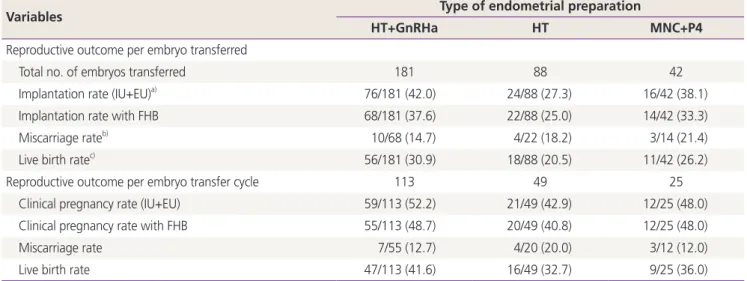
The clinical results of FET are presented in Table 2. The re- sults of the present study revealed that the primary outcome of the study — the IR per embryo transferred — was not
statistically different among the 3 groups (76/181 [42.0%]
in group A vs. 24/88 [27.3%] in group B vs. 16/42 [38.1%]
in group C, P>0.05). Similar results were found for the IRs with fetal heartbeat per embryo transferred (68/181 [37.6%]
in group A vs. 22/88 [25.0%] in group B vs. 14/42 [33.3%]
in group C, P>0.05) and for the LBRs per embryo transferred (56/181 [30.9%] in group A vs. 18/88 [20.5%] in group B vs.
11/42 [26.2%] in group C, P>0.05). The 3 groups were com- parable with respect to reproductive outcome per embryo transfer cycle. There were no statistically significant differences in the CPR, CPR with fetal heartbeat, miscarriage rate, and LBR.
The obstetric outcomes are shown in Table 3. A total of 73 ongoing pregnancies were confirmed. In group A, 38 of 48 were singleton pregnancies, 8 of 48 were twin pregnancies, and 2 of 48 were triple pregnancies (1 triple pregnancy was excluded because of second-trimester termination owing to an incompetent internal os of the cervix). In group B, 14 of 16 were singleton pregnancies, 1 of 16 was a twin pregnancy,
and 1 of 16 was a triple pregnancy. In group C, 7 of 11 were singleton pregnancies and 2 of 11 were twin pregnancies.
The percentages of vaginal delivery and cesarean section in singleton pregnancies were similar among the 3 groups. All twin and triple pregnancies were delivered via cesarean sec- tion. The fetal weight at delivery was also comparable among the 3 groups. Overall, no adverse events and hospitalizations were reported. In our observed obstetric outcome, 11 dicho- rial diamniotic twin pregnancies (8 in group A, 1 in group B, and 2 in group C) and 2 triple pregnancies (monochorial diamniotic+singleton) were found in each of groups A and B.
None of the newborns had congenital malformations.
Discussion
This study suggests that HT with or without GnRHa and MNC with P4 result in similar IRs, CPRs, and LBRs. These findings Table 1. Baseline characteristics
Variables Type of endometrial preparation
HT+GnRHa HT MNC+P4
No. of patients 113 49 25
Age (yr) 37.9±7.6 36.5±6.6 37.1±4.4
BMI (kg/m2) 21.6±3.1 20.0±4.1 23.6±6.3
Previous fresh cycles 2.4 (1–7) 2.0 (1–6) 3.3 (1–6)
Previous FET cycles 2.1 (0–4) 2.2 (0–4) 1.8 (0–4)
Mean duration of infertility (mon) 54.3±32.2 45.4±24.5 46.2±33.5
Etiology of infertility
Male factor 20/113 (17.7) 9/49 (18.4) 6/25 (24.0)
Diminished ovarian reserve 37/113 (32.7) 18/49 (36.7) 3/25 (12.0)
Tubal factor 14/113 (12.4) 7/49 (14.3) 5/25 (20.0)
Unexplained 15/113 (13.3) 5/49 (10.2) 7/25 (28.0)
Others 27/113 (23.9) 10/49 (20.4) 4/25 (16.0)
Duration of cryopreservation (mon) 37.8 38.5 31.6
Embryo survival (%) 92.0 92.6 93.3
Developmental stage of cryopreservation
Cleavage stage (day 3 or 4) 160/181 (88.4) 80/88 (90.9) 36/42 (85.7)
Blastocyst stage (day 5) 21/181 (11.6) 8/88 (9.1) 6/42 (14.3)
Mean No. of embryos transferred 1.6 1.8 1.7
Total No. of embryos transferred 181 88 42
Endometrial thickness (mm) 9.0±2.8 8.0±1.6 8.4±2.0
Data are shown as mean±standard deviation, number (%) or number (range).
HT, hormone therapy; GnRHa, gonadotropin-releasing hormone agonist; MNC, modified natural cycle; P4, progesterone; BMI, body mass in- dex; FET, frozen–thawed embryo transfer.
indicate that endometrial preparation with HT without GnRHa does not decrease the success rate of FET. This is consistent with the results of several previous studies. For example, in a retrospective comparison of 417 women with regular men- strual cycles undergoing HT FET with GnRHa versus natural cycles, there was no difference in IRs, CPRs, and LBRs [12].
Similarly, in a prospective randomized study comparing en-
dometrial preparation with and without previous GnRHa, E2 was administered at a dose of 6 mg/day to women not treated with GnRHa and at 4 mg/day to women with previous GnRHa. That trial reported the successful use of E2 and P4 without previous ovarian suppression with GnRHa in women with functioning ovaries who were undergoing FET [19]. This was also seen in the report of Dal Prato et al. [20]. In the most Table 2. Clinical results of frozen–thawed embryo transfer
Variables Type of endometrial preparation
HT+GnRHa HT MNC+P4
Reproductive outcome per embryo transferred
Total no. of embryos transferred 181 88 42
Implantation rate (IU+EU)a) 76/181 (42.0) 24/88 (27.3) 16/42 (38.1)
Implantation rate with FHB 68/181 (37.6) 22/88 (25.0) 14/42 (33.3)
Miscarriage rateb) 10/68 (14.7) 4/22 (18.2) 3/14 (21.4)
Live birth ratec) 56/181 (30.9) 18/88 (20.5) 11/42 (26.2)
Reproductive outcome per embryo transfer cycle 113 49 25
Clinical pregnancy rate (IU+EU) 59/113 (52.2) 21/49 (42.9) 12/25 (48.0)
Clinical pregnancy rate with FHB 55/113 (48.7) 20/49 (40.8) 12/25 (48.0)
Miscarriage rate 7/55 (12.7) 4/20 (20.0) 3/12 (12.0)
Live birth rate 47/113 (41.6) 16/49 (32.7) 9/25 (36.0)
Data are shown as mean±standard deviation or number (%).
HT, hormone therapy; GnRHa, gonadotropin-releasing hormone agonist; MNC, modified natural cycle; P4, progesterone; IU, intrauterine; EU, extrauterine; FHB, fetal heartbeat.
a)Presence of an intrauterine or extrauterine gestational sac; b)Pregnancy loss until 12 weeks after a previous clinical confirmation of pregnancy on ultrasound; c)Live birth of a child beyond 24 weeks of gestation.
Table 3. Obstetric outcomes
Variables Type of endometrial preparation
HT+GnRHa HT MNC+P4
Ongoing pregnanciesa) 48 16 9
Live birth rateb) 56 18 11
Singleton ongoing pregnancies 38/48 (79.2) 14/16 (87.5) 7/9 (77.8)
Vaginal delivery 23/38 (60.5) 9/14 (64.3) 4/7 (57.1)
Cesarean section 15/38 (39.5) 5/14 (35.7) 3/7 (42.9)
Preterm delivery 1 1 1
Fetal weight (g) 2,936.4±452.2 3,274.1±392.5 2,819.6±269.0
Twin or triple ongoing pregnancies 9c)/48 (18.8) 2d)/16 (12.5) 2e)/9 (22.2)
Preterm delivery 5 1 0
Fetal weight (g) 1,910.2±725.0 1,966.9±558.1 2,502.3±324.3
Data are shown as mean±standard deviation or number (%).
HT, hormone therapy; GnRHa, gonadotropin-releasing hormone agonist; MNC, modified natural cycle; P4, progesterone.
a)Viable pregnancy with fetal heartbeat at 12 weeks of gestational age; b)Live birth of an infant beyond 24 weeks of gestation; c)One ongoing triple pregnancy was excluded because of second-trimester termination owing to an incompetent internal os of the cervix (eight twin+one triple pregnancies); d)One twin+one triple pregnancies; e)Two twin pregnancies.
recently published systematic review and meta-analysis on the most effective method of endometrial preparation before FET, it was also concluded that is not possible to identify one method of endometrium preparation in FET as being superior over another [21].
Embryo implantation is the most critical step in ART, and is determined by the direct and linear interaction of 3 pri- mary factors that are integral to the physiological process:
endometrial competence with adequate P4 priming, viable embryo, and a synchronized dialogue between the endome- trium and the preimplantation embryo [22]. Ovarian steroids such E2 and P4 play crucial roles in endometrial receptivity, blastocyst implantation, and maintenance of pregnancy [22]. In the past, the most popular protocol was endome- trial preparation with exogenous E2 and P4 after pituitary downregulation with a GnRHa, to avoid spontaneous ovu- lation. The main advantage of such a protocol is that the risk of cycle cancellation can be drastically reduced by the GnRHa used to prevent premature endometrial luteinization.
Moreover, the date of embryo thawing and transfer can be selected by the medical staff or the patient, thus minimiz- ing the related cycle monitoring procedures (i.e., hormonal analyses and ultrasound scans of the endometrium) as well as the patient anxiety. However, the protocol has disadvan- tages, including the high cost of the GnRHa, patient incon- venience, risk of hypoestrogenic adverse effects before hor- monal replacement, adverse effects of E2 supplementation (e.g., increased thrombotic risk), and prolonged treatment (especially in the case of pregnancy) [23]. Therefore, an HT FET with GnRHa cycle is a more flexible and convenient pro- tocol for patients with irregular cycles, and it achieved simi- lar results to those of other endometrial preparation proto- cols used in women with regular cycles. In fact, this study at our center also suggested higher IRs, CPRs, and LBRs after HT FET with GnRHa cycles than after HT FET without GnRHa or after MNC with P4, although there were no statistically significant differences.
This study has certain limitations. First, this retrospective study could not investigate other potential confounders, including ovulation protocol, supplementation agent for implantation (embryo glue, aspirin, intralipid, Tractocile, immunoglobulin, etc.), and social habits (diet, nutritional supplements, exercise, etc.), that may affect the FET results.
Second, we analyzed only limited perinatal outcomes, in- cluding type of delivery, preterm delivery, and fetal weight
on delivery, and some of the data were self-reported by the patients. Third, the sample size was too small to reach definite conclusions. Nevertheless, our findings highlight the importance of estimating perinatal outcomes in women un- dergoing FET, and provide comparable data among 3 treat- ment groups. Furthermore, relatively high IRs, CPRs, and LBRs were recorded. This may be because of several reasons.
(i) We used only high-grade, top-quality embryos for FET. (ii) Although the use of luteal support is still controversial, it is a standard practice at our fertility center, supported by the results of a retrospective study and a randomized controlled trial [24,25]. Recently, Kim et al. [26] showed that during natural FET, luteal phase support with P4 supplementation decreased miscarriage rate and improved the LBR. (iii) We used only the vitrification method for frozen embryo thaw- ing. (iv) No participants withdrew from the study or had their cycle cancelled because of spontaneous ovulation, en- dometrial thickness <7 mm, or failure to thaw the embryo.
When the pituitary gland is not suppressed with a GnRHa, it is important to start E2 in the early follicular phase (on day 1 or 2). With this approach, although initial follicular activ- ity is sometimes present, spontaneous ovulation seems to be inhibited. Starting E2 after day 3 of the cycle might lead to an increased incidence of luteinizing hormone surge and luteinization of the endometrium [27].
In conclusions, the results of the present study suggest that HT FET with GnRHa, HT FET without GnRHa, or MNC with P4 FET in patients with regular menstruation may be good options with no adverse effects on cycle outcome.
However, the study lacked sufficient statistical power to reach definitive conclusions about the comparability of the 3 studied interventions. Therefore, additional double-blinded, randomized controlled trials with increased resolving power are required in the future to more accurately evaluate the efficacy of each treatment regimen.
Acknowledgements
This research was supported by Basic Science Research Program through the National Research Foundation of Korea (NRF) funded by the Ministry of Education (NRF- 2017R1C1B5018002).
Conflict of interest
No potential conflict of interest relevant to this article was re- ported.
References
1. Trounson A, Mohr L. Human pregnancy following cryo- preservation, thawing and transfer of an eight-cell em- bryo. Nature 1983;305:707-9.
2. De Neubourg D, Peeraer K, Debrock S, D'Hooghe T.
Belgium model of coupling reimbursement of ART costs to restriction in number of embryos transferred. BMJ 2014;348:g1559.
3. De Neubourg D, Bogaerts K, Wyns C, Albert A, Camus M, Candeur M, et al. The history of Belgian assisted reproduction technology cycle registration and control:
a case study in reducing the incidence of multiple preg- nancy. Hum Reprod 2013;28:2709-19.
4. Gera PS, Tatpati LL, Allemand MC, Wentworth MA, Coddington CC. Ovarian hyperstimulation syndrome:
steps to maximize success and minimize effect for as- sisted reproductive outcome. Fertil Steril 2010;94:173-8.
5. Check JH, Choe JK, Nazari A, Fox F, Swenson K. Fresh embryo transfer is more effective than frozen for do- nor oocyte recipients but not for donors. Hum Reprod 2001;16:1403-8.
6. Ashrafi M, Jahangiri N, Hassani F, Akhoond MR, Madani T. The factors affecting the outcome of frozen- thawed embryo transfer cycle. Taiwan J Obstet Gynecol 2011;50:159-64.
7. Veleva Z, Orava M, Nuojua-Huttunen S, Tapanainen JS, Martikainen H. Factors affecting the outcome of frozen- thawed embryo transfer. Hum Reprod 2013;28:2425-31.
8. Eftekhar M, Rahmani E, Pourmasumi S. Evaluation of clinical factors influencing pregnancy rate in frozen em- bryo transfer. Iran J Reprod Med 2014;12:513-8.
9. Loutradi KE, Kolibianakis EM, Venetis CA, Papanikolaou EG, Pados G, Bontis I, et al. Cryopreservation of human embryos by vitrification or slow freezing: a systematic review and meta-analysis. Fertil Steril 2008;90:186-93.
10. Achache H, Revel A. Endometrial receptivity markers, the journey to successful embryo implantation. Hum Re- prod Update 2006;12:731-46.
11. Kawamura T, Motoyama H, Yanaihara A, Yorimitsu T, Arichi A, Karasawa Y, et al. Clinical outcomes of two different endometrial preparation methods for cryopre- served-thawed embryo transfer in patients with a nor- mal menstrual cycle. Reprod Med Biol 2007;6:53-7.
12. Gelbaya TA, Nardo LG, Hunter HR, Fitzgerald CT, Horne G, Pease EE, et al. Cryopreserved-thawed embryo trans- fer in natural or down-regulated hormonally controlled cycles: a retrospective study. Fertil Steril 2006;85:603-9.
13. Spandorfer SD, Fasouliotis SJ, Cimmino C, Shpizner M, Veeck L, Rosenwaks Z. Blastocyst frozen embryo trans- fer (FET): comparison of outcome with replacement in natural or programmed/medicated cycle. Fertil Steril 2004;82:S154.
14. Morozov V, Ruman J, Kenigsberg D, Moodie G, Brenner S. Natural cycle cryo-thaw transfer may improve preg- nancy outcome. J Assist Reprod Genet 2007;24:119-23.
15. Chang EM, Han JE, Kim YS, Lyu SW, Lee WS, Yoon TK.
Use of the natural cycle and vitrification thawed blas- tocyst transfer results in better in-vitro fertilization out- comes: cycle regimens of vitrification thawed blastocyst transfer. J Assist Reprod Genet 2011;28:369-74.
16. Hill MJ, Miller KA, Frattarelli JL. A GnRH agonist and exogenous hormone stimulation protocol has a higher live-birth rate than a natural endogenous hormone protocol for frozen-thawed blastocyst-stage embryo transfer cycles: an analysis of 1391 cycles. Fertil Steril 2010;93:416-22.
17. Ghobara T, Vandekerckhove P. Cycle regimens for fro- zen-thawed embryo transfer. Cochrane Database Syst Rev 2008;1:CD003414.
18. Rotterdam ESHRE/ASRM-Sponsored PCOS consensus workshop group. Revised 2003 consensus on diagnostic criteria and long-term health risks related to polycystic ovary syndrome (PCOS). Hum Reprod 2004;19:41-7.
19. Simon A, Hurwitz A, Zentner BS, Bdolah Y, Laufer N.
Transfer of frozen-thawed embryos in artificially pre- pared cycles with and without prior gonadotrophin- releasing hormone agonist suppression: a prospective randomized study. Hum Reprod 1998;13:2712-7.
20. Dal Prato L, Borini A, Cattoli M, Bonu MA, Sciajno R, Flamigni C. Endometrial preparation for frozen-thawed embryo transfer with or without pretreatment with gonadotropin-releasing hormone agonist. Fertil Steril 2002;77:956-60.
21. Groenewoud ER, Cantineau AE, Kollen BJ, Macklon NS, Cohlen BJ. What is the optimal means of preparing the endometrium in frozen-thawed embryo transfer cycles?
A systematic review and meta-analysis. Hum Reprod Up- date 2013;19:458-70.
22. Rashid NA, Lalitkumar S, Lalitkumar PG, Gemzell-Dan- ielsson K. Endometrial receptivity and human embryo implantation. Am J Reprod Immunol 2011;66 Suppl 1:23-30.
23. van de Vijver A, Polyzos NP, Van Landuyt L, De Vos M, Camus M, Stoop D, et al. Cryopreserved embryo transfer in an artificial cycle: is GnRH agonist down-regulation necessary? Reprod Biomed Online 2014;29:588-94.
24. Veleva Z, Orava M, Nuojua-Huttunen S, Tapanainen JS, Martikainen H. Factors affecting the outcome of frozen- thawed embryo transfer. Hum Reprod 2013;28:2425-31.
25. Bjuresten K, Landgren BM, Hovatta O, Stavreus-Evers A.
Luteal phase progesterone increases live birth rate after frozen embryo transfer. Fertil Steril 2011;95:534-7.
26. Kim CH, Lee YJ, Lee KH, Kwon SK, Kim SH, Chae HD, et al. The effect of luteal phase progesterone supplementa- tion on natural frozen-thawed embryo transfer cycles.
Obstet Gynecol Sci 2014;57:291-6.
27. Remohi J, Vidal A, Pellicer A. Oocyte donation in low re- sponders to conventional ovarian stimulation for in vitro fertilization. Fertil Steril 1993;59:1208-15.