• 검색 결과가 없습니다.

Predictors of Long-Term Survival in Acute Coronary Syndrome Patients With Left Ventricular Dysfunction After Percutaneous Coronary Intervention

N/A
N/A
Protected

Academic year: 2022

Share "Predictors of Long-Term Survival in Acute Coronary Syndrome Patients With Left Ventricular Dysfunction After Percutaneous Coronary Intervention"

Copied!
6
0
0

로드 중.... (전체 텍스트 보기)

전체 글

(1)

Korean Circulation Journal

Introduction

In Korea, the prevalence of acute coronary syndrome (ACS) pa-

Print ISSN 1738-5520 • On-line ISSN 1738-5555

Predictors of Long-Term Survival in Acute Coronary Syndrome Patients With Left Ventricular Dysfunction

After Percutaneous Coronary Intervention

Doo Hwan Lee, RT 1,2 , Myung Ho Jeong, MD 1,2 , Jung Ae Rhee, MD 3 , Jin Su Choi, MD 3 , Ki Hong Lee, MD 1,2 , Min Goo Lee, MD 1,2 , Doo Sun Sim, MD 1,2 , Keun-Ho Park, MD 1,2 , Nam Sik Yoon, MD 1,2 , Hyun Ju Yoon, MD 1,2 ,

Kye Hun Kim, MD 1,2 , Hyung Wook Park, MD 1,2 , Young Joon Hong, MD 1,2 , Ju Han Kim, MD 1,2 , Youngkeun Ahn, MD 1,2 , Jeong Gwan Cho, MD 1,2 , Jong Chun Park, MD 1,2 , and Jung Chaee Kang, MD 1,2

1

The Heart Center of Chonnam National University Hospital, Gwangju,

2

The Heart Research Center Nominated by Korea Ministry of Health and Welfare, Gwangju,

3
Department of Preventive Medicine, Chonnam National University Medical School, Gwangju, Korea

Background and Objectives: Predictive factors of mortality in acute coronary syndrome (ACS) patients with left ventricular dysfunction were analyzed during 5-year clinical follow-up after percutaneous coronary intervention (PCI).

Subjects and Methods: A total of 329 ACS consecutive patients (64.6±11.3 years, 227 males) who underwent PCI from January 2001 to March 2006 were followed for 5 years. All patients had lower than 40% of left ventricular ejection fraction (LVEF). Patients were divided into Group I (survived longer than 5-years: n=130, 101 males) and Group II (survived shorter than 5 years: n=199, 126 males).

Results: The cumulative survival rate was 88.0% at 1 month, 78.0% at 6 months, 75.0% at 1 year, 67.0% at 2 years, 62.0% at 3 years, 57.0% at 4 years and 40% at 5-years. Group II was older (61.6±11.2 years vs. 66.4±11.4 years, p<0.001), and showed higher prevalence of female gender (28.4% vs. 36.7%, p=0.006) and lower LVEF (35.3±5.2 vs. 33.6±5.6) than Group I. The independent predictors for mortality were LVEF <30% {odds ratio (OR)=1.793, 95% confidence interval (CI): 1.234-2.452, p=0.002}, serum creatinine >3.0 mg/dL (OR=2.455, 95% CI: 1.306-4.614, p=0.005), older than 65 years (OR=1.594, 95% CI: 1.152-2.206, p=0.005), and female gender (OR=1.524, 95% CI:

1.090-2.130, p=0.014).

Conclusion: Five-year survival rate was 40% in ACS patients with left ventricular dysfunction, and the predictors for mortality were low LVEF, high serum creatinine, old age, and female gender. (Korean Circ J 2012;42:692-697)

KEY WORDS: Acute coronary syndrome; Prognosis; Heart failure; Angioplasty.

Received: March 6, 2012 Revision Received: April 18, 2012 Accepted: May 2, 2012

Correspondence: Myung Ho Jeong, MD, The Heart Research Center Nom- inated by Korea Ministry of Health and Welfare, Chonnam National Univer- sity Hospital, 42 Jebong-ro, Dong-gu, Gwangju 501-757, Korea

Tel: 82-62-220-6243, Fax: 82-62-228-7174 E-mail: [email protected]

• The authors have no financial conflicts of interest.

This is an Open Access article distributed under the terms of the Creative Commons Attribution Non-Commercial License (http://creativecommons.

org/licenses/by-nc/3.0) which permits unrestricted non-commercial use, distribution, and reproduction in any medium, provided the original work is properly cited.

tients is increasing, as is resultant mortality.

1)

High-risk ACS pa- tients require active treatment because of very high mortality. Re- cent treatment guidelines recommend percutaneous coronary in- tervention (PCI) as an active invasive method at the early stage for high-risk patients.

2)

Left ventricular ejection fraction (LVEF) is a very important clinical factor for diagnosis, treatment, and prognosis, particularly for patients with acute myocardial infarction (AMI).

3)

Re- cently, PCI has been more widely used in patients with left ventric- ular dysfunction because of advanced techniques and instruments.

Previous reports showed that a major adverse cardiac event (MACE)

following PCI was associated with pre-procedural left ventricular

dysfunction,

4)

and survival rate at the acute stage and the later stage

was higher in patients with normal left ventricular function com-

pared to those with left ventricular dysfunction.

5)

Age, renal insuffici-

ency, multi-vessel disease, and left ventricular dysfunction obviously

(2)

also affect short-term survival rate of patients with AMI undergo- ing PCI.

6)

In a study investigating mortality after PCI in patients with left ventricular dysfunction, the survival rate tended to be lower in patients with low LVEF than in those with normal LVEF.

7)

However, there has been no established definite predictor of long-term sur- vival after PCI in patients with ACS accompanied by left ventricular dysfunction. Therefore, the present study aimed at identifying fac- tors affecting the long-term survival rate after PCI in ACS patients with low LVEF.

Subjects and Methods

Study population

From January 2001 to March 2006, a total of 329 patients with ACS undergoing PCI and preprocedural LVEF below 40% was analyzed.

They were divided into the group surviving 5 years or longer {Group I, n=130, sex ratio (M : F)=101 : 29} and the group surviving less than 5 years {Group II, n=199, sex ratio (M : F)=126 : 73}.

Methods

We divided 329 ACS patients who admitted to Chonnam National University Hospital and LVEF below 40% into the group surviving 5 years or longer (Group I) and the group surviving less than 5 years (Group II), and examined differences between the two groups in sex, age, clinical diagnosis, LVEF, coronary disease risk factors (hy- pertension, diabetes mellitus, smoking, hypercholesterolemia), lab- oratory findings, coronary angiographic characteristics, and con- comitant medication. LVEF was measured by Simpson’s method.

8)

The morphological characteristics of coronary artery lesions were an- alyzed through the classification method of the American College of Cardiology/American Heart Association (ACC/AHA).

9)

Blood flow was classified using Thrombolysis in Myocardial Infarction (TIMI).

10)

Significant stenosis of lesion was defined narrowing of the coro- nary artery more than 75%. Successful reperfusion was defined as post-procedural TIMI flow of III with residual stenosis less than 25%. A total of 254 (77.2%) patients were followed up by clinical visits. The other patients were followed-up by telephone and mail to ascertain the occurrence of long-term outcomes. A total of 329 (100%) patients were followed for up to 5 years.

Statistical analysis

For continuous variables, the differences between the 2 groups were evaluated by an independent sample t-test or Mann-Whitney rank-sum test, and were presented in mean±standard deviation. For discrete variables, differences were expressed as counts and percent- ages and percentages were analyzed with chi-square test between the groups as appropriate. We constructed Kaplan-Meier curves

for survival rate. Cox regression was used in order to identify inde- pendent prognostic factors. All statistical analyses were 2-tailed, with clinical significance defined as p<0.05. All statistical analyses were performed with Statistical Package for the Social Sciences (SPSS version 18.0, SPSS Inc., Chicago, IL, USA).

Results

Baseline clinical characteristics

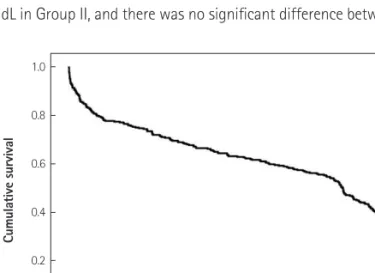
A total 329 patients were analyzed and they were divided into Group I (n=130, 39.5%) and Group II (n=199, 60.5%). The cumula- tive survival rate in these patients was 88.0% in 1 month, 78.0% in 6 months, 75.0% in 1 year, 67.0% in 2 years, 62.0% in 3 years, 57.0%

in 4 years, and 40.0% in 5 years (Fig. 1). The average age was signi- ficantly higher in Group II than Group I (61.6±11.2 vs. 66.4±11.4 years old, p<0.001). Female gender was more common in Group II than Group I {29 (28.4%) vs. 73 (36.7%), p=0.006}. Disease distri- bution included 233 (70.8%) patients with acute ST elevation myo- cardial infarction, 37 (11.2%) patients with non-ST elevation myo- cardial infarction, and 59 (17.9%) patients with unstable angina, no difference between the two groups. As to the risk factors of cardio- vascular disease, 100 (30.4%) patients were smokers, 135 (41.0%) patients had hypercholesterolemia, 152 (46.2%) hypertension, and 125 (38.0%) diabetes mellitus, and there was no significant differ- ence between the two groups. In echocardiogram, the mean LVEF was significantly higher in Group I than Group II (35.3±5.2% vs.

33.6±5.6%, p=0.004) (Table 1).

Laboratory tests and myocardial markers

The creatinine level was 1.2±0.8 mg/dL in Group I and 1.4±1.4 mg/

dL in Group II, and there was no significant difference between the

Fig. 1. Five-year survival in acute coronary syndrome patients with left ventricular dysfunction.

1.0

0.8 0.6 0.4

0.2 0.0

Time (years)

Cu m ul at iv e su rv iv al

0 1 2 3 4 5

(3)

two groups (p=0.052). N-terminal B-type natriuretic peptide was 4701±6586.9 pg/mL in Group I and 12411±40229.5 pg/mL in Group II and high-sensitivity C-reactive protein was 1.6±3.0 mg/dL and 5.2±38.1 mg/dL, respectively, and there were no significant differ- ences between the two groups. Creatine kinase-MB on visit was 95.4±150.9 U/L in Group I and 96.8±248.9 U/L in Group II, and there was no significant difference between the two groups. Tro- ponin I on visit was 50.2±152.8 ng/mL in Group I and 33.4±86.2 ng/

mL in Group II, and there was no significant difference between the two groups (Table 2).

Findings of coronary angiography and intervention

In coronary angiographic findings, culprit lesion was left main in 13 patients (4.0%), left anterior descending artery in 189 (57.4%), right coronary artery in 74 (22.5%), and left circumflex artery in 49 (14.9%). The number of involved vessels was one in 182 patients (55.3%), two in 91 (27.7%), and three in 52 (15.8%). The lesion type according to ACC/AHA classification was A in 0 patient (0%), B1 in 103 (31.3%), B2 in 98 (29.8%), and C in 128 (38.9%). The type of co-

ronary flow according to TIMI classification was 0 in 131 patients (39.8%), I in 18 (5.5%), II in 89 (27.1%), and III in 82 (24.9%). The number of patients who underwent intra-aortic balloon pump in- sertion was 31 (15.6%) in Group I and 19 (14.6%) in Group II. The number of patients who used abciximab was 25 (19.28%) in Group I and 29 (14.6%) in Group II. The PCI success rate was 90.8% (118/

130) in Group I and 93.0% (185/199) in Group II, and there was no significant difference between the two groups (Table 3).

Medications

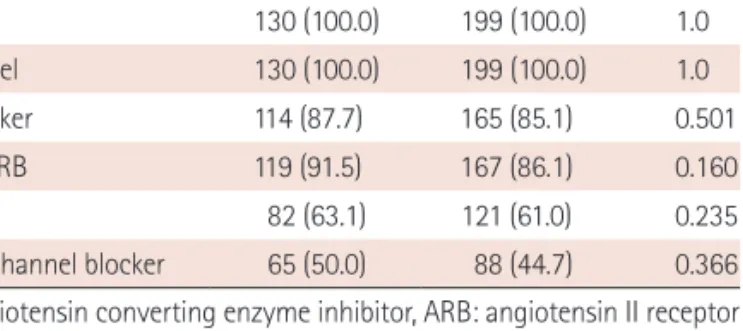
All the patients were prescribed aspirin and clopidogrel, and beta blocker was prescribed to 114 patients (87.7%) in Group I and 165 (85.1%) in Group II, angiotensin-converting enzyme inhibitor or an- giotensin II receptor blocker to 119 (91.5%) in Group I and 167 (86.1%) in Group II, statin to 82 (63.1%) in Group I and 121 (61.0%) in Group II, and calcium channel blocker to 65 (50.0%) in Group I and 88 (44.7%) in Group II. There were no significant differences between the two groups in any medication (Table 4).

Table 1. Baseline clinical characteristics Group I (n=130)

Group II

(n=199) p

Age (years) 61.6±11.2 66.4±11.4 0.000

Female (%) 29 (28.4) 73 (36.7) 0.006

Clinical diagnosis (%) 0.602

ASTEMI 92 (70.8) 141 (70.9)

NSTEMI 17 (13.1) 20 (10.1)

Unstable angina 21 (16.2) 38 (19.1)

Risk factor (%)

Hypertension 56 (43.1) 96 (48.5) 0.337

Diabetes mellitus 45 (34.6) 80 (40.4) 0.291

Smoking 46 (35.4) 54 (27.3) 0.119

Hypercholesterolemia 56 (44.1) 79 (40.9) 0.644

LVEF (%) 35.3±5.2 33.6±5.6 0.004

ASTEMI: acute ST elevation myocardial infarction, NSTEMI: non-ST eleva- tion myocardial infarction, LVEF: left ventricular ejection fraction

Table 2. Comparison of biochemical markers of cardiac myocardial injury Group I

(n=130)

Group II

(n=199) p

Creatinine (mg/dL) 1.2±0.8 1.4±1.4 0.052

NT-proBNP (pg/mL) 4701±6586.9 12411±40229.5 0.215

hs-CRP(mg/dL) 1.6±3.0 5.2±38.1 0.367

CK-MB (U/L) 95.4±150.9 96.8±248.9 0.955

Troponin I (ng/mL) 50.2±152.8 33.4±86.2 0.256

NT-proBNP: N-terminal B-type natriuretic peptide, hs-CRP: high-sensitivity C-reactive protein, CK-MB: creatine kinase-MB

Table 3. Comparison of coronary angiographic characteristics Group I

(n=130)

Group II

(n=199) p

Target vessel (%) 0.298

Left main 6 (4.7) 7 (3.6)

LAD 77 (59.7) 112 (57.1)

LCX 23 (17.8) 26 (13.3)

RCA 23 (17.8) 51 (26.0)

Number of involved vessel (%) 0.630

One vessel disease 75 (58.1) 107 (56.1)

Two vessel disease 37 (28.7) 54 (27.6)

Three vessel disease 17 (13.2) 34 (17.3)

ACC/AHA types (%) 0.889

A 0 (0) 0 (0)

B1 42 (33.1) 61 (31.1)

B2 39 (30.7) 59 (30.1)

C 46 (36.2) 76 (38.8)

TIMI flow grade (%) 0.403

0 53 (42.1) 78 (40.2)

I 6 (4.8) 12 (6.2)

II 40 (31.7) 49 (25.3)

III 27 (21.4) 55 (28.4)

Success rate of PCI (%) 118 (90.8) 185 (94.9) 0.178

IABP used (%) 19 (15.1) 31 (16.1) 0.813

Abciximab used (%) 25 (19.7) 29 (15.0) 0.276

LAD: left anterior descending coronary artery, RCA: right coronary artery,

LCx: left circumflex coronary artery, TIMI: Thrombolysis in Myocardial Infarc-

tion, ACC/AHA: American College of Cardiology/American Heart Association,

IABP: intra aortic balloon pump, PCI: percutaneous coronary intervention

(4)

Independent predictors of 5-year mortality after percutaneous coronary intervention

Cox regression survival analysis was used to identify independent predictors affecting 5-year mortality. Significant predictors for mortality were LVEF below 30% {odds ratio (OR)=1.793, 95% con- fidence interval (CI): 1.234-2.452, p=0.002}, serum creatinine over 3.0 mg/dL (OR=2.455, 95% CI: 1.306-4.614, p=0.005), age over 65 (OR=1.594, 95% CI: 1.152-2.206, p=0.005), and female gender (OR=

1.524, 95% CI: 1.090-2.130, p=0.014) (Table 5).

Discussion

Cardiovascular disease is increasing steadily not only in devel- oped countries but also in Korea, and is one of the most common cause of death. Among cardiovascular diseases, ACS comprises over 50% of deaths and the prevalence is also rising steadily. Mor- tality becomes higher if patients have ACS accompanied by left ven- tricular dysfunction. Therefore, the present study was to analyze factors that might predict death in ACS patients with low LVEF in order to identify high-risk patients earlier and enhance survival.

The present study showed that independent predictors affecting the long-term survival rate were low LVEF, high serum creatinine, old age, and female gender.

In the present study, the cumulative survival rate was 88.0% in 1 month, 78.0% in 6 months, 75.0% in 1 year, 62.0% in 3 years, and

40.0% in 5 years. In a previous study regarding all AMI patients, the cumulative survival rate was 87.0% in the initial 48 hours and 83.0% in 1 year, and went down to 81.0%, 79.0% and 77.0% each year.

10)

The reason for the lower survival rate in the present study compared with previous study was the patients in the present study were limited to ACS patients with LVEF lower than 40%. Consider- ing that a study with Korean subjects showed similar survival rates at 1-year 89.2% and at 2-year 86.2%, LVEF is believed to have a significant effect on the survival rate in the present study.

11)

Further- more, survival analysis in the present study showed that mortality was the highest within 1 year, especially within 6 months. It might suggest that clinicians should give more intensive care in acute phase after PCI in ACS patients with low LVEF.

Left ventricular function measured by echocardiogram is known to be an objective and important marker for evaluating the progno- sis of AMI patients.

12)

It has been proved by many studies that left ventricular function is an important prognostic factor affecting the survival rate.

13-15)

In the present study as well, LVEF below 30% as an independent variable measured by echocardiogram was an im- portant prognostic factor affecting the 5-year survival rate. Accord- ingly, it might be essential to evaluate ventricular function with echocardigram during ACS patients’ hospital stay and it is impor- tant in planning patient treatment and predicting survival.

Walsh et al.

16)

reported that decreased glomerular filtration rate was associated with worse clinical outcomes and was an independent predictor for in-hospital mortality in patients with STEMI undergo- ing primary PCI. Also, the previous study showed that patients with serum creatinine over 1.5 mg/dL showed higher 1-year mortality than those with normal level,

17)

and serum creatinine level higher than 3.0 mg/dL was an independent predictor affecting the 5-year long-term survival rate. Analysis with Korea Heart Dysfunction Reg- istry showed that serum creatinine level higher than 2.0 mg/dL as independent predictor for long term clinical outcomes (hazard ra- tio=2.29, 95% CI: 1.90-2.76).

18)

Like these reports, the present study also showed that serum creatinine level was an independent pre- dictor affecting not only the 1-year short-term survival rate but also the 5-year long survival rate. Therefore, it would be helpful for im- proving the survival rate in ACS patients with low LVEF and renal insufficiency undergoing PCI through combination of treatments for renal dysfunction and active treatment for cardiovascular disease.

As to difference according to gender, previous studies showed in- consistent results. Choi et al.

19)

reported that cumulative mortality was 21% in men and 30% in women, indicating significantly higher women’s mortality than men. Even more, the Minnesota Heart Sur- vey

20)

showed that women’s mortality was higher than men’s among AMI patients even after correction for factors such as clinical symp- toms and past history. Also, He et al.

21)

studied the prognosis of Table 4. Comparison of the prescribed medications

Medications (%) Group I

(n=130)

Group II

(n=199) p

Aspirin 130 (100.0) 199 (100.0) 1.0

Clopidogrel 130 (100.0) 199 (100.0) 1.0

Beta-blocker 114 (87.7) 165 (85.1) 0.501

ACEI or ARB 119 (91.5) 167 (86.1) 0.160

Statin 82 (63.1) 121 (61.0) 0.235

Calcium channel blocker 65 (50.0) 88 (44.7) 0.366 ACEI: angiotensin converting enzyme inhibitor, ARB: angiotensin II receptor blocker

Table 5. Cox regression survival analysis for predictive factors of mortality during five-year clinical follow-up

Variables OR 95% CI p

Left ventricular ejection fraction <30% 1.793 1.234-2.452 0.002 High creatinine >3.0 mg/dL 2.455 1.306-4.614 0.005

Old age >65 years 1.594 1.152-2.206 0.005

Female 1.524 1.090-2.130 0.014

No use of ACEI or ARB 1.489 0.884-2.508 0.135

Beta-blocker 1.230 0.743-2.035 0.421

OR: odds ratio, CI: confidence interval, ACEI: angiotensin converting en-

zyme inhibitor, ARB: angiotensin II receptor blocker

(5)

754 patients admitted for AMI and found that women had higher than men in short-term (relative odds=1.74, 95% CI: 1.17-2.60) and long-term mortality (51% vs. 35.9%, log rank p=0.002). In the pres- ent study as well, female gender was found to be an independent predictor affecting ACS patients’ 5-year survival rate. In contrast, Maynard et al.

22)

and Karlson et al.

23)

reported that the short-term mortality of AMI patients did not showed any significance after cor- rection with age between men and women, although unadjusted mortality was higher in women than men (16% in women vs. 11%

in men). Also, Fiebach et al.

24)

reported that AMI patients’ mortality on admission and for 3 years were higher in women than in men, but no difference was observed between men and women after cor- rection for basic clinical characteristics. This might be explained that although mortality is higher in women than men, gender itself is not an independent risk factor for long-term survival in patients with ACS. This phenomenon was caused by women’s comorbidities, es- pecially hypertension, diabetes and left ventricular dysfunction. In the present study, women’s mortality was higher than men’s, and fe- male gender itself was found to be an independent predictor for long-term prognosis in ACS patients with low EF even after adjust- ing confounding factors including basic demographic findings. It might suggest that female gender itself is an important prognostic factor for the ACS patients in the situation of low LVEF. However, lar- ger-scale prospective research may be necessary to get more ac- curate results.

The present study has several limitations. First, it was conducted as long-term retrospective research. Larger scale prospective ran- domized clinical trials are needed to support the results of the pres- ent study. Second, the cause of death could not be confirmed for some cases. Third, the effect of continuous drug therapy, drug switch and stopping of medication were not measured completely in all patients.

In conclusion, the 5-year survival rate was 40% among 329 ACS patients with LVEF below 40% who underwent PCI during the pe- riod from January 2001 to March 2006. And LVEF below 30%, se- rum creatinine over 3.0 mg/dL, age over 65, and being female were independent predictors for the 5-year survival rate in ACS patients undergoing PCI with low LVEF.

Acknowledgments

This study was conducted with the support of the Health & Med- ical Technology R&D Program of the Ministry of Health and Welfare (A084869).

References

1. Korea National Statistical Office. 2004 annual report on the course of

as death statistics. Korea National Statistical Office;2004. p.32-4.

2. Antman EM, Anbe DT, Armstrong PW, et al. ACC/AHA guidelines for the management of patients with ST-elevation myocardial infarction:

a report of the American College of Cardiology/American Heart Asso- ciation Task Force on Practice Guidelines (Committee to Revise the 1999 Guidelines for the Management of Patients with Acute Myocar- dial Infarction). Circulation 2004;110:e82-292.

3. Pfeffer MA, Braunwald E, Moyé LA, et al. Effect of captopril on mortali- ty and morbidity in patients with left ventricular dysfunction after myo- cardial infarction: results of the survival and ventricular enlargement trial: the SAVE Investigators. N Engl J Med 1992;327:669-77.

4. Schühlen H, Kastrati A, Dirschinger J, et al. Intracoronary stenting and risk for major adverse cardiac events during the first month. Cir- culation 1998;98:104-11.

5. Kohli RS, DiSciascio G, Cowley MJ, Nath A, Goudreau E, Vetrovec GW.

Coronary angioplasty in patients with severe left ventricular dysfunc- tion. J Am Coll Cardiol 1990;16:807-11.

6. Halkin A, Singh M, Nikolsky E, et al. Prediction of mortality after prima- ry percutaneous coronary intervention for acute myocardial infarc- tion: the CADILLAC risk score. J Am Coll Cardiol 2005;45:1397-405.

7. Holper EM, Blair J, Selzer F, et al. The impact of ejection fraction on outcomes after percutaneous coronary intervention in patients with congestive heart failure: an analysis of the National Heart, Lung, and Blood Institute Percutaneous Transluminal Coronary Angioplasty Reg- istry and Dynamic Registry. Am Heart J 2006;151:69-75.

8. Quinones MA, Waggoner AD, Reduto LA, et al. A new, simplified and accurate method for determining ejection fraction with two-dimen- sional echocardiography. Circulation 1981;64:744-53.

9. Scanlon PJ, Faxon DP, Audet AM, et al. ACC/AHA guidelines for coro- nary angiography: a report of the American College of Cardiology/

American Heart Association Task Force on practice guidelines (Com- mittee on Coronary Angiography): developed in collaboration with the Society for Cardiac Angiography and Interventions. J Am Coll Car- diol 1999;33:1756-824.

10. Gibson CM, Cannon CP, Daley WL, et al. TIMI frame count: a quantita- tive method of assessing coronary artery flow. Circulation 1996;93:

879-88.

11. Gwon HC, Lyu OY, Park SW, et al. Long term survival rate and prog- nostic factors of acute myocardial infarction. Korean Circ J 1990;20:

687-96.

12. Zannad F, Briancon S, Juilliere Y, et al. Incidence, clinical and etiologic features, and outcomes of advanced chronic heart failure: the EPICAL Study: Epidémiologie de l’Insuffisance Cardiaque Avancée en Lor- raine. J Am Coll Cardiol 1999;33:734-42.

13. Halkin A, Stone GW, Dixon SR, et al. Impact and determinants of left ventricular function in patients undergoing primary percutaneous cor- onary intervention in acute myocardial infarction. Am J Cardiol 2005;

96:325-31.

14. Kouvaras G, Cokkinos D, Spyropoulou M. Increased mortality of dia- betics after acute myocardial infarction attributed to diffusely im- paired left ventricular performance as assessed by echocardiography.

Jpn Heart J 1988;29:1-9.

15. Krumholz HM, Howes CJ, Murillo JE, Vaccarino LV, Radford MJ, Eller-

(6)

beck EF. Validation of a clinical prediction rule for left ventricular ejec- tion fraction after myocardial infarction in patients > or = 65 years old.

Am J Cardiol 1997;80:11-5.

16. Walsh CR, O’Donnell CJ, Camargo CA Jr, Giugliano RP, Lloyd-Jones DM.

Elevated serum creatinine is associated with 1-year mortality after acute myocardial infarction. Am Heart J 2002;144:1003-11.

17. Kim JY, Jeong MH, Ahn YK, et al. Decreased glomerular filtration rate is an independent predictor of in-hospital mortality in patients with ST- segment elevation myocardial infarction undergoing primary percu- taneous coronary intervention. Korean Circ J 2011;41:184-90.

18. Tofler GH, Stone PH, Muller JE, et al. Effects of gender and race on prognosis after myocardial infarction: adverse prognosis for women, particularly black women. J Am Coll Cardiol 1987;9:473-82.

19. Choi DJ, Han S, Jeon ES, et al. Characteristics, outcomes and predic- tors of long-term mortality for patients hospitalized for acute heart failure: a report from the Korean Heart Failure Registry. Korean Circ J

2011;41:363-71.

20. Demirovic J, Blackburn H, McGovern PG, Luepker R, Sprafka JM, Gilb- ertson D. Sex differences in early mortality after acute myocardial in- farction (the Minnesota Heart Survey). Am J Cardiol 1995;75:1096-101.

21. He J, Klag MJ, Whelton PK, Zhoa Y, Weng X. Short- and long-term prognosis after acute myocardial infarction in Chinese men and wom- en. Am J Epidemiol 1994;139:693-703.

22. Maynard C, Litwin PE, Martin JS, Weaver WD. Gender differences in the treatment and outcome of acute myocardial infarction: Results from the Myocardial Infarction Triage and Intervention Registry. Arch Intern Med 1992;152:972-6.

23. Karlson BW, Herlitz J, Hartford M. Prognosis in myocardial infarction in relation to gender. Am Heart J 1994;128:477-83.

24. Fiebach NH, Viscoli CM, Horwitz RI. Differences between women and men in survival after myocardial infarction: biology or methodology?

JAMA 1990;263:1092-6.

수치

Fig. 1. Five-year survival in acute coronary syndrome patients with left  ventricular dysfunction.1.00.80.60.40.20.0 Time (years)Cumulative survival 0                    1                   2                    3                    4                   5
Table 2. Comparison of biochemical markers of cardiac myocardial injury Group I (n=130) Group II(n=199) p Creatinine (mg/dL) 1.2±0.8 1.4±1.4 0.052 NT-proBNP (pg/mL) 4701±6586.9 12411±40229.5 0.215 hs-CRP(mg/dL) 1.6±3.0 5.2±38.1 0.367 CK-MB (U/L) 95.4±150.9
Table 5. Cox regression survival analysis for predictive factors of mortality  during five-year clinical follow-up

참조

관련 문서