295
Recent Progress of the Use of Interventional Therapy for Chronic Total Occlusion
Sunao Nakamura, MD
1and Jang-Ho Bae, MD
21Department of Cardiology, New Tokyo Hospital, Chiba, Japan
2Heart Center, Konyang University Hospital, Daejeon, Korea
ABSTRACT
Chronic total occlusion (CTO) remains one of the most challenging lesion subsets for interventional cardiologists due to a low success rate and higher incidence of restenosis, especially with current use of bare metal stents (BMSs).
However, successful CTO revascularization has a beneficial effect on long-term survival and relief of angina. With recent advances in technology (with the use of special techniques and devices), the initial success rate of recanali- zation of occlusions is quite high (approximately 90%). However, the long-term clinical outcome of the use of bare metal stents is not satisfactory due to a high restenosis rate. Recently, the introduction of the sirolimus-eluting stent (SES) and paclitaxel-eluting stent (PES) has shown favorable clinical outcomes, such as a reduction in the restenosis rate in patients with CTOs. Consequently, the use of the new types of stents can reduce the incidence of major adverse cardiac events detected at follow-up.
(Korean Circ J 2008;38:295-300)KEY WORDS:
Coronary occlusion; Angioplasty; Drug-Eluting stents.
Introduction
Chronic total occlusion (CTO) of coronary artery dis- ease is defined as total occlusion with either a known duration of more than three months or the presence of bridging collaterals. The long-term success after per- cutaneous coronary intervention (PCI) for CTOs is hampered by high rates of subacute reocclusion and late restenosis. After successful recanalization of total oc- clusion (provided the vessel remains patent), patients report relief from symptoms and develop improvement of left ventricular function, have fewer cardiac events and have fewer requirements for bypass surgery.
1)2)In addition, several randomized trials have demonstrated that stent implantation decreases the rate of restenosis and reocclusion
3-9)and confers a long-term survival ad- vantage.
10)However, restenosis had remained the major complication that has limited the late outcome after PCI prior to the introduction of drug-eluting stents (DESs).
Since 2002, DES has been available in Asian countries and there have been several reports about the efficacy of DESs for the reduction of restenoais after DES im- plantation, and the reports have described a dramatic reduction of restenosis
11-15)as compared with the use of
bare metal stents (BMSs). Another obstacle of PCI for CTO is technically difficulty to recanalization of CTOs.
With recent advanced in technology (special techniques and devices) and increased operator experience, the initial success rate of opening occlusions reached quite high percentage (around 90%), so we have much higher success rate of recanalization of CTOs and much lower incidence of restenosis. Has the time come to do more CTOs now?
Basic Knowledge of Chronic Total Occlusion Interventions
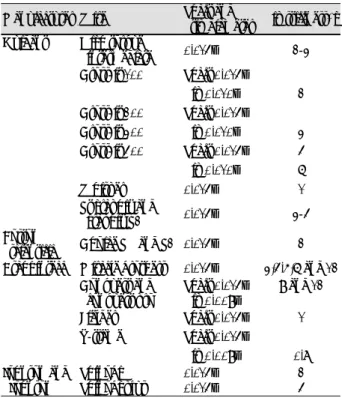
Consideration of the pathological features of CTOs, assessment of the difficulty of treatment of CTOs based on angiographic findings (Table 1) and a strong consid- eration of the appropriate selection for the indication of CTO-PCI are very important to select a proper strat- egy to treat CTOs with the right materials during pro- cedures and ultimately improve patient long-term clinical outcome. Furthermore, an appropriate access site (fem- oral and/or radial) should be considered based on the clinical condition of the patients (radial or femoral does not matter as a 6 Fr guiding catheter is an appro- priate size in either case). Dual injection (simultaneous contralateral injection) should be performed to evaluate the length of the lesion, to use as a landmark of the target of PCI guide wire, and to use as a route of the
Correspondence: Sunao Nakamura, MD, Department of Cardiology, New Tokyo Hospital, 473-1 Nemoto Matsudo, Chiba 271-0077, Japan Tel: 81-47-366-7000, Fax: 81-47-366-7029
E-mail: [email protected]
retrograde approach. In addition, selection of an ap- propriate guiding catheter (a back-up catheter is usually required) is important to provide safe access of the interventional tool (e.g., guide wire, balloon, stent). If additional back up of the guiding catheter is required, several techniques to stabilize the catheter should be used.
Finally, the most important selection of a CTO tool is guide wire selection. A guide wire should be selected based on each condition of a CTO. Recently, several man- ufacturers have developed special guide wires dedicated for the treatment of CTOs.
Recent Progress of Chronic Total Occlusion Intervention Devices
Guide wires
This step is a specific major feature of CTO PCI.
Recently some physicians have recommended the use of a special guide wire combining the hydrophilic tip of the guide wire and slightly stiffer body of the guide wire to improve tracking in the CTO lesion. The CTO guide wire itself has to penetrate the proximal edge to
advance in the core of the CTO lesion with avoidance of subintimal tracking and finally has to be localized in the distal true lumen. The guide wire should have “stiff- ness, steerability and slipperiness” inside the CTO le- sion. However, as there is no perfect CTO guide wire, it is most important to select an appropriate wire for each CTO condition. The mechanical characteristics of the wires are described in Table 2.
Hydrophilic wires (Whisper, Fielder, X-treme)
Hydrophilic wires are rarely used in case of CTO in- tervention as these wires can penetrate easily into the subintimal space without tactile feedback. The only ex- ception is a hydrophilic soft wire such as the Whisper and Fielder wire in case of CTO lesions with a straight micro-channel (functional total occlusion). Recently, some physicians have recommended the use of hydrophil- lic wires to trace the very small channel inside the CTOs.
Non-coated coil wires (Conquest, Miracle brothers, others)
Non-coated coil wires tend to advance straight with more resistance inside the CTO (especially the Miracle Brothers and the Conquest guide wires), which have ex- ceptional torque response even within a fibro-calcified CTO. A non-lubricated wire is important especially when attempting to penetrate the distal fibrous cap of a CTO. Thus, lower-force wires are generally initially used (e.g. Intermediate, Miracle Brothers, 3g) and if highly calcified lesions are encountered, the guide wire should be substituted with a more powerful, stiffer guide wire that is suitable for each situation of a CTO lesion.
Wires for aretrograde approach (Fielder, X-treme)
The retrograde approach for CTO is relatively new trend, especially in cases where the left anterior descend- ing (LAD) septal channel is used. Once retrograde wiring succeeds through the septal channel, recanalization of the CTOs can succeed with a high success rate. However, the size of the septal channel is quite small with some tortuosity, and steep angled bending is present that is close to thedistal right coronary artery (RCA). Thus, guide wires for the retrograde approach require a micro- tube catheter support and should be a hydrophilic wire such as the Fielder and X-treme wire to negotiate the tortuous and small vessel. After successful passage of the wire and micro-catheter through the collateral channel into the target vessel, the guide wire should be changed to a stiffer wire to open the CTO in a retrograde manner.
Tornus catheter system
The Tornus catheter (Asahi Intecc, Aichi, Japan) was developed as a novel penetration catheter for severely tight stenotic coronary lesions. The outer diameter is 0.70 mm (2.1 Fr). The inner diameter is 0.46 mm and is suitable for a 0.014 inch guide wire. Since the coil is
Table 1. Factors influencing the success of CTO interventions 1. Severe calcification
2. Target vessel tortuosity 3. Unknown length of CTO 4. No visible stump
5. Presence of a bridging collateral 6. Long length of CTO
CTO: chronic total occlusion
Table 2. Characteristics of wires for chronic total occlusion Manufacturer Wire Shaft and
tip diameter Tip stiffness, g Guidant High torque
intermediate 0.014” 2-3 Cross-it 100 Shaft 0.014”
Tip 0.010” 2 Cross-it 200 Shaft 0.014”
Cross-it 300 Tip 0.010” 3 Cross-it 400 Shaft 0.014” 4 Tip 0.010” 6
Whisper 0.014” 1
Pt graphix and
graphix P2 0.014” 3-4 Boston
scientific Choice PT and P2 0.014” 2 Asahi intecc Miracle brothers 0.014” 3,4.5,6 and 12
Conquest and conquest pro
Shaft 0.014”
Tip 0.009”
9 and 12
Fielder Shaft 0.014” 1 X-treme Shaft 0.014”
Tip 0.009” 0.8 Johnson and
Johnson
Shinobi Shinobi plus
0.014”
0.014”
2 4
stranded with eight stainless wires and a length of 150 mm from a tapered tip, the Tornus catheter has desired flexibility and torquability.
It can cross through severe stenosis easily with a coun- terclockwise rotation along the guide wire because the shaft is stranded clockwise. If the tip of the catheter does not advance through the lesion by manipulation, it is sometimes required to release the catheter from ro- tational force in order to avoid breakage of the shaft. Due to the severe hardness inside the CTO, the Tornus ca- theter is used to make a small track in the CTO lesion, resulting in successful delivery of a balloon catheter and stent system to the lesion.
Recent Progress of Chronic Total Occlusion Intervention Techniques
Stabilization of the guide catheter
It is very important to select an appropriate guide catheter (basically, a strong back-up catheter is better) not only for crossing the CTO lesions by the guide wire but also for delivering the several devices after recana- lization of the lesions. However, occasionally the guide catheter backs out as the wires or devices are advanced, and the guide has inadequate back up. Thus, it is some- times necessary to stabilize the guide catheter by another method. At first, the guide wire has to be repositioned by deep seating or use of a larger guide catheter. If additional back up of the guide catheter is required, the use of the anchor wire technique and anchor balloon technique are needed to resolve situations using side branches with a wire alone or balloon inflation.
Troubleshooting techniques
At first, to enable maximal guide wire torquability and pushability, a micro-tube catheter should be regularly used. An appropriate guide wire for each CTO condition is then selected; however, the selection process is very difficult and there is no straightforward selection pro- cedure. Generally, torquability is proportional to the ha- rdness of the wire tip of the guide wire, but with a harder wire less resistance is felt at the tip by the operator, and there is a higher risk of creating a false lumen and less ability to negotiate bending in the CTO lesion. After selection of the first guide wire, the wire has to penetrate the CTO lesion and advance to the core of occlusion while avoiding progress in the subintimal pathway and hopefully cross the distal edge of the lesion. If there is a difficult situation during this procedure, it is necessary to change the guide wires and to use several special te- chniques to solve the situation.
Parallel wire technique
When a guide wire is repeatedly advanced into the subintimal space, it can be left to use as a landmark to
avoid the new wire protruding in the same space that easily causes collapse of the distal true lumen. Then, a second wire is advanced through a micro-tube catheter in order to avoid twisting the two wires. A modification of this technique called the “seesaw wiring method”
provides the alternate use of two guide wires to double the chance to place the wires in the distal true lumen.
The effectiveness of the parallel wire technique is the following. (1) The first wire can occlude the entry site of the false lumen and can be used as a landmark (with the potential to reduce the contrast). (2) The first wire can modify the arterial geometry, resulting in a reduction of the resistance for the second wire passage. (3) The second wire can find the true lumen easier than the first wire using the first wire as a landmark. In this situation, the tapered-tip wires are considered more adequate for the second wire than the conventional wires as they can create a channel difference from the channel created by the first wire owing to the stiff and tapered tips.
Intravascular ultrasound-guided wiring technique The IVUS-guided wiring technique is a useful strat- egy, especially for the detection of the entry site of the CTO. For these cases, and if the branch is large enough to advance an IVUS catheter, the IVUS catheter can pinpoint the central area of the main lumen at the beginning of the CTO lesion. Furthermore, IVUS can provide information such as the best position of the wire entry point and can check the location of the wire in the CTO lesion.
Retrograde approach technique
Recently, the retrograde approach has been introduced using a septal collateral channel to treat RCA or LAD CTO, especially, when antegrade crossing of a CTO fails.
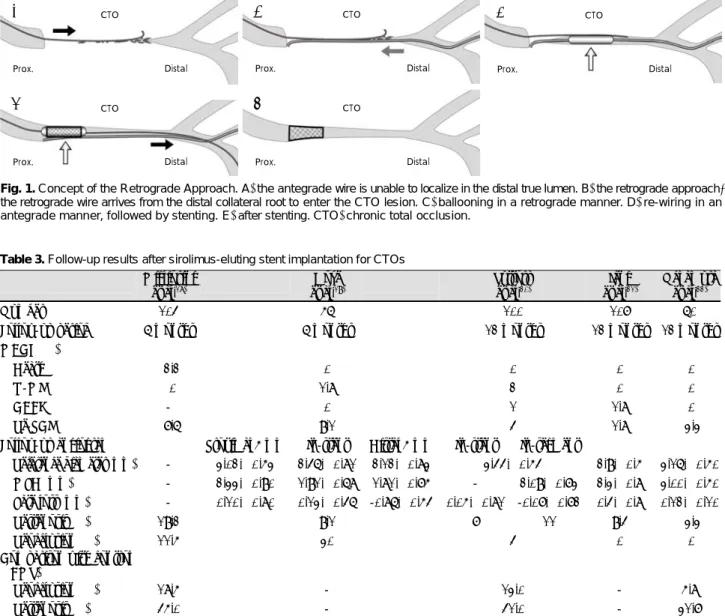
16)The basic concept of the retrograde approach is shown in Figure 1. In this technique, the operator uti- lizes the existence of clear visibility and continuous septal connected straight collaterals that is a shorter route to the recipient vessel, and has a less tortuous anatomy as demonstrated by bilateral injection angiography. Careful selection of the guiding catheter is necessary, as a su- pportive and short guide catheter (90 cm) should be used to enable a longer coronary segment to pass through.
The hydrophilic soft wire with support micro-tube ca- theter is necessary to advance through the collateral with the retrograde approach of the CTO. This technique is used for long RCA and LAD CTOs, in which the ret- rograde wire is navigated through a septal branch. Once these wires advance into the target recipient, the wire should be advanced in the antegrade guide catheter or aorta.
The retrograde wire is easily trapped in the guide ca-
theter by a PCI balloon to provide large back-up support
to advance the small size balloon retrogradely and dilate
the CTO lesion. After dilatation of CTO lesion, the an- tegrade wire is localized in the distal true lumen easily with an antegrade manner by proceeding along the ret- rograde wire that is already passed to the proximal vessel.
If the retrograde guide wire cannot enter the inside of the target vessel, the controlled antegrade and retrograde subintimal tracking (CART) technique should be used.
17)In these situations, it is very important to mi-nimize the enlargement of the subintimal space at the CTO site;
therefore, the CART technique is introduced. The basic concept of the CART technique is that once the retro- grade guide wire penetrates from the distal true lumen into the CTO lesion of the subintimal space, a small size balloon is advanced over the retrograde wire, and balloon to make a large crack. Consequently, the an- tegrade wire is advanced into the subintimal space easily, and eventually the antegrade wire easily localizes in the distal true lumen (Fig. 1).
Recent Progress of Clinical Data for Chronic Total Occlusion
Intervention With the Use of Drug-Eluting Stents
The long-term success after PCI for CTOs is ham- pered by high rates of subacute reocclusion and late restenosis. Several randomized trials have demonstrated that stent implantation decreases the rates of restenosis and reocclusion, and confers a long-term survival ad- vantage, even with use of bare metal stents. However, restenosis remains a major complication limiting late outcome after PCI. The use of DESs has proved to de- crease restenosis (Table 3 and 4) in patients with CTOs and has also been shown to improve long-term clinical outcome. A lower success rate and higher restenosis rate of PCI for CTOs is a goal for interventional cardi- ologists. However, with the use of drug-eluting stents,
Table 3. Follow-up results after sirolimus-eluting stent implantation for CTOs Migliorini
et al.18) Hoye
et al.19) Suttorp
et al.20) Jang
et al.21) Nakamura et al.22)
Number 104 56 100 107 60
Follow-up period 6 months 6 months 12 months 12 months 12 months MACE (%)
Death 02.2 0 0 0 0
Q-MI 0 1.8 2 0 0
CABG - 0 1 1.8 0
Re-PCI 07.6 9.1 4 1.8 03.3
Follow-up angiogram Proximal 5 mm In-stent Distal 5 mm In-stent In-segment
Reference diameter (mm) - 3.02±0.53 2.46±0.81 2.12±0.83 3.44±0.54 2.9±0.5 3.16±0.50 MLD (mm) - 2.33±0.90 1.91±0.68 1.81±0.75 - 2.09±0.73 2.3±0.8 3.00±0.50 Late loss (mm) - 0.10±0.80 0.13±0.46 -0.86±0.54 0.05±0.81 -0.07±0.72 0.4±0.8 0.12±0.10
Restenosis (%) 19.2 9.1 7 11 9.4 03.3
Reocclusion (%) 11.5 30 4 0 0
Comparison with control (BMS)
Reocclusion (%) 18.5 - 13.0 - 5.8
Restenosis (%) 45.0 - 41.0 - 31.7
CTO: chronic total occlusion, MACE: major adverse cardiac effect, Q-MI: Q wave myocardial infarction, CABG: coronary artery bypass graft, Re-PCI: re-percutaneous coronary intervention, MLD: minimal luminal diameter, BMS: bare metal stents
Fig. 1. Concept of the Retrograde Approach. A: the antegrade wire is unable to localize in the distal true lumen. B: the retrograde approach;
the retrograde wire arrives from the distal collateral root to enter the CTO lesion. C: ballooning in a retrograde manner. D: re-wiring in an antegrade manner, followed by stenting. E: after stenting. CTO: chronic total occlusion.
CTO
Prox. Distal
CTO
Prox. Distal
CTO
Prox. Distal
CTO
Prox. Distal
CTO
Prox. Distal
A B C
D E
there is a high success rate and a considerable lower restenosis rate after PCI for CTOs. Therefore, the time has now come to perform a PCI for CTOs as a routine procedure by interventionists, and all interventional cardiologists will require the basic skills of CTO inter- vention in the near future.
Conclusion
With recent advanced special techniques and devices, such as dedicated CTO guide wires and the Tornus sy- stem (devices) and the parallel wiring technique, IVUS- guided wiring technique, retrograde wiring approach (techniques), the initial success rate of PCI for CTO is high (approximately 90%).
According to the several emerging studies that have evlautated the efficacy of drug-eluting stent implantation after successful recanalization of CTOs, the use of drug- eluting stents enhances definitely the long-term clinical outcomes after PCI for CTOs.
REFERENCES
1) Heyder M, Engel HJ, Hormann E. Angioplasty of chronic coro- nary artery occlusions: effect on clinical symptoms and left ven- tricular function. Z Kardiol 1996;85:125-32.
2) Bell MR, Berger PB, Bresnahan JF, Reeder GS, Bailey KR, Hol- mes DR Jr. Initial and long-term outcome of 354 patients after coronary balloon angioplasty of total coronary occlusions. Cir- culation 1992;85:1003-11.
3) Sirnes PA, Golf S, Myreng Y, et al. Stenting in Chronic Coronary Occlusion (SICCO): a randomized, controlled trial of adding stent implantation after successful angioplasty. J Am Coll Cardiol 1996;28:1444-51.
4) Hancock J, Thomas MR, Holmberg S, Wainwright RJ, Jewitt DE.
Randomized trial of elective stenting after successful percutaneous
transluminal coronary angioplasty of occluded coronary arteries.
Heart 1998;79:18-23.
5) Rubartelli P, Niccoli L, Verna E, et al. Stent implantation versus balloon angioplasty in chronic coronary occlusions: results from the GISSOC trial. J Am Coll Cardiol 1998;32:90-6.
6) Buller CE, Dzavik V, Carere RG, et al. Primary stenting versus balloon angioplasty in occluded coronary arteries. Circulation 1999;100:236-42.
7) Sievert H, Rohde S, Utech A, et al. Stent or angioplasty after re- canalization of chronic coronary occlusions? Am J Cardiol 1999;
84:386-90.
8) Hoher M, Wohrle J, Grebe OC, et al. A randomized trial of elective stenting after balloon recanalization of chronic total occlusions.
J Am Coll Cardiol 1999;34:722-9.
9) Lotan C, Rozenman Y, Hendler A, et al. Stents in total occlusion for restenosis prevention: the multicentre randomized STOP study.
Eur Heart J 2000;21:1960-6.
10) Olivari Z, Rubartelli P, Piscione F, et al. Immediate results and one-year clinical outcome after percutaneous coronary interven- tions in chronic total occlusions. J Am Coll Cardiol 2003;41:1672-8.
11) Morice MC, Serruys PW, Sousa JE, et al. A randomized compar- ison of a sirolimus-eluting stent with a standard stent for cor- onary revascularization. N Engl J Med 2002;346:1773-80.
12) Degertekin M, Serruys PW, Foley DE, et al. Persistent inhibition of neointimal hyperplasia after sirolimus-eluting stent implanta- tion: long-term (up to 2 years) clinical, angiographic, and intra- vascular ultrasound follow-up. Circulation 2002;106:1610-3.
13) Rensing BJ, Vos J, Smits PC, et al. Coronary restenosis elimina- tion with a sirolimus eluting stent: first European human experi- ence with 6-month angiographic and intravascular ultrasonic follow-up. Eur Heart J 2001;22:2125-30.
14) Lefevre T, Louvard Y, Loubeyre C, et al. A randomized study com- paring two guide wire strategies for angioplasty of chronic total coronary occlusion. Am J Cardiol 2000;85:1144-7.
15) Violaris AG, Melkert R, Serruys PW. Long-term luminal renar- rowing after successful elective coronary angioplasty of total oc- clusions: a quantitative angiographic analysis. Circulation 1995;
91:2140-50.
16) Surmely JF, Katoh O, Tsuchikake E, Nasu K, Suzuki T. Coronary Table 4. Follow-up results after paclitaxel-eluting stent implantation for CTOs
Werner et al.23) Buellesfeld et al.24) Jang et al.21)
Number 48 45 29
Follow-up period 12 months 6 months 12 months
MACE (%)
Death 0 0 3.4
Q-MI 0 0 0
CABG 0 0 0
Re-PCI 6.3 15.6 0.9
Follow-up angiogram In-stent In-segment
Reference diameter (mm) 2.57±0.47 2.92±0.51 2.90±0.51 3.1±0.4
MLD (mm) 2.05±0.59 2.02±0.78 1.78±0.80 2.0±0.9
Late loss (mm) 0.19±0.62 0.26±0.55 0.13±0.58 -
Restenosis (%) 2.1 - -
Reocclusion (%) 8.3 18 28.6
Comparison with control (BMS)
Reocclusion (%) 23.4 - -
Restenosis (%) 51.1 - -
CTO: chronic total occlusion, MACE: major adverse cardiac effect, Q-MI: Q wave myocardial infarction, CABG: coronary artery bypass graft, Re-PCI: re-percutaneous coronary intervention, MLD: minimal luminal diameter, BMS: bare metal stents
septal collaterals as an access for the retrograde approach in the percutaneous treatment of coronary chronic total occlusion. Ca- theter Cardiovasc Interv 2007;69:826-32.
17) Surmely JF, Tsuchikane E, Katoh O, et al. New concept for CTO recanalization using a controlled antegrade and retrograde subin- timal tracking: the CART technique. J Invasive Cardiol 2006;18:
334-8.
18) Migliorini A, Moschi G, Vergara R, Parodi G, Carrabba N, Anto- niucci D. Drug-eluting stent-supported percutaneous coronary intervention for chronic total coronary occlusion. Catheter Car- diovasc Interv 2006;67:344-8.
19) Hoye A, Tanabe K, Lemos PA, et al. Significant reduction in re- stenosis after the use of sirolimus-eluting stents in the treatment of chronic total occlusions. J Am Coll Cardiol 2004;43:1954-8.
20) Suttorp MJ, Laarman GJ, Rachel BM, et al. Primary Stenting of Totally Occluded Native Coronary Arteries II (PRISON II): a randomized comparison of bare metal stent implantation with
sirolimus-eluting stent implantation for the treatment of total coronary occlusions. Circulation 2006;114:921-8.
21) Jang JS, Hong MK, Lee CW, et al. Comparison between sirolimus- and paclitaxel-eluting stents for the treatment of chronic total occlusions. J Invasive Cardiol 2006;18:205-8.
22) Nakamura S, Muthusamy TS, Bae JH, Cahyadi YH, Udayachalerm W, Tresukosol D. Impact of sirolimus-eluting stent on the outcome of patients with chronic total occlusions. Am J Cardiol 2005;95:
161-6.
23) Werner G, Shwarz G, Prochnau D, et al. Paclitaxel-eluting stents for the treatment of chronic total occlusions: a strategy of exten- sive lesion coverage with drug-eluting stents. Catheter Cardiovasc Interv 2006;67:1-9.
24) Buellesfeld L, Gerckens U, Mueller R, Schmidt T, Grube E. Pol- ymer-based paclitaxel-eluting stent for treatment of chronic total occlusions of native coronaries: results of a Taxus CTO registry.
Catheter Cardiovasc Interv 2005;66:173-7.