INTRODUCTION
The prevalence of diabetes and obesity are consistently in- creasing among Koreans.1 As socioeconomic conditions and
health-related dietary habits change, the prevalence of chron- ic degenerative diseases is increasing.2 Among chronic dis- eases, metabolic syndrome (MS), which is largely caused by poor dietary and lifestyle habits, is an important national and international concern that threatens public health, increases the prevalence of diabetes and cardiovascular disease, and af- fects quality of life.3 Although the exact pathogenic mecha- nism of MS remains unclear, abdominal obesity and insulin resistance are known to play major roles.4 According to data from the Korean Health Insurance Review & Assessment Ser- vice in 2014, the proportion of patients with MS in Korea was higher in individuals in their fourth (4–5%), fifth (15.6%), and sixth (36.6%) decades of life.5
MS has been reported to have a significant effect on oral health.6 Individuals with MS have poorer periodontal status
Presence of Metabolic Syndrome Components Is Associated with Tooth Loss in Middle-Aged Adults
Min-Jeong Cho1, Youn-Hee Choi1,2, Hyeon Chang Kim3,4, Jee-Seon Shim3,4, Atsuo Amano5, Ji-Young Kim6, and Keun-Bae Song1
1Department of Preventive Dentistry, School of Dentistry, Kyungpook National University, Daegu;
2Institute for Translational Research in Dentistry, Kyungpook National University, Daegu;
3Cardiovascular and Metabolic Disease Etiology Research Center, Yonsei University College of Medicine, Seoul;
4Department of Preventive Medicine, Yonsei University College of Medicine, Seoul, Korea;
5Department of Preventive Dentistry, Osaka University Graduate School of Dentistry, Osaka, Japan;
6Department of Dental Hygiene, Ulsan College, Ulsan, Korea.
Purpose: In general, the prevalence of metabolic syndrome (MS) and tooth loss increases with age. We investigated the relation- ship between the presence of MS, its elements, and tooth loss in middle-aged Korean adults.
Materials and Methods: This study included Korean adults between 30 and 64 years of age who resided in the capital area of Seoul.
From January to June 2014, individuals interested in participating in the oral health survey among those who visited the university hospital’s cardiovascular center and provided informed consent were selected. Among 748 subjects who responded to the oral health questionnaires, 30 were excluded due to unclear responses; therefore, a total of 718 were included in the final analysis.
Results: The crude odds ratio (OR) of ≥one MS component affecting tooth loss was 1.45 [95% confidence interval (CI), 1.06–2.00].
After adjusting for sex, age, education, income level, occupation, smoking status, kidney disease, chronic obstructive pulmonary disease, and rheumatic disease, the adjusted OR was 1.47 (95% CI, 1.06–2.05), which was statistically significant (p<0.05). The OR for tooth loss was higher in the presence of ≥one component of MS (50–64 years of age) in females.
Conclusion: This study suggests that female aged 50–64 years may have higher likelihood of tooth loss upon the presence of at least one MS component. Prevention against MS among female of older age could contribute to maintenance of remaining teeth.
Further well-designed studies are needed.
Key Words: Metabolic syndrome, middle age, tooth loss
pISSN: 0513-5796 · eISSN: 1976-2437
Received: December 24, 2018 Revised: February 26, 2019 Accepted: March 20, 2019
Corresponding author: Youn-Hee Choi, DDS, MPH, PhD, Department of Preven- tive Dentistry, School of Dentistry, Institute for Translational Research in Dentistry, Kyungpook National University, 2177 Dalgubeol-daero, Jung-gu, Daegu 41940, Korea.
Tel: 82-53-660-6875, Fax: 82-53-423-2947, E-mail: [email protected]
•The authors have no potential conflicts of interest to disclose.
© Copyright: Yonsei University College of Medicine 2019
This is an Open Access article distributed under the terms of the Creative Com- mons Attribution Non-Commercial License (https://creativecommons.org/licenses/
by-nc/4.0) which permits unrestricted non-commercial use, distribution, and repro- duction in any medium, provided the original work is properly cited.
Yonsei Med J 2019 Jun;60(6):554-560 https://doi.org/10.3349/ymj.2019.60.6.554
than those without MS,7 and those with diabetes exhibit a higher incidence of periodontal disease.8 Moreover, hyperten- sion plays a role in alveolar bone destruction, and smoking and alcohol use are also associated with periodontal disease.9 Pro- gression of atherosclerotic vascular degeneration in the pres- ence of cardiovascular risk factors may lead to decreased blood supply to the periodontal tissue, decreased resistance to anaerobic bacteria, and increased risk for periodontal dis- ease.10 Periodontal tissue may serve as a reservoir for bacteria and their products, inflammation and immune mediators, which in turn may become a risk factor for diabetes and/or cardiovascular disease.11
Periodontal disease is one of the most frequent chronic con- ditions of the oral cavity and is one representative oral disease that causes tooth loss.12 According to the Korea National Health and Nutrition Examination Survey (KNHANES), in 2015, the number of residual teeth in Korean adults was 28.4 in individ- uals in their fourth, 27.5 in the fifth, 25.3 in the sixth, and 22.5 in the seventh decades of life, with the number of remaining teeth decreasing with older age.13
In general, the prevalence of MS and tooth loss increases with age. As the older adult population is increasing globally and since their concerns with health are increasing, the impor- tance of oral health, as well as general health, should not be ig- nored. Although there have been studies investigating the rela- tionship between MS and the number of residual teeth in Korea, the most recent used data from the 2012 Korean National Health and Nutrition Survey. Few have investigated the rela- tionship between MS and the number of remaining teeth since 2012, including the Korean National Health and Nutrition Sur- vey data.14-16 Therefore, this study was conducted as part of a Cardiovascular and Metabolic Disease Etiology Research Cen- ter (CMERC)17 cohort study to investigate the relationship be- tween MS, individual elements of MS, and tooth loss in middle- aged Korean adults.
MATERIALS AND METHODS
This study received approval from the Institutional Review Board (4-2013-0661) of Severance Hospital of Yonsei Univer- sity College of Medicine (Seoul, Korea) and from the Institu- tional Review Board of the Kyungpook National University Hospital (Daegu, Korea) (KNUH 2014-07-040).
Study participants
This study was conducted in collaboration with the CMERC,17 a cohort study funded by the Ministry of Health and Welfare of the Korean Government in 2013 to examine the relationship between cardiovascular and metabolic diseases and oral health. This study included individuals aged 30–64 years who resided in Seoul, Korea. From January to June 2014, individu- als who were interested in participating in the oral health sur-
vey among those who visited the research clinic and provided written consent were selected. Individuals who were diag- nosed with malignant tumor(s) within 2 years or were still un- dergoing cancer treatment; were diagnosed with myocardial infarction, stroke, or cardiac failure; were currently involved in drug trials; or who were pregnant or planning to become preg- nant were excluded from consideration. Among the 748 sub- jects who responded to the oral health questionnaires, 30 were excluded due to unclear responses, leaving 718 in the final analysis.
Variables
MS was classified into three or more abnormalities according to the results of measurement of waist circumference, low high-density lipoprotein cholesterol, fasting blood sugar, tri- glyceride, and blood pressure according to the most widely used standard in the United States (National Cholesterol Edu- cation Program-Adult Treatment Panel); abdominal obesity (waist circumference, male ≥90 cm, female ≥85 cm), low high- density lipoprotein cholesterol (male ≤40 mg/dL, female ≤50 mg/dL); triglyceride [≥150 mg/dL (1.7 mmol/L)]; fasting glu- cose [≥100 mg/dL (6.1 mmol/L)]; and diastolic/systolic blood pressure (≥130/85 mm Hg).18 The waist circumference of the subjects was measured using a tape measure (SECA 201, Seca, Hamburg, Germany) while breathing out, after confirming the mid-point between the lower end of the last rib and the upper end of the iliac crest from the middle of the axilla. Blood sam- ples were collected from subjects in a fasted state and submit- ted to a single laboratory (Seoul Clinical Laboratories, Yongin, Korea). Low high-density lipoprotein cholesterol and triglycer- ide levels were measured using an auto-analyzer (ADIVA1800, Siemens Medical, Deerfield, IL, USA). Glucose was measured using a colorimetric method, and low high-density lipopro- tein cholesterol and triglyceride levels were measured using an enzymatic method. Blood pressure was measured three times at 2 min intervals on the right arm (HEM-7080, Omron Health, Kyoto, Japan) so as to maintain a stable state in a sit- ting position for 5 min before measurement. Also, we investi- gated for the presence of chronic diseases, such as kidney dis- ease, chronic obstructive pulmonary disease (COPD), or rheumatic disease. Measures and methods for variables, ex- cept for the oral variables, are explained in the preceding arti- cle.17
Oral questionnaires were based on data with proven validity and reliability by Jin, et al.19 In an oral health survey, the num- ber of teeth lost was determined by the response to the ques- tionnaire item, “How many missing teeth do you have except the wisdom teeth?”20 The subjects were divided into two groups:
those with tooth loss and those without tooth loss.
Statistical analysis
The chi-squared test was performed to examine differences in general characteristics and between subjects with and with-
out tooth loss. Logistic regression analysis was performed to investigate the relationship between MS components and tooth loss. Subjects were divided into two groups (30–49 and 50–64 years of age) to investigate the relationship between in- dividual components of MS and tooth loss using logistic re- gression analysis.21,22 Multiple regression analysis was per- formed by subdividing individuals into two groups (30–49 and 50–64 years of age) in the groups of individuals with MS com- ponents and those without MS components. Data were ana- lyzed using SPSS version 23.0 (IBM Corporation, Armonk, NY, USA); p<0.05 was considered to be statistically significant.
RESULTS
Among 718 subjects, 158 (41.7%) were 30–49 years of age and 221 (58.3%) were 50–64 years of age in the group without tooth loss. In the group with tooth loss, 76 (22.4%) participants were 30–49 and 263 (77.6%) were 50–64 years of age. In the group without missing teeth, 137 (36.1%) exhibited no MS compo- nents and 242 (63.9%) had ≥one component of MS. In the group with tooth loss, 95 (28.0%) had MS components and 244 (72.0%) had MS components, a difference that was a statistically sig- nificant (p<0.05) (Table 1).
The crude odds ratio (OR) of ≥one MS component affecting tooth loss was 1.45 [95% confidence interval (CI), 1.06–2.00].
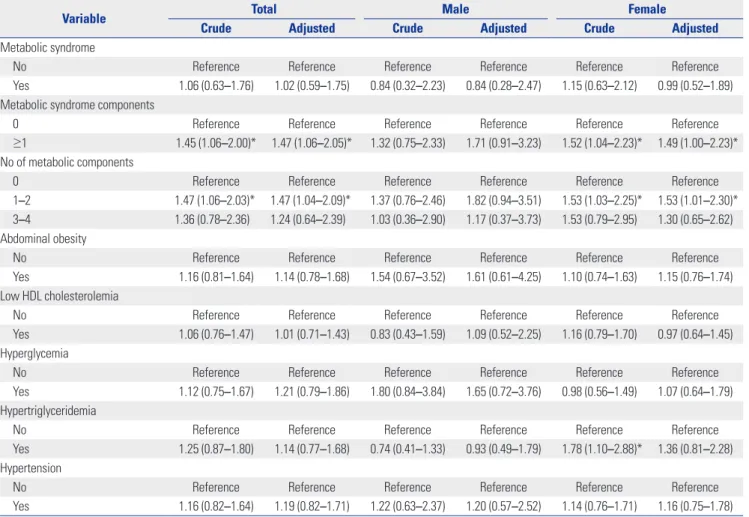
After adjusting for sex, age, education, income level, occupa- tion, smoking status, kidney disease [2 (0.3%)], COPD [10 (1.4%)], and rheumatic disease [3 (0.4%)], the adjusted OR was 1.47 (95% CI, 1.06–2.05), which was statistically signifi- cant. The OR of the presence of one-two MS components af- fecting tooth loss was 1.47 (95% CI, 1.06–2.03). After adjusting for sex, age, education, income level, occupation, smoking sta- tus, kidney disease, COPD, and rheumatic disease, the adjust- ed OR was 1.47 (95% CI, 1.04–2.09), which was statistically sig- nificant. However, the OR of the presence of three-four MS components affecting tooth loss was not statistically signifi- cant (p>0.05). Among females, the OR of MS components (≥1) affecting tooth loss was 1.49 (95% CI, 1.00–2.23), after adjust- Table 1. Characteristics of Metabolic Syndrome Components according
to Missing Teeth
Variable Total (n=718)
Missing teeth p
value No (n=379) Yes (n=339)
Age group (yr) <0.001*
30–39 116 (16.2) 85 (22.4) 31 (9.1)
40–49 118 (16.4) 73 (19.3) 45 (13.3)
50–59 375 (52.2) 185 (48.8) 190 (56.1)
60–64 109 (15.2) 36 (9.5) 73 (21.5)
Sex 0.696
Male 211 (29.4) 109 (28.8) 102 (30.1)
Female 507 (70.6) 270 (71.2) 237 (69.9)
Education <0.001*
Middle school 146 (20.3) 49 (12.9) 97 (28.6) High school 292 (40.7) 152 (40.1) 140 (41.4) College 241 (33.6) 151 (39.8) 90 (26.5) Graduate school 39 (5.4) 27 (7.2) 12 (3.5)
Income 0.165
Low 159 (22.1) 80 (21.1) 79 (23.3)
Middle-low 321 (44.8) 160 (42.2) 161 (47.5) Middle-high 212 (29.5) 122 (32.2) 90 (26.5)
High 26 (3.6) 17 (4.5) 9 (2.7)
Occupation 0.007*
Manager or
professional 153 (21.3) 94 (24.8) 59 (17.4) Office or service 130 (18.1) 72 (19.0) 58 (17.1) Housewife 228 (31.8) 121 (31.9) 107 (31.6) Others 181 (25.2) 76 (20.1) 105 (31.0)
Unemployed 26 (3.6) 16 (4.2) 10 (2.9)
Smoking status 0.292
Never 532 (74.1) 287 (75.7) 245 (72.3)
Experienced 186 (25.9) 92 (24.3) 94 (27.7)
Metabolic syndrome 0.837
Yes 64 ( 8.9) 33 (8.7) 31 (9.1)
No 654 (91.1) 346 (91.3) 308 (90.9)
Metabolic syndrome components 0.020*
0 232 (32.3) 137 (36.1) 95 (28.0)
≥1 486 (67.7) 242 (63.9) 244 (72.0)
No of metabolic components 0.237
0 232 (32.3) 137 (36.1) 95 (28.0)
1 266 (37.0) 131 (34.6) 135 (39.8)
2 156 (21.7) 78 (20.6) 78 (23.0)
3 50 (7.0) 26 (6.9) 24 (7.1)
4 14 (1.9) 7 (1.8) 7 (2.1)
Abdominal obesity
Male 79.78±8.63 79.21±7.76 80.38±9.46 0.067
Female 79.78±8.74 79.70±8.87 79.88±8.61 0.989 Low HDL cholesterolemia
Male 50.36±12.91 50.04±12.75 50.71±13.14 0.915 Female 59.26±14.27 59.69±14.47 58.77±14.04 0.928 Hyperglycemia 92.03±20.71 91.47±17.57 92.65±23.74 0.450
Table 1. Characteristics of Metabolic Syndrome Components according to Missing Teeth (Continued)
Variable Total
(n=718)
Missing teeth p value No (n=379) Yes (n=339) Hypertriglyceridemia 121.12±84.83 117.62±80.90 125.03±89.18 0.789 Blood pressure
Systolic blood
pressure 117.55±29.77 115.82±14.86 119.48±40.33 0.113 Diastolic blood
pressure 74.85±9.27 74.39±8.96 75.36±9.60 0.035 HDL, high-density lipoprotein.
Data presented as a n (%) or mean±standard deviation.
*Statistically significant difference according to chi-squared test.
ing for sex, age, education, income level, occupation, smoking status, kidney disease, COPD, and rheumatic disease. There was a slight trend for the relationship between hypertriglyceri- demia and tooth loss (Table 2).
Data reflecting the relationship between MS and number of missing teeth according to age are summarized in Table 3. In the older age group (50–64 years), the OR of MS components (≥1) affecting tooth loss was 1.59 (95% CI, 1.07–2.37) after ad- justing for age, sex, education, income level, occupation, smoking status, kidney disease, COPD, and rheumatic disease.
In MS components (≥1) and the older age group (50–64 years), the OR affecting tooth loss was 2.56 (95% CI, 1.45–4.52) after adjusting for sex, education, income level, occupation, smoking status, kidney disease, COPD, and rheumatic disease (Table 4).
DISCUSSION
This study investigated the risk ratio of tooth loss according to
the number of MS risk factors in Korean adults. Adult tooth loss is primarily due to periodontal disease caused by alveolar bone destruction in the periosteal tissue of patients with elevat- ed levels of various inflammatory markers.23,24 It has been sug- gested that periodontitis elevates the levels of systemic cyto- kines, further enhancing lipolysis, which in turn may lead to an increase in circulating triglycerides.25 Inflammation in peri- odontal tissues increases inflammatory cytokine, bacterial, and lipopolysaccharide levels and shares some common risk fac- tors with MS, including hyperglycemia, obesity, dyslipidemia, and hypertension. Periodontitis has been considered to be a risk factor for MS and can modify the disease pathway.26 Nishimura, et al.27 suggested that periodontal disease should be regarded as a component of MS; however, a causal relationship remains unclear.
Morita, et al.28 reported that the risk for periodontitis increas- es as the number of risk factors for MS increases. In a prelimi- nary study conducted before this study, the risk ratio for the presence of periodontitis was 2.03 times higher in patients with MS. In addition, adults 30–49 years of age exhibited asso-
Table 2. Logistic Regression Analysis of Metabolic Syndrome Components and the Presence of Tooth Loss
Variable Total Male Female
Crude Adjusted Crude Adjusted Crude Adjusted
Metabolic syndrome
No Reference Reference Reference Reference Reference Reference
Yes 1.06 (0.63–1.76) 1.02 (0.59–1.75) 0.84 (0.32–2.23) 0.84 (0.28–2.47) 1.15 (0.63–2.12) 0.99 (0.52–1.89) Metabolic syndrome components
0 Reference Reference Reference Reference Reference Reference
≥1 1.45 (1.06–2.00)* 1.47 (1.06–2.05)* 1.32 (0.75–2.33) 1.71 (0.91–3.23) 1.52 (1.04–2.23)* 1.49 (1.00–2.23)*
No of metabolic components
0 Reference Reference Reference Reference Reference Reference
1–2 1.47 (1.06–2.03)* 1.47 (1.04–2.09)* 1.37 (0.76–2.46) 1.82 (0.94–3.51) 1.53 (1.03–2.25)* 1.53 (1.01–2.30)*
3–4 1.36 (0.78–2.36) 1.24 (0.64–2.39) 1.03 (0.36–2.90) 1.17 (0.37–3.73) 1.53 (0.79–2.95) 1.30 (0.65–2.62) Abdominal obesity
No Reference Reference Reference Reference Reference Reference
Yes 1.16 (0.81–1.64) 1.14 (0.78–1.68) 1.54 (0.67–3.52) 1.61 (0.61–4.25) 1.10 (0.74–1.63) 1.15 (0.76–1.74) Low HDL cholesterolemia
No Reference Reference Reference Reference Reference Reference
Yes 1.06 (0.76–1.47) 1.01 (0.71–1.43) 0.83 (0.43–1.59) 1.09 (0.52–2.25) 1.16 (0.79–1.70) 0.97 (0.64–1.45) Hyperglycemia
No Reference Reference Reference Reference Reference Reference
Yes 1.12 (0.75–1.67) 1.21 (0.79–1.86) 1.80 (0.84–3.84) 1.65 (0.72–3.76) 0.98 (0.56–1.49) 1.07 (0.64–1.79) Hypertriglyceridemia
No Reference Reference Reference Reference Reference Reference
Yes 1.25 (0.87–1.80) 1.14 (0.77–1.68) 0.74 (0.41–1.33) 0.93 (0.49–1.79) 1.78 (1.10–2.88)* 1.36 (0.81–2.28) Hypertension
No Reference Reference Reference Reference Reference Reference
Yes 1.16 (0.82–1.64) 1.19 (0.82–1.71) 1.22 (0.63–2.37) 1.20 (0.57–2.52) 1.14 (0.76–1.71) 1.16 (0.75–1.78) HDL, high-density lipoprotein.
Data presented as odds ratios (95% confidence intervals).
*Statistically significant (p<0.05). Adjusted for age, sex, education, income, occupation, smoking habits, kidney disease, chronic obstructive pulmonary disease, and rheumatic disease.
ciations between MS and periodontitis; however, adults ≥60 years of age exhibited a rather weak relationship between MS and periodontitis.20 This may be explained by the fact that the risk for periodontal disease is reduced because the number of remaining teeth is small due to already extracted or missing teeth. By examining periodontal disease history and the num- ber of remaining teeth, Joshipura, et al.29 reported that tooth loss may increase the risk for coronary artery disease.
Song, et al.14 reported a significant difference in the associa- tion between MS and the number of natural teeth. Kang and Yul30 reported that the risk ratio of tooth loss was 1.47 times higher in individuals with MS. Kim, et al.15 investigated the re- lationship between tooth loss and MS using KNHANES data (2012). In female especially, the number of remaining teeth was lower in those with MS, and the risk ratio of MS was 1.87 times higher when the number of remaining teeth was small.
Kim, et al.15 and this study both examined the relationship be- tween MS and tooth loss as cross-sectional studies. Kim, et al.15 demonstrated how residual teeth can affect MS in their hy- pothesis. Kaye, et al.31 reported that the risk ratio of missing teeth was 1.39, the depth of the periodontal pocket was 1.37, the clinical attachment loss was 1.19, the alveolar bone loss Table 3. Age-Specific Association Between Metabolic Syndrome and Tooth Loss
Variable Age (30–49 years) Age (50–64 years)
Crude Adjusted Crude Adjusted
Metabolic syndrome
No Reference Reference Reference Reference
Yes 0.86 (0.29–2.53) 1.56 (0.44–5.52) 1.05 (0.57–1.91) 1.02 (0.3–1.95)
Metabolic syndrome components
0 Reference Reference Reference Reference
≥1 1.24 (0.68–2.25) 1.26 (0.64–2.50) 1.60 (1.09–2.34)* 1.59 (1.07–2.37)*
No of metabolic components
0 Reference Reference Reference Reference
1–2 1.14 (0.3–2.06) 1.35 (0.71–2.59) 1.14 (0.76–1.70) 1.10 (0.72–1.67)
3–4 1.00 (0.20–3.19) 1.26 (0.37–4.27) 1.23 (0.38–3.94) 1.17 (0.35–3.94)
Abdominal obesity
No Reference Reference Reference Reference
Yes 1.01 (0.53–1.95) 1.30 (0.61–2.80) 1.23 (0.80–1.88) 1.17 (0.74–1.83)
Low HDL cholesterolemia
No Reference Reference Reference Reference
Yes 0.80 (0.42–1.52) 0.89 (0.44–1.80) 1.13 (0.76–1.67) 1.08 (0.70–1.65)
Hyperglycemia
No Reference Reference Reference Reference
Yes 1.31 (0.64–2.66) 1.36 (0.63–2.97) 1.10 (0.66–1.83) 1.14 (0.67–1.92)
Hypertriglyceridemia
No Reference Reference Reference Reference
Yes 0.72 (0.34–1.53) 0.69 (0.28–1.72) 1.44 (0.93–2.24) 1.44 (0.91–2.29)
Hypertension
No Reference Reference Reference Reference
Yes 1.64 (0.88–3.06) 1.58 (0.80–3.14) 1.01 (0.66–1.55) 1.03 (0.66–1.62)
HDL, high-density lipoprotein.
Data presented as odds ratios (95% confidence intervals).
*Adjusted for age, sex, education, income, occupation, smoking habits, kidney disease, chronic obstructive pulmonary disease, and rheumatic disease.
≥40% was 1.25, and tooth mobility was 1.43 times higher in participants with MS. Therefore, this study sought to deter- mine whether the risk of MS itself poses an impact on tooth survival considering a bi-directional biological relationship, and we would like to emphasize the importance of oral health care for MS patients or higher risk MS persons.
Furuta, et al.32 examined middle-aged Japanese adults 35 to 60 years of age and reported the association between MS and periodontal disease. The number of teeth lost was significantly associated with ≥three MS components (p<0.05). In the present study, the risk ratio for tooth loss was 1.47 times higher than that for ≥one MS components, and the difference was statisti- cally significant (p>0.05).
Zhu and Hollis33 found that the risk ratio of MS was higher if the number of remaining teeth remained smaller. The risk ra- tio of MS was 1.79 times higher in edentulous patients. Ojima, et al.34 reported that the risk of MS was 1.66 times higher when the number of missing teeth was more due to dental caries, with a statistically significant difference (p<0.05). As a result, the presence of MS may increase number of missing teeth due to chronic oral diseases, such as periodontitis and dental caries.
Therefore, we should always consider the impact of increasing
age.
Although we cannot explain the biological mechanism of MS and tooth loss in this study, metabolic status and/or blood circulation system may play an important role in the health of the periodontium.35 Tooth loss in adults is caused by periodon- tal diseases defined by destruction of periodontium. In this study, we could expect that persons at higher risk of MS tend to lose teeth. The results of this study might support this mech- anism. Therefore, we would like to recommend that patients with MS should receive intensive regular periodontal manage- ment at dental clinics.
This study had limitations, the first of which was its cross- sectional study, which may have introduced bias in patient selection. Second, a dentist did not conduct a direct oral ex- amination to determine the cause of tooth loss; we only used information obtained from oral health questionnaires. Third, patients with cancer or cardiovascular disease were excluded from the study, although those who had chronic diseases, such as renal diseases or rheumatic diseases, were considered. Also, this study was limited because of a relatively low frequency of MS, compared with the Korean National Health and Nutrition Survey data. This study can be meaningful because it included a relatively large number of subjects, although not with a sam- ple size as large as national surveys conducted by trained spe- cialists at large hospitals in Korea. The risk of tooth loss was higher in the group 50–64 years of age with MS than the group 30–49 years of age. As the difference in age was relatively large and since residual confounding can occur, we adjusted once
again for age. The OR was 1.59 (95% CI, 1.07–2.37) in the group of individuals 50–64 years of age. Similarly, there was a signifi- cant difference.
In conclusion, this study suggests that the presence of at least one MS component is associated with the prevalence of tooth loss in female and that its age-combined effect with an age between 50–64 years could have a stronger relationship. Pre- vention against MS for female of older age could help prevent teeth loss. Further well-designed studies are needed.
ACKNOWLEDGEMENTS
This work was supported by a grant from the Korea Health Tech- nology R&D Project through the Korea Health Industry Devel- opment Institute (KHIDI), funded by the Ministry of Health &
Welfare, Republic of Korea (grant number: HI13C0715), the Ministry of Education of the Republic of Korea, and the Nation- al Research Foundation of Korea (NRF-2017S1A 3A2067165).
AUTHOR CONTRIBUTIONS
Conceptualization: Min-Jeong Cho, Youn-Hee Choi. Data curation:
Min-Jeong Cho, Ji-Young Kim. Formal analysis: Min-Jeong Cho, Ji- Young Kim. Funding acquisition: Hyeon Chang Kim, Youn-Hee Choi.
Investigation: Jee-Seon Shim. Methodology: Jee-Seon Shim. Project administration: Hyeon Chang Kim, Youn-Hee Choi. Resources:
Youn-Hee Choi. Software: Jee-Seon Shim. Supervision: Atsuo Amano, Keun-Bae Song. Validation: Min-Jeong Cho. Visualization: Min-Jeong Cho, Youn-Hee Choi. Writing—original draft: Min-Jeong Cho. Writ- ing—review & editing: Min-Jeong Cho, Youn-Hee Choi.
ORCID iDs
Min-Jeong Cho https://orcid.org/0000-0002-6127-3702 Youn-Hee Choi https://orcid.org/0000-0001-5712-8097 Hyeon Chang Kim https://orcid.org/0000-0001-7867-1240 Jee-Seon Shim https://orcid.org/0000-0002-8671-3153 Atsuo Amano https://orcid.org/0000-0002-5158-147X Ji-Young Kim https://orcid.org/0000-0001-8926-7091 Keun-Bae Song https://orcid.org/0000-0002-5416-5500
REFERENCES
1. Song SO, Lee YH, Kim DW, Song YD, Nam JY, Park KH, et al.
Trends in diabetes incidence in the last decade based on Korean National Health Insurance claims data. Endocrinol Metab (Seoul) 2016;31:292-9.
2. Laaksonen DE, Lakka HM, Niskanen LK, Kaplan GA, Salonen JT, Lakka TA. Metabolic syndrome and development of diabetes mellitus: application and validation of recently suggested defini- tions of the metabolic syndrome in a prospective cohort study.
Am J Epidemiol 2002;156:1070-7.
3. Ford ES, Li C. Metabolic syndrome and health-related quality of life among U.S. adults. Ann Epidemiol 2008;18:165-71.
4. Primeau V, Coderre L, Karelis AD, Brochu M, Lavoie ME, Messier V, et al. Characterizing the profile of obese patients who are meta- Table 4. Association between MSC Plus Age and Tooth Loss
Variables Odds ratio (95% CI)
Crude Model I Model II
MSC (0)+age
(30–49 yrs) Reference Reference Reference
MSC (0)+age
(50–64 yrs) 2.09 (1.16–3.77)* 2.07 (1.15–3.74)* 1.61 (0.87–2.97) MSC (≥1)+age
(30–49 yrs) 1.24 (0.68–2.25) 1.22 (0.67–2.22) 1.17 (0.64–2.15) MSC (≥1)+age
(50–64 yrs) 3.34 (1.94–5.75)* 3.35 (1.95–5.78)* 2.56 (1.45–4.52)*
Sex 0.87 (0.62–1.21) 0.92 (0.57–1.51)
Education 0.68 (0.55–0.85)
Income 0.99 (0.81–1.21)
Occupation 1.05 (0.91–1.21)
Smoking habits 1.32 (0.80–2.19)
Kidney disease 1.44 (0.06–33.61)
COPD 0.77 (0.21–2.82)
Rheumatic disease 0.45 (0.04–5.12)
MSC: metabolic syndrome components; CI, confidence interval; COPD, chronic obstructive pulmonary disease.
*Statistically significant p<0.05. Model I: *p<0.05, adjusted for sex. Model II:
*p<0.05, sex, adjusted for education, income, occupation, smoking habits, kid- ney disease, COPD, and rheumatic disease.
bolically healthy. Int J Obes (Lond) 2011;35:971-81.
5. National Health Insurance. Health Insurance Review & Asses- ment Service. Available at: https://www.hira.or.kr/cms/08/05/02/01/
hira_eng.pdf.
6. Park YA, Jeong SH, Yoon SH, Choi YH, Song KB. Associations be- tween general health and diet habits and oral health among the elderly in Pohang city. J Korean Acad Oral Health 2006;30:183-92.
7. Casanova L, Hughes FJ, Preshaw PM. Diabetes and periodontal disease: a two-way relationship. Br Dent J 2014;217:433-7.
8. Wakai K, Kawamura T, Umemura O, Hara Y, Machida J, Anno T, et al. Associations of medical status and physical fitness with peri- odontal disease. J Clin Periodontol 1999;26:664-72.
9. American Academy of Periodontology. Parameter on systemic conditions affected by periodontal diseases. J Periodontol 2000;71 Suppl 5S:880-3.
10. Loesche WJ. Periodontal disease as a risk factor for heart disease.
Compendium 1994;15:978-82.
11. McFall WT Jr. Tooth loss in 100 treated patients with periodontal disease. A long-term study. J Periodontol 1982;53:539-49.
12. Khader Y, Khassawneh B, Obeidat B, Hammad M, El-Salem K, Bawadi H, et al. Periodontal status of patients with metabolic syn- drome compared to those without metabolic syndrome. J Peri- odontol 2008;79:2048-53.
13. Ministry of Health and Welfare, Korea Centers for Disease Control and Preventive. Korea Health Statistics 2015: Korean National Health and Nutritional Examination survey (KNHANES VI-3). Se- jong: Ministry of Health and Welfare; 2015. p.298.
14. Song IS, Han K, Ryu JJ, Park JB. Association between underweight and tooth loss among Korean adults. Sci Rep 2017;7:41524.
15. Kim SW, Cho KH, Han KD, Roh YK, Song IS, Kim YH. Tooth loss and metabolic syndrome in South Korea: The 2012 Korean Na- tional Health and Nutrition Examination Survey. Medicine (Balti- more) 2016;95:e3331.
16. HJ Kang. A study on periodontal disease and tooth loss in meta- bolic syndrome patient. J Dent Hyg Sci 2015;15:445-6.
17. Shim JS, Song BM, Lee JH, Lee SW, Park JH, Choi DP, et al. Car- diovascular and Metabolic Diseases Etiology Research Center (CMERC) cohort: study protocol and results of the first 3 years of enrollment. Epidemiol Health 2017;39:e2017016.
18. Expert Panel on Detection, Evaluation, and Treatment of High Blood Cholesterol in Adults. Executive summary of the third re- port of the National Cholesterol Education Program (NCEP) Ex- pert Panel on detection, evaluation, and treatment of high blood cholesterol in adults (Adult Treatment Panel III). JAMA 2001;285:
2486-97.
19. Jin HJ, Bae KH, Kim JB, Park DY, Jeong SH, Kim BI, et al. Validity and reliability of a questionnaire for evaluating periodontal dis- ease. J Korean Acad Oral Health 2014;38:170-5.
20. Cho MJ, Shim JS, Kim HC, Song KB, Choi YH. Relationship be-
tween metabolic syndrome components and periodontal health determined using a self-reported questionnaire. J Korean Acad Oral Health 2016;40:231-7.
21. Na DW, Jeong E, Noh EK, Chung JS, Choi CH, Park J. Dietary fac- tors and metabolic syndrome in middle-aged men. J Agr Med Commun Health 2010;35:388-94.
22. Arai H, Yamamoto A, Matsuzawa Y, Saito Y, Yamada N, Oikawa S, et al. Prevalence of the metabolic syndrome in elderly and mid- dle-aged Japanese. J Clin Gerontol Geriatr 2010;1:42-7.
23. Sheiham A, Nicolau B. Evaluation of social and psychological fac- tors in periodontal disease. Periodontol 2000 2005;39:118-31.
24. Cairo F, Nieri M, Gori AM, Rotundo R, Castellani S, Abbate R, et al. Periodontal variables may predict sub-clinical atherosclerosis and systemic inflammation in young adults. A cross-sectional study. Eur J Oral Implantol 2009;2:125-33.
25. Nakarai H, Yamashita A, Takagi M, Adachi M, Sugiyama M, Noda H, et al. Periodontal disease and hypertriglyceridemia in Japa- nese subjects: potential association with enhanced lipolysis. Me- tabolism 2011;60:823-9.
26. Gurav AN. The association of periodontitis and metabolic syn- drome. Dent Res J (Isfahan) 2014;11:1-10.
27. Nishimura F, Soga Y, Iwamoto Y, Kudo C, Murayama Y. Periodon- tal disease as part of the insulin resistance syndrome in diabetic patients. J Int Acad Periodontol 2005;7:16-20.
28. Morita T, Yamazaki Y, Mita A, Takada K, Seto M, Nishinoue N, et al. A cohort study on the association between periodontal disease and the development of metabolic syndrome. J Periodontol 2010;81:512-9.
29. Joshipura KJ, Rimm EB, Douglass CW, Trichopoulos D, Ascherio A, Willett WC. Poor oral health and coronary heart disease. J Dent Res 1996;75:1631-6.
30. Kang HJ, Yul BC. Relationship between metabolic syndrome and oral diseases in the middle aged and elderly people. J Korean Soc Dent Hyg 2015;15:947-61.
31. Kaye EK, Chen N, Cabral HJ, Vokonas P, Garcia RI. Metabolic syn- drome and periodontal disease progression in men. J Dent Res 2016;95:822-8.
32. Furuta M, Liu A, Shinagawa T, Takeuchi K, Takeshita T, Shimazaki Y, et al. Tooth loss and metabolic syndrome in middle-aged Japa- nese adults. J Clin Periodontol 2016;43:482-91.
33. Zhu Y, Hollis JH. Associations between the number of natural teeth and metabolic syndrome in adults. J Clin Periodontol 2015;42:113-20.
34. Ojima M, Amano A, Kurata S. Relationship Between Decayed Teeth and Metabolic Syndrome: Data From 4716 Middle-Aged Male Japanese Employees. J Epidemiol 2015;25:204-11.
35. Musskopf ML, Daudt LD, Weidlich P, Gerchman F, Gross JL, Op- permann RV. Metabolic syndrome as a risk indicator for peri- odontal disease and tooth loss. Clin Oral Investig 2017;21:675-83.