• 검색 결과가 없습니다.

The Comparison of Balance using Cumberland Ankle Instability Tool to Stable and Instability Ankle

N/A
N/A
Protected

Academic year: 2021

Share "The Comparison of Balance using Cumberland Ankle Instability Tool to Stable and Instability Ankle"

Copied!
8
0
0

로드 중.... (전체 텍스트 보기)

전체 글

(1)

Research Article Open Access

Cumberland 발목 불안정성 도구에 의한 안정성과 불안정성 발목의 균형 비교

김기종⋅제갈혁

1†

⋅전현주

2

⋅최범진

3

⋅최현진

4

⋅유성훈

5

⋅김용억

6 

동신대학교 대학원 물리치료학과,

1

동인요양병원 물리치료실,

2

유달요양원 물리치료실,

3

동아병원 관절센터,

4

순천평화병원 물리치료실,

5

광주트라우마센터 물리치료실,

6

동신대학교 물리치료과

The Comparison of Balance using Cumberland Ankle Instability Tool to Stable and Instability Ankle

Ki-Jong Kim, PT, PhDc, Hyuk Jegal, PT, PhDc

1†

, Hyun-Ju Jun, PT, PhDc

2

, Bum-Jin Choi, PT, PhDc

3

, Hyun-Jin Choi, PT, PhDc

4

, Seong-Hun Yu, PT, PhD

5

,

Young-Eok Kim, MD, PhD

6

Department of Physical Therapy, Graduate School of Dongshin University

1

Department of Physical Therapy, Dongin Geriastric Hospital,

2

Department of Physical Therapy, Udal Sanatorium,

3

Center of Joint Disease, Donga Hospital,

4

Department of Physical Therapy, Suncheon Pyungwha Hospital,

5

Department of Physical Therapy, Gwangju Trauma Center,

6

Department of Physical Therapy, College of Health and Welfare, Dongshin University

Received: April 17, 2013 / Revised: June 11, 2013 / Accepted: June 25, 2013

ⓒ 2013 Journal of the Korean Society of Physical Medicine

| Abstract |

PURPOSE: The purpose of this study was to investigate the comparison of balance on Stable Ankle(SA), Instability Ankle(IA) using Cumberland Ankle Instability Tool(CAIT).

METHODS: Total 54(SA: 27, IA: 27) subjects were volunteered to participate in the study. SA can be defined CAIT score ≥ 28, with no history of injury to ankle. IA can be defined persisting symptoms of giving way and ≤ 24 on the CAIT after ankle sprain. the balance measured using Biodex Balance System

®

(BBS). BBS instability protocols used static, dynamic balance level less stable(2), moderate stable(4) and level more stable(8).

RESULTS: There were significant differences at overall,

†Corresponding Author : [email protected]

Anterior-Posterior(AP), Medial-Lateral(ML) of static balance, dynamic balance level 2, 4. The dynamic balance level 8 found significant difference at ML, but not found significant differences at overall, AP.

CONCLUSION: We suggest that CAIT is acquired more exact information for IA intervention, as balance measured.

Key Words: Instability ankle, Stable ankle, Balance, CAIT

Ⅰ. 서 론

발목 염좌는 일상생활이나 스포츠 활동 중에 흔히

발생될 수 있으며 , 자주 발목에 불안정성 증상이 남게

된다(Hertel, 2002). 발목 염좌는 발바닥 굽힘(plantar

(2)

flexion)과 안쪽들림(inversion)이 정상 가동범위를 지났 을 때 발생한다(Hyeon, 2003). 발목 염좌로 인한 외측 인대의 손상을 입는 초기 기간을 급성기로 정의하고 급성기 이후 과훈련, 과사용과 또는 과거에 부상이 제 대로 재활되지 않은 경우를 만성기로 정의 내리며 (Lee 등, 2000), 최대 74%까지 만성 발목 불안정으로 발전 할 수 있다(Anandacoomarasamy와 Barnsley, 2005).

Freeman(1965)는 반복적인 발목 염좌의 결과로 발목 이 휘청거리는 주관적인 느낌을 불안정성 발목으로 정 의하였다. 이에 따른 평가도구로 Ankle Joint Functional Assessment Tool(AJFAT)과 Functional Ankle Instability Questionnaire(FAIQ)이 불안정성 발목을 평가하기 위한 대표적인 도구이다(Hubbard와 Kaminski, 2002; Rozzi 등, 1999). AJFAT는 신뢰도에 대한 보고가 없고, 편측 (unilateral) 불안정성을 가진 사람에게만 사용가능하였 다 . FAIQ는 불안정성 발목의 등급을 나누는 것에 있어 서 민감도가 떨어지고 , 신뢰도와 타당도에 대한 보고가 없다(Hiller 등, 2006). 반면 최근에 Cumberland 발목 불 안정성 도구는 높은 신뢰도와 타당도를 가지고 있는 것으로 알려졌다 (Sawkins 등, 2007). 이 평가 도구는 불 안정성 발목 정도를 최초로 점수화 시킨 것으로 9개의 질문으로 구성되어 있으며, 총점 30점 만점에서 28점 이상은 정상이며, 24점 이하는 불안정성 발목이 있는 것으로 정의 내린다. 하지만 불안정성 발목에 대한 표 준화된 평가 방식이 존재하지 않는 것도 사실이다 (Donahue 등, 2011).

불안정성 발목의 원인 중에는 균형의 결핍이 있으며 발목 염좌를 유발하는 것으로 알려져 왔다(Arnold 등, 2009; Mc guine 등, 2000; Tropp, 1984). 균형 훈련은 발목 염좌를 방지하기 위한 흔한 중재 방법 중 하나이며 (Arnold와 Docherty, 2004; Mattacola와 Dwyer, 2002), 균 형은 정적과 동적으로 분류될 수 있다(Becker와 Rosenbaum, 1999; Richie, 2001).

선행 연구에서 안정성과 불안정성 발목의 균형을 비교했을 때 유의한 차이를 발견되었다(Cornwall와 Murrell, 1991; Leanderson 등, 1993; Tropp, 1984). 하지만 또 다른 연구에서는 안정성과 불안정성 발목에서 균형 의 비교하여 유의한 차이를 발견하지 못하였다(de

Vries 등, 2010). 이러한 상이한 결과를 가져온 것은 각각 의 연구가 불안정성 발목을 판단하는 평가도구의 타당 도와 신뢰도가 서로 다르기 때문이라고 사료된다.

따라서 본 연구는 신뢰도와 타당도가 높은 Cumberland 발목 불안정성 도구를 사용하여 안정성과 불안정성 발 목을 분류하여 균형을 비교하여 보다 정확한 정보를 얻고, 불안정성 발목의 표준화된 평가 도구로 사용할 수 있는지 알아보고자 하였다.

Ⅱ. 연구 방법

1. 연구 대상

본 연구는 광주광역시에 거주하는 20대 건강한 성인 남녀를 대상으로 실험을 실시되었다 . 대상자는 총 54명 (안정성 발목: 27, 불안정성 발목: 27)으로 본 연구에 대한 목적을 듣고 서면으로 동의하였다. 안정성 발목은 부상에 대한 과거력이 없고 Cumberland 발목 불안정성 도구 점수가 28점 이상으로 선정되었다. 발목 불안정성 발목은 발목 염좌 후 휘청거림(giving way)을 느끼며, Cumberland 발목 불안정성 도구 점수가 24점 이하로 선정되었다. 대상자의 일반적 특성은 다음과 같다 (Table 1).

Group Age(years) Height(cm) Weight(Kg) CAIT(score) SA 24.3±3.5 166.9±8.2 58.5±9.5 28.5±0.8

IA 25.2±2.9 170±8.4 62.0±11.2 17.7±5.8 Mean±SD; SA: Stable Ankle; IA: Instability Ankle Table 1. The general characteristic of subjects

2. 측정방법

1) 균형 감각 측정

본 연구에서는 Biodex Balance System

®

(BBS, Biodex

Medical System Inc, 미국)이 균형을 측정하는 도구로

사용되었다 . 피험자가 눈을 뜬 상태로 지지판 위에 다

리는 무릎을 10° 굽힘하고 반대측 무릎은 90° 굽힘하며,

프로그램 지시에 따라 발의 위치를 입력하여 측정을

(3)

실시하였다(Alonso 등, 2011)(Fig. 1). 지지판 안정도는 1~8 단계이며, 전체, 전-후, 내측-외측 방향으로 측정 이 가능하다. 균형 감각이 좋을수록 낮은 값을 보인다.

측정은 30초간 실시 후 10초 휴식하였고, 총 3번 측정하 여 평균값을 산출되었다(Lee 등, 2010). 정적 균형 감각 측정 후 동적 균형 감각을 연속으로 측정되었다. BBS 측정 단계는 정적 균형에서 동적 균형은 안정도가 낮음 (2), 중간(4), 높음(8)에서 실시되었다(Alonso 등, 2011;

Negahban 등, 2013).

Fig. 1. Measure of balance

2) 불안정성 발목 측정(Cumberland 발목 불안정성 도구)

불안정성 발목을 알아보기 위하여 Cumberland 발목 불안정성 도구(ICC

2,1

.96)를 사용하였다. 9개의 질문으 로 구성되어 있으며 , 그 가운데 5문제는 3점부터 0점까 지, 2문제는 4점부터 0점까지, 1문제는 5점부터 0점까 지, 또 다른 1문제는 2점부터 0점으로 되어있다. 총점 30점 만점에서 28점 이상은 안정성 발목으로, 24점 이 하는 불안정성 발목으로 정의 하였다. 점수가 높을수록 정상에 가깝고 반대로 낮을수록 안정성이 떨어짐을 나 타낸다(Kim, 2012; Sawkins 등, 2007)(부록 1).

3. 통계 방법

본 연구에서 측정된 모든 자료는 PASW version 18.0

통계프로그램을 이용하여 평균과 표준편차의 기술통 계량을 산출되었다.

각 측정 항목의 정규분포를 알아보기 위하여 Shaphiro-wilk 검정을 실시하였고, 모든 항목이 정규분 포를 하였다 . 동일 집단에 대한 여부를 알아보기 위하 여 독립 표본 t 검정(Independent t-test)을 이용하여 대상 자의 일반적 특성에 대한 동질성 검정을 하였다. 안정 성과 불안정성 발목군 사이에 비교를 위해 독립 표본 t-검정(independent t-test)을 실시하여 분석하였다. 모든 통계적 분석은 유의수준 α=0.05로 하였다.

Ⅲ. 결 과

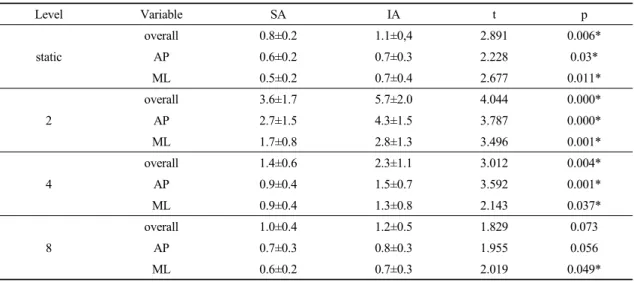
1. 안정성과 불안정성 발목의 균형 감각 비교 안정성과 불안정성 발목의 균형 감각을 비교한 결과 는 다음과 같다 . 정적 균형의 경우 전체, 앞-뒤, 내-외측 방향의 불안정성 발목군에서 모두 유의한 증가를 나타 냈다(p<.05)(Table 2). 동적 균형의 경우 안정도 2에서 전체 , 앞-뒤, 내-외측 방향의 불안정성 발목군에서 모두 유의한 증가를 나타냈고, 안정도 4에서 전체, 앞-뒤, 내 -외측 방향의 불안정성 발목군에서 모두 유의한 증가 를 나타냈다(p<.05)(Table 2). 동적 균형의 경우 안정도 8에서 내-외측에 불안정성 발목군에 유의한 증가가 있 었지만(p<.05)(Table 2), 전체, 앞-뒤에서 유의한 차이가 없었다(p>.05)(Table 2).

Ⅳ. 고 찰

발목 염좌의 경험은 70% 넘는 높은 재발률을 가지고

있으며(Yeung 등, 1994), 그 결과 만성 불안정성으로

발전하여 불안정성 발목을 가지게 된다(Beynnon 등,

2001). 불안정성 발목의 원인 중 하나가 균형이다(Cha

와 Kim, 2009). 적절한 균형에는 시각, 전정감각, 고유수

용성 감각이 필수적인 요소로 영향을 미친다(Bressel

등 , 2007; Gribble 등, 2007; Subasi 등, 2008). 고유수용성

감각 운동은 정적 , 동적 안정성에도 영향을 미처 불안

(4)

Level Variable SA IA t p

overall 0.8±0.2 1.1±0,4 2.891 0.006*

static AP 0.6±0.2 0.7±0.3 2.228 0.03*

ML 0.5±0.2 0.7±0.4 2.677 0.011*

overall 3.6±1.7 5.7±2.0 4.044 0.000*

2 AP 2.7±1.5 4.3±1.5 3.787 0.000*

ML 1.7±0.8 2.8±1.3 3.496 0.001*

overall 1.4±0.6 2.3±1.1 3.012 0.004*

4 AP 0.9±0.4 1.5±0.7 3.592 0.001*

ML 0.9±0.4 1.3±0.8 2.143 0.037*

overall 1.0±0.4 1.2±0.5 1.829 0.073

8 AP 0.7±0.3 0.8±0.3 1.955 0.056

ML 0.6±0.2 0.7±0.3 2.019 0.049*

p<.05; Mean±SD; AP: Anterior Posterior; ML: Medial Lateral; SA: Stable ankle; IA: Instability Ankle

Table 2. Comparison of balance on stable and instability ankle (unit : degree)

정성 발목 재발 방지에 중요하다(Kim 등, 2004; Hale 등, 2007). 본 연구에서는 Cumberland 발목 불안정성 도구를 사용하여 안정성과 불안정성 발목을 분류하고 그에 따른 정적, 동적 균형의 비교를 실시하였다.

정적 균형은 움직임 없이 한발이나 양발로 서 있을 수 있는 자세를 말한다 (Gribble과 Hertel, 2003). 본 연구 에서 정적 균형은 전체, 앞-뒤, 내-외측에서 안정성과 불안정성 발목 비교에서 불안정성 발목이 유의한 증가 를 나타냈다. 이는 안정성 발목을 가진 축구선수와 불 안정성 발목 가진 축구선수를 비교하여 조사한 결과 불안정성 발목군에서 발바닥 굽힘-발등 굽힙, 안쪽들 림 -가쪽들림 동작의 고유수용성 감각에서 유의한 증가 를 나타낸 것과 일치한 결과이었다 (Chun과 Choi, 2009).

하지만 Kim(2007)의 연구에서 안정성과 불안정성 발목 과의 정적 균형 비교에서 전체, 앞-뒤, 내-외측에서 유의 한 차이를 발견하지 못하였다 . 이것은 신뢰도와 타당도 가 검증되지 않은 변형된 FAIQ를 사용하여 불안정성 발목을 분류하였기 때문이라고 사료된다(Hiller 등, 2006).

동적 균형은 일상 활동에서 필수적인 요소이다(Park 등 , 2010). Chun(2009)는 FAIQ를 사용하여 안정성과 불 안정성 발목의 고유수용성 감각 비교에서 유의한 차이

를 나타냈지만 반면에 동적 균형 검사에서는 전체 , 앞- 뒤 , 내-외측에서 유의한 차이를 발견하지 못하였다. 이 러한 상반된 결과는 불안정성 발목의 선정 기준으로 신뢰도와 타당도가 검정되지 않은 FAIQ를 사용했기 때문인 것으로 사료된다. 반복적 발목 염좌와 관련하여 Mc Guine과 Keene(2006)은 고등학교 축구선수와 농구 선수를 대상으로 균형 훈련을 실시한 결과 발목 염좌 손상 빈도를 감소시켰다고 보고하였다. Hubbard 등 (2007)은 근력과 동적 균형의 결손이 불안정성 발목의 원인이라고 하였다. 이는 본 연구의 동적 균형 안정도 가 낮음과 중간의 전체, 앞-뒤, 내-외측과 높음의 내-외 측에서 불안정성 발목이 유의한 증가를 나타낸 것과 일치한 결과이다 . 하지만 본 연구에서 동적 균형 안정 도가 높음에서 전체 , 앞-뒤에서 유의한 차이를 보이지 않은 것은 정적 균형부터 동적 균형을 연속으로 측정한 결과에 따른 적응 때문으로 사료된다(Mohammadirad 등 , 2012). 따라서 불안정성 발목을 분류하기 위해 신뢰 도와 타당도가 높은 Cumberland 발목 불안정성 도구를 사용하면 균형에 대한 보다 정확한 정보를 얻을 수 있다 고 생각한다.

본 연구에서는 Cumberland 발목 불안정성 도구를

사용하여 안정성과 불안정성 발목의 균형을 비교 하였

(5)

지만 연구 대상의 수가 제한적이었으며 , 20대에 국한되 었다. 따라서 추후 연구에서는 연구 참여 대상과 연령 을 다양화 하며 측정 방식을 보다 세밀히 한다면 보다 정확한 결과를 알 수 있을 것이라고 생각 된다.

Ⅴ. 결 론

본 연구는 Cumberland 발목 불안정성 도구를 사용하 여 안정성과 불안정성 발목군으로 분류하였고, 각 그 룹에 대한 균형을 비교하여서 다음과 같은 결론을 얻 었다.

안정성과 불안정성 발목의 정적 균형 비교에서 전 체, 앞-뒤, 내-외측에서 유의한 차이를 나타내었다. 동 적 균형 비교에서도 전체, 앞-뒤, 내-외측에서 유의한 차이를 나타내었다.

따라서 Cumberland 발목 불안정성 도구를 바탕으로 분류된 대상자의 BBS를 이용한 실험결과에서도 안정 성과 불안정성 발목에서 균형이 차이가 있음을 알 수 있었다. 불안정성 발목에 대한 중재를 실시하기 전에 Cumberland 발목 불안정성 도구를 사용하면 균형에 대 한 보다 정확한 정보를 얻을 수 있다고 생각한다.

References

Alonso AC, Brech GC, Bourquin AM et al. The influence of lower-limb dominance on postural balance. Sao Paulo Med J. 2011;129(6):410-3.

Anandacoomarasamy A, Barnsley L. Long term outcomes of inversion ankle injuries. Br J Sports Med.

2005;39(3):e14.

Arnold BL, De la Motte SJ, Linens SW et al. Functional ankle instability is associated with balance impairments: a meta-analysis. Med Sci Sports Exerc.

2009;41(5):1048-62.

Arnold BL, Docherty CL. Bracing and rehabilitation: what’'s new. Clin Sports Med. 2004;23(1):83-95.

Becker HP, Rosenbaum D. Chronic recurrent ligament instability on the lateral ankle. Orthopade.

1999;28(6):483-92.

Beynnon BD, Renstrom PA, Alosa DM et al. Ankle ligament injury risk factors: a prospective study of college athletes. J Orthop Res. 2001;19(2):213-20.

Bressel E, Yonker JC, Kras J et al. Comparison of static and dynamic balance in female collegiate soccer, basketball, and gymnastics athletes. J Athl Train.

2007;42(1):42-6.

Cha SH, Kim JS. The effects of balance exercises on functional ankle instability with ankle sprained patients.

Kinesiology. 2009;11(2):73-83.

Chun SY. The effects of proprioceptive exercise program on motor function of lower limb in male soccer players with functional ankle instability. Graduate School of Korea National Sport University. Doctor's thesis.

2009.

Chun SY, Choi OJ. The Ankle joint position sense, strength and Functional Ability of the Soccer Player with Functional Ankle Instability. The Korea Journal of Sports Science. 2009;18(3):1119-30.

Cornwall MW, Murrell P. Postural sway following inversion sprain of the ankle. J Am Podiatr Med Assoc.

1991;81(5):243-7.

de Vries JS, Kingma I, Blankevoort L et al. Difference in balance measures between patients with chronic ankle instability and patients after an acute ankle inversion trauma. Knee Surg Sports Traumatol Arthrosc.

2010;18(5):601-6.

Donahue M, Simon J, Docherty CL. Critical review of self-reported functional ankle instability measures.

Foot Ankle Int. 2011;32(12):1140-6.

Freeman M. Instability of the foot after injuries to the lateral ligaments of the ankle. J Bone Joint Surg [Br].

1965;47(4):669-77.

Gribble PA, Hertel J. Considerations for normalizing measures

of the star excursion balance test. Meas Phys Educ

(6)

Exerc Sci. 2003;7(2):89-100.

Gribble PA, Tucker WS, White PA. Time-of-day influences on static and dynamic postural control. J Athl Train.

2007;42(1):35-41.

Hale SA, Hertel J, Olmsted-Kramer LC. The effect of a 4-week comprehensive rehabilitation program on postural control and lower extremity function in individuals with chronic ankle instability. J Orthop Sports Phys Ther. 2007;37(6):303-11.

Hertel J. Functional anatomy, pathomechanics, and pathophysiology of lateral ankle instability. J Athl Train. 2002;37(4):364-75.

Hiller CE, Refshauge KM, Bundy AC et al. The Cumberland ankle instability tool: a report of validity and reliability testing. Arch Phys Med Rehabil. 2006;87(9):1235-41.

Hubbard TJ, Kaminski TW. Kinesthesia is not affected by functional ankle instability status. J Athl Train.

2002;37(4):481-6.

Hubbard TJ, Kramer LC, Denegar CR et al. Contributing factors to chronic ankle instability. Foot and Ankle International. 2007;28(3);343-54.

Hyeon GS. The effects of isokinetic exercise programs on the muscular function recovery of athletes with chronic ankle sprain. Journal of Sports and Leisure Studies.

2003;19(2):1503-13.

Kim KJ. The effect of strength and proprioception combined training on functional ankle instability. Graduate School of Dongshin University. Master’s thesis. 2012.

Kim MC. Isokinetic Muscular Strength of the Lower Limbs and Balance in Soccer Players with Functional Ankle Instability. Sports Medicine Graduate School of Sports Science. Dankook University. Master’s thesis. 2008.

Kim YS, Park SV, K HJ et al. The effect of the disk training and the combined training on functional stability of ankles. Exercise Science. 2004;13(1):113-24.

Leanderson J, Wykman A, Eriksson E. Ankle sprain and postural sway in basketball players. Knee Surg Sports Traumatol Arthrosc. 1993;1(3-4):203-5.

Lee BH, Kim CK, Lee HS et al. The effects of kinesio taping applied to regions on balance index. Journal of Coaching Development. 2010;12(4):99-104.

Lee KT, Song BY, Young KW et al. Analysis of the injuries in professional soccer player. The Korean Journal of Sports Medicine. 2000;18(2):176-80.

Richie DH Jr. Functional instability of the ankle and the role of neuromuscular control: a comprehensive review.

J Foot Ankle Surg. 2001;40(4):240-51.

Rozzi S. L, Lephart SM, Sterner R et al. Balance training for persons with functionally unstable ankles. J Orthop Sports Phys Ther. 1999;29(8);478-86.

Mattacola CG, Dwyer MK. Rehabilitation of the ankle after acute sprain or chronic instability. J Athl Train.

2002;37(4):413-29.

Mc Guine TA, Greene JJ, Best T et al. Balance as a predictor of ankle injuries in high school basketball players.

Clin J Sport Med. 2000;10(4):239-44.

Mc Guine TA, Keene JS. The effect of a balance training program on the risk of ankle sprains in high school athletes. Am J Sports Med. 2006;34(7):1103-11.

Mohammadirad S, Salavati M, Takamjani IE et al. Intra and intersession reliability of a postural control protocol in athletes with and without anterior cruciate ligament reconstruction: a dual-task paradigm. Int J Sports Phys Ther. 2012;7(6):627-36.

Negahban H, Etemadi M, Naghibi S et al. The effects of muscle fatigue on dynamic standing balance in people with and without patellofemoral pain syndrome. Gait Posture. 2013;37(3):336-9.

Park WH, Kim DK, Yoo JC et al. Correlation between dynamic postural stability and muscle strength, anterior instability, and knee scale in anterior cruciate ligament defi cient knees. Arch Orthop Trauma Surg.

2010;130(8):1013-18.

Sawkins K, Refshauge K, Kilbreath S et al. The placebo effect

of ankle taping in ankle instability. Med Sci Sports

Exerc. 2007;39(5):781-7.

(7)

Subasi SS, Gelecek N, Aksakoglu G. Effects of different warm-up periods on knee proprioception and balance in healthy young individuals. J Sport Rehab.

2008;17(2):186-205.

Tropp H, Ekstrand J, Gillquist J. Factors affecting stabilometry

recordings of single limb stance. Am J Sports Med.

1984;12(3):185-8.

Yeung MS, Chan KM, So CH et al. An epidemiological survey on ankle sprain. Br J Sports Med. 1994;28(2):112-6.

[부록 1] Cumberland Ankle Instability Tool

각각의 질문에 가장 잘 묘사한 것을 하나만 선택해주십시오.

left right score

1. 나의 발목에 통증이    

전혀 없다.     5

운동하는 동안 있다.     4

편평하지 않는 곳을 달릴 때     3

편평한 곳을 달릴 때     2

편평하지 않는 곳을 걸을 때     1

편평한 곳을 걸을 때     0

2. 나의 발목이 불안정하다고 느끼는 때는    

전혀 없다.     4

운동하는 도중 가끔(매 번은 아님)     3

운동하는 도중 자주(매 번)     2

일상 생활에서 가끔     1

일상 생활에서 자주     0

3. 갑자기 방향전환(turn)했을 때 나의 발목이 불안정하다고 느낀 경험이    

전혀 없다.     3

뛰고 있을 때 가끔     2

뛰고 있을 때 자주     1

걷고 있을 때     0

4. 계단을 내려갈 때 내발목이 불안정하다고 느낀 경험이    

전혀 없다     3

빠르게 내려갈 때     2

자주     1

항상     0

(8)

5. 한발로 서있을 때 내발목이 불안정하다고 느낀 경험이    

전혀 없다.     2

내 발이 공 위에 있을 때     1

편평한 곳에 있을 때     0

6. 내발목이 불안정하다고 느끼는 때는    

전혀 없다.     3

깡충 옆에서 옆으로 뛸 때(side to side)     2

특정 지점으로 깡충 뛸 때     1

점프 할 때     0

7. 내발목이 불안정하다고 느끼는 때는    

전혀 없다.     4

편평하지않는곳을달릴때(run)     3

편평하지 않는 곳을 느리게 달릴 때(jog)     2

편평하지 않는 곳을 걸을 때     1

편평한 곳을 걸을 때     0

8. 발목이 뒤집히려고 할 때 나는 그것을    

즉시 멈출 수 있다     3

자주 멈출 수 있다     2

가끔 멈출 수 있다     1

멈출 수 없다     0

뒤집히려는 경향이 없다     3

9. 발목이 뒤집힌 후에 나의 발목이 정상으로 돌아오기 까지는    

거의 즉시 그렇게 된다     3

하루 안쪽으로     2

1-2일     1

2일 이상     0

발목이 뒤집힌 적이 결코 없다.     3

수치

Fig. 1. Measure of balance
Table 2. Comparison of balance on stable and instability ankle (unit : degree)

참조

관련 문서

Treatment of Chronic Ankle Lateral Instability using Modified Bröstrom Procedure with Anchor suture &amp; Arthroscopy.. Jin-Young Lee M.D., Gab-Lae Kim, M.D.,

Immediate Effect of Fabric Ankle Foot Orthosis on Balance in Children With Unilateral Cerebral Palsy.. Yon-ju Sim 1,3 , MSc, PT, You-jin Yang 2,3 , MSc,

Background: To evaluate the effect of Kinesio taping applied on the ankle instability, joint range of motion and balance.. Methods: The participants included in this study were

Methods: In 30 male college soccer player with functional ankle instability subjects of this study randomization, fibular reposition taping (FRT) group (n=10), kinesio taping

Conclusions: Based on such results, it can be said that balance training on the stable surface is effective as much as training on the unstable surface for the subjects

Evaluation of Muscle Activity and Foot Pressure during Gait, and Isokinetic Strength and Balance in Persons with Functional Ankle Instability.. Sun-Ah Lee, MSc⋅Ah-Ram Kim, PhD, PT

The Effect of Ankle Balance Traning on Unstable and Stable Surface on Proprioception, Balance and Muscle Strength in Obese Middle-Aged Woman.. Han Junho, PT Lee Hyojeong,

Effects of Virtual Reality Exercise Program after Applying Taping and Microwave on Balance with Functional Ankle Instability.. Jeong Chanjoo, PT, Ph.D Kim Kijong, PT, Ph.D