* Corresponding author: Eun Kyung Cho
Department of Biomedical Laboratory Science, Kyungwoon University, 730 Gangdong-ro, Sandong-myeon, Gumi 39160, Korea
E-mail: [email protected]
* ORCID: https://orcid.org/0000-0002-0583-4675
ORIGINAL ARTICLE
Study on the Fourth Industrial Revolution and Clinical Laboratory Science Techniques
Hyun Ho Sung 1 , Kwang-Mo Choi 2 , You Hyun Jung 3 , Eun Kyung Cho 4
1
Department of Clinical Laboratory Science, Dongnam Health University, Suwon, Korea
2
Department of Laboratory Medicine, Samsung Medical Center, Seoul, Korea
3
Department of Biomedical Laboratory Science, Dankook University College of Health Sciences, Cheonan, Korea
4
Department of Biomedical Laboratory Science, Kyungwoon University, Gumi, Korea
4차 산업혁명과 임상검사과학기술에 관한 연구
성현호 1 , 최광모 2 , 정유현 3 , 조은경 4
1
동남보건대학교 임상병리과,
2삼성서울병원 진단검사의학과,
3단국대학교 임상병리학과,
4경운대학교 임상병리학과
ARTICLE INFO ABSTRACT
Received August 19, 2019 Revised 1
stSeptember 4, 2019 Revised 2
ndSeptember 6, 2019 Accepted September 6, 2019
The aim of this study was to introduce clinical laboratory science techniques with the core technology of the 4th Industrial Revolution. Among the core technologies of the 4th Industrial Revolution, AI, IOT, block-chain, robotics, and nanotechnology were analyzed and linked by themes. The scope of the job of clinical laboratory technologists (also known as medical laboratory technologists and medical technologists) is laboratory medicine testing, pathology testing, and clinical physiology testing. Through a number of previous papers, 73 linkages in the laboratory medicine area, 27 linkages in the pathology area, and 47 linkages in the clinical physiology area were examined. In the 4th industrial revolution and clinical laboratory science techniques, AI (4), IOT (3), block-chain (4), robotics (3) and nanotechnology (15) sectors were surveyed. The limitation of this study was the limitation in collecting and analyzing all the data and non-clinical areas were not analyzed. In addition, there was no validity test and no similar study. In conclusion, the core technologies of the 4th industrial revolution and clinical laboratory science techniques are closely related. Therefore, further research on the future and social benefits of clinical laboratory science techniques is needed.
Copyright © 2019 The Korean Society for Clinical Laboratory Science. All rights reserved.
Key words
Clinical laboratory science techniques Core technologies
Fourth industrial revolution
서 론
4차 산업혁명은 2013년 독일에서 시작 되었으며, 유럽 및 전 세계로 빠르게 확산되고 있어 정보통신기술 강국인 우리나라의 생태계를 재배치할 수 있다[1]. 국내에 4차 산업혁명은 Schwab 이 2016년 세계 경제 포럼에서 그 도래를 선언 한 이래로 많은 논의가 시작되었다[2, 3]. 4차 산업혁명의 핵심기술은 인공지능
과 로봇기술, 가상·증강현실, 사물인터넷, 자율주행, 드론, 블록 체인, 3D 프린팅 등 물리적, 생물학적, 디지털 분야의 경계를 모 호하게 만드는 기술이라고 정의하였다[3, 4]. 4차 산업혁명 대 표 기술의 개념에는 심지어 인체를 포함하고 있어 의료분야에 서도 4차 산업혁명의 패러다임이 빠르게 적용되고 있다[5]. 4차 산업혁명의 대부분 기술은 의료기술과 접목된다. 의학계 중진 97% 이상은 이러한 신기술이 의료계에 영향을 줄 것이라고 예 측하고 있으며, 인공지능, 빅데이터 활용, 로봇, 3D프린팅, 정밀 의료를 의료계에 영향을 미칠 5대 첨단 분야로 생각하고 있다 [6]. 특히, 아직까지 적용되지 않은 기술로 블록체인기술은 의료 정보에 있어 건강인이나 환자의 이익에 기여할 것이며[7], 연구
Korean Society for Clinical Laboratory Science
가 진행 중인 인공장기 등 합성생물학 기술과 유전자 치료를 할 수 있는 유전자 편집기술(clustered regularly interspaced short palindromic repeats, CRISPR)등이 대표된다[8-12]. 보 건의료기술은 4차 산업혁명 이전에 유-헬스케어(u-health- care), 차세대 염기서열 분석, 의료용 로봇, 유전체학(geno- mincs), 전사체학(transcriptomics), 단백질체학(proteomics), 현장검사(point-of-care testing, POCT)등이 벌써부터 시행 되어 왔다[13-16]. 따라서 본 연구는 4차 산업혁명 핵심기술과 연계된 임상검사과학의 적용과 보급 그리고 응용에 관한 소개 를 목적으로 접근하였다.
재료 및 방법
본 연구에서는 임상병리사의 기본지식을 바탕으로 4차 산업 혁명의 핵심기술과 관련된 임상검사과학기술 분류를 도출하였 다. 도출된 임상검사과학기술 분류는 PubMed, MEDLINE, Scopus, EMBASE, ProQuest 및 Cochrane Library를 포함한 선행논문의 체계적인 검색을 통해 연구를 진행했으며, 4차 산업 혁명의 핵심기술과 연계된 임상검사과학기술을 독립적으로 검 토하여 선정하였다.
1. 4차 산업혁명 핵심기술
인터넷 구글 학술검색(https://scholar.google.co.kr)에서 검색어로 “4차 산업혁명”, 기간설정으로 “2015년부터 2019 7 월까지” 검색하였을 때 4차 산업혁명과 관련된 학술자료는 국 내에만 14.900개의 검색결과가 나타나 전문적인 학술자료로 만 한정하더라도 매우 광범위하다. 따라서 본 연구는 2017년 통 계청의 산업중분류별 4차 산업혁명 기술 개발 활용 에서 분류한 4차 산업혁명 관련기술을 선택하여 분류하였다. 산업중분류별 4차 산업혁명 관련기술로 제시된 것은 사물인터넷, 클라우드, 빅데이터, 모바일, 인공지능, 블록체인, 3D 프린팅, 로봇기술, 가상증강현실 9개로 분류하고 있다. 전문, 과학 및 기술 서비스 업 기업수 543개 중 연구개발업은 49개 중 관련 기술로 사물인 터넷 11개, 클라우드 15개, 빅데이터 17개, 모바일 19개, 인공 지능 7개, 블록체인 5개, 3D 프린팅 7개, 로봇기술 5개, 가상증 강현실 3개로 중복된 기술 활용은 확인이 어려웠다. 이러한 기 술 활용분야는 주로 제품(서비스)개발 62개로 많았으며, 마케 팅전략 11개, 조직관리 10개, 생산 공정 6개 순으로 분류되었 다. 보건업 및 사회복지서비스업은 27개 기업수가 제시되고 있 는데, 빅데이터를 활용하여 제품(서비스)개발 1개로 분류되었 다[17]. 이러한 내용을 바탕으로 본 연구에서는 9개의 4차 산업
혁명 기술 중 핵심기술로 인공지능, 사물인터넷, 블록체인, 로봇 기술 기술인 4개를 선택하였고, 사물인터넷을 모바일과 빅테이 터 그리고 클라우드 기술을 포함하여 분류하고 하나의 기술로 조작적으로 분류하였으며, 3D 프린팅과 가상증강현실은 제외 하였다. 본 연구는 추가로 나노기술을 포함하였는데, 나노기술 은 의학, 전자공학, 생체재료학 등 광대한 적용범위로 클라우스 슈밥이 제시한 핵심기술 중 포함되어 있어[2], 인공지능, 사물인 터넷, 블록체인, 로봇기술, 나노기술로 총 5개의 핵심기술을 테 마별 분석 연계하였다.
2. 임상검사과학기술
임상검사과학기술과 관련된 선행논문을 대한임상검사과학 회지(http://www.kjcls.org)에서 검색하였다. 검색어를 “임 상병리”로 하였을 때 1975년 제7권 “임상병리기술학의 최근동 향”부터 2019년 51권 2호까지 총 47개에 해당하는 논문이 검 색되었다. “기술”로 검색하였을 때 2018년 50권 4호까지 10개 의 논문이 검색되었다. 임상검사과학기술의 분류는 법률적 업 무범위를 바탕으로 분류 하였다. 임상병리사 관련 법률은 의료 기사 등에 관한 법률, 의료기사 등에 관한 법률 시행령, 의료기 사 등에 관한 법률 시행규칙이 있다. 임상병리사의 법률적 업무 범위는 의료기사 등에 관한 법률 제2조(의료기사의 종류 및 업 무) 1호에 임상병리사는 “각종 화학적 또는 생리학적 검사”로 대통령령으로 정하는 업무를 수행한다. 구체적인 업무범위는 동법 시행령의 “별표 1에 따른다”라고 명시되어 있다. 시행 2019.7.2. 의료기사 등에 관한 법률 시행령 “별표 1”에서 의료 기사, 보건의료정보관리사 및 안경사의 업무 범위(제2조제1항 관련) “1호” 임상병리사 “가”항에 기생충학·미생물학·법의 학·병리학·생화학·세포병리학·수혈의학·요화학·혈액학·혈 청학 분야, 방사성동위원소를 사용한 가검물 분야 및 기초대사·
뇌파·심전도·심폐기능 등 생리기능 분야의 화학적·생리학적 검사에 관한 다음의 구분에 따른 업무 1) 검사물 등의 채취·검 사, 2) 검사용 시약의 조제, 3) 기계·기구·시약 등의 보관·관리·
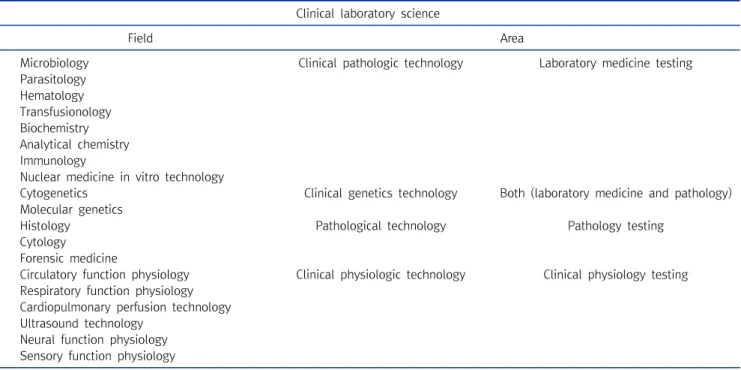
사용, 4) 혈액의 채혈·제제·제조·조작·보존·공급 그리고 나 항 에 그 밖에 화학적·생리학적 검사로 되어 있다. Koo [18]는 우 리나라 임상병리사의 전공학문인 보건계열 임상병리학을 국제 적 용어인 임상검사과학으로 인용한 후 “임상병리기술학, 병리 기술학, 임상유전기술학, 핵의학기술학, 임상생리기술학”으로 분류하였다. 따라서 본 연구는 임상검사과학기술과 최근 기술 들의 연계성을 위하여 미생물학·기생충학·생화학·혈액학·수 혈학·면역학·방사면역측정학 분야를 “검사의학검사”로, 조직 병리학·세포병리학·법의학 분야를 “병리검사”로, 기초대사·
Table 1. Classification of clinical laboratory science
Clinical laboratory science
Field Area
Microbiology Clinical pathologic technology Laboratory medicine testing
Parasitology Hematology Transfusionology Biochemistry Analytical chemistry Immunology
Nuclear medicine in vitro technology
Cytogenetics Clinical genetics technology Both (laboratory medicine and pathology) Molecular genetics
Histology Pathological technology Pathology testing
Cytology
Forensic medicine
Circulatory function physiology Clinical physiologic technology Clinical physiology testing Respiratory function physiology
Cardiopulmonary perfusion technology Ultrasound technology
Neural function physiology Sensory function physiology
심전도·심폐기능·뇌파 등 생리기능 분야를 “임상생리검사”로 조작적 분류하였다(Table 1).
3. 미래의 임상검사과학기술
해외 선행논문을 살펴보면 Kricka 등[19]은 “Future of laboratory medicine”에서 이미 현실화 된 과거의 예측 그리고 향후 미래의 예측까지 그 개요를 제시하고 있다. 1996년에 2006∼2016년 10년의 예측을 담은 “Technology that will initiate future revolutionary changes in healthcare and the clinical laboratory” 문헌에서는 예방의학, 분자의료통합, 컴 퓨터 기술과 정보, 위험인자를 이용한 예측 검사들과 유전자 칩 기술과 같은 분석 장치의 소형화, 분자 생물학, 유전체학, 로봇 공학, 약물 유전체학, 나노기술, 환자를 위한 대규모 데이터뱅 크, 단백질 발현 프로파일 질량 분석 등을 예측하였다[20].
1997년 Wilkinson 등의 2007∼2017년 10년간의 예측을 다룬
“The role of technology in the clinical laboratory of the future”에서는 분자진단 바이오센서를 이용한 환자 옆 검사 (near patient testing, NPT), 이미지분석, 로봇공학, 정보관리 측면으로 원격, 음성인식 등으로 발전될 것으로 예견하였다 [21]. O’Leary의 2006∼2026년을 내다본 문헌으로 “Pathology 2026. The future of laboratory medicine”에서는 대규모수 탁기관 및 연구소, 로봇공학, 자동화 및 휴머노이드기술, 원격진 료(원격 현미경, 원격이 가능한 전산 시스템), 전공분야의 통합,
나노로봇, 8대 전염병검사를 위한 휴대검사기기, 고밀도 단염 기다형성 배열의 일반화, 바이오센서 연료전지 등을 언급하였 다[22]. 국내에는 4차 산업혁명과 임상검사과학기술의 최신지 견 등의 문헌으로 연구가 소수 이뤄지고 있어 본 논문에서는 현 재 시행되고 있거나 향후 진행될 기술을 중심으로 분류하였다.
결 과
4차 산업혁명과 관련된 법률은 “헌법 제127조” 과학기술 관 련 헌법조항이 있으며, 빅데이터와 관련된 “개인정보보호법”
이 있고, 이는 2016년 5월 30일 국회에 상정된 “빅데이터의 이 용 및 산업진흥 등에 관한 법률안”으로 연결된다. 또한 “국가정 보화 기본법” 일부 개정 법률안은 2016년 12월 16일 기존의 지 식정보사회를 지능정보사회로 재 정의한 내용이며, 2017년 2 월 22일 인공지능에 집중되어 있는 “지능정보사회 기본법안”, 산업측면의 “디지털기반 산업 기본법안”이 있다. 의료와 관련 된 규제법으로는 의료법 중 원격의료 금지와 관련된 조항을 들 수 있다. 2018년 12월 10일 보건복지부는 관계부처와 함께 대 통령직속 4차 산업혁명위원회 제9차 회의 심의를 통해 “4차 산 업혁명 기반 헬스케어 발전전략”을 확정했다. 이는 헬스케어 빅 데이터 생산·관리 시범체계 운영, 인공지능 신약개발 활용, 스 마트 임상시험 구축사업, 스마트 융복합 의료기기 개발, 헬스케 어산업 생태계 조성으로 5가지로 크게 분류되며, 세부과제는 소
Table 3. Recent techniques of biochemistry and urinalysis in laboratory medicine testing
Field Technique
Biochemistry, Urinalysis CRISPR Electronic transmission of image
Total laboratory automation Dry chemistry technology
Bio-marker Automated urine microscopy
Point-of-care Urinary flow cytometry & urinary tract infection Dried blood spots (DBS) MALDI-TOF MS
Mass spectrometer Chip-based assay
Cloud-based technology
Abbreviations: See Table 1; CRISPR, clustered regularly interspaced short palindromic repeats.
Table 2. Recent techniques of microbiology and parasitology in laboratory medicine testing
Field Technique
Microbiology, Parasitology Microscopy-based method Microarray technology
Serology based method Microsatellites
Complement fixation test Nanotechnology
Latex agglutination test Biosensing technology
Indirect fluorescent antibody test High throughput ‘omics’ technologies Enzyme-linked immunosorbent assay (ELISA) High throughput sequencing (HTS)
Dot-ELISA Bioinformatics
Luciferase Immunoprecipitation System (LIPS) Transcriptomics
Immunochromatographic assay Proteomics
Molecular-based method MALDI-TOF MS
Polymerase chain reaction (PCR) SELDI-TOF MS
Real-time polymerase chain reaction (RT-PCR) Culture and phenotypic
Loop-mediated isothermal amplification (LAMP) In vitro antimicrobial susceptibility
Luminex xMAP technology Acute and convalescent antibody
Random amplified polymorphic DNA (RAPD) Monoclonal antibody staining Amplified fragment length polymorphism (AFLP) Antigen detection
Restriction fragment length polymorphism (RFLP) Biosensor
Abbreviations: MALDI-TOF MS, matrix-assisted laser desorption ionization-time-of-flight mass spectrometer; SELDI-TOF MS, surface-enhanced laser desorption-ionization-time-of-flight mass spectrometer.
관 부처의 검토를 거쳐 시행될 예정이다.
1. 검사의학검사 분야의 최근 기술
미생물학과 기생충학 관련 최신 기술은 말디토프 질량분석 기와 셀디토프 질량분석기와 단백질체학, 전사체학, 생물정보 학, 바이오센서, 현미경 기반 기법 등 현재와 과거의 다양한 기 술 등을 포함하여 36가지 이상의 기술로 분류할 수 있다[23, 24]. 생화학에서는 유전자 편집기술, 검사실 자동화, 현장검사 기술, 클라우드 기반 기술, 질량분석기, 분자진단연계, 치료약 물감시, 생체지표, 오믹스(omics), 건조혈액검사(dried blood spots, DBS) 등의 기술이 다양한 임상검사과학기술에 융합되 어 있다[25-27]. 요화학은 사진 전송, 건식화학, 현미경자동화, 유세포분석 및 요로감염, 질량분석, 칩 기반 분석 등으로 소개하 고 있다[28]. 수혈의학은 핵산증폭검사법, 차세대 염기서열분 석, 진유전체 등이 소개되고 있다[29, 30]. 혈액학은 단일세포
기술, 디지털 영상, 디지털 형태학, 차세대 염기서열분석, 울트 라 딥 중합효소연쇄반응, 진유전체 등을 소개하고 있다[31]. 면 역학은 간접면역형광검사, 칩기술, 디지털 효소면역측정, 복합 효소면역측정, 질량분석, DNA 미세배열 등을 소개하고 있다 [32, 33]. 방사면역측정학은 방사성의약품, 약물전달, 약물개 발, 방사선동위원소표지화 등이 있다(Table 5) [34].
2. 병리검사 분야의 최근 기술
조직병리학은 디지털병리학에서 인공지능작업과정, 분자병 리학에서 임상데이터와 바이오마커 분석결과의 데이터 통합, 고효율 조직 오믹스 데이터 분석, 차세대 염기서열분석법을 소 개하고 있다[35, 36]. 세포병리학에서는 종양세포에서 유도된 DNA 분자진단, 광학단층촬영, 차원 세포학-3D 단층 촬영과 정 량 위상 이미지로 이미지 유세포 측정, 유식 질량 세포측정, 이 미지 질량 세포측정 등을 소개하고 있다[37, 38]. 법의학은 형태
Table 4. Recent techniques of hematology and transfusionology in laboratory medicine testing
Field Technique
Hematology, Transfusionology Single-cell technology Nucleic acid amplification technology (NAT) Digital imaging - transcription-mediated amplification (TMA) Digital morphology - Polymerase Chain Reaction (PCR)
Next generation sequencing (NGS) Next Generation Sequencing (NGS) Ultra-deep PCR
Exome Abbreviations: See Table 1.
Table 5. Recent techniques of immunology and radioimmunoassay in laboratory medicine testing
Field Technique
Serology, Radioimmunoassay Indirect immunofluorescence (IIF) Molecular imaging
Chip technique (Spot immunoassay) Detectors and imaging system
Digital ELISA Radiopharmaceutical
Multiplex ELISA Drug delivery
Mass spectrometry Drug development
DNA microarray Radioisotope cell labeling
Abbreviations: See Table 1; DNA, deoxyribonucleic acid.
Table 6. Recent techniques of pathology testing
Field Technique Field Technique
Histopathology Digital pathology (Whole slide images, AI workflow) Forensic medicine Morphometric analysis
Molecular pathology Microbial forensics
- Pathology integration of clinical data Virtual autopsy (Virtopsy
Ⓡ) - Analysis of high-throughput tissue omics data Touch DNA
- Next Generation Sequencing (NGS) DNA methylation analysis
Cytopathology Molecular testing using tumor-derived cfDNA Next generation serology
Optical coherence tomography Genotyping to forensic phenotyping
Dimensional cytology (3D tomographic images) Facial reconstruction
Quantitative phase imaging (SL‐QPM) Scanning electron microscopy
Imaging flow and mass cytometry DNA fingerprinting
- Imaging flow cytometry Alternative light photography
- Flow mass cytometry LA-ICP-MS
- Image mass cytometry
Abbreviations: See Table 1; LA-ICP-MS, laser ablation-inductively coupled plasma-mass spectrometry; 3D, 3-dimensional.
측정분석, 미생물 법의학, 가상부검, DNA 메틸화 분석, 레이저 삭박 다검출기 유도결합 플라즈마 질량분석기 등 다양한 최신 임상검사과학기술을 소개하고 있다(Table 6) [29, 40].
3. 임상생리검사 분야의 최근 기술
순환기능생리학은 기초대사에서 생체전기 임피던스법을 이 용한 체성분분석과 휴식대사량, 적외선 체열검사, 24시간 활동 혈압 측정검사 등이 있다. 심장검사와 관련된 기술은 표준12유 도 심전도, 24시간 심전도, 운동부하검사, 심장전기생리검사 등 이다. 호흡기능생리학과 관련된 기술은 유량측정 폐활량계, 체 적변동기록법, 기관지과민성검사, 운동부하검사 등이 있다. 초
음파학은 2D와 3D 심장초음파와 도플러효과를 이용한 컬러, 간헐파, 연속파, 조직도플러 심장초음파를 이용한 심장초음파 검사가 있으며, 경동맥초음파검사, 뇌혈류초음파검사, 혈관초 음파검사 등이 있다. 신경기능생리학은 뇌파검사와 관련 기술 로 10-20법과 10-10법을 이용하여 다양한 전극조합을 하는 뇌 파 몽타주를 사용하며, 파워스펙트럼분석법을 이용한 정량화 뇌파, 3차원 뇌파, 수면다원검사, 근전도검사, 각종 유발전위검 사 등이 있다. 감각기능생리학의 경우 안과와 관련된 기술은 망 막전위도검사, 다초점망막전위도검사, 안초음파검사, 시각유 발전위검사, 빛간섭단층촬영검사, 형광안저조영술검사 등이 있다. 평형기능검사와 관련된 기술은 비디오 안구운동기록법,
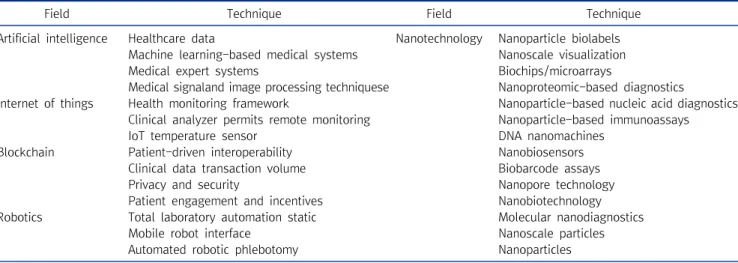
Table 8. Fourth industrial revolution and clinical laboratory science techniques
Field Technique Field Technique
Artificial intelligence Healthcare data Nanotechnology Nanoparticle biolabels Machine learning-based medical systems Nanoscale visualization
Medical expert systems Biochips/microarrays
Medical signaland image processing techniquese Nanoproteomic-based diagnostics
Internet of things Health monitoring framework Nanoparticle-based nucleic acid diagnostics Clinical analyzer permits remote monitoring Nanoparticle-based immunoassays
IoT temperature sensor DNA nanomachines
Blockchain Patient-driven interoperability Nanobiosensors
Clinical data transaction volume Biobarcode assays
Privacy and security Nanopore technology
Patient engagement and incentives Nanobiotechnology
Robotics Total laboratory automation static Molecular nanodiagnostics
Mobile robot interface Nanoscale particles
Automated robotic phlebotomy Nanoparticles
Table 7. Recent techniques of clinical physiology testing
Field Technique Field Technique
Basal metabolism Body composition analysis Ultrasonography Echocardiography
Bioelectrical impedance analysis 2Dimensional echocardiography
Resting metabolic rate 3Dimensional echocardiography
Digital infrared thermography Color Doppler
Imaging Pulsed wave Doppler
Ambulatory blood pressure monitoring Continuous-wave Doppler
Cardiac function 12-Lead ECG Tissue Doppler
Holter monitoring Carotid artery ultrasound
Treadmill test Transcranial Doppler
Pulmonary function Vital capacity (VC) Ophthalmic Electroretinography (ERG)
Forced vital capacity test Multi-focal electroretinography
Body plethysmography Electrooculography (EOG)
Bronchial hypersensitivity test Ophthalmic ultrasonography
Neurological function EEG montage Visual evoked potential (VEP)
International 10-20 system Optical coherence tomography (OCT)
Modified combinatorial Fluorescein angiography (FAG)
nomenclature 10-10 system Other Video oculography (VOG)
Quantitative EEG Eye tracking test (ETT)
Steroelectroencephalography (SEEG) Dynamic posturography
Polysomnography (PSG) Electronystagmography (ENG)
Electromyography (EMG) Pure Tone Audiometry
Evoked potential (EP) Speech audiometry
Electrogustometry
시표추적검사, 동적자세검사, 전기안진검사 등이 소개하고 있 다. 이비인후과와 관련된 기술은 순음청력검사, 어음청력검사, 전기미각검사 등을 소개하고 있다(Table 7).
4. 4차 산업혁명의 임상검사과학기술의 접근
임상검사과학기술의 인공지능 접근은 건강관리 데이터, 기 계학습 기반 의료 시스템, 의료전문가시스템, 의료 신호 및 이미 지 처리 기술 등으로 나열 하고 있다[41]. 사물인터넷에서의 임
상검사과학기술 접근은 건강관리플랫폼[42], 검사실의 장비관 리, 시약관리, 온도제어 등의 구성요소 관리 등이 있다[43]. 블 록체인에서의 임상검사과학기술 접근은 환자 중심의 상호 운용 성, 임상 데이터 거래량, 개인 정보 및 보안, 환자 참여 및 인센티 브 등이 있다[44]. 로봇기술의 임상검사과학기술 접근은 정적 검사실 자동화와 동적 로봇 인터페이스, 로봇 채혈 자동화 등이 있다[45]. 나노기술에서 임상검사과학기술 접근은 나노 입자 바이오 라벨, 나노 스케일 시각화, 바이오칩-마이크로 어레이,
나노 단백질 기반 진단, 나노 입자 기반 핵산 진단, 나노 입자 기 반 면역 분석, DNA 나노 머신, 나노 바이오 센서, 바이오 바코드 분석, 나노 포어 기술, 분자 바이오 기술, 분자 나노 진단, 나노 스 케일 입자, 나노입자 등이 있다(Table 8) [46].
고 찰
본 연구는 최근 국가 정책의 중점사항인 4차 산업혁명 기반 기술 연구 분야에서 강조하는 핵심기술과 임상병리사 관련 법 률에 따른 업무범위와 연계한 임상검사과학기술들의 적용 및 보급 그리고 응용에 관한 내용을 소개하는 것을 목적으로 하였 다. 2019년 보건복지부 연구개발사업 중점사항은 미래의료기 술분야로 질환에 대한 혁신적 진단·치료를 위한 4차 산업혁명 융·복합 기술개발과 의료현장에서의 활용 연구의 지원이다. 구 체적인 내용으로 의료기술 개발 전 단계에 활용할 수 있는 빅데 이터 보호·연계·활용 플랫폼 기술개발 등이며, 연구기반 확대 와 4차 산업혁명 핵심기술인 인공지능, 사물인터넷, 로봇 등과 바이오 기술을 융합하여 맞춤형 예방·관리가 가능한 첨단 의료 기기 개발 강화이다. 2012년 10월 한국보건의료인국가시험원 의 연구비로 진행된 임상병리사 2차 직무분석연구에서는 2000 년도에 진행된 1차 직무분석 연구자료를 바탕으로 임무(duty), 일(task), 일의요소(task element) 세 단계로 직무분석활용실 태 및 분석기법인 데이컴 방식(developing a curriculum, DACUM)의 연구결과로 임상병리사 직무기술서는 (A) 채혈, 외 래검사, (B) 혈액검사, (C) 생리기능검사, (D) 화학검사, (E) 미생 물검사, (F) 조직세포검사, (G) 면역혈청검사, (H) 혈액은행검 사, (I) 핵의학검사, (J) 유전자검사, (K) 염색체검사, (L) 유세포 검사, (M) 경영관리 13개의 임무로 분류하고 있다. 2015년부터 공기업과 정부기관 중심으로 국가직무능력표준(national com- petency standard, NCS)의 직무기술을 활용하고 있다. 임상병 리사의 국가직무능력표준 분류체계(https://www.ncs.go.kr)에서 는 대분류 06번 보건·의료, 중분류 02번 의료, 소분류 04번 임 상지원, 세분류는 현재 개발 진행 중인 직무로 검색된다. 국가직 무능력표준은 2002년부터 고용노동부와 한국산업인력공단에 서 인력을 체계적으로 양성하기 위한 목적으로 현재까지 개발 되고 있다. 임상병리사를 양성하고 있는 대학에서도 학과 자체 적으로 NCS 교육과정을 개발하고 있으며, 4차 산업혁명에 대 비한 핵심역량기반 교육 시스템이 적용되고 있다. 임상검사과 학기술의 미래 예측 선행 연구는 2014년 실험실과 조직 및 인력 의 변화, 자동화 및 로봇공학, 컴퓨팅 및 정보기술, 분석 기술, 현 장검사, 원격의료, 마이크로기술, 나노기술, 유전체학, 단백질
체학, 근거기반의료, 현미경 및 조직병리학으로 분류하여 예측 하고 임상검사실은 광범위한 범위로 의학 및 건강관리의 범주 에 속한다고 하였다[19]. 임상병리검사의 법률적 업무범위에 따른 검사의학 분야에서 미생물학과 관련된 기술들과 최근 기 술들은 총 36개[23, 24]로 분류하고 있는데 그 중 말디토프 질량 분석기, 셀디토프 질량분석기, 효소면역측정, 단백질체학, 전사 체학, 생물정보학, 현미경 기반 방법 등은 생화학, 혈액학, 수혈 학, 면역학, 핵의학, 병리학 등과 혼합된 기술로 사용되고 있어 기술 혹은 업무적 세부 내용에 따른 범위의 분류가 필요할 것으 로 생각된다. 생화학에서 소개하고 있는 유전자 편집기술, 검사 실자동화, 현장검사, 오믹스, 건조혈액검사 등도 업무분야를 초 월한 기술로 볼 수 있다. 혈액학, 수혈의학에서 분류된 차세대 염기서열분석, 단일세포기술, 디지털 영상, 디지털 형태학, 울 트라 딥 중합효소연쇄반응, 진유전체[29-31] 등은 검사의학 분 야 내의 세 분야와 병리학 분야와 업무범위를 초월한 융합기술 로 볼 수 있다. 따라서 미래에는 검사실 분야별 통합을 예견하고 있다[19]. 임상생리학 분야는 사람과 사람이 만나는 접점 업무 이다. 임상생리학 분야는 우리나라의 4차 산업혁명기술에서 사 물인터넷, 클라우드, 빅데이터, 모바일, 인공지능, 블록체인, 3D 프린팅, 로봇기술, 가상·증강현실, 나노기술 등이 다양하게 접목될 분야로 생각된다. 전기저항을 이용한 체성분 분석은 벌 써부터 사물인터넷, 인공지능, 클라우드, 빅데이터, 음성인식서 비스 등 개인화 서비스가 이루어졌다. 또한 방사선 없는 심장의 전기 생리학적 기능 검사와 나노기술를 응용하여 부정맥 기질 검사 및 치료를 위하여 적용이 되고 있다. 신경생리학적 검사를 통해 뇌 활동 기록과 감정, 인식능력, 신경회로 복원 등이 가능 할 것이다. 최근 안과검사에서 딥러닝과 머신러닝을 통한 인공 지능이 유용하며, 각막 증례, 녹내장, 연령 관련 황반 변성 및 당 뇨병 성 망막 병증과 같은 많은 눈 상태에 대한 진단 및 치료를 소개하고 있다[47]. 본 연구를 진행하면서 임상생리학 분야는 검사의학 분야만큼 그 범위가 매우 광범위하고 전체적으로 기 술하기가 어려웠다. 생리기능검사를 종합적으로 분류하고 검 사 분야별로 분류한 선행논문이 없어 향후 분야별 기술 등을 분 류하고 선행논문들과 함께 미래를 분석하는 후속 연구가 계획 되고 발표가 필요하다고 사료된다. 4차 산업혁명은 다양한 기술 의 융복합적 접목으로, 빅 데이터분석 적용, 로봇윤리, 기계 의 료 윤리 등의 문제가 해결하기 매우 어려운 문제들을 내포 있다.
또한, 임상병리사들의 근무구조의 변화 및 조직구조의 변화를 예측하고, 검사실 규모의 경제를 실현하기 위한 검사전문회사 의 대형화 및 대중화가 예견되고, 현장검사로 검사소요시간이 줄어들게 될 것이며, 의료 서비스의 품질을 향상시킬 것으로 예
견하고 있다[22]. 또한 4차 산업혁명 기술을 통해 정밀의료, 즉 맞춤의학, 개별화 의료가 하나의 큰 추세로 등장하였다. 국내 유 전자 분야에서는 일부 12가지 항목에 대해 소비자 직접 서비스 (direct-to-consumer, DTC)가 시행되었고 소비자 직접 서비 스는 병원이나 의사를 통하지 않고 일부 유전자 검사를 소비자 가 직접 의뢰 하는 것으로, 우리나라는 비의료 유전자 검사 기관 관련분야의 개인정보 처리방침 및 안전성 확보조치항목과 가이 드라인의 개선이 필요한 상태이다. 미국에서는 CLIA (clinical laboratory improvement amendments) 질 관리 가이드라인 을 제시하여 시작되었는데도 불구하고 원시데이터 변형 확인의 중요성을 강조하고 있다[48]. 따라서 개인 유전정보의 활용성 과 부가가치가 높아지고 있으며, 보건복지부 “정”은 보건복지 Issue and Focus에서 유전자 검사 기관의 개인정보 보호관리 강화방안에서는 2016년 6월 30일부터 민간 유전자 검사 기관 에서의 개인 의뢰 유전자 검사 서비스가 허용되면서 유전정보 보호에 대한 적극적 예방 조치가 필요한 시점이다. 임상검사과 학기술에서 검사의학 분야는 임상에 적용된 시점이 19세기 존 스홉킨스 병원과 영국의 가이 병원에서 부터이며, 기초의학을 바탕으로 200년 남짓의 학문적인 발전하고 있다. 검사의학 분 야에서 진단검사에 사용되는 비용은 전체 5% 정도로 평가되며, 진단 활용 비중은 70%를 차지하고 있다[49]. 근거중심의학에 서 임상검사과학기술은 진단검사의학 전문의, 병리 전문의, 내 과 전문의, 신경과 전문의 등의 의사와 임상병리사들의 역할이 중요함을 입증하는 내용이다. 본 연구의 제한점으로는 첫째, 임 상검사과학기술의 임상 분야의 모든 자료를 수집·분석하기에 는 한계가 있었다. 둘째, 임상검사과학기술의 비임상분야 현황 은 분석하지 못했다. 셋째, 조작적으로 분류한 임상검사과학기 술 분야와 4차 산업혁명과 임상검사과학기술 분야의 연계성 등 을 객관적인 전문가 등의 통계적 절차를 거치지 못했다. 넷째, 본 연구와 비슷한 선행연구가 없었다. 따라서 현재 분야별 혹은 기술별로 임상검사과학기술이 임상에 적용되고 또는 적용될 현 황의 전수조사분석이 필요할 것이며, 임상검사과학기술이 비 임상에 적용되고 있는 현황조사까지 필요할 것이다. 또한 결과 에 따른 전문가 의견 혹은 설문조사를 통하여 설문조사를 실시 하여 타당성을 확보하는 후속연구가 필요할 것으로 사료된다.
본 연구의 결론은 4차 산업혁명 핵심기술과 임상검사과학기술 은 밀접한 관련이 있으며, 기술의 발전으로 인한 임상검사과학 기술의 진화는 임상병리검사 결과의 오류로 인한 진단 오류로 검사결과를 제공받는 대상에게 미치는 위험 등을 최소화하는 업무변화이다. 따라서 국내에서 진단에 사용되는 임상검사과 학기술과 질 관리 사용비용 그리고 진단 결과에 기여하는 이익
비용에 대한 양적, 질적 연구가 진행되어야 할 것으로 사료된다.
요 약
본 연구의 목적은 4차 산업혁명 핵심기술과 연계된 임상검사 과학기술을 소개하는 것이다. 4차 산업혁명 핵심기술 중 인공지 능, 사물인터넷, 블록체인, 로봇, 나노기술, 총 5개의 핵심기술 을 테마별 분석 연계하였다. 임상병리사의 업무범위는 검사의 학검사, 병리검사, 임상생리검사이다. 검사의학 분야의 최근기 술은 73개, 병리학 분야는 27개, 임상생리학 분야는 47개로 조 사하였다. 4차 산업혁명과 임상검사과학기술 연계는 인공지능 은 4개, 사물인터넷 3개, 블록체인 4개, 로봇 3개, 나노기술 15 개로 조사하였다. 본 연구의 제한점은 모든 자료를 수집·분석에 는 한계가 있었다. 비임상분야는 분석하지 못했다. 그리고 타당 성 확인이 없었고 비슷한 연구가 없었다. 결론으로 4차 산업혁 명 핵심기술과 임상검사과학기술은 밀접한 관련이 있다. 따라 서 임상검사과학기술의 사회적 이익과 분야별 관련 후속 연구 가 필요하다.
Acknowledgements: This study was financially supported by Dongnam Health University.
Conflict of interest: None
Author’s information (Position): Sung HH
1
, Professor;Choi KM
2
, M.T.; Jung YH3
, Adjunct professor; Cho EK4
, Professor.REFERENCES