ABSTRACT
Background : Acute promyelocytic leukemia (APL) is a unique subtype of acute myeloid leukemia (AML). All-trans retinoic acid (ATRA) triggers APL cells to differentiate into mature granulocytes.
Differentiation syndrome (DS) otherwise known as retinoic acid syndrome is a complication associat- ed with the treatment of APL with ATRA. DS is characterized by unexplained fever, weight gain, peripheral edema, dyspnea, pleuropericardial effusion, hypotension, and acute renal failure.
Incidence of DS ranges from 2-27%, and detailed knowledge about DS is limited. The purpose of this
급성전골수구성백혈병 환자에서 all-trans retinoic acid (ATRA)의 분화증후군 발생과 위험인자 분석
정고운
a, 박애령
a, 김순주
a, 황보신이
a, 나현오
b,�, 이정연
c,�가톨릭대학교 서울성모병원 약제부
a, 가톨릭대학교 약학대학
b, 이화여자대학교 약학대학
cIncidence and Risk Factors for All-Trans Retinoic Acid-Induced Differentiation Syndrome in Acute Promyelocytic Leukemia
Goun Jung
a, Ae-Ryoung Park
a, Soon-Joo Kim
a, Shin-Yi Hwangbo
a, Hyen-O La
b,�and Sandy Jeong Rhie
c,�Department of Pharmacy, The Catholic University of Korea Seoul ST. Mary’ s Hospital 222 Banpo-daero, Seocho-gu, Seoul, 06591, Republic of Korea
aCollege of Pharmacy, The Catholic University of Korea, 43 Jibong-ro, Bucheon-si, Gyeonggi-do, 14662, Republic of Korea
bDivision of Life and Pharmaceutical Sciences & College of Pharmacy, Ewha Womans University, 52, Ewhayeodae-gil, Seodaemun-gu, Seoul 03760 Republic of Korea
c투고일자 2017.7.5; 심사완료일자 2017.8.10; 게재확정일자 2017.12.28
�교신저자 나현오 Tel:02-2164-6598 E-mail:[email protected] 공동교신 이정연 Tel:02-3277-3023 E-mail:[email protected]
Original Article
연구배경 및 목적
급성전골수구성백혈병(acute promyelocytic leu- kemia, APL)은 급성골수성백혈병(acute myeloid leukemia, AML)의 아형 중 하나로 급성골수성백혈병 환자의 10-15%에서 나타나는 드문 질환이다.
1)급성전 골수구성백혈병은 전골수구 단계에서 세포의 분화가 정지되는 특징을 보이며 주된 치료법은 all-trans retinoic acid (ATRA) 또는 arsenic trioxide와 같은 정상적인 세포 분화를 유도하는 약제와 세포 독성 항암 제를 병용하는 것이다.
2),3)비타민 A 유도체인 ATRA의 대표적인 부작용은 분 화증후군(differentiation syndrome, DS)으로 발열, 체중증가, 부종, 호흡곤란, 흉막삼출, 저혈압, 신부전 등의 증상이 나타난다.
4)-6)분화증후군은 관해유도 치료 중 약 2-27%에서 발생하며,
7),8)덱사메타손 10 mg을 12시간 간격으로 최소 3일간 정맥 투여하여 치료하고
ATRA의 투약 중단을 고려하기도 한다.
9)-11)분화증후군에 의한 사망률은 5-30%로 알려져 있으 며,
12)분화증후군 예방에 대한 연구가 지속적으로 진행 되고 있다. 전골수세포의 정상적인 분화를 유도하는 ATRA와 arsenic trioxide를 병용하는 경우 분화증후 군 예방을 위한 스테로이드 사용에 대한 임상적 지침이 있으나, ATRA와 세포 독성 항암제를 병용하는 경우의 예방적 스테로이드 사용에 대해서는 논란의 여지가 있 다.
9)분화증후군의 위험인자를 밝히기 위해 기존 연구에 서 다양한 요소들이 언급되고 있다. 이전 연구에서 언 급된 위험인자로는 백혈구, 알부민, 전신활동도, 체질 량지수, 혈청 크레아티닌 등이 있지만 일관적인 결과를 얻지 못하고 있는 실정이다.
7),13)-17)이에 본 연구에서는 급성전골수구성백혈병 환자를 대상으로 ATRA 치료로 인한 분화증후군의 발생 양상 및 위험인자를 분석하여 분화증후군 발생의 고위험군 study is to investigate the prevalence and risk factors of DS in APL patients.
Methods : This study was retrospectively conducted on patients diagnosed with APL that received initial oral administration of ATRA January 2012-June 2015. This study analyzed incidence, onset, clinical signs and symptoms, management, and risk factors of DS.
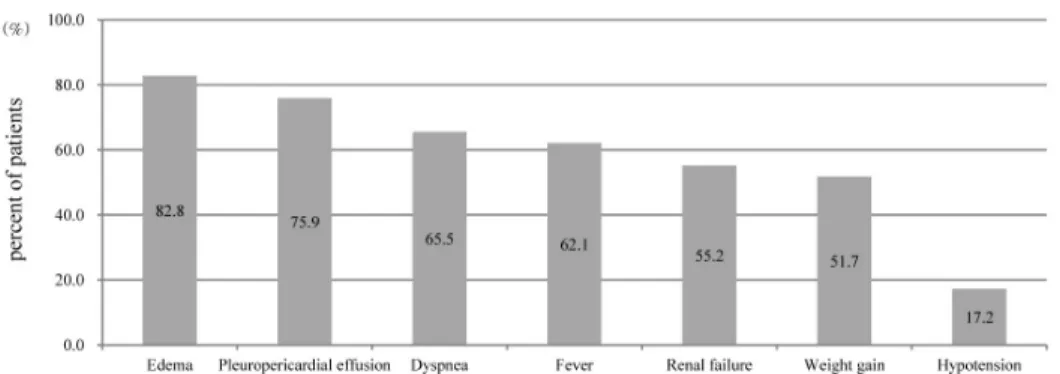
Results : Among 95 patients, 29 patients (30.5%) experienced DS, 12 with moderate form (12.6%) and 17 with severe form (17.9%). The first peak occurred during the first week of ATRA treatment. The most frequent clinical manifestations of DS were edema (82.8%), pleuropericardial effusion (75.9%), dyspnea (65.5%), and fever (62.1%). Intravenous dexamethasone was administered in 82.8% of patients with DS. ATRA was discontinued in 93.1% of patients with DS. The univariate analysis of prognostic factors identified the following characteristics as significantly associated with DS: blood urea nitrogen (BUN) ≥20 mg/dL and lactate dehyrogenase (LDH) ≥900 U/L. Upon multivariate analysis, abnormal levels of BUN remained independent prognostic factors for DS (OR 4.06; 95% CI 1.19-13.79; p=0.03).
Conclusion : In this study, high level of BUN is one of the risk factors that can predict the potential side effects of DS. We recommend the use of steroid to prevent DS for people taking ATRA with abnormal level of BUN.
[Key words] Acute promyelocytic leukemia (APL), All-trans retinoic acid (ATRA), Differentiation
syndrome (DS)
을 분류하고, 그에 따른 예방 약제 사용의 근거를 마련 하고자 하였다.
연구방법
2012년 1월부터 2015년 6월까지 가톨릭대학교 서울 성모병원(이하 서울성모병원) 혈액내과에서 급성전골 수구성백혈병 진단을 받고 관해유도 목적으로 ATRA 를 복용한 환자를 대상으로 하였다.
대상 환자의 특성 및 분화증후군의 발생 양상은 전자 의무기록을 통해 후향적으로 조사하였다. ATRA 투약 시작 시점의 대상 환자의 특성(나이, 성별, 알레르기, 키, 체중, 혈액화학적 수치 등)과 분화증후군 발생 여부 를 조사하였다. 분화증후군의 발생 여부는 관해유도 치 료를 위해 입원한 기간 중에 발열, 체중증가, 부종, 호 흡곤란, 흉막삼출, 저혈압, 신부전 증상 중 2가지 이상 발생한 경우로 정의하였고, 발생 시기, 임상 양상, 증상 조절 방법을 조사하였다.
7)분화증후군의 발생 시기에 따라 ATRA 최초 복용일로부터 7일 이내에 분화증후 군이 발생한 경우를 early DS군, 8일 이후에 발생한 경우를 late DS군으로 분류하였고, 발생한 임상 양상 의 개수가 2-3개인 경우를 moderate DS군, 4개 이상 인 경우를 severe DS군으로 분류하였다.
7)ATRA 투약 시작 시점의 기초임상정보를 통해 분화증후군의 발생 에 영향을 미치는 위험인자를 분석하였다.
통계분석은 SPSS version 22.0을 이용하였고, 분화 증후군의 발생 양상은 카이제곱검정 또는 Fisher 정확 검정으로, 위험인자는 로지스틱 회귀분석을 사용하여 분석하였다. p-value가 0.05 미만일 때 통계적으로 유의한 것으로 정의하였다.
본 연구는 서울성모병원 임상연구심사위원회(Insti- tutional Review Board, IRB)의 승인을 받아 진행하 였다(KC15RASE0650).
연구결과
1. 대상 환자의 특성
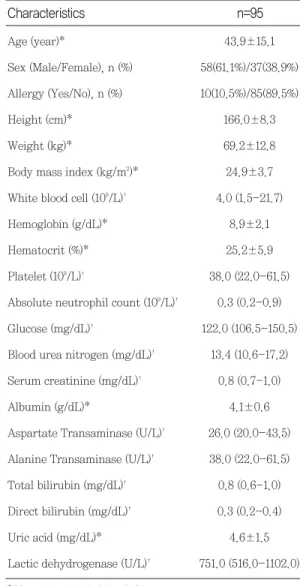
대상 환자는 총 95명으로 대상 환자의 특성은(Table 1)과 같았다.
2. 분화 증후군의 발생 양상 분석 1) 분화증후군의 발생률
95명의 환자 중 29명(30.5%)의 환자에서 분화증후군 이 발생하였고, 이 중 moderate DS는 12명(12.6%), severe DS는 17명(17.9%)이었다.
* Mean±standard deviation (sd)
�
Median (Interquartile range (IQR); Q1-Q3)
Characteristics n=95
Table 1 Initial characteristics of patients
Age (year)* 43.9±15.1
Sex (Male/Female), n (%) 58(61.1%)/37(38.9%) Allergy (Yes/No), n (%) 10(10.5%)/85(89.5%)
Height (cm)* 166.0±8.3
Weight (kg)* 69.2±12.8
Body mass index (kg/m2)* 24.9±3.7 White blood cell (109/L)� 4.0 (1.5-21.7)
Hemoglobin (g/dL)* 8.9±2.1
Hematocrit (%)* 25.2±5.9
Platelet (109/L)� 38.0 (22.0-61.5) Absolute neutrophil count (109/L)� 0.3 (0.2-0.9) Glucose (mg/dL)� 122.0 (106.5-150.5) Blood urea nitrogen (mg/dL)� 13.4 (10.6-17.2) Serum creatinine (mg/dL)� 0.8 (0.7-1.0)
Albumin (g/dL)* 4.1±0.6
Aspartate Transaminase (U/L)� 26.0 (20.0-43.5) Alanine Transaminase (U/L)� 38.0 (22.0-61.5) Total bilirubin (mg/dL)� 0.8 (0.6-1.0) Direct bilirubin (mg/dL)� 0.3 (0.2-0.4)
Uric acid (mg/dL)* 4.6±1.5
Lactic dehydrogenase (U/L)� 751.0 (516.0-1102.0)
2) 분화증후군의 발생 시기
ATRA 복용으로부터 분화증후군 발생일의 중앙값은 10일이었다(범위; 0-29일). Severe DS군의 분화증후
군 발생일의 중앙값은 5일, moderate DS군은 14일로 severe DS군에서 분화증후군이 상대적으로 빨리 나타 났다. 분화증후군은 ATRA를 복용한지 7일 이내에 가 장 많이 발생하였다(Fig. 1).
Fig. 1 Time to occurrence of moderate and severe DS
Fig. 2 Clinical signs and symptoms of differentiation syndrome (DS)
Edema 8 (66.7%) 16 (94.1%) 0.13
Pleuropericardial effusion 6 (50.0%) 16 (94.1%) 0.01
Dyspnea 4 (33.3%) 15 (88.2%) 0.01
Fever 5 (41.7%) 13 (76.5%) 0.12
Renal failure 6 (50.0%) 10 (58.8%) 0.64
Weight gain 3 (25.0%) 12 (70.6%) 0.02
Hypotension 1 (8.3%) 4 (23.5%) 0.37
p value Severe DS (n=17)
n (%) Moderate DS (n=12)
n (%) Clinical signs and symptoms
Table 2. Clinical signs and symptoms of moderate and severe DS
3) 분화증후군의 임상 양상
분화증후군의 임상 양상은 부종, 흉막삼출, 호흡곤란 등의 순으로 나타났다(Fig. 2). Severe DS군이 mod- erate DS군보다 흉막삼출, 호흡곤란, 체중증가 증상이 유의하게 높게 나타났고(Table 2), early DS군이 late DS군에 비해 흉막삼출 증상이 높게 나타났다(p=0.01) (Table 3).
4) 분화증후군의 증상 조절 방법
분화증후군 발생 시 증상 조절은 이뇨제 투약이 100%
이루어졌으며, ATRA 중단, 덱사메타손 투약 등의 순 으로 이루어졌다(Fig. 3). Severe DS군에서 moder-
ate DS군보다 덱사메타손 투약과 기계 환기가 유의하 게 많이 이루어졌고(Table 4), early DS군의 경우 100% 기계 환기가 이루어졌다(p=0.003)(Table 5).
5) 분화증후군의 위험인자 분석
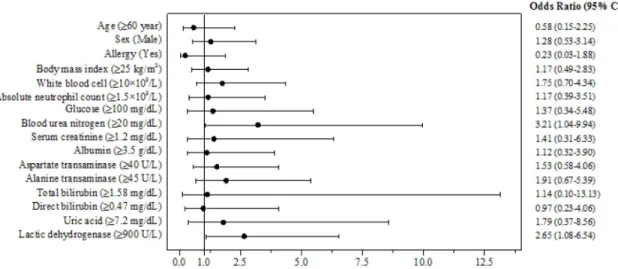
단변량 로지스틱 회귀분석을 통해 BUN 수치가 20 mg/dL 이상(OR 3.21, 95% CI 1.04-9.94; p=0.04), LDH 수치가 900 U/L 이상(OR 2.65; 95% CI 1.08- 6.54; p=0.03)인 경우가 분화증후군이 높게 나타나는 것으로 나타났다(Fig. 4).
이를 바탕으로 다변량 로지스틱 회귀분석을 하였으 나 통계적으로 유의한 결과를 얻지 못하였다. 나이와 성별을 보정한 다변량 로지스틱 회귀분석에서는 BUN
Edema 10 (76.9%) 14 (87.5%) 0.63
Pleuropericardial effusion 13 (100.0%) 9 (56.3%) 0.01
Dyspnea 9 (69.2%) 10 (62.5%) 1.00
Fever 10 (76.9%) 8 (50.0%) 0.25
Renal failure 5 (38.5%) 11 (68.8%) 0.10
Weight gain 8 (61.5%) 7 (43.8%) 0.34
Hypotension 3 (23.1%) 2 (12.5%) 0.63
p value Late DS (n=16)
n (%) Early DS (n=13)
n (%) Clinical signs and symptoms
Table 3 Clinical signs and symptoms of early and late DS
Fig. 3 Management of differentiation syndrome (DS)
수치가 20 mg/dL 이상인 경우 분화증후군이 높게 발 생하였다(OR 4.06, 95% CI 1.19-13.79; p=0.03)
(Fig. 5).
Diuretics 12 (100.0%) 17 (100.0%) N/A*
ATRA withdrawal 11 (91.7%) 16 (94.1%) 1.00
Intravenous dexamethasone 7 (58.3%) 17 (100.0%) 0.01
Mechanical ventilation 6 (50.0%) 15 (88.2%) 0.04
Dialysis 1 (8.3%) 6 (35.3%) 0.19
p value Severe DS (n=17)
n (%) Moderate DS (n=12)
n (%) Management
Table 4 Management of moderate and severe DS
*N/A (Not available)
Diuretics 13 (100.0%) 16 (100.0%) N/A*
ATRA withdrawal 12 (92.3%) 15 (93.8%) 1.00
Intravenous dexamethasone 12 (92.3%) 12 (75.0%) 0.34
Mechanical ventilation 13 (100.0%) 8 (50.0%) 0.003
Dialysis 4 (30.8%) 3 (18.8%) 0.67