Vol. 23, No. 2 109~117 (2017)
https://doi.org/10.20909/kopast.2017.23.2.109
Current Scenario of Gas Scavenging Systems Used in Active Packaging - A Review
Kirtiraj K. Gaikwad and Youn Suk Lee*
Department of Packaging, Yonsei University, Wonju 220-710, Korea
Abstract Due to the rise of customer’s alertness about fresh foods to health, in the past few years, the consumption of fresh food has increased sturdily. The use of gas scavengers is the most appropriate packaging technologies for fresh, fresh-cut produces and in ready to eat products. The gas absorber/scavenger has ability to protect or stabilize the wanted properties and shelf life of food. The success of gas absorbers in food depends on many parameters such as types of foods, storage temperature, relative humidity, initial gas concentration, and the characteristics of package materials. In this review article, we focus on the most recent research trends in gas scavenging systems used in food packaging, future trends. Intense research from industry and engineers remains important to the development of gas scavenging package that fulfill consumer requirements, enhance product quality, and offer environmentally friendly design and cost-effective application.
Keywords Food packaging, Active function, Gas scavenger
Introduction
In recent years, consumers have become increasingly con- scious about their health and are hence are willing to pay a higher price for healthy, fresh food. Consequently, the con- sumer food industries have begun to apply advanced tech- nologies to preserve the freshness and nutrients of food. The preservations techniques like use of synthetic preservatives, salting, blanching, use of high temperature, and drying of foods used in the past that persevere till today
1-3). Never- theless, some foods are served fresh without the use of syn- thetic food preservatives. Earlier in the 20
thcentury, a number of chemicals were incorporated into food products to absorb different gases like, oxygen, and carbon dioxide gases
4).
The use of polymer packaging materials varying in gas per- meability started to be widely used by the 1970
5). Concerns regarding the oxidation by oxygen and also the oxygen which transmits through the packaging material lead to the devel- opment of chemical means of oxygen removal by using pack- ets or sachets within the package, which saw the beginnings of new category of packaging called active packaging, including oxygen absorbers
6).
Carbon dioxide is generally beneficial for food protection and is thus often used as a flushing gas in modified atmo-
sphere packaging (MAP). High concentration of CO
2prevents microbial growth in food products and hence it benefits to maintain their freshness and extend their shelf life
7). CO
2is used to protect foods from oxidation. Nitrogen (N
2) is com- monly used to inhibit oxidation, but CO
2is often combined with N
2for antioxidant food packaging. An ideal level of improved CO
2concentration is helpful also for maintaining the fresh produce by decreasing the physiological activities such as respiration, ethylene production and so on
8). The global market increasing year by years as presented in Table 1. This is because of the high demand for fresh and safe food.
The ripening of fruit and vegetables is a bio-chemical pro- cess that is caused by ethylene gas, a natural plant hormone.
It initiates and accelerates the ripening of fruit and vegetables, and then causes them to deteriorate
9-11). By lowering the level of ethylene gas surrounding fruits and vegetables, their shelf life can be greatly increased, slowing the maturation of fruit and greatly reducing decay as shown in Fig. 1. When produce is shipped, trucked, and flown from farm to market, the pro- ducers and commercial industries utilize devices to absorb the ethylene gas that fruits and vegetables emit as they ripen
12). The use of these devices essentially stops the ripening process so that produce can be shipped to market looking freshly picked, and not wilted or fuzzy. These ethylene gas absorbing or neutralizing devices (with an organic carrier medium of volcanic ash) have been utilized safely by both producers and industries for over 20 years
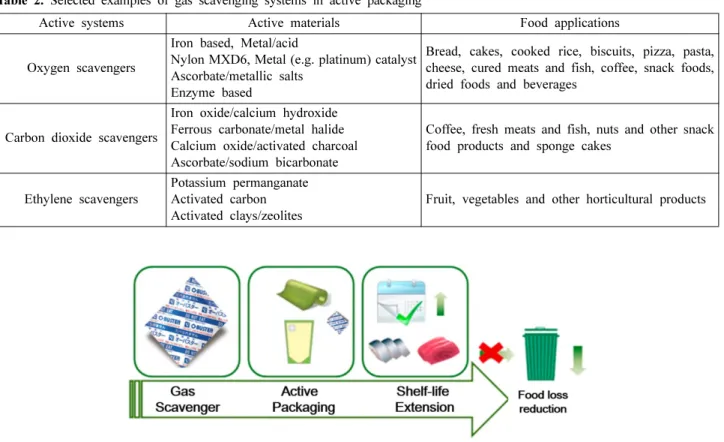
13). The different types of gas scav- enging systems used in food packaging are as presented in
†Corresponding Author : Youn Suk Lee
Department of Packaging, Yonsei University, Wonju 26493, Korea E-mail : [email protected]