Tumor Necrosis Factor-α as a Predictor for the
Development of Nonalcoholic Fatty Liver Disease:
A 4-Year Follow-Up Study
Yun Yong Seo1,*, Yong Kyun Cho1,*, Ji-Cheol Bae2, Mi Hae Seo3, Se Eun Park3, Eun-Jung Rhee3, Cheol-Young Park3, Ki-Won Oh3, Sung-Woo Park3, Won-Young Lee3
1Department of Gastroenterology, Kangbuk Samsung Hospital, Sungkyunkwan University School of Medicine; 2Department of Internal Medicine, Samsung Medical Center, Sungkyunkwan University School of Medicine; 3Department of Endocrinology and Metabolism, Kangbuk Samsung Hospital, Sungkyunkwan University School of Medicine, Seoul, Korea
Background: Tumor necrosis factor (TNF)-α is associated with insulin resistance and systemic inflammatory responses. The aim of this study was to investigate the relationship between TNF-α and the development of nonalcoholic fatty liver disease (NAFLD) in a longitudinal study.
Methods: Three hundred and sixty-three apparently healthy subjects (mean age, 40.5±6.1 years; male, 57.6%) without NAFLD were enrolled in 2003. Anthropometric and laboratory measurements were performed. The participants were grouped into tertiles according to their serum TNF-α levels from samples taken in 2003. At a 4-year follow-up, we compared the odds ratios (ORs) of the development of NAFLD according to the tertiles of TNF-α levels measured in 2003.
Results: At the 4-year follow-up, the cumulative incidence of NAFLD was 29.2% (106/363). The group that developed NAFLD had higher levels of TNF-α than those in the group without NAFLD (3.65±1.79 pg/mL vs. 3.15±1.78 pg/mL; P=0.016). When the 2003 serum TNF-α levels were categorized into tertiles: incidence of NAFLD observed in 2007 was significantly higher with in- creasing tertiles (22.6%, 35.8%, and 41.5%, respectively; P<0.05). The risk of developing NAFLD was significantly greater in the highest tertile of TNF-α than in the lowest tertile after adjusting for age, smoking, and BMI (OR, 2.20; 95% confidence interval, 1.12 to 4.01; P<0.05).
Conclusion: Higher serum TNF-α levels in subjects without NAFLD were associated with the development of NAFLD. The re- sults of study might suggest a pathologic role of inflammation in NAFLD.
Key Words: Inflammation; Non-alcoholic fatty liver disease; Tumor necrosis factor-alpha
INTRODUCTION
Nonalcoholic fatty liver disease (NAFLD) is characterized by
excessive hepatic accumulation of triglycerides and free fatty acids in the liver [1]. The pathologic spectrum of NAFLD is broad, ranging from simple steatosis to nonalcoholic steato-
Received: 8 January 2013, Accepted: 14 February 2013 Corresponding author: Won-Young Lee
Department of Endocrinology and Metabolism, Kangbuk Samsung Hospital, Sungkyunkwan University School of Medicine, 29 Saemunan-ro, Jongno-gu, Seoul 110-746, Korea
Tel: +82-2-2001-2579, Fax: +82-2-2001-1588, E-mail: [email protected]
*These authors contributed equally to this work.
Copyright © 2013 Korean Endocrine Society
This is an Open Access article distributed under the terms of the Creative Com- mons Attribution Non-Commercial License (http://creativecommons.org/
licenses/by-nc/3.0/) which permits unrestricted non-commercial use, distribu- tion, and reproduction in any medium, provided the original work is properly cited.
hepatitis (NASH), potentially progressing to fibrosis and cir- rhosis [2]. After fat infiltrates the liver, progression to hepato- cellular inflammation and fibrosis may occur [3,4]. Additional factors, such as oxidative stress, mitochondrial abnormalities, and cytokines such as tumor necrosis factor (TNF)-α, are im- portant in mediating this process. Serum levels of TNF-α are significantly increased in fatty liver disease, and are well cor- related with the severity of liver disease [4].
TNF-α appears to play a central role in the development of hepatic steatosis. TNF-α is a proinflammatory cytokine that mediates hepatic inflammation, oxidative stress, and apoptosis or necrosis of liver cells [5,6]. The cytokine TNF-α is an im- portant cytokine, exerting biological effects in different tissues and species at multiple levels [7].
Several clinical studies have investigated the role of TNF-α as a marker for NAFLD in cross-sectional analyses, but the re- sults have been contradictory [8-10]. There have been no stud- ies that have demonstrated a relationship between TNF-α and NAFLD in a longitudinal analysis.
Therefore, in this study, we investigated the relationship be- tween TNF-α levels at baseline and the incidence of NAFLD development in a 4-year follow-up of a cohort of 363 appar- ently healthy Korean subjects.
METHODS
Participants
This study included 363 subjects in an observational cohort.
Participants underwent medical screening at an industrial medical check-up in 2003 and at a follow-up in 2007. The re- sults were previously reported as the Kangbuk Samsung Medi- cal Center-Adipokine Study (KBSMC-Adipokine Study) [11].
Subjects with viral hepatitis B, hepatitis C, other liver diseases, acute or chronic inflammation, malignancy, or excessive alco- hol consumption (>20 g/day) were excluded. Questionnaires were used to determine alcohol consumption (g/day). In addi- tion, participants taking medications such as peroxisome pro- liferator-activated receptor-γ agonists, metformin, or antioxi- dants (vitamin E or C) were excluded. Alcohol intake, smok- ing habits, medication, and medical history were assessed by chart review and standardized questionnaire. The study proto- col was approved by the Institutional Review Board and the Ethics Committee of Kangbuk Samsung Hospital.
Biochemical assays
Blood samples were obtained after 12 hours of overnight fast-
ing and used to measure fasting plasma glucose, total choles- terol, low density lipoprotein cholesterol, high density lipo- protein cholesterol, fasting insulin, creatinine, direct bilirubin, and the following liver function parameters: aspartate amino- transferase (AST), alanine aminotransferase (ALT), gamma- glutamyltransferase (GGT), and alkaline phosphatase (ALP).
Samples for measuring TNF-α were separated and stored at -80˚C prior to measurement of serum levels by enzyme-linked immunosorbent assay (ELISA, Bio Vendor Laboratory Medi- cine, Modrice, the Czech Republic). As a marker of insulin re- sistance (IR), homeostatic model assessment (HOMA) of IR was calculated as follows [12]: HOMA-IR=[fasting insulin (µIU/mL)×fasting glycaemia (mmol/L)]/22.5.
Ultrasonography
Abdominal ultrasonography (Logic Q700 MR, GE, Milwau- kee, WI, USA) was performed in all subjects. Fatty liver was diagnosed based on standard criteria, including hepatorenal echo contrast, liver brightness, and vascular blurring, using a 3.5 MHz probe [12]. Several experienced radiologists, all of whom were blinded to the subjects’ clinical status, performed the ultrasounds. We did not assess interobserver reliability.
Statistical analysis
Statistical analyses were performed with SPSS version 17.0 (SPSS Inc., Chicago, IL, USA). Normality was tested using the Kolmogorov-Smirnov test. The chi-squared test was used to compare categorical variables between groups. For continu- ous variables, parameters that followed a normal distribution were analyzed with a t test or analysis of variance (ANOVA) and described as the mean±SD. Parameters that did not fol- low a normal distribution were analyzed with the Mann-Whit- ney U test or the Kruskal-Wallis test and expressed as the me- dian (interquartile range).
TNF-α levels were grouped into tertiles, and multiple logis- tic regression analysis was used to calculate odds ratios (ORs) for NAFLD. Subjects with higher TNF-α tertiles (second and third tertiles) were compared with the lowest tertile. Two-sid- ed values of P<0.05 were considered significant.
RESULTS
The study cohort included 363 subjects (210 males, 153 females) with an average age of 40.5 years (range, 34 to 46). The sub- jects were divided into two groups: those with NAFLD (n=
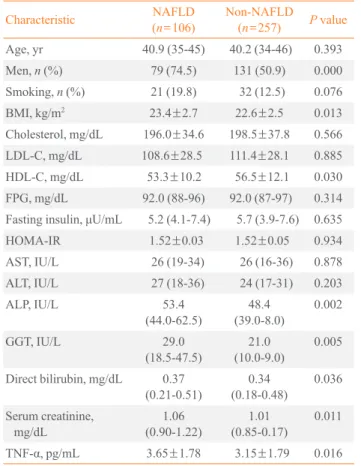
106) and those without NAFLD (n=257) in 2007. Table 1 shows
a comparison of the baseline characteristics between subjects according to the presence or absence of NAFLD in 2007. The mean ages of the NAFLD and non-NAFLD groups were not significantly different. The NAFLD group had a significantly higher proportion of male subjects and a higher body mass in- dex (BMI) (Table 1). Additionally, the baseline serum levels of ALP, GGT, direct bilirubin, and creatinine were significant- ly higher in the NAFLD group. The activities of the liver ami- notransferases AST and ALT and the IR marker HOMA-IR were not significantly different between the two groups. Table 1 also shows the serum levels of TNF-α in 2003 according to the presence or absence of NAFLD in 2007. TNF-α levels were significantly higher in the NAFLD group than in the non-NAFLD group (3.65±1.78 pg/mL vs. 3.15±1.79 pg/mL;
P=0.016).
The range of levels of TNF-α for each tertile was as fol- lows: tertile 1, 0 to 2.4 pg/mL (mean, 1.48); tertile 2, 2.4 to 3.8 pg/mL (mean, 3.14); and tertile 3, 3.8 to 12.0 pg/mL (mean, 5.25). When distributions of serum levels of TNF-α were ex- pressed by tertile, we observed a statistically significant gradi- ent for the development of NAFLD (22.6%, 35.8%, and 41.5%, respectively; P<0.05) (Table 2).
Table 3 shows the risk of NAFLD after 4 years of follow-up according to TNF-α levels separated by tertiles. The OR of the highest tertile compared with the lowest tertile was 2.20 (95%
confidence interval, 1.21 to 4.01; P=0.010), even after adjust- ment for age, BMI, and smoking.
DISCUSSION
In this study, we sought to fill a gap in the existing literature regarding the relationship between TNF-α and NAFLD. Previ- ously, it had been hypothesized that TNF-α plays a role in the Table 1. Baseline Clinical Characteristics of Subjects in 2003
Grouped by the Presence of Nonalcoholic Fatty Liver Disease in 2007
Characteristic NAFLD
(n=106) Non-NAFLD
(n=257) P value
Age, yr 40.9 (35-45) 40.2 (34-46) 0.393
Men, n (%) 79 (74.5) 131 (50.9) 0.000
Smoking, n (%) 21 (19.8) 32 (12.5) 0.076
BMI, kg/m2 23.4±2.7 22.6±2.5 0.013
Cholesterol, mg/dL 196.0±34.6 198.5±37.8 0.566 LDL-C, mg/dL 108.6±28.5 111.4±28.1 0.885 HDL-C, mg/dL 53.3±10.2 56.5±12.1 0.030 FPG, mg/dL 92.0 (88-96) 92.0 (87-97) 0.314 Fasting insulin, μU/mL 5.2 (4.1-7.4) 5.7 (3.9-7.6) 0.635
HOMA-IR 1.52±0.03 1.52±0.05 0.934
AST, IU/L 26 (19-34) 26 (16-36) 0.878 ALT, IU/L 27 (18-36) 24 (17-31) 0.203
ALP, IU/L 53.4
(44.0-62.5) 48.4
(39.0-8.0) 0.002
GGT, IU/L 29.0
(18.5-47.5) 21.0
(10.0-9.0) 0.005 Direct bilirubin, mg/dL 0.37
(0.21-0.51) 0.34
(0.18-0.48) 0.036 Serum creatinine,
mg/dL 1.06
(0.90-1.22) 1.01
(0.85-0.17) 0.011
TNF-α, pg/mL 3.65±1.78 3.15±1.79 0.016
Values are expressed as median (interquartile range) or mean±SD.
NAFLD, nonalcoholic fatty liver disease; BMI, body mass index; LDL- C, low density lipoprotein cholesterol; HDL-C, high density lipopro- tein cholesterol; FPG, fasting plasma glucose; HOMA-IR, homeostatic model assessment of insulin resistance; AST, aspartate aminotransfer- ase; ALT, alanine aminotransferase; ALP, alkaline phosphatase; GGT, gamma-glutamyltransferase; TNF, tumor necrosis factor.
Table 2. Tertile Distributions of Serum Tumor Necrosis Factor-α Levels Grouped by the Presence of Nonalcoholic Fatty Liver Disease in 2007
Variable Tertile NAFLD
(n=106) Non-NAFLD (n=257)
TNF-αa T1 24 (22.6) 97 (37.7)
T2 38 (35.8) 83 (32.4)
T3 44 (41.5) 77 (29.9)
Values are expressed as number (%).
NAFLD, nonalcoholic fatty liver disease; TNF, tumor necrosis factor.
aTNF-α tertiles, pg/mL (mean): T1, 0 to 2.4 (1.48); T2, 2.4 to 3.8 (3.14);
T3, 3.8 to 12 (5.25).
Table 3. Odds Ratio (95% CI) for the Development of Nonal- coholic Fatty Liver Disease Associated with Each Tumor Ne- crosis Factor-α Tertile
Odds ratio (95% CI) P value Model 1a
TNF-α tertile 1 vs. 2 1.85 (1.03-3.3) 0.041 TNF-α tertile 1 vs. 3 2.31 (1.29-4.13) 0.005 Model 2b
TNF-α tertile 1 vs. 2 1.79 (0.98-3.27) 0.057 TNF-α tertile 1 vs. 3 2.20 (1.21-4.01) 0.010 CI, confidence interval; TNF, tumor necrosis factor.
aVariables not corrected for covariates, bVariables corrected for covari- ates (age, body mass index, and smoking).
pathogenesis of diseases related to IR, including NAFLD [13, 14]. Indeed, TNF-α production has been reported to be elevat- ed in peripheral blood cell cultures collected from obese pa- tients with NAFLD [7]. Nevertheless, direct evidence of TNF-α involvement in the early stages of NAFLD has not been previ- ously described.
Human studies of TNF-α and NAFLD have shown conflict- ing results, probably due to heterogeneity in study populations or various factors that might affect serum levels of TNF-α. In a cross-sectional study by Hui et al. [8], TNF-α levels were found to be significantly higher in NAFLD patients compared to control patients, but there was no significant difference in TNF-α levels between patients with NAFLD and those with NASH as diagnosed by liver biopsy. In another cross-sectional study of patients with NASH, NAFLD, and control patients, serum TNF-α and soluble TNF receptor 1 were significantly higher in patients with NASH compared to patients with NAFLD and controls [9]. However, in a study by Musso et al.
[10], there were no significant differences in TNF-α serum levels among nonobese, nondiabetic NASH patients and matched controls.
To date, a temporal association between TNF-α and NAFLD has not been demonstrated in a longitudinal analysis.
We sought to determine whether or not TNF-α and NAFLD are significantly related over time. We observed a significant rela- tionship between TNF-α and the development of NAFLD after 4 years.
TNF-α is a central mediator of IR, activating proinflamma- tory pathways such as c-jun N-terminal kinase and nuclear factor-κB. The proinflammatory cytokine TNF-α has an im- portant role in these pathways, especially in patients with obe- sity or type 2 diabetes mellitus [15]. Thus, TNF-α may con- tribute to IR, which then may further promote inflammation by impairing the anti-inflammatory effect of insulin [16]. Fur- thermore, TNF-α is known to attract inflammatory leukocytes to the liver and to enhance the expression of sterol regulatory element binding protein-1c, which regulates de novo lipogene- sis and is more highly expressed in NAFLD [17].
A study by Satapathy et al. [18] supported a potential role of TNF-α in the pathogenesis of NAFLD. In patients with NASH and elevated ALT, treatment with a TNF-α inhibitor (pentoxi- fylline) significantly reduced AST, ALT, and serum TNF-α levels and improved the IR index.
This study had several limitations. First, the diagnosis of NAFLD was not histologically confirmed, but was made by ultrasound, which has a reported sensitivity of 67% to 89%
and specificity of 77% to 89% [19,20]. Second, alcohol intake was surveyed by a self-recorded questionnaire; therefore, we cannot rule out the possibility of misreporting or recall bias. In addition, lifestyle risk factors, which can affect future NAFLD, including exercise and dietary habits, were not con- sidered. Thus, the data were subject to potential under- or overestimation. Third, we did not adjust for high sensitivity C- reactive protein (hs-CRP) and HOMA-IR. We did not measure hs-CRP, and there was no significant difference after adjust- ment for HOMA-IR. Lastly, our cohort was composed of par- ticipants who had volunteered for health check-ups, which might also introduce a selection bias.
In conclusion, this study showed a significant relationship between baseline TNF-α levels and the later development of NAFLD. The role of the cytokine TNF-α in NAFLD needs to be confirmed through further studies.
CONFLICTS OF INTEREST
No potential conflict of interest relevant to this article was re- ported.
ACKNOWLEDGMENTS
This work was supported by MSD Korea research grant # MRI- 110907-004 and Daewoong research grant # MRI-110907-005.
REFERENCES
1. Falck-Ytter Y, Younossi ZM, Marchesini G, McCullough AJ. Clinical features and natural history of nonalcoholic steatosis syndromes. Semin Liver Dis 2001;21:17-26.
2. Matteoni CA, Younossi ZM, Gramlich T, Boparai N, Liu YC, McCullough AJ. Nonalcoholic fatty liver disease: a spectrum of clinical and pathological severity. Gastroen- terology 1999;116:1413-9.
3. Bacon BR, Farahvash MJ, Janney CG, Neuschwander-Tetri BA. Nonalcoholic steatohepatitis: an expanded clinical en- tity. Gastroenterology 1994;107:1103-9.
4. McCullough AJ. Pathophysiology of nonalcoholic steato- hepatitis. J Clin Gastroenterol 2006;40 Suppl 1:S17-29.
5. Hotamisligil GS, Shargill NS, Spiegelman BM. Adipose expression of tumor necrosis factor-alpha: direct role in obesity-linked insulin resistance. Science 1993;259:87-91.
6. Wellen KE, Hotamisligil GS. Obesity-induced inflamma- tory changes in adipose tissue. J Clin Invest 2003;112:
1785-8.
7. Poniachik J, Csendes A, Diaz JC, Rojas J, Burdiles P, Mal- uenda F, Smok G, Rodrigo R, Videla LA. Increased pro- duction of IL-1alpha and TNF-alpha in lipopolysaccha- ride-stimulated blood from obese patients with non-alco- holic fatty liver disease. Cytokine 2006;33:252-7.
8. Hui JM, Hodge A, Farrell GC, Kench JG, Kriketos A, George J. Beyond insulin resistance in NASH: TNF-alpha or adiponectin? Hepatology 2004;40:46-54.
9. Abiru S, Migita K, Maeda Y, Daikoku M, Ito M, Ohata K, Nagaoka S, Matsumoto T, Takii Y, Kusumoto K, Nakamura M, Komori A, Yano K, Yatsuhashi H, Eguchi K, Ishibashi H. Serum cytokine and soluble cytokine receptor levels in patients with non-alcoholic steatohepatitis. Liver Int 2006;
26:39-45.
10. Musso G, Gambino R, Durazzo M, Biroli G, Carello M, Faga E, Pacini G, De Michieli F, Rabbione L, Premoli A, Cassader M, Pagano G. Adipokines in NASH: postprandial lipid metabolism as a link between adiponectin and liver disease. Hepatology 2005;42:1175-83.
11. Kim YC, Cho YK, Lee WY, Kim HJ, Park JH, Park DI, Sohn CI, Jeon WK, Kim BI, Park SE, Rhee EJ, Park CY, Oh KW, Park SW, Kim SW, Ryu SH. Serum adipocyte- specific fatty acid-binding protein is associated with non- alcoholic fatty liver disease in apparently healthy subjects.
J Nutr Biochem 2011;22:289-92.
12. Matthews DR, Hosker JP, Rudenski AS, Naylor BA, Treach- er DF, Turner RC. Homeostasis model assessment: insulin resistance and beta-cell function from fasting plasma glu- cose and insulin concentrations in man. Diabetologia 1985;
28:412-9.
13. Bluher M. Clinical relevance of adipokines. Diabetes Metab J 2012;36:317-27.
14. Peraldi P, Spiegelman BM. Studies of the mechanism of inhibition of insulin signaling by tumor necrosis factor-al- pha. J Endocrinol 1997;155:219-20.
15. Diehl AM. Tumor necrosis factor and its potential role in insulin resistance and nonalcoholic fatty liver disease. Clin Liver Dis 2004;8:619-38.
16. Plomgaard P, Bouzakri K, Krogh-Madsen R, Mittendorfer B, Zierath JR, Pedersen BK. Tumor necrosis factor-alpha induces skeletal muscle insulin resistance in healthy hu- man subjects via inhibition of Akt substrate 160 phosphor- ylation. Diabetes 2005;54:2939-45.
17. Endo M, Masaki T, Seike M, Yoshimatsu H. TNF-alpha induces hepatic steatosis in mice by enhancing gene ex- pression of sterol regulatory element binding protein-1c (SREBP-1c). Exp Biol Med (Maywood) 2007;232:614-21.
18. Satapathy SK, Garg S, Chauhan R, Sakhuja P, Malhotra V, Sharma BC, Sarin SK. Beneficial effects of tumor necrosis factor-alpha inhibition by pentoxifylline on clinical, bio- chemical, and metabolic parameters of patients with non- alcoholic steatohepatitis. Am J Gastroenterol 2004;99:
1946-52.
19. Joy D, Thava VR, Scott BB. Diagnosis of fatty liver dis- ease: is biopsy necessary? Eur J Gastroenterol Hepatol 2003;15:539-43.
20. Saadeh S, Younossi ZM, Remer EM, Gramlich T, Ong JP, Hurley M, Mullen KD, Cooper JN, Sheridan MJ. The utili- ty of radiological imaging in nonalcoholic fatty liver dis- ease. Gastroenterology 2002;123:745-50.