Endocrinol Metab 2014;29:530-535
http://dx.doi.org/10.3803/EnM.2014.29.4.530 pISSN 2093-596X · eISSN 2093-5978
Original Article
Standardized Thyroid Cancer Mortality in Korea between 1985 and 2010
Yun Mi Choi, Tae Yong Kim, Eun Kyung Jang, Hyemi Kwon, Min Ji Jeon, Won Gu Kim, Young Kee Shong, Won Bae Kim
Department of Internal Medicine, Asan Medical Center, University of Ulsan College of Medicine, Seoul, Korea
Background: The prevalence of thyroid cancer has increased very rapidly in Korea. However, there is no published report focus- ing on thyroid cancer mortality in Korea. In this study, we aimed to evaluate standardized thyroid cancer mortality using data from Statistics Korea (the Statistical Office of Korea).
Methods: Population and mortality data from 1985 to 2010 were obtained from Statistics Korea. Age-standardized rates of thy- roid cancer mortality were calculated according to the standard population of Korea, as well as World Health Organization (WHO) standard population and International Cancer Survival Standard (ICSS) population weights.
Results: The crude thyroid cancer mortality rate increased from 0.1 to 0.7 per 100,000 between 1985 and 2010. The pattern was the same for both sexes. The age-standardized mortality rate (ASMR) for thyroid cancer for Korean resident registration popula- tion increased from 0.19 to 0.67 between 1985 and 2000. However, it decreased slightly, from 0.67 to 0.55, between 2000 and 2010. When mortality was adjusted using the WHO standard population and ICSS population weights, the ASMR similarly in- creased until 2000, and then decreased between 2000 and 2010.
Conclusion: Thyroid cancer mortality increased until 2000 in Korea. It started to decrease from 2000.
Keywords: Thyroid neoplasms; Mortality; Standard population
INTRODUCTION
Thyroid cancer is the most common endocrine malignancy [1].
The incidence of thyroid cancer has increased worldwide, in- cluding in Korea [2]. In the United States, the age-adjusted in- cidence rate increased from 4.9 per 100,000 (3.1 in males, 6.5 in females) to 14.7 per 100,000 (7.4 in males, 21.8 in females) between 1975 and 2011 [3]. According to the Korea National Cancer Incidence Database, crude and age-standardized cancer incidence rates during 2011 were 81.0 per 100,000 (27.9 in males, 134.1 in females) and 58.3 per 100,000 (20.2 in males,
96.8 in females), respectively. The incidence of thyroid cancer was increased by 23.3% per year in both sexes, and since 2009 it has been the most common cancer in women in Korea [4].
Enhanced detection using high-resolution ultrasonography may have contributed to the increased incidence in thyroid can- cer. However, it cannot fully explain the increase, and there seems to be a true increase in thyroid cancer incidence [5,6]. It is also possible that increases in exposure to some unknown risk factors account for the increase in incidence [7]. Despite the surge in incidence, disease-specific thyroid cancer mortality has reportedly remained stable [8,9].
Received: 2 October, 2014, Revised: 24 October, 2014, Accepted: 27 October, 2014
Corresponding author: Tae Yong Kim
Department of Internal Medicine, Asan Medical Center, University of Ulsan College of Medicine, 88 Olympic-ro 43-gil, Songpa-gu, Seoul 138-736, Korea Tel: +82-2-3010-3249, Fax: +82-2-3010-6962, E-mail: [email protected]
Copyright © 2014 Korean Endocrine Society
This is an Open Access article distributed under the terms of the Creative Com- mons Attribution Non-Commercial License (http://creativecommons.org/
licenses/by-nc/3.0/) which permits unrestricted non-commercial use, distribu- tion, and reproduction in any medium, provided the original work is properly cited.
pISSN 2093-596X · eISSN 2093-5978
No report has focused on time trends in thyroid cancer mor- tality in Korea. In this study, we aimed to evaluate standard- ized thyroid cancer mortality between 1985 and 2010 using data from Statistics Korea (the Statistical Office of Korea).
METHODS
Data source
Cancer-specific mortality data for 1985 to 2010 were obtained from Statistics Korea (Table 1) [10]. The cause of death was coded and classified according to ICD-9 and ICD-10 depend- ing on the time period. Population data from the Population and Housing Census were also obtained from Statistics Korea [4].
Analysis
The crude mortality rate (CMR) and age-standardized mortali- ty rate (ASMR) were calculated for thyroid cancer. Age-stan- dardized mortality is used to compare survival across time or between different cancer populations with different age distri- butions. ASMR was determined using Korean resident registra- tion population in 2005 (defined as the standard Korean popu- lation), the world standard population from the World Health Organization (WHO) and the International Cancer Survival Standard (ICSS) [11-13]. The ICSS provides three groups of standard cancer populations according to cancer sites, which were categorized by the pattern of incidence across age. Thy- roid cancer was classified as ICSS group 2 (for cancer sites with broadly constant incidences across ages) [13,14].
RESULTS
The CMR for thyroid cancer was 0.11 per 100,000 in 1985 and 0.74 per 100,000 in 2010 (Table 2, Fig. 1A). CMR increased from 0.11 to 0.17, 0.35, 0.58, 0.70, and 0.74 per 100,000 at each re- spective 5-year interval from 1985 to 2010. The trend was simi- lar in both sexes. In males, the CMR increased from 0.06 to 0.09, 0.20, 0.32, 0.35, and 0.39 per 100,000 at each respective 5-year interval from 1985 to 2010. In females, the CMR increased from 0.16 to 0.25, 0.50, 0.84, 1.03, and 1.08 per 100,000 at each re- spective 5-year interval from 1985 to 2010.
The ASMR was calculated using Korean resident registra- tion population in 2005. The ASMR increased from 0.19 to 0.26, 0.47, and 0.67 per 100,000 at each respective 5-year in- terval from 1985 to 2000. However, it then decreased from 0.67 to 0.66 and 0.55 from 2000 to 2005 and 2010, respectively (Ta- ble 2, Fig. 1B). The ASMR patterns were similar between the
sexes. In males, the ASMR increased from 0.11 to 0.15, 0.28, and 0.36 per 100,000 at the respective 5-year intervals from 1985 to 2000. It then decreased from 0.36 to 0.33 and 0.29 from 2000 to 2005 and 2010, respectively. In females, the ASMR increased from 0.26 to 0.37, 0.65, 0.97, and 0.99 per 100,000 over 5-year intervals between 1985 and 2005 and then decreased to 0.82 in 2010.
ASMR was calculated using the WHO standard population weight. The ASMR increased from 0.17 to 0.24, 0.44, and 0.65 per 100,000 at each respective 5-year interval from 1985 to 2000. However, it decreased slightly from 0.65 to 0.63 and 0.55 between 2000 and 2010 (Table 2, Fig. 1C). This ASMR pattern was observed in both sexes.
When we adjusted mortality for the ICSS cancer population weight, the ASMR pattern was similar to that for the Korean and WHO populations. The ASMR increased from 0.53 to 0.83, 1.49 and 2.40 per 100,000 at 5-year intervals from 1985 to 2000. It then decreased slightly from 2.40 to 2.33 and 2.12 be- tween 2000 and 2010 (Table 2, Fig. 1D). This ASMR pattern was observed in both sexes.
DISCUSSION
This is the first study to focus on changes in thyroid cancer mortality over a 25-year period in Korea. Using national statis- tics data, we showed that the ASMR for thyroid cancer in- creased between 1985 and 2000. However, the ASMR de- creased slightly after 2000 in Korea. Changes in thyroid cancer mortality in other countries are inconclusive. A recent global study reported thyroid cancer mortality rates in 2012 of 0.6 per 100,000 in females and 0.3 per 100,000 in males [15]. This re- sult was similar to our ASMR for 2010 determined using the WHO population. According to a SEER cancer statistics re- view (1975 to 2010), the overall average annual percent change of thyroid cancer mortality was slightly increased by 0.9% be- tween 2001 and 2010 (1.6% in males and 0.9% in females) [6,16,17]. However, an European group reported a decrease in thyroid cancer mortality in several countries worldwide (in- cluding Republic of Korea), particularly in women [15].
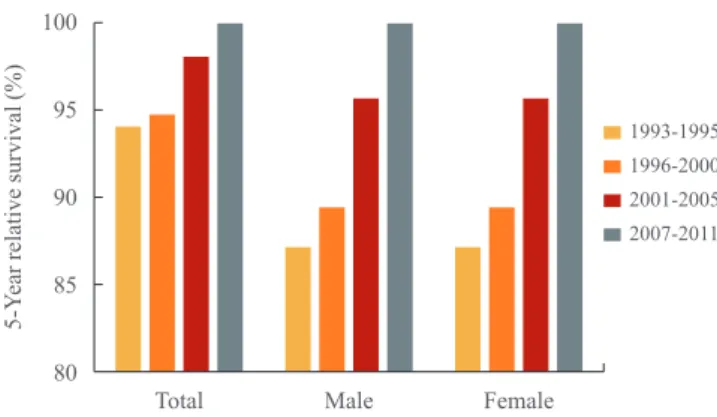
Recently, the National Cancer Center in Korea reported an- nual national cancer statistics in Korea [4,18]. In a recent re- port, 5-year relative survival rates for all cancer sites were shown for four diagnosis periods: 1993 to 1995, 1996 to 2000, 2001 to 2005, and 2007 to 2011 [4]. The 5-year relative surviv- al rate for thyroid cancer increased between 1993 and 2011 (from 94.2% to 94.9%, 98.3%, and 100.0%), as shown in Fig.
Table 1. Population Data and Number of Deaths from Thyroid Cancer in 1985 to 2010 in Korea according to Sex and Age Variable198519901995 Population, personDa
Male, person
Da
Female, person DaPopulation, personDa
Male, person
Da
Female, person DaPopulation, personDa
Male, person
Da
Female, person
Da
Total age, yr
40,419,6524520,227,5641220,192,0883343,390,3747221,770,9191921,619,4555344,553,71015622,357,3524522,196,358111 0–43,702,55501,922,75801,779,79703,279,79001,726,86301,552,92703,427,40901,821,35001,606,0590 5–93,916,35002,025,35301,890,99703,862,50801,999,00101,863,50703,096,11501,626,92201,469,1930 10–144,475,98502,310,57002,165,41503,991,91702,054,49401,937,42303,711,98001,913,80101,798,1790 15–194,316,26412,227,32202,088,94214,448,99602,267,12902,181,86703,863,49101,987,04401,876,4470 20–244,245,09002,185,72002,059,37004,396,30902,294,29002,102,01904,304,37802,237,94002,066,4380 25–294,070,40812,027,18502,043,22314,333,50002,160,91202,172,58804,137,91302,078,41702,059,4960 30–343,115,23811,589,61011,525,62804,207,71412,142,82502,064,88914,230,23902,146,35102,083,8880 35–392,581,18101,324,36901,256,81203,201,21001,648,20501,553,00504,133,86432,103,01612,030,8482 40–442,187,50811,108,68501,078,82312,539,26911,315,18201,224,08713,071,10181,579,85041,491,2514 45–492,089,21221,042,98901,046,22322,176,89061,100,96621,075,92442,464,29521,261,50921,202,7860 50–541,695,2597809,6194885,64032,010,0184994,51101,015,50742,063,768141,028,88711,034,88113 55–591,267,7578560,5802707,17761,622,85310760,9933861,86071,913,46123923,6257989,83616 60–641,006,8765440,3870566,48951,157,05913494,8454662,21491,495,08222673,7199821,36313 65–69722,8176306,7103416,1073900,31412375,7523524,56291,043,97922420,8739623,10613 70–74501,2549190,5531310,7018595,11611233,3083361,8088762,54429293,6968468,84821 75–79312,0902103,5130208,5772377,17110127,9054249,2666455,67322160,4984295,17518 over 80213,388251,3031162,0851289,638473,6910215,9474378,0091199,6370278,37211 Variable200020052010 Population, personDa
Male, person
Da
Female, person DaPopulation, personDa
Male, person
Da
Female, person DaPopulation, personDa
Male, person
Da
Female, person
Da
Total age, yr
45,985,28926623,068,1817322,917,10819347,041,43432723,465,6508323,575,78424447,990,76135623,840,8969424,149,865262 0–43,130,25801,641,16601,489,09202,382,35001,237,30101,145,04902,219,08401,142,22001,076,8640 5–93,444,05601,831,44601,612,61003,168,88701,654,22801,514,65902,394,66301,243,29401,151,3690 10–143,064,44201,615,01301,449,42903,434,89101,816,31801,618,57303,173,22601,654,96401,518,2620 15–193,691,58411,913,88501,777,69913,100,52301,626,37801,474,14503,438,41401,826,17901,612,2350 20–243,848,18602,028,20601,819,98003,662,12301,915,90201,746,22103,055,42001,625,37101,430,0490 25–294,096,97822,057,32112,039,65713,671,84731,858,33201,813,51533,538,94901,802,80501,736,1440 30–344,093,22812,068,20202,025,02614,096,28212,059,91302,036,36913,695,34811,866,39711,828,9510 35–394,186,95312,117,49212,069,46104,112,78562,065,66812,047,11754,099,14712,060,23312,038,9140 40–443,996,33642,029,41331,966,92314,123,04142,082,42712,040,61434,131,42322,071,43122,059,9920 45–492,952,02371,496,10441,455,91933,900,899161,961,85931,939,040134,073,35852,044,64122,028,7173 50–542,350,250131,185,23961,165,01172,855,297171,426,59771,428,700103,798,131171,887,973111,910,1586 55–591,968,47225959,680111,008,792142,278,438181,126,99791,151,44192,766,695241,360,74791,405,94815 60–641,788,84929836,46516952,384131,888,85331897,38412991,469192,182,236171,057,03551,125,20112 65–691,376,12240593,9748782,148321,680,06743755,94912924,118311,812,16848833,24215978,92633 70–74918,12153348,2268569,895451,252,73464514,24115738,493491,566,01454672,89415893,12039 75–79600,59850211,34711389,25139766,87056270,63212496,238441,084,36777410,72615673,64162 over 80476,96540133,8504343,11536665,54768195,52411470,02357962,118110280,74418681,37492 aDeath, person.
2 [4]. Survival rates improved in both males and females (from 87.2% to 89.5%, 95.8%, and 100.1% in males and from 95.4%
to 95.9%, 98.7%, and 99.9% in females). These findings for thyroid cancer reflect our ASMR analysis for 1985 to 2010.
The reasons for the decrease in ASMR in Korea after 2000 are unclear. The incidence of thyroid cancer in Korea increased rapidly during recent decades. According to Han et al. [19], the
thyroid cancer screening rate in Korea in 2009 was 13.2%
(8.4% of men and 16.4% of women). In addition, the use of high- resolution ultrasonography may have contributed to the early detection of asymptomatic small thyroid nodules [20]. As a re- sult, the size distribution of detected thyroid cancers has shifted toward smaller lesions [9,21]. The increasing number of surgi- cally treated cases of thyroid cancer is predominantly due to an Fig. 1. Crude and age-standardized thyroid cancer mortality rates in 1985 to 2010 in Korea for both sexes. (A) Crude thyroid cancer mortality rates. (B) Age-standardized (by Korean resident registration population in 2005) thyroid cancer mortality rates. (C) Age-stan- dardized (by the World Health Organization [WHO] population) thyroid cancer mortality rates. (D) Age-standardized (by the Interna- tional Cancer Survival Standard [ICSS] population) thyroid cancer mortality rates.
1.2 1.0 0.8 0.6 0.4 0.2 0.0
1.2 1.0 0.8 0.6 0.4 0.2 0.0
1.5
1.0
0.5
0.0
3
2
1
0
Crude mortality rate (/100,000)Age-standardized (WHO) mortality rate (/100,000) Age-standardized (Kor) mortality rate (/100,000)Age-standardized (ICSS) mortality rate (/100,000)
1985 1990 1995 2000 2005 2010
1985 1990 1995 2000 2005 2010
1985 1990 1995 2000 2005 2010
1985 1990 1995 2000 2005 2010 Total
Total
Total
Total Male
Male
Male
Male Female
Female
Female
Female A
C
B
D Table 2. Crude and Age-Standardized Thyroid Cancer Mortality Rates in 1985 to 2010 in Korea for Both Sexes
Variable
Crude mortality rate (per 100,000)
Age-standardized mortality rate (per 100,000)
By Korean population By WHO population By ICSS population
Total Male Female Total Male Female Total Male Female Total Male Female
1985 0.11 0.06 0.16 0.19 0.11 0.26 0.17 0.12 0.22 0.53 0.37 0.66
1990 0.17 0.09 0.25 0.26 0.15 0.37 0.24 0.16 0.30 0.83 0.57 0.99
1995 0.35 0.20 0.50 0.47 0.28 0.65 0.44 0.28 0.54 1.49 0.93 1.82
2000 0.58 0.32 0.84 0.67 0.36 0.97 0.65 0.40 0.78 2.40 1.34 2.96
2005 0.70 0.35 1.03 0.66 0.33 0.99 0.64 0.39 0.80 2.33 1.43 2.87
2010 0.74 0.39 1.08 0.55 0.29 0.82 0.55 0.36 0.66 2.12 1.29 2.61
WHO, World Health Organization; ICSS, International Cancer Survival Standard.
increase in tumors measuring 1 cm or less [22]. Therefore, in- creased screening of thyroid cancer using neck ultrasonogra- phy and treatment during the early stages could be reasons for the recent decrease in thyroid cancer mortality. The standard- ization of treatment for thyroid cancer could be another reason for these changes. However, at present the exact cause of these changes is not clear.
This study has an important limitation: the method used by Statistics Korea to collect data on the cause of death was changed in 1999. Since 1999, the cause of death has been supplemented by external data. It is possible that this change influenced the mortality trend until 2000. However, there has been no change in the data collection method since 1999. The ASMR for thy- roid cancer decreased between 2000 and 2010.
In summary, the ASMR for thyroid cancer in Korea in- creased until 2000 and then decreased slightly between 2000 and 2010 in both sexes.
CONFLICTS OF INTEREST
No potential conflict of interest relevant to this article was re- ported.
ACKNOWLEDGMENTS
This study was supported by research funding from the Thy- roid Division of the Korean Endocrine Society. We would like to thank professional statistician Dr. Seunghee Baek of Clinical Epidemiology and Biostatistics, Asan Medical Center, Univer- sity of Ulsan College of Medicine, Seoul, Korea.
100
95
90
85
80
1993-1995 1996-2000 2001-2005 2007-2011
5-Year relative survival (%)
Total Male Female
Fig. 2. Trends in 5-year relative survival rates (%) for thyroid can- cer in Korea by the year of diagnosis (1993 to 2011). Five-year relative survival rates are shown for four diagnosis periods: 1993 to 1995, 1996 to 2000, 2001 to 2005, and 2007 to 2011. Adapted from Jung et al. Cancer Res Treat 2014;46:109-23 [4].
REFERENCES
1. Kweon SS, Shin MH, Chung IJ, Kim YJ, Choi JS. Thyroid cancer is the most common cancer in women, based on the data from population-based cancer registries, South Korea.
Jpn J Clin Oncol 2013;43:1039-46.
2. Ferlay J, Shin HR, Bray F, Forman D, Mathers C, Parkin DM. Estimates of worldwide burden of cancer in 2008:
GLOBOCAN 2008. Int J Cancer 2010;127:2893-917.
3. National Cancer Institute. SEER Cancer Statistics Review, 1975-2011 [Internet]. Bethesda: National Cancer Institute;
2014 [cited 2014 Sep 1]. Available from: http://seer.cancer.
gov/csr/1975_2011/.
4. Jung KW, Won YJ, Kong HJ, Oh CM, Lee DH, Lee JS.
Cancer statistics in Korea: incidence, mortality, survival, and prevalence in 2011. Cancer Res Treat 2014;46:109-23.
5. Li N, Du XL, Reitzel LR, Xu L, Sturgis EM. Impact of en- hanced detection on the increase in thyroid cancer inci- dence in the United States: review of incidence trends by socioeconomic status within the surveillance, epidemiolo- gy, and end results registry, 1980-2008. Thyroid 2013;23:
103-10.
6. Vigneri R, Malandrino P, Vigneri P. The changing epidemi- ology of thyroid cancer: why is incidence increasing? Curr Opin Oncol 2015;27:1-7.
7. Zhu C, Zheng T, Kilfoy BA, Han X, Ma S, Ba Y, Bai Y, Wang R, Zhu Y, Zhang Y. A birth cohort analysis of the in- cidence of papillary thyroid cancer in the United States, 1973-2004. Thyroid 2009;19:1061-6.
8. Brito JP, Davies L. Is there really an increased incidence of thyroid cancer? Curr Opin Endocrinol Diabetes Obes 2014;
21:405-8.
9. Davies L, Welch HG. Current thyroid cancer trends in the United States. JAMA Otolaryngol Head Neck Surg 2014;
140:317-22.
10. Statistics Korea. Cause of death statistics 2012 [Internet].
Daejeon: Statistics Korea; c1996 [cited 2014 Sep 1]. Avail- able from: http://kostat.go.kr.
11. Statistics Korea. Resident registration population of 2005 [Internet]. Daejeon: Statistics Korea; c1996 [cited 2014 Sep 1]. Available from: http://kosis.kr/ups/ups_01List01.
jsp?grp_no=1002&pubcode=AW&type=.
12. National Cancer Institute. Surveillance Epidemiology and End Results Program, World (WHO 2000-2025) Standard [Internet]. Bethesda: National Cancer Institute; 2013 [cited 2014 Sep 1]. Available from: http://seer.cancer.gov/stdpop-
ulations/world.who.html
13. National Cancer Institute. Surveillance Epidemiology and End Results Program, Age standards for survival [Inter- net]. Bethesda: National Cancer Institute; 2014 [cited 2014 Sep 1]. Available from: http://seer.cancer.gov/stdpopula- tions/survival.html.
14. Corazziari I, Quinn M, Capocaccia R. Standard cancer pa- tient population for age standardising survival ratios. Eur J Cancer 2004;40:2307-16.
15. La Vecchia C, Malvezzi M, Bosetti C, Garavello W, Ber- tuccio P, Levi F, Negri E. Thyroid cancer mortality and in- cidence: A global overview. Int J Cancer. Epub 2014 Oct 4.
DOI: http://dx.doi.org/10.1002/ijc.29251.
16. National Cancer Institute. SEER Cancer Statistics Review, 1975-2010 [Internet]. Bethesda: National Cancer Institute;
2013 [cited 2014 Sep 1]. Available from: http://seer.cancer.
gov/archive/csr/1975_2010.
17. Rahib L, Smith BD, Aizenberg R, Rosenzweig AB, Flesh- man JM, Matrisian LM. Projecting cancer incidence and deaths to 2030: the unexpected burden of thyroid, liver, and pancreas cancers in the United States. Cancer Res 2014;74:
2913-21.
18. Jung KW, Won YJ, Kong HJ, Oh CM, Seo HG, Lee JS.
Cancer statistics in Korea: incidence, mortality, survival and prevalence in 2010. Cancer Res Treat 2013;45:1-14.
19. Han MA, Choi KS, Lee HY, Kim Y, Jun JK, Park EC. Cur- rent status of thyroid cancer screening in Korea: results from a nationwide interview survey. Asian Pac J Cancer Prev 2011;12:1657-63.
20. Kang HW, No JH, Chung JH, Min YK, Lee MS, Lee MK, Yang JH, Kim KW. Prevalence, clinical and ultrasonograph- ic characteristics of thyroid incidentalomas. Thyroid 2004;
14:29-33.
21. Cho BY, Choi HS, Park YJ, Lim JA, Ahn HY, Lee EK, Kim KW, Yi KH, Chung JK, Youn YK, Cho NH, Park do J, Koh CS. Changes in the clinicopathological characteristics and outcomes of thyroid cancer in Korea over the past four decades. Thyroid 2013;23:797-804.
22. Lee SH, Kim TY, Ryu JS, Gong G, Kim WB, Kim SC, Hong SJ, Shong YK. Trends analysis of characteristics of thyroid cancer patients in one medical center. J Korean En- docr Soc 2008;23:35-43.