Blood Res2013;48:292-303. bloodresearch.or.kr
296 Letters to the Editor
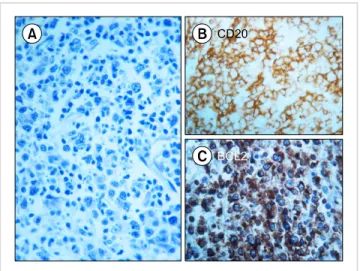
Fig. 1. (A) Bone marrow biopsy (Giemsa stain, high magnification) showing a neoplastic infiltrate composed predominantly of blastic cells with centroblastic morphology, with minor components composed of small centrocyte-like cells. These findings are indicative of diffuse large B-cell lymphoma with features suggestive of a centrofollicular origin.
(B) Immunostaining with CD20L26 antibodies reveals diffuse membrane expression in neoplastic cells. (C) Immunostaining with BCL2 reveals diffuse cytoplasmatic expression by neoplastic cells.
Primary diffuse large B-cell lym- phoma of the bone marrow in a frail and elderly patient success- fully treated with rituximab, cy- clophosphamide, doxorubicin, vin- cristine, and prednisone
TO THE EDITOR: The involvement of bone marrow (BM) in aggressive non-Hodgkin lymphomas (NHLs) usually in- dicates systemic dissemination. However, although un- common, extranodal involvement of the BM as an isolated and unique localization of aggressive NHLs [1] such as ana- plastic large cell lymphoma [2] or diffuse large B-cell lym- phoma (DLBCL) [3-6], has also been reported. In particular, primary DLBCL of the BM is a rare type of extranodal lymphoma with poor prognosis [1, 4]. Approximately 10 cases of primary DLBCL of the BM have been described thus far [3], and few of them have been reported in in- dividuals of very advanced age. Here, we report a case of primary DLBCL of the BM that was successfully treated using rituximab, cyclophosphamide, doxorubicin, vincris- tine, and prednisone (R-CHOP chemotherapy; 3-week standard schedule) in a frail 76-year-old woman.
The patient was being treated for pancytopenia and dysp- nea on exertion caused by severe macrocytic anemia, which required multiple red blood cells (RBC) transfusions. Her Eastern Cooperative Oncology Group performance status was 2. In terms of comorbidities, she presented with a long-standing history of hypertension, reduced renal func- tion (creatinine clearance as estimated by the Cockroft-Gault formula was 60 mL/minㆍ1.73 m2), and chronic cere- brovascular disease with slight cognitive and neurological impairment. Her antihypertensive medication consisted of a combination of enalapril and amlodipine. At admission, the patient presented with severe malaise and fatigue.
Physical examination revealed pallor and tachycardia, but neither lymphadenopathy nor hepatosplenomegaly was observed. Morphological examination of peripheral blood smears showed marked thrombocytopenia with prominent erythrocyte and platelet anisopoikilocytosis; however, no other abnormalities were detected. Although rare circulat- ing neutrophils were present, no immature or atypical cells were observed.
Myelodysplastic syndrome (MDS) was suspected, and a comprehensive work-up was performed. BM aspiration re- vealed a dry tap; examination of the BM specimen by tre- phine biopsy showed involvement of large abnormal lym- phoid cells (Fig. 1) and fibrosis. A standard radiological work-up found no other suspected disease localizations.
18F-fluorodeoxyglucose positron emission tomography (PET)
[7] revealed disseminated BM with diffuse uptake with no evidence of disease involvement of other sites. The patient was diagnosed with primary DLBCL. A comprehensive labo- ratory evaluation showed high levels of lactate dehydrogen- ase but no other remarkable abnormalities. The age-adjusted International Prognostic Index was 3 (high risk).
Although the prognosis of this type of NHL is poor and requires an aggressive approach, including high-dose che- motherapy with autologous stem cell transplantation (ASCT), which would normally be indicated [1, 3, 4, 8], the patient was considered unsuitable for an intensive ther- apeutic program. Therefore, standard treatment with R-CHOP and prophylactic granulocyte-colony stimulating factor treatment were given. The patient received six R-CHOP courses with no significant toxicity, although she required RBC and platelet transfusions until the commence- ment of the third course, the latter administered with pro- phylactic intent given her extremely low platelet count.
After the second R-CHOP cycle, the peripheral blood count improved significantly, and the patient achieved transfusion independence with regard to both RBC units and platelet concentrates.
At the time of completion of the planned program (six R-CHOP courses), BM revaluation by trephine biopsy showed no remnant lymphoma cells. Results of the PET scan were normal. Complete remission (CR) of DLBCL was therefore demonstrated, and two additional courses of R-CHOP were administered as consolidation therapy.
Twenty-four months since the end of the patient’s course of immunochemotherapy, she is well with no sign of disease, as demonstrated by recent clinical reevaluations, including
bloodresearch.or.kr Blood Res 2013;48:292-303.
Letters to the Editor 297
a whole-body PET scan and BM trephine biopsy.
In conclusion, we describe a case of an elderly and frail patient with primary DLBCL of the BM that was discovered during work-up for pancytopenia, which was initially sus- pected to be caused by MDS; the patient achieved long-last- ing CR that was maintained for 20 months following the completion of eight courses of R-CHOP. Primary DLBCL of the BM is a rare but distinctive form of extranodal NHL with a poor prognosis and a reported 2-year survival rate of approximately 30% and median survival time of 14.9 months [4]. Given its rarity, no standard therapy for primary DLBCL of the BM has been established. However, as R-CHOP has become the standard treatment for DLBCL in elderly patients, this case suggests that, similar to other types of DLBCL, this regimen can be a well-tolerated, front- line treatment with an efficacy to allow durable CR, even in DLBCL cases with poor prognosis such as ours.
The follow-up period for this patient was too short to draw any firm conclusions; however, compared with the usually dismal outcome of this type of NHL, the 24-month continuous clinical response observed in this case would be considered a satisfactory therapeutic result. In this con- text, R-CHOP can be considered a reasonable approach in cases where advanced age, toxicity concerns, and comorbid- ities may detract from the pursuit of more aggressive treat- ments such as high-dose chemotherapy and ASCT.
Pasquale Niscola1, Massimiliano Palombi1, Stefano Fratoni2, Alessio Perrotti1, Paolo de Fabritiis1
1Hematology Division, 2Department of Pathology, S. Eugenio Hospital, Rome, Italy Correspondence to: Pasquale Niscola Hematology Division, S. Eugenio Hospital, Piazzale dell’Umanesimo 10, 00144, Rome, Italy
E-mail: [email protected]
Received on Jul. 27, 2013; Revised on Aug. 1, 2013; Accepted on Nov. 21, 2013 http://dx.doi.org/10.5045/br.2013.48.4.296
AuthorsÊ Disclosures of Potential Conflicts of Interest No potential conflicts of interest relevant to this article were reported.
REFERENCES
1. Martinez A, Ponzoni M, Agostinelli C, et al. Primary bone mar- row lymphoma: an uncommon extranodal presentation of ag- gressive non-hodgkin lymphomas. Am J Surg Pathol 2012;36:
296-304.
2. Gudgin E, Rashbass J, Pulford KJ, Erber WN. Primary and isolated anaplastic large cell lymphoma of the bone marrow. Leuk Lymphoma 2005;46:461-3.
3. Chang H, Hung YS, Lin TL, et al. Primary bone marrow diffuse large B cell lymphoma: a case series and review. Ann Hematol 2011;90:791-6.
4. Strauchen JA. Primary bone marrow B-cell lymphoma: report of
four cases. Mt Sinai J Med 2003;70:133-8.
5. Kajiura D, Yamashita Y, Mori N. Diffuse large B-cell lymphoma initially manifesting in the bone marrow. Am J Clin Pathol 2007;127:762-9.
6. Hishizawa M, Okamoto K, Chonabayashi K, Kaneko H, Watanabe M, Tsudo M. Primary large B-cell lymphoma of the bone marrow. Br J Haematol 2007;136:351.
7. Matthies A, Schuster SJ, Alavi A. Staging and monitoring re- sponse to treatment in primary non-Hodgkin's lymphoma of bone marrow using (18)F-fluorodeoxyglucose positron emission tomography. Clin Lymphoma 2001;1:303-6.
8. Kazama H, Teramura M, Yoshinaga K, Masuda A, Motoji T.
Long-term remission of primary bone marrow diffuse large B-cell lymphoma treated with high-dose chemotherapy rescued by in vivo rituximab-purged autologous stem cells. Case Rep Med 2012;2012:957063.
Late but effective long-term re- sponse to splenectomy in the treatment of immune thrombo- cytopenia
TO THE EDITOR: Splenectomy is the preferred treatment for steroid-refractory immune thrombocytopenia (ITP) [1].
The initial response to splenectomy is rapid and charac- terized, in most cases, by immediate thrombocytosis; this finding is considered a favorable predictive factor for long-term response to splenectomy in ITP patients [2, 3].
If platelet count does not increase after splenectomy, it may indicate failure of the procedure and lead providers to consider other salvage treatments.
We report a case of a late response to splenectomy in a patient who was diagnosed with ITP at another center in 1991 at the age of 23 years. At primary diagnosis, a comprehensive work-up for underlying disorders was un- remarkable, except for slight positivity for antinuclear anti- bodies (ANA). The patient was initially prescribed pre- dnisone at a dosage of 1 mg/kg body weight/day; after ap- proximately 1 year, the dosage was appropriately tapered and administration of the steroid was eventually stopped.
However, shortly thereafter, the patient experienced a re- lapse of ITP. She refused splenectomy; therefore, prednisone was restarted and continued at the lowest effective dosage (25–30 mg/day) that allowed stable maintenance of a platelet count >30×109/L until 2006. During this time, she was followed up at different hematologic centers. In 2006, the patient was reevaluated because of unresponsiveness to pre- dnisone and was found to have heterozygous factor V Leiden mutation, with no other abnormalities. She refused splenec-