499 https://doi.org/10.9713/kcer.2020.58.4.499
PISSN 0304-128X, EISSN 2233-9558
총 설
Electrochemical Biosensors based on Nanocomposites of Carbon-based Dots
Yen-Linh Thi Ngo†, Jayasmita Jana, Jin Suk Chung and Seung Hyun Hur† School of Chemical Engineering, University of Ulsan, Daehak-ro 93, Nam-gu, Ulsan 44610, Korea
(Received 17 April 2020; Received in revised from 17 July 2020; Accepted 3 August 2020)
Abstract − Among the many studies of carbon-based nanomaterials, carbon-based dots (CDs) have attracted considerable interest owing to their large surface area, intrinsic low-toxicity, excellent biocompatibility, high solubility, and low-cost with environmentally friendly routes, as well as their ability for modification with other nanomaterials. CDs have several applications in biosensing, photocatalysis, bioimaging, and nanomedicine. In addition, the fascinating electrochemical properties of CDs, including high active surface area, excellent electrical conductivity, electrocatalytic activity, high porosity, and adsorption capability, make them potential candidates for electrochemical sensing materials. This paper reviews the recent developments and synthesis of CDs and their composites for the proposed electrochemical sensing platforms. The electrochemical principles and future perspective and challenges of electrochemical biosensors are also discussed based on CDs-nanocomposites.
Key words: Carbon dots, Graphene quantum dots, Nanocomposite, Electrochemical, Biosensor
1. Introduction
The increasing demand for accurate and precise molecular detection has led to considerable research efforts to enhance the analytical efficiency in terms of cost, portability, and direct analysis in complex biological compounds. Electrochemical sensing systems have excellent capability of determining a wide range of compounds ranging from organic, biological species, and ionic molecules to metal ions with outstanding properties, such as rapid response, high sensitivity, excellent selectivity, simplicity, and low cost [1,2].
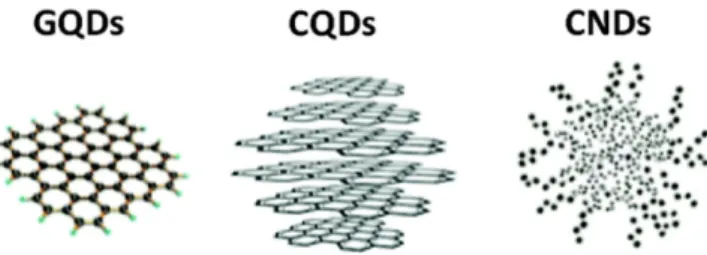
Carbon is a versatile element that has aroused intense interest because of its ability to form several different hybridization states (sp, sp2, and sp3), making it capable of forming a wide range of allotropes from the hardest to softest materials [3]. Tremendous efforts have focused on carbon nanostructures from theory to practice for development in a range of application fields. Among them, well-defined carbon-based dots (CDs) are family members of zero-dimensional (0D) carbon nanostructures that have attracted considerable interest as electrochemical biosensors because of their great characteristics derived from both carbon and graphene [4]. Carbon-based dots can be categorized into GQDs, CQDs (carbon quantum dots), and CNDs (carbon nanodots) based on the crystalline structure and arrangement of carbon [5], as shown in Fig. 1. CQDs and CNDs can be synthesized from a range of carbon precursors except for graphene; thus, they are referred to as carbon dots (CDs) in this review. CDs consist of carbon, nitrogen, oxygen, and hydrogen, and the morphologies are
mostly quasi-spherical with a diameter less than 10 nm; the structure can be amorphous or graphitic [6,7]. GQDs can be imaged as fragments of nano-sized monolayer graphene, containing functional groups, such as carboxyl, epoxide, carbonyl, or hydroxyl groups, as reaction sites [5]. Thus, they have been utilized widely for the modification of electrode materials owing to their small size, low intrinsic toxicity, good biocompatibility, large surface area, excellent chemical stability, low cost and ease of fabrication within a wide range of synthesis processes and precursors. Although both types of CDs and GQDs exhibit interesting characteristics, GQDs have more applications in electrochemical sensing than CDs because of their intrinsic electrochemical activity, greater electrical conductivity, facilitated electron transfer, and easier implantation on the surface with receptors, owing to the π-π stacking interaction of each atomic plane [4].
Although the sensing applications based on CDs and GQDs focused mainly on bioimaging and optical sensing [8] owing to their excellent photoluminescence properties, carbon-based nanomaterials have also been used as electrode modifiers for electrochemical biosensors using pristine CDs/GQDs or functionalized/composites with carbon- based nanomaterials for the detection of various analyte species.
Therefore, unlike the common carbon-based nanomaterials, CDs
†To whom correspondence should be addressed.
E-mail: [email protected], [email protected]
This is an Open-Access article distributed under the terms of the Creative Com- mons Attribution Non-Commercial License (http://creativecommons.org/licenses/by- nc/3.0) which permits unrestricted non-commercial use, distribution, and reproduc- tion in any medium, provided the original work is properly cited.
Fig. 1. Classification of carbon-based dots. Reproduced with per- mission from ref. [5], copyright 2016, The Royal Society of Chemistry.
and GQDs have attracted great interest in the development of modified electrode due to high electrocatalytic activity, large surface area, high stability, rapid response, and versatile quantification techniques. In addition, CDs and GQDs exhibit a high conductivity owing to π-π stacking interaction between below and above the atomic planes.
Compared to graphene or other inorganic QDs, they have more surface-active sites and more accessible edges with various functional groups, which results in an excellent dispersion in various solvents.
Besides, with the quantum confinement and edge effect, CDs and GQDs show high-speed electron transport and excellent conductivity, which makes them a relevant transducer material to enhance or control the electron in electrochemical sensors.
This review focuses primarily on electrochemical biosensors utilizing CDs or GQDs as the key components in electrochemical affinity biosensing platforms. First, the structural properties and fabrication methods of CDs and GQDs are summarized. A determination of various analytes using electrochemical biosensors based on CDs or GQDs is then discussed. Finally, the future trends, as well as the challenges to take full advantage of these properties in electrochemical sensing in recent years, are outlined.
2. Carbon-Based Dots: Fabrication and Properties
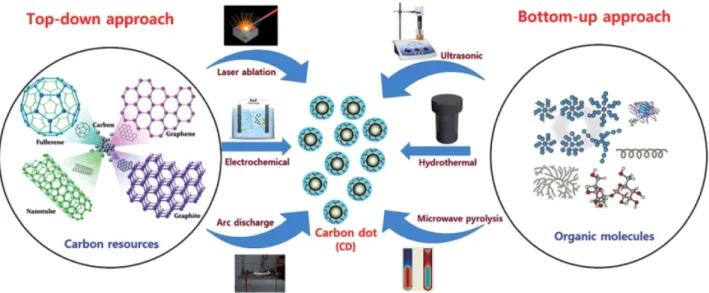
Carbon-based dots were discovered in 2004 by Xu et al. during SWCNTs purification and are composed mainly of carbon [9]. The synthesis routes for the fabrication of CDs and GQDs can be classified into two families as “top-down” and “bottom-up” methods (Fig. 2).
Top-down approaches involve the breaking down of large carbon materials, such as graphite, graphene, activated carbon, or carbon nanotubes (CNTs) [6,10], to nano-sized particles using chemical or physical processes (e.g., hydrothermal [11], electrochemical oxidation [12], acidic oxidation [13], ultrasonication treatment [14], microwave radiation [15], and chemical exfoliation [16]). In contrast, bottom-up
methods refer to the synthesis of nanodots from different molecular precursors, such as citrate, carbohydrates, and special organic molecules by carbonization [17], hydrothermal [18,19], or microwave-assisted hydrothermal methods [20]. In addition to “pure” CDs or GQDs, the structure of CDs or GQDs can be modified with other molecular precursors by doping with nitrogen, boron, sulfur, or other heteroatoms [6,21]. More details of both methods are reported elsewhere [3,10,22].
The abundant supply of raw materials, the obtained structure resembling the precursor structure, and the existence of hydrophilic oxygenated groups are advantages of top-down methods for preparing CDs and GQDs. However, top-down synthesis methods still have some drawbacks, such as the use of expensive and special equipment, low yield, and non-selectivity during the cutting process, leading to difficulty in controlling the size distribution of the products [23]. In contrast, bottom-up approaches for the fabrication of CDs and GQDs can be controlled with a well-defined structure, product size with facile processing. Moreover, they also provide a more uniform chemical composition, fewer defects on the structure, and higher yields compared to top-down methods, even after doping with other atoms [10].
CDs are promising candidates for numerous applications, including photocatalysts [24], solar cells [25], energy conversion and storage [26], bioimaging [27], biosensing [28,29], and drug delivery [30], owing to their unique properties, simplicity of synthesis with a wide range of raw materials, and potential functionalization with organic, polymeric, inorganic, or biological species. In contrast, GQDs are graphene sheets with sizes below 100 nm, which have more active sites on the surface, larger specific surface area, and more accessible edges than graphene [31]. With the many functional groups (carbonyl, carboxyl, hydroxyl, amino, etc.) at their edges, GQDs have excellent solubility and ability to functionalize with other substances. GQDs also have high rate electron transport and excellent conductivity owing to the quantum confinement and edge effects that help enhance electron transfer, making them a promising
Fig. 2. Schematic diagram of the top-down and bottom-up approaches for synthesizing CDs and GQDs. Reproduced with permission from ref. [22], copyright 2017, The Royal Society of Chemistry.
material for the development of electrochemical (bio)sensors [32].
In addition, the process of doping the structure of CDs or GQDs with heteroatoms is effective for improving the electrocatalytic properties, electrical conductivity, and chemical stability. Therefore, in the last few years, CDs and GQDs have been employed as relevant nanomaterials for electrochemical applications. The next section discusses the detection of various analytes based on bare CDs or GQDs or composite/
functionalized CDs/GQDs.
3. Electrochemical Sensing
In this mini-review, electrochemical sensors based on CDs and GQDs were developed using four different strategies: (i) sensors consisting simply of “pure” CDs doped with other atoms; and sensors based on nanocomposite fabricated by (ii) functionalizing CDs/
GQDs with organic molecules, (iii) hybrid CDs/GQDs with metal/
metal oxides, and (iv) coupling CDs/GQDs with organic molecules and metal/metal oxide.
3-1. Based on heteroatoms doped - CDs or GQDs
Chemical doping of CDs is an effective method and has been demonstrated in previous studies [33,34]. The enhancement of the electronic and electrocatalytic activity of CDs has been attributed to the increasing density of free charge carriers. Therefore, these materials are used more in electrochemical biosensing as electrode
modifiers.
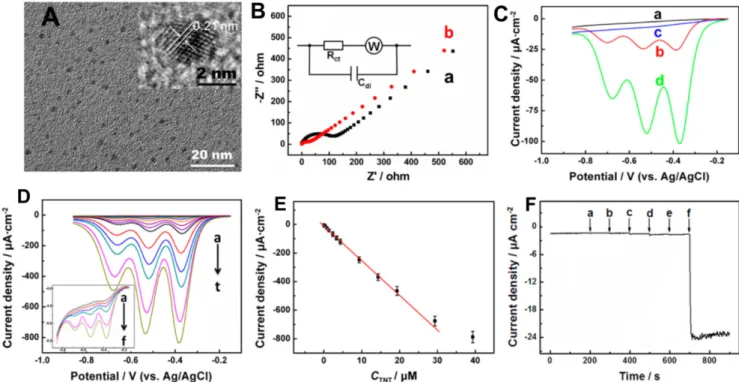
In 2015, Zhang et al. fabricated nitrogen-doped CDs (NCDs) by a microwave-assisted pyrolysis method for the electrochemical detection of 2,4,6-trinitrotoluene (TNT) in environmental contaminants [35]. GCE modified with NCDs exhibited a fine capability to reduce TNT with a linear range from 5 nM to 30 μM and limit of detection (LOD) of 1 nM. The measurements revealed a minimum distinguishable response concentration compared to other methods, as well as high specificity owing to the high intrinsic activity and large surface area of NCDs, and the added effects of amino functionalization.
Jiang et al. [36] also proposed a novel strategy for the high-yield synthesis of NCDs by a microwave irradiation method within 10 min using diethanolamine (DEA) as both a carbon and nitrogen source without a solvent or catalyst. The obtained NCDs could attract the electroactive dopamine (DA) compound through functional groups on the surface, which exhibited high sensitivity, excellent selectivity, good stability, and reproducibility for the direct and rapid detection of DA in human serum and urine samples. The detection of DA was by differential pulse voltammetry (DPV) with the obtained linear range of 5 × 10⁻⁸ to 8 × 10⁻⁶ M and a detection limit as low as 1.2 × 10⁻⁹ M (Fig. 3).
Fu et al. [37] reported a low-temperature method to synthesize NCDs on a glassy carbon electrode (GCE) surface using a direct dipping process for electrochemical reaction. The NCDs/GCE was used to detect hydrogen peroxide (H2O2) and paracetamol (PA) in
Fig. 3. (A) TEM image of CDs. (B) Electrochemical impedance spectroscopy (EIS) obtained at (a) bare GC electrode and (b) CDs/GC elec- trode. (C) DPVs obtained at the bare GC electrode (a, b) and CDs/GC electrode (c, d) in the absence (a, c) and presence (b, d) of 5 μM TNT in 0.1 M N2-saturated PBS (containing 0.2 M KCl), pH 7.0. (D) DPVs responding to various concentrations of TNT at the CDs/
GC electrode with the magnified low concentration region in the inset (a-t: from 0 to 39.33 μM). (E) Plot of the linear relationship between the peak currents at -0.37 V and TNT concentrations. (F) Chronoamperometric response obtained at the CDs/GC electrode to the successive injection of 5 μM (a) NB, (b) 2-NT, (c) 4-NT, (d) 2,4-DNT, (e) 2,6-DNT, and (f) TNT at a constant potential of -0.37 V.
Reproduced with permission from ref. [35], copyright 2015, American Chemical Society.
pharmaceutical sensing in clinical fields. The enhanced electrocatalytic activity for PA oxidation and H2O2 reduction can be attributed to their surface functional groups and N-doping-induced charge delocalization.
Cyclic voltammetry (CV) curves of NCDs/GCE for determination PA and H2O2 showed linear detection ranges from 0.5 to 600 μM and 0.05 μM to 2.25 mM and a LOD of 140 nM and 33 nM, respectively.
The sensing performance of the NCDs/GCE exhibited excellent stability, reproducibility, and selectivity and was applied successfully to real samples.
In addition to one heteroatom-doped CDs structures, Liu et al.
[38] recently co-doped CDs with dual heteroatoms - nitrogen (N) and fluorine (F) using a hydrothermal carbonization method. By doping with dual heteroatoms, the CDs showed improved biocompatibility and exhibited electron – donating/accepting potential. The as-synthesized F,N-CDs can form a complex with laccase, referred to as Lac-F,N- CDs. The Lac-F,N-CDs/GCE electrochemical sensor towards catechol exhibited remarkable stability, high selectivity, rapid response, and LOD of 0.014 μM as well as a high sensitivity compared to other methods. More significantly, electrochemical sensors based on Lac-F,N-CDs have long cycling stability as well as a high sensitivity in detecting catechol by chronoamperometry. Thus, it has potential
applications for detecting catechol in tap water, lake water, seafood, and compost bioremediation.
3-2. Based on CDs/GQDs hybrid with organic molecules or biopolymers
To improve the electrocatalytic activity of carbon-based nanomaterials, an effective method was to introduce heteroatoms and defective sites onto the carbon frameworks to increase the number of catalytic sites [39,40]. On the other hand, the resulting CDs have lower electron transport efficiency because of the oxygen-rich functional groups, abundant grain boundaries, and defects. Therefore, combining both high electrical conductivity and electrocatalytic activity is essential for the development of electrochemical sensors.
Hu et al. [41] evaluated the ability of CDs/rGO composites to detect dopamine (DA) with high sensitivity and excellent stability. Based on the electrostatic interactions between the carboxyl groups of CDs and amine groups of DA, and the π-π stacking interactions between the phenyl moiety of DA and π-conjugation of rGO, the CDs/rGO- modified electrode not only provided a good environment for DA oxidation but also enhanced the selectivity of DA from interfering in DA detection. Under optimized conditions, the DPV oxidation
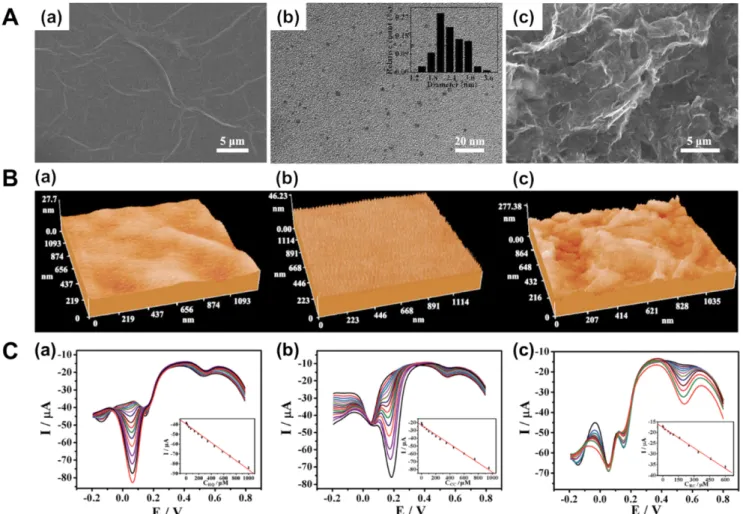
Fig. 4. (A) SEM images of (a) GO and (c) CD/rGO, TEM images of (b) CDs. Inset: size distribution of CDs. (B) AFM images of (a) GO/GCE, (b) CD/GCE and (c) CD/rGO/GCE. (C) DPVs of different (a) HQ concentrations (from 0 to 1000 µM), (b) CC concentrations (from 0 to 900 µM) (C) RC concentrations (from 0 to 600 µM) at the CDs/rGO/GCE in the presence of two interfering substances (concentra- tion 0.2 µM). Reproduced with permission from ref. [44], copyright 2015, The Royal Society of Chemistry.
peaks showed a good linear range of 0.01 μM – 450 μM with a LOD of 1.5 nM. Moreover, the CDs/rGO based sensor was applied to determine the DA concentration during injection with satisfactory results, and its activity was maintained for at least a month.
In addition to MWCNTs, graphene or reduced graphene oxide (rGO) has been explored in many studies because of their excellent characteristics, such as high electronic conductivity, chemical stability, and large surface area [42]. For example, Bai et al. [43] synthesized a sensing material based on CDs-decorated multi-walled carbon nanotube nanocomposites (CDs/MWCNTs), in which CDs are electrocatalysts as electron donors, and MWCNTs are chosen as the matrix material as electron acceptors owing to their good electrical conductivity and large surface area. The CDs/MWCNTs electrode exhibited enhanced synergistic electrocatalytic activity towards H2O2 detection compared to pure CDs or MWCNTs owing to the effects of the edge plane-like defective sites and lattice oxygen in the nanocomposites. The CDs/MWCNTs-based sensor showed excellent sensing performance with a wide linear range as well as a low detection limit (0.25 μM). Based on the facile fabrication and good electrocatalytic performance, CDs/MWCNTs are potential electrochemical sensing materials for H2O2 in biological and biomedical fields.
Based on the presence of functional groups on CDs and MWCNTs after the treatment process, Wei et al. [45] developed electrochemical sensing materials through electrostatic interactions and fabricated an MWCNTs/CDs/MWCNTs modified electrode, which was used to detect dihydroxybenzene isomers, including hydroquinone (HQ),
catechol (CC), and resorcinol (RS) in polluted water. The electrochemical response of HQ, CC, and RS at the MWCNTs/CDs/MWCNTs electrode was examined using the DPV method. The electrode showed a broad linear range for HQ, CC, and RS of 1.0 to 200.0 mM, 4.0 to 200.0 mM, and 3.0 to 400.0 mM, respectively, and a corresponding LOD for HQ, CC and RS of 0.07 μM, 0.06 μM, and 0.15 μM.
Zhang et al. [44] also reported a novel sensor based on the CDs/
rGO nanocomposite as an electrochemical sensor for determination HQ, CC, and RS; rGO was used as the support matrix combined with CDs (Figs. 4A and B). The electrochemical property was improved via synergetic effects between rGO and CDs, hydrogen bonding, and π-π stacking forces. DPV revealed detection limits for HQ, CC, and RS of 0.17 μM, 0.28 μM, 1.0 μM, respectively (Fig. 4C).
In addition, the above studies exhibited excellent selectivity, reproducibility, practical applicability, and reliability in real water samples.
Compared to CDs, GQDs are excellent candidates to combine with other nanomaterials because of their similar properties to graphene as well as being easily functionalized with oxygen- containing groups. Huang et al. [46] developed an ultrasensitive electrochemical sensor for detecting DA based on the GQDs/
MWCNTs composite. Through the π-π stacking force, the electron transfer of DA is enhanced, which is attributed to the existence of conjugated large π bonds in the composite. As expected, the prepared sensor has excellent selectivity of DA among other interfering species.
The GQDs/MWCNTs-based sensor showed high sensitivity toward
Fig. 5. (A) Schematic diagram of GQDs/MWCNTs-based electrochemical DA sensor. (B): (a) TEM image of GQDs, (b) SEM images of MWCNTs and (c) GQDs/MWCNTs, (d) XRD spectra of MWCNTs and GQDs/MWCNTs. (C): (a) DPVs of DA with different concen- trations (a–i: 0.005, 0.01, 0.1, 0.5, 1.0, 5.0, 10.0, 50.0, and 100.0 μM, respectively); (b) plots of Ipa vs CDA; (c) DPVs of 0.1 mM DA with different times; and (d) reusability of the biosensors. Reproduced with permission from ref. [46], copyright 2020, American Chemical Society.
DA with good linearity in a wide linear range (0.005 – 100μM) with a low detection limit of 0.87 nM. It was also successfully applied for measuring DA in human serum and living PC12 cell with excellent performance. Fig. 5 presents the fabrication steps of GQDs/MWCNTs and some electrochemical results.
L. Li et al. [47] used N-doped carbon nanofiber (NCNFs) as a support to anchor N-doped GQDs (NGQDs) to maintain a large electroactive surface area and improve the conductivity, leading to rapid electron transfer, which enhanced the electrochemical activity for nitrite determination. The NGQDs@NCNFs composite was synthesized by combining electrospinning, carbonization, and hydrothermal methods. The electrochemical sensor based on NGQDs@NCNFs for nitrite analysis exhibited excellent analysis performance, such as a wide linear range (5 – 300 μM and 400 – 3000 μM) and LOD of 3 mM, as well as good recovery, indicating great practical applicability in food and environment.
In addition to the above-mentioned organic molecules, the modified electrodes composed of composites of CDs or GQDs with other biological molecules, such as riboflavin and chitosan, have also been reported [2,48-52]. Riboflavin (6,7-dimethyl-9-(d- 1-ribityl)-isoalloxazine), which is commonly called vitamin B2, is an essential precursor of these coenzymes. The electrochemical behavior of flavins has been investigated [53,54]. In 2014, Roushani et al. [48] designed a novel electrochemical sensor based on a GQDs/
riboflavin (GQDs/RF)-modified electrode to detect persulfate (S2O82-).
In this research, GQDs were dropped on a GCE, and the resulting GQDs/GCE was activated and coated with RF. Facile preparation of the modified electrode, with stability, reproducibility, and excellent electrocatalytic activity toward S2O82− reduction, was reported. An amperometric response toward S2O82− showed a linear range from 1 μM to 1 μM with an estimated detection limit of 0.2 μM and rapid response time of 3 s.
In addition to coenzymes, biopolymers, such as carrageenan, agar, chitosan, and chitin, have attracted considerable attention as an immobilization matrix for enzyme and nanomaterials. In particular, chitosan (CS) is an amino polysaccharide that has been studied as a structural material for designing electrochemistry biosensors by cross-linking with enzymes or other substances because of its outstanding biological properties, excellent membrane-forming ability, nontoxicity, high mechanical strength, low cost, and susceptibility to chemical modifications through the presence of amino and hydroxyl groups on its chains [55,56]. Therefore, Roushani et al.
[49] reported the modification of a GCE with a nanohybrid film containing CS and CDs for the detection of tryptophan (Trp). Because of unique properties, such as good conductivity, large surface area, high stability, simplicity, and efficient catalytic activity, the CDs/
CS nanohybrid film improved the electro-oxidation process towards Trp, leading to enhanced sensitivity of the electrochemical sensor for the detection of Trp. The CDs/CS-based sensor showed a high sensitivity of 4 nA μM−1 as well as a LOD of 90 nM. Yu et al. [50]
evaluated a novel electrochemical sensor for the determination of
2,4-dichlorophenol (2,4-DCP) in environmental samples based on nanocomposites of CDs, CS, and hexadecyltrimethyl ammonium bromide (CTAB) constructed via electrostatic self-assembly between them. In particular, CDs and CTAB were fixed and combined by CS to fabricate the electrode owing to their good water solubility.
The CDs/CTAB/CS nanocomposite-based sensor exhibited excellent electrocatalytic activity with a low detection limit of 0.01 μM toward the 2,4-DCP, which represents a potential candidate for designing low toxicity and environment-friendly electrochemical sensors. Ji et al. [51] developed N-doped CDs (NCDs) from polyacrylamide in a single step and followed by glucose oxidase (GOx) enzyme immobilization on the NCDs-modified electrode with the help of amino groups on CS via amino-carboxyl reactions as a glucose biosensor. The high stability, sensitivity, and excellent reproducibility of the NCDs/CS/GOx-based sensor for glucose determination were attributed to the strong attachment of GOx by amino-carboxyl reactions for enzyme immobilization. The N-induced charge delocalization at N-doped CDs enhances the electrocatalytic activity in the O2 reduction. The detection limit was 0.25 mM, with a linear concentration range from 1 to 12 mM. The electrode can be applied in practical analyses suggesting that NCDs are promising materials for the production of electrochemical biosensors. Mollarasouli et al. [2]
reported a non-enzymatic H2O2 sensor using GQDs functionalized with chitosan (GQDs-CS) with the immobilization of methylene blue (MB) via an amino-hydroxyl reaction as a GCE modifier. The detection limit and two linear concentration ranges of the GQDs/
CS/MB electrode were 0.7 μM, 1 × 10⁻⁶− 2.9 × 10⁻³ M and 2.9 – 11.78 mM, respectively. The synergistic effects between the GQDs, CS, and MB make a non-enzymatic sensor with attractive characteristics, including simple, rapid response, wide linear range, stability, sensitivity, selectivity, and practicality for H2O2 detection food and water samples.
High sensitivity and precise selectivity are two essential factors in the practicality of a sensor. To enhance the selectivity, molecular imprinting technology (MIT), with high specificity, stability, and reusability is favored by researchers. Molecularly imprinted electrochemical sensors (MIECSs) combining MIT and an electrochemical sensor is an efficient approach to the design of electrode materials consisting of complementary identification sites and chemical functionality of the target molecule. Nevertheless, because of the poor conductivity and electrocatalytic activity, the sensitivity of MIECS could be enhanced using conductive nanomaterials.
Recently, a molecularly imprinted polymer (MIP) was used to recognize some particular target analytes with high selectivity.
Zheng et al. [52] reported the development of CS and CDs composite film-modified molecularly imprinted electrochemical sensors (MIECS) for the rapid detection of glucose with high sensitivity. The electrode was modified with a CDs/CS solution to improve the electrochemical behavior, whereas 3-aminobenzeneboronic acid (APBA), as a functional monomer, and glucose, as a template, were used to fabricate a molecularly imprinted polymer (MIP) film to detect glucose by DPV. Under
optimized experimental conditions, the obtained MIECS had two linear ranges, from 0.5 to 40 μM and from 50 to 600 μM, with a LOD of 0.09 μM in electrochemical sensing towards glucose. The MIECS also showed good reproducibility, stability, and excellent selectivity in the presence of interfering species, as well as strong practicability in real samples.
Tan et al. [57] reported an electrochemical sensor based on molecularly imprinted intrinsically conducting polymers, such as polypyrrole (PPy) and GQDs (MIPPy/GQDs), for the determination of bisphenol A (BPA) in water samples. The proposed sensor exhibited high sensitivity, which was attributed to the high electron transfer rate and electrical conductivity of GQDs. In contrast, the high selectivity was attributed to the BPA-imprinted sites in the MIPPy/GQDs composite. Through DPV measurements, a linear relationship with the BPA concentration was obtained in the range from 0.1 to 50 μM and the LOD was 0.04 μM. The as-prepared sensor was applied to the determination BPA in environmental samples with satisfactory recoveries.
3-3. Based on CDs/GQDs with metal/metal oxide nanocomposite Gold nanoparticles (AuNPs) have excellent electrocatalytic activity, and have been used to construct electrochemical sensors
because of their unique properties, such as excellent conductivity, high electrocatalytic ability, and biocompatibility in recent studies [58]. They play an important role in enhancing the electron transfer capacity and increasing the surface area of modified electrodes.
The synergistic effects between the AuNPs and other nanomaterials can provide electro-sensitive and selective systems for the electrochemical detection of a range of analytes. Therefore, Li et al. [59] proposed GQDs/AuNPs as an electrochemical sensing material for the detection of quercetin in biological samples (Fig. 6A). The quantitative detection of quercetin was examined using the DPV method, showing high sensitivity and selectivity, a broad linear range (0.01 – 6 mM) with a detection limit of 2 nM, which was more sensitive and stable than that reported previously (Fig. 6B). No interference effect under the coexistence of biological matrices was observed, highlighting its potential in practical applications (Fig. 6C). On the other hand, Tang et al. [60] also prepared GQDs/AuNPs modified GCE using an electrodeposition method, which showed excellent synergistic electrochemical activity for the oxidation of luteolin in the detection process. GQDs were electrodeposited successfully on Au NP- modified GCE, showing an increasing effective area and efficient interface for luteolin combination. In addition, the resistance of
Fig. 6. (A) Schematic illustration of the fabrication of GQDs/AuNPs/GCE and the electrochemical determination of quercetin. (B) DPVs of different concentrations of quercetin (a–n): 0.01 – 6 μM on the GQDs/AuNPs/GCE in 0.1 M PBS (pH 2.0). Inset: oxidation peak cur- rent with respect to quercetin concentration. (C) The electrochemical behavior of some common flavonoids (1.0 μM) on the GQDs/
AuNPs/GCE in the 0.1 M PBS (pH 2.0). Inset: the structure of the above-mentioned flavonoids. Reproduced with permission from ref.
[59], copyright 2016, Wiley-VCH Verlag GmbH & Co. KGaA, Weinheim.
nanocomposite was smaller than the others, suggesting that electron transfer was faster compared to others. Using the DPV measurements, the calibration curve of GQDs/AuNPs was linear from 1×10⁻⁸ to 1×10⁻⁵ M and the LOD of luteolin was 1 nM. The GQDs/AuNPs were also applicable to real samples by the successful detection of luteolin in peanut hulls. Zhuang et al. [61] fabricated nanohybrids composed of CDs and Au by heating CDs and hydroauric acid under alkaline conditions in the absence of a reducing agent, stabilizing agent, or surfactant. The obtained CDs/Au nanohybrid- modified GCE exhibited outstanding electrocatalysis toward the oxidation of nitrite owing to the synergistic effects between CDs and Au. The sensor-based on a CDs/Au nanohybrid for nitrite was stable, reproducible, and sensitive with a LOD of 0.06 μM.
Similar to Au, different metal nanoparticles (NPs)/nanowires (NWs), such as Pt, Ni, and PtAu, AuAg bimetallic, have been used widely to enhance the electrocatalytic activity of sensors [62-65].
Rao et al. presented one such example in 2018. In their experiment, MIECS based on a GCE modified with GQDs coated on hollow Ni nanospheres (hNiNS) was applied successfully to the determination of bisphenol S (BPS) in plastic samples [66]. GQDs and hNiNS were used as electrode modifications to increase the active area and the electron-transport ability for amplifying the sensor signal. In contrast, the MIP film was electropolymerized using pyrrole in the presence of BPS as a template to detect BPS via DPV based on hydrogen bonding and π-π stacking interactions. The DPV response of BPS showed a good linear relationship with a concentration in the range of 0.1 – 50 μM and a low detection limit of 0.03 μM.
Nanoalloys have attracted considerable attention for miniaturizing functional units and developing novel electrochemical systems because of their excellent electrochemical behavior. For biosensing electrodes, the Pd-Au nanoalloy is a good candidate in electrochemical biosensors because of its large surface area, good biocompatibility, and remarkable conductivity [67,68]. Huang et al. [67] prepared Pd-Au@CDs nanocomposites using CDs as the stabilizing and mild reducing agent, then used them to modify GCE as an electrochemical electrode for target DNA after immobilizing a single-stranded probe DNA by a carboxyl ammonia condensation reaction. Under optimal conditions, this sensor can detect the target DNA in the range between 5.0×10⁻¹⁶ and 1.0×10⁻¹ M as well as the LOD of 1.82×10⁻¹⁷ M with good stability, excellent specificity and ultrahigh sensitivity;
this electrode was applied successfully to detect DNA in human serum.
In addition to integration with metals, metal oxides have also attracted attention in the electrochemical fields owing to their high catalytic activity, low-cost, and stability [69]. In 2014, Li et al. [28]
proposed a non-enzymatic electrochemical sensor and H2O2 based on CDs/octahedral cuprous oxide (CDs/Cu2O) nanocomposites for the detection of glucose. The CDs/Cu2O was prepared using a hydrothermal and ultrasonic treatment method. Compared to pure Cu2O, the CDs/Cu2O nanocomposite exhibited preferable electrocatalytic performance to glucose oxidation and H2O2 reduction, which can
be assigned to the synergistic effects between CDs and the low-index planes of (111)-octahedral Cu2O. Amperometric response sensing of glucose was realized with a linear calibration range from 0.02 to 4.3 mM with a LOD of 8.4 mM and no noticeable response with interferents. In addition, this sensor also showed good electrocatalytic performance to H2O2 reduction with a wide linear range (5 mM – 5.3 mM) and low limit detection (2.8 mM). In another study, iron oxide (F3O4) magnetic nanoparticles (MNPs) were integrated into GQDs (GQDs/Fe3O4) for use as an electrochemical sensing material towards the determination of some amino acids at physiological pH [70]. After GQDs/Fe3O4 was electrodeposited on GCE, the proposed GQDs/Fe3O4-based sensor exhibited much higher electroactivity compared to individual GQDs and Fe3O4 MNPs for the determination of amino acids because of the synergy among GQDs and Fe3O4 MNP.
The remarkable properties of GQDs/Fe3O4 can be used to capture amino acids onto its surface, which are essential for the determination of multi-amino acids. Abbas et al. [71] reported the formation of CDs/
Fe3O4 hybrid nanocomposite by facilitating the adsorption of C- dots over Fe3O4 NPs using amine-carbonyl interactions. The as-prepared nanocomposite possessed an aggregation-free morphology with enhanced electrocatalytic characteristics, as tested against the electrochemical oxidation of uric acid (UA). The enhanced current response was considered to be a synergistic outcome of the active redox couple, Fe(III/II), the high surface area of Fe3O4 NPs supported by a layer of highly conductive CDs acting as efficient charge sensitizers. Applying the CDs/Fe3O4 nanocomposite, a linear concentration range of 0.01 to 0.145 μM was provided by direct current amperometric (DC-AMP) for UA detection with a measurable signal sensitivity up to 6.0×10⁻⁹ M. In particular, the satisfactory recovery for the quantification of UA from human urine samples further confirmed the potential of the assays for practical applications.
Transition metal oxides with a spinel ferrite MFe2O4 structure has attracted attention for electrochemical applications, in which the electrical and magnetic properties of MFe2O4 depend on the M2+ cation (Cu, Mn, Co, Ni, Zn, and Mg). Shiri et al. [72] reported a high-performance electrochemical sensing platform based on the CDs@CuFe2O4 nanocomposite for the detection of rifampicin (RIF) and isoniazid (INZ). The electrochemical performance of the CDs@CuFe2O4 modified electrode towards the oxidation of RIF and INZ was investigated by the square wave voltammetry (SWV) method. The linear range vs. concentration of RIF and INZ was 0.07 – 8μM and 0.1 to 14 μM, respectively, and the LOD was estimated to be 0.022 μM and 0.041 μM for RIF and INZ, respectively.
The CDs@CuFe2O4 as a sensor exhibited desirable features for RIF and INZ detection, such as high sensitivity, low limit detection, good reproducibility, repeatability, acceptable anti-interference ability, and stability. The sensor also had excellent practical applicability for the detection of RIF and INZ in biological fluids and pharmaceutical samples with satisfactory recoveries. Fig. 7 presents these results.
Layered double hydroxides (LDHs), which are a class of layered anionic clays, are composed of brucite-like layers similar to hydrotalcite
and interlayer anions along with water molecules [73]. With unique properties, LDHs are suitable materials for constructing electrochemical biosensors through the immobilization of various proteins or enzymes [74]. On the other hand, ionic electron transfer was affected by the low conductivity. Therefore, the addition of highly conductive carbon materials, such as CDs/GQDs, is an effective strategy for the fabrication of LDH-based modified electrodes with improved electrochemical sensing. In 2015, Wang et al. [75] designed an electrochemical H2O2 sensor by immobilizing horseradish peroxidase (HRP) using CDs and CoFe-LDHs composite modified on GCE. The biosensor based on HRP/CDs/CoFe-LDHs indicated rapid direct electron transfer with
a rate constant ks of 8.46 s-1, good electrocatalytic reduction, and excellent sensing performance toward H2O2, which can be attributed to the synergistic effects among HRP, CDs, and CoFe-LDHs. The amperometric response of HRP/CDs/CoFe-LDHs showed a linear range of 0.1 – 23.1μM with an estimated LOD of 0.04 μM. Considering its outstanding electrochemical performance, the HRP/CDs/CoFe- LDHs is a promising material for the detection of H2O2 in practical applications. In 2017, a nanocomposite based on GQDs and CoNiAl- LDHs as a ternary component was synthesized by a co-precipitation method and applied as a non-enzymatic glucose sensor [76]. From the XRD results, the proposed structure of GQDs/CoNiAl-LDHs Fig. 7. (A): TEM images of (a) CuFe2O4 and (b) CDs@CuFe2O4, (c) FT-IR spectra and (d) XRD pattern of CDs and CDs@CuFe2O4. (B): (a)
CVs for the CPE, CuFe2O4/CPE, CDs/CPE and CDs@CuFe2O4/CPE in a 0.1 M KCl solution containing 1 mM of the redox probe [Fe(CN)6]3-/4-. Inset: Equivalent circuit for this system; (b) Nyquist plots for the different prepared electrodes under the same condi- tions. (C) SW voltammograms using the CDs@CuFe2O4/CPE for (a) different concentrations of INZ (0.1–14.0 µM) in the presence of a constant concentration of 3.0 µM RIF, and (b) different concentrations of RIF (0.07–8.0 µM) in the presence of a constant concen- tration of 6.0 µM INZ. Insets illustrate the calibration plots of the voltammetric current as a function of the analyte concentration:
frequency 30 Hz; pulse amplitude 25 mV; scan increment 10 mV. Reproduced with permission from ref. [72], copyright 2017, The Royal Society of Chemistry and the Centre National de la Recherche Scientifique.
was simulated and displayed GQDs and nitrate anions on the surface and between the layers, respectively. The GQDs/CoNiAl-LDH-based sensor offered good electrocatalytic properties, such as high sensitivity, good selectivity, favorable reproducibility, and suitable long-term stability toward glucose oxidation, which was attributed to the strong association of the CoNiAl-LDHs with CQDs, further facilitating charge transport. The proposed sensor displayed a wide linear range from 0.01–14.0 mM with a detection limit of 6 μM and high sensitivity of 48.717 μAmM−1. In addition, its capacity for the determination of glucose was demonstrated by its applicability to real samples.
3-4. Based on CDs/GQDs with organic molecules and metal/
metal oxide nanocomposite
During recent years, the nanocomposites composed of CDs/
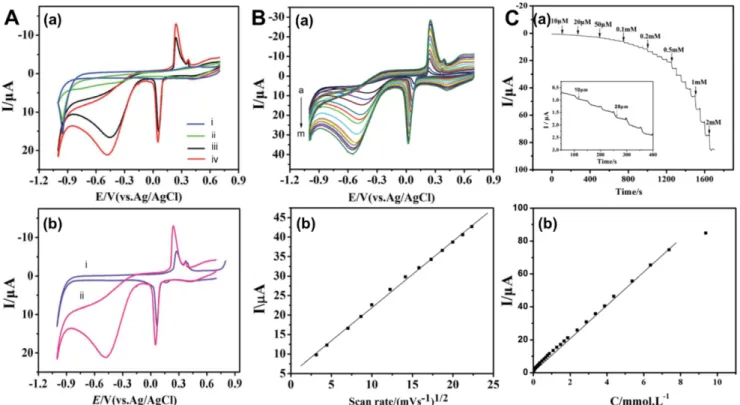
GQDs with metal nanoparticles and organic molecules used as an immobilization matrix for enzyme and nanomaterials have attracted considerable attention because of their advantageous characteristics improving the performance of the electrochemical sensor. In this regard, Jiang’s group [77] synthesized a sensing material based on the immobilization of silver nanocubes (AgNCs), GQDs, and chitosan (CS) on a gold electrode (GE), which allowed the sensitive and selective detection of H2O2. The good electrocatalytic activity of the CS/GQDs/AgNCs can be attributed to the synergistic effect between GQDs, which resulted in a much larger active surface area
and provided more electron transfer passage, and AgNCs, which promoted the electrochemical performance (Fig. 8(A-B)). According to the amperometric experiments as shown in Fig. 8C, the sensor displayed a linear range from 10 μM to 7.38 mM with a low detection limit of 0.15 μM and high selectivity, as well as good reproducibility for H2O2 detection.
Substances containing multiple electroactive nanomaterials used to modify the electrode interface in sensing systems were also investigated. In 2016, Xi et al. [78] developed the hollow nanospheres structure (HNSs) based on Pd NPs decorated double shell structured N- doped GQDs (NGQDs)@N-doped carbon (NC) with ultrafine Pd NPs and “nanozyme” NGQDs as dual signal-amplifying nanoprobes, was applied in electrochemical H2O2 sensing for cancer detection (Fig. 9(A-B)). Because of the synergistic effect between the robust and conductive HNSs supports and catalytically active Pd NPs and NGQDs in facilitating electron transfer, the NGQDs@NC@Pd HNSs hybrid material exhibited a large surface area, fast electron transfer rate and high electrocatalytic activity toward the direct reduction of H2O2. As presented in Fig. 9C, this sensor shows good performance including a wide linear detection range up to 1.4 mM, LOD of 20 nM, as well as high sensitivity, good reproductivity, stability and anti-interference ability. For in vitro detection of cancer, it also could be used in specific detection of a trace amount of H2O2 released from various living cancer cells in a normal state or under
Fig. 8. (A): (a) CVs of the (i) bare gold electrode (GE), (ii) CS/GQDs/GE, (iii) CS/AgNCs/GE, and (iv) CS/GQDs/AgNCs/GE in 0.1 M pH 7.0 PBS containing 1 mM H2O2; (b) CVs of CS/GQDs/AgNCs/GE in 0.1 M pH 7.0 PBS in the absence (a) and presence (b) of 1 mM H2O2; scan rate: 100 mV/s. (B): (a) CVs of the CS/GQDs/AgNCs/GE in 0.1 M pH 7.0 PBS containing 0.1 mM H2O2 at different scan rates from 10 – 500 mV/s; (b) plots of the reduction peak currents at −0.45 V and the square root of the scan rates. (C): (a) Amperometric response of the CS/GQDs/AgNCs/GE to the successive addition of 0.1 M H2O2 to 5 mL 0.1 M pH 7.0 PBS at an applied potential of − 0.45 V, inset is the blow-up of the low concentration region; (b) plot of response current to H2O2 concentration. Reproduced with per- mission from ref. [77], copyright 2016, The Royal Society of Chemistry.
chemotherapy and radiotherapy.
In 2017, a ternary nanocomposite consisting of Ag NPs, CDs, and rGO was prepared using a one-step electrodeposition method, which was applied to the determination of doxorubicin in biomedical samples [79]. From the CV experiment results, the AgNPs/CDs/
rGO possessed superior electrocatalytic activities for DOX reduction.
In particular, the nanocomposite-modified electrode contained AgNPs, CDs, and rGO, which would promote the conductivity efficiently and increase the surface areas and active sites for electron transfer.
A good linear relationship between the DPV peak current intensity vs. DOX concentration was obtained in the range from 1.0 × 10⁻⁸ to 2.5 × 10⁻⁶ M and the LOD was approximately 2 nM. In real biological samples, high detection recovery and low relative standard deviation (RSD) values were obtained, which highlighted the high reliability and applicability of AgNPs/CDs/rGO for DOX detection. Ionic liquid- functionalized graphene oxide (IL-GO) with strong electrical conductivity, good dispersibility, and high specific surface area, which was also employed for electrochemical applications as a carrier material for nanomaterials [80]. Chen et al. [81] prepared a PtNPs/CDs/IL-GO nanocomposite to modify the GCE for the detection of H2O2. In this study, IL-GO can be used as a Pt nanocomposite support material, and the surface functional groups of carbon materials play an
important role in improving the catalytic activity of Pt NPs, leading to significant enhancement of the conductivity and the promotion of electron transfer between the electrode interface and H2O2. Electrochemical experiments showed that the PtNPs/CDs/IL-GO- based sensor exhibited high selectivity, a wide linear range (1 – 900 μM), and a low detection limit (0.1 μM) with respect to the reduction of H2O2.
Among the various electrode-modified materials, the nanocomposite composed of gold nanoparticles (Au NPs), CDs, and CS was also employed for electrochemical biosensors. For example, the simple and sensitive determination of dopamine (DA) was realized on an AuNPs/CDs/CS electrode with a low detection limit of 0.001 μM and a wide linear range of 0.01 – 100μM [82]. Later, Guo et al. [83]
introduced a rapid and highly sensitive electrode chemical sensor for patulin detection based on a combination of CDs, CS, and AuNPs as a modified electrode with a molecularly imprinted polymer (MIP).
A MIP was fabricated on the modified electrode surface, adopting the method of surface molecular self-assembly and co-polymerization of functional monomer and template molecule, which could enhance the selectivity to the target materials (Fig. 9A). As shown in Fig.
9D, only patulin can be adsorbed in the molecular imprinting cavity, which impeded electron transfer from the [Fe(CN)6]3-/4- ion pair to
Fig. 9. (A) Schematics illustrating the preparation process of NGQDs@NC@Pd HNSs: (1) amino-functionalization of SiO2 nanospheres; (2) wrapping SiO2 nanospheres with GQD nanosheets; (3) coating of PDA on surface of SiO2@GQDs; (4) loading of Pd NPs on the sur- face of SiO2@GQDs@PDA; (5) further carbonization and HF etching to form NGQD@NC@Pd HNSs. (B) SEM images of (a) af-SiO2 nanospheres; (b) af-SiO2@GQDs nanospheres; (c) af-SiO2@GQDs@PDA nanospheres; (d) af-SiO2@GQDs@PDA@Pd nanospheres;
(e-f) NGQDs@NC@Pd HNS with different magnification. Insets are their corresponding photographs. (C): (i) CV curves of NGQDs
@NC@Pd/GCE, NC@Pd/GCE, NGQDs@NC/GCE, and NC/GCE in PBS (pH 7.4) containing 1.0 mM H2O2 (scan rate of 50 mV/s);
(ii) CV curves of NGQDs@NC@Pd/GCE in PBS (pH 7.4) with various H2O2 concentration with a scan rate of 50 mV/s; (iii) Amper- ometric response of NGQDs@NC@Pd/GCE with successive step changes of H2O2 concentration. The insets are (a) the enlarged graph of the highlight region of part C, (b) the corresponding calibration curves, and (c) the amperometric response of NGQDs@NC@Pd/
GCE with successive step changes of 20 nM H2O2; (iv) Influence of 20 μM O2 (a), DA (b), UA (c), AA (d), and 50 μM O2 (e), DA (f), UA (g), AA (h) on the amperometric response of equal amount of H2O2 in 0.1 M PBS (pH 7.4). Applied potential: 0 V. Reproduced with permission from ref. [78], copyright 2016, American Chemical Society.
the electrode surface, leading to a decrease in the current peak. In addition, the electrochemical performance was improved after a triple modification electrode with CDs, CS, and AuNPs, with a wide linear range from 1×10–12 to 1×10⁻⁹ M and a LOD of 7.57 × 10⁻¹³ M. These results are shown in Fig. 9. The MIP/Au/CS/CDs sensor showed a rapid equilibrium adsorption time, high binding affinity, and selectivity, making it a promising sensor in practical applications for the determination of patulin. In another study, MICES based on GCE modified with palladium nanoparticles (Pd NPs) involved in 5-(4-hydroxybenzylidenamino)-2-mercaptobenzimidazole (BZ)-functionalized GQDs was also synthesized for citrinin (CIT) analysis in chicken egg samples [84]. The linearity range and detection limit of the MIP/Pd/BZ/GQDs sensor were 1×10⁻⁹ to 5×10⁻⁹ M and 2×10⁻¹⁰ M, respectively. This sensor could be used for routine analysis with high selectivity, excellent repeatability, sensitivity, and long-term stability without interference.
Similar to graphene as a 2D structure, graphitic carbon nitride (g-C3N4) is also a well-known material with many excellent characteristics, which exposes their entire high surface area to guest species. Ponnaiah et al. [85] reported the successful fabrication of a CDs/Fe3O4@g-C3N4 nanocomposite as an efficient electrochemical sensing platform for SCN- in the saliva samples of smokers and nonsmokers of tobacco. The as-prepared CDs/Fe3O4@g-C3N4 showed excellent sensing ability, good linear relationship (0.001 – 0.9 μM), and lower detection limit (140 pM) compared to previously reported electrodes. The proposed sensor obtained favorable recovery, highlighting the potential applicability of the sensor for clinical diagnosis and environmental monitoring. In addition to g-C3N4, organic conductive polymers have been used to enhance the electrocatalytic activity of sensors, in which polyaniline (PANI) has attracted considerable attention owing to its low cost, excellent conductivity, unique electrochemical behavior, and ease of blending with other materials [86,87]. Hatamluyi et al. [87] designed a highly selective sensing platform for the simultaneous determination of two important anticancer drugs, irinotecan (CPT-11) and 5-fluorouracil (5-FU), based on GQDs/
PANI/ZnO nanocomposites. CV and electrochemical impedance spectroscopy (EIS) showed that the as-synthesized GQDs/PANI/
ZnO has a high surface area and effectively supports the electroactive species, which improves the electrocatalytic activity because of the synergistic effects of GQDs, PANI, and ZnO. The resulting sensor showed excellent sensitivity with desirable linear ranges of 0.1 – 25 μM and 0.1 – 50 μM and LODs of 0.011 and 0.023 M for CPT-11 and 5-FU, respectively. The reliability of the GQDs/PANI/ZnO – based sensor was justified by the accurate and sensitive detection of CPT- 11 and 5-FU in the pharmaceutical and biological samples.
4. Conclusions and Future Perspective
The past few years have witnessed an increasing demand for the sensitive and selective detection of single or multi-analytes at different molecular levels. Based on the reported literature, the electrochemical
bioassays relating CDs and GQDs have brought a great way to accomplish these increasing demands. CDs and GQDs have been used as surface modifiers and have been exploited widely for electroanalysis purposes owing to their large surface area, facile synthesis methods, and great electrocatalytic activity. Moreover, the effectiveness of using CDs and GQDs in constructing electrochemical sensing platforms depends strongly on the large number of functional groups on their surface, which can be immobilized with other molecules, but further studies are required.
To date, doping CDs or GQDs with various heteroatoms is one of the ways to tune their electrochemical properties, which helps improve the sensitivity of the electrochemical sensors based on CDs or GQDs. In these strategies, CDs or GQDs (or doped CDs/GQDs) have been used alone without modification or hybrid nanomaterials modified with different nanomaterials, including metal/metal oxide nanoparticles, organic compounds, or polymeric structures as electrode modifiers. Synergistic effects from different species of electroactive nanomaterials could be achieved when hybrid nanomaterials of CDs or GQDs were used to modify the electrode, which could lead to an increase in conductivity, expansion of the surface areas and active sites, and acceleration of the electron transfer rate. Moreover, the multi-amplifying electrochemical signal response would be acquired for the highly sensitive detection of analytes when using nanocomposites consisting of multiple electroactive nanomaterials to modify the electrode interface. The as-prepared sensor based on CDs and GQDs exhibited excellent electrocatalytic properties for the detection of a wide variety of analytes, such as H2O2, glucose, dopamine, nitrite, and bisphenol, in toxic environment compounds, cosmetics, pharmaceutical, biological, and clinical samples.
The studies on CDs-based and GQDs-based nanomaterials in electrochemical sensors are still in the early stage, and there have been fewer studies than those of optical sensors. The review hopes to open new opportunities for further developments and promote the application of these nanomaterials as electrochemical sensing platforms towards different analytes and their levels with improved properties. In addition, an investigation of the composite of CDs/
GQDs with 2D materials, such as hexagonal-boron nitride, layer metal oxide, and metal oxide nanosheets, is still needed to improve the sensing performance. Synergistic effects superior to each of the individual components are expected. Nevertheless, despite having excellent sensor sensitivity, the sensor should be studied further to ensure conversion from the laboratory to application in real samples, which includes the development of a low-cost fabrication process and an effective sensing platform for the real sample analysis.
Acknowledgments
This study was supported by the Basic Science Research Program through the National Research Foundation of Korea (NRF) funded by The Ministry of Science, ICT and Future Planning (2019R1A2B5B02069683).
References
1. Khodadadi, A., Faghih-Mirzaei, E., Karimi-Maleh, H., Abbaspour- rad, A., Agarwal, S. and Gupta, V. K., “A New Epirubicin Bio- sensor Based on Amplifying DNA Interactions with Polypyrrole and Nitrogen-doped Reduced Graphene: Experimental and Dock- ing Theoretical Investigations,” Sens. Actuators B Chem., 284, 568-574(2019).
2. Mollarasouli, F., Asadpour-Zeynali, K., Campuzano, S., Yáñez- Sedeño, P. and Pingarrón, J. M., “Non-enzymatic Hydrogen Per- oxide Sensor Based on Graphene Quantum Dots-chitosan/meth- ylene Blue Hybrid Nanostructures,” Electrochim. Acta, 246, 303- 314(2017).
3. Asadian, E., Ghalkhani, M., and Shahrokhian, S., “Electrochem- ical Sensing Based on Carbon Nanoparticles: A Review,” Sens.
Actuators B Chem., 293, 183-209(2019).
4. Campuzano, S., Yáñez-Sedeño, P. and Pingarrón, J. M., “Carbon Dots and Graphene Quantum Dots in Electrochemical Biosens- ing,” Nanomaterials, 9, 634(2019).
5. Cayuela, A., Soriano, M. L., Carrillo-Carrión, C., Valcárcel, M.,
“Semiconductor and Carbon-based Fluorescent Nanodots: the Need for Consistency,” Chem. Commun., 52, 1311-1326(2016).
6. Sciortino, A., Cannizzo, A. and Messina, F., “Carbon Nanodots:
A Review—From the Current Understanding of the Fundamen- tal Photophysics to the Full Control of the Optical Response,” C, 4, 67(2018).
7. Zheng, X. T., Ananthanarayanan, A., Luo, K. Q. and Chen, P.,
“Glowing Graphene Quantum Dots and Carbon Dots: Properties, Syntheses, and Biological Applications,” Small, 11, 1620-1636(2015).
8. Le, T. H., Lee, D. H., Kim, J. H., Park, S. J., “Synthesis of Enhanced Fluorescent Graphene Quantum Dots for Catecholamine Neu- rotransmitter Sensing,” Korean J. Chem. Eng., 37, 1000-1007(2020).
9. Xu, X., Ray, R., Gu, Y., Ploehn, H. J., Gearheart, L., Raker, K., et al., “Electrophoretic Analysis and Purification of Fluorescent Single-Walled Carbon Nanotube Fragments,” J. Am. Chem. Soc., 126, 12736-12737(2004).
10. Xie, R., Wang, Z., Zhou, W., Liu, Y., Fan, L. and Li, Y., “Graphene Quantum Dots as Smart Probes for Biosensing,” Anal. Methods, 8, 4001-4016(2016).
11. Pan, D., Zhang, J., Li, Z. and Wu, M., “Hydrothermal Route for Cutting Graphene Sheets into Blue-Luminescent Graphene Quan- tum Dots,” Adv. Mater., 22, 734-738(2010).
12. Li, H., He, X., Kang, Z., Huang, H., Liu, Y. and Liu, J., “Water- Soluble Fluorescent Carbon Quantum Dots and Photocatalyst Design,” Angew. Chem. Int. Ed, 49, 4430-4434(2010).
13. Peng, J., Gao, W., Gupta, B. K., Liu, Z., Romero-Aburto, R. and Ge, L., “Graphene Quantum Dots Derived from Carbon Fibers,”
Nano Lett., 12, 844-849(2012).
14. Zhuo, S., Shao, M. and Lee, S.-T., “Upconversion and Down- conversion Fluorescent Graphene Quantum Dots: Ultrasonic Prepa- ration and Photocatalysis,” ACS Nano, 6, 1059-1064(2012).
15. Li, L.-L., Ji, J., Fei, R., Wang, C.-Z., Lu, Q. and Zhang, J.-R.,
“A Facile Microwave Avenue to Electrochemiluminescent Two- Color Graphene Quantum Dots,” Adv. Funct. Mater., 22, 2971- 2979(2012).
16. Liu, F., Jang, M.-H., Ha, H. D., Kim, J.-H., Cho, Y.-H., Seo, T.
S., “Facile Synthetic Method for Pristine Graphene Quantum
Dots and Graphene Oxide Quantum Dots: Origin of Blue and Green Luminescence,” Adv. Mater., 25, 3657-3662(2013).
17. Dong, Y., Shao, J., Chen, C., Li, H., Wang, R. and Chi, Y., “Blue Luminescent Graphene Quantum Dots and Graphene Oxide Pre- pared by Tuning the Carbonization Degree of Citric Acid,” Car- bon, 50, 4738-4743(2012).
18. Tao, S., Song, Y., Zhu, S., Shao, J., Yang, B., “A New Type of Polymer Carbon Dots with High Quantum Yield: From Synthe- sis to Investigation on Fluorescence Mechanism,” Polymer, 116, 472-478(2017).
19. Liu, S., Tian, J., Wang, L., Zhang, Y., Qin, X. and Luo, Y., “Hydro- thermal Treatment of Grass: A Low-Cost, Green Route to Nitro- gen-Doped, Carbon-Rich, Photoluminescent Polymer Nanodots as an Effective Fluorescent Sensing Platform for Label-Free Detec- tion of Cu(II) Ions,” Adv. Mater., 24, 2037-2041(2012).
20. Tang, L., Ji, R., Cao, X., Lin, J., Jiang, H., Li, X., “Deep Ultraviolet Photoluminescence of Water-Soluble Self-Passivated Graphene Quantum Dots,” ACS Nano, 6, 5102-5110(2012).
21. Sagbas, S. and Sahiner, N., in A. Khan, M. Jawaid, Inamuddin, A. M. Asiri (Eds.), Nanocarbon and its Composites, Woodhead Publishing, 651-676(2019).
22. De, B. and Karak, N., “Recent Progress in Carbon Dot–metal Based Nanohybrids for Photochemical and Electrochemical Appli- cations,” J. Mater. Chem. A, 5, 1826-1859(2017).
23. Tian, P., Tang, L., Teng, K. S. and Lau, S. P., “Graphene Quan- tum Dots from Chemistry to Applications,” Mater. Today Chem., 10, 221-258(2018).
24. Han, M., Zhu, S., Lu, S., Song, Y., Feng, T. and Tao, S., “Recent Progress on the Photocatalysis of Carbon Dots: Classification, Mechanism and Applications,” Nano Today, 19, 201-218(2018).
25. Guo, X., Zhang, H., Sun, H., Tade, M. O. and Wang, S., “Green Synthesis of Carbon Quantum Dots for Sensitized Solar Cells,”
ChemPhotoChem, 1, 116-119(2017).
26. Hu, C., Li, M., Qiu, J. and Sun, Y.-P., “Design and Fabrication of Carbon Dots for Energy Conversion and Storage,” Chem. Soc.
Rev., 48, 2315-2337(2019).
27. Kasouni, A., Chatzimitakos, T. and Stalikas, C., “Bioimaging Applications of Carbon Nanodots: A Review,” C, 5, 19(2019).
28. Li, Y., Zhong, Y., Zhang, Y., Weng, W. and Li, S., “Carbon Quan- tum Dots/octahedral Cu2O Nanocomposites for Non-enzymatic Glu- cose and Hydrogen Peroxide Amperometric Sensor,” Sens. Actuators B Chem., 206, 735-743(2015).
29. Cho, M.-J. and Park, S.-Y., “Carbon-dot-based Ratiometric Flu- orescence Glucose Biosensor,” Sens. Actuators B Chem., 282, 719-729(2019).
30. Kim, J., Park, J., Kim, H., Singha, K. and Kim, W. J., “Trans- fection and Intracellular Trafficking Properties of Carbon Dot-gold Nanoparticle Molecular Assembly Conjugated with PEI-pDNA,”
Biomaterials, 34, 7168-7180(2013).
31. Sun, H., Wu, L., Wei, W. and Qu, X., “Recent Advances in Graphene Quantum Dots for Sensing,” Mater. Today, 16, 433-442 (2013).
32. Tuteja, S. K., Chen, R., Kukkar, M., Song, C. K., Mutreja, R.
and Singh, S., “A Label-free Electrochemical Immunosensor for the Detection of Cardiac Marker Using Graphene Quantum Dots (GQDs),” Biosens. Bioelectron., 86, 548-556(2016).
33. Xu, G., Han, J., Ding, B., Nie, P., Pan, J., Dou, H., “Biomass-derived Porous Carbon Materials with Sulfur and Nitrogen Dual-doping
for Energy Storage,” Green Chem., 17, 1668-1674 (2015).
34. Guo, Q., Zhang, M., Zhou, G., Zhu, L., Feng, Y. and Wang, H.,
“Highly Sensitive Simultaneous Electrochemical Detection of Hydroquinone and Catechol with Three-dimensional N-doping Carbon Nanotube Film Electrode,” J. ElectroAnal. Chem., 760, 15- 23(2016).
35. Zhang, L., Han, Y., Zhu, J., Zhai, Y. and Dong, S., “Simple and Sensitive Fluorescent and Electrochemical Trinitrotoluene Sen- sors Based on Aqueous Carbon Dots,” Anal. Chem., 87, 2033- 2036(2015).
36. Jiang, Y., Wang, B., Meng, F., Cheng, Y. and Zhu, C., “Micro- wave-assisted Preparation of N-doped Carbon Dots as a Biosensor for Electrochemical Dopamine Detection,” J. Colloid Interface Sci., 452, 199-202(2015).
37. Fu, L., Wang, A., Lai, G., Lin, C.-T., Yu, J. and Yu, A., “A Glassy Carbon Electrode Modified with N-doped Carbon Dots for Improved Detection of Hydrogen Peroxide and Paracetamol,”
Microchim. Acta, 185, 87(2018).
38. Liu, L., Anwar, S., Ding, H., Xu, M., Yin, Q. and Xiao, Y.,
“Electrochemical Sensor Based on F,N-doped Carbon Dots Dec- orated Laccase for Detection of Catechol,” J. ElectroAnal. Chem., 840, 84-92(2019).
39. Zhou, M., Guo, J., Guo, L.-P. and Bai, J., “Electrochemical Sens- ing Platform Based on the Highly Ordered Mesoporous Car- bon−Fullerene System,” Anal. Chem., 80, 4642-4650(2008).
40. Banks, C. E., Davies, T. J. Wildgoose, G. G. and Compton, R. G.,
“Electrocatalysis at Graphite and Carbon Nanotube Modified Elec- trodes: Edge-plane Sites and Tube Ends are the Reactive Sites,”
Chem. Commun., 37(7), 829-841(2005).
41. Hu, S., Huang, Q., Lin, Y., Wei, C., Zhang, H. and Zhang, W.,
“Reduced Graphene Oxide-carbon Dots Composite as An Enhanced Material for Electrochemical Determination of Dopa- mine,” Electrochim. Acta, 130, 805-809(2014).
42. Ngo, Y.-L.T. and Hur, S. H., “Low-temperature NO2 Gas Sensor Fabricated with NiO and Reduced Graphene Oxide Hybrid Struc- ture,” Mater. Res. Bull., 84, 168-176(2016).
43. Bai, J., Sun, C. and Jiang, X., “Carbon Dots-decorated Multi- walled Carbon Nanotubes Nanocomposites as a High-performance Electrochemical Sensor for Detection of H2O2 in Living Cells,”
Anal. Bioanal.Chem., 408, 4705-4714(2016).
44. Zhang, W., Zheng, J., Lin, Z., Zhong, L., Shi, J. and Wei, C.,
“Highly Sensitive Simultaneous Electrochemical Determination of Hydroquinone, Catechol and Resorcinol Based on Carbon Dot/
reduced Graphene Oxide Composite Modified Electrodes,” Anal.
Methods, 7, 6089-6094(2015).
45. Wei, C., Huang, Q., Hu, S., Zhang, H., Zhang, W. and Wang, Z.,
“Simultaneous Electrochemical Determination of Hydroquinone, Catechol and Resorcinol at Nafion/multi-walled Nanotubes/car- bon Dots/multi-walled Nanotubes Modified Glassy Electrode,”
Electrochim. Acta, 149, 237-244(2014).
46. Huang, Q., Lin, X., Tong, L. and Tong, Q.-X., “Graphene Quantum Dots/Multiwalled Carbon Nanotubes Composite-Based Electro- chemical Sensor for Detecting Dopamine Release from Living Cells,” ACS Sustain. Chem. Eng., 8, 1644-1650(2020).
47. Li, L., Liu, D., Wang, K., Mao, H. and You, T., “Quantitative Detec- tion of Nitrite with N-doped Graphene Quantum Dots Decorated N-doped Carbon Carbon, Nanofibers Composite-based Electro-
chemical Sensor,” Sens. Actuators B Chem., 252, 17-23(2017).
48. Roushani, M. and Abdi, Z., “Novel Electrochemical Sensor Based on Graphene Quantum Dots/riboflavin Nanocomposite for the Detec- tion of Persulfate,” Sens. Actuators B Chem., 201, 503-510 (2014).
49. Roushani, M. and Sarabaegi, M., “Novel Electrochemical Sen- sor Based on Carbon Nanodots/chitosan Nanocomposite for the Detection of Tryptophan,” J. Iran. Chem. Soc., 12, 1875-1882(2015).
50. Yu, L., Yue, X., Yang, R., Jing, S. and Qu, L., “A Sensitive and Low Toxicity Electrochemical Sensor for 2,4-dichlorophenol Based on the Nanocomposite of Carbon Dots, Hexadecyltrimethyl Ammo- nium Bromide and Chitosan,” Sens. Actuators B Chem., 224, 241-247(2016).
51. Ji, H., Zhou, F., Gu, J., Shu, C., Xi, K. and Jia, X., “Nitrogen-Doped Carbon Dots as A New Substrate for Sensitive Glucose Deter- mination,” Sensors, 16, 630(2016).
52. Zheng, W., Wu, H., Jiang, Y., Xu, J., Li, X. and Zhang, W., “A Molecularly-imprinted-electrochemical-sensor Modified with Nano- carbon-dots with High Sensitivity and Selectivity for Rapid Deter- mination of Glucose,” Anal. Biochem., 555, 42-49(2018).
53. Hartley, A. M. and Wilson, G. S., “Unusual Adsorption Effects in the Electrochemical Reduction of Flavin Mononucleotide at Mer- cury Electrodes,” Anal. Chem., 38, 681-687(1966).
54. Roushani, M., Karami, E., Salimi, A. and Sahraei, R., “Amperomet- ric Detection of Hydrogen Peroxide at Nano-ruthenium Oxide/
riboflavin Nanocomposite-modified Glassy Carbon Electrodes,”
Electrochim. Acta, 113, 134-140(2013).
55. Chen, L. and Gorski, W., “Bioinorganic Composites for Enzyme Electrodes,” Anal. Chem., 73, 2862-2868(2001).
56. Wang, Z., Zhou, X., Zhang, J., Boey, F. and Zhang, H., “Direct Electrochemical Reduction of Single-Layer Graphene Oxide and Subsequent Functionalization with Glucose Oxidase,” J. Phys.
Chem. C, 113, 14071-14075(2009).
57. Tan, F., Cong, L., Li, X., Zhao, Q., Zhao, H. and Quan, X., “An Electrochemical Sensor Based on Molecularly Imprinted Poly- pyrrole/graphene Quantum Dots Composite for Detection of Bisphenol A in Water Samples,” Sens. Actuators B Chem., 233, 599-606(2016).
58. Saha, K., Agasti, S. S., Kim, C., Li, X. and Rotello, V. M., “Gold Nanoparticles in Chemical and Biological Sensing,” Chem. Rev., 112, 2739-2779(2012).
59. Li, J., Qu, J., Yang, R., Qu, L. and Harrington, P. de B., “A Sen- sitive and Selective Electrochemical Sensor Based on Graphene Quantum Dot/Gold Nanoparticle Nanocomposite Modified Elec- trode for the Determination of Quercetin in Biological Sam- ples,” Electroanalysis, 28, 1322-1330(2016).
60. Tang, J., Huang, R., Zheng, S., Jiang, S., Yu, H., Li, Z., “A Sen- sitive and Selective Electrochemical Sensor Based on Graphene Quantum Dots/gold Nanoparticles Nanocomposite Modified Elec- trode for the Determination of Luteolin in Peanut Hulls,” Micro- chem. J., 145, 899-907(2019).
61. Zhuang, Z., Lin, H., Zhang, X., Qiu, F. and Yang, H., “A Glassy Carbon Electrode Modified with Carbon Dots and Gold Nanoparti- cles for Enhanced Electrocatalytic Oxidation and Detection of Nitrite,” Microchim. Acta, 183, 2807-2814(2016).
62. Zhang, S., Li, R., Liu, X., Yang, L., Lu, Q. and Liu, M., “A Novel Multiple Signal Amplifying Immunosensor Based on the Strategy of in Situ-produced Electroactive Substance by ALP and Car-