The Effects of Rehabilitation Exercise Using a Home Video Game (PS2) on Gait Ability of Chronic Stroke Patients
Won-Seob Shin
1, Dong-Yeop Lee
2and Seung-Won Lee
1*1Dept. of Physical Therapy, Sahmyook University
2Dept. of Physical Therapy, Sunmoon University
가정용 게임기를 이용한 재활운동이 뇌졸중 환자의 보행 능력에 미치는 효과
신원섭
1, 이동엽
2, 이승원
1*1삼육대학교 물리치료학과
2선문대학교 물리치료학과
Abstract The purpose of this study was investigate the effect of rehabilitation exercise using a home video game(PS2, Sony) on gait ability in the chronic stroke patients. The subjects of this study were 32 patients who underwent stroke for more than 6 months and were assigned to a game-based exercise group (n=16) or a control group (n=16). The Game-based exercise group executed a rehabilitation exercise three times a week during 6 weeks, at the rehabilitation unit. The exercise was performed by PS2 for one hour. Control group maintained their usual life without application of exercise. Outcome measures included gait ability. After the completion of the game-based exercise, 10m walking velocity was improved significantly (p<0.05). Six minute walking distance was increased significantly (p<0.05). These results showed that the rehabilitation exercise using a home video game is effective in the improvement of gait ability in chronic stroke patients. This study suggest that interesting, motivating game-based rehabilitation exercise and effective in recovery of function exercise for chronic stroke patients should be necessary to develop and apply.
요 약 본 연구는 가정용 게임기를 이용한 재활 운동을 적용하여 뇌졸중 환자의 보행능력에 효과가 있는가를 알아
보고자 하였다. 뇌졸중으로 6개월 이상 장애를 가진 32명이 연구에 참여하였고 게임운동군 16명과 대조군 16명으로 나누었다. 게임운동군은 가정용 게임기(PS2, sony)를 이용하여 1시간씩 주 3회를 6주간 실시하였다. 대조군은 운동의
적용없이 평상시 생활을 유지하도록 하였다. 운동 전과 후에 보행능력을 측정하여 효과를 비교하였다. 통계처리 방법
으로 전‧후 차이를 검증하기 위하여 Wilcoxon rank 검정을 실시하였고 대조군과의 차이 검증을 위하여 Mann–Whitney U 검정을 실시하였다. 모든 통계적 유의수준은 0.05로 하였다. 본 연구의 결과 보행능력에서 10 m 보행속도가 유의 하게 증가하였고(p<.05), 6분 보행거리도 유의하게 증가하였다(p<.05). 결론적으로 가정용 게임기를 이용한 재활운동이
뇌졸중 환자의 보행능력에 효과가 있는 것으로 나타났다. 향후 뇌졸중 환자에게 흥미를 유발하고 기능회복의 효과를
가진 게임형태의 재활운동이 다양하게 개발되어 적용하는 연구가 필요하다고 생각한다.
Key Words : Stroke, Gait, Home video game, Rehabilitation
*Corresponding Author : Lee, Seung-Won([email protected])
Received October 16, 2009 Revised December 15, 2009 Accepted January 20, 2010
1. Introduction
Most of the survivors from stroke have a combination
of sensory, motor, cognitive and emotional impairments leading to restrictions in their capacity to perform basic activities of daily living(ADL)[1]. The stroke patients do
not control a muscle tone and contraction appropriately caused by central integrated disorders and ascending and descending pathway damages. So they have kinetic problems with selective muscle control[2]. Paralyzed muscles become so weak that stroke patients used unaffected side limbs mainly[3].
For these reason, stroke patients have abnormal gait patterns. They have short weight bearing time during affected stance phase, step length difference between affected and unaffected side, and totally decrease of gait speed[4, 5]. During swing phase in gait cycle, stroke patients has a reduced peak flexion values at all or any one of the lower-limb joints; a delay in the flexion at the hip, knee, or ankle; and lack of progression of flexion throughout the swing phase at the hip, knee, or ankle[6].
These gait deficits could cause falls, elevated energy cost of gait, and compromised walking endurance[7].
The purpose of rehabilitation is to help the patient reach the highest level of function by preventing complications, reducing disability, and improving independence[8]. The ADL should be directly trained in order to improve the functional recovery after stroke, implying that therapy needs to be focused primarily on relearning functional skills that are relevant to individual patients. In practical terms this amounts to the administration of task-oriented therapy relevant to the patients’ ADL[9].
Walking ability is major part of functional and independent ADL, so that it is important to recovery in stroke patients[10]. Especially, gait speed is a cardinal indicator of poststroke gait performance[11]. So, there were studies to improve walking abilities by using a functional task training[12] and task-oriented exercises in the pool[13]. So, there were studies to improve walking abilities by using a functional task training[12] and task-oriented exercises in the pool[13].
In recent years, the computer and display technology has grown immensely. Practical applications for the use of this technology encompassed rehabilitation with task-oriented concept and established effectiveness[14]. It has become increasingly interested in studying of game-based rehabilitation training [15, 16]. Those training
(2007) found that the rehabilitation training using a home video game were supplied visual and auditory biofeedback effected on functional recovery in stroke patients[15]. But, Flynn’s study had limitation to generalize that subject was only one person. In another study, Yavuzer (2008) provided useful evidence on recoveries by a same device, but only for upper extremity[16]. There is little research yet on the effectiveness on gait abilities in stroke patients by game-based rehabilitation training.
The purpose of this study was to investigate the effect of rehabilitation exercise using a home video game device to improve mobility and gait function in the chronic stroke patients.
2. Method
2.1 Subjects
The subjects were thirty-two patients diagnosed with stroke more than 6 month and recruited from local welfare center in Seoul. The inclusion criteria required that subjects can walk independently for 10min, understand and execute instructions. The exclusion criteria required that subjects not have visual and vestibular disorders, cardiopulmonary disease and medication to affecting in balance. All the subjects provided informed consent after being explained the purpose and method of the study.
2.2 Procedures
Participants were assigned to two groups of game exercise(n=16) and control(n=16). Controls were matched by age, gender and statue with reference to their medical charts[18]. In this study, exercise session in game exercise group begins with a warm-up(5 min) followed by an exercise period(50 min) and a 5-min cool-down period.
Warm-up and cool-down exercises consisted of muscle stretching, deep breathing and range of motion exercise.
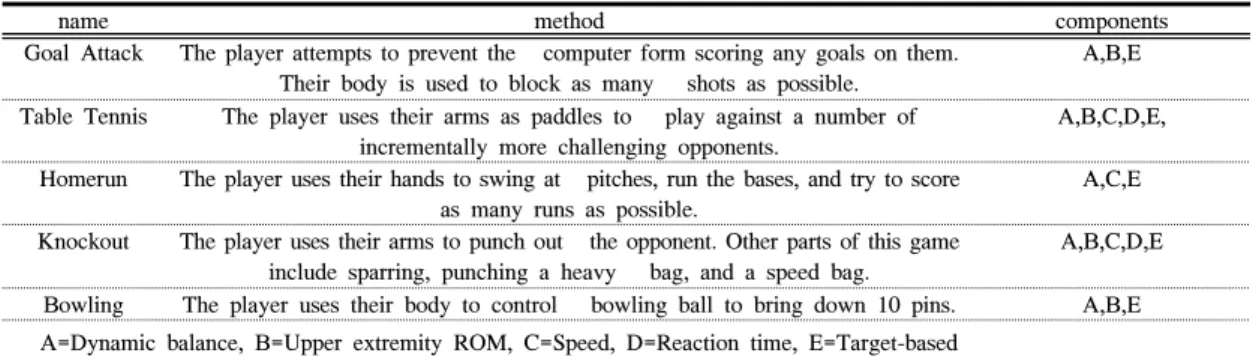
The applied game programs and their components were described in table 1.
Home video game device were the Playstation 2(Sony, Japan) and eyetoy play(Sony, Japan), a commercially
name method components Goal Attack The player attempts to prevent the computer form scoring any goals on them.
Their body is used to block as many shots as possible.
A,B,E
Table Tennis The player uses their arms as paddles to play against a number of incrementally more challenging opponents.
A,B,C,D,E,
Homerun The player uses their hands to swing at pitches, run the bases, and try to score as many runs as possible.
A,C,E
Knockout The player uses their arms to punch out the opponent. Other parts of this game include sparring, punching a heavy bag, and a speed bag.
A,B,C,D,E
Bowling The player uses their body to control bowling ball to bring down 10 pins. A,B,E A=Dynamic balance, B=Upper extremity ROM, C=Speed, D=Reaction time, E=Target-based
[Table 1] Description of game programs and components
own television screen[15, 16]. Objects within the game environment move and react when contacted by the user’s image, creating an interactive experience between sound and visual feedback indicate the success or failure of movement relative to the game task. Participants practiced for 60 min. sessions at a frequency of 3 times a week, for a total of 6 weeks[19, 20].
[Fig. 1] Training using a home video game
2.3 Measurements 2.3.1 10-meter walk test
Gait speed was measured by timing subjects over 10 meters with a stopwatch. To avoid the effects of acceleration and deceleration, measurements were taken over the middle 10 meters of a 14-meter walkway.
Subjects completed two 10-meter walk tests[21].
2.3.2 6-minute walk test
6-minute walk test was used to measure walking endurance. Subjects walked for 6 minutes up and down a 50-meter walkway that had 5-meter increments marked discretely on the wall. The total distance covered in 6 minutes was determined by counting the laps, using the wall markers and measuring the distance covered from the last marker with a tape measure to the nearest centimeter[22].
2.4 Statistics
The analysis of data was performed using SPSS version 15.0 program. Wilcoxon rank test was used to test for differences in gait abilities between before and after in each group. Mann–Whitney U test was executed to determine differences between two groups. For all analyses, a significant level set at α=0.05.
3. Results
3.1 General characteristics of subjects Subjects of both groups were 16 stroke patients, 8 males and 8 females. Average age of the game exercise group was 60.75 years, height was 160.50 cm, and weight was 66.00 kg. Average age of the control was 60.69 years, height was 161.25 cm, and weight was 64.53 kg.
General characteristics of subjects were described in table 2.
Game exercise (n=16)
Control (n=16) Z/x2
Gender(male/female) 8/8 8/8 1.00
Age(years) 60.75±7.53a 60.69±9.23 -.038 Height(cm) 160.50±8.59 161.25±8.69 -.151 Weight(kg) 66.00±7.71 64.53±7.69 -.359
Type
(ischemic/hemorrhage) 10/6 11/5 .710
Side(left/right) 7/9 8/8 .723
Duration(month) 69.19±36.42 71.50±33.87 -.434 MMSE-K(point) 25.06±2.82 24.19±2.76 -1.01
a mean±SD
[Table 2] General characteristics of subjects
3.2 Comparison of gait function
Results of the gait function of each group are summarized in table 3.
The 10m walking speed was significantly increased after game exercise(p<.05), but the control was not.
6-minute walk distance was significantly increased after game exercise(p<.05), but the control was not.
Game exercise Control Z 10-meter
walk test (m/s)
pre .86±.32a .87±.19 -.434 post 1.10±.34 .88±.19 -2.017*
Z -3.519*** .450
6-minute walk test
(m)
pre 225.87±60.16 228.20±49.19 -.113 post 268.79±56.42 227.01±49.34 -1.998*
Z -3.516*** .501
a mean±SD, *p<.05, ***p<.001
[Table 3] Comparison of gait function
[Fig. 3] Comparison of 6-minute walk test
4. Discussion
In rehabilitation, gait speed is usually used to measure independent gait ability and functional recovery level which make ADL. Many previous studies have focused on gait speed and the daily living abilities of chronic stroke patients. According to the former studies of gait speed, below 0.4m/s is possible only for limited activities at home, 0.58-0.8m/s for limited social activities and above 0.8m/s for social activities[23, 24]. But at least 1.1-1.5m/s of gait speed is quite needed to live without any problems in the various outward environment[10]. In this study not only game-based exercise group but also control group had above 0.8m/s in 10m walking velocity before exercise, it showed all participants could do social activities. Actually they had no problems to walk without help to local welfare centers. They might recover their gait abilities partially with their continuous efforts and partially with natural cure. In the result, game exercise group improved gait speed from 0.86m/s to 1.10m/s(27.9%). In the Kim’ study (2007), the ankle strengthening group with applying electric stimulation for 8weeks improved by above 19.5% on the gait speed[25].
And other Kim (2006) found that the task-oriented exercise in the pool for 12 weeks improved gait speed from 0.71m/s to 1.00m/s(19.5%)[13]. The result of Shin’
Compared to the result of the former studies, the variation difference of gait speed was depended on the period of exercise, and functional task training was effective for functional recovery of walking. As the result of functional task training, though walking training was not forced in this study the gait speed was improved by 27.9%. It testified that rehabilitation on game-based exercise was very effective for improving the gait abilities.
6-minutes walk test is generally useful evaluation method to measure the walking endurance[22]. Chronic stroke patients walk about 207m-259m during 6 minutes[21, 26]. In this study Home video game(PS2) resulted increasing of 6-minute walking distance from 225.87m before exercise to 268.79m after exercise by 42.92m(19.0%). Flansbjer (2008) told that 6-minute walking distance was increased from 228m to 250m(9.6%) after progress resistance exercises for 10 weeks[26]. Macko (2005) testified walking distance was increased from 231.9m to 281.8m(21.5%) through treadmill training with 60-70% of maximum heart rate[27]. Compared to the previous studies' results on walking exercise and strengthening exercise, this study resulted that game-based rehabilitation training is very effective to increase 6-minute walking distance.
Improving walking abilities will decrease the energy needed to walk and reduce injuries due to gait abnormalities such as hyperextension at the knee. And it could also mitigate compensatory strategies that may generate overuse injuries in the nonparetic leg, resulting in an increased risk for falling[28]. Rehabilitation processing for chronic stroke patients goes very slow. To make the patients exercise continually for long time, keeping them motivated for exercise and their will to be recovered affect on the performances[29]. Actually both low level of interest in exercise and short expectation for exercising effect have brought low rehabilitation performances[30]. Krebs (2007) said that applying the exercise composed with simply repetitive actions for long time made the patients' motivation decrease, and so he emphasized the effectiveness of task-oriented method[20].
From this point of view our study result was consisted with the previous Flynn’s study[15]. Most participants enjoyed the video game activity and maintained a high feeling of success and enjoyment throughout the intervention period. While they were exercising they
could see their figures on screen. It gave them visual feedback on their movement plans. As a consequence, their control and accuracy of movement was improved[15].
We applied home video game on rehabilitation exercise for the chronic stroke patients who had been decreased walk abilities because of the unbalance caused by unaffected side exercise. Results of this study, home video game was effective to increase gait speed and walking distance. Finally home video game was testified to have exercising effect on the improvement of gait ability. We strongly recommend game -based rehabilitation exercise is appropriate method for improving gait ability for chronic stroke patients. For future studies, we suggest that qualitative evaluation on applying various games for rehabilitation and the efficiency of functional recovery should be considered.
5. Conclusion
Our study investigated the effect of rehabilitation training using a home video game on gait abilities in the chronic stroke patients. The 10m walking speed and 6-minute walk distance were significantly increased after game exercise(p<.05). These results showed that the rehabilitation exercise using a home video game is effective in the improvement of gait ability of chronic stroke patients. This study suggest that interesting, motivating game-based rehabili tation exercise and effective in recovery of function exercise for chronic stroke patients should be necessary to develop and apply.
It is to be hoped that this paper will yield general insights into virtual reality using home video games.
References
[1] J. Hochstenbach, R. Donders, T. Mulder, J. Van Limbeek, and H. Schoonderwaldt, "Long-term outcome after stroke: a disability-orientated approach", International Journal of Rehabilitation Research, vol.
19, pp. 189-200, 1996.
[2] P. Davies, Shoulder probliems associated with hemiplegia, 3 ed. Berlin: Springer-Verlag, 1985.
[3] F. M. Campbell, A. M. Ashburn, R. M. Pickering, and M. Burnett, "Head and pelvic movements during a dynamic reaching task in sitting: implications for physical therapists", Archives of Physical Medicine and Rehabilitation, vol. 82, pp. 1655-1660, 2001.
[4] R. Nakamura, S. Watanabe, T. Handa, and I. Morohashi,
"The relationship between walking speed and muscle strength for knee extension in hemiparetic stroke patients: a follow-up study", Archives of Physical Medicine and Rehabilitation, vol. 154, pp. 111-113, 1988.
[5] R. Wagenaar and W. Beek, "Hemiplegic gait: a kinematic analysis using walking speed as a basis", Journal of Biomechanics, vol. 25, pp. 1007-1015, 1992.
[6] I. A. De Quervain, S. R. Simon, S. Leurgans, W. S.
Pease, and D. McAllister, "Gait pattern in the early recovery period after stroke", Journal of Bone and Joint Surgery American, vol. 78, pp. 1506-1514, 1996.
[7] M. H. Granat, D. J. Maxwell, A. C. Ferguson, K. R.
Lees, and J. C. Barbenel, "Peroneal stimulator;
evaluation for the correction of spastic drop foot in hemiplegia", Archives of Physical Medicine and Rehabilitation, vol. 77, pp. 19-24, 1996.
[8] C. E. Skilbeck, D. T. Wade, R. L. Hewer, and V. A.
Wood, "Recovery after stroke", Journal of Neurology, Neurosurgery and Psychiatry, vol. 46, pp. 5-8, 1983.
[9] G. Kwakkel, R. C. Wagenaar, T. W. Koelman, G. J.
Lankhorst, and J. C. Koetsier, "Effects of intensity of rehabilitation after stroke. A research synthesis", Stroke, vol. 28, pp. 1550-1556, 1997.
[10] J. Carr and R. Shepherd, Neurological Rehabilitation.
Oxford: Butterworth-Heinemann, 1998.
[11] R. Dickstein, "Rehabilitation of gait speed after stroke:
a critical review of intervention approaches", Neurorehabilitation & Neural Repair, vol. 22, pp.
649-660, 2008.
[12] W. S. Shin, S. M. Lee, S. W. Lee, D. Y. Lee, and C.
H. Song, "The effects of task-oriented functional training on a muscle strengh, balance and gait ability of chronic stroke patients", Journal of adpted physical activity, vol. 16, pp. 149-165, 2008.
[13] K. U. Kim, H. M. Kim, S. Y. Woo, and B. K. Chung,
"The effect of the aqua-rehabilitation program on the stroke patient's muscle strength an ADL performance", Journal of adpted physical activity, vol. 14, pp. 99-115,
vol. 8, pp. 187-211; discussion 212-189, 2005.
[15] S. Flynn, P. Palma, and A. Bender, "Feasibility of using the Sony PlayStation 2 gaming platform for an individual poststroke: a case report", Journal of Neurologic Physical Therapy, vol. 31, pp. 180-189, 2007.
[16] G. Yavuzer, A. Senel, M. B. Atay, and H. J. Stam,
"''Playstation eyetoy games'' improve upper extremity-related motor functioning in subacute stroke:
a randomized controlled clinical trial", European Journal of Physical and Rehabilitation Medicine, vol.
44, pp. 237-244, 2008.
[17] P. L. Weiss, D. Rand, N. Katz, and R. Kizony, "Video capture virtual reality as a flexible and effective rehabilitation tool", Journal of Neuroengineering and Rehabilitation, vol. 1, p. 12, 2004.
[18] S. A. Kong and S. W. Han, "Effects of the elastic band training on the daily living and the range of motion in chronic hemiplegia", Journal of adpted physical activity, vol. 16, pp. 117-134, 2008.
[19] D. Bourbonnais, S. Bilodeau, Y. Lepage, N. Beaudoin, D. Gravel, and R. Forget, "Effect of force-feedback treatments in patients with chronic motor deficits after a stroke", American Journal of Physical Medicine &
Rehabilitation, vol. 81, pp. 890-897, 2002.
[20] D. E. Krebs, D. M. Scarborough, and C. A. McGibbon,
"Functional vs. strength training in disabled elderly outpatients", American Journal of Physical Medicine &
Rehabilitation, vol. 86, pp. 93-103, 2007.
[21] C. M. Dean, C. L. Richards, and F. Malouin,
"Task-related circuit training improves performance of locomotor tasks in chronic stroke: a randomized, controlled pilot trial", Archives of Physical Medicine and Rehabilitation, vol. 81, pp. 409-417, 2000.
[22] A. Swisher and A. Goldfarb, "Use of the Six-Minute Walk/Run Test to predict peak oxygen consumption in older adults", Cardiopulmonary Physical Therapy, vol.
9, pp. 3-5, 1998.
[23] S. Lord, K. McPherson, H. K. McNaughton, L.
Rochester, and M. Weatherall, "Community ambulation after stroke: how important and obtainable is it and what measures appear predictive?", Archives of Physical Medicine and Rehabilitation, vol. 85, pp. 234-239, 2004.
[24] J. Perry, M. Garrett, J. K. Gronley, and S. J. Mulroy,
"Classification of walking handicap in the stroke
stimulation on the ability of balance control and gait in stroke patients", Journal of sport and leisure studies, vol. 31, pp. 921-931, 2007.
[26] U. B. Flansbjer, M. Miller, D. Downham, and J.
Lexell, "Progressive resistance training after stroke:
effects on muscle strength, muscle tone, gait performance and perceived participation", Journal of Rehabilitation Medicine, vol. 40, pp. 42-48, 2008.
[27] R. F. Macko, F. M. Ivey, L. W. Forrester, D. Hanley, J. D. Sorkin, L. I. Katzel, K. H. Silver, and A. P.
Goldberg, "Treadmill exercise rehabilitation improves ambulatory function and cardiovascular fitness in patients with chronic stroke: a randomized, controlled trial", Stroke, vol. 36, pp. 2206-2211, 2005.
[27] A. Forster and J. Young, "Incidence and consequences of falls due to stroke: a systematic inquiry", British Medical Journal, vol. 311, pp. 83-86, 1995.
[28] J. Johnson, V. Pearson, and L. McDivitt, "Stroke rehabilitation: assessing stroke survivors' long-term learning needs", Rehabilitation Nursing, vol. 22, pp.
243-248, 1997.
[29] R. Forkan, B. Pumper, N. Smyth, H. Wirkkala, M. A.
Ciol, and A. Shumway-Cook, "Exercise adherence following physical therapy intervention in older adults with impaired balance", Physical Therapy, vol. 86, pp.
401-410, 2006.
Won-Seob Shin
[Regular member]• Feb. 2005 : M.S in Physical therapy, Sahmyook Univ.
• Feb. 2009 : Ph.D. in Physical Therapy, Sahmyook Univ.
• Mar. 2009 ∼ current : Lecturer, Department of Physical Therapy, Sahmyook Univ.
<Research Interests>
Kinegiology, Musculoskeletal Physical Therapy
Dong-Yeop, Lee
[Regular member]• Feb. 2005 : M.S in Public Health, Konyang University
• Oct. 2008 : Ph.D. in Physical Therapy, Sahmyook Univ.
• Mar. 2009 ∼ current : Professor, Department of Physical Therapy, Sunmoon Univ.
<Research Interests>
Clinical kinegiology, Clinical anatomy, Neurorehabilitation
Seung-Won, Lee
[Regular member]• Feb. 2004 : M.S in Physical therapy, Sahmyook Univ.
• Feb. 2008 : Ph.D. in Physical Therapy, Sahmyook Univ.
• Sep. 2008 ∼ current : Professor, Department of Physical Therapy, Sahmyook Univ.
<Research Interests>
Neuroscience, Geriatrics