ABSTRACT
Background: Pulmonary surfactant (PS) replacement therapy, as a safe and effective treatment for respiratory distress syndrome (RDS) may have further increased with the extended insurance coverage since 2011 in Korea. Thus, this study aimed to investigate the epidemiologic data of PS replacement therapy for RDS in Korea and to analyze the complications associated with RDS.
Methods: We included 19,442 infants who were treated with PS and diagnosed with RDS (International Classification of Diseases-10 codes: P22.0) between 2014 and 2018 from the Health Insurance Review and Assessment database. Birth certificate data from Statistics Korea were used to estimate the incidence of RDS.
Results: The average incidence of RDS within the study period was 0.99% among live births.
Repeated doses of PS were administered to 1,688 infants (8.7%), ranging from 2 doses in 929 infants (4.8%) to 9 doses in 1 infant (0.01%). The incidence of RDS in term infants markedly increased over 5 years from 0.2% to 0.34%. The incidence was similarly increased among the preterm infants. The RDS mortality rate was 6.3% and showed a decreasing trend according to year. The mortality rate was significantly higher in the lower gestational age group. A decreasing trend was observed in the incidence of the complications, such as patent ductus arteriosus, intraventricular hemorrhage, and bronchopulmonary dysplasia, except for pneumothorax in term infants. The complications were also higher in the lower gestational age group and the lower birth weight group. However, pneumothorax was the most frequent complication in the term infant group and in infants with birth weight ≥ 2,500 g.
Conclusion: Advancements in neonatal care and extended insurance coverage have increased the use of PS replacement therapy for RDS. This, in turn, decreased neonatal mortality and the incidence of the associated complications. The appropriate therapeutic strategy for RDS should be decided according to the gestational age and lung pathology.
Keywords: Respiratory Distress Syndrome; Pulmonary Surfactant; Epidemiologic Studies;
Infants, Newborn
Original Article
Received: Apr 8, 2020 Accepted: Jun 10, 2020 Address for Correspondence:
Soon Min Lee, MD, PhD
Department of Pediatrics, Yonsei University College of Medicine, 50-1 Yonsei-ro, Seodaemun-gu, Seoul 03722, Korea.
E-mail: [email protected]
© 2020 The Korean Academy of Medical Sciences.
This is an Open Access article distributed under the terms of the Creative Commons Attribution Non-Commercial License (https://
creativecommons.org/licenses/by-nc/4.0/) which permits unrestricted non-commercial use, distribution, and reproduction in any medium, provided the original work is properly cited.
ORCID iDs Jeong Eun Shin
https://orcid.org/0000-0002-4376-8541 So Jin Yoon
https://orcid.org/0000-0002-7028-7217 Joohee Lim
https://orcid.org/0000-0003-4376-6607 Jungho Han
https://orcid.org/0000-0001-6661-8127 Ho Seon Eun
https://orcid.org/0000-0001-7212-0341 Min Soo Park
https://orcid.org/0000-0002-4395-9938 Kook In Park
https://orcid.org/0000-0001-8499-9293 Soon Min Lee
https://orcid.org/0000-0003-0174-1065
Jeong Eun Shin , So Jin Yoon , Joohee Lim , Jungho Han , Ho Seon Eun , Min Soo Park , Kook In Park , and Soon Min Lee
Department of Pediatrics, Yonsei University College of Medicine, Seoul, Korea
Pulmonary Surfactant Replacement Therapy for Respiratory Distress
Syndrome in Neonates: a Nationwide Epidemiological Study in Korea
Pediatrics
Funding
This study was supported by a faculty research grant of Yonsei University College of Medicine for (6-2016-0125).
Disclosure
The authors have no potential conflicts of interest to disclose.
Author Contributions
Conceptualization: Lee SM. Methodology:
Lee SM, Shin JE. Software: Lee SM, Shin JE.
Validation: Yoon SJ, Lim JH, Han JH, Eun HS, Park MS, Park KI. Investigation: Shin JE. Writing - original draft: Shin JE, Lee SM. Writing - reviewing & editing: Lee SM.
INTRODUCTION
Pulmonary surfactant (PS) replacement therapy has been established as a safe and effective treatment for immaturity-related surfactant deficiency since the early 1990s.1 Systematic reviews have reported that surfactant administration in preterm infants with established respiratory distress syndrome (RDS) decrease the mortality rate, incidence of pulmonary air leak, and risk of chronic lung disease or death at 28 days of age.2,3 However, recent studies have suggested that in addition to PS deficiency, there are other causes leading to RDS, especially in near-term and term infants.4
In Korea, surfactant replacement therapy has been available for neonatal RDS since 1991,5 and several products for artificial PS replacement therapy are currently being marketed (e.g., Surfacten®, Exosurf®, Newfactan®, Curosurf®, and Infasurf®). Insurance coverage for single- dose surfactant replacement was initiated in 1992 and for multiple doses in 2007. In 2011, the insurance system also extended coverage for early prophylactic therapy with a single administration within 2 hours after birth for premature infants with a birth weight < 1,250 g or a gestational age < 30 weeks.6 Since then, the survival rates of very-low-birth-weight infants (VLBWIs) and extremely-low-birth-weight infants have significantly improved.7,8 Moreover, minimally invasive PS administration has been applied with insurance coverage since December 2018. The survival rate has been encouraging and is similar to that achieved in advanced countries in Europe and North America.9
PS has traditionally been administered through an endotracheal tube either as bolus, in smaller aliquots, or by infusion. However, the optimal method of PS administration in preterm infants has not been elucidated to date owing to the availability of limited and conflicting data. Repeated PS doses for predetermined indications have decreased the mortality rate and morbidity.3 However, there is insufficient evidence to recommend the optimal number of fractional doses of surfactant or the optimal body position during administration.1 With the development of new methods of minimally invasive PS administration, prophylactic PS replacement therapy may be advantageous compared to continuous positive airway pressure therapy with rescue administration of PS with less invasive surfactant administration.10
Several studies have reported on the PS preparations in Korea; however, these studies were published before 2010.11-13 The latest multicenter collaborative study in 2010 showed increasing trends of PS use. The study reported that 3,160 patients in 72 hospitals were treated with 8,364 vials of surfactant, which cost 4,993 million Korean won (KRW).11 Among them, 318 infants died, yielding a mortality rate of 10.1%.11 The use of PS therapy may have further increased with the provision of extended insurance coverage since 2011;
however, nationwide data are not available regarding this. National epidemiologic data can be useful for estimating the medical resources required for disease control. Thus, this study aimed to investigate the epidemiologic data of PS replacement therapy for RDS in Korea and analyze the complications associated with RDS. To the best of our best knowledge, this is the first nationwide study on surfactant replacement therapy using the national insurance health data in Korea.
METHODS
Patients and data source
We initially identified 20,671 infants who were treated with PSs between 2014 and 2018 from the Health Insurance Review and Assessment (HIRA) database. Among them, 19,442 patients diagnosed with RDS (International Classification of Diseases-10 [ICD-10] codes: P22.0) were finally included in this study. The data were retrieved from the same database, and we created the dataset (HIRA dataset No. M20190718866) that included patients treated with PSs and their health insurance claims. HIRA stores the healthcare claims of almost all Korean residents for review and assessment; specifically, approximately 98% of the patients are covered by the National Health Insurance Service while 2% are covered by medical aid.14 We used birth certificate data from Statistics Korea to estimate the incidence of RDS requiring PS treatment.15 The complications associated with RDS included pneumothorax, patent ductus arteriosus (PDA), intraventricular hemorrhage (IVH), and bronchopulmonary dysplasia (BPD) and pulmonary hemorrhage which were obtained from diagnosis codes (ICD-10 codes) inputted by the hospital, small for gestational age (SGA) and the information, including gestational age or birth weight were also obtained by the ICD-10 codes in database. The HIRA database contains the sex, region, the information of payment of each patient.
Statistical analyses
The baseline characteristics of the subjects were expressed as means and standard deviations for continuous variables and as percentages for categorical variables. The cohort was stratified according to the gestational age and birth weight or year. The χ2 test was used to compare the neonatal characteristics and complications between the groups. Logistic regression models were used to determine the significant changes in the incidence of complications, as stratified by the gestational age or birth weight and to obtain odds ratios (ORs) and 95% confidence intervals (CIs) for each risk factors associated with mortality in RDS. All statistical analyses were performed using SAS version 9.4 (SAS Institute, Cary, NC, USA). P values < 0.05 were considered statistically significant.
Ethics statement
In this study, all identifiable variables, including claim-, individual-, and organizational-level identification numbers, were re-generated in random by the HIRA database to protect the patients' privacy. The study protocol was approved by the Institutional Review Board (IRB) of Gangnam Severance Hospital (IRB No. 3-2019-0147). Informed consent was waivered.
RESULTS
A total number of 26,392 PS replacement therapy were performed for 20,671 infants between 2014 and 2018. Five products were used in Korea, the proportion of them showed 45%, 40%, 11%, 3%, and 1%. The indication for PS replacement therapy was RDS in 19,442 of the 20,671 infants (94%). Multiple doses of PSs were administered to 1,688 infants (8.7%), as follows:
2 doses in 929 infants (4.8%), 3 doses in 438 infants (2.3%), 4 doses in 191 infants (1.0%), 5 doses in 84 infants (0.4%), 6 doses in 32 infants (0.2%), 7 doses in 9 infants (0.1%), 8 doses in 4 infants (0.02%), and 9 doses in 1 infant (0.01%). The incidence of RDS was 0.99%, and the annual incidence rate showed an increasing trend from 0.84% in 2014 to 1.16% in 2018.
The total number of term infants with RDS and incidence of RDS in term infants markedly increased over 5 years, respectively. Incidence of RDS in preterm infants also showed an
increasing trend. In addition, RDS showed 0.25% of infants with a birth weight of 2,500 g or more, 5.1% of infants with a birth weight of 1,500 to 2,500 g. Incidence of RDS in VLBWIs was 48.1%, showing an increasing trend by 9.5% during 5 years (Table 1). The proportion of SGA among infants with RDS was 3.3% (646 infants) ranging from 1.9% to 4.2% during 5 years. The average total amount of admission payment was 21,115,115 ± 17,031,077 KRW, the payment by patients was 42,686 ± 184,351 KRW and the payment by insurance was 21,072,428
± 1,003,284 KRW. The distribution of RDS incidence by province is shown in Fig. 1; ranging from 0.13% to 2.38%.
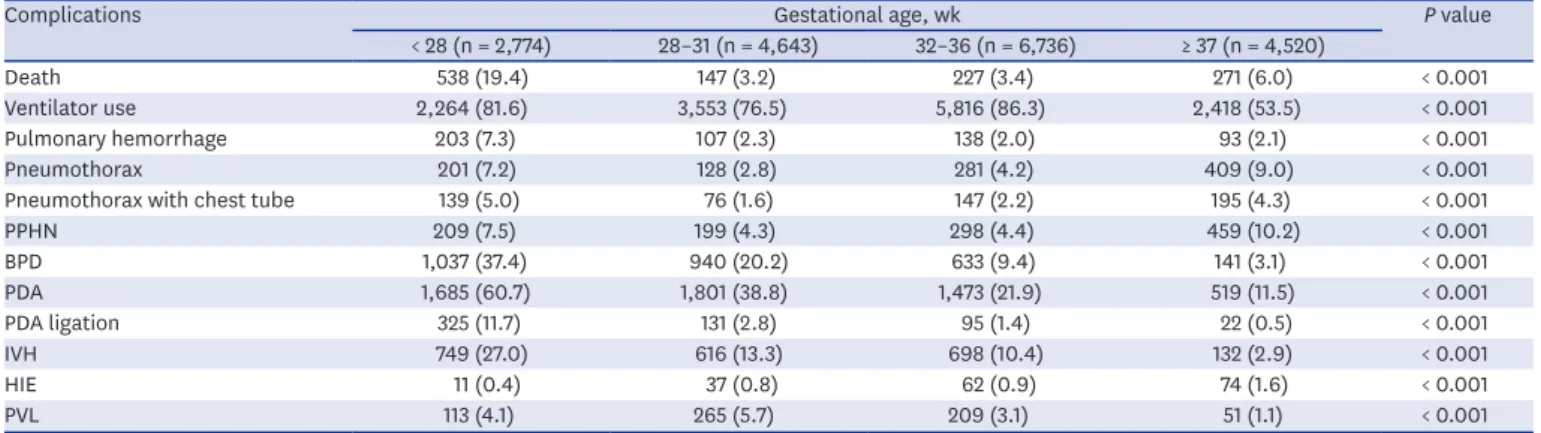
Among patients with PS treatment, the number of preterm infants was 3.3 times higher than that of term infants (76.8% vs. 23.2%). The mortality rate associated with RDS was 6.3%, which showed a decreasing trend according to the year (Table 2). Among the 18,673 (96%
of the total cohort) infants with available data for gestational age, the mortality rate was significantly higher in the lower gestational age group (Tables 3 and 4). Morbidity, including pulmonary hemorrhage, BPD, PDA, and IVH was also higher in the lower gestational age group.
However, pneumothorax most frequently occurred in the term infant group (Tables 3 and 4).
Table 1. Incidence of RDS in term and preterm infants (2014–2018)
Characteristics Total 2014 2015 2016 2017 2018
All live birth 1,964,691 435,435 438,420 406,243 357,771 326,822
RDS, overall 19,442 (0.99) 3,637 (0.84) 4,044 (0.92) 4,061 (1.00) 3,907 (1.10) 3,793 (1.16)
Preterm 14,922 (10.6) 2,855 (9.8) 3,241 (10.7) 3,135 (10.7) 2,928 (10.8) 2,763 (11.0)
Term 4,520 (0.25) 782 (0.19) 803 (0.20) 926 (0.25) 979 (0.30) 1,030 (0.34)
BW, g
< 1,500 6,495 (48.1) 1,209 (43.2) 1,350 (45.0) 1,330 (47.5) 1,343 (53.7) 1,263 (52.6)
1,500–2,500 5,228 (5.1) 1,018 (4.6) 1,205 (5.5) 1,123 (5.4) 989 (5.1) 893 (5.0)
≥ 2,500 4,520 (0.25) 782 (0.19) 803 (0.19) 926 (0.24) 979 (0.29) 1,030 (0.34)
Data are presented as number (%). Percentage of RDS in each subgroup was presented as the number of RDS per the number of live birth of that subgroup. The data of live births was driven from birth certification data from Statistics Korea.
RDS = respiratory distress syndrome, BW = birth weight.
Seoul (1.56)
Incheon (0.46)
Gangwon (0.80)
Chungbuk (0.30) Chungnam
(0.63) Gyeonggi
(0.68)
Gyeongbuk (0.13)
Gyeongnam (0.98)
Daegu (1.98)
Ulsan (0.74) Busan (2.38) Daejeon
(1.41)
Gwangju (1.08)
Jeonnam (0.38)
Jeonbuk (0.54)
(0.68)Jeju
Incidence (%)
< 0.5 0.5–1.0 1.0–1.5 1.5–2.0 2.0–2.5
Fig. 1. The geographic distribution of the respiratory distress syndrome incidence (% of live births, 2014–2018).
The data were obtained from Health Insurance Review and Assessment database and Statistics Korea.
Table 2. Demographic characteristics and complications of infants with RDS
Characteristics Total (n = 19,442) 2014 (n = 3,637) 2015 (n = 4,044) 2016 (n = 4,061) 2017 (n = 3,907) 2018 (n = 3,793) P value
Male 10,924 (56.2) 2,040 (56.1) 2,204 (54.5) 2,283 (56.2) 2,239 (57.3) 2,158 (56.9) 0.114
Preterm 14,922 (76.8) 2,855 (78.5) 3,241 (80.1) 3,135 (77.2) 2,928 (74.9) 2,763 (72.8) < 0.001
Term 4,520 (23.2) 782 (21.5) 803 (19.9) 926 (22.8) 979 (25.1) 1,030 (27.2) < 0.001
Ventilator use 14,641 (75.3) 2,695 (74.1) 3,006 (74.3) 2,976 (73.3) 2,924 (74.8) 3,040 (80.1) < 0.001
Pulmonary hemorrhage 564 (2.9) 130 (3.6) 115 (2.8) 108 (2.7) 98 (2.5) 113 (3.0) 0.062
Pneumothorax 1,060 (5.5) 190 (5.2) 191 (4.7) 211 (5.2) 222 (5.7) 246 (6.5) 0.098
Pneumothorax in term 409 (9.0) 54 (6.9) 46 (5.7) 89 (9.6) 99 (10.1) 121 (11.7) 0.078
Pneumothorax in preterm 651 (4.3) 136 (4.8) 145 (4.5) 122 (3.9) 123 (4.2) 125 (4.5) 0.522
Pneumothorax with chest tube 580 (3.0) 119 (3.3) 103 (2.5) 114 (2.8) 120 (3.1) 124 (3.3) 0.256
PPHN 1,210 (6.2) 217 (6.0) 204 (5.0) 213 (5.2) 263 (6.7) 313 (8.3) < 0.001
MAS 425 (2.2) 73 (2.0) 65 (1.6) 92 (2.3) 92 (2.4) 103 (2.7) 0.014
BPD 2,914 (15.0) 527 (14.5) 591 (14.6) 640 (15.8) 624 (16.0) 532 (14.0) 0.067
PDA 5,839 (30.0) 1,140 (31.3) 1,150 (28.4) 1,152 (28.4) 1,246 (31.9) 1,151 (30.3) < 0.001
PDA ligation 616 (3.2) 141 (3.9) 110 (2.7) 87 (2.1) 118 (3.0) 160 (4.2) < 0.001
IVH 2,326 (12.0) 471 (13.0) 470 (11.6) 450 (11.1) 467 (12.0) 468 (12.3) 0.120
HIE 191 (1.0) 16 (0.4) 25 (0.6) 27 (1.5) 58 (1.5) 65 (1.7) < 0.001
PVL 655 (3.4) 85 (2.3) 140 (3.5) 118 (2.9) 179 (4.6) 133 (3.5) < 0.001
Death 1,229 (6.3) 283 (7.8) 234 (5.8) 262 (6.5) 227 (5.8) 223 (5.9) 0.001
Data are presented as number (%).
RDS = respiratory distress syndrome, PPHN = persistent pulmonary hypertension, MAS = meconium aspiration syndrome, BPD = bronchopulmonary dysplasia, PDA = patent ductus arteriosus, IVH = intraventricular hemorrhage, HIE = hypoxic ischemic encephalopathy, PVL = periventricular leukomalacia.
Table 3. Complications of infants with RDS by gestational age group
Complications Gestational age, wk P value
< 28 (n = 2,774) 28–31 (n = 4,643) 32–36 (n = 6,736) ≥ 37 (n = 4,520)
Death 538 (19.4) 147 (3.2) 227 (3.4) 271 (6.0) < 0.001
Ventilator use 2,264 (81.6) 3,553 (76.5) 5,816 (86.3) 2,418 (53.5) < 0.001
Pulmonary hemorrhage 203 (7.3) 107 (2.3) 138 (2.0) 93 (2.1) < 0.001
Pneumothorax 201 (7.2) 128 (2.8) 281 (4.2) 409 (9.0) < 0.001
Pneumothorax with chest tube 139 (5.0) 76 (1.6) 147 (2.2) 195 (4.3) < 0.001
PPHN 209 (7.5) 199 (4.3) 298 (4.4) 459 (10.2) < 0.001
BPD 1,037 (37.4) 940 (20.2) 633 (9.4) 141 (3.1) < 0.001
PDA 1,685 (60.7) 1,801 (38.8) 1,473 (21.9) 519 (11.5) < 0.001
PDA ligation 325 (11.7) 131 (2.8) 95 (1.4) 22 (0.5) < 0.001
IVH 749 (27.0) 616 (13.3) 698 (10.4) 132 (2.9) < 0.001
HIE 11 (0.4) 37 (0.8) 62 (0.9) 74 (1.6) < 0.001
PVL 113 (4.1) 265 (5.7) 209 (3.1) 51 (1.1) < 0.001
Data are presented as number (%).
RDS = respiratory distress syndrome, BPD = bronchopulmonary dysplasia, PDA = patent ductus arteriosus, IVH = intraventricular hemorrhage, HIE = hypoxic ischemic encephalopathy, PVL = periventricular leukomalacia, PPHN = persistent pulmonary hypertension.
Table 4. Complications of infants with RDS by birth weight group
Complications Birth weight, g P value
< 1,000 (n = 3,071) 1,000–1,500 (n = 3,424) 1,500–2,500 (n = 5,228) > 2,500 (n = 4,520)
Death 585 (19.0) 103 (3.0) 106 (2.0) 271 (6.0) < 0.001
Ventilator use 2,521 (82.1) 2,567 (75.0) 4,474 (85.6) 2,418 (53.5) < 0.001
Pulmonary hemorrhage 247 (8.0) 89 (2.6) 66 (1.3) 93 (2.1) < 0.001
Pneumothorax 226 (7.4) 104 (3.0) 149 (2.9) 409 (9.0) < 0.001
Pneumothorax with chest tube 145 (4.7) 57 (1.7) 72 (1.4) 195 (4.3) < 0.001
PPHN 264 (8.6) 133 (3.9) 192 (3.7) 459 (10.2) < 0.001
BPD 1,129 (36.8) 832 (24.3) 472 (9.0) 141 (3.1) < 0.001
PDA 1,853 (60.3) 1,492 (43.6) 1,203 (23.0) 519 (11.5) < 0.001
PDA ligation 346 (11.3) 129 (3.8) 55 (1.1) 22 (0.5) < 0.001
IVH 786 (25.6) 531 (15.5) 543 (10.4) 132 (2.9) < 0.001
HIE 16 (0.5) 18 (0.5) 51 (1.0) 74 (1.6) < 0.001
PVL 129 (4.2) 171 (5.0) 221 (4.2) 51 (1.1) < 0.001
Data are presented as number (%).
RDS = respiratory distress syndrome, BPD = bronchopulmonary dysplasia, PDA = patent ductus arteriosus, IVH = intraventricular hemorrhage, HIE = hypoxic ischemic encephalopathy, PVL = periventricular leukomalacia, PPHN = persistent pulmonary hypertension.
The complications associated with RDS according to the gestational age group are shown in Tables 3 and 4. There were 16,243 (84%) patients for whom data were available for subgroup analysis according to the birth weight. The incidence of most RDS complications was higher in the lower birth weight group; however, the incidence of pneumothorax was higher for the infants with birth weight ≥ 2,500 g (Tables 3 and 4).
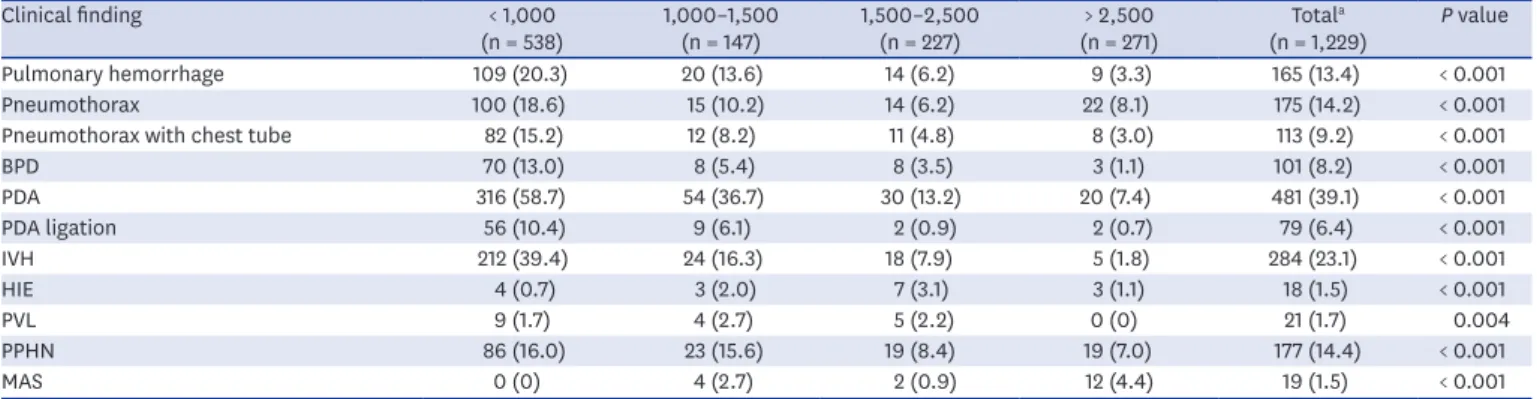
Pulmonary hemorrhage and pneumothorax in deceased infants with RDS (n = 1,229) showed higher incidence compared to those in whole population in this cohort (13.4% vs. 2.9%, 14.2% vs. 5.5%, respectively) (Tables 2 and 5). Pulmonary hemorrhage, pneumothorax, persistent pulmonary hypertension, BPD and IVH were shown as an independent risk factor of the mortality after adjusting gestational age and RDS-related complications (OR, 3.94, 3.05, 2.21, 1.28, and 1.64, respectively). Gestational age was independently associated with the mortality of infants with RDS, which showed significantly high OR 4.70 in the infants <
28 weeks compared to the term infants, and lower odds in the infants with 28–36 weeks than term infants (Table 6).
Table 5. Morbidity of infants with RDS who died
Clinical finding < 1,000
(n = 538) 1,000–1,500
(n = 147) 1,500–2,500
(n = 227) > 2,500
(n = 271) Totala
(n = 1,229) P value
Pulmonary hemorrhage 109 (20.3) 20 (13.6) 14 (6.2) 9 (3.3) 165 (13.4) < 0.001
Pneumothorax 100 (18.6) 15 (10.2) 14 (6.2) 22 (8.1) 175 (14.2) < 0.001
Pneumothorax with chest tube 82 (15.2) 12 (8.2) 11 (4.8) 8 (3.0) 113 (9.2) < 0.001
BPD 70 (13.0) 8 (5.4) 8 (3.5) 3 (1.1) 101 (8.2) < 0.001
PDA 316 (58.7) 54 (36.7) 30 (13.2) 20 (7.4) 481 (39.1) < 0.001
PDA ligation 56 (10.4) 9 (6.1) 2 (0.9) 2 (0.7) 79 (6.4) < 0.001
IVH 212 (39.4) 24 (16.3) 18 (7.9) 5 (1.8) 284 (23.1) < 0.001
HIE 4 (0.7) 3 (2.0) 7 (3.1) 3 (1.1) 18 (1.5) < 0.001
PVL 9 (1.7) 4 (2.7) 5 (2.2) 0 (0) 21 (1.7) 0.004
PPHN 86 (16.0) 23 (15.6) 19 (8.4) 19 (7.0) 177 (14.4) < 0.001
MAS 0 (0) 4 (2.7) 2 (0.9) 12 (4.4) 19 (1.5) < 0.001
Data are presented as number (%).
RDS = respiratory distress syndrome, BPD = bronchopulmonary dysplasia, PDA = patent ductus arteriosus, IVH = intraventricular hemorrhage, HIE = hypoxic ischemic encephalopathy, PVL = periventricular leukomalacia, PPHN = persistent pulmonary hypertension, MAS = meconium aspiration syndrome.
aTotal number of infants with RDS who died. The number available for birth weight data was 1,183 (96%).
Table 6. The factors associated with death among RDS infants
Variables OR 95% CI P value
Gestational age < 0.001
< 28 vs. ≥ 37 4.70 3.93–5.51
28–31 vs. ≥ 37 0.63 0.50–0.80
32–36 vs. ≥ 37 0.61 0.58–0.73
Pulmonary hemorrhage 3.94 3.14–4.94 < 0.001
Pneumothorax with chest tube 3.05 2.41–3.86 < 0.001
BPD 0.28 0.18–0.29 < 0.001
PDA ligation 0.94 0.71–1.25 0.664
IVH 1.64 1.38–1.94 < 0.001
HIE 1.52 0.89–2.60 0.129
PVL 0.54 0.34–0.86 0.009
PPHN 2.21 1.81–2.69 < 0.001
MAS 0.64 0.40–1.05 0.076
RDS = respiratory distress syndrome, OR = odds ratio, CI = confidence interval, BPD = bronchopulmonary dysplasia, PDA = patent ductus arteriosus, IVH = intraventricular hemorrhage, HIE = hypoxic ischemic encephalopathy, PVL = periventricular leukomalacia, PPHN = persistent pulmonary hypertension, MAS = meconium aspiration syndrome.
DISCUSSION
In this study, we used national epidemiologic data and found an incidence of 1% of RDS with PS replacement therapy and relating mortality and morbidity. Our results showed that the incidence of RDS is consistently increasing in term infants despite decreasing trends in the birth rates. During the 5-year study period, the number of PS-treated term infants increased by 250, while the birth rate decreased by 100,000. RDS was prevalent in 0.34% of term infants in 2018 compared to 0.19% in 2014. This indicates either a possibility of increasing RDS incidence or a trend of active PS replacement in term infants.
In Korea, after formal import of the PS preparations, the outcomes of PS replacement therapy were reported in multicenter studies, including 60 patients in 16 hospitals in 1993,16 1,066 patients in 64 hospitals in 1997,17 1,596 patients in 62 hospitals in 2004,12 1,921 patients in 57 hospitals in 2009,13 and 3,160 patients in 72 hospitals in 2011.11 The mortality rate associated with RDS significantly decreased and was reported to be 40.0% in 1990/1991, 28.7% in 1996, 18.7% in 2002, 14.3% in 2007, and 10.1% in 2010.11-13,16,17 However, these data are limited to before 2010, when the extended insurance coverage was not applicable. As insurance coverage was extended to include PS replacement therapy in 2011, our results can represent all patients treated with PSs in Korea, as this study is based on the national health insurance data.
With respect to the complications associated with RDS, the prevalence of pneumothorax and pulmonary hemorrhage was not significantly changed over 5 years among all infants with RDS treated with PS. However, among the term infants, the incidence of pneumothorax notably increased from 6.9% up to 11.7%. On the other hand, the incidence of pneumothorax in neonates who admitted to NICU was reported as 0.5% to 1.3% in previous single center studies in Korea.18,19 This can be interpreted as increased surfactant-related complications or underlying severe pulmonary pathology in term infants. In addition, the ideal treatment of RDS is often delayed in term infants delivered in local hospital, which can contribute the higher incidence of pneumothorax than that in preterm infants who are mostly delivered in general or university hospital. Careful observation for pneumothorax and timely consideration for PS therapy can be needed.
The incidence of RDS decreases with advancing gestational age, from approximately 60%–80% in infants born at 26–28 weeks of gestation to approximately 15%–30% among those born at 32–36 weeks of gestation.20,21 In our study, we found that RDS was prevalent in 10.6% of the preterm infants born at less than 37 weeks of gestation, 48.1% of infants below 1,500 g. From the annual report of Korean Neonatal Network (KNN), the incidence of RDS among VLBWIs was 75.9% in 2018, which showed higher than our result based on HIRA database and Statistics Korea.22 We also found that the incidence of RDS treated with PS consistently increased in the VLBW patients from 43.2% to 52.6%. However, according to the annual KNN reports, PS administration showed 3.7% of decrease during 2014–2018.22,23 The difference may occur because the number of VLBWIs registered to KNN was smaller than that registered to Statistics Korea and HIRA. Also, this discrepancy in the incidence of RDS with PS may be due to omission of the detail information about the gestational age (4%), birth weight (16%), or due to the use of non-reimbursable PSs, which can lead to the underestimation of the total number of VLBWIs and/or the rates of PS administration.
The incidence of RDS at 32 weeks of gestation was approximately 30% in the US in the 1990s.24 And Hibbard et al.25 reported that the incidence of RDS was 10.5% in infants at 34
weeks of gestation and 2.8% in infants at 36 weeks of gestation. The Danish Medical Birth Registry Cohort showed that the incidence of RDS in infants born at 32–36 weeks of gestation was approximately 5.7%.26 In the same study, the incidence of intracranial or IVH was 2.0%
and of PDA was 3.4% in the RDS group. In our study, the incidence of IVH or PDA is higher than previous study, it is necessary to take careful consideration for preventing complication among the late preterm infants.
The burden of RDS in the near-term and term infants has been recently highlighted, and an increasing number of studies have suggested that the clinical presentation in the near- term and term infants may be different from that observed in the very preterm infants.1,27 Recent studies have suggested that in addition to PS deficiency, there are other dominant causes leading to RDS, especially in the near-term and term infants; such as elective cesarean section, maternal diabetes or hypertension.4,28,29 Tsakalidis et al.30 reported that RDS in premature infants aged < 35 weeks of gestation can be adequately treated with a single dose of surfactant, but the near-term and term infants with RDS require multiple doses of surfactant.
In another study, 48 per 1,986 (2.42%) neonates developed RDS, of which 7 (14.6%) weighed
≥ 2,500 g.31 In our study, PS was used in 0.25% of the term infants, and the incidence of accompanying pneumothorax was higher than that in the preterm infants, indicating a different pathophysiology of RDS and/or complicated conditions such as delivery room care, times at treatment, and transport to another hospitals in the term infants.
The diagnosis of RDS is based on the decision by neonatologists according to the clinical manifestations and chest X-ray findings. The dose and infant position during PS administration depend on the manufacturer's instructions, and no universal guidelines are available to date. There can be some variance of practice within hospitals and among doctors.
There are some limitations of this study. We did not include data on the severity of conditions and health behavior of the recipients. As the information, including gestational age or birth weight was obtained from diagnosis codes inputted by the hospital, some data on RDS may have been omitted or limited information about the diseases of the patients may have been available. There is also a discrepancy between the diagnoses entered in the data and the actual disease experienced by the patient has. And there was a limit to clarify the clinical significance of RDS complications such as IVH or PDA. Further, as the claims data are generated to reimburse the healthcare services eligible for coverage, healthcare services not covered by insurance were not assessed. The information about the residence of beneficiaries may not be reliable because the HIRA data are collected based on the location of the providers. The area where the beneficiary has received the healthcare service may be different from the area where the beneficiary resides. However, despite these limitations, we believe that our study is valuable because the use of national health insurance data makes our findings reflective of the latest national epidemiology on RDS and PS replacement therapy. Accordingly, the findings can be used for developing related public health policies and intervention for further RDS control.
In conclusion, the advances in neonatal care and extended insurance coverage have increased the use of surfactant replacement therapy for RDS, and this, in turn, has decreased the neonatal mortality rate. The incidence of complications, such as pneumothorax, PDA, IVH, and BPD, showed a decreasing trend in the term infants, except for pneumothorax. Term and near-term RDS should be differentiated, and the appropriate therapeutic strategy for RDS should be decided according to the gestational age and lung pathology.
ACKNOWLEGMENTS
The authors thank Medical Illustration & Design (MID) for helping to design Fig. 1.
REFERENCES
1. Engle WA; American Academy of Pediatrics Committee on Fetus and Newborn. Surfactant-replacement therapy for respiratory distress in the preterm and term neonate. Pediatrics 2008;121(2):419-32.
PUBMED | CROSSREF
2. Polin RA, Carlo WA; Committee on Fetus and Newborn; American Academy of Pediatrics. Surfactant replacement therapy for preterm and term neonates with respiratory distress. Pediatrics 2014;133(1):156-63.
PUBMED | CROSSREF
3. Soll R, Ozek E. Multiple versus single doses of exogenous surfactant for the prevention or treatment of neonatal respiratory distress syndrome. Cochrane Database Syst Rev 2009;(1):CD000141.
PUBMED | CROSSREF
4. Moya F, Sinha S, D'Agostino RB Sr. Surfactant-replacement therapy for respiratory distress syndrome in the preterm and term neonate: congratulations and corrections. Pediatrics 2008;121(6):1290-1.
PUBMED | CROSSREF
5. Bae CW, Kim CY, Chung SH, Choi YS. History of pulmonary surfactant replacement therapy for neonatal respiratory distress syndrome in Korea. J Korean Med Sci 2019;34(25):e175.
PUBMED | CROSSREF
6. Bae CW. The history of neonatology in Korea. J Korean Med Assoc 2016;59(7):490-7.
CROSSREF
7. Shim JW, Jin HS, Bae CW. Changes in survival rate for very-low-birth-weight infants in Korea: comparison with other countries. J Korean Med Sci 2015;30 Suppl 1:S25-34.
PUBMED | CROSSREF
8. Hahn WH, Chang JY, Chang YS, Shim KS, Bae CW. Recent trends in neonatal mortality in very low birth weight Korean infants: in comparison with Japan and the USA. J Korean Med Sci 2011;26(4):467-73.
PUBMED | CROSSREF
9. Chung SH, Bae CW. Improvement in the survival rates of very low birth weight infants after the establishment of the Korean Neonatal Network: comparison between the 2000s and 2010s. J Korean Med Sci 2017;32(8):1228-34.
PUBMED | CROSSREF
10. Aldana-Aguirre JC, Pinto M, Featherstone RM, Kumar M. Less invasive surfactant administration versus intubation for surfactant delivery in preterm infants with respiratory distress syndrome: a systematic review and meta-analysis. Arch Dis Child Fetal Neonatal Ed 2017;102(1):F17-23.
PUBMED | CROSSREF
11. Bae CW, Hahn WH, Chang JY, Kim SM. Surfactant replacement therapy for RDS: a collaborative study of 72 multi-center trials in Korea (2010) and a review of Korean experiences over 20 years. J Korean Soc Neonatol 2011;18(2):409-11.
CROSSREF
12. Bae CW, Kim YM. Surfactant therapy for neonatal respiratory distress syndrome: experience in Korea over 15 years. Korean J Pediatr 2004;47(9):940-8.
13. Bae CW, Hahn WH. Surfactant therapy for neonatal respiratory distress syndrome: a review of Korean experiences over 17 years. J Korean Med Sci 2009;24(6):1110-8.
PUBMED | CROSSREF
14. Kim L, Kim JA, Kim S. A guide for the utilization of Health Insurance Review and Assessment Service national patient samples. Epidemiol Health 2014;36:e2014008.
PUBMED | CROSSREF
15. Statistics Korea. http://kosis.kr/eng/statisticsList/statisticsListIndex.do?menuId=M_01_01&vwcd=MT_
ETITLE&parmTabId=M_01_01#SelectStatsBoxDiv. Updated 2019. Accessed March 31, 2020.
16. Bae CW, Kwon YD, Ko SJ, Kim KS, Kim HM, Park WS, et al. Surfactant replacement therapy in neonates with respiratory distress syndrome: a collective evaluation of trials from 16 hospitals. J Korean Pediatr Soc 1993;36(2):244-65.
17. Bae CW. Surfactant replacement therapy in RDS: a collaborative study of multi-center trials in Korea. J Korean Soc Neonatol 1997;4(1):124-35.
18. Lim HS, Kim H, Jin JY, Shin YL, Park JO, Kim CH, et al. Characteristics of pneumothorax in a neonatal intensive care unit. J Korean Soc Neonatol 2011;18(2):257-64.
CROSSREF
19. Park SW, Yun BH, Kim KA, Ko SY, Lee YK, Shin SM. A clinical study about symptomatic spontaneous pneumothorax. Korean J Perinatol 2006;17(3):304-9.
20. Stoelhorst GM, Rijken M, Martens SE, Brand R, den Ouden AL, Wit JM, et al. Changes in neonatology:
comparison of two cohorts of very preterm infants (gestational age <32 weeks): the project on preterm and small for gestational age infants 1983 and the Leiden follow-up project on prematurity 1996–1997.
Pediatrics 2005;115(2):396-405.
PUBMED | CROSSREF
21. Ventolini G, Neiger R, Mathews L, Adragna N, Belcastro M. Incidence of respiratory disorders in neonates born between 34 and 36 weeks of gestation following exposure to antenatal corticosteroids between 24 and 34 weeks of gestation. Am J Perinatol 2008;25(2):79-83.
PUBMED | CROSSREF
22. The Executive Committee of Korean Neonatal Network. 2018 Korean Neonatal Network Annual Report.
Cheongju: Korean Centers for Disease Control and Prevention; 2019.
23. The Executive Committee of Korean Neonatal Network. 2014 Korean Neonatal Network Annual Report.
Cheongju: Korean Centers for Disease Control and Prevention; 2015.
24. Koivisto M, Marttila R, Kurkinen-Räty M, Saarela T, Pokela ML, Jouppila P, et al. Changing incidence and outcome of infants with respiratory distress syndrome in the 1990s: a population-based survey. Acta Paediatr 2004;93(2):177-84.
PUBMED | CROSSREF
25. Hibbard J, Wilkins I, Sun L, Gregory K, Haberman S, Hoffman M, et al. Respiratory morbidity in late preterm births. JAMA 2010;304(4);419-25.
PUBMED | CROSSREF
26. Thygesen SK, Olsen M, Østergaard JR, Sørensen HT. Respiratory distress syndrome in moderately late and late preterm infants and risk of cerebral palsy: a population-based cohort study. BMJ open 2016;6(10):e011643.
PUBMED | CROSSREF
27. Mathews TJ, MacDorman MF. Infant mortality statistics from the 2005 period linked birth/infant death data set. Natl Vital Stat Rep 2008;57(2):1-32.
PUBMED
28. Ware LB, Matthay MA. Alveolar fluid clearance is impaired in the majority of patients with acute lung injury and the acute respiratory distress syndrome. Am J Respir Crit Care Med 2001;163(6):1376-83.
PUBMED | CROSSREF
29. Condò V, Cipriani S, Colnaghi M, Bellù R, Zanini R, Bulfoni C, et al. Neonatal respiratory distress syndrome: are risk factors the same in preterm and term infants? J Matern Fetal Neonatal Med 2017;30(11):1267-72.
PUBMED | CROSSREF
30. Tsakalidis C, Giougki E, Karagianni P, Dokos C, Rallis D, Nikolaidis N. Is there a necessity for multiple doses of surfactant for respiratory distress syndrome of premature infants? Turk J Pediatr 2012;54(4):368-75.
PUBMED
31. Nagendra K, Wilson CG, Ravichander B, Sood S, Singh SP. Incidence and etiology of respiratory distress in newborn. Med J Armed Forces India 1999;55(4):331-3.
PUBMED | CROSSREF