Received:March 31, 2020, Revised:May 8, 2020, Accepted:May 15, 2020 Corresponding to:Young Ho Lee http://orcid.org/0000-0003-4213-1909
Division of Rheumatology, Department of Internal Medicine, Korea University Anam Hospital, Korea University College of Medicine, 73 Goryeodae-ro, Seongbuk-gu, Seoul 02841, Korea. E-mail:[email protected]
Copyright ⓒ 2020 by The Korean College of Rheumatology. All rights reserved.
This is an Open Access article, which permits unrestricted non-commerical use, distribution, and reproduction in any medium, provided the original work is properly cited.
Association Between Signal Transducers and Activators of Transcription 4 rs7574865 Polymorphism and Systemic Lupus Erythematosus: A Meta-analysis
Young Ho Lee, M.D., Ph.D., Gwan Gyu Song, M.D., Ph.D.
Department of Rheumatology, Korea University College of Medicine, Seoul, Korea
Objective. The purpose of this study was to determine whether the rs7574865 polymorphism of signal transducers and tran- scription 4 activators (STAT4) in multiple ethnic populations is associated with susceptibility to systemic lupus erythematosus (SLE). Methods. A meta-analysis on the STAT4 T allele rs7574865 polymorphism was performed in all subjects of study as well as in each ethnic population. Results. It included twenty-four manuscripts with 36 comparative studies of 22,898 SLE patients and 24,838 controls. The mean frequency of the STAT4 rs7574865 T allele was 28.5%, ranging from 14.3% to 35.7%, among the controls. T allele rates were 14.3%, 22.8%, 31.9%, 32.4%, and 35.7%, respectively in African American, European, Arab, Asian, and Latin American populations. Meta-analysis revealed a substantial correlation in all subjects between STAT4 rs7574865 and SLE (odds ratio=1.549, 95% confidence interval=1.459∼1.644, p<0.001). Analysis after stratification of race showed a strong association between the STAT4 rs7574865 T allele and SLE in Europeans, Asians, Latin Americans, African Americans, and Arabs. Conclusion. This meta-analysis demonstrated that the STAT4 rs7574865 polymorphism in different eth- nic groups was correlated with SLE susceptibility, and that its prevalence depended on ethnicity. (J Rheum Dis 2020;27:277-284)
Key Words. STAT4 transcription factor, Genetic polymorphism, Systemic lupus erythematosus, Meta-analysis
INTRODUCTION
Signal transducers and activators of transcription (STATs) are transcription factors that locate in the cyto- plasm, where they are phosphorylated by membrane- bound receptors and then translocate to the nucleus [1].
STATs control the entire hematopoietic process by regu- lating cytokine binding to specific cell-surface receptors [1]. STAT4, in particular, is a member of the STAT family, which is activated by interleukin-12 (IL-12) through its receptor and plays an essential downstream role in cell differentiation and proliferation. The system of type I in- terferon (IFN) plays an important role in the initiation and development of systemic lupus erythematosus (SLE) [2], and STAT4 induces the output of IFN-ÿ. STAT4 is al- so involved in the development of Th17 cells which have
a dominant role in autoimmune-associated inflammation [3]. The polymorphism of STAT4 rs7574865 is located within the third intron of the gene. Notably, there is no evidence to suggest that this intronic polymorphism by it- self is directly related to changes in protein function.
Nevertheless, the STAT4 rs7574865 polymorphism shows the strongest association with autoimmunity, and several SNPs are strongly associated with this intronic SNP [4].
The STAT4 rs7574865 polymorphism has been reported to be associated with SLE in multiple ethnic groups [5-28]. Allelic frequencies of genes are usually significantly different among populations; therefore, ethnicity-specific association studies are needed to confirm genetic associa- tions in various ethnic populations. In this research, we used a meta-analysis method to examine the relationship between the STAT4 rs7574865 polymorphism and SLE
susceptibility in various populations.
MATERIALS AND METHODS
Identification of eligible studies and data extraction
We searched for reports investigating the relationships between SLE and STAT4 polymorphisms. The MEDLINE and EMBASE databases were searched for available stud- ies which analyzed STAT4 polymorphisms in SLE pa- tients (up to January 2020). As Medical Subject Headings (MeSH) or text words, keyword combinations such as
“interferon regulatory factor,” “STAT4,” “polymorphism,”
“rs7574865,” “systemic lupus erythematosus,” and “SLE”
were entered. References were also investigated in the se- lected studies to identify additional research not indexed by the electronic databases. No limitations were imposed on language or region. Studies were included if: (1) case-control studies, (2) data were original (independent of studies), and (3) adequate data were given to measure an odds ratio (OR). We excluded studies according to the following criteria: (1) studies containing duplicate data, (2) studies in which they were not possible to determine the number of null and wild genotypes or alleles, and (3) studies in which family members were studied, because these analyzes are based on considerations of linkage.
From each research, the following information was ex- tracted: author, year of publication, ethnicity of the study population, demographics, number of cases and controls, and the allele frequency of the STAT4 rs7574865 poly- morphism. Any differences among reviewers were re- solved by consensus, and the meta-analysis was carried out in accordance with the guidelines of PRISMA [29].
Evaluation of statistical associations
In each study the frequency of the STAT4 rs7574865 T allele was determined using the method of allele counting.
Meta-analyzes were then carried out using the contrast model for the alleles. For each report, point estimates of risk, ORs, and confidence intervals (CI) of 95% were determined. Moreover, heterogeneities within and be- tween the studies were evaluated using Q-statistics from Cochran. This heterogeneity test evaluated the null hy- pothesis all studies were evaluating the same effect. The effect of heterogeneity was measured using I2, which ranged from 0%∼100% and reflected the proportion of inter-study variation that could be due to heterogeneity rather than chance [30]. Nominally allocated as low mod-
erate, and high values were I2 values of 25%, 50%, and 75%. The model of fixed effects presumed that genetic factors had similar effects on SLE susceptibility through- out all studies, and that the observed differences between studies were caused by chance alone [31]. The model of random effects assumed that different studies displayed significant variability and measured both in-study sam- pling error and inter-study variance [32]. In case of sig- nificant inter-study heterogeneity, the random effects model was used [33]. Otherwise, fixed effect model was chosen. Statistical manipulations were carried out using the Comprehensive Meta-Analysis software (Biostat, Englewood, NJ, USA).
Evaluation of heterogeneity, sensitivity, and publication bias
Subgroup analyzes were conducted based on ethnicity in order to explore the potential sources of heterogeneity found in this meta-analysis. In addition, sensitivity analy- sis was carried out not only to determine the effect of each individual study on pooled ORs by removing each in- dividual study, but also to examine the statistically robust effects of this meta-analysis. While funnel plots have been used to detect publishing bias, they demand several studies of different sample sizes involving subjective judgements. Therefore, we evaluated publishing bias us- ing Egger's linear regression test, which measures funnel plot asymmetry using a natural OR logarithm scale [34].
RESULTS
Studies included in the meta-analysis
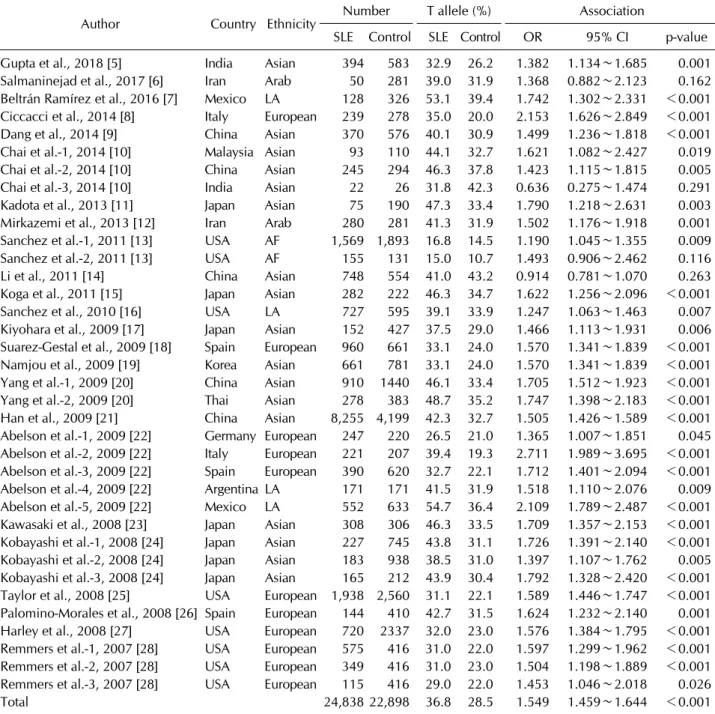
A total of 259 studies were identified using electronic and manual searches, of which 36 were chosen for a full-text review based on the contents of the title and abstract. Twelve of these 36 studies have been omitted, ei- ther because they did not contain data on rs7574865 or overlapping data. Of the 24 studies that met the inclusion criteria [6-29], 3 studies contained data from 3 different groups [10,24,28], 1 studies contained data from 5 differ- ent groups [22] and 1 studies contained data from 2 dif- ferent groups [20]. In this meta-analysis, which con- tained 22,898 SLE patients and 24,838 controls from 11 European, 17 Asian, 4 Latin American, 21 Arab, and 2 African American populations, a total of 36 different com- parisons were considered (Table 1). Meta-analyzes specif- ic to ethnicity were carried out on each ethnic population.
Table 1. Characteristics of individual studies included in meta-analysis
Author Country Ethnicity Number T allele (%) Association
SLE Control SLE Control OR 95% CI p-value Gupta et al., 2018 [5] India Asian 394 583 32.9 26.2 1.382 1.134∼1.685 0.001 Salmaninejad et al., 2017 [6] Iran Arab 50 281 39.0 31.9 1.368 0.882∼2.123 0.162 Beltrán Ramírez et al., 2016 [7] Mexico LA 128 326 53.1 39.4 1.742 1.302∼2.331 <0.001 Ciccacci et al., 2014 [8] Italy European 239 278 35.0 20.0 2.153 1.626∼2.849 <0.001 Dang et al., 2014 [9] China Asian 370 576 40.1 30.9 1.499 1.236∼1.818 <0.001 Chai et al.-1, 2014 [10] Malaysia Asian 93 110 44.1 32.7 1.621 1.082∼2.427 0.019 Chai et al.-2, 2014 [10] China Asian 245 294 46.3 37.8 1.423 1.115∼1.815 0.005 Chai et al.-3, 2014 [10] India Asian 22 26 31.8 42.3 0.636 0.275∼1.474 0.291 Kadota et al., 2013 [11] Japan Asian 75 190 47.3 33.4 1.790 1.218∼2.631 0.003 Mirkazemi et al., 2013 [12] Iran Arab 280 281 41.3 31.9 1.502 1.176∼1.918 0.001 Sanchez et al.-1, 2011 [13] USA AF 1,569 1,893 16.8 14.5 1.190 1.045∼1.355 0.009 Sanchez et al.-2, 2011 [13] USA AF 155 131 15.0 10.7 1.493 0.906∼2.462 0.116 Li et al., 2011 [14] China Asian 748 554 41.0 43.2 0.914 0.781∼1.070 0.263 Koga et al., 2011 [15] Japan Asian 282 222 46.3 34.7 1.622 1.256∼2.096 <0.001 Sanchez et al., 2010 [16] USA LA 727 595 39.1 33.9 1.247 1.063∼1.463 0.007 Kiyohara et al., 2009 [17] Japan Asian 152 427 37.5 29.0 1.466 1.113∼1.931 0.006 Suarez-Gestal et al., 2009 [18] Spain European 960 661 33.1 24.0 1.570 1.341∼1.839 <0.001 Namjou et al., 2009 [19] Korea Asian 661 781 33.1 24.0 1.570 1.341∼1.839 <0.001 Yang et al.-1, 2009 [20] China Asian 910 1440 46.1 33.4 1.705 1.512∼1.923 <0.001 Yang et al.-2, 2009 [20] Thai Asian 278 383 48.7 35.2 1.747 1.398∼2.183 <0.001 Han et al., 2009 [21] China Asian 8,255 4,199 42.3 32.7 1.505 1.426∼1.589 <0.001 Abelson et al.-1, 2009 [22] Germany European 247 220 26.5 21.0 1.365 1.007∼1.851 0.045 Abelson et al.-2, 2009 [22] Italy European 221 207 39.4 19.3 2.711 1.989∼3.695 <0.001 Abelson et al.-3, 2009 [22] Spain European 390 620 32.7 22.1 1.712 1.401∼2.094 <0.001 Abelson et al.-4, 2009 [22] Argentina LA 171 171 41.5 31.9 1.518 1.110∼2.076 0.009 Abelson et al.-5, 2009 [22] Mexico LA 552 633 54.7 36.4 2.109 1.789∼2.487 <0.001 Kawasaki et al., 2008 [23] Japan Asian 308 306 46.3 33.5 1.709 1.357∼2.153 <0.001 Kobayashi et al.-1, 2008 [24] Japan Asian 227 745 43.8 31.1 1.726 1.391∼2.140 <0.001 Kobayashi et al.-2, 2008 [24] Japan Asian 183 938 38.5 31.0 1.397 1.107∼1.762 0.005 Kobayashi et al.-3, 2008 [24] Japan Asian 165 212 43.9 30.4 1.792 1.328∼2.420 <0.001 Taylor et al., 2008 [25] USA European 1,938 2,560 31.1 22.1 1.589 1.446∼1.747 <0.001 Palomino-Morales et al., 2008 [26] Spain European 144 410 42.7 31.5 1.624 1.232∼2.140 0.001 Harley et al., 2008 [27] USA European 720 2337 32.0 23.0 1.576 1.384∼1.795 <0.001 Remmers et al.-1, 2007 [28] USA European 575 416 31.0 22.0 1.597 1.299∼1.962 <0.001 Remmers et al.-2, 2007 [28] USA European 349 416 31.0 23.0 1.504 1.198∼1.889 <0.001 Remmers et al.-3, 2007 [28] USA European 115 416 29.0 22.0 1.453 1.046∼2.018 0.026
Total 24,838 22,898 36.8 28.5 1.549 1.459∼1.644 <0.001
SLE: systemic lupus erythematosus, OR: odd ratio, CI: confidence interval, LA: Latin American, AF: African American.
Frequency of the STAT4 rs7574865 T allele in different ethnic groups
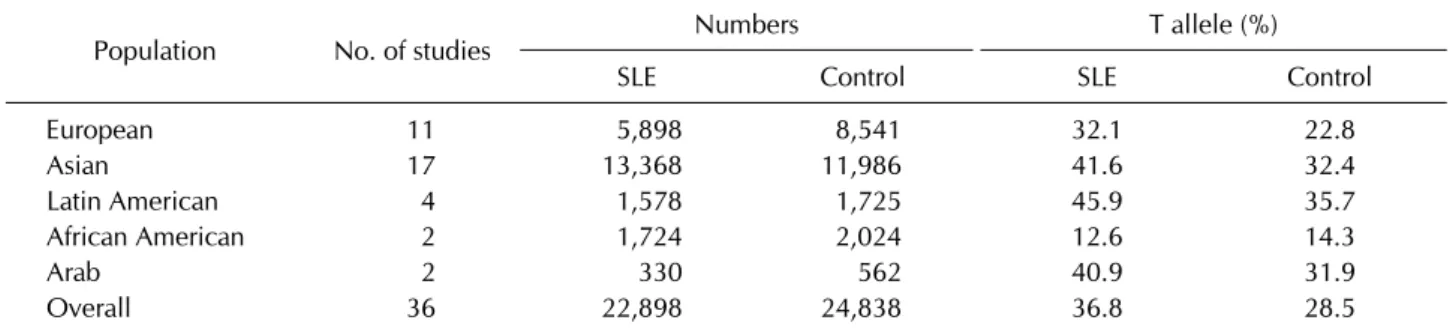
Among the controls, the mean frequency of the STAT4 rs7574865 T allele was 28.5%, varying from 14.3% to 35.7%. While the African American population showed the lowest prevalence of T alleles compared to other eth- nic groups, the highest frequency was demonstrated by the Latin American population (Table 2). The T allele fre- quencies in the African American, European, Arab, Asian, and Latin American populations were 14.3%, 22.8%,
31.9%, 32.4%, and 35.7%, respectively, with respect to normal controls.
Association between the STAT4 rs7574865 polymorphism and SLE
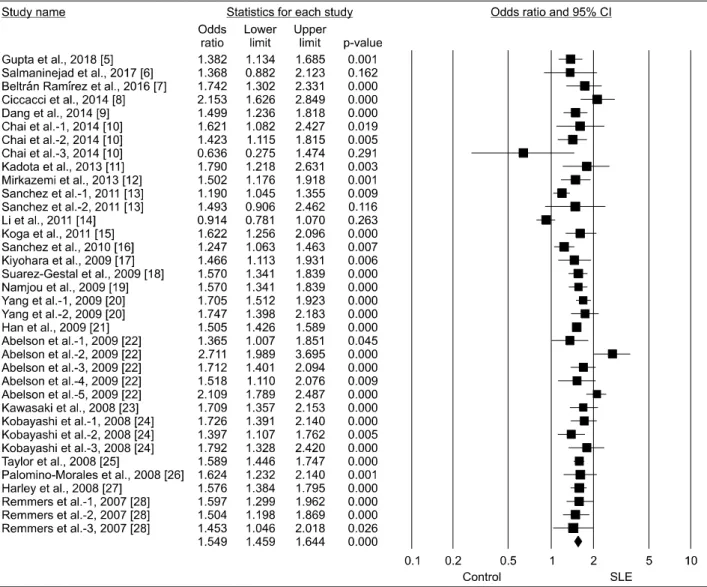
Meta-analysis showed an association in all subjects be- tween SLE and STAT4 rs7574865 polymorphism (OR=
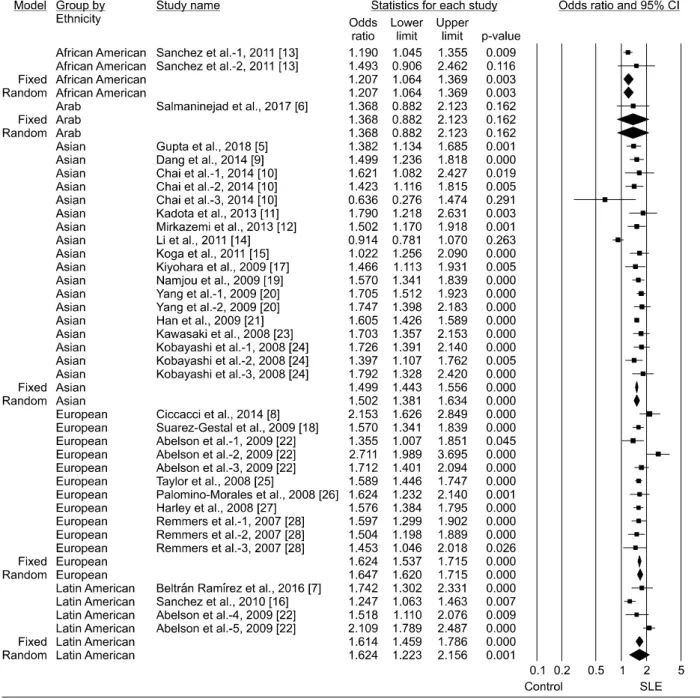
1.549, 95% CI=1.459∼1.644, p<0.001) (Table 3, Figure 1). Analysis after ethnicity stratification revealed that in Europeans, Asians, Latin Americans, African Americans
Table 3. Meta-analysis of the STAT4 rs7574865 polymorphism and SLE association
Polymorphism Population No. of studies
Test of association Test of heterogeneity Publication bias OR 95% CI p-value Model I2 p-value p-value
T allele Overall 36 1.549 1.459∼1.644 <0.001 R 69.4 <0.001 0.560
European 11 1.647 1.520∼1.785 <0.001 R 42.4 0.066 0.323
Asian 17 1.502 1.375∼1.641 <0.001 R 71.0 <0.001 0.920
Latin American 4 1.624 1.223∼2.156 0.001 R 85.4 <0.001 0.946
African American 2 1.207 1.064∼1.369 0.003 F 0 0.388 NA
Arab 2 1.469 1.887∼1.819 <0.001 F 0 0.715 NA
SLE: systemic lupus erythematosus, OR: odd ratio, CI: confidence interval, F: fixed effect model, R: random effect model, NA: not available.
Table 2. Prevalence of the STAT4 rs7574865 polymorphism T allele
Population No. of studies Numbers T allele (%)
SLE Control SLE Control
European 11 5,898 8,541 32.1 22.8
Asian 17 13,368 11,986 41.6 32.4
Latin American 4 1,578 1,725 45.9 35.7
African American 2 1,724 2,024 12.6 14.3
Arab 2 330 562 40.9 31.9
Overall 36 22,898 24,838 36.8 28.5
SLE: systemic lupus erythematosus.
and Arabs, the STAT4 rs7574865 T allele was sig- nificantly associated with SLE (Table 3, Figure 2).
Association between the STAT4 rs7574865 polymorphism and clinical features of SLE
STAT4 rs7574865 was more strongly associated with SLE characterized by double-stranded (ds) DNA anti- bodies, nephritis, and/or age at diagnosis, 30 years [23,25]. Each of 3 studies indicated a strong association between the rs7574865 polymorphism and the pro- duction of anti-Sm antibodies, pericarditis, hematologic disorders and photosensitivity [8,14,20]. However, one study did not detect any correlation between the poly- morphism and the specific clinical manifestations of SLE, such as photosensitivity, malar rash, discoid rash, oral ul- cer, arthritis, pleuritis, pericarditis, proteinuria, seizures, leucopenia, anti-ds DNA, and antinuclear antibody, al- though sample size could be the reason for the insignif- icance in the comparisons [12].
Heterogeneity, sensitivity, and publication bias
Meta-analysis showed between-study heterogeneity be- tween STAT4 rs7574865 polymorphism and SLE in allstudy subjects and in the populations of Europe, Asia and Latin America; however, no heterogeneity was observed in the population of African America. Sensitivity analysis also showed that no single study significantly affected the pooled OR, and excluding two studies with potential overlap data [27,28] did not significantly affected the pooled OR (OR=1.551, 95% CI=1.450∼1.658, p<
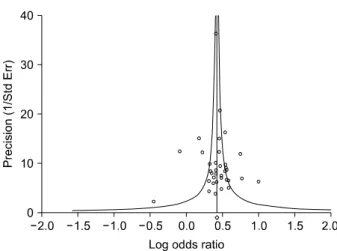
0.001), thereby suggesting that the findings of this meta-analysis are robust. There was no proof of pub- lication bias (Egger's regression test, p>0.1) (Table 3, Figure 3) in the funnel plot and Egger's regression test.
DISCUSSION
In this study, through a comprehensive meta-analysis, we updated information regarding the association be- tween the STAT4 rs7574865 polymorphism and SLE. The T allele prevalence was determined in various pop- ulations, and ethnic-specific meta-analyses were performed.
Notably, rs7574865 T allele prevalence was found to dif- fer among ethnic populations (14.3%∼35.7%). The mean T allele frequency in the controls was 28.5%, which was the lowest among African Americans and the highest
Figure 1. Odd ratio and 95% confidence interval (CI) of individual studies and pooled data for the association between the STAT4 rs7574865 polymorphism T allele and systemic lupus erythematosus (SLE) in all subjects.
among Latin Americans. In addition, ethnicity-specific meta-analysis revealed an association among European, Asian, Latin American, African-American Americans, and Arabs.
The result of this meta-analysis suggests that STAT4 could be a genetic risk factor for SLE, showing similar po- tential across multiple racial groups. Autoimmune dis- eases are triggered through the breakdown of self-toler- ance; therefore, some common pathways are shared.
STAT4 is involved in the signaling pathway of several es- sential cytokines, including IL-12, IFNs, and IL-23 [33].
Previously, STAT4-deficient mice had been shown to be resistant to animal models of diabetes, experimental au- toimmune encephalomyelitis, and arthritis [35]. These results suggest that STAT4 could be a common genetic risk factor for autoimmune diseases.
Interestingly, increased expression of type I IFN-regu- lated genes has previously been documented in the pe- ripheral blood leukocytes of SLE patients, suggesting the role of type I IFN in the pathogenesis of the disease [2].
Notably, rs7574836 polymorphism is located in the third intron of the STAT4 gene, and its functional significance has not yet been established. However, since the hap- lotype susceptibility is located within STAT4 intron 3, it may be responsible for splice variations or changes in STAT4's regulatory effects. In addition, it has also been shown that the STAT4 risk-haplotype increases the sensi- tivity of IFN-α signaling [36]. IFN-matured dendritic cells also present an increased risk of autoimmunity by supporting autoimmune T-and B-cells and by generating increased levels of anti-dsDNA antibody, both of which can contribute to the development of SLE [37].
Figure 2. Odd ratios and 95% confidence intervals (CIs) of individual studies and of pooled data for the association between the T allele and systemic lupus erythematosus (SLE) in each ethnic group.
This meta-analysis differs from an earlier meta-analysis of the relationship between STAT4 rs7574865 poly- morphism and SLE risk conducted by Yuan et al. [38], be- cause this study included 16 more studies, 14,445 more SLE patients, and 11,747 more controls in addition to meta-analysis conducted on Latin American and African American populations. The results of this meta-analysis showing the STAT4 rs7574865 polymorphism as a sus- ceptibility factor for SLE in the European and Asian pop- ulations are in agreement with the results of the previous
study. This meta-analysis also confirmed that the Latin Americans and African Americans associate the STAT4 rs7601754 polymorphism with SLE risk.
There are some limitations to this study which should be considered. First, the analysis may have been affected by heterogeneity and confounding factors, as is com- monly found in any other meta-analysis. Second, the STAT4 polymorphism may be associated with clinical manifestations in addition to the susceptibility to disease.
However, a thorough meta-analysis was not performed by
Figure 3. Funnel plot of studies for the association between the T allele and systemic lupus erythematosus in all subjects (Egger’s regression p-value=0.614). Std err: standard error.
the limited amount of data available on the association between the STAT4 rs7574865 polymorphism and se- verity of the disease and/or clinical features.
CONCLUSION
In conclusion, this meta-analysis, which included 22,898 SLE patients and 24,838 controls, indicates that in multiple ethnic groups the functional STAT4 rs7574865 polymorphism is correlated with SLE susceptibility and that the prevalence of the rs7574865 T allele depends on ethnicity.
CONFLICT OF INTEREST
No potential conflict of interest relevant to this article was reported.
AUTHOR CONTRIBUTIONS
Y.H.L. was involved in conception and design of study, acquisition of data, analysis and/or interpretation of data, drafting the manuscript, revising the manuscript crit- ically for important intellectual content. G.G.S. was in- volved in conception and design of study, analysis and/or interpretation of data, drafting the manuscript
REFERENCES
1. Horvath CM. STAT proteins and transcriptional responses to extracellular signals. Trends Biochem Sci 2000;25:
496-502.
2. Banchereau J, Pascual V. Type I interferon in systemic lupus erythematosus and other autoimmune diseases. Immunity 2006;25:383-92.
3. Korman BD, Kastner DL, Gregersen PK, Remmers EF.
STAT4: genetics, mechanisms, and implications for auto- immunity. Curr Allergy Asthma Rep 2008;8:398-403.
4. Korman BD, Kastner DL, Gregersen PK, Remmers EF.
STAT4: genetics, mechanisms, and implications for auto- immunity. Curr Allergy Asthma Rep 2008;8:398‐403.
5. Gupta V, Kumar S, Pratap A, Singh R, Kumari R, Kumar S, et al. Association of ITGAM, TNFSF4, TNFAIP3 and STAT4 gene polymorphisms with risk of systemic lupus eryth- ematosus in a North Indian population. Lupus 2018;27:
1973-9.
6. Salmaninejad A, Mahmoudi M, Aslani S, Poursani S, Ziaee V, Rezaei N. Association of STAT4 gene single nucleotide polymorphisms with Iranian juvenile-onset systemic lupus erythematosus patients. Turk J Pediatr 2017;59:144-9.
7. Beltrán Ramírez O, Mendoza Rincón JF, Barbosa Cobos RE, Alemán Ávila I, Ramírez Bello J. STAT4 confers risk for rheumatoid arthritis and systemic lupus erythematosus in Mexican patients. Immunol Lett 2016;175:40-3.
8. Ciccacci C, Perricone C, Ceccarelli F, Rufini S, Di Fusco D, Alessandri C, et al. A multilocus genetic study in a cohort of Italian SLE patients confirms the association with STAT4 gene and describes a new association with HCP5 gene. PLoS One 2014;9:e111991.
9. Dang J, Shan S, Li J, Zhao H, Xin Q, Liu Y, et al. Gene-gene interactions of IRF5, STAT4, IKZF1 and ETS1 in systemic lupus erythematosus. Tissue Antigens 2014;83:401-8.
10. Chai HC, Chua KH, Lim SK, Phipps ME. Insight into gene polymorphisms involved in toll-like receptor/interferon signalling pathways for systemic lupus erythematosus in South East Asia. J Immunol Res 2014;2014:529167.
11. Kadota K, Mori M, Yanagimachi M, Miyamae T, Hara T, Kanetaka T, et al. Analysis of gender differences in genetic risk: association of TNFAIP3 polymorphism with male childhood-onset systemic lupus erythematosus in the Japanese population. PLoS One 2013;8:e72551.
12. Mirkazemi S, Akbarian M, Jamshidi AR, Mansouri R, Ghoroghi S, Salimi Y, et al. Association of STAT4 rs7574865 with susceptibility to systemic lupus erythematosus in Iranian population. Inflammation 2013;36:1548-52.
13. Sánchez E, Comeau ME, Freedman BI, Kelly JA, Kaufman KM, Langefeld CD, et al. Identification of novel genetic sus- ceptibility loci in African American lupus patients in a can- didate gene association study. Arthritis Rheum 2011;63:
3493-501.
14. Li P, Cao C, Luan H, Li C, Hu C, Zhang S, et al. Association of genetic variations in the STAT4 and IRF7/KIAA1542 re- gions with systemic lupus erythematosus in a Northern Han Chinese population. Hum Immunol 2011;72:249-55.
15. Koga M, Kawasaki A, Ito I, Furuya T, Ohashi J, Kyogoku C, et al. Cumulative association of eight susceptibility genes with systemic lupus erythematosus in a Japanese female population. J Hum Genet 2011;56:503-7.
16. Sanchez E, Webb RD, Rasmussen A, Kelly JA, Riba L, Kaufman KM, et al. Genetically determined Amerindian an- cestry correlates with increased frequency of risk alleles for systemic lupus erythematosus. Arthritis Rheum 2010;62:
3722-9.
17. Kiyohara C, Washio M, Horiuchi T, Tada Y, Asami T, Ide S, et al. Cigarette smoking, STAT4 and TNFRSF1B poly- morphisms, and systemic lupus erythematosus in a Japanese population. J Rheumatol 2009;36:2195-203.
18. Suarez-Gestal M, Calaza M, Dieguez-Gonzalez R, Perez- Pampin E, Pablos JL, Navarro F, et al. Rheumatoid arthritis does not share most of the newly identified systemic lupus erythematosus genetic factors. Arthritis Rheum 2009;60:
2558-64.
19. Namjou B, Sestak AL, Armstrong DL, Zidovetzki R, Kelly JA, Jacob N, et al. High-density genotyping of STAT4 reveals multiple haplotypic associations with systemic lupus eryth- ematosus in different racial groups. Arthritis Rheum 2009;
60:1085-95.
20. Yang W, Ng P, Zhao M, Hirankarn N, Lau CS, Mok CC, et al.
Population differences in SLE susceptibility genes: STAT4 and BLK, but not PXK, are associated with systemic lupus erythematosus in Hong Kong Chinese. Genes Immun 2009;
10:219-26.
21. Han JW, Zheng HF, Cui Y, Sun LD, Ye DQ, Hu Z, et al.
Genome-wide association study in a Chinese Han pop- ulation identifies nine new susceptibility loci for systemic lupus erythematosus. Nat Genet 2009;41:1234-7.
22. Abelson AK, Delgado-Vega AM, Kozyrev SV, Sánchez E, Velázquez-Cruz R, Eriksson N, et al. STAT4 associates with systemic lupus erythematosus through two independent ef- fects that correlate with gene expression and act additively with IRF5 to increase risk. Ann Rheum Dis 2009;68:
1746-53.
23. Kawasaki A, Ito I, Hikami K, Ohashi J, Hayashi T, Goto D, et al. Role of STAT4 polymorphisms in systemic lupus eryth- ematosus in a Japanese population: a case-control associa- tion study of the STAT1-STAT4 region. Arthritis Res Ther 2008;10:R113.
24. Kobayashi S, Ikari K, Kaneko H, Kochi Y, Yamamoto K, Shimane K, et al. Association of STAT4 with susceptibility to rheumatoid arthritis and systemic lupus erythematosus in the Japanese population. Arthritis Rheum 2008;58:
1940-6.
25. Taylor KE, Remmers EF, Lee AT, Ortmann WA, Plenge RM, Tian C, et al. Specificity of the STAT4 genetic association for severe disease manifestations of systemic lupus erythematosus.
PLoS Genet 2008;4:e1000084.
26. Palomino-Morales RJ, Rojas-Villarraga A, González CI, Ramírez G, Anaya JM, Martín J. STAT4 but not TRAF1/C5
variants influence the risk of developing rheumatoid arthri- tis and systemic lupus erythematosus in Colombians. Genes Immun 2008;9:379-82.
27. International Consortium for Systemic Lupus Erythematosus Genetics (SLEGEN), Harley JB, Alarcón-Riquelme ME, Criswell LA, Jacob CO, Kimberly RP, et al. Genome-wide as- sociation scan in women with systemic lupus eryth- ematosus identifies susceptibility variants in ITGAM, PXK, KIAA1542 and other loci. Nat Genet 2008;40:204-10.
28. Remmers EF, Plenge RM, Lee AT, Graham RR, Hom G, Behrens TW, et al. STAT4 and the risk of rheumatoid arthri- tis and systemic lupus erythematosus. N Engl J Med 2007;
357:977-86.
29. Moher D, Liberati A, Tetzlaff J, Altman DG; PRISMA Group.
Preferred reporting items for systematic reviews and meta- analyses: the PRISMA statement. PLoS Med 2009;6:
e1000097.
30. Higgins JP, Thompson SG. Quantifying heterogeneity in a meta-analysis. Stat Med 2002;21:1539-58.
31. Egger M, Smith GD, Phillips AN. Meta-analysis: principles and procedures. BMJ 1997;315:1533-7.
32. DerSimonian R, Laird N. Meta-analysis in clinical trials.
Control Clin Trials 1986;7:177-88.
33. Watford WT, Hissong BD, Bream JH, Kanno Y, Muul L, O'Shea JJ. Signaling by IL-12 and IL-23 and the immunor- egulatory roles of STAT4. Immunol Rev 2004;202:139-56.
34. Egger M, Davey Smith G, Schneider M, Minder C. Bias in meta-analysis detected by a simple, graphical test. BMJ 1997;315:629-34.
35. Chitnis T, Najafian N, Benou C, Salama AD, Grusby MJ, Sayegh MH, et al. Effect of targeted disruption of STAT4 and STAT6 on the induction of experimental autoimmune encephalomyelitis. J Clin Invest 2001;108:739-47.
36. Kariuki SN, Kirou KA, MacDermott EJ, Barillas-Arias L, Crow MK, Niewold TB. Cutting edge: autoimmune disease risk variant of STAT4 confers increased sensitivity to IFN- alpha in lupus patients in vivo. J Immunol 2009;182:34-8.
37. Zheng J, Yin J, Huang R, Petersen F, Yu X. Meta-analysis re- veals an association of STAT4 polymorphisms with sys- temic autoimmune disorders and anti-dsDNA antibody.
Hum Immunol 2013;74:986-92.
38. Yuan H, Feng JB, Pan HF, Qiu LX, Li LH, Zhang N, et al. A meta-analysis of the association of STAT4 polymorphism with systemic lupus erythematosus. Mod Rheumatol 2010;20:257-62.